试题 第1 页(共10 页)                                                                                            试题 第2 页(共10 页)
………………○………………内………………○………………装………………○………………订………………○……………… 线………………○………………
………………○………………外………………○………………装………………○………………订………………○……………… 线………………○………………
…             学校:______________姓名:_____________班级:_______________考号:______________________


2026 年高考第一次模拟考试
高三英语
(考试时间:120 分钟  试卷满分:150 分)
注意事项:
1.答卷前,考生务必将自己的姓名、准考证号等填写在答题卡和试卷指定位置上。
2.回答选择题时,选出每小题答案后,用铅笔把答题卡上对应题目的答案标号涂黑。如需改动,用橡
皮擦干净后,再选涂其他答案标号。回答非选择题时,将答案写在答题卡上。写在本试卷上无效。
3.考试结束后,将本试卷和答题卡一并交回。
第一部分  听力(共两节,满分 30 分)
做题时,先将答案标在试卷上。录音内容结束后,你将有两分钟的时间将试卷上的答案转涂到答题卡上。
第一节(共5 小题;每小题1.5 分,满分7.5 分)
听下面5 段对话。每段对话后有一个小题,从题中所给的A、B、C 三个选项中选出最佳选项。听完
每段对话后,你都有10 秒钟的时间来回答有关小题和阅读下一小题。每段对话读两遍。
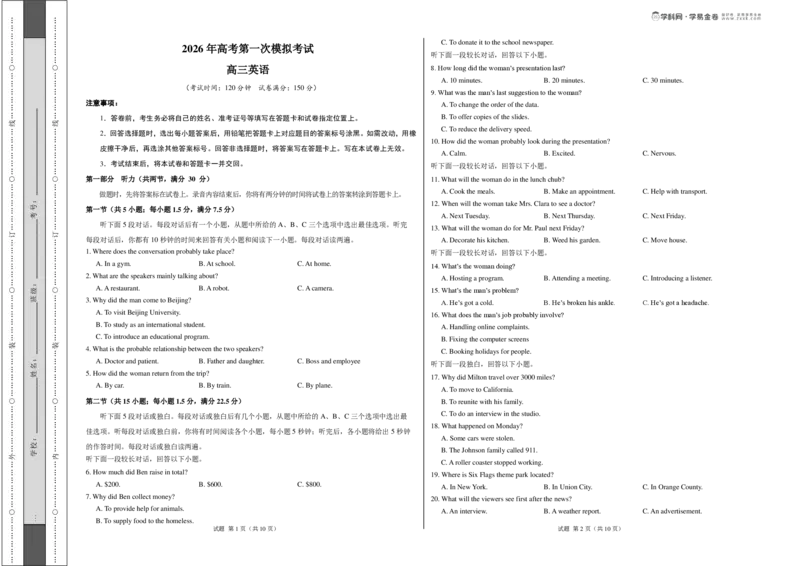
1. Where does the conversation probably take place?
A. In a gym.
B. At school.
C. At home.
2. What are the speakers mainly talking about?
A. A restaurant.
B. A robot.
C. A camera.
3. Why did the man come to Beijing?
A. To visit Beijing University.
B. To study as an international student.
C. To introduce an educational program.
4. What is the probable relationship between the two speakers?
A. Doctor and patient.
B. Father and daughter.
C. Boss and employee
5. How did the woman return from the trip?
A. By car.
B. By train.
C. By plane.
第二节(共15 小题;每小题1.5 分,满分22.5 分)
听下面5 段对话或独白。每段对话或独白后有几个小题,从题中所给的A、B、C 三个选项中选出最
佳选项。听每段对话或独白前,你将有时间阅读各个小题,每小题5 秒钟;听完后,各小题将给出5 秒钟
的作答时间。每段对话或独白读两遍。
听下面一段较长对话,回答以下小题。
6. How much did Ben raise in total?
A. $200.
B. $600.
C. $800.
7. Why did Ben collect money?
A. To provide help for animals.
B. To supply food to the homeless.
C. To donate it to the school newspaper.
听下面一段较长对话,回答以下小题。
8. How long did the woman’s presentation last?
A. 10 minutes.
B. 20 minutes.
C. 30 minutes.
9. What was the man’s last suggestion to the woman?
A. To change the order of the data.
B. To offer copies of the slides.
C. To reduce the delivery speed.
10. How did the woman probably look during the presentation?
A. Calm.
B. Excited.
C. Nervous.
听下面一段较长对话,回答以下小题。
11. What will the woman do in the lunch chub?
A. Cook the meals.
B. Make an appointment.
C. Help with transport.
12. When will the woman take Mrs. Clara to see a doctor?
A. Next Tuesday.
B. Next Thursday.
C. Next Friday.
13. What will the woman do for Mr. Paul next Friday?
A. Decorate his kitchen.
B. Weed his garden.
C. Move house.
听下面一段较长对话,回答以下小题。
14. What’s the woman doing?
A. Hosting a program.
B. Attending a meeting.
C. Introducing a listener.
15. What’s the man’s problem?
A. He’s got a cold.
B. He’s broken his ankle.
C. He’s got a headache.
16. What does the man’s job probably involve?
A. Handling online complaints.
B. Fixing the computer screens
C. Booking holidays for people.
听下面一段独白,回答以下小题。
17. Why did Milton travel over 3000 miles?
A. To move to California.
B. To reunite with his family.
C. To do an interview in the studio.
18. What happened on Monday?
A. Some cars were stolen.
B. The Johnson family called 911.
C. A roller coaster stopped working.
19. Where is Six Flags theme park located?
A. In New York.
B. In Union City.
C. In Orange County.
20. What will the viewers see first after the news?
A. An interview.
B. A weather report.
C. An advertisement.
{#{QQABaYyAgggIAJBAAQgCAwnwCkAYkAACAIgGQEAUIAABwQFABAA=}#}

试题 第3 页(共10 页)                                                                                       试题 第4 页(共10 页)

………………○………………内………………○………………装………………○………………订………………○……………… 线………………○………………
             此
卷
只
装
订
不
密
封

………………○………………外………………○………………装………………○………………订………………○……………… 线………………○………………

第二部分  阅读(共两节, 满分50 分)
第一节(共15 小题;每小题2.5 分, 满分37.5 分)
阅读下列短文, 从每题所给的A、B、C 和D 四个选项中选出最佳选项。
A
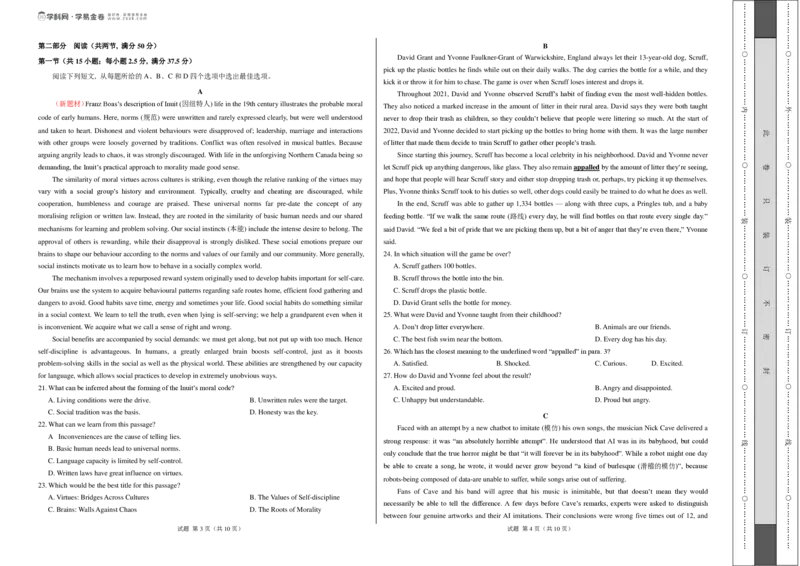
(新题材)Franz Boas’s description of Inuit (因纽特人) life in the 19th century illustrates the probable moral
code of early humans. Here, norms (规范) were unwritten and rarely expressed clearly, but were well understood
and taken to heart. Dishonest and violent behaviours were disapproved of; leadership, marriage and interactions
with other groups were loosely governed by traditions. Conflict was often resolved in musical battles. Because
arguing angrily leads to chaos, it was strongly discouraged. With life in the unforgiving Northern Canada being so
demanding, the Inuit’s practical approach to morality made good sense.
The similarity of moral virtues across cultures is striking, even though the relative ranking of the virtues may
vary with a social group’s history and environment. Typically, cruelty and cheating are discouraged, while
cooperation, humbleness and courage are praised. These universal norms far pre-date the concept of any
moralising religion or written law. Instead, they are rooted in the similarity of basic human needs and our shared
mechanisms for learning and problem solving. Our social instincts (本能) include the intense desire to belong. The
approval of others is rewarding, while their disapproval is strongly disliked. These social emotions prepare our
brains to shape our behaviour according to the norms and values of our family and our community. More generally,
social instincts motivate us to learn how to behave in a socially complex world.
The mechanism involves a repurposed reward system originally used to develop habits important for self-care.
Our brains use the system to acquire behavioural patterns regarding safe routes home, efficient food gathering and
dangers to avoid. Good habits save time, energy and sometimes your life. Good social habits do something similar
in a social context. We learn to tell the truth, even when lying is self-serving; we help a grandparent even when it
is inconvenient. We acquire what we call a sense of right and wrong.
Social benefits are accompanied by social demands: we must get along, but not put up with too much. Hence
self-discipline is advantageous. In humans, a greatly enlarged brain boosts self-control, just as it boosts
problem-solving skills in the social as well as the physical world. These abilities are strengthened by our capacity
for language, which allows social practices to develop in extremely unobvious ways.
21. What can be inferred about the forming of the Inuit’s moral code?
A. Living conditions were the drive.
B. Unwritten rules were the target.
C. Social tradition was the basis.

D. Honesty was the key.
22. What can we learn from this passage?
A Inconveniences are the cause of telling lies.

B. Basic human needs lead to universal norms.
C. Language capacity is limited by self-control.

D. Written laws have great influence on virtues.
23. Which would be the best title for this passage?
A. Virtues: Bridges Across Cultures
B. The Values of Self-discipline
C. Brains: Walls Against Chaos

D. The Roots of Morality
B
David Grant and Yvonne Faulkner-Grant of Warwickshire, England always let their 13-year-old dog, Scruff,
pick up the plastic bottles he finds while out on their daily walks. The dog carries the bottle for a while, and they
kick it or throw it for him to chase. The game is over when Scruff loses interest and drops it.
Throughout 2021, David and Yvonne observed Scruff’s habit of finding even the most well-hidden bottles.
They also noticed a marked increase in the amount of litter in their rural area. David says they were both taught
never to drop their trash as children, so they couldn’t believe that people were littering so much. At the start of
2022, David and Yvonne decided to start picking up the bottles to bring home with them. It was the large number
of litter that made them decide to train Scruff to gather other people’s trash.
Since starting this journey, Scruff has become a local celebrity in his neighborhood. David and Yvonne never
let Scruff pick up anything dangerous, like glass. They also remain appalled by the amount of litter they’re seeing,
and hope that people will hear Scruff story and either stop dropping trash or, perhaps, try picking it up themselves.
Plus, Yvonne thinks Scruff took to his duties so well, other dogs could easily be trained to do what he does as well.
In the end, Scruff was able to gather up 1,334 bottles — along with three cups, a Pringles tub, and a baby
feeding bottle. “If we walk the same route (路线) every day, he will find bottles on that route every single day.”
said David. “We feel a bit of pride that we are picking them up, but a bit of anger that they’re even there,” Yvonne
said.
24. In which situation will the game be over?
A. Scruff gathers 100 bottles.


B. Scruff throws the bottle into the bin.
C. Scruff drops the plastic bottle.


D. David Grant sells the bottle for money.
25. What were David and Yvonne taught from their childhood?
A. Don’t drop litter everywhere.

B. Animals are our friends.
C. The best fish swim near the bottom.
D. Every dog has his day.
26. Which has the closest meaning to the underlined word “appalled” in para. 3?
A. Satisfied.
B. Shocked.
C. Curious.

D. Excited.
27. How do David and Yvonne feel about the result?
A. Excited and proud.

B. Angry and disappointed.
C. Unhappy but understandable.

D. Proud but angry.
C
Faced with an attempt by a new chatbot to imitate (模仿) his own songs, the musician Nick Cave delivered a
strong response: it was “an absolutely horrible attempt”. He understood that AI was in its babyhood, but could
only conclude that the true horror might be that “it will forever be in its babyhood”. While a robot might one day
be able to create a song, he wrote, it would never grow beyond “a kind of burlesque (滑稽的模仿)”, because
robots-being composed of data-are unable to suffer, while songs arise out of suffering.
Fans of Cave and his band will agree that his music is inimitable, but that doesn’t mean they would
necessarily be able to tell the difference. A few days before Cave’s remarks, experts were asked to distinguish
between four genuine artworks and their AI imitations. Their conclusions were wrong five times out of 12, and
{#{QQABaYyAgggIAJBAAQgCAwnwCkAYkAACAIgGQEAUIAABwQFABAA=}#}

试题 第5 页(共10 页)                                                                                            试题 第6 页(共10 页)
………………○………………内………………○………………装………………○………………订………………○……………… 线………………○………………
………………○………………外………………○………………装………………○………………订………………○……………… 线………………○………………
…             学校:______________姓名:_____________班级:_______________考号:______________________


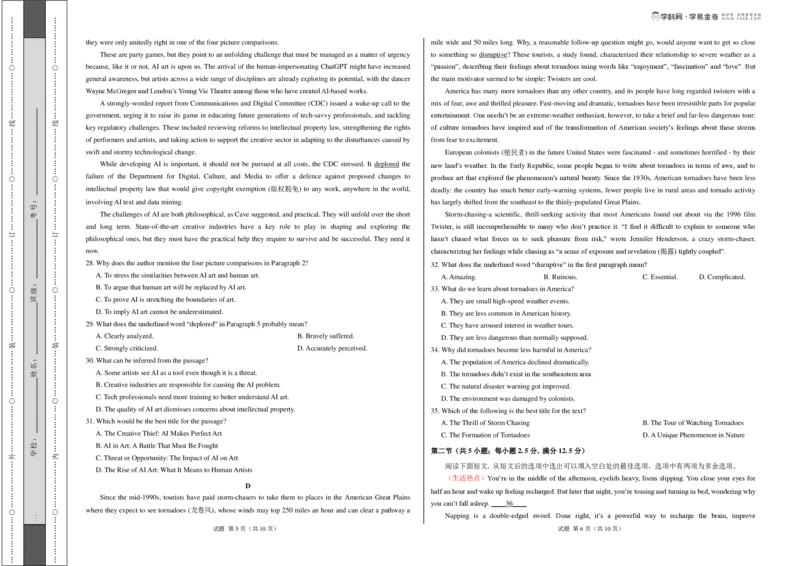
they were only unitedly right in one of the four picture comparisons.
These are party games, but they point to an unfolding challenge that must be managed as a matter of urgency
because, like it or not, AI art is upon us. The arrival of the human-impersonating ChatGPT might have increased
general awareness, but artists across a wide range of disciplines are already exploring its potential, with the dancer
Wayne McGregor and London’s Young Vic Theatre among those who have created AI-based works.
A strongly-worded report from Communications and Digital Committee (CDC) issued a wake-up call to the
government, urging it to raise its game in educating future generations of tech-savvy professionals, and tackling
key regulatory challenges. These included reviewing reforms to intellectual property law, strengthening the rights
of performers and artists, and taking action to support the creative sector in adapting to the disturbances caused by
swift and stormy technological change.
While developing AI is important, it should not be pursued at all costs, the CDC stressed. It deplored the
failure of the Department for Digital, Culture, and Media to offer a defence against proposed changes to
intellectual property law that would give copyright exemption (版权豁免) to any work, anywhere in the world,
involving AI text and data mining.
The challenges of AI are both philosophical, as Cave suggested, and practical. They will unfold over the short
and long term. State-of-the-art creative industries have a key role to play in shaping and exploring the
philosophical ones, but they must have the practical help they require to survive and be successful. They need it
now.
28. Why does the author mention the four picture comparisons in Paragraph 2?
A. To stress the similarities between AI art and human art.
B. To argue that human art will be replaced by AI art.
C. To prove AI is stretching the boundaries of art.
D. To imply AI art cannot be underestimated.
29. What does the underlined word “deplored” in Paragraph 5 probably mean?
A. Clearly analyzed.

B. Bravely suffered.
C. Strongly criticized.

D. Accurately perceived.
30. What can be inferred from the passage?
A. Some artists see AI as a tool even though it is a threat.
B. Creative industries are responsible for causing the AI problem.
C. Tech professionals need more training to better understand AI art.
D. The quality of AI art dismisses concerns about intellectual property.
31. Which would be the best title for the passage?
A. The Creative Thief: AI Makes Perfect Art
B. AI in Art: A Battle That Must Be Fought
C. Threat or Opportunity: The Impact of AI on Art
D. The Rise of AI Art: What It Means to Human Artists
D
Since the mid-1990s, tourists have paid storm-chasers to take them to places in the American Great Plains
where they expect to see tornadoes (龙卷风), whose winds may top 250 miles an hour and can clear a pathway a
mile wide and 50 miles long. Why, a reasonable follow-up question might go, would anyone want to get so close
to something so disruptive? These tourists, a study found, characterized their relationship to severe weather as a
“passion”, describing their feelings about tornadoes using words like “enjoyment”, “fascination” and “love”. But
the main motivator seemed to be simple: Twisters are cool.
America has many more tornadoes than any other country, and its people have long regarded twisters with a
mix of fear, awe and thrilled pleasure. Fast-moving and dramatic, tornadoes have been irresistible parts for popular
entertainment. One needn’t be an extreme-weather enthusiast, however, to take a brief and far-less dangerous tour:
of culture tornadoes have inspired and of the transformation of American society’s feelings about these storms
from fear to excitement.
European colonists (殖民者) in the future United States were fascinated - and sometimes horrified - by their
new land’s weather. In the Early Republic, some people began to write about tornadoes in terms of awe, and to
produce art that explored the phenomenon’s natural beauty. Since the 1930s, American tornadoes have been less
deadly: the country has much better early-warning systems, fewer people live in rural areas and tornado activity
has largely shifted from the southeast to the thinly-populated Great Plains.
Storm-chasing-a scientific, thrill-seeking activity that most Americans found out about via the 1996 film
Twister, is still incomprehensible to many who don’t practice it. “I find it difficult to explain to someone who
hasn’t chased what forces us to seek pleasure from risk,” wrote Jennifer Henderson, a crazy storm-chaser,
characterizing her feelings while chasing as “a sense of exposure and revelation (揭露) tightly coupled”.
32. What does the underlined word “disruptive” in the first paragraph mean?
A. Amazing.
B. Ruinous.
C. Essential.
D. Complicated.
33. What do we learn about tornadoes in America?
A. They are small high-speed weather events.
B. They are less common in American history.
C. They have aroused interest in weather tours.
D. They are less dangerous than normally supposed.
34. Why did tornadoes become less harmful in America?
A. The population of America declined dramatically.
B. The tornadoes didn’t exist in the southeastern area.
C. The natural disaster warning got improved.
D. The environment was damaged by colonists.
35. Which of the following is the best title for the text?
A. The Thrill of Storm Chasing

B. The Tour of Watching Tornadoes
C. The Formation of Tornadoes

D. A Unique Phenomenon in Nature
第二节(共5 小题;每小题2. 5 分, 满分12. 5 分)
阅读下面短文, 从短文后的选项中选出可以填入空白处的最佳选项。选项中有两项为多余选项。
(生活热点)You’re in the middle of the afternoon, eyelids heavy, focus slipping. You close your eyes for
half an hour and wake up feeling recharged. But later that night, you’re tossing and turning in bed, wondering why
you can’t fall asleep. ____36____
Napping is a double-edged sword. Done right, it’s a powerful way to recharge the brain, improve
{#{QQABaYyAgggIAJBAAQgCAwnwCkAYkAACAIgGQEAUIAABwQFABAA=}#}

试题 第7 页(共10 页)                                                                                       试题 第8 页(共10 页)

………………○………………内………………○………………装………………○………………订………………○……………… 线………………○………………
             此
卷
只
装
订
不
密
封

………………○………………外………………○………………装………………○………………订………………○……………… 线………………○………………

concentration, and support mental and physical health. Done wrong, it can leave you foggy, disoriented, and
struggling to fall asleep later. ____37____
Most people experience a natural decline in alertness in the early afternoon, typically between 1 pm and 4 pm.
This isn’t just due to a heavy lunch. ____38____ The early afternoon period is part of this cycle, which is why so
many people feel sleepy at that time.
Studies suggest that a short nap during this period can help boost alertness, and improve cognitive function
without interfering with nighttime sleep. ____39____ Napping too long may result in waking up feeling worse
than before. Once a nap extends beyond 30 minutes, the brain transitions into slow-wave sleep, making it much
harder to wake up. And if a nap is taken too late in the day, it can make it harder to fall asleep at night.
____40____ Keeping naps between 10 and 20 minutes prevents dizziness. The ideal time is before 2
pm—napping too late can push back the body’s natural sleep schedule. The best naps happen in a cool, dark, and
quiet environment, similar to nighttime sleep conditions.
A. That midday nap might be the reason.
B. But napping is not suitable for everyone.
C. But there’s something worth paying attention to.
D. To nap effectively, timing and environment matter.
E. Our internal body clock creates cycles of wakefulness and tiredness.
F. These “power naps” allow the brain to rest without slipping into deep sleep.
G. The key lies in understanding how the body regulates sleep and wakefulness.
第三部分 语言运用(共两节,满分30 分)
第一节(共15 小题,每小题1 分,满分15 分)
阅读下面短文, 从每题所给的A、B、C 和D 四个选项中选出可以填入空白处的最佳选项。
Every Saturday we trained with the same marathon running club. I had no idea he was blind because he
____41____ past me alongside his guide runner. It took a few weeks before I was ____42____ asking him what, if
anything, he could see. I wasn’t just ____43____ by his running times. He also had a beautiful smile that lit up the
room.
We had our first ____44____ date climbing the famous sand dune on Pacific Coast Highway. Eight years into
our marriage, Adrian decided to learn to ____45____, so he could fulfill his dream of competing in an Ironman
triathlon.
Adrian’s first lesson was a ____46____, but his coach’s enthusiasm was short-lived. His next instructor was
easy to give in and recommended my husband ____47____ swimming. So, being a competitive swimmer in high
school, I was ____48____ I could teach him.
Soon I realized how much of a ____49____ swimming was for my husband, even with a tether rope. His
progress at each lesson was slow but _____50_____. Nearly a month later, he tried without the tether rope, but
_____51_____ going in the wrong direction. Every time I raised my voice over the roaring waves he felt so
_____52_____ by my instructions.
Fortunately these days we laugh because Adrian is even faster than I am. He has grown more _____53_____
with me when I have to raise my voice. I, _____54_____, no longer say, “You went the wrong way!”, which
makes him feel bad. Instead, I say, “Over here,” to which he ____55____ , and then swims back toward me.
41. A. jumped
B. flew
C. rode
D. drove
42. A. comfortable
B. pleased
C. awkward
D. anxious
43. A. influenced
B. defeated
C. confused
D. impressed
44. A. easy
B. official
C. vital
D. complete
45. A. run
B. bike
C. swim
D. diet
46. A. mess
B. relief
C. success
D. disaster
47. A. abandon
B. keep
C. risk
D. appreciate
48. A. confident
B. doubtful
C. grateful
D. fortunate
49. A. benefit
B. burden
C. regret
D. struggle
50. A. slim
B. steady
C. hard
D. alarming
51. A. gradually
B. rarely
C. cautiously
D. frequently
52. A. encouraged
B. worried
C. frustrated
D. surprised
53. A. patient
B. careful
C. popular
D. disappointed
54. A. in fact
B. in brief
C. in turn
D. in return
55. A. looks
B. nods
C. bows
D. shouts
第二节(共10 小题;每小题1.5 分 ,满分15 分)
阅读下面短文,在空白处填入1 个适当的单词或括号内单词的正确形式。
(原创题)You may wonder what professional athletes eat for breakfast. The answer varies widely, ___56___
(influence) by personal taste, their sport, and even their training schedule.
However, two key principles ___57___ (be) universal. First, consistency matters. Most athletes stick to the
same pre-competition breakfast for mental readiness. Second, and more ___58___(important), the need for fuel is
supreme.
___59___ (give) their enormous energy consumption, athletes require far ___60___(many) calories and
specific nutrients than the average person. Nutritionist Dr. Marc Bubbs explains that intense exercise increases
___61___ (rely) on carbohydrates. Therefore, an athlete’s diet must be packed with them. For example, while an
average person’s breakfast smoothie might use water, ___62___ athlete’s version would use fruit juice and extra
fruit to boost carbs. The goal is to “fuel for the demand” of each day—whether for competition, practice,
___63___ recovery.
In short, an athlete’s breakfast is less about a single perfect food and more about a strategic intake of energy,
tailored precisely ___64___ the physical demands ahead. This ___65___(strategy) approach makes all the
difference in their performance.
第四部分 写作(共两节, 满分40 分)
第一节(满分15 分)
(原创题)假定你是李华,你校正在筹备“中华文化月”(Chinese Culture Month)系列活动。学校英文
报拟开设“传统故事新编”(Retelling Classic Tales)专栏,现面向全校征集稿件。你已完成一篇根据“愚公
移山(Yu Gong Moves the Mountains)”改编的英文短故事初稿。请你给外教Smith 先生写一封邮件,内容
包括:
(1)介绍活动及你的投稿内容;
{#{QQABaYyAgggIAJBAAQgCAwnwCkAYkAACAIgGQEAUIAABwQFABAA=}#}

试题 第9 页(共10 页)                                                                                            试题 第10 页(共10 页)
………………○………………内………………○………………装………………○………………订………………○……………… 线………………○………………
………………○………………外………………○………………装………………○………………订………………○……………… 线………………○………………
…             学校:______________姓名:_____________班级:_______________考号:______________________


(2)希望获得的帮助(如语言润色、文化表达准确性、故事吸引力等)。
注意:
(1)词数80 左右;
(2)请按如下格式在答题卡的相应位置作答。
Dear Mr. Smith,
____________________________________________________________________________________________
____________________________________________________________________________________________
____________________________________________________________________________________________
____________________________________________________________________________________________
____________________________________________________________________________________________
Yours,
Li Hua
第二节(满分25 分)
阅读下面材料,根据其内容和所给段落开头语续写两段,使之构成一篇完整的短文。
 When I adopted him, he had been rescued from death inside a tightly tied black trash bag abandoned right
beside a garbage truck on the road. An alert garbage man noticed the bag moving and used a metal rake (耙子) to
tear open the bag to look inside. There was my shaking puppy dog. The rake damaged the nerves in his back so he
limped a little, but he could run as fast as lightning.
For my dog’s first birthday, I entered him in a fun run sponsored by our local Society for the Prevention of
Cruelty to Animals (SPCA). I’m not much of a runner, but the run was only 3 kilometers, so I thought it would be
fun for both of us.
We practiced for weeks. On our practice runs, he was always eager to go and usually dragged me along
behind him. I worked on his leash (拴狗链) manners so that he wouldn’t trip me on the big day. I felt we were
ready for anything.
The fun run was downtown among the big buildings, so the noise of barking dogs all around us rose to a
deafening pitch at the start of the race. My dog was frightened when the starting tone went off. He had trouble
running in the right direction with all the confusion around us. Soon the runners began to thin out, and my dog was
running straight and fast. We were passing people and making great time. I was dreaming of a gold-medal finish.
However, when we were six blocks from the finish, my dog suddenly stopped and dropped to the ground like
a sack of potatoes. I almost dislocated my shoulder from the sudden stop as I was pulled backward by the leash.
He was lying flat on his belly with his head down in the middle of the crossroads. At first I thought something
bad had happened to him. He was shaking and sobbing. I did a quick check and couldn’t see anything wrong. I
tried to get him up, but he refused. The police officer doing traffic control impatiently signed me to move away so
he could release the cars.
注意:
1.续写词数应为150 左右;
2.请按如下格式在答题卡的相应位置作答。
But I couldn’t get my seventy-five-pound dog to get up.
____________________________________________________________________________________________
____________________________________________________________________________________________
____________________________________________________________________________________________
____________________________________________________________________________________________
____________________________________________________________________________________________
_______________
Another half-block of carrying him brought the answer—a moving garbage truck.
____________________________________________________________________________________________
____________________________________________________________________________________________
____________________________________________________________________________________________
____________________________________________________________________________________________
____________________________________________________________________________________________
_______________


{#{QQABaYyAgggIAJBAAQgCAwnwCkAYkAACAIgGQEAUIAABwQFABAA=}#}