浙江省强基联盟
2025 年10 月高三
联考英语试题
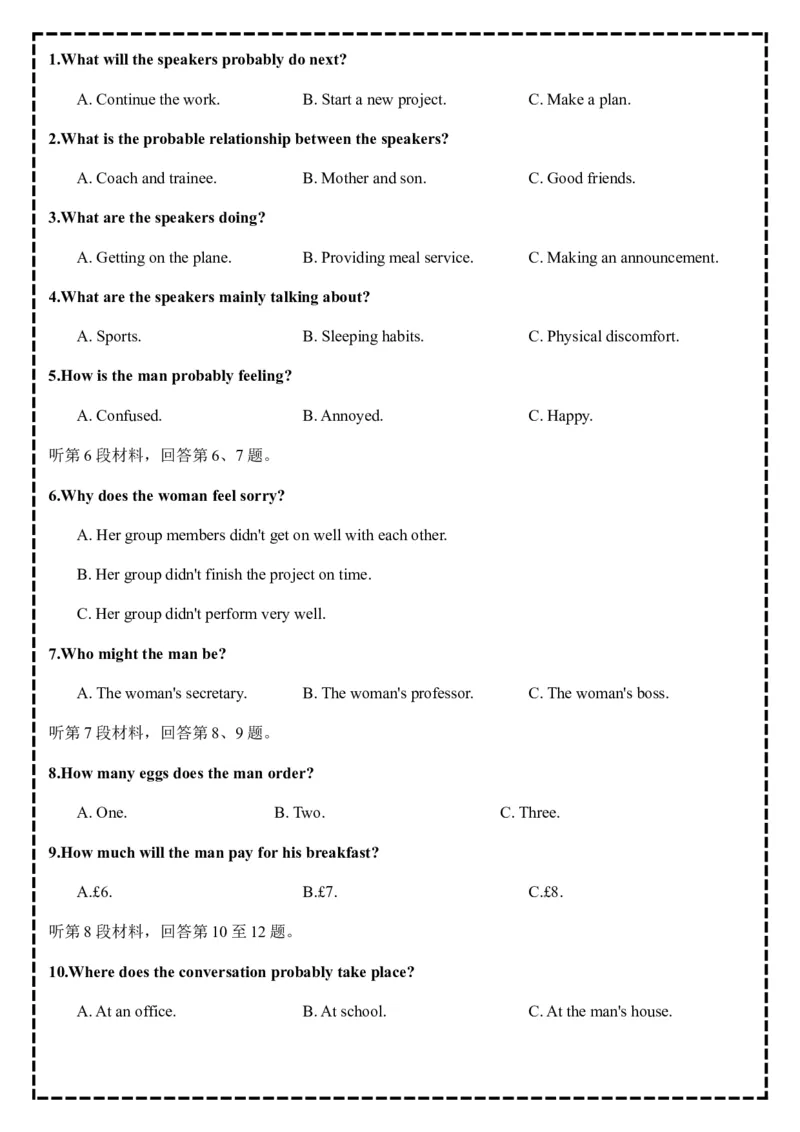
1.What will the speakers probably do next?
A. Continue the work.
B. Start a new project.
C. Make a plan.
2.What is the probable relationship between the speakers?
A. Coach and trainee.
B. Mother and son.
C. Good friends.
3.What are the speakers doing?
A. Getting on the plane.
B. Providing meal service.
C. Making an announcement.
4.What are the speakers mainly talking about?
A. Sports.
B. Sleeping habits.
C. Physical discomfort.
5.How is the man probably feeling?
A. Confused.
B. Annoyed.
C. Happy.
听第6 段材料,回答第6、7 题。
6.Why does the woman feel sorry?
A. Her group members didn't get on well with each other.
B. Her group didn't finish the project on time.
C. Her group didn't perform very well.
7.Who might the man be?
A. The woman's secretary.
B. The woman's professor.
C. The woman's boss.
听第7 段材料,回答第8、9 题。
8.How many eggs does the man order?
A. One.
B. Two.
C. Three.
9.How much will the man pay for his breakfast?
A.£6.
B.£7.
C.£8.
听第8 段材料,回答第10 至12 题。
10.Where does the conversation probably take place?
A. At an office.
B. At school.
C. At the man's house.
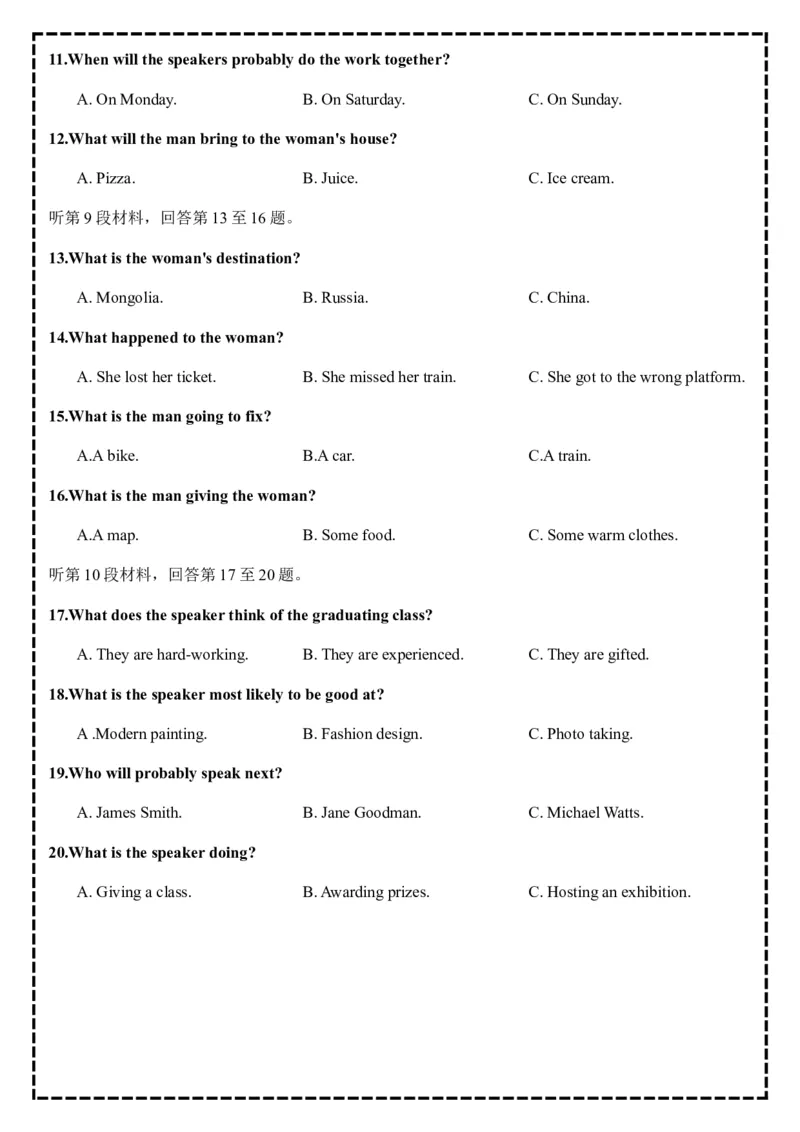
11.When will the speakers probably do the work together?
A. On Monday.
B. On Saturday.
C. On Sunday.
12.What will the man bring to the woman's house?
A. Pizza.
B. Juice.
C. Ice cream.
听第9 段材料,回答第13 至16 题。
13.What is the woman's destination?
A. Mongolia.
B. Russia.
C. China.
14.What happened to the woman?
A. She lost her ticket.
B. She missed her train.
C. She got to the wrong platform.
15.What is the man going to fix?
A.A bike.
B.A car.
C.A train.
16.What is the man giving the woman?
A.A map.
B. Some food.
C. Some warm clothes.
听第10 段材料,回答第17 至20 题。
17.What does the speaker think of the graduating class?
A. They are hard-working.
B. They are experienced.
C. They are gifted.
18.What is the speaker most likely to be good at?
A .Modern painting.
B. Fashion design.
C. Photo taking.
19.Who will probably speak next?
A. James Smith.
B. Jane Goodman.
C. Michael Watts.
20.What is the speaker doing?
A. Giving a class.
B. Awarding prizes.
C. Hosting an exhibition.
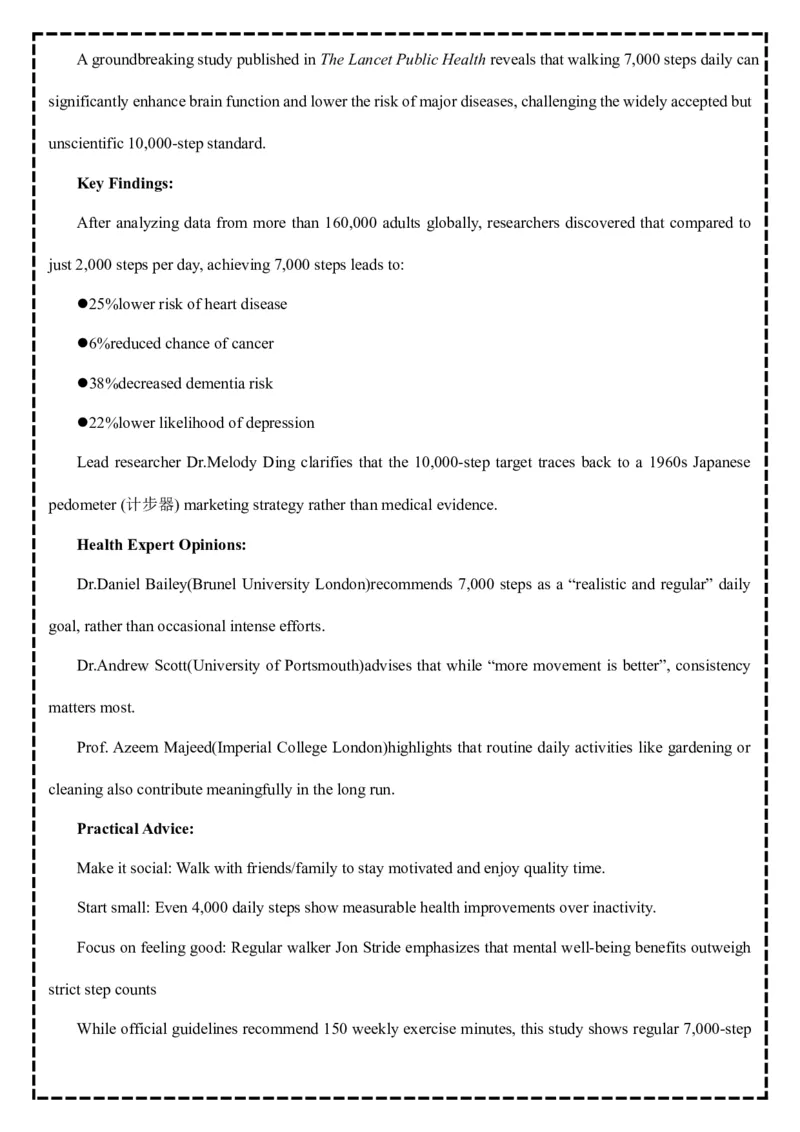
A groundbreaking study published in The Lancet Public Health reveals that walking 7,000 steps daily can
significantly enhance brain function and lower the risk of major diseases, challenging the widely accepted but
unscientific 10,000-step standard.
Key Findings:
After analyzing data from more than 160,000 adults globally, researchers discovered that compared to
just 2,000 steps per day, achieving 7,000 steps leads to:
25%lower risk of heart disease
6%reduced chance of cancer
38%decreased dementia risk
22%lower likelihood of depression
Lead researcher Dr.Melody Ding clarifies that the 10,000-step target traces back to a 1960s Japanese
pedometer (计步器) marketing strategy rather than medical evidence.
Health Expert Opinions:
Dr.Daniel Bailey(Brunel University London)recommends 7,000 steps as a “realistic and regular” daily
goal, rather than occasional intense efforts.
Dr.Andrew Scott(University of Portsmouth)advises that while “more movement is better”, consistency
matters most.
Prof. Azeem Majeed(Imperial College London)highlights that routine daily activities like gardening or
cleaning also contribute meaningfully in the long run.
Practical Advice:
Make it social: Walk with friends/family to stay motivated and enjoy quality time.
Start small: Even 4,000 daily steps show measurable health improvements over inactivity.
Focus on feeling good: Regular walker Jon Stride emphasizes that mental well-being benefits outweigh
strict step counts
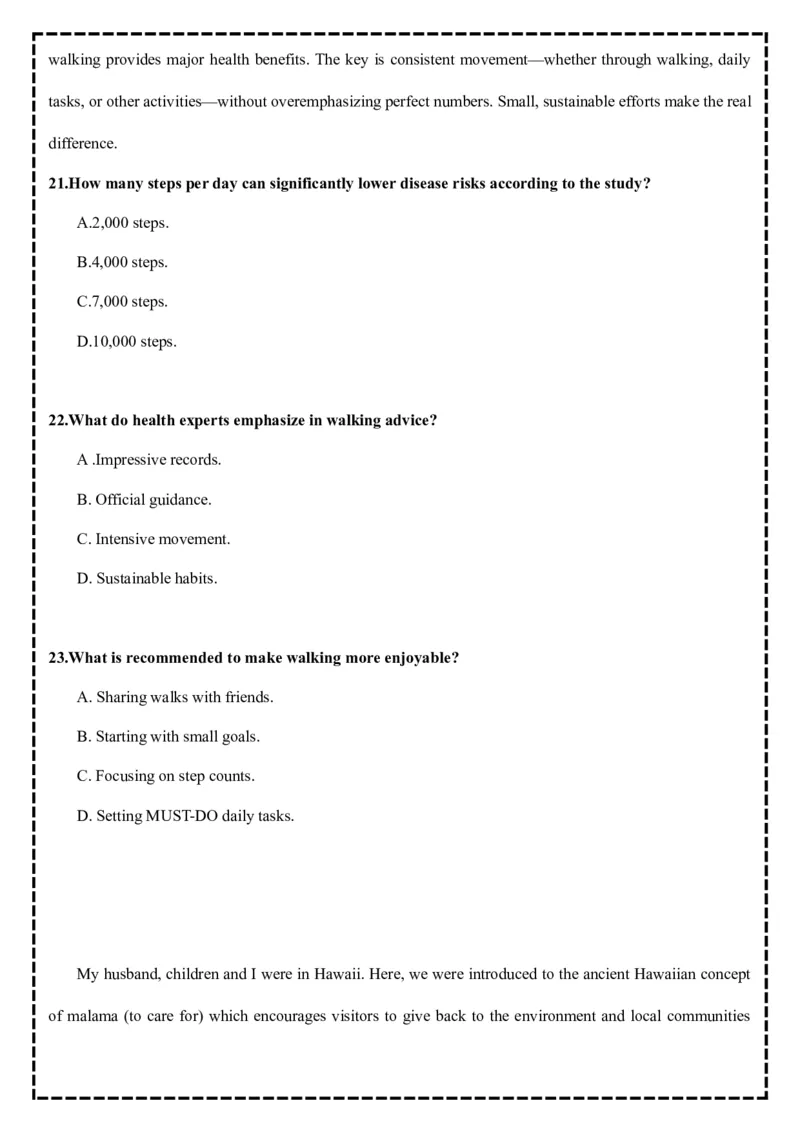
While official guidelines recommend 150 weekly exercise minutes, this study shows regular 7,000-step
walking provides major health benefits. The key is consistent movement—whether through walking, daily
tasks, or other activities—without overemphasizing perfect numbers. Small, sustainable efforts make the real
difference.
21.How many steps per day can significantly lower disease risks according to the study?
A.2,000 steps.
B.4,000 steps.
C.7,000 steps.
D.10,000 steps.
22.What do health experts emphasize in walking advice?
A .Impressive records.
B. Official guidance.
C. Intensive movement.
D. Sustainable habits.
23.What is recommended to make walking more enjoyable?
A. Sharing walks with friends.
B. Starting with small goals.
C. Focusing on step counts.
D. Setting MUST-DO daily tasks.
My husband, children and I were in Hawaii. Here, we were introduced to the ancient Hawaiian concept
of malama (to care for) which encourages visitors to give back to the environment and local communities
through activities like habitat restoration, beach cleanups or food provision. But mālama goes beyond
ecotourism — it's about leaving a place better than you found it.
And after seeking out these experiences during a three-week stay, we found mālama not only improves
Hawaii, but it also made our time there much more meaningful.
Malama volunteer experiences are found across the islands. For example, on Maui, you can help restore
native forests and volunteer at a nursery; while on O' ahu, visitors can clear invasive algae from Maunalua
Bay. In some cases, travelers booking with partnering hotels and participating in designated activities will
qualify for a discounted—or even free—night at dozens of hotels and resorts.
"Malama today is more vital than ever," our guide Rogers said. "Too many tourists walk carelessly on our
land, ignoring restrictions and damaging sensitive ecosystems...don't just think Hawaii is beautiful; help keep
it that way. It's a shared responsibility.” As Rogers explained, mālama isn’t just about seeing or appreciating a
landscape; it invites visitors to connect and contribute to it, with the idea that caring for a place fosters a
stronger relationship with it.
After eight days, we ventured to Molokai, Hawaii's least developed island. No resorts or chain stores
spoiled its wild beauty—just dramatic cliffs meeting rough seas. Deep in the eastern wilderness, we met Greg
Solatario, whose family has taken care of this land for generations. His simple off-grid life perfectly embodied
mālama. Greg welcomed us warmly before leading us through jungle-covered ruins of ancestral villages. As
we approached, his son Devak blew a conch shell—a traditional request to enter. "The land remembers, "Greg
explained, showing us medicinal plants and ancient fishing spots. His parting words stayed with me:“Malama
shouldn’t be just Hawaiian —the whole world needs this way of caring."
24.How does the author present the topic in the first paragraph?
A. By quoting an expert.
B. By giving examples.
C. By explaining a concept.
D. By providing statistics.
25.What can Malama volunteers experience in Hawaii
A. Developing Maunalua Bay.
B. Reviving local forests.
C. Asking for hotel discounts.
D. Organizing big activities.
26.What do we know about Greg Solatario's family?
A. They built new resorts in the wild.
B. They have long protected the land.
C. They offered guided tours to locals.
D. They fixed up the old village ruins.
27.Which of the following best describes the author's trip in Hawaii?
A. The wise improve what they enjoy.
B. Where there is a will, there is a way.
C. God helps those who help themselves.
D. When in Rome, do as the Romans do.
As the global population continues to expand, traditional farming methods are struggling to provide
enough food. However, an innovative agricultural company in Compton, Los Angeles, may have the solution.
Their revolutionary farming system could transform food production, offering remarkable efficiency and
sustainability.
It's far from the storybook picture of a farm —no mud, no boots, no hens pecking in the yard. Unlike
conventional farms, this high-tech facility operates without soil, heavy machinery, or pesticides. Instead, it
relies on automation and advanced plant science to maximize output. Using precisely calibrated( 符合标准
的) LED lighting and nutrient delivery systems, the facility produces up to 350 times more yields compared
to traditional farms while using just 10%of the water—and it can be replicated(复制)almost anywhere.
The entire process—from planting seeds to packaging produce—is automated. From the moment a worker
tips seeds into the sowing machine, robots take over. Nearly 80 plant scientists study best growing conditions
for each plant, working with over 100 engineers who translate these findings into hardware and software
solutions.
"Plants are really just little software programs," explains one of the scientists. By studying plant DNA
without changing it, scientists can program qualities like growth, flavor, and nutrition. For instance, exposing
plants to blue light at specific growth cycles creates leaves with a satisfying crunch at harvest. The same
principles can enhance antioxidant levels in vegetables by up to 40%.Since crops never contact soil, pesticides,
or human hands, they require no washing—reducing both water waste and contamination risks.
One of the greatest threats to the natural world is habitat loss due to farmland expansion. If successful,
farms like this could reduce deforestation while meeting food demands. Yet the high costs—including energy-
intensive artificial lighting—may block global adoption, particularly in developing nations where
infrastructure is limited.
Could this be the future of agriculture? With its incredible efficiency, minimal environmental impact, and
potential for worldwide replication, this high-tech farming model may soon become essential in feeding our
growing world—if the challenges of scaling and affordability can be overcome.
28.What is the main feature of the innovative farming system?
A. It demands water-free technology.
B. It gets high yields with little input.
C. It is widely introduced in the world.
D. It mixes old and new farming methods.
29.What is the scientists' major role in the process of the farming system?
A. They are gene editors.
B. They are machine operators.
C. They are system monitors.
D. They are plant programmers.
30.What may limit the worldwide spread of this farming system?
A. Low public acceptance.
B. Great farmland loss.
C. Poor production facilities.
D. High energy demands.
31.What is the author's attitude toward the future of agriculture?
A. Optimistic.
B. Critical.
C. Indifferent.
D. Doubtful.
When we think about what makes humans unique, a good sense of humor is often high on the list. Laughter
and playful teasing seem like traits only we possess. However, recent research suggests that animals—
particularly great apes—may also engage in behavior that resembles humor.
A study led by primatologist (灵长类动物学家) Isabelle Laumer at the Max Planck Institute reveals
fascinating insights. “We documented young apes deliberately sneaking up to hit adults, then waiting
expectantly for a reaction,"Laumer explains. “This isn't random play—it meets all the criteria of intentional
teasing. "Over 75 hours of video recordings showed this behavior mirrors how human children joke: repetitive,
surprising, and aimed at seeking responses. The researchers noted that the apes even paused to watch for the
adult's reaction, much like a child waiting to see if their joke landed.
But humor in animals may not be limited to apes. Dog owners often notice their pets making breathy,
snorting sounds during play, which some scientists interpret as laughter. In a 2025 study, researchers found
that playing these sounds to shelter dogs reduced their stress levels. Similarly, dolphins emit joyful sounds
during play-fighting, elephants trumpet excitedly when playing, and some parrots tease other animals—like
confusing dogs with whistles—just for fun.
Why might animals exhibit humor? In humans, laughter strengthens social connections and eases tension.
Scientists argue that playful teasing in apes or “laughter” in dogs could serve a similar purpose—breaking the
ice and reinforcing relationships. Some researchers believe these behaviors may have evolved(进化)to help
animals manage complex social ranks or reduce conflict. However, Laumer cautions that more research is
needed to confirm this theory, as observing humor in animals remains challenging.
While we may never know if animals understand punchlines, their behaviors hint at humor's deep
evolutionary roots. As Laumer reflects:" The line between human and animal laughter isn't as sharp as we
thought.”
32.What did Laumer's study find about young apes?
A. They enjoy teasing others.
B. They often fight in groups.
C. They seek adult protection.
D. They learn from human kids.
33.What does the underlined word "trumpet" in paragraph 3 mean?
A. Wag.
B. Smile.
C. Nod.
D. Shout.
34.Why might animals show humor?
A. To improve social status.
B. To strengthen social bonds.
C. To win in complex conflicts.
D. To get much more pleasure.
35.What can be a suitable title for the text?
A. Animal Social Behaviors
B. Do Animals Copy Our Laughs?
C. Animals Play Tricks Too
D. Why Animals Understand Humor?
Nostalgia—the warm feeling of longing for the past—is everywhere in today's culture. Movies like
Barbie, Indiana Jones, and Top Gun are drawing huge crowds by bringing back old favorites. 36
On the surface, nostalgia simply makes us feel good. 37 According to Professor Ziyan Yang from the
Institute of Psychology, CAS, nostalgia creates feelings of warmth, belonging, and even a mental escape to
the past. During tough times — whether personal struggles or global crises—nostalgia acts like an emotional
safety net. Movies and music are powerful triggers because they recreate familiar emotions and experiences.
38 First, it gives us a sense of control. Even when life feels unpredictable, reflecting on our past helps
us feel more grounded and secure. Second, nostalgia strengthens social bonds. Though it seems like a personal
experience, nostalgic memories often remind us of family, friends, and shared moments.
What does nostalgia do to our brains? Mostly good things! Studies show it boosts happiness, creativity,
and energy by activating positive emotions. 39 This youthful optimism encourages us to take risks and
chase our goals. Some researchers suggest nostalgia acts like a “psychological immune system”, helping us
cope with stress.
But can too much nostalgia be harmful? In small amounts, it's healthy. However, if we think about the
past too much, it can keep us from moving forward. The key is balance—enjoying memories without losing
sight of the present. 40 It helps us reconnect with our true selves and remember who we really are.
In short, nostalgia isn't just about reliving the past — it's a tool that helps us navigate the present and
future with hope.
A. But why do we love nostalgia so much?
B. This is why reunions feel so meaningful to us.
C. Nostalgia also serves key psychological needs.
D. However, psychology experts say there's more to it.
E. It can even make us feel younger and more optimistic.
F. Remembering happy memories brings comfort and joy.
G. Still, in general, nostalgia is a natural and positive part of life.
One afternoon, as I was diving into life's deeper questions with my students, a thoughtful boy named Jack
raised his hand. "Why do so many people feel lost?" he asked. 41 their curiosity, I decided to show them
the ropes through experience rather than simply 42
. "Follow me," I said, leading them toward the nearby 43
.
Whispers filled the air. “Why are we going there?” Emma murmured. “Are there wild animals?” Liam
added nervously." Are we even going to 44 this?” A voice trembled from the back. I stayed 45 ,walking
calmly ahead. The students trailed behind me, their minds racing with 46
. Some panicked over 47
ions;
others pictured snakes. With every step, their anxiety 48 , yet I said nothing.
After forty minutes, we stopped at the forest's edge. 49 them, I smiled." Don't worry — we won't be
entering. But tell me, what did you notice on our way here?” The students fell silent. "You were so caught up
in 50 of the unknown, "I continued," that you 51 the birds singing, the sunlight filtering through the leaves,
and the 52
around you."
Jack's eyes lit up with realization. “So...we worry so much about the future that we 53 to live now?”
"Exactly," I replied. "Life is a 54 . If we let fear take over, we'll miss its wonders." The students nodded,
their faces brightening.
As we walked back, they laughed, finally noticing the world they'd overlooked before. The lesson was
simple but profound: The 55 shapes the future. Don't let fear steal today's gifts.
41.A.Ignoring
B. Sensing
C. Inspiring
D. Celebrating
42.A.complain
B. argue
C. explain
D. announce
43.A.mountain
B. river
C. desert
D. forest
44.A.survive
B. enjoy
C. remember
D. control
45.A.curious
B. silent
C. shocked
D. amused
46.A.plans
B. guesses
C. decisions
D. jokes
47.A.hungry
B. magical
C. fierce
D. imaginary
48.A.grew
B. emerged
C. faded
D. fell
49.A.Calling on
B. Pointing at
C. Turning to
D. Waiting for
50.A.joy
B. fear
C. anger
D. hope
51.A.heard
B. missed
C. avoided
D. recorded
52.A.beauty
B. harmony
C. warmth
D. mystery
53.A.refuse
B. pretend
C. forget
D. hate
54.A.game
B. battle
C. gift
D. journey
55.A.present
B. chance
C. effort
D. luck
The karez is a 2,000-year-old underground water system from Xinjiang, showcasing China's
brilliant ancient engineering. This smart network of wells and tunnels 56 (bring)mountain water to deserts
without pumps or electricity, which helps turn dry land into green farms, proving Chinese farmers' 57
(wise)in fighting harsh nature.
The system is made up of three carefully engineered parts: vertical wells 58 (dig)for maintenance,
underground tunnels built with a precise 0.1% slope, and surface canals 59 (deliver)water to farmlands.
Believed to have originated during the Han Dynasty, the karez reflects early Chinese innovation. "It
demonstrates 60 our ancestors solved problems creatively," notes Dr.Li from the Turpan Museum. Today,
around 400 karez systems remain in use, 61 (active)supporting 30% of Turpan's famous grape farms.
Unlike modern water systems, the karez operates in harmony 62 nature. "Relying on gravity
instead of power, it's a model of sustainability," explains farmer Ablimit. Impressed by its efficiency, UNESCO
has recognized its 63 (ecology)importance since its inclusion in the World Heritage Irrigation Structures list
in 2016.
More than just an engineering feat,t he karez embodies Chinese philosophy. As visitor Wang Ying
observes, "While ancient civilizations focused on building monuments reaching for the sky, the Chinese
created underground networks designed 64 (support)life."
Still inspiring modern water management, this ancient system proves sustainable solutions can
stand _65_
test of time and that ancient innovations still hold valuable lessons today.
假定你是李华,外教老师Jenny 准备在班里举办一次辩论赛,他给出了“Mobile phones in
class?”和“Group or individual study?”两个题目供大家选择。请给Jenny 写一封邮件,内容包括:
(1) 你的选择;
(2) 说明理由。
注意:
(1) 写作词数应为80 左右;
(2) 请按如下格式在答题纸的相应位置作答。
Dear Jenny,
Yours,
Li Hua
When I was ten, my parents told me we were going to China for our summer holiday. I was over the moon
— I had only ever seen the Great Wall and the Forbidden City in books ,and now I would actually get to walk
through history!
For weeks, I imagined the towering palaces, the red-and-gold gates, and the stories hidden in every corner.
Finally, the day arrived, and there I was, standing in the heart of Beijing, staring up at the most magnificent
buildings I had ever seen.
The Forbidden City was even more incredible in real life. The golden roofs shone under the sun, the delicate
carvings told silent tales of emperors and warriors, and the vast courtyards made me feel like I had stepped into a
fairy tale. Every turn revealed something new—a dragon statue, a marble staircase, a hidden garden—and I
couldn't stop taking pictures, desperate to capture every detail. My parents laughed as I dragged them from one
spot to another, insisting on yet another photo.
What struck me most were the colors. The imperial yellow of the rooftops against the deep red walls looked
brighter than any picture could show. Even the stone pathways seemed to glow with centuries of footsteps. I
remembered running my fingers along a carved marble railing, wondering how many hands had touched that
same spot over six hundred years.
The place was packed with tourists, all murmuring in different languages, their faces filled with the same
amazement as mine. Some pointed at the architecture, others posed for pictures, and a few just stood quietly,
taking it all in. The energy was infectious — everyone seemed to feel the magic of this ancient place. As the
afternoon wore on, we followed the crowd toward the exit. The sea of people was overwhelming, and I, being
small for my age, grasped my father's hand tightly, afraid to get lost in the rushing crowd. The noise, the heat, and
the excitement made everything feel like a blur — until suddenly, I looked down at the large hand I was holding
— the wrong watch, the wrong-colored ring.
My blood turned to ice.
There he was, just three people away.