文档文本内容
1
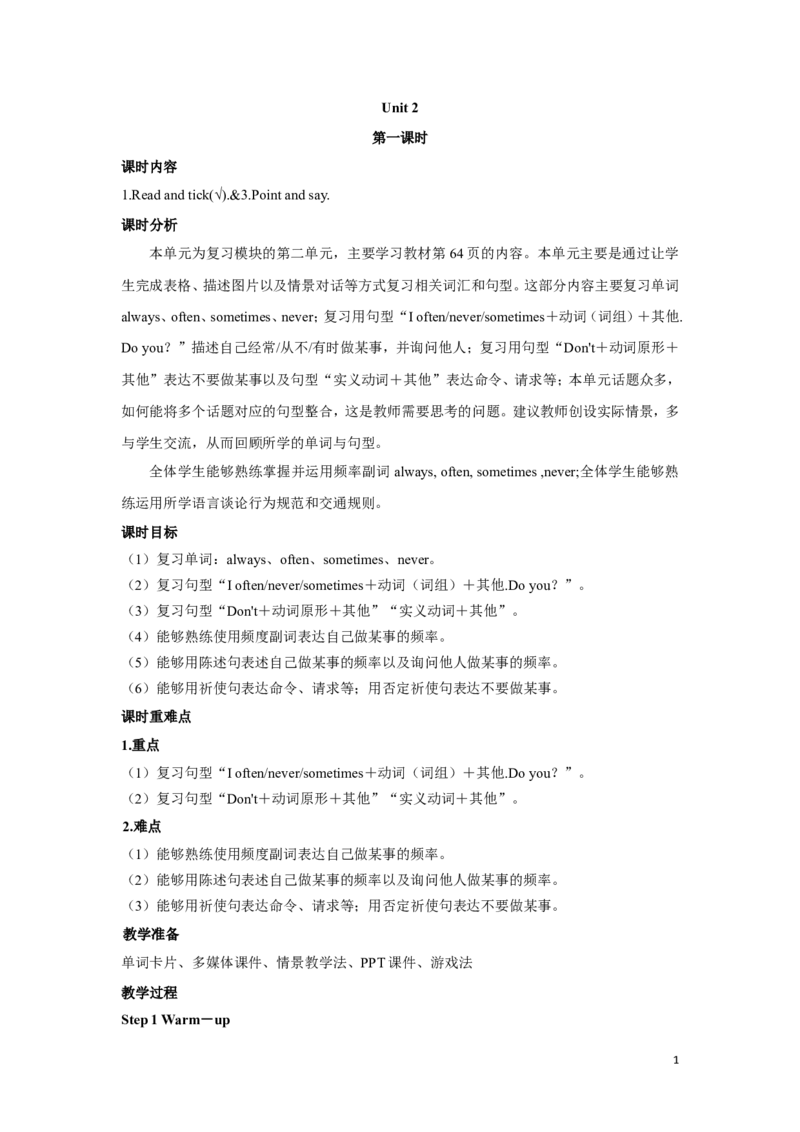
Unit 2
第一课时
课时内容
1.Read and tick(√).&3.Point and say.
课时分析
本单元为复习模块的第二单元,主要学习教材第64 页的内容。本单元主要是通过让学
生完成表格、描述图片以及情景对话等方式复习相关词汇和句型。这部分内容主要复习单词
always、often、sometimes、never;复习用句型“I often/never/sometimes+动词(词组)+其他.
Do you?”描述自己经常/从不/有时做某事,并询问他人;复习用句型“Don't+动词原形+
其他”表达不要做某事以及句型“实义动词+其他”表达命令、请求等;本单元话题众多,
如何能将多个话题对应的句型整合,这是教师需要思考的问题。建议教师创设实际情景,多
与学生交流,从而回顾所学的单词与句型。
全体学生能够熟练掌握并运用频率副词always, often, sometimes ,never;全体学生能够熟
练运用所学语言谈论行为规范和交通规则。
课时目标
(1)复习单词:always、often、sometimes、never。
(2)复习句型“I often/never/sometimes+动词(词组)+其他.Do you?”。
(3)复习句型“Don't+动词原形+其他”“实义动词+其他”。
(4)能够熟练使用频度副词表达自己做某事的频率。
(5)能够用陈述句表述自己做某事的频率以及询问他人做某事的频率。
(6)能够用祈使句表达命令、请求等;用否定祈使句表达不要做某事。
课时重难点
1.重点
(1)复习句型“I often/never/sometimes+动词(词组)+其他.Do you?”。
(2)复习句型“Don't+动词原形+其他”“实义动词+其他”。
2.难点
(1)能够熟练使用频度副词表达自己做某事的频率。
(2)能够用陈述句表述自己做某事的频率以及询问他人做某事的频率。
(3)能够用祈使句表达命令、请求等;用否定祈使句表达不要做某事。
教学准备
单词卡片、多媒体课件、情景教学法、PPT 课件、游戏法
教学过程
Step 1 Warm-up
2
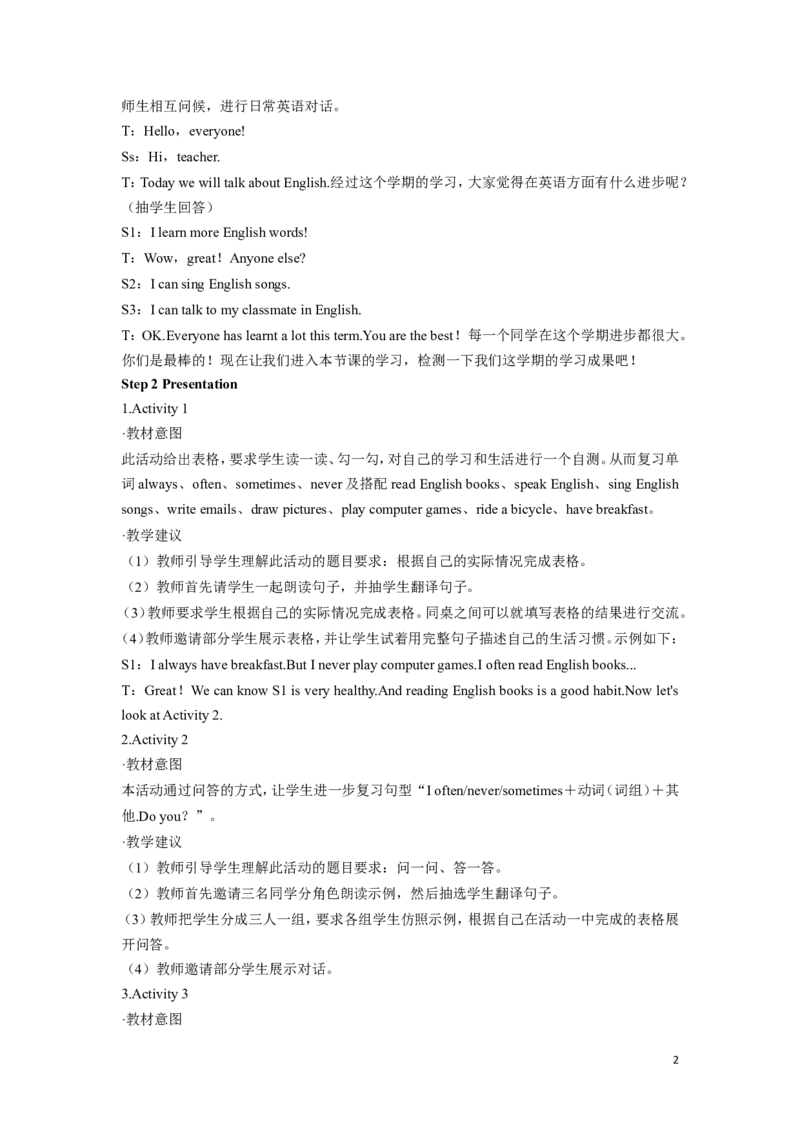
师生相互问候,进行日常英语对话。
T:Hello,everyone!
Ss:Hi,teacher.
T:Today we will talk about English.经过这个学期的学习,大家觉得在英语方面有什么进步呢?
(抽学生回答)
S1:I learn more English words!
T:Wow,great!Anyone else?
S2:I can sing English songs.
S3:I can talk to my classmate in English.
T:OK.Everyone has learnt a lot this term.You are the best!每一个同学在这个学期进步都很大。
你们是最棒的!现在让我们进入本节课的学习,检测一下我们这学期的学习成果吧!
Step 2 Presentation
1.Activity 1
·教材意图
此活动给出表格,要求学生读一读、勾一勾,对自己的学习和生活进行一个自测。从而复习单
词always、often、sometimes、never 及搭配read English books、speak English、sing English
songs、write emails、draw pictures、play computer games、ride a bicycle、have breakfast。
·教学建议
(1)教师引导学生理解此活动的题目要求:根据自己的实际情况完成表格。
(2)教师首先请学生一起朗读句子,并抽学生翻译句子。
(3)教师要求学生根据自己的实际情况完成表格。同桌之间可以就填写表格的结果进行交流。
(4)教师邀请部分学生展示表格,并让学生试着用完整句子描述自己的生活习惯。示例如下:
S1:I always have breakfast.But I never play computer games.I often read English books...
T:Great!We can know S1 is very healthy.And reading English books is a good habit.Now let's
look at Activity 2.
2.Activity 2
·教材意图
本活动通过问答的方式,让学生进一步复习句型“I often/never/sometimes+动词(词组)+其
他.Do you?”。
·教学建议
(1)教师引导学生理解此活动的题目要求:问一问、答一答。
(2)教师首先邀请三名同学分角色朗读示例,然后抽选学生翻译句子。
(3)教师把学生分成三人一组,要求各组学生仿照示例,根据自己在活动一中完成的表格展
开问答。
(4)教师邀请部分学生展示对话。
3.Activity 3
·教材意图
3
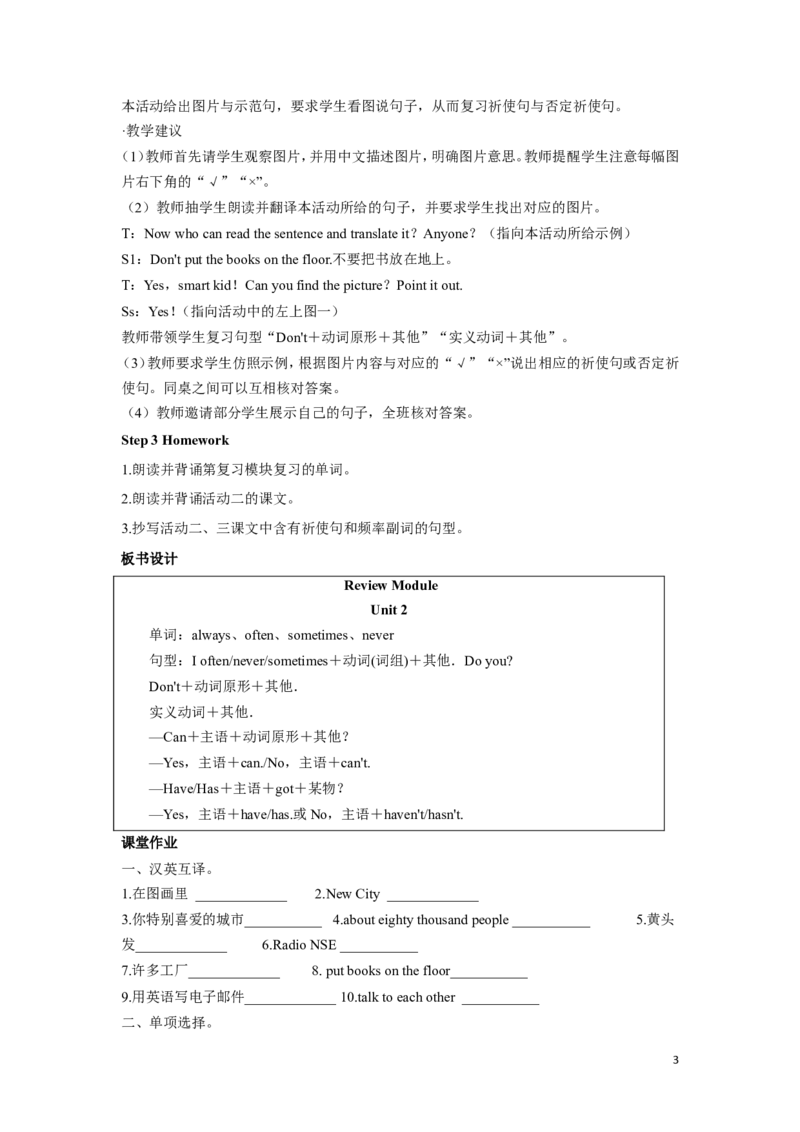
本活动给出图片与示范句,要求学生看图说句子,从而复习祈使句与否定祈使句。
·教学建议
(1)教师首先请学生观察图片,并用中文描述图片,明确图片意思。教师提醒学生注意每幅图
片右下角的“√”“×”。
(2)教师抽学生朗读并翻译本活动所给的句子,并要求学生找出对应的图片。
T:Now who can read the sentence and translate it?Anyone?(指向本活动所给示例)
S1:Don't put the books on the floor.不要把书放在地上。
T:Yes,smart kid!Can you find the picture?Point it out.
Ss:Yes!(指向活动中的左上图一)
教师带领学生复习句型“Don't+动词原形+其他”“实义动词+其他”。
(3)教师要求学生仿照示例,根据图片内容与对应的“√”“×”说出相应的祈使句或否定祈
使句。同桌之间可以互相核对答案。
(4)教师邀请部分学生展示自己的句子,全班核对答案。
Step 3 Homework
1.朗读并背诵第复习模块复习的单词。
2.朗读并背诵活动二的课文。
3.抄写活动二、三课文中含有祈使句和频率副词的句型。
板书设计
 Review Module
Unit 2
单词:always、often、sometimes、never
句型:I often/never/sometimes+动词(词组)+其他.Do you?
Don't+动词原形+其他.
实义动词+其他.
—Can+主语+动词原形+其他?
—Yes,主语+can./No,主语+can't.
—Have/Has+主语+got+某物?
—Yes,主语+have/has.或No,主语+haven't/hasn't.
课堂作业
一、汉英互译。
1.在图画里 _____________        2.New City  _____________
3.你特别喜爱的城市___________   4.about eighty thousand people ___________             5.黄头
发_____________          6.Radio NSE ___________
7.许多工厂_____________         8. put books on the floor___________
9.用英语写电子邮件_____________ 10.talk to each other  ___________
二、单项选择。
4
(   )1._________a fantastic present !
A. How               B. Where         C. What
(   )2. Have you got a book_________ America?
A. in                 B. about           C. for
(   )3.What do you do at Spring festvial ?
    A. We see dragon boat race.
B. We have a big family dinner.
C. Nothing
(   )4. Shanghai is in the_________ of China.
A. west              B. east             C. north
(   )5.I’ve got a violin_________ I can’t play it.
A. but               B. and              C. or
三、根据所给中文提示完成下列对话。
1.你有一头大象吗?是的,我有。
______you ______ an elephant?  Yes, I ________
2.书桌上有一本老师的书。
There____ a book of the teacher on____ ____.
3.你会用英语数数吗?不,我不会。
____ you count_____ ______?  No, I_____.
4.她在做什么?她在听音乐。
What _____she _____? She is____ to music.
5.此处禁止右转。
_____ ____ _____here.
四、读一读,选出合适的词填空。
      soon, be, have got, New York, postcard, from, visit, fly, park, but
    Laura lives in 1.________, but she isn’t American. She is 2.________ England. Today, Sam and
Amy have got a 3.________, it’s from Laura.
Dear Sam and Amy:
    Daming is my friend and I want you to 4._______ my friends, too. Do you like China?
Someday I want to 5._______ China. I like Chinese kite and I 6._______ it with Daming in the
7.______ . I 8.________ some chopsticks, 9._______they are difficult. Can you teach me?
I hope you can write to me. Daming says he will write to me 10.________.
五、阅读短文,回答下列问题
   This is my favourite city. It’s got about eighty thousand people. There is a long wall around the
city. The wall is 30 kilometres long. There are lots of tall buildings and it’s got lots of factories.
There are also lots of shops and restaurants in this city. This city has got many wide streets. There
is also a river. There are often boats on the river. The city has got a beautiful park. You can ride
your bike there. You can have a picnic. Or you can go swimming. There is also a very famous
5
library in the city and a big theatre. There are five stations. There are four bus stations and there is
one train station.
1.How big is this city?
__________________________________________________
2.Are there lots of shops and factories?
__________________________________________________
3.Has this city got a beautiful school in this article(在这篇文章里)?
__________________________________________________
4.What can you do?
__________________________________________________
5.What’s often on the river?
Answers:
一、1.in the picture  2.新城  3.your favourite city   4.大约八万人  5.yellow hair  6.NSE 广播台 7. lots of
factories  8.把书本放在地板上  9.write an email in English/write emails in English  10.互相谈论
二、1. C   2. B    3. B    4. B    5. A
三、1.Have got; have  2.is; the table   3.Can; in English; can’t  4. is doing; listening
5. Don’t turn right
四、1. New York 2. from3. postcard 4. be5. visit6. fly 7.park   8. have got   9. but   10. soon
五、1. It’s got about eighty thousand people.
2. Yes, there are.
3. No, it hasn’t.
4. You can have a picnic, ride your bike and go swimming.
5. There are often boats on the river.