专题11 阅读理解记叙文
1.(2025 年全国高考一卷)
In my ninth-grade writing class last year, I met a cowboy who saved his town, a strict father who demanded
his son earn straight A’s, and a modern-day Juliet who died of heartbreak after her parents rejected the love of her
young life. More than once, I found myself wondering just how my students, who’d created these people, knew
their subjects so well.
But things were different for their first essay, which was about the question: “Why is writing important?” Most
of the essays filled less than one page, and few contained a sentence that could be interpreted as a thesis (论点)
statement. I was shocked. Then I realized that the problem was the question itself. They could have written pages
on the necessity of computers, but writing, in and of itself, simply didn’t strike them as important. This would have
to change.
As a new unit started, I asked everyone to write a persuasive piece on a health-related topic of their choice.
This time they found the exercise much more interesting. For the next two assignments, a personal-narrative unit
followed by a creative-writing workshop, I only required that the piece meet the specifications of its genre (体裁)
and that it contain a thesis. The results were staggering. The students took on diverse topics and turned in stories,
10 to 20 pages each, with characters that broadened my view and touched my heart.
I walked into class believing that writing is important as a means of communication. However, my students
demonstrated something more important to me. When the final bell rang in June, I walked away with a yearbook
full of messages about writing’s most powerful significance — the ability to connect people, to put us in another’s
skin, to teach us what it means to be human.
21. Who are the people mentioned at the beginning of paragraph 1?
A. Ninth graders.
B. Students’ parents.
C. Modern writers.
D. Fictional characters.
22. Why did the students perform poorly in writing their first essay?
A. They were not given enough time.
B. They had a very limited vocabulary.
C. They misunderstood the question.
D. They had little interest in the topic.
23. What does the underlined word “staggering” in paragraph 3 mean?
A. Mixed.
B. Amazing.
C. Similar.
D. Disturbing.
24. What does the author’s experience show?
A. Teaching is learning.
B. Still waters run deep.
C. Knowledge is power.
D. Practice makes perfect.
2.(2025 年全国高考二卷)Kathy Ho teaches high school inside Lucile Packard Children’s Hospital Stanford
(LPCH). “Sometimes I don’t like saying that I’m a teacher,” says Ho. “People get in their minds an idea of what
teachers do, but that’s not really what it is here.”
“Here” is room 386, where each year, about 500 LPCH patients also become students. The hospital school is
free of parents, doctors, and medical procedures. It’s a place of learning. About half of Ho’s students stay for a
week or less; others are there for more than a year. Most of Ho’s students will recover, which means that preparing
them to return to school is an increasingly important component of care.
Still, in room 386, academics don’t come first. Physical health and mental health are the priority. “If you’re
scared about something and thinking only about that, there’s no way you’re going to be able to learn,” Ho says.
“I’m a coach, an adviser, and a comforter, and that’s what it means to be a hospital teacher.”
There are up to 30 students at any given time in Ho’s class. She generally works with their regular teachers to
get lessons and tests being used at their home schools. Some teachers don’t give the kids any assignments; they
express sympathy instead. “I feel like it is a disservice to the kids,” Ho says. “They think their teachers don’t care
about their schoolwork.”
Ho recognizes the psychological benefit of helping kids keep up with their peers (同龄人) outside the hospital.
“I actually think the medicine is only a small piece for some problems,” says Julie Good, director of pain
management services at LPCH. “It’s about problem-solving around what it means to have a full life. Those kids
have dreams. School can keep those dreams alive by giving kids a way to learn and grow.”
4. Who does Ho teach at LPCH?
A. Sick children.
B. Young nurses.
C. Medical students.
D. Patients’ parents.
5. What is a characteristic of Ho’s job?
A. Prioritizing academics.
B. Encouraging innovation.
C. Treating various diseases.
D. Playing multiple roles.
6. What does the underlined word “it” refer to in paragraph 4?
A. Offering regular lessons.
B. Paying extra attention.
C. Assigning no schoolwork.
D. Showing no sympathy.
7. How does the hospital school benefit the students according to Good?
A. It eases peer pressure.
B. It helps them live in hope.
C. It frees them from aches.
D. It entertains them with stories.
3.(2025 年1 月浙江首考)When I was a child I was often told what not to eat. “You don’t want to get fat” was
on constant repeat throughout my childhood. It really messed up my relationship with food — something that took
me years to overcome. Because of this, I’m careful not to connect what my kids weigh with their worth as people. I
encourage my daughter to make healthy snack choices and often dissuade (劝阻) her from a second dessert. But
one day when I heard her saying “I think I’m too fat,” my heart sank. It made me wonder if giving her advice on
snacks was having an unintentionally negative impact.
According to Charlotte Markey, a professor of psychology, food is one of the rare subjects where, as parents,
saying less is more. “There are so many things in parenting that are good to talk through, but I’m not convinced
that food is one of them,” she says. “It just creates some worries and insecurities in kids that aren’t necessarily
healthy.”
Instead, she recommends applying a well-known concept among nutrition experts called the “Division of
Responsibility,” where parents provide a variety of mostly healthy foods to their kids at fixed times, and the kids
themselves decide what and how much they want to consume — even if that means occasionally eating more
cookies than carrots.
Allowing kids to eat what they want also exposes them to the natural consequences of their decisions. “When
your child says, ‘My stomach hurts,’ you can say, ‘Well you had a lot of sugary foods and you might feel better if
you made some other choices,’” says Markey. “Let them feel like they have some control over it.”
I’ve been trying out these strategies and I’ve found that when I’m less restrictive, they do make better
decisions. “Feeding is a long game,” says Markey. “The food you have available makes a huge difference. Even if
they don’t eat it, they’ re seeing it. And then all of a sudden it clicks.”
24. What can be inferred about the author from the first paragraph?
A. She is upset by her kids’ weight.
B. She is critical of the way she was fed.
C. She is interested in making food.
D. She is particular about what she eats.
25. Which of the following would Markey disapprove of?
A. Allowing kids to eat cookies occasionally.
B. Offering various foods to kids at fixed times.
C. Explaining to kids the risks of taking snacks.
D. Talking with kids about school at mealtimes.
26. What should kids do according to the “Division of Responsibility”?
A. Make diet decisions on their own.
B. Share their food with other kids.
C. Eat up what is provided for them.
D. Help their parents do the dishes.
27. What does the author think of the strategies she has been following?
A. Costly.
B. Complex.
C. Workable.
D. Contradictory.
4.(2025 高考北京卷)Throughout our Junior year, my classmates and I have been worried about what colleges
will see when they look at our whole life story reduced to a single 200-word essay. Will the golden word “success”
form in their minds when they review our achievements? Or will they see the big word “fail” in red? The shadow of
this mysterious (神秘的) institution steals away what success means to us.
My first step of redefining success began with course registrations. It is a well-known fact, especially in my
school, that Junior year is the time of packing many AP classes into the schedule. When asked why they chose so
many AP classes, my friends responded: “I don’t know.” They themselves don’t know why they are following the
crowd and longing for the pressures of academic difficulty. Therefore, they do not feel the satisfaction of being
academically challenged.
Completing many courses no longer brings out the feeling of success because more than four AP classes per
year is a norm set by top universities. Determined to follow my instincts (本能) on what I felt success means, I only
chose two classes that I knew I would enjoy. The feeling of success was no longer attached to what grade I received
but to the pure joy of learning.
Even my failures are attached to a feeling of success; after I take a step back and look at the big picture, I see
them as a launching pad (平台) for my next big achievement. In the ninth grade, I went in for my first group
interview for a leadership position as a shy girl. Not standing a chance against competitive applicants, I came out of
the interview with an upset look. Nevertheless, this interview wasn’t a wasted opportunity. I talked to one of the
senior applicants who answered questions in a way that reflected the faith she had in herself.
This year, with an open mind and new knowledge in mind, I walked into another group interview while telling
myself I was that cool senior. I managed to secure a leadership position. Ultimately, success came little by little.
24. Throughout the Junior year, what was the author’s major concern?
A. Pressure from choosing AP classes.
B. Performance in group interviews.
C. Competition with seniors.
D. Recognition by colleges.
25. The author chose fewer AP classes because of _______.
A. her own understanding of success
B. her desire for academic challenges
C. her strong urge to follow the crowd
D. her dream of entering a top university
26. Which would best describe the author’s first group interview?
A Dignifying.
B. Rewarding.
C. Engaging.
D. Relaxing.
27. What can we learn from this passage?
A. Everyone is the maker of their own success.
B. Success favours those with a golden heart.
C. Success knocks at your door only once.
D. A college holds the key to success.
1.(2024 年新高考I 卷)“I am not crazy,” says Dr. William Farber, shortly after performing acupuncture (针灸)
on a rabbit. “I am ahead of my time.” If he seems a little defensive, it might be because even some of his coworkers
occasionally laugh at his unusual methods. But Farber is certain he’ll have the last laugh. He’s one of a small but
growing number of American veterinarians ( 兽医) now practicing “holistic” medicine-combining traditional
Western treatments with acupuncture, chiropractic (按摩疗法) and herbal medicine.
Farber, a graduate of Colorado State University, started out as a more conventional veterinarian. He became
interested in alternative treatments 20 years ago when he suffered from terrible back pain. He tried muscle-relaxing
drugs but found little relief. Then he tried acupuncture, an ancient Chinese practice, and was amazed that he
improved after two or three treatments. What worked on a veterinarian seemed likely to work on his patients. So,
after studying the techniques for a couple of years, he began offering them to pets.
Leigh Tindale’s dog Charlie had a serious heart condition. After Charlie had a heart attack, Tindale says, she
was prepared to put him to sleep, but Farber’s treatments eased her dog’s suffering so much that she was able to
keep him alive for an additional five months. And Priscilla Dewing reports that her horse, Nappy, “moves more
easily and rides more comfortably” after a chiropractic adjustment.
Farber is certain that the holistic approach will grow more popular with time, and if the past is any indication,
he may be right: Since 1982, membership in the American Holistic Veterinary Medical Association has grown from
30 to over 700. “Sometimes it surprises me that it works so well,” he says. “I will do anything to help an animal.
That’s my job.”
24. What do some of Farber’s coworkers think of him?
A. He’s odd.
B. He’s strict.
C. He’s brave.
D. He’s rude.
25. Why did Farber decide to try acupuncture on pets?
A. He was trained in it at university.
B. He was inspired by another veterinarian.
C. He benefited from it as a patient.
D. He wanted to save money for pet owners.
26. What does paragraph 3 mainly talk about?
A. Steps of a chiropractic treatment.
B. The complexity of veterinarians’ work.
C. Examples of rare animal diseases.
D. The effectiveness of holistic medicine.
27. Why does the author mention the American Holistic Veterinary Medical Association?
A. To prove Farber’s point.
B. To emphasize its importance.
C. To praise veterinarians.
D. To advocate animal protection.
2.(2024 年新高考II 卷)Do you ever get to the train station and realize you forgot to bring something to read?
Yes, we all have our phones, but many of us still like to go old school and read something printed.
Well, there’s a kiosk (小亭) for that. In the San Francisco Bay Area, at least.
“You enter the fare gates (检票口) and you’ll see a kiosk that is lit up and it tells you can get a one-minute, a
three-minute, or a five-minute story,” says Alicia Trost, the chief communications officer for the San Francisco Bay
Area Rapid Transit — known as BART. “You choose which length you want and it gives you a receipt-like short
story.”
It’s that simple. Riders have printed nearly 20,000 short stories and poems since the program was launched
last March. Some are classic short stories, and some are new original works.
Trost also wants to introduce local writers to local riders. “We wanted to do something where we do a call to
artists in the Bay Area to submit stories for a contest,” Trost says. “And as of right now, we’ve received about 120
submissions. The winning stories would go into our kiosk and then you would be a published artist.”
Ridership on transit (交通) systems across the country has been down the past half century, so could short
stories save transit?
Trost thinks so.
“At the end of the day all transit agencies right now are doing everything they can to improve the rider
experience. So I absolutely think we will get more riders just because of short stories,” she says.
And you’ll never be without something to read.
4. Why did BART start the kiosk program?
A. To promote the local culture.
B. To discourage phone use.
C. To meet passengers’ needs.
D. To reduce its running costs.
5. How are the stories categorized in the kiosk?
A. By popularity.
B. By length.
C. By theme.
D. By language.
6. What has Trost been doing recently?
A. Organizing a story contest.
B. Doing a survey of customers.
C. Choosing a print publisher.
D. Conducting interviews with artists.
7. What is Trost’s opinion about BART’s future?
A. It will close down.
B. Its profits will decline.
C. It will expand nationwide.
D. Its ridership will increase.
3.(2024 年浙江卷1 月)When was the last time you used a telephone box? I mean to make an actual phone
call — not to shelter from the rain. Ages ago right? The last time I used a phone box for its intended purpose
was…2006. I was conducting auditions (试演) for my play in my tiny old shared house in London. Hoping to
impress some talented actors to come and work for me for nothing, I spread some throws over the sofas and lit
candles to make it seem a bit more ”young professional”.
As I rushed outdoors to empty the wastepaper baskets, the door swung shut behind me. Suddenly I was locked
outside. My mobile phone was inside, but luckily there was a telephone box across the street. So, I called Directory
Assistance, got put through to our landlady’s managing agent, and had a spare key sent to me with just enough time
to get back in before the actors arrived.
As it has been many years since I last used one, I should hardly be surprised that then are no longer any public
telephones near my house. The last one standing has just been turn into a “mini community library”: any passer-by
can “borrow” a book from its shelves return it later, or replace it with another title from their own collection.
For a few months after the “library” opened, I didn’t bother taking a look, as I had assumed that it would be
stuffed full of cheese love stories. Then I noticed fork conducting spring cleans dropping boxes of voluminous
books on various subjects there. And these books were free. This unbeatable price-point encouraged me to
experiment with dozens of titles that I would never normally consider buying. And I’ve discovered some great
books!
If I ever get trapped outside my house again, my local telephone box will, sadly no longer be able to connect
me with my keys. But it can certainly keep me entertained while I wait for my wife to rescue me.
4. What does the underlined word “it” in the first paragraph refer to?
A. The play.
B. The shared house.
C. The sofa.
D. The telephone box.
5. Why did the author use the telephone box in 2006?
A. To place an urgent call.
B. To put up a notice.
C. To shelter from the rain.
D. To hold an audition.
6. What do we know about the “mini community library”?
A. It provides phone service for free.
B. Anyone can contribute to its collection.
C. It is popular among young readers.
D. Books must be returned within a month.
7. Why did the author start to use the “library”?
A. He wanted to borrow some love stories.
B. He was encouraged by a close neighbour.
C. He found there were excellent free books.
D. He thought it was an ideal place for reading.
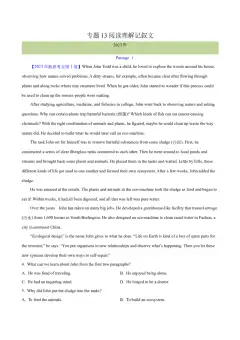
1.(2023 年新高考I 卷)When John Todd was a child, he loved to explore the woods around his house, observing
how nature solved problems. A ditry stream, for example, often became clear after flowing through plants and
along rocks where tiny creatures lived. When he got older, John started to wonder if this process could be used to
clean up the messes people were making.
After studying agriculture, medicine, and fisheries in college, John went back to observing nature and asking
questions. Why can certain plants trap harmful bacteria (细菌)? Which kinds of fish can eat cancer-causing
chemicals? With the right combination of animals and plants, he figured, maybe he could clean up waste the way
nature did. He decided to build what he would later call an eco-machine.
The task John set for himself was to remove harmful substances from some sludge (污泥). First, he
constructed a series of clear fiberglass tanks connected to each other. Then he went around to local ponds and
streams and brought back some plants and animals. He placed them in the tanks and waited. Little by little, these
different kinds of life got used to one another and formed their own ecosystem. After a few weeks, John added the
sludge.
He was amazed at the results. The plants and animals in the eco-machine took the sludge as food and began to
eat it! Within weeks, it had all been digested, and all that was left was pure water.
Over the years John has taken on many big jobs. He developed a greenhouse-like facility that treated sewage
(污水) from 1,600 homes in South Burlington. He also designed an eco-machine to clean canal water in Fuzhou, a
city in southeast China.
“Ecological design” is the name John gives to what he does. “Life on Earth is kind of a box of spare parts for
the inventor,” he says. “You put organisms in new relationships and observe what’s happening. Then you let these
new systems develop their own ways to self-repair.”
4. What can we learn about John from the first two paragraphs?
A. He was fond of traveling.
B. He enjoyed being alone.
C. He had an inquiring mind.
D. He longed to be a doctor.
5. Why did John put the sludge into the tanks?
A. To feed the animals.
B. To build an ecosystem.
C. To protect the plants.
D. To test the eco-machine.
6. What is the author’s purpose in mentioning Fuzhou?
A. To review John’s research plans.
B. To show an application of John’s idea.
C. To compare John’s different jobs.
D. To erase doubts about John’s invention.
7. What is the basis for John’s work?
A. Nature can repair itself.
B. Organisms need water to survive.
C. Life on Earth is diverse.
D. Most tiny creatures live in groups.
2.(2023 年新高考II 卷)Turning soil, pulling weeds, and harvesting cabbage sound like tough work for middle
and high school kids. And at first it is, says Abby Jaramillo, who with another teacher started Urban Sprouts, a
school garden program at four low-income schools. The program aims to help students develop science skills,
environmental awareness, and healthy lifestyles.
Jaramillo’s students live in neighborhoods where fresh food and green space are not easy to find and fast food
restaurants outnumber grocery stores. “The kids literally come to school with bags of snacks and large bottles of
soft drinks,” she says. “They come to us thinking vegetables are awful, dirt is awful, insects are awful.” Though
some are initially scared of the insects and turned off by the dirt, most are eager to try something new.
Urban Sprouts’ classes, at two middle schools and two high schools, include hands-on experiments such as
soil testing, flower-and-seed dissection, tastings of fresh or dried produce, and work in the garden. Several times a
year, students cook the vegetables they grow, and they occasionally make salads for their entire schools.
Program evaluations show that kids eat more vegetables as a result of the classes. “We have students who say
they went home and talked to their parents and now they’re eating differently,” Jaramillo says.
She adds that the program’s benefits go beyond nutrition. Some students get so interested in gardening that
they bring home seeds to start their own vegetable gardens. Besides, working in the garden seems to have a
calming effect on Jaramillo’s special education students, many of whom have emotional control issues. “They get
outside,” she says, “and they feel successful.”
4. What do we know about Abby Jaramillo?
A. She used to be a health worker.
B. She grew up in a low-income family.
C. She owns a fast food restaurant.
D. She is an initiator of Urban Sprouts.
5. What was a problem facing Jaramillo at the start of the program?
A. The kids’ parents distrusted her.
B. Students had little time for her classes.
C. Some kids disliked garden work.
D. There was no space for school gardens.
6. Which of the following best describes the impact of the program?
A. Far-reaching.
B. Predictable.
C. Short-lived.
D. Unidentifiable.
7. What can be a suitable title for the text?
A. Rescuing School Gardens
B. Experiencing Country Life
C. Growing Vegetable Lovers
D. Changing Local Landscape
3.(2023 年浙江卷1 月)Live with roommates? Have friends and family around you? Chances are that if you’re
looking to live a more sustainable lifestyle, not everyone around you will be ready to jump on that bandwagon.
I experienced this when I started switching to a zero waste lifestyle five years ago, as I was living with my
parents, and I continue to experience this with my husband, as he is not completely zero waste like me. I’ve learned
a few things along the way though, which I hope you’ll find encouraging if you’re doing your best to figure out
how you can make the change in a not-always-supportive household.
Zero waste was a radical lifestyle movement a few years back. I remember showing my parents a video of Bea
Johnson, sharing how cool I thought it would be to buy groceries with jars, and have so little trash! A few days
later, I came back with my first jars of zero waste groceries, and my dad commented on how silly it was for me to
carry jars everywhere. It came off as a bit discouraging.
Yet as the months of reducing waste continued, I did what I could that was within my own reach. I had my
own bedroom, so I worked on removing things I didn’t need. Since I had my own toiletries (洗漱用品), I was able
to start personalising my routine to be more sustainable. I also offered to cook every so often, so I portioned out a
bit of the cupboard for my own zero waste groceries. Perhaps your household won’t entirely make the switch, but
you may have some control over your own personal spaces to make the changes you desire.
As you make your lifestyle changes, you may find yourself wanting to speak up for yourself if others
comment on what you’re doing, which can turn itself into a whole household debate. If you have individuals who
are not on board, your words probably won’t do much and can often leave you feeling more discouraged.
So here is my advice: Lead by action.
24.What do the underlined words “jump on that bandwagon” mean in the first paragraph?
A.Share an apartment with you.
B.Join you in what you’re doing.
C.Transform your way of living.
D.Help you to make the decision.
25.What was the attitude of the author’s father toward buying groceries with jars?
A.He disapproved of it.
B.He was favorable to it.
C.He was tolerant of it.
D.He didn’t care about it.
26.What can we infer about the author?
A.She is quite good at cooking.
B.She respects others’ privacy.
C.She enjoys being a housewife.
D.She is a determined person.
27.What is the text mainly about?
A.How to get on well with other family members.
B.How to have one’s own personal space at home.
C.How to live a zero waste lifestyle in a household.
D.How to control the budget when buying groceries.
4.(2023 年天津卷第一次高考)One freezing morning last February, I walked through Ontario Place. Trees were
frosted sculptures. Large chunks of ice floated in the lake. Then I saw a group of people in bathing suits bouncing
up and down in the water. They held hands, shouting and yelling into the sky. They looked and sounded so free.
I’ve always found cold water thrilling. The shock of it is like pressing a switch. It seems to reset my body and
soul.
And last winter, I definitely needed a reset. I woke up most mornings with a dull, grey feeling as I forced
myself out of bed to start the day. I needed something to cheer myself up, but I didn’t know what, until that day.
The ice warriors (勇士) emerged from the lake, their skin steaming. Trembling, they were yet laughing and
hugging each other. I called out:  “You guys are awesome!” One woman waved back, “Come and join us! We’ re
here every Monday morning.”
The night before my first dip (游泳), I was excited and nervous. Cold water was one thing, but this icy lake
was a whole other level. Should I back out? Eventually, I got up in the dark and drove to the meeting spot.
After some wild warm up, I charged into the lake along with others. We yelled into the sky. Teeth chattering
heart rates slowing, fingers and toes going numb ( 麻木), we stayed there for somewhere between two and five
minutes. Knowing it was my first time, people cheered me on. It felt amazing. I was stupid with cold, but I couldn’t
remember the last time I’d felt so happy.
Now I go dipping almost every day, and I’ve come to long for that moment when the cold becomes a second
skin and my internal voice goes silent. Apart from the thrill of those first heart-stopping dives, which, ironically,
saved me from going under, what has drawn me is this community of generous, open-hearted souls.
We laughed together, often, but from the stories we’ve shared about ourselves, I know I’m not the only one
who faces life’s challenges. Holding hands in the freezing lake, we looked out for each other last winter and will do
so through this one.
It won’t fix everything in our lives—but for some reason, it helps. At the end of each session I return home
feeling stronger, lighter, more able to carry on. As another winter sets in, I’m more than ready to embrace the cold
again.
39.When the author saw the people in the lake, her feeling can be best described as __________
A.nervous
B.amazed
C.frightened
D.calm
40.Why did the author think of joining the swimmers?
A.To expand her social circle.
B.To lift her spirits again.
C.To adapt to the cold weather.
D.To prepare for a new career
41.What can be learnt about the author’s first dipping?
A.She hesitated a bit before going.
B.She suffered from a heart problem.
C.She stayed in cold water too long.
D.She regretted not doing enough warm up.
42.What change has cold water swimming brought about in the author?
A.She is more intelligent.
B.She gets more competitive.
C.She becomes a better storyteller.
D.She regains her inner peace.
43.What message does the author most likely want to convey?
A.Severe cold builds up character
B.Group wisdom brightens our life.
C.Tackling the odds together cures.
D.Doing sports promotes friendship.
5.(2023 年天津卷第二次高考)I looked through the window of the charming little violin shop, and my heart
began to race.
I'd been out to dinner that evening. Since it wasn't dark yet after the meal, I decided to walk home from the
restaurant. I had traveled that way before, yet I had never noticed that old little shop. But that night I felt drawn to
the violin shop the moment I came across it.
I wiped the dirt from the window to get a better look inside. Several violins hung from the dark walls, quietly
waiting to be chosen. As my eyes rested on them, I felt as though I were looking through a window into my own
past.
My childhood was all about the pursuits I had attempted, most of which had been chosen by Mom. She was
like, “Join the swim team, Tara. Your sister is a good swimmer;surely you will be, too. ”What she refused to
acknowledge, however, was that I was visibly afraid of water.
Every Saturday I begged Mom not to make me go to the swim meet, but had little chance of success. That
said, with a bang of the starting gun, I would dive into the cold water with all my strength and swim to the other
side of the pool as fast as I could, only to find that the other swimmers slid past me. I would have given it up if I
had not heard my father's encouraging shouts to cheer me on. When at last my hand would grab the edge of the
pool, he would always be there with a warm, dry towel, telling me how proud he was of my desperate efforts.
Then came a turning point in my life the day our school orchestra( 管弦乐队)visited my class, and gave a
demonstration. The drums annoyed me. The flutes( 笛子)bored me. But the violin…ah, the violin. It made the
sweetest sound I'd ever heard!My heart was dancing along with its flowing tune. For the first time in my life, I went
so wild with joy.
Tightly holding the permission slip from the orchestra director, I ran all the way home after school, and
shakily handed it to my parents with a fear that they might dismiss my desire. They didn't. Mom was thrilled to see
me finally excited about something, and Dad winked(眨眼示意)at me while eagerly signing the slip.
I began practicing the violin with great passion, and rose quickly in ability. Before long I had won the first seat
in the community orchestra …
39.What did the sight of the violins in that little shop bring to Tara's mind?
A.Her miserable past.
B.An unforgettable sport event.
C.The stories behind the violins.
D.Her childhood memory.
40.What Dad did for Tara during the swimming competition implies that he is ________.
A.mindless and bad-tempered
B.caring and supportive
C.strict and demanding
D.tolerant and sympathetic
41.What fascinated Tara during her school orchestra's demonstration?
A.The tune of the flutes.
B.The beat of the drums.
C.The sound of the violin.
D.The manner of the musicians.
42.What enabled Tara to win the first seat in the community orchestra?
A.The steady improvement in her taste.
B.Her strong desire for success.
C.Her natural gift for music.
D.The rapid progress in her ability.
43.What message does Tara's story convey?
A.It's never too young to learn.
B.A passionate interest works wonders.
C.Hard work will pay off in the long run.
D.Like mother, like daughter.
6.(2023 年全国甲卷)
Terri Boltonis a dab hand when it comes to DIY (do-it-yourself). Skilled at putting up shelves and piecing
together furniture, she never pays someone else to do a job she can do herself.
She credits these skills to her late grandfather and builder Derek Lloyd. From the age of six, Terri, now 26,
accompanied Derek to work during her school holidays. A day’s work was rewarded with £ 5 in pocket money. She
says: “I’m sure I wasn’t much of a help to start with painting the rooms and putting down the flooring throughout
the house. It took weeks and is was backbreaking work, but I know he was proud of my skills.”
Terri, who now rents abhouse with friends in Wandsworth, South West London, says DIY also saves her from
losing any deposit when a tenancy (租期) comes to an end. She adds: “I’ve moved house many times and I always
like to personalise my room and put up pictures. So, it’s been useful to know how to cover up holes and repaint a
room to avoid any charges when I’ve moved out.”
With millions of people likely to take on DIY projects over that coming weeks, new research shows that more
than half of people are planning to make the most of the long, warm summer days to get jobs done. The average
spend per project will be around £ 823. Two thirds of people aim to improve their comfort while at home. Two fifth
wish to increase the value of their house. Though DIY has traditionally been seen as male hobby, the research
shows it is women now leading the charge.
4.Which is closest in meaning to “a dab hand” in paragraph 1?
A.An artist.
B.A winner.
C.A specialist.
D.A pioneer.
5.Why did Terri’s grandfather give her £ 5 a day?
A.For a birthday gift.
B.As a treat for her work.
C.To support her DIY projects.
D.To encourage her to take up a hobby.
6.How did Terri avoid losing the deposit on the house she rented?
A.By making it look like before.
B.By furmishing it herself.
C.By splitting the rent with a roommate.
D.By cancelling the rental agreement.
7.What trend in DIY does the research show?
A.It is becoming more costly.
B.It is getting more time-consuming.
C.It is turning into a seasonal industry.
D.It is gaining popularity among females.
7.(2023 年全国乙卷)
Living in Iowa and trying to become a photographer specializing in landscape (风景) can be quite a challenge,
mainly because the corn state lacks geographical variation.
Although landscapes in the Midwest tend to be quite similar, either farm fields or highways, sometimes I find
distinctive character in the hills or lakes. To make some of my landscape shots, I have traveled up to four hours
away to shoot within a 10-minute time frame. I tend to travel with a few of my friends to state parks or to the
countryside to go on adventures and take photos along the way.
Being at the right place at the right time is decisive in any style of photography. I often leave early to seek the
right destinations so I can set up early to avoid missing the moment I am attempting to photograph. I have missed
plenty of beautiful sunsets/sunrises due to being on the spot only five minutes before the best moment.
One time my friends and I drove three hours to Devil’s Lake, Wisconsin, to climb the purple quartz (石英)
rock around the lake. After we found a crazy-looking road that hung over a bunch of rocks, we decided to
photograph the scene at sunset. The position enabled us to look over the lake with the sunset in the background. We
managed to leave this spot to climb higher because of the spare time until sunset. However, we did not mark the
route (路线) so we ended up almost missing the sunset entirely. Once we found the place, it was stressful getting
lights and cameras set up in the limited time. Still, looking back on the photos, they are some of my best shots
though they could have been so much better if I would have been prepared and managed my time wisely.
4. How does the author deal with the challenge as a landscape photographer in the Midwest?
A. By teaming up with other photographers.
B. By shooting in the countryside or state parks.
C. By studying the geographical conditions.
D. By creating settings in the corn fields.
5. What is the key to successful landscape photography according to the author?
A. Proper time management.
B. Good shooting techniques.
C. Adventurous spirit.
D. Distinctive styles.
6. What can we infer from the author trip with friends to Devil’s Lake?
A. They went crazy with the purple quartz rock.
B. They felt stressed while waiting for the sunset.
C. They reached the shooting spot later than expected.
D. They had problems with their emipment.
7. How does the author find his photos taken at Devil’s Lake?
A. Amusing.
B. Satisfying.
C. Encouraging.
D. Comforting.