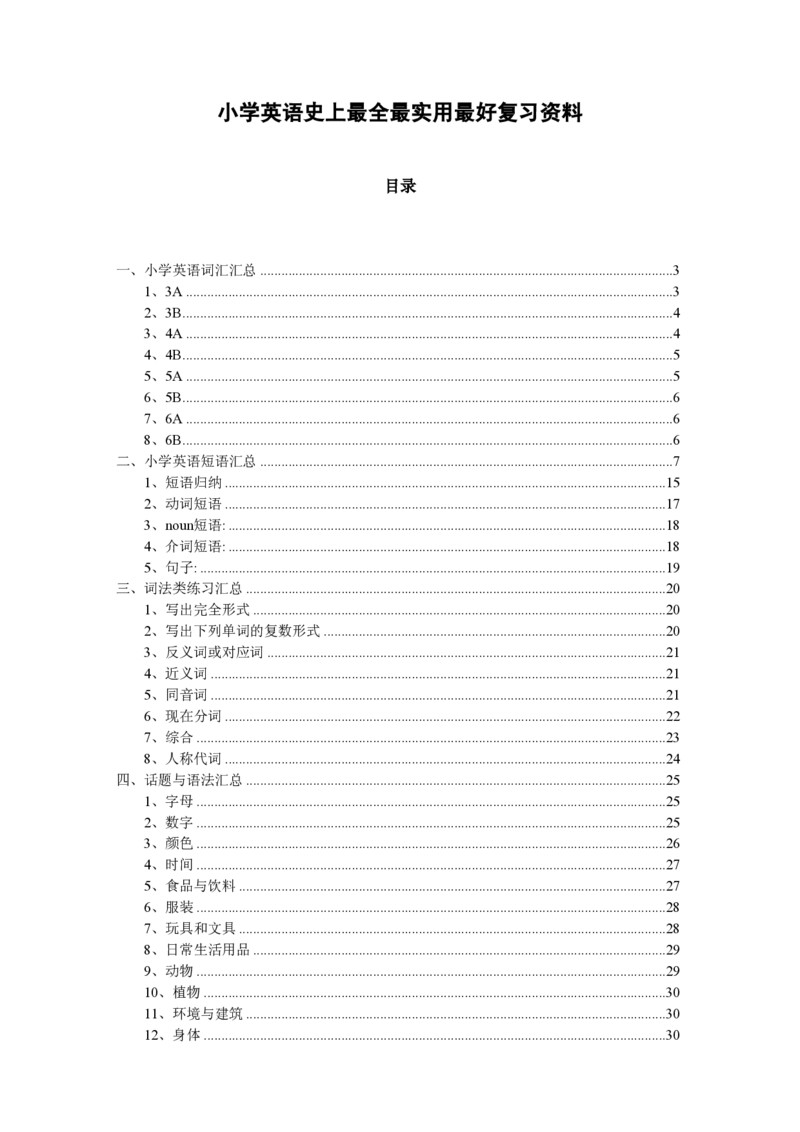
小学英语史上最全最实用最好复习资料
目录
一、小学英语词汇汇总.....................................................................................................................3
1、3A..........................................................................................................................................3
2、3B...........................................................................................................................................4
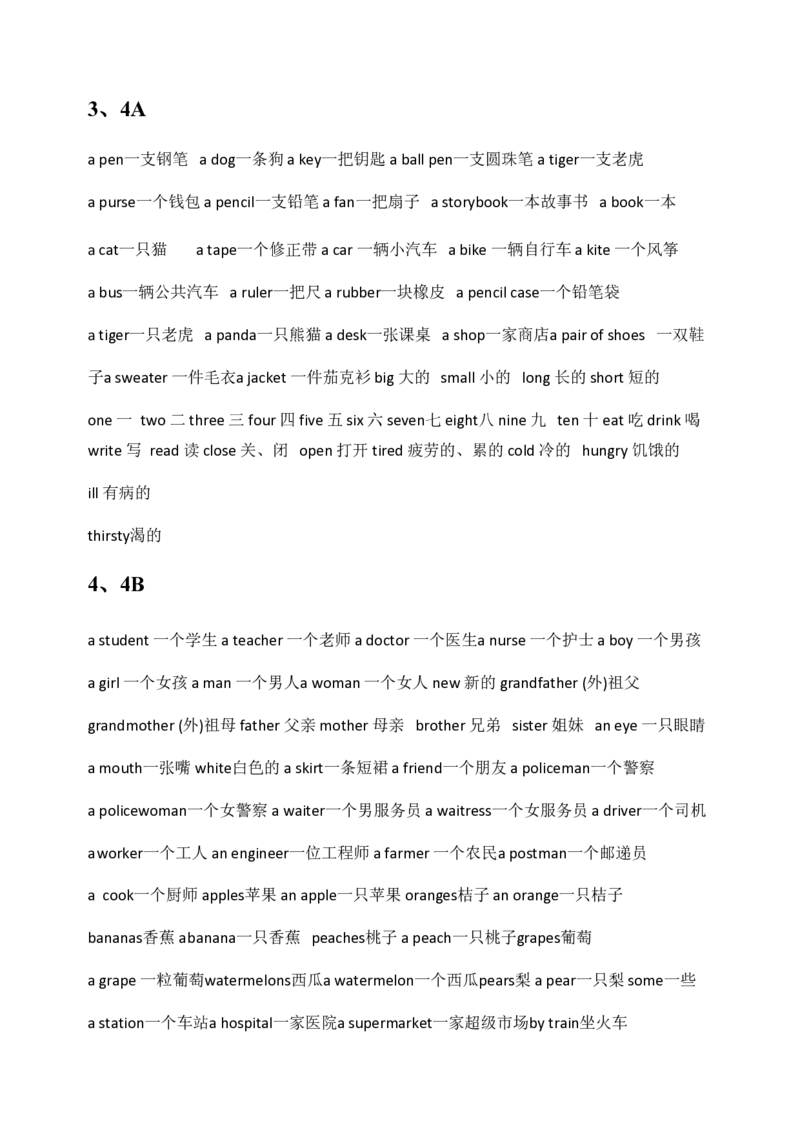
3、4A..........................................................................................................................................4
4、4B...........................................................................................................................................5
5、5A..........................................................................................................................................5
6、5B...........................................................................................................................................6
7、6A..........................................................................................................................................6
8、6B...........................................................................................................................................6
二、小学英语短语汇总.....................................................................................................................7
1、短语归纳.............................................................................................................................15
2、动词短语.............................................................................................................................17
3、noun短语:............................................................................................................................18
4、介词短语:............................................................................................................................18
5、句子:....................................................................................................................................19
三、词法类练习汇总.......................................................................................................................20
1、写出完全形式.....................................................................................................................20
2、写出下列单词的复数形式.................................................................................................20
3、反义词或对应词.................................................................................................................21
4、近义词.................................................................................................................................21
5、同音词.................................................................................................................................21
6、现在分词.............................................................................................................................22
7、综合.....................................................................................................................................23
8、人称代词.............................................................................................................................24
四、话题与语法汇总.......................................................................................................................25
1、字母.....................................................................................................................................25
2、数字.....................................................................................................................................25
3、颜色.....................................................................................................................................26
4、时间.....................................................................................................................................27
5、食品与饮料.........................................................................................................................27
6、服装.....................................................................................................................................28
7、玩具和文具.........................................................................................................................28
8、日常生活用品.....................................................................................................................29
9、动物.....................................................................................................................................29
10、植物...................................................................................................................................30
11、环境与建筑.......................................................................................................................30
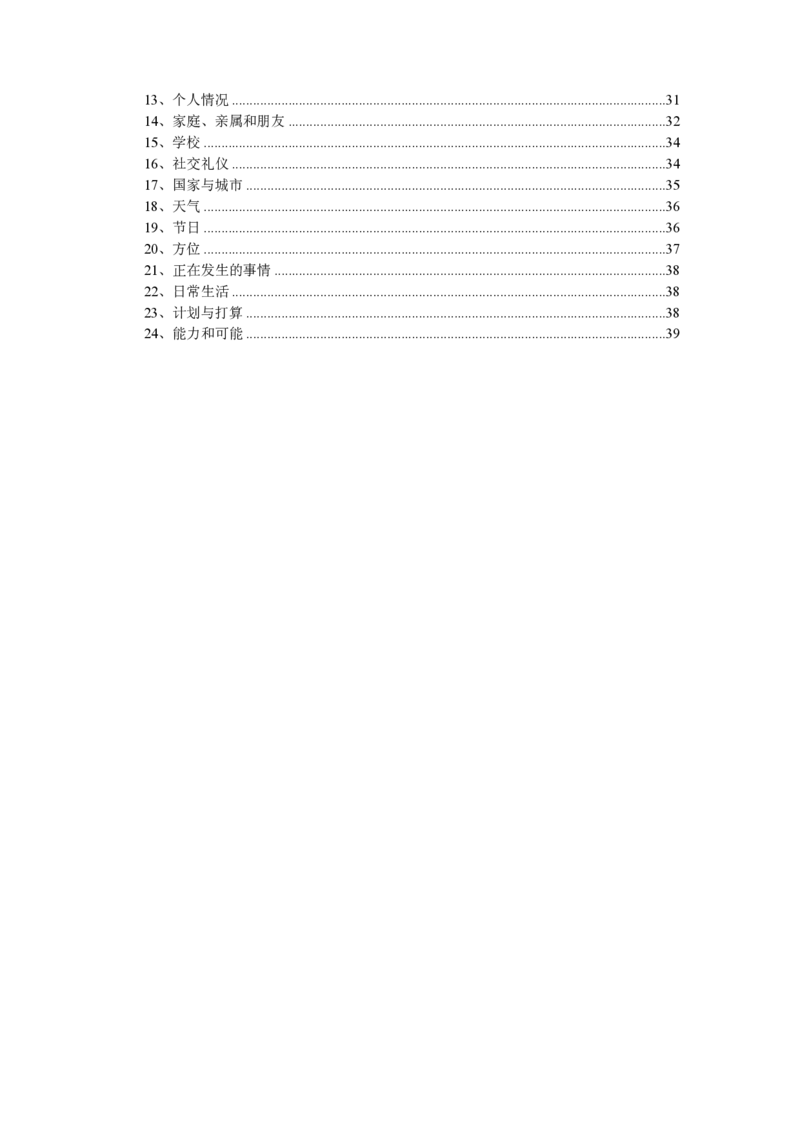
12、身体...................................................................................................................................3013、个人情况...........................................................................................................................31
14、家庭、亲属和朋友...........................................................................................................32
15、学校...................................................................................................................................34
16、社交礼仪...........................................................................................................................34
17、国家与城市.......................................................................................................................35
18、天气...................................................................................................................................36
19、节日...................................................................................................................................36
20、方位...................................................................................................................................37
21、正在发生的事情...............................................................................................................38
22、日常生活...........................................................................................................................38
23、计划与打算.......................................................................................................................38
24、能力和可能.......................................................................................................................39一、小学英语词汇汇总
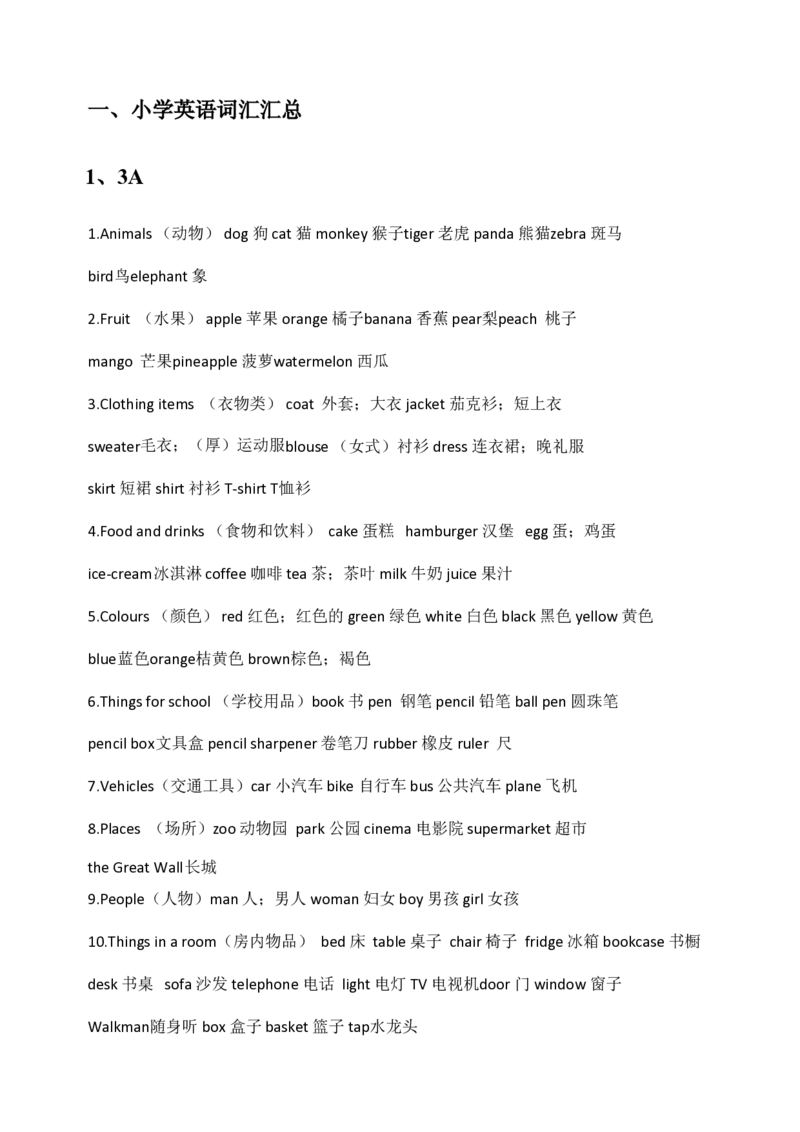
1、3A
1.Animals(动物)dog狗cat猫monkey猴子tiger老虎panda熊猫zebra斑马
bird鸟elephant象
2.Fruit (水果)apple苹果orange橘子banana香蕉pear梨peach 桃子
mango 芒果pineapple菠萝watermelon西瓜
3.Clothingitems (衣物类)coat 外套;大衣jacket茄克衫;短上衣
sweater毛衣;(厚)运动服blouse(女式)衬衫dress连衣裙;晚礼服
skirt短裙shirt衬衫T-shirtT恤衫
4.Foodanddrinks(食物和饮料) cake蛋糕 hamburger汉堡 egg蛋;鸡蛋
ice-cream冰淇淋coffee咖啡tea茶;茶叶milk牛奶juice果汁
5.Colours(颜色)red红色;红色的green绿色white白色black黑色yellow黄色
blue蓝色orange桔黄色brown棕色;褐色
6.Thingsforschool(学校用品)book书pen 钢笔pencil铅笔ballpen圆珠笔
pencilbox文具盒pencilsharpener卷笔刀rubber橡皮ruler 尺
7.Vehicles(交通工具)car小汽车bike自行车bus公共汽车plane飞机
8.Places (场所)zoo动物园 park公园cinema电影院supermarket超市
theGreatWall长城
9.People(人物)man人;男人woman妇女boy男孩girl女孩
10.Thingsinaroom(房内物品) bed床 table桌子 chair椅子 fridge冰箱bookcase书橱
desk书桌 sofa沙发telephone电话 light电灯TV电视机door门window窗子
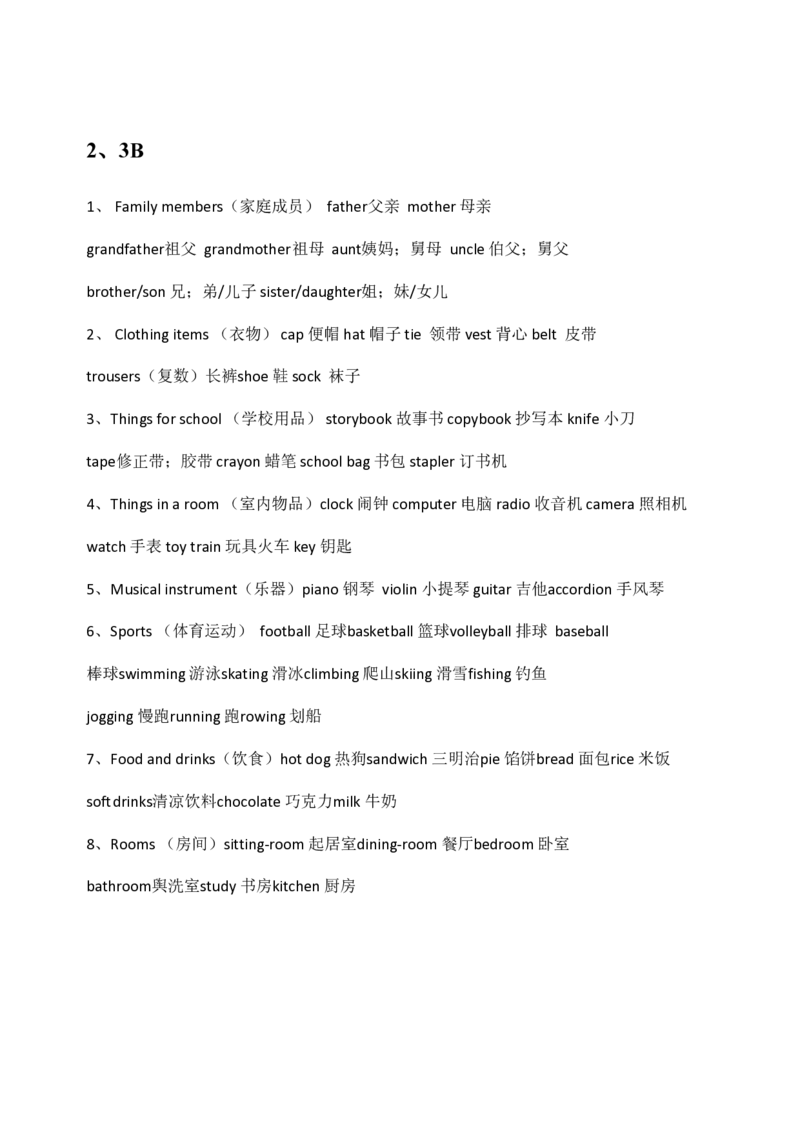
Walkman随身听box盒子basket篮子tap水龙头2、3B
1、Familymembers(家庭成员) father父亲 mother母亲
grandfathe r祖父 grandmother祖母 aunt姨妈; 舅母 u ncle伯 父;舅父
broth e r/son兄;弟/儿 子 sist er/daughter姐 ;妹/女儿
2、Clothingi t ems(衣物)cap便帽hat帽子tie 领带vest背心belt 皮带
trousers(复 数)长 裤shoe鞋 so ck 袜 子
3、Thingsforschoo l( 学校 用品) storybook故事书copybook抄写本knife小刀
tape修正带 ; 胶带c rayon蜡笔scho olbag书包 staple r订书机
4、Thingsinar oom( 室内 物品) cloc k闹钟 comp uter电脑radio收音机camera照相机
watch手表 t oy train 玩具火车key钥匙
5、Mu sical inst rume nt(乐器) pia no钢琴 violin小提琴guitar吉他accordion手风琴
6、Sports( 体育运动) football足球 bask e tball篮 球voll eyball 排球 baseball
棒球swimm ing游泳skatin g滑冰cl imbing爬山skii ng滑雪fishing 钓鱼
jogging慢跑run ning跑rowi ng划船
7、Foo danddrinks(饮食)hotdog热狗sandwich三明治pie馅饼bread面包rice米饭
softdrink s清凉 饮料chocolate巧克 力 milk牛奶
8、Rooms(房间)sittin g-room起居 室dining-room餐厅bedroom卧室
bathroom舆 洗室study书房kitche n厨房3、4A
apen一支钢笔 adog一条狗akey一把钥匙aballpen一支圆珠笔atiger一支老虎
a purse一个钱包apencil一支铅笔afan一把扇子 astorybook一本故事书 abook一本
a cat一只猫 a tape一个修正带 a car 一辆小汽车 a bike 一辆自行车 a kite 一个风筝
a bus一辆公共汽车 aruler一把尺 arubber一块橡皮 apenc ilcase一个铅笔袋
a tiger一只老虎 apanda一只熊猫 adesk一张课桌 ashop一家商店 apa iro fshoe s 一双鞋
子 asweat er一件毛衣 ajack et一件茄克衫 b ig大的 sm all小的 lo ng长的 sho rt短的
one 一 two二 t hree 三 four 四 fiv e五 six六s even七 eight 八 n ine 九 ten 十 eat吃 d rink喝
write写 read读close关、闭 open打开tired疲劳的、累的cold冷的 hungry 饥饿的
ill有病的
thirsty渴的
4、4B
a student 一个学生 a teacher 一个老师 a doctor 一个医生a nurse 一个护士 a boy 一个男孩
a girl 一个女孩 a man 一个男人a woman 一个女人 new 新的 grandfather (外)祖父
grandmother (外)祖母 father 父亲 mother 母亲 brother 兄弟 sister 姐妹 an eye 一只眼睛
a mouth一张嘴 white白色的 a skirt一条短裙 a friend一个朋友 a policeman一个警察
a policewoman一个女警察 awaiter一个男服务员 awaitress一个女服务员 adriver一个司机
aworker一个工人 a nengineer一位工程师 afarme r一个农民 apostman一个邮递员
a cook一个厨师 apples苹果 a napple一只苹果 oranges桔子 a norange一只桔子
bananas香蕉aba n ana一只香蕉 peaches桃子apeach一只桃子 grap es葡萄
agrape 一粒葡萄watermelon s西瓜awatermelon一个西瓜 pe ars梨apear 一只梨som e一些
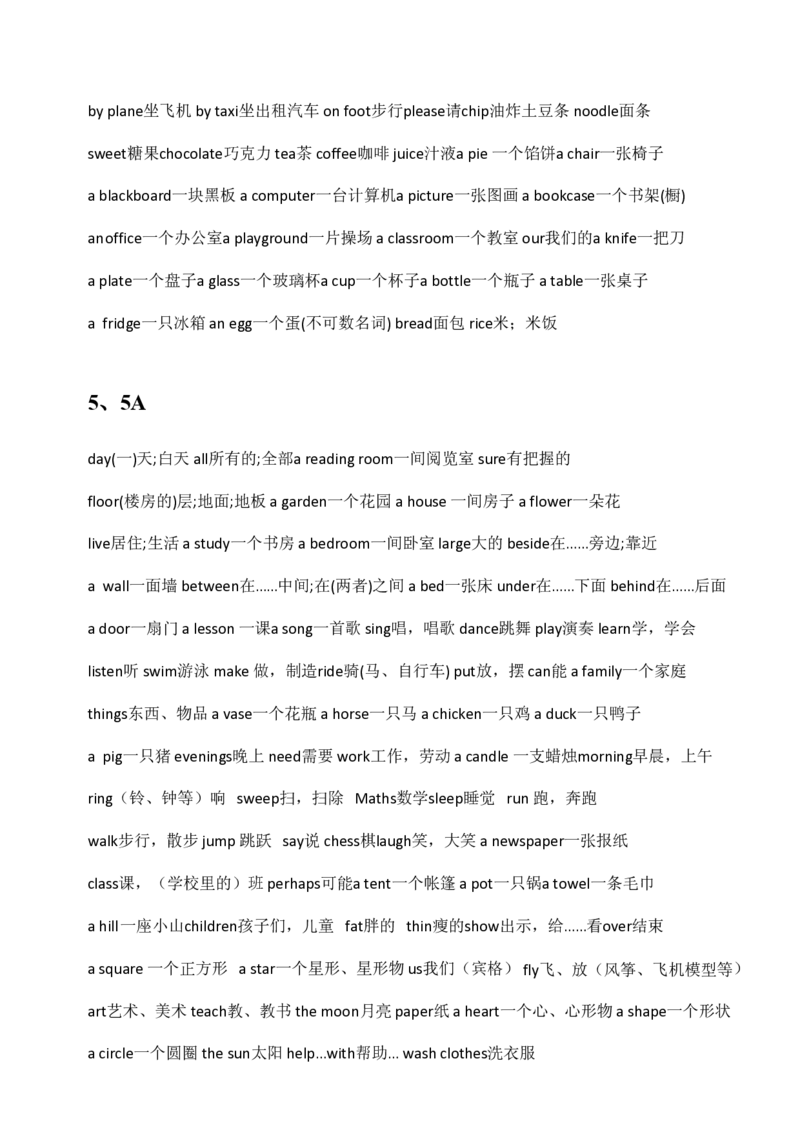
a station一个车站 ahospital一家医院 asupermarket一家超级市场b ytrain坐火车by plane坐飞 机 bytaxi坐出租汽 车 onfoot步行please请chip油炸土豆 条noodle面 条
sweet糖果chocolate巧克力 tea茶 coffee咖啡 juice汁液a pie 一个馅饼a chair一张椅子
a blackboard一块黑板 acomputer一台计算机 apicture一张图画 abookcase一个书架(橱 )
anoffice一个办公室 aplayground一片操 场 aclassroom一个教 室our我们的 aknife一把刀
a plate一个盘子 aglass一个玻璃杯 acup一个杯子 abottle一个瓶子 atable一张桌子
a fridge一只冰箱 a negg一个蛋(不可数名词 )bread面包 rice米;米饭
5、5A
day(一)天;白天 all所有的;全部a reading room一间阅览室 sure有把握的
floor(楼房的)层;地面;地板 a garden一个花园 a house 一间房子 a flower一朵花
live居住;生活 a study一个书房 a bedroom一间卧室 large大的 beside在……旁边;靠近
a wall一面墙 between在……中间;在(两者)之间 abed一张床 under在……下面 behind在……后面
a door一扇门 a lesson 一课a song一首歌 sing唱,唱歌 dance跳舞 play演奏 learn学,学会
listen听 swim游泳 make 做,制造ride骑(马、自行车) put放,摆 can能 a family一个家庭
things东西、物品 a vase一个花瓶 a horse一只马 a chicken一只鸡 a duck一只鸭子
a pig一只猪 evenings晚上 need需要 work工作,劳动 acand le一支蜡烛morning早晨,上午
ring(铃、钟等)响 sweep扫,扫除 Maths数学sleep睡觉 run 跑,奔跑
walk步行,散步 jump 跳跃 say说 chess棋laugh笑,大笑 a newspaper一张报纸
class课,(学校里的)班 perhaps可能a tent一个帐篷 a pot一只锅a towel一条毛巾
ahill一座小山children孩子们,儿 童 fat胖 的 thin瘦的show出示,给……看over结 束
asquare 一个 正 方形 astar一个星形、 星形物us我们( 宾格)fly飞、放(风筝、飞机模 型等)
art艺术、美术 teach教、教书 the moon月亮 paper纸 a heart一个心、心形物 a shape一个形状
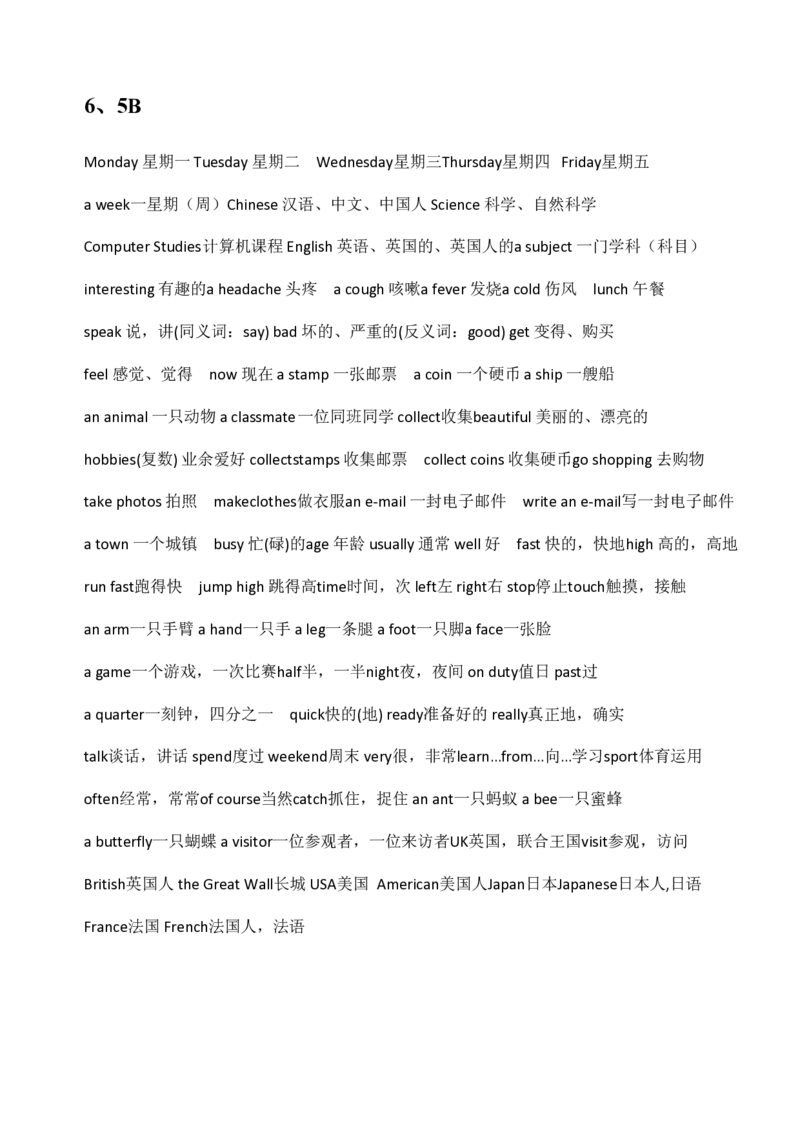
acircle一个圆圈thesun太阳help…with帮助…washclothes洗衣服6、5B
Monday星期一Tuesday星期二 Wednesday星期三Thursday星期四 Friday星期五
a week一星期(周)Chinese汉语、中文、中国人Science科学、自然科学
Compute rStudie s计算机课 程English英语、英国的、英国人的asubje c t一门学科( 科 目)
interesting 有趣的aheadach e头疼 acough咳嗽 afever发 烧acold伤风 lunch午餐
speak 说,讲 (同义词 :say)bad坏的、严重的(反 义词: good)get变得、购买
feel感觉 、觉得 n ow现在 astam p一张 邮票 aco in一 个硬币aship 一艘船
ananimal一只动物ac lass mate一位同班同学collect收集 bea utiful美丽的、漂 亮的
hobb ies(复 数 )业余 爱好collectst amp s收集邮票 col lectcoins收 集硬币 goshopp in g去购物
takephotos拍照 makeclothes做衣 服ane-mail一封电子邮件 write ane-mai l写一封 电子邮件
atown一 个城镇 busy忙 (碌)的 age年龄usu ally通常 well好 fas t快的, 快地high高 的,高地
runfast跑得快 j umph igh跳得高time时间, 次l eft左right右stop停止to uch触 摸,接触
an arm 一只手臂a hand 一只手 aleg 一条 腿afoot 一只脚aface一张 脸
a game一个游戏 ,一 次比赛half半,一半 night夜 ,夜间 onduty值日past过
a quarter一刻钟 ,四分之一 quick快的( 地 )ready准备好 的really真 正 地,确实
talk谈话,讲话spend度过weekend周末very很,非常 lear n…from… 向…学习 sport体育运用
often经常,常常ofcourse当然catch抓住, 捉住anant一只 蚂蚁abee一只蜜蜂
a butterfly一只蝴 蝶avisitor 一位参观者, 一位来访者UK英国,联合王国visit参观,访问
British英国人theGr eatWall长城USA美国 Amer ican 美国人Japan 日 本Japanese日 本 人,日语
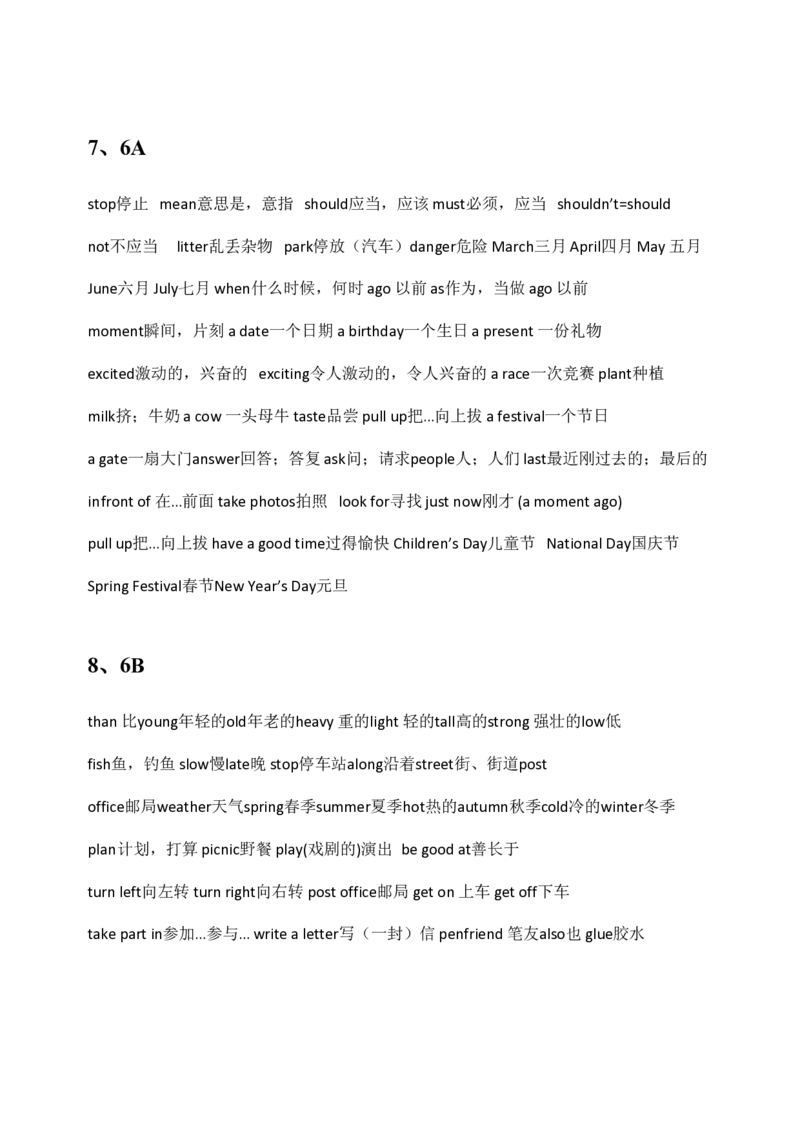
France法国French法 国人,法语7、6A
stop停止 mean意思是,意指 should应当,应该 must必须,应当 shouldn’t=should
not不应当 litter乱丢杂物 park停放(汽车)danger危险 March三月 April四月 May 五月
June六月 July七月 when什么时候,何时 ago 以前 as作为,当做 ago 以前
moment瞬间,片刻 a date一个日期 a birthday一个生日 a present 一份礼物
excited激动的,兴奋的 exciting令人激动的,令人兴奋的 a race一次竞赛 plant种植
milk挤;牛奶 a cow 一头母牛 taste品尝 pull up把…向上拔 a festival一个节日
a gate一扇大门answer回答;答复 ask问;请求people人;人们 last最近刚过去的;最后的
infron to f在…前面 tak ephotos拍照 loo kfor寻找 ju stnow刚才 (amomen tag o )
pull up把…向上 拔h a veag oodtime过得愉 快Childr en’sDay儿童 节 Natio nalDay国庆 节
Spring Festival春节 New Year’sDa y元旦
8、6B
than 比young年轻的old年老的heavy 重的light 轻的tall高的strong 强壮的low低
fish鱼,钓鱼 slow慢late晚 stop停车站along沿着street街、街道post
office邮局weather天气spring春季summer夏季hot热的autumn秋季cold冷的winter冬季
plan计划,打 算picnic野 餐play(戏剧的)演出 begoodat善长于
tur nleft 向左转tu rnrig ht向右转p osto ffice邮局ge ton上 车getof f下车
take part in参加…参与… write a letter写(一封)信 penfriend 笔友also也 glue胶水二、小学英语短语汇总
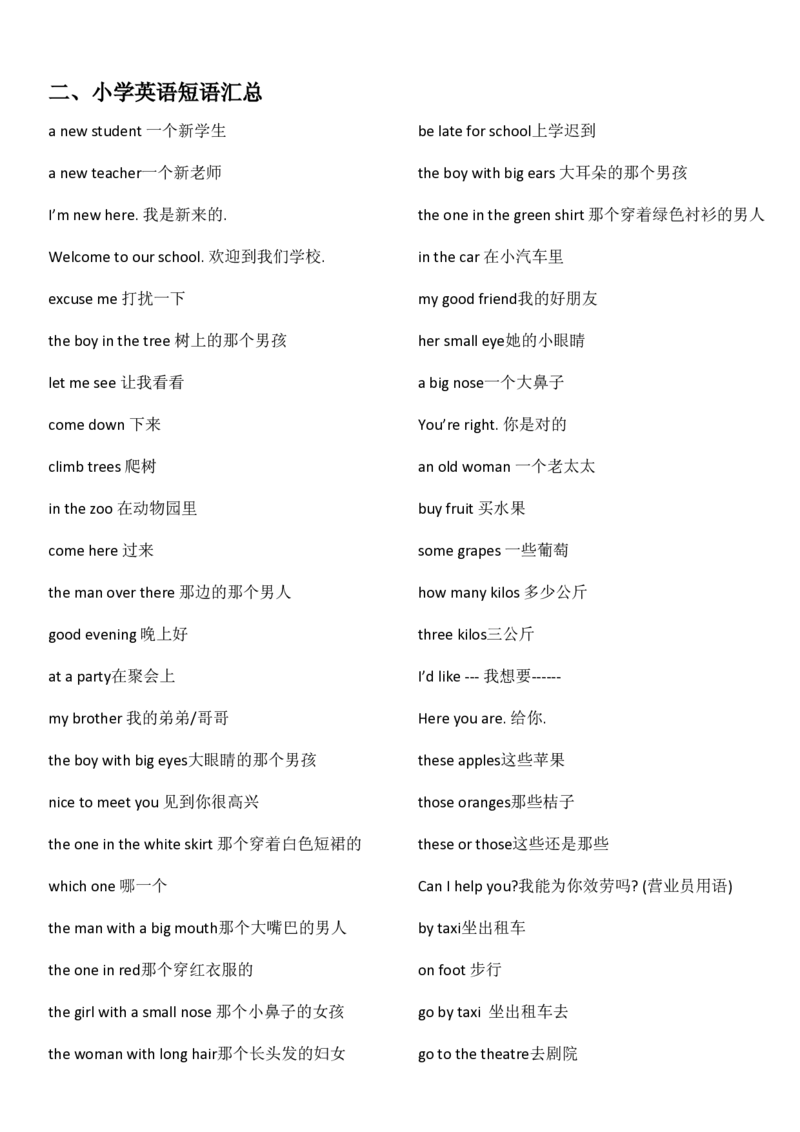
anewstudent一个新学生 belateforschool上学迟到
anewteacher一个新老师 theboywithbigears大耳朵的那个男孩
I’mnewhere.我是新来的. theoneinthegreenshirt那个穿着绿色衬衫的男人
Welcometoourschool.欢迎到我们学校. inthecar在小汽车里
excuseme打扰一下 mygoodfriend我的好朋友
theboyinthetree树上的那个男孩 hersmalleye她的小眼睛
letmesee让我看看 abignose一个大鼻子
comedown下来 You’reright.你是对的
climbtrees爬树 anoldwoman一个老太太
inthezoo在动物园里 buyfruit买水果
comehere过来 somegrapes一些葡萄
themanoverthere那边的那个男人 howmanykilos多少公斤
goodevening晚上好 threekilos三公斤
ataparty在聚会上 I’dlike---我想要------
mybrother我的弟弟/哥哥 Hereyouare.给你.
theboywithbigeyes大眼睛的那个男孩 theseapples这些苹果
nicetomeetyou见到你很高兴 thoseoranges那些桔子
theoneinthewhiteskirt那个穿着白色短裙的 theseorthose这些还是那些
whichone哪一个 CanIhelpyou?我能为你效劳吗?(营业员用语)
themanwithabigmouth那个大嘴巴的男人 bytaxi坐出租车
theoneinred那个穿红衣服的 onfoot步行
thegirlwithasmallnose那个小鼻子的女孩 gobytaxi 坐出租车去
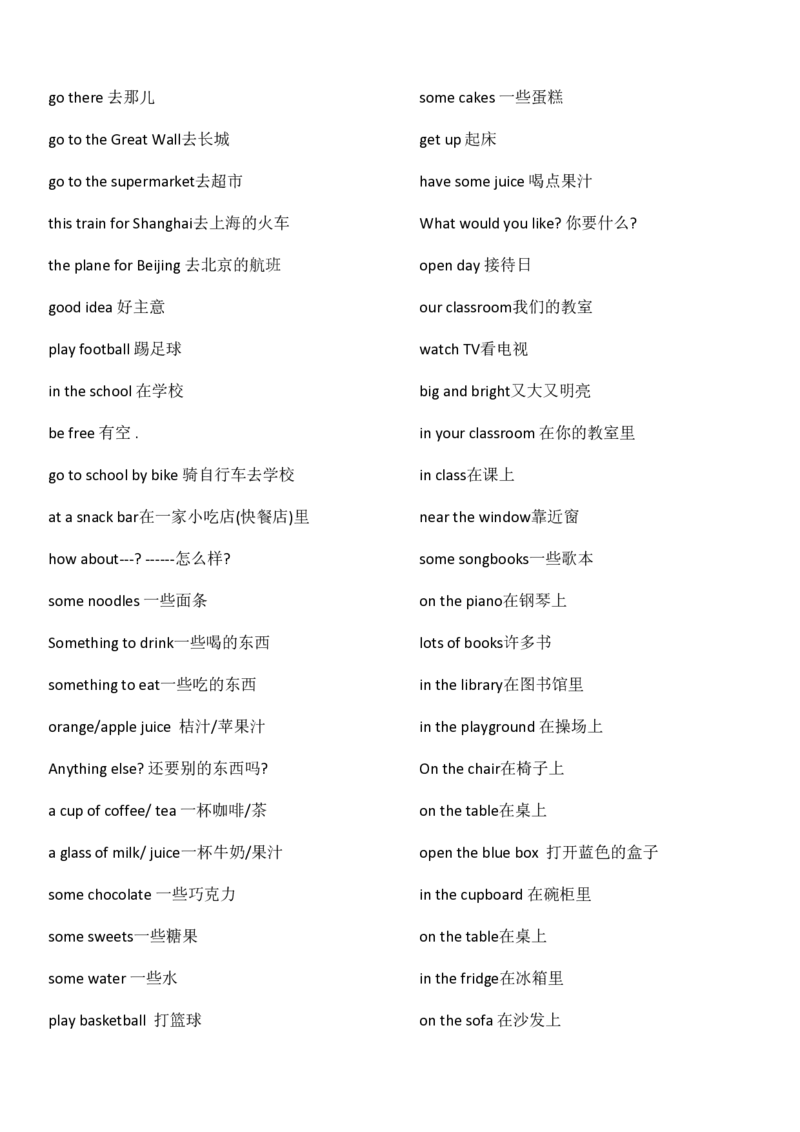
thewomanwithlonghair那个长头发的妇女 gotothetheatre去剧院go there 去那儿 somecakes一些蛋糕
go to the Great Wall去长城 getup起床
go to the supermarket去超市 havesomejuice喝点果汁
this train for Shanghai去上海的火车 Whatwouldyoulike?你要什么?
the plane for Beijing 去北京的航班 openday接待日
good idea 好主意 ourclassroom我们的教室
play football 踢足球 watchTV看电视
in the school 在学校 bigandbright又大又明亮
be free 有空 . inyourclassroom在你的教室里
go to school by bike 骑自行车去学校 inclass在课上
at a snack bar在一家小吃店(快餐店)里 nearthewindow靠近窗
how about---? ------怎么样? somesongbooks一些歌本
some noodles 一些面条 onthepiano在钢琴上
Something to drink一些喝的东西 lotsofbooks许多书
something to eat一些吃的东西 inthelibrary在图书馆里
orange/apple juice 桔汁/苹果汁 intheplayground在操场上
Anything else? 还要别的东西吗? Onthechair在椅子上
a cup of coffee/ tea 一杯咖啡/茶 onthetable在桌上
a glass of milk/ juice一杯牛奶/果汁 openthebluebox 打开蓝色的盒子
some chocolate 一些巧克力 inthecupboard在碗柜里
some sweets一些糖果 onthetable在桌上
some water 一些水 inthefridge在冰箱里
play basketball 打篮球 onthesofa在沙发上use chopsticks 用筷子 amapoftheworld一幅世界地图
I’d like to try. 我想试试. amapofChina一幅中国地图
a pair of chopsticks 一双筷子 behindthedoor在门后
Let me try again. 让我再试试. inthebasketball在篮子里
in my classroom 在我的教室里 underthebed在床下
Good idea!好主意! onmychair在我的椅子上
the first day of the new term 新学期的第一天 inthecat’smouth在猫的嘴里
all the students 所有的学生 lookhappy看起来快乐
at school 在学校 ataMusiclesson在一节音乐课上
see each other 互相见面 twoo’clockintheafternoon下午两点钟
a new building 一座新大楼 inthemusicroom在音乐室里
a lot of 许多 haveamusiclesson 上一节音乐课
I’m not sure. 我不确定。 singasong 唱首歌,唱歌
go and see 去看看 followme跟着我
have a look 看一看 singtogether一起唱
how many 多少 makeapuppet做木偶
near your house 在你的房子附近 makeamodelplane做飞机模型,做模型飞机
on the plate 在盘子里 playtheviolin拉小提琴
her parents 她的父母 playtheguitar弹吉他
near her school 在她的学校附近 playthepiano弹钢琴
very much 很,非常 putabookonyourhead在你头上放一本书
some dolls 一些洋娃娃 haveanicecream吃冰淇淋
on the wall 在墙上 afterclass下课后play basketball 打篮球 playcomputergames打电脑游戏
a Halloween party 一个万圣节聚会 dohousework做家务
What do they need? 他们需要什么? Sundaymorning星期天上午
like masks 喜欢面具 athome在家
a pumpkin lantern 一个南瓜灯 Areyoufreenow?你现在有空吗?
What else do you need? 你还需要些什么? sweepthefloor扫地、擦地板
Here’s your change. 这儿是你的零钱。 cleanthewindows擦窗户
some sweets 一些糖果 dohomework做家庭作业
on Saturdays and Sundays 在周六和周日 helpmewithmyMaths帮助我学习数学
like swimming 喜欢游泳 thisafternoon今天下午
play table tennis with friends 和朋友打乒乓 washclothes洗衣服
watch TV 看电视 makeacake做蛋糕
listen to music 听音乐 seeyouthisafternoon今天下午见
read the book 读书 comeandhelpme过来帮我
open the door开门 sitonthechair坐在椅子上
write the new words写新单词 howabout怎么样
read the book读书 afterschool放学后
draw a picture画一幅画 threeo’clockintheafternoon下午三点钟
drink the water喝水 lookfor寻找
this red vase这个红色的花瓶 helpyou帮助你
in the picture在图片里 intheplayground在操场上
eat the noodles吃面条 playbasketball打篮球
put the flowers in the vase把花放在花瓶里 goandjointhem去加入他们go to the playground去操场 aboxofchocolate一盒巧克力
study in the library 在图书馆学习 somefruit一些水果
clean the library 打扫图书馆 inthefridge在冰箱里
read a newspaper 看报纸 anArtlesson一节美术课
read a magazine 看杂志 lookattheblackboard看着黑板
play chess 下棋 flyakite放风筝
play cards 打扑克 drawacircle画一个圆
play with a yo-yo 玩溜溜球 showushowtodrawit给我们看看怎么画它
sit on a football 坐在足球上 onthepaper在纸上
eat the food 吃食物 makeacard做一张卡片
play computer games 玩电脑游戏 manycircles许多圆形
clean the study 打扫书房 一节体育课aPElesson
on the kite 在风筝上 在操场 intheplayground
all busy 都忙 上一节体育课 haveaPElesson
a camping trip 一次日野营旅行 按照指令followtheorders
their teachers 他们的学生 发出指令givetheorders
near the hill 在小山附近 站成一排standinaline
a camping site 一个野营营地 做锻炼dosomeexercise
a big tent 一个大帐篷 上下upanddown
a tin of chicken 一罐头鸡肉 上下跳 jumpupanddown
a tin of fish 一罐头鱼肉 仔细地听listencarefully
over there 在那边 十次tentimes
two new blankets 两条新毛毯 向左转turnleft向右转turn right 谈论talkabout
做这个十次do this ten times 在星期五下午onFridayafternoon
把…放在…上 put …on 放学后afterschool
把…放在…里面 put…in 上网surf theInternet
仰躺 lie on one’s back 向我学英语learnEnglishfromme
抬起 lift up 听音乐listentomusic
用……触摸 touch…with 在家athome
右手 right hand 荡秋千playontheswings
每天 every day 做家务dohousework
忙碌的一天 a busy day 当然ofcourse/sure
在晚上 at night 看卡通watchcartoons
值日 on duty 抓昆虫catchinsects
快点 be quick 抓蝴蝶catchbutterflies
一场足球赛 a football game 我们的好朋友ourgoodfriends
看电视 watch TV 一所小学aPrimarySchool
吃晚饭 have supper 在树上inthetree/onthetree
打扫图书馆 clean the library 在瓶子里inbottles
做作业 do one’s homework 英语俱乐部theEnglishClub
加入我们 join us 不同的国家differentcountries
开始上课 classes begin 居住在纽约liveinNewYork
洗衣服 wash clothes 说英语speakEnglish
在周末 at the weekends 教英语teachEnglish
过周末spend one’s weekends 一个大城市abigcity读书 read books 做衣服makeclothes
参观中国 visit China 洗衣服washclothes
日本参观者Japanese visitors Ben的爱好Ben’shobby
一个英国朋友an English friend 一些爱好somehobbies
发邮件 write an e-mail 许多漂亮的邮票manybeautifulstamps
写信write a letter 出示…给…看show…to…
打乒乓play table tennis 动物邮票animalstamps
居住live in 在花园里inthe garden
一个小镇 a small town 做饭cookfood
相同的年龄 the same age 浇花watertheflowers
在学校 at school 相同的爱好thesamehobby
从周一到周五 from Monday to Friday 一次电话通话atelephonecall
大声地说 speak loudly 午饭以后afterlunch
跑得快 run fast 呆在床上stayinbed
跳得高 jump high 严重的咳嗽abadcough
走路小心walk carefully 吃药takesomemedicine
安静地坐sit quietly 去看医生gotoseeadoctor
跳舞跳得美dance beautifully 张开你的嘴openyourmouth
拍照 take photos 好好休息haveagoodrest
购物 go shopping 打错电话wrongnumber
收集邮票 collect stamps 新学期anewterm
收集中国邮票collect Chinese stamps 星期一上午Mondaymorning
种花 grow flowers 在星期一上午onMondaymorning她的学生 her students watchTV看电视
第一节课the first lesson playcomputergames玩电脑游戏
欢迎回到学校 welcome back to school gotobed睡觉
什么科目what subjects alotof\alot大量的;许多
八门课eight subjects publicsigns公共标志
八节课eight lessons onthewall在墙上
在一周内in a week stayawayfrom…远离……
立刻,马上at once walkonthegrass在草地上走
他的家人his family hebird’scage鸟笼
感觉病了feel ill makenoise发出噪音
来自日本from Japan takeawalk散步
No smoking 禁止吸烟 aten-yuannote一张十元的钞票
No littering禁止扔杂物 lookaround四周看
No parking禁止停车 pickup捡起
No eating and drinking 禁止吃喝 anewstudentinBen’sclass本班上的一位新学生
keep off the grass不接近草坪 gohometogether一起回家
Be quiet保持安静 afterschool放学以后
Do not touch不要摸 talkabout谈论有关……
climb trees爬树 thethirdofMarch三月三日
go to the park去公园 yourbirthday你的生日
go home回家 blowout吹灭
have an ice cream吃一个冰激凌 asabirthdaypresent作为生日礼物
have dinner吃饭 birthdaycake生日蛋糕come to my birthday party 来参加我的生日聚会 closeyoureyes闭上你的眼睛
have a birthday party举办生日聚会 playagame玩游戏
a VCD of Japanese cartoons 一张日本卡通光盘 NationalDay(国庆日)
open the door 开门 theNationalDayholiday(国庆假期)
make a birthday card 做一张生日贺卡 lastweek/lastyear上个星期/去年
take off脱下 aftertheholiday(假期后)
Sports Day运动日 gotoschoolearly(很早上学)/early–late
all the students所有的学生 intheschoolplayground(在学校操场上)
very exciting非常令人兴奋 beforeclass(上课前)/before–after
look for寻找 afunnycartoon(一部有趣的卡通片)
a running race一场赛跑 visitafarmwithmyfamily(和我的家人一起参观农场)
let me see让我看看 onthefarm(在农场里)
a moment ago / just now刚才 watertrees(浇树)
on the ground在地上 pullupcarrots(拔胡萝卜)
pick them up for me 帮我把它们捡起来 milkcows(挤牛奶)
in front of 在……前面 collecteggs(收集鸡蛋)
a pair of glasses一副眼镜(单数) fruittrees(果树)
a roll of film一卷胶卷(单数) pickalotoforanges摘许多橘子
three diaries三本日记 tastethem(品尝它们)
a pair of earphones一副耳机(单数) gotothefarm(去农场)
listen to music 听音乐 attheweekends(在周末)
yesterday evening 昨天晚上 watchcartoons(看动画片)
under the table在桌子下面 visitthezoo(参观动物园)playvolleyball打排球
dressupincostumes用戏服装扮
cleanthehouse(打扫房子)
lastHalloween去年万圣节
visitLiuTao’sgrandparents拜访刘涛的祖父母
eatmooncakes吃月饼
campingtrip(野营旅行)
playwithlanterns玩灯笼
atacamp(在一个营地上)
watchthemoon赏月
cookalotoffood(做许多食物)
ondifferentholidays在不同的节日
playalotofgames(玩许多游戏)
lastyear去年
gocamping(去野营)
atEaster在复活节
haveagoodtime(玩得很高兴)
listentohim听他讲
comeafter在……之后到来
inthegrass在草丛中
NewYear'sDay元旦
apopularholiday一个流行的节日
onNewYear'sDay在元旦
inChina在中国
atChristmas在圣诞节
inJanuaryorFebruary在一月或二月
gotoparties去参加聚会
eatricedumplings吃粽子
haveabiglunch吃一顿丰盛的午餐
liketoplaywithlanterns喜欢玩灯笼
atSpringFestival在春节
eatchocolateeggs吃巧克力蛋
WhatdopeopleusuallydoatSpringFestival? makepumpkinlanterns制作南瓜灯笼
人们通常在春节干什么?
givepresentstoyourfriends把礼物给你的朋友
visittheirrelativesandfriends
gotoBeijing去北京
拜访他们的亲戚和朋友
thisafternoon今天下午
eatlotsofdeliciousfood吃许多美味的食物
playwithballoons玩气球
lastSpringFestival上个春节
singanddance唱歌跳舞
ofcourse当然
meetHelenintheplayground在操场上遇见海伦
myfavouriteholiday我最喜爱的节日
inOctober在十月visit a farm with my parents 和我的父母亲一起参观农场 undertheseat在座位下面
play with friends 和朋友玩 openthepresents打开礼物
watch the dragon boat races 观看龙舟比赛
6B词组归纳
on Christmas Day 在圣诞日 Jim's family 吉姆一家人
去散步goforawalk
in his grandparent's house在他爷爷奶奶的房子里
很高兴见到…begladtosee
Christmas trees 圣诞树
聊天haveachat
the presents under the Christmas tree 在圣诞树下的礼物
双胞胎姐妹twinsisters
so many 这么多
看起来很像lookthesame
from grandmother 来自祖母
大10年tenyearsolderthan
open it for me 为我打开它
小20分钟twentyminutesyoungerthan
like drinking tea 喜欢喝茶
唯一的孩子theonlychild
Christmas presents 圣诞礼物
再试试tryagain
at Jim's house 在吉姆家
擅长于英语begoodatEnglish
draw and write in the diary 在日记上画和写
擅长于唱歌begoodatsinging
go to the supermarket 去超市
…做得好dowellin
sit at the back of the bus 坐在公共汽车的后面
体育需要帮助needhelpwithPE
get off 下车
怎么拉?What’swrong?/What’sthematter?
the seat in front of me 在我前面的座位
一位好篮球运动员agoodbasketballplayer
the woman beside him 在他旁边的妇女
那是事实。That’strue.
walk to the driver 走向驾驶员
男孩中的一些someoftheboys
after lunch 午餐后
在我班里inmyclass
You are welcome. 不用谢
别担心。Don’tworry.
write his diary 写他的日记做更多锻炼 do more exercise 去邮局gotothepostoffice
变得更强壮 get stronger 在中山路onZhongshanRoad
起得早 get up early 在街上inthestreet
慢跑去学校 jog to school 乘5路车takebusNo.5
玩球类运动 play ball games 在电影院前infrontofthecinema
开始上课 start our lesson 在第二个车站下车getoffatthesecondstop
读新单词 read the new words 到达购物中心gettotheshoppingcentre
我们所有人 all of us 一本关于动物的书abookaboutanimals
上学迟到 be late for school 跑出商店runoutoftheshop
来自于 be from/ come from 过来帮助cometohelp
去历史博物馆的路 the way to the History Museum 沿着街跑runalongthestreet
认识路 know the way 开始跑starttorun
怎样到达那儿 how to get there 拿回钱包getmypurseback
告诉我 tell me 跳高highjump
沿着街走 walk along the street 跳远longjump
在第四个十字路口左拐 turn left at the fourth crossing 下个星期nextweek
在你右边 on you right (要)一年foroneyear
多远 how far 知道天气knowtheweather
错过它 miss it 纽约的天气theweatherinNewYork
五公里远 five kilometres away 在夏天insummer
一段长的距离 a long walk 最好的季节thebestseason
每五分钟 every five minutes 在乡下inthecountryside
每六天 every six days 听起来不错。Soundsgreat.大多数时间 most of the time 上一节室外活动课haveaclassouting
哪个季节 which season 为班级课题forclassproject
最喜欢春天 like spring best 什么动物whatanimal
堆雪人 make snowmen/ make a snowman 回家来comehome
冬天需要温暖的衣服 need warm clothes for winter 昨天下午yesterdayafternoon
树木变绿 the tree turn green 读有关昆虫的…readaboutinsects
有课,上课 have school 在报纸上inthenewspaper
他们的周末计划 their plans for the weekend 想要一位笔友wantapenfriend/wouldlikeapenfriend
看京剧 see a Beijing opera 一些书写纸somewritingpaper
加入我们 join us 干什么?Whatfor?
花园剧院 the Garden Theatre 写一封信writealetter
顺便问问 by the way 写信给我的奶奶writetomygrandma
明天下午 tomorrow afternoon 成为好朋友begoodfriends
在音乐会上 at the concert 有共同的爱好havethesamehobby
和Jim一起来 come with Jim 我希望如此。Ihopeso.
去远足 go on an outing 告诉…关于…tell…about…
野餐 have a picnic 最喜欢的科目favouritesubject
看演出 see a play 电子邮件地址e-mailaddress
参加歌唱比赛 take part in a singing contest 一瓶胶水abottleofglue
运动会 sports meeting 一些其他科目someothersubjects
一位小学生 a primary school student 小学毕业finishprimaryschool
在金陵小学 at Jinling Primary School 上中学gotomiddleschool
第二中学 No. 2 Middle School 关于你的每件事everythingaboutyou祝好! With best wishes!/Best wishes!
我们五个 five of us
来自澳大利亚 be from Australia/ come from Australia
睡觉比…晚 go to bed later than
比我们所有人好 better than all of us
和…一样高 as tall as
和…一样跑得快 run as fast as
比…飞得低 fly lower than1、短语归纳
a: alittle(一点) alot(很,非常),alotof(许多),lotsof(许多,很多), abottleof(一盒……),
apieceof(一张/片……),acupof(一杯……),aglassof(一玻璃杯……), allright(好,行,不错),
most of(大部分……),plentyof(很多,大量的),
be:be goodfor(对于……来 说 是好 的),bebadf or(对于……来说 是不好的),begoin g to(将要做… …),
be goodat(在 ……方面出色),belatefor(……迟到),between…and…(在……两者之间),
both…and…(两着都……).
come:comefrom(来自……),Comein(进来).Comeon过来呀!快来呀)!Comewithme(跟我来)!
differentfrom(与……不同),ofcourse(当然)
D o:d oo ne’sh omework(做家庭作业), d oh ousework(做家务),d os omer eading(读书),o nd uty(值日),
do morning exercises(做早操).
get:getdown(下来),getup(起床), getonwith(在……方面进展),gethome(到家),gettoschool(到校)
go:goboating(去划船),goswimming(去游泳),gorunning(去跑步),gowalking(去散步),
go s ho pping(去购物),go sk ating(去滑冰),gosk iing (去滑雪),gofishi ng( 去钓鱼),
go sightseeing(去游 览 ,去观光),goclim bi ng(去爬山), go ho me(回家),goto sch ool(去上学),
goto work(去上班),gostraig ht/ down/on/along(一 直 走 ),goalong(沿 着 … …一直走)
have:havebre akf ast(吃早餐),havelunch(吃午饭),h av esupper(吃晚饭),have dinner(吃正餐),
haveaclass(上课),havealook(看一看),havegot(有),haveagoodappetite(有好胃口,食欲强),
havea picnic(野餐)
how:howmany(多少),howmuch{多少(用于不可数名词)},howold(几岁),howoften(多久一次)
look:lookat(看……),looklike(看起来象), verymuch(很,非常),inEnglish(用英语)
put:putinto(把……放到……),puton(穿上……), put…away…(把……放好/收起来),
take:take(good)careof(好好爱护,关心,照顾,保管),takephotos(照相),takeabath(洗澡),
takeexercise(进行锻炼,进行练习).2、动 词 短语
flyakite(放风筝),rideabike(骑自行车),playagame(做游戏),throw…away(把……扔掉),turnon(开……),
standup(站起来),singasong(唱歌),askaquestion(问问题),runaway(流走,跑走),lookforwardto(盼望),
tryto(尝试做…….),beangrywith(对…生气),dividedby(除以…),cometo(合计),collect coins(收集硬币),
climbuptothemountain/hill…(爬到山上)bytheway(顺便问问),
time短语:inthemorning(在早上),intheafternoon(在下午),intheevening(在晚上),
Goodmorning/afternoon/evening/night(早上/下午/晚上好/晚安).forhours(持续……小时),
foranhour(持续一个小时),Atthistimeofday(每天的这个时候),fiveminutespastnine(九点零五分)
,quarterpastnine(九点十五分),quartertonine(差十五分到九点),allday(整天),
on Sunday/Monday/Tuesday/Wednesday/Thursday/Friday/Saturday(在星期天/星期一/星期二/星期三/
星期四/星期五/星期六),Mid-autumnFestival(中秋节),SpringFestival(春节),NationalDay(国庆节),
Children’sDay(儿童节),NewYear(新年),Women’sDay(妇女节),MayDay(劳动节),Teachers’Day(教师节)
,Party’s Birthday(党生日)
3、noun短语:
familytree(家族谱),favouritefood/drinks/colour/subject(喜爱的食物) paintbrush(画笔),
anoffice worker(一个办公室文员),classteacher(班主任),anold…(一个/件老的/旧的……),
yearsold(…..岁),thehighjump(跳高),thelongjump(跳远),
amapofChina/theUK…(一张中国/英国……地图),e-mail address(电子邮箱地址),
telephonenumber(电话号码)
交通手段:onfoot(走路),by bus/car/ship/plane/underground/bike(乘公共汽车/小轿车/轮船/飞机/地
铁/自行车),4、介词短语:
atthebeginningof(在……的开始),attheendof(在…..的结尾/结束), attheweekend(在周末),
ontheweekdays(在工作日),infrontof(在…..的前面),inthefrontof(在……物品内的前面),
inthemiddleof(在……的中间),nextto(在……旁边),atthegateof(在……的大门),
onthefloor(在地板上),onthe…( )floor(在第几层楼),onthegroundfloor(在一楼),
athome(在家),atschool(在学校),over there(那里,那边),inthesun(在阳光下),
from…to…(从……到……),turnright/left(向右/左转),onthe left(在左边),ontheright(在右边),
totheeast/west/north/southof(在…….的东/西/北/南方),fromtheleft/right(从左/右),
kilometers/metresaway(离……千米/米远),inClassOne(在一班),inGrade Six(在六年级)
5、句子:
Pleasesayhelloto…forme(宾格)/人名{请代(我)向……问好}.Hereitis(是).Heretheyare().
Hereyou are(给你).Nicetomeetyou(很高兴见到你)!Nothingmuch(没什么).Notatall(没关系).
Shall we…?{(用于建议)我们……好吗?}I’lltakeit(我买了).It’stimeto…(是做……的时候了)
It’stime for….(是……的时候了) Excuseme(对不起,打扰了). Seeyou(再见)!welcometo…(欢迎到……),
You’re welcome(别客气).Whatabout…?(……呢?) Howdoyoudo?{你好吗?(用于初次见面,答句相同)
Howdo youlike…?(你觉得……怎么样?)Itdoesn’tmatter.(没关系)That’sapity.(真糟糕)
Nevermind!(不要紧)Andyou?(你呢?)Happybirthday!(生日快乐)
地方建筑:postoffice(邮局),policestation(警察局),trainstation(火车站),
sports stadium(大型露天运动场),departmentstore(百货商场),kindsof(不同种类),
theChildren’s Home(少年之家),primaryschool(小学),middleschool(中学)三、词法类练习汇总
1、写出完全形式。
1.who's whois 2.she's she is 3.he's he is 4.what's whatis
5.where’swhere is6.we're weare 7.you're youare 8.that's that is
9.I'm Iam 10.isn't isnot 11.aren't are not 12.they're theyare
13.don't do not 14.let's let us 15.can’t can not 16. it's it is
17.I’ve I have 18. I’d I would 19. hasn’t has not
2、写出下列单词的复数形式。
1.bus buses 2.box boxes 3.glass glasses 4.class classes
5.watch watches 6.mango mangoes 7.firefly fireflies 8.sheep sheep
9.people people 10.man men 11.woman women 12.apple apples
13.family families 14.library libraries 15.baby babies 16.boy boys
17.toy toys 18.child children 19.foot feet 20.strawberry strawberries
21.horse horse 22.policeman policemen 23.dress dresses 24. fish fish
25.tooth teeth 26.country countries 27. foot feet 28.dragonfly dragonflies
29.me us 30.building buildings 31. cloth clothes 32. this these
33. that those 34.circle circles 35.story stories
3、反义词或对应词。
1.same different 2.new old 3.old young 4.short long
5.big small 6.tall short 7.yes no 8.open close
9.hot cold 10.here there 11.sit stand 12.up down
13.thin fat 14.father mother 15.right wrong 16.black white
17.this that 18.these those 19.boy girl 20. grandfather grandmother
21.man woman 22.husband wife 23.aunt uncle 24.brother sister
25. he she 26. left right 27. go come 28. nurse doctor
29. good bad 30. minus plus 31. his her 32. busy free
33. hand foot 34. legs arms4、近义词。
1. desk table 2. like love 3. often usually 4. start begin 5 .great good
5、同音词。
1. to too 、 two 2. right write 3. no know 4. for four
5. hear here 6. I eye 7. see (C) sea 8. son sun
9. be (B) bee 10. there their 11. U you 12. Y why
13. by buy 、 bye 14. pair pear 15. R are 16. whose who’s
17. aunt aren’t
6、现在分词。
1. swim ( 现在分词 ) swimming 2. come( 现在分词 ) coming
3. dance (-ing形式) dancing 4. ski (-ing形式) skiing
5. sit (-ing形式) sitting 6. fly (-ing形式) flying
7. stay (-ing形式) staying 8. travel (-ing形式) travelling
9. cry (-ing形式) crying 10. play (-ing形式) playing
11. listen (-ing形式) listening 12. collect (-ing形式) collecting
13. make (-ing形式) making 14. take (-ing形式) taking
15. write (-ing形式) writing 16. read(-ing形式) reading
17. clean (-ing形式) cleaning 18. sing (-ing形式) singing
19. sweep (-ing形式) sweeping 20. run (-ing形式) running
7、综合。
1. study (第三人称单数) studies 2. students(名词所有格)students’
3. sister(名词所有格)sister’s 4. two(序数词) second5. have(第三人称单数) has 6. cat (名词所有格) cat’s
7. Tom(名词所有格) Tom’s 8.teacher(动词) teach
9. cry(第三人称单数) cries 10.Nancy(名词所有格) Nancy’s
11. can(否定式) can’t 12. good(比较级)better
13.catch(第三人称单数) catches 14. wash (第三人称单数)washes
15. quickly(形容词) quick 16. visit(名词) visitor
17. China(形容词) Chinese 18. French(名词) France
19. quiet(副词) quietly 20. one(序数词) first
21. cook(第三人称单数) cooks 22. do(第三人称单数) does
23. beautifully(形容词) beautiful 24. many (比较级) more
25. Australian(名词) Australia 26. brush(第三人称单数) brushes
27. work(名词)worker
8、人称代词。
1. I (宾格) me 2.you(宾格) you 3. he (宾格) him 4. she(宾格) her
5. I(复数) we 6. you (复数) you 7. he/she/it (复数) they
8. we(宾格) us 9. you(宾格) you 10. they (宾格) them
11. I (形容词性物主代词) my 12. you(形容词性物主代词) your
13. he (形容词性物主代词) his 14. she (形容词性物主代词) her
15.they(形容词性物主 代词 )their 16.I(名词性物主代词) mine
17. you (名词性物主代词) yours 18. he (名词性物主代词) his
19. she (名词性物主代词) hers 20. we(名词性物主代词) ours
21. you(名词性物主代词) yours 22. they(名词性物主代词) theirs四、话题与语法汇总
话题
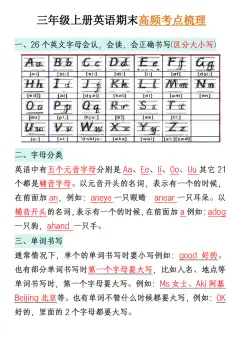
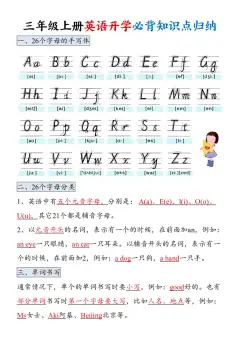
1、字母
(大小)辨认、书写顺序:AaBbCcDdEeFfGgHhIiJjKkLlMmNn
OoPpQqRrSsTtUuVvWwXxYyZz.
元音字母:Aa,Ee,Ii,Oo,Uu
半元音字母:Yy
书写容易错误的字母:E,F,G,M,N,d,i,p,q,x,y.
2、数字
基数词和序数词的运用,如计算、购物等.
基数词:One,two,three,five,six,seven,eight,nine,ten,eleven,twelve,thirteen,fourteen,fifteen…
twenty,twenty-one…thirty,forty,fifty…eighty,ninety,one/ahundred,one/ahundredandone…two
hundred.
序数词:first,second,third,fourth,fifth,sixth,seventh,eighth,ninth,tenth,eleventh,twelfth…
twentieth,twenty-first,twenty-second,twenty-third,twenty-four…thirtieth,fortieth,fiftieth…eightieth,
ninetieth…
相关句型:
1)What’sthirtyandforty?Thatcomestoseventy.
2)What ’syourteleph onenumber? M ytelephone numberis83555723.
3)Whattimeisit?It’s halfpastten.
4)Whendoyouusuallygetup? Atsixthirty-five.
5)Whered oyoulive? IliveatNo.48RenminRoad.
6)Howoldareyou? I’mtwelve.7) How much does it cost? It costs 50 yuan.
8) How many cars have you got? I have got 6 cars.
9) How many birds can you see in the tree? I can see 3.
10) How many dolls are there on the bed? There is one/a doll.
11) How many dolls are there on the bed? There are four dolls.
12) Which floor do you live on? I live on the fifth floor.
13) Excuse me, can you tell me the way to Baiyun hotel?
Yes, go down this street, then turn left at the third crossing….
14) Who’s the fifth girl from the right? She’s my cousin.
注意: 数词的应用; 不可数名词及它的量的表示方法;many与much在用法
上的区别;there is/are与have/has在用法上的区别.
3、颜色
实物的颜色
colours: red, pink(粉红), yellow, brown, grey(灰色),blue, purple(紫色), orange,
black, white, dark blue(深蓝), light blue(浅蓝).
相关句型:
1) What colour is your coat? It’s ...
2) What’s your favourite colour? My favourite colour is …
4、时间
年、季节、月、星期、日、时刻
year, season( spring, summer, autumn, winter) ,
month: January, February, March, April, May, June, July, August, September,
October, November, December.
Week: Sunday, Monday, Tuesday, Wednesday, Thursday, Friday, Saturday.
Day: 1st May (the first of May), May 2nd ( May the second)
Time: (an) hour, minute, second
10:05 (five minutes past ten, ten o five)
10:10 (ten minutes past ten, ten ten)
10:15 (quarter past ten, ten fifteen)
10:30 (half past ten, ten thirty)
10:45 (quarter to eleven, ten forty-five)
11:00 (eleven o’clock)
相关句型:
1) How old is your mother? She’s thirty-six years old.
2) How many months are there in a year? There are 12.3) When’s your birthday? My birthday is on 15th January ( the fifteenth of January).
4) When do you get up? I get up at six o’clock.
5) When does spring last? It lasts for 3 months from March to May.
6) What time is it? It’s quarter to nine.
5、食品与饮料
人对食品与饮料的喜好;东西方食品
food : meat, rice, fish, bread, egg…
drinks : water, milk ,orange juice ,coke, coffee…
相关句型:
1) Would you like something to drink/eat? Yes, I’d like some…No, thanks .
2) Would you like to eat/drink…? I’d like to eat/drink…No, thanks .
3) What’s your favourite food/drinks? My favourite food/drink is …
4) Could I have some…? Yes, please .
6、服装
服装的颜色:人对服装的喜好;某人的穿戴; 所属关系
clothes: hat, cap, coat, shirt , T-shirt, skirt, dress, sweater, jacket, trousers, sock, shoe
put on, wear
所属关系: 形容词性的物主代词:my, your, his, her, its, our, their
名词性的物主代词: mine, yours, his, hers, its, ours, theirs
相关句型:
1) What does it look like? It likes wearing a blue shirt.
2) Whose shoes are these? They’re mine. They’re Tom’s .
3) Is this /that/it your book? Yes, it is. No, it isn’t.
4) Is this pencil yours? Yes, it is. No, it isn’t.
5) Are these /those/they your coats and trousers? Yes, they are. No, they aren’t.
6) Are those clothes theirs? Yes, they are. No, they aren’t.
7) This is my hat. That hat is his.
注意:
名词单,复数;物主代词(名词性的物主代词,形容词性的物主代词);名词所有格,如:Tom’s ,
my father’s , the teachers’.
7、玩具和文具
特点、颜色、所属关系;存在的位置
Toys: doll, toy…文具: desk, book, bag ,pen, pencil, pencil-box, ruler, chair, ball
存在的位置 : in, on, under, beside, behind, in front of, in the front of , in the middle of, at the back of…(a
place/a person).
相关句型:
1) There is a cup of tea on the table.
2) There are some oranges in the fridge.
3) Is there any milk in the glass? Yes, there is. No, there isn’t.
4) Are there any oranges in the fridges? Yes, there are. No, there aren’t.
5) What’s under the desk? There is an oranges . / There are some oranges.
8、日常生活用品
特点、颜色、所属关系;存在的位置
words: shelf, table, clock, brush, telephone, light, computer, bike, fridge, glass, knife,
keyboard, bottle, box, plate, photo, photograph, fax, radio, super-market,
特点: big, small, heavy, light, white, black, empty, full, old, new, beautiful, cute, tall, short, strong, plump,
nice, good, bad…
9、动物
家畜、家禽;农场动物、动物园及野生动物的特点;生活地点和所属关系
words(animals): cat, dog, duck, goose (geese) fish, sheep, bird, panda, monkey, rabbit, hen , cock, chick,
tiger, lion, pig, cow , mouse (mice)
生活地点:at home, in a farm, in a zoo …
所属关系:同上话题(7)
10、植物
特点、所属关系;存在的位置
words: tree, rose, flower, leave (leaves) …
11、环境与建筑
特点、所属关系;存在的位置
buildings: factory, hospital, park, house, library, museum, office, farm, post office, bank, police station,
train station, sports stadium, department store, store, school, classroom, house: bathroom,
living-room, sitting-room, bedroom, kitchen, garden…
房子的基本构造: door, gate, wall, window, floor…相关句型:
1) Where do you study at ? I study at Longdong Primary School.
2) Where does your mother work at ? She works at a hospital.
3) Let’s meet at the gate of the park.
4) My brother is playing in the garden.
12、身体
特点
body: head, hair, eye, nose, ear, mouth, neck, shoulder, hand, finger,foot(feet) ,toe…
外貌: fat, thin, plump , tall, short, old, young, round face, two big blue eyes, long
hair, short hair, black hair ,white hair…
相关句型:
1) I’m /You’re /He’s/She’s /We’re /They’re (not) tall.
2) Is he/she tall or short? He’s /She’s tall (short).
3) I/We/They/You have (got) black hair.
4) He/She has ( got ) a round face.
5) Has he/she got long hair ? Yes, he/she has.No, he/she hasn’t.
注意:描述人的外貌时,have与has用法上的区别; 形容词的用法,如 :tall, short, old, young, black ,
long…
13、个人情况
姓名、年龄、地址、特点与爱好
age, year, address, e-mail address, hobby,
hobby: collecting stamps(coins) , going swimming… doing sth
相关句型:
1) How old are you ? I’m thirteen years old.
2) I’m a thirteen-year old boy.
3) What’s your address? I live at No.48 Renmin road.
4) What’s your e-mail address? My e-mail address is 123VIP@126.com.
5) What’s your hobby? My hobby is going running. Or : I like going running.
6) I /You/ They like music.
7) He likes sightseeing.
8) Do you like reading? Yes, I do. No, I don’t.
9) Does he /she like playing basketball? Yes, he/she does. No, he/she doesn’t.
注意: 描述个人的喜好时:名词和动词- ing 形式作宾语;
主语是第三人称单数时一般现在时动词的变化。
动词ing的变化规律:1)直接加ing ,如: open-opening, clean-cleaning, meet-meeting, sing-singing, study-studying, …
2)去掉词尾不发音的e ,如:take-taking, close-closing, come-coming, drive-driving, have-having, use-
using, write-writing, practice-practicing, …
3)重读闭音节的,双写最后的字母,加 ing , 如: sit-sitting, put-putting, begin-beginning , get-getting,
swim-swimming, run-running, cut-cutting, become-becoming, …
主语是第三人称单数时一般现在时动词的变化规律(与名词变复数规律相同):
1) 直接加s, 如:cook-cooks, come-comes, close-closes,…
2)以o, x, s, sh, ch 结尾+es , 如: teach-teaches, go-goes, do-does, catch-catches, wash-washes, brush-
brushes, miss-misses, …
3)辅音字母加y结尾,把y改为i ,+es, 如:fly-flies, worry-worries, carry-carries, …
4)以f或fe结尾,把f或fe,改为v+es.
5)特殊:have-has, …
14、家庭、亲属和朋友
姓名、年龄、地址、特点与爱好:与你的关系
words: family, grandfather(grandpa/granddad), grandmother(grandma/grand mum), father, mother,
brother, sister, uncle, aunt, cousin, friend
相关句型:
1) Is he/she Tom’s cousin? Yes, he/she is.No, he/she isn’t.
2) Who’s he/she? He’s/She’s my friend.
3) How many people are there in your family? Who are they?
There are four, my father, my mother, my brother and me.
注意: 1)名词单复数,如:family-families;
名词单数--复数规律:
1)直接加s, 如: boy-boys, term-terms,
2) 以o, x, s, sh, ch 结尾+es , 如: box-boxes, class-classes, glass-glasses, coach-coaches, dress-dresses, fax-
faxes, inch-inches, match-matches,
3) 辅音字母加y结尾,把y改为i ,+es, 如:baby-babies, lady-ladies, factory-factories, peach-
peaches, library-libraries, watch-watches ,4) 以f或fe结尾,把f或fe,改为v+es: leaf-leaves, knife-knives, wife-wives, shelf-shelves, …
5) 特殊: man-men, policeman-policemen, woman-women, child-children, goose-geese, tooth-teeth,
foot-feet,
6) 不变: hair, milk, tea, coffee, water, bread, rice, paper, juice, meat, people, fish, sheep, …
2) 名词所有格,表明是“谁的” 如: my cousin’s , his parents’
它的构成规则: 单数名词后+“ ’s”, Mike’s mother.
复数名词词尾有,其后只+“ ’”,Teachers’ Da教师节.
若是两人共有时,只在后者+ “’s ”,
Jim and Tom’s mother.吉姆和汤姆的母亲。
不是两者所共有的,两者都+ “ ’s ”,
Jim’s and Tom’s mother.吉姆母亲和汤姆的母亲。
名词若是无生命,所有格构成用of,
a map of China.一幅中国地图
15、学校
学校建筑和学校生活
words: school building, classroom, dormitory, playground, library…
subjects: Chinese, maths , English, music, computer, PE, art, biology, politics , history, meeting,
geography…
相关句型:
1) What’s your favourite subject? English.
2) Where’s the library? It’s behind the dormitory.
3) When do you go to school? At 7:20.
4) When does Chinese begin on Monday? At Eight o’clock.
5) Does geography begin at twenty to ten on Monday?Yes, it does. No, it doesn’t.
6) We’re having an English class.
16、社交礼仪
礼貌用语;询问与应答
1.Greetings: Hello! Hi! Good morning/afternoon/evening.How are you ? Fine, thanks. And you?
Please say hello to your parents for me.
2. Introduction: My name is … I’m a pupil. I’m new here.
This is Mr/Mrs/Miss White.
Hello, nice to meet you .
3. Farewells: Goodbye/Bye-bye/Bye.
See you then/tomorrow.
Good night.
It’s late. I must go home now.
Thanking for coming.
4. Thanks: Thank you (very much).You’re welcome.Not at all.
5. apologies: Sorry. I’m sorry. That’s all right. Excuse me.
6. Incitation: Will you go shopping with me?
Would you like to go ? I’d love to . Thank you.
7. Asking for permission: May I have an apple ?
Could /Can I use your bike? Sure. Certainly. Yes, of course. Yes, do please.
8. Expressing wishes: Happy birthday! Thank you.
9. Offering help: Can I help you? What can I do for you?
10. Making appointments: Are you free tomorrow? What about tomorrow afternoon?
Let’s meet at the gate at 7:50.
Shall we visit the museum?
11. Hello! May I speak to Kate? Speaking/It’s Kate here.Who’s this/that, please ?
12. Taking meals: Would you like something to eat/drink?
Would you like some fish/meat?
13. Shopping : Can I help you ,sir?
What can I do for you, sir ?
What about this one?
Do you like this one?
I want /I’d like some oranges.
How much is the shirt /are the socks?
It’s to small. Two kilos, please .
I’ll take it.
14. Asking the way: Excuse me. Where is the Guangzhou Library?
Can you tell you me the way to the Garden Hotel, please?
Can I take this bus to Beijing Road?
Is there a hotel near here? It’s over there. Turn right/left
17、国家与城市
地理位置;特点
Countries: China, Japan, America (the USA), English( the UK), Australia, Russia, Canada, Italy, India, France,
Nationalities: Chinese, Japanese, American, Englishman, Australian, Russian, Canadian, Italian, Indian,
French,
相关句型:
1) Where’s Japan? It’s to the east of China.2) Where does your friend come from? She comes from English.
3) Where are they from? They’re from Russia.
4) What country do you from? I come from China.
5) What country is he from? He’s from France.
6) What language does she speak? She speaks French.
7) What language do they speak? They speak Chinese.
18、天气
气候特征
weather : hot, cold, cool, warm, sun, shine, sunny, rain ,heavy rain, light rain, rainy, wind, strong wind,
windy, snow , heavy snow, light snow snowy, cloud, cloudy…
temperature: 15 ( fifteen degrees centigrade), 0 (zero degree centigrade), -5 (minus degrees centigrade)…
相关句型:
1) What’s the weather like in spring? It’s warm, rainy and wet.
2) What will the weather be like there? It will be sunny.
3) Is it snowing? Yes, it is a snowy day.
4) Will there be cloudy? Yes, there will.
5) The sun is shining.
6) I like taking a warm bath.
19、节日
节日的特点;节日的活动
festivals : New Year’s Day, Spring Festival, Women’s Day, April foolish Day, May Day, Mother’s Day,
Children’s Day, Father’s Day, Party’s Day, Army’s Day, Mid-autumn Festival, Teachers’ Day , National Day,
Thanks Giving Day, Christmas Day.
New Year’s Day: 1st January.
Spring Festival: It’s the Chinese New Year. It’s the first day of the Chinese year. It’s a very special festival for
all Chinese people. It is usually at the end of January or the beginning of February /in late January or early
February. The children can get “lucky money”.
Women’s Day: It’s on 8th March.
April Foolish Day: on 1st April, on this day, people can play jokes to their friends.
May Day: 1st May, laborers’ day.
Mother’s Day: on the second Sunday of May.
Children’s Day: on June 1st.
Father’s Day: on the third Sunday in June.
Party’s birthday: in China, it’s on 1st July.
Army’s Day: in China, it’s on 1st August.
Mid-autumn Festival: on 15th August of Chinese lunar calendar. In China , people eat special cakes calls
moon cakes and watch the full moon.
Teachers’ Day: on 10th September.
National Day: in China, it’s at the beginning of October.
Thanks Giving Day: the last Thursday in November, it’s American festival.Christmas Day: December 25th.
20、方位
人或物的位置;问路与应答
place : in, on ,at, under, near, next to, beside, behind, in front of , in the front of , in the middle (of ), back,
on the right/left, the second/…person from the right/left
A: Excuse me. Where’s the department store?
Can you tell me the way to the Garden Hotel, Please?
Can I take this bus to Beijing Road?
Is there a hotel near here?
B: It’s over there.
Turn right /left at the first crossing. The hotel is on the right/left.
I’m sorry, I don’t know.
21、正在发生的事情
现在进行的动作和发生的事 be doing something
1) I’m/You’re/He’s /She’s /We’re/They’re (not) working.
2) Are you playing football? Yes, I am/we are.
3) Is he/she taking exercise? Yes, he/she is. No, he/she isn’t.
4) Are they going shopping? Yes, they are. No, they aren’t.
5) What are you doing? I’m/We’re cleaning the room.
6) What’s he/she doing? He’s/She’s having supper.
7) What are they doing? They’re reading.
22、日常生活
日常生活、工作、学习的活动 daily routine
get up brush one’s teeth, wash one’s face, make breakfast , have breakfast, go to school/work, do morning
exercises, have classes, play basketball, play football, run ,jump, go home, have lunch, have supper, do
one’s homework, watch TV, do some reading, take a bath, go to bed
1) What time do you get up? I usually get up at 6 o’clock.
2) Shen Zhen often takes a bath at 9 o’clock in the morning.
3) My mother is never late for work.
23、计划与打算
计划和将要进行的动作和发生的事 be going to do …
1) I’m/You’re /He’s/She’s /We’re/They’re (not) going to visit the museum.
2) Are you going to swim? Yes, I am/we are. No, I’m not/we aren’t.3) Is he/she going to see Miss Wang? Yes, he/she is. No, he/she isn’t.
4) What are you going to do tomorrow? I’m /We’re going to visit the farm.
5) I/You/He/She/They/We will go skiing.
6) Are you going to be busy tomorrow? Yes, I am/we are.
7) go swimming, go shopping, go climbing, go skiing, go walking, go running, go fishing, go skating, go
sightseeing,…
24、能力和可能
可能进行的动作和发生的事
1)I/You/He/She/We/They can(can’t) come here tomorrow.
2)Can he/she visit the factory today? Yes, he/she can. No, he/she can’t.
3)Can they go by bus? Yes, they can. No, they can’t.
4)May I visit the factory this afternoon? Yes, of course /Sure/Certainly.
5)May I sit here? Yes, of course/please do.
注意: 情态动词can的用法, can do (+动词原形).
小学英语语法大全
第一章 名 词
一、定义
名词是表示人或事物名称的词。它既可以表示具体的东西,也可以是表示抽象的东西。
二、分类
1. 名词可以根据意义分为普通名词和专有名词
如:john is a student
student是普通名词,john是专有名词
普通名词前可以用不定冠词a/an, 定冠词the
或不加冠词,专有名词前一般不加冠词,专有名词的首字母要大写。
2.
普通名词又可以分为个体名词、集体名词、物质名词和抽象名词,其中个体名词与集体名词是可数
名词,物质名词和抽象名称是不可数名词。
3. 专有名词
专有名词是表示人名、地名、团体、机构、组织等的专有名词,多为独一无二的事物。
三、名词的数
1、名词分为可数名词和不可数名词。可数名词——可以数的名词
不可数名词——数不清(没有复数)
drink?milk tea water orange juice coke coffee porridge
food?rice bread meat fish fruit cake dumplings
2、可数名词与不定冠词a(an)连用有数数形式,不可数名词不能与不定冠词a(an)连用,没有复数形
式
many+可数名词复数
much/a little+不可数名词
some, any , a lot of (lots of) 两者都可以修饰。
3、可数名词可以直接用数词来修饰
不可数名词 数词 +量词 +of + 名词
对可数名词的数量提问用how many
对不可数名词的数量提问用 how much
4、不可数名词的量有以下两种表示方法:
1) some, much ,a little ,a lot of ,a bit of , plenty of 用等表示多少。
注意既可以与可数名词复数,又可以与不可数名词连用的有:plenty of ,some ,a lot of ,lots
of ,most of 等。
如there is much water in the bottle .瓶中有很多水。
i'll tell you much good news.我要告诉你许多好消息。
we should collect some useful information我们应该收集一些有用的消息。
2) 用单位词表示。
用a ... of 表示。
如 a cup of ( 一杯......),a bottle of (一瓶......)
a piece of ( 一张......),a pair of shoes(一双鞋)
如two cups of tea(两杯茶),five pieces of paper(五张纸)
注意单位词后的动词单复数形式往往取决于单位词的单复数形式;千、百等数词与名词加用,表示
复数时,数词仍保持单数,名词变复数。
如two hundred students(200名学生)
ten thousand trees(10000棵树)
测试点he caught a lot of
fish他抓到了许多鱼(此处为许多条鱼,fish的复数仍为fish或fishes)
=he caught a lot of fishes.
the paper is about some fresh-water
fishes.这篇论文是有关几种淡水鱼的。(此处fish表示不同种类的鱼,加复数词尾-es)
5、可数名词分为单数和复数。
名词单数就是该词本身,在其前面加a或an。
1)单数
如a desk(一张桌子)an old desk(一张旧书桌)
2)复数:要表示一个以上概念时,要用名词复数形式
规则变化
1)一般情况下加-s
如book--books(书) desk--desks(书桌)
2)以s ,x ,ch , sh结尾加-es
如box--boxes(盒子) bus--buses(公共汽车)
注意①以 th 结尾加-s, month--months
②stomach--stomachs
3)以辅音字母+结尾,变y为i再加- es。
如city--cities(城市) country--countries(国家)
注意以元音+y,直接加s。如:day--days(天),boy--boys(男孩)
4)以f或fe结尾,复数变f或 fe 为v再加-es
如knife-knives(书) , half-halves(一半)
(thief ,wife ,life ,shelf ,knife ,leaf ,self ,half ,wolf)
注意①有少数词后直接加s,如roof-roofs (屋顶)
5)以o结尾
(1)辅音字母加o结尾名词的加-es
如tomato-tomatoes(西红杮)
potato-potatoes(土豆)
(2) 元音字母加o结尾名词的加-s
如piano-pianos (钢琴), zoo-zoos(动物园)
photo-photos (照片), kangaroo-kangaroos(袋鼠)
kilo-kilos(千克)
注意zero 两种方式都可:zero-zeros或 zeroes(零)
不规则变化
1) 元音字母发变化。
如man--men(男人) , woman--women(妇女)
tooth--teeth(牙齿) , foot--feet(脚)
mouse--mice(老鼠) , policeman--policemen(警察)
policewoman--policewomen(女警察)
2) 词尾发生变化。
如child--children(小孩) , ox--oxen(公牛)
3) 单、复数形式相同。
如fish--fish(鱼) ,sheep--sheep(绵羊) ,deer--deer(鹿) ,chinese--chinese(中国人)
,yuan--yuan(元) ,jinn--jinn(斤)
注意 不说an english,要说an englishman.
①fish作鱼肉讲时不可数,没有复数。
②fishes指各种不同种类鱼或指几条鱼。
4) 形似单数,实为复数意义。
如people(人,人们)these people
(不说a people,可说a person)police(公安,警察)ten police
(不说a police,可说a policeman)
5) 由man和woman构成的合成名词,变复数将名词及man或woman都变成复数。
如a man driver-men drivers(男司机)
a woman doctor-women doctors (女医生)
6) 合成名词变为复数时,通常只将里面所含的主体名词变为复数。
如passer-by-passers-by(过路人)
bus driver-bus drivers(汽车司机)
注意如果没有主体名词,就在最后一词上加-s。如:
grown-up-grown-ups(成年人)
letter-box-letter-boxes (信箱)
注意①hair和fruit通常作单数,表示总体。若表示若干根头发或若干种水果,则需用这两个词的复
数形式。
如would you like some more fruit? 你要不要再吃点水果?
we bought a lot of fruit from the market. 我们从市场上买了许多水果,
china has some good frits. 中国有一些好的水果。(指种类)
she has a few white hairs. 她有几要白头发。
his black hair is going white. 他的黑发逐渐变成灰白色。
注意②wind ,snow和rain这类词,有时也可以有复数形式,表示多次的风、雪或雨。
注意以boy 和girl开头的复合名词变成复数时,一般只把后一名词变成复数。
如 boy student-boy students(男学生)
girlfriend--girlfriends(女朋友)
7) 有些名词只有作复数。
如scissors(剪刀)a pair of
scissors(一把剪刀)trousers(裤子)shorts(短裤)jeans(工装裤)compasses(两脚规)scales(天平)s
unglasses(太阳镜)surroundings(环境)savings(储蓄)writings(作品)
名词+man(woman)构成的复合名词,其复数形式通常与简单名词一样,即把man(woman)改成men(wome
n)。
如englishman--englishmen(英国人)
frenchwoman--frenchwomen(法国妇女)
注意german不是复合词,它的复数是germans。
四、名词的所有格
有些名词的可以加来表示所有关系,带这种词尾的名词的形式称为该名词的所有格。
如mary's father(玛丽的父亲)
jim's mother(吉姆的母亲)
与所有格相对来看,不带这种词尾的形式就称为普通格。
1.名词所有格的构成法
1)单数名词词尾加's复数名词词尾如没有s,也要加's。
如tom's knife(汤姆的小刀)
children's books(儿童书籍)
2)表示几个人共有一样东西,只需在最后一个人名字后加,如果表示各自所有,则需在各个名字后加。
如jim and mike's room吉姆和麦克(共用)的房间
jim's and mike's rooms吉姆和麦克(各自)的房间
3)若名词已有复数词尾-s,只加"'"即可。
如the students' reading-room(学生阅览室)
everyone needs to have at least eight hours' sleep a night.
每个人每晚需要至少8小时的睡眠。(新目标英语九年级)
注意①所有格的读音和名词复数的读音一样。
②名词所有格主要用于表示有生命东西(特别是人或高级动物)的名词。
如this is a woman's work. 这是女人干的工作。
this is a girls' school. 这是一所女子学校。
4)以-s结尾的专有名词,构成所有格仍然加's,或只加',但读音都是/iz/。
如 mr jones's(mr jones')book(琼斯先生的书)
keats' works(济慈的作品)
(1)表示时间和距离的名词。
如where is today's newspaper? 今天的报纸在哪儿?
an hour's walk isn't far. 一小时的路程不远。
(1)
有些无生命东西的名词,如国家,城市季节,太阳,月亮,大地,江河,海洋,船等名词也可用's
,表示所有关系。
如china's population(中国人口)
the city's life(城市生活)
注意在表示店铺或某人家时,为避免重复(因前面已提到),名词所有格后面可省略它所修饰的名词
。
my uncle's(我叔叔家) ,the doctor's(医生的诊所)
2.短语所有格
有生命的名词,我们用's结构来表示所有关系,如果是无生命的,我们就要用"名词+of+名词"的结
构来表示。
the window of the house(这间房子的窗户)
注意当's所有格用来表示事物类别或属性时不可用of所有格。如:男式鞋应是men's,而不是shoes
of men。
3.of +名词所有格
of +名词所有称为双重所有格,使用时要注意以下几项。
1)表示部分时,前面的词一定要有a ,an ,some ,any ,few ,two ,no ,several
(几个)之类有修饰语,不能是one和the 。
如可说:a book of my brother's 我兄弟的一本书
不说:books of my brother's或 book of my brother's .
2)当带有感情色彩时,可用the ,this ,that ,these ,those于名词前。
如the pretty daughter of your sister's 你姐姐的漂亮的女儿
did you read that book of lu xun's ? 你读过鲁迅的那本书吗?
3)of 前面的名词不能是专有名词。
如不说:this is john of his uncle's.4)of 后面的名词必须是特定的。
如these books of my friend's are good 我朋友的这些书很好。
5)of 后面的名词必须是指人的名词。
比较不说it is a leaf of the tree's.
a picture of my father指的是爸爸本人的照片。
注意of 所有格和双重所有格有时可以交替使用,意义无甚区别。
如a friend of my brother→a friend of my brother's
测试点a car of betty's cars ,不可换为a car of betty.。jim's and tom's fathers are in
the same office now.吉姆的父亲的汤姆父亲目前在同一办公室。
常用口诀
表示民族的名词顺口溜
(1)“中、日、瑞”友好是一致。
(2)“英、法”联盟a变e。
(3)其他一律加s
即chinese,japanese单复数同形;englishman,frenchman的复数为englishmen,frenchmen;其他
像german,american,australian等的复数形式是在后面加“s”。
o结尾的名词顺口溜
1)有生命的以o结尾的名词变复数时,词尾加es,凡无生命的以o结尾的名词变复数时,词尾加s。
有生命:potato-potatoes, tomato-tomatoes, hero-heroes, negro--negroes
如无生命:zoo-zoos, radio-radios, photo-photos, piano-pianos, zero-zeros,
bamboo(竹竿)--bamboos, tobacco(烟丝)--tobaccos1)
2)两人两菜一火山。(+es)
小学—
中学课本中以o结尾的名词构成复数时,加es的只有negro(黑人),hero(英雄),potato(土豆
),tomato(西红杮),volcano(火山),这就是“两人两菜一火山”。
或:黑人和英雄吃土豆和西红柿egroes and heroes eat tomatoes and potatoes)
2)其余以o结尾的名词变复数时均加s。
图景:你在“zoo”里,看见一要“bamboo”,上面挂着一张“photo”,所照的是一架“piano”,
上面放着一台“radio”。
zoo-zoos , bamboo-bamboos,photo-photos piano-pianos, radio-radios.
f、fe结尾的顺口溜
(1)以f(e)结尾的名词变为复数时,有的把f(e)改为v(e)再加s,其他的以“f(e)”结尾的名词则
直接加“s”。
妻子持刀去宰狼,小偷吓得发了慌;
躲在架后保己命,半片树叶遮目光。
wife(妻子),knife(刀子),wolf(狼)thief(小偷),shelf(架子),life(生命)leaf(
树叶),self(自己),half(一半),这9个名词变复数时,都要改“f(e)”为“ve”再加“s”。
(2)以f结尾的名词,一般把把f改为ves,但也有特殊情况是直接加-s的,
如gulf, roof, chief, serf, belief, proof, handkerchief。编成口诀联想:
海湾边、屋顶上,首领农仆相望;
谁说他们无信仰,语气定在手帕上
巧记不规则名词单变复
男女脚步牙鹅,老鼠加虱婆。
man-men; woman-women; foot-feet; tooth-teeth; goose-geese; mouse-mice; louse-lice.
第二章 冠 词
一、定义
冠词是一种虚词,本身不能单独使用,也没有词义,它用在名词的前面(相当于名词的帽子),帮助
指明名词的含义。
二、分类
共3类:定冠词(the definite article),不定冠词(the indefinite article)、零冠词(zero
article)。
三、用法
1、定冠词的用法
a 、an与数词one 同源,是"一个"的意思。a用于辅音音素前,而an则用于元音音素前。
(1)
表示某一类人或某事物中的任何一个,经常用在第一次提到某人或某物时,用不定冠词起介绍作用,
表示一个。
i gave him a book yesterday .我昨天给了他一本书
i am reading an interesting story . 我在读一则有趣的故事。
(2) 表示人或事物的某一种类, 强调整体, 即以其中的一个代表一类。
a horse is useful to mankind. 马对人类有用。
(3) 不定冠词用在事物的"单位"前,如时间, 速度, 价格等意义的名词之前,表示 "每一"。
we often go to school two times a day. 我们常常一天两次去学校。
i went to the library once a week at least.
(4) 不定冠词用来指某人某物,但不具体说明任何人或任何物。
a boy came to see you a moment ago. 刚才有一个小孩来找你。
(5)在序数词前表示"又一;再一"时。如:
i want to read the story a second time 我想再读一遍这篇小说 。
(6) 表示不特定的"某一个"时。如:
a mr. smith is calling on the phone. 有一位史密斯先生来电话找你 。
(7)在特定的短语里表示特定的含义,与不可数名词连用,如:
have a good time 过得高兴
(8) 一日三餐前有修饰语时。如:
-mum, what shall we have for lunch?-jiaozi.
-oh, what a wonderful lunch! i enjoy it very much.
(9) 在形容词最高级前表示"非常"时。如:
lesson nine is a most difficult lesson, but it isn't the most difficult one.
(10)不定冠词用于某些词组中。
a little / a few / a lot / a type of / a pile / a great many / many a / as a rule / in
a hurry / in a minute / in a word / in a short while / after a while / have a cold /
have a try / keep an eye on / all of a sudden
2.定冠词的用法
定冠词the与指示代词this,that,these,those同源,有"那(这)个"
"这(那)些"的意思,但较弱,可以和一个名词连用,来表示某个或某些特定的人或东西。以下为
必须加定冠词的情形:
(1)在表示双方都明白的人或物的名词之前:
take the medicine. 把药吃了。
(2)在上文提到过的人或事的名称之前:
he bought a house. i've been to the house.
他买了幢房子。我去过那幢房子。
(3)在指世上独一无二的事物的名词之前:
the sun, the sky, the moon, the earth
(4)与单数名词连用表示一类事物,如:
the fox is cunning .狐狸是狡猾的。
(5)与形容词或分词连用,表示一类人:the rich 富人; the living 生者。
(6)用在序数词和形容词最高级,及形容词only, very, same等前面:
where do you live? i live on the second floor. 你住在哪?我住在二层。
that's the very thing that ineed 那正是我需要的东西。
(7)在表示"...世纪...年代"的结构之前
he began to learn russian in the 1950s. 他在20实际50年代开始学俄语 。
但注意:in one's 50s意为"在某人五十多岁时"。如:
he looked quite healthy though he was in his 80s.
(8)在比较级的两种句型中: ①表示"越 ......,就越......"时。如:
the lighter, the better. 越轻越好 。
② 表示"两者中比较......"时,用定冠词。如:
there are two books on the table. i like the thicker one.
(9)用在"动词+sb.+介词+the+身体部位名称"的结构中(注意:介词常用in/on/by)。如:
the ball hit me on the back. 球打中了他的头 。
(10) 在表示"计量单位"的可数名词前(注意:介词用by)。如:
the workers are paid by the hour/day/month. 按月付给工人工资 .
(11)用在某些由普通名词构成的专有名词前:the great wall(长城),the people's
park(人民公园)等。
the people's republic of china 中华人民共和国
the united states 美国(12)用在表示乐器的名词之前:
she plays the piano. 她会弹钢琴.
the little girl likes to play the violin. 小女孩喜欢拉小提琴。
(13)定冠词用在文艺活动,运动场所的名称前。
they are going to the cinema tonight. 他们今晚要去影院看电影。
(14)用在姓氏的复数名词之前,表示一家人:
the greens 格林一家人 (或格林夫妇)
(15)在方位名词之前 ,如:in the west on the west
(16)在某些短语中 in the day, in the morning (afternoon,evening), the day after
tomorrow ,the day before yesterday, the next morning, in the sky
(water,field,country) in the dark, in the rain, in the distance, in the middle
(of), in the end, on the whole, by the way, go to the theatre
3、零冠词(不用定冠词)
(1) 在物质名词前,如:
water is very important . 水是非常重要的 。
(2) 在抽象名词前,如:
failure is the mother of success. 失败乃成功之母。
(3) 复数名词表示人或物的种类时,如:
doctors cure patients. 医生治病救人 .
those people are teachers, not students. 这些人是老师,不是学生 .
(4) 在有关游戏的名词前,如:
do you like to play chess? 你喜欢下棋吗 ?
(5) 在"by + 交通工具"的短语里,如:
shall we walk or go by bus? 我们乘车还是步行 ?
(6) 在国名,人名和地名前通常不用定冠词,如 :
england,mary;
(7)在年份、季节、月份、节日、 假日、日期、星期等表示时间的名词之前,不加冠词;
we go to school from monday to friday. 我们从星期一到星期五都上课。
(8)在称呼或表示官衔,职位的名词前不加冠词;
the guards took the american to general lee.
士兵们把这个美国人送到李将军那里。
(9)在三餐、球类运动的名称前,不加冠词 。如:
have breakfast,play chess
(10) 在某些固定词组中,是否有冠词,意义不同。如:
in hospital住院,in the hospital在医院里 in bed在卧床 ,in the bed在床上
in front of在......(外)前面,in the front of 在......(内)前部
go to hospital 去医院看病 go to the hospital 去医院
(并不是去看病,而是有其他目的)
口 诀泛指用a/ an,单数可数;特指用the,不特不the。
释:1)泛指用a/ an,单数可数——泛指的单数可数名词前要用a/ an。2)特指用the——
如果是特指,那么无论是可数名词单数、复数或不可数名词前均要用the。3)不特不the——
不特指则不用the,包括泛指的可数名词单数前用a/
an,泛指的可数名词复数前不用冠词,泛指的不可数名词前也不用冠词三种情况。
定冠词:特指双熟悉,上文已提及,世上独一无二,序数最高级,某些专有名,习语及乐器。
(1)the用在“特指”谈话双方都知道的某个人或某些人或物前。如:
where is the teacher?
老师在哪里?
(2)the用在上文已提到的人或事物前。如:
i can see a cat. the cat is lucy”s.
我能看见一只猫,那只猫是露茜的。
(3)the用在世界上独一无二的事物前。如:
the earth goes around the sun.
地球围绕着太阳转。
(4)the用在序数词或形容词最高级前。如:
mike is the tallest of the three boys.
迈克是三个男孩中最高的一个。
(5)the用在由普通名词构成的专有名词前。如:the great wall(长城),the people”s
park(人民公园 )等。
(6)the用在一些习惯用语中或乐器名词前。如:in the day(在白天),play the
piano(弹钢琴)等。
不用冠词:代词限定名词前,专有名词不可数,复数名词表泛指,学科球类三餐饭,季节星期月份
前,颜色语种和国名,称呼习语及头衔。
(1)名词前已有作定语用的this, that, these, those, my, your, his, her, our, their,
some等限定词时,不用冠词。如:this eraser, her pencil-box, some boxes, those women等。
(2)泛指的不可数名词前一般不用冠词。如:meat, rice, water, bread, tea, milk, juice等。
(3)复数名词表示泛指时,不用冠词。如:
the people in the room are doctors.
房间里的那些人是医生。
(4)在表示学科的名词前一般不用冠词。如:chinese, english, maths, physics,
history等。在三餐饭和球类运动名词前一般不加冠词。如:have breakfast/ lunch/ supper,
play basketball/ football等。
(5)在季节、节日、星期、月份前不用冠词。如:autumn, summer, winter, spring, teacher”s
day, children”s day, sunday, february等。
(6)在表颜色、语种和国家名词前不用冠词。如:white, brown, french, australia等。
(7)在表示称呼语的名词之前,以及职务、头衔的名词前不用冠词。如:doctor green is a scientist.
格林博士是位科学家。
有水无湖、有球无星、有山无峰、有独无欧(二)、有(足)族无球(运动)、有文无章、学而不
专:
1)有水无湖:海、洋、海湾、河等,都用the;单个湖不用the,(但多个湖用the);
the red sea,the pacific ocean,the persian gulf, the yangtze river
the great lakes(五大湖);lake erie(伊利湖)
2)有球无星:地球,月亮用the;行星不用the: mars,venus;
3)有山无峰:the huangshan mountains(黄山);mount everest(珠穆朗玛峰);
mount(or mt.) tai(泰山).
4)有独无欧(偶):独一无二的,the earth,the moon,the sun用the;
欧洲等七大洲不用the.
europe,africa,asia,north america,south america,antarctica,oceania
5)有(足)族无球(运动):种族用the:the indians(印第安人);球类运动
baseball,basketball
6)有文无章:历史性的文件用the;小说等的章节不用the
the constitution(宪法); chapter one
7)学而不专:学校放在词组的前面时用the;专有名词放在词组的前面时不用the;
the university of fudan; fudan university
第三章 介词
一、定义
介词preposition缩写prep.,又叫前置词,表示其后的名词或代词(或是相当于名词的其他短语或
从句)与其他句子成分的关系。介词是一种虚词,不能单独在句中作成分。
二、介词的用法
1、表示时间的(at 、on、in、at、before ,after、by、
until、through、from、since、within)
(1)at:用于表示时刻,时间的某一点。
at noon在午时 at night在夜间 at present目前
(2)on:用于星期,某天,某一天的上午、下午、晚上(指具体的某一天时,一律用)
on sunday在星期天 on sunday morning 在星期天的上午
on march 8 在3月8日
(3)in:用于表示周、月、季节、年、泛指上午、下午、晚上。
in 1999 在1999年 in november 在11月份
in summer 在夏季 in the afternoon在下午
过……后(未来时间)i think he will be back in an hour .我想他一小时后就会回来。
i heard that she would be back in a month.我听说她一个月后回来的。
(4)before:在……之前
wei hua got up before 7 o’clock this morning .今天早晨,魏华在7点之前起床了。
(5)after:在……之后
after that ,no noe should ever kill a seagull . 从那时起,任何人不得捕杀海鸥。
(6)by:在……前(时间),截止(到)……
by the time i arrived ,she had already gone .
在我到达之前,她已经走了。
(7)for:达……之久(表示过了多少时间),可以和一般现在时,过去时,将来时连用,但是经常和完
成时连用。
florence often worked for twenty-four hours without rest .
弗洛沦斯常常工作24小时而不休息。
(8)during:在……期间
during the lifetime of one man ,north america and europe will more further apart by
nearly two metres .
在一个人的一生期间,北美洲和欧洲由于漂移,其间的距离将要增加差不多两米。
(9)through:一直……(从开始到结束)
he ,who led the united states through these years ,was shot on april 14, 1865 ,at
a theater in washington
领导美国度过了这些年代的他,于1865年4月14日在美国华盛顿一家戏院里被人枪杀。
(10)from:从……起(时间)
the worders were made to work from 7 in the morning to 7 in the evening
.工人们被迫从早7点工作到晚7点。
(11)since:自从……以来(表示从以前某时一直到现在仍在继续)
since that time ,my eyes had never been very good.从那时起,我的眼睛一直不是很好。
(12)within:不……超过的范围
he will arrive within an hour .他一小时内就人到。
2、表示地点(at、in、on
、under、over、above、below、near、by、between、among、around、around、in front
of、behind、in 、into、out of、along、across、,through、
to、for、from)(1) at:在某地点(表示比较狭窄的场所)
at school上学 at home在家 at 320 xinfu district 在新抚区320号
at the station 在火车站
(2)in:在某地(表示比较宽敞的场所)
she will arrive in shanghai at ten .10点她将到达上海。
(3)表示地点方向的on ,under ,over ,above ,below
①on:在……上面,有接触面
on the table 在桌子上面
②above:在……上方
sometimes juliana could hear planes above the trees.
有时朱莉安娜能听到树林上空的飞机声。
③over:在……正上方,是under的反义词
over these tombs ,they built pyramids .在这些坟墓上,他们建起了金字塔。
④under:在……下面,在……之内
the twin sisters put the basket under the tree .这姐俩把篮子放到了树下。
⑤below:在……下方,(不一定是正下方)
three thousand metres below her ,she could see nothing except the thick jungle .
3000米以下,除了茂密的丛林之外,她什么也看不见。
(4)near ,by
①near:近的,不远的(=not far)是的反义词,near还可以指时间,in the near
future在不远的将来。
green’s lake was a small lake near his home .格林湖是他家附近的一个小湖。
②by:在……旁边,比的距离要近
juliana walked by the side of the river for six more long days .
朱莉安娜沿着河岸又走了足足6天。
(5)between ,among ,around
①between:在两者之间
the differences between american english and british english are not very great
.美国英语和英国英语之间的差别不是很大。
②among:在三者或者更多的之中
there are some american students among us .在我们中间有几个美国学校。
③around:环绕,在…..的周围,在……的四周
they arrived at a valley with high mountains all around it .
他们到达了四周有高山环绕的山谷
(6)in front of ,behind
①in front of :在……的前面
there is a car in front of the house .房子前面有一辆小汽车。②behind :在…..后边
are there any cows behind the house ?房子后面有一些牛吗?
(7)in ,into ,out of
①in:在…..之内,用于表示静止的位置
there are four girls in the room.房间里有4个女孩。
②into:进入,用于表示有特定终点的运动方向,通常用于表示动作的动作之后。如:come ,go ,walk
,jump ,run..
she took me from the hall into my classroom .她把我从门厅带进我的教室里边去。
(8)along ,across ,through
①along:沿着
go along zhongshan road and turn right at the second crossing .
沿着中山路走然后在第二个十这路口向右拐。
②across:横过(平面物体)
very slowly,the continents are moving across the face of the world .
各个洲在地球表面缓缓漂移。
③through:贯通,通过
the students walked through the gate with uncle wang .
学生们随着王叔叔通过大门。
(9)to ,for ,from
①到达……地点(目的地)或方向
where’s jack? he has gone to london.杰克上哪了?他去伦敦了。
②for:表示目的,为了……
do you know what he comes here for ? 你知道他为什么来这儿吗?
③from:从……地点起
how far is it from london to new york? 从伦敦到纽约有多远?
3、表示手段和材料的介词用
(1)with
①和……在一起
these plates keep moving ,like great ships ,carrying the continents with them .
这些板块载着各个大陆,像航船一样不断地漂移。
②具有,带有
a person with good manners is always kind and polite.
有礼貌的人总是和和气气,彬彬有礼的。
③用某种工具或方法
he could swim with some special swimming shoes.
穿着一些特制的游泳鞋,他能游泳。
(2)in:表示用什么材料(例如:墨水,铅笔等)或用什么语言。表示衣着,声调特点时,不用with而用in。
what’s this in english. 这个用英语怎么说?
(3)by:通过……方法,手段
what do you mean by the word“island”? “island”是什么意思
i prefer traveling by train .我更喜欢乘火车旅行。
4、其他
(1) of , from
①of 属于)……的,表示…..的数量或种类
it was beginning of the term .这是学期开始的时候。
②from:来自(某地,某人),以….起始
she is a lady from canada .她是一位加拿大的女士。
(2)without ,like ,as
①without :没有,是with的反义词
she often worked for twenty-four without rest .她通常工作24小时而不休息。
②like:像……一样
like many children of her age ,ding fang is a young pioneer .
像很多同龄的孩子一样同,丁芳是个少先队员。
③as:作为
they are carrying us as passengers.它们把我们当作乘客运载着。
(3)against:反对。靠着
everyone tried to fight against the locusts .所有的人奋力扑打蝗虫。
(4) about:
① 关于,各处,四周
nightingale wrote a book about nursing .南丁格尔写了一部关于护理方面的书。
② 询问某人,某物的情况或提出建议
what about your family ? 你家里人怎么样?
口 诀
口诀1:年月周前要用in,日子前面却不行。遇到几号要用on,上午下午又是in。要说某日上下午,
用on换in才能行。午夜黄昏用at,黎明用它也不借。
at也在时分前,说“差”用to,说“过”要用part。
口诀2: in在……里, out在……外,在旁边的是beside,靠近的为by 。 on在……上,
under在……下, above在上头, below在底下。
口诀3:this、that、tomorrow,yesterday,next、last、one。接年、月、季、星期、周,介词省略已习
惯。 over、under正上下,above、below则不然,若与数量词连用,混合使用亦无关。'
beyond超出、无、不能,against靠着,对与反。besides,except分内外,among之内along沿。
同类比较except,加for异类记心间。
口诀4:before、after表一点, ago、later表一段。 before能接完成时,ago过去极有限。
since以来during间,since时态多变换。 与之相比beside,除了last but one。
口诀5:
①早、午、晚要用in 例:in the morning 在早上 in the afternoon 在下午
in the evening 在晚上 in the day 在白天
②黎明、午、夜、点与分用at 例: at dawn, at daybreak 在黎明时候 at noon 在中午
at night 在夜间 at midnight 在午夜 at six o'clock 在6点钟
at 7:30 (seven thirty) 在7点半 at half past eleven 在11点半
at nine fifteen 在9点15分 at ten thirty a.m. 在上午10点30分
at the weekend 在周末
③年、月、年月、季节、周用in。 例;in 1986 在1986年 in 1927 在1927年 in april
在四月 in march 在三月 in december 1986 1986年12月 in july l983 1983年7月
in spring 在春季 in summer 在夏季 in autumn 在秋季 in winter 在冬季
in the fist week of this semester 这学期的第一周 in the third week 在第三周
④阳光、灯、影、衣、冒 雨用in,在阳光下,在灯下,在树阴下,穿衣、着装、冒雨等都要用in。
例:don't read in dim light. 切勿在暗淡的灯光下看书。 they are reviewing their
lessons in the bright light. 他们在明亮的灯光下复习功课。 they are sitting in the
shade of a tree. 他们坐在树阴下乘凉。he went in the rain to meet me at the station.
他冒雨到车站去接我。in the bright sunlight 在明亮的阳光下 the woman in white
穿着白色衣服的妇女
⑤将来时态in...以后 例: they will come back in 10 days. 他们将10天以后回来。
i'll come round in a day or two. 我一两天就回来。 we'll be back in no time.
我们一会儿就回来。 come and see me in two days' time. 两天后来看我。(从现在开始)
after... (从过去开始)
⑥小处at大处in
i'm in liaoning, at anshan. 我住在辽宁省鞍山市.
有形with无形by,语言 、单位、材料in
例:the workers are paving a road with stone. 工人们正用石子铺路。(有形)
the teacher is correcting the paper with a new pen.
这位教师正用一支新笔批改论文。(有形)
"taking tiger mountain by strategy" is a good opera.
<<智取威虎山>>是-出好戏。(无形)the product is separated by distilation into gasoline and gas oil.
这种产品是用蒸馏分离出气油和粗柴油。 (表示方式、手段、方法--无形)
i really can't express my idea in english freely in-deed.
我确实不能用英语流利地表达我的思想。 (表示某种语言用in)
the kilometer is the biggest unit of length in the metric system.
公里是米制中最长的长度单位。 (表示度、量、衡单位的用in )
this board was cast in bronze not in gold. 这个牌匾是铜铸的,不是金铸的。
⑦特征、方面与方式、心情成语惯用in
特征或状态:
they found the patient in a coma. 他们发现病人处于昏迷状态。
he has not been in good health for some years. 他几年来身体一直不好。
the house was in ruins. 这房屋成了废墟。
her clothes were in rags. 她的衣跟穿破了。
还有一些心理短语也用in,如: in jest 诙谐地,in joke 开玩笑地,in spite 恶意地, in
fairness 公正地,in revenge 报复, in mercy 宽大,in sorrow 伤心地等。
⑧介词at、to表方向,攻击、位置、善、恶、分"。
介词at和to都可以表示方向;
用at表示方向时,侧重于攻击的目标,往往表示恶意;用to表示方向时,突出运动的位置或动作的
对象,侧重表示善意。
she came at me. 她向我扑过来。
she came to me. 她向我走过来。
he shouted at the old man. 他大声喝斥那老人。
he shouted to the old man. 他大声向那老人说
she talked at you just now. 她刚才还说你坏话呢。
she talked to you just now. 她刚才还同你谈话呢.
she threw a bone at the dog. 她用一块骨头砸狗。
she threw a bone to the dog. 她把一块骨头扔给狗吃
`
小学英语语法大全
第一章 名 词
一、定义
名词是表示人或事物名称的词。它既可以表示具体的东西,也可以是表示抽象的东西。
二、分类
1. 名词可以根据意义分为普通名词和专有名词如:john is a student
student是普通名词,john是专有名词
普通名词前可以用不定冠词a/an, 定冠词the
或不加冠词,专有名词前一般不加冠词,专有名词的首字母要大写。
2.
普通名词又可以分为个体名词、集体名词、物质名词和抽象名词,其中个体名词与集体名词是可数
名词,物质名词和抽象名称是不可数名词。
3. 专有名词
专有名词是表示人名、地名、团体、机构、组织等的专有名词,多为独一无二的事物。
三、名词的数
1、名词分为可数名词和不可数名词。
可数名词——可以数的名词
不可数名词——数不清(没有复数)
drink?milk tea water orange juice coke coffee porridge
food?rice bread meat fish fruit cake dumplings
2、可数名词与不定冠词a(an)连用有数数形式,不可数名词不能与不定冠词a(an)连用,没有复数形
式
many+可数名词复数
much/a little+不可数名词
some, any , a lot of (lots of) 两者都可以修饰。
3、可数名词可以直接用数词来修饰
不可数名词 数词 +量词 +of + 名词
对可数名词的数量提问用how many
对不可数名词的数量提问用 how much
4、不可数名词的量有以下两种表示方法:
1) some, much ,a little ,a lot of ,a bit of , plenty of 用等表示多少。
注意既可以与可数名词复数,又可以与不可数名词连用的有:plenty of ,some ,a lot of ,lots
of ,most of 等。
如there is much water in the bottle .瓶中有很多水。
i'll tell you much good news.我要告诉你许多好消息。
we should collect some useful information我们应该收集一些有用的消息。
2) 用单位词表示。
用a ... of 表示。
如 a cup of ( 一杯......),a bottle of (一瓶......)
a piece of ( 一张......),a pair of shoes(一双鞋)
如two cups of tea(两杯茶),five pieces of paper(五张纸)
注意单位词后的动词单复数形式往往取决于单位词的单复数形式;千、百等数词与名词加用,表示
复数时,数词仍保持单数,名词变复数。如two hundred students(200名学生)
ten thousand trees(10000棵树)
测试点he caught a lot of
fish他抓到了许多鱼(此处为许多条鱼,fish的复数仍为fish或fishes)
=he caught a lot of fishes.
the paper is about some fresh-water
fishes.这篇论文是有关几种淡水鱼的。(此处fish表示不同种类的鱼,加复数词尾-es)
5、可数名词分为单数和复数。
名词单数就是该词本身,在其前面加a或an。
1)单数
如a desk(一张桌子)
an old desk(一张旧书桌)
2)复数:要表示一个以上概念时,要用名词复数形式
规则变化
1)一般情况下加-s
如book--books(书) desk--desks(书桌)
2)以s ,x ,ch , sh结尾加-es
如box--boxes(盒子) bus--buses(公共汽车)
注意①以 th 结尾加-s, month--months
②stomach--stomachs
3)以辅音字母+结尾,变y为i再加- es。
如city--cities(城市) country--countries(国家)
注意以元音+y,直接加s。如:day--days(天),boy--boys(男孩)
4)以f或fe结尾,复数变f或 fe 为v再加-es
如knife-knives(书) , half-halves(一半)
(thief ,wife ,life ,shelf ,knife ,leaf ,self ,half ,wolf)
注意①有少数词后直接加s,如roof-roofs (屋顶)
5)以o结尾
(1)辅音字母加o结尾名词的加-es
如tomato-tomatoes(西红杮)
potato-potatoes(土豆)
(2) 元音字母加o结尾名词的加-s
如piano-pianos (钢琴), zoo-zoos(动物园)
photo-photos (照片), kangaroo-kangaroos(袋鼠)
kilo-kilos(千克)
注意zero 两种方式都可:zero-zeros或 zeroes(零)
不规则变化
1) 元音字母发变化。
如man--men(男人) , woman--women(妇女)
tooth--teeth(牙齿) , foot--feet(脚)
mouse--mice(老鼠) , policeman--policemen(警察)policewoman--policewomen(女警察)
2) 词尾发生变化。
如child--children(小孩) , ox--oxen(公牛)
3) 单、复数形式相同。
如fish--fish(鱼) ,sheep--sheep(绵羊) ,deer--deer(鹿) ,chinese--chinese(中国人)
,yuan--yuan(元) ,jinn--jinn(斤)
注意 不说an english,要说an englishman.
①fish作鱼肉讲时不可数,没有复数。
②fishes指各种不同种类鱼或指几条鱼。
4) 形似单数,实为复数意义。
如people(人,人们)these people
(不说a people,可说a person)
police(公安,警察)ten police
(不说a police,可说a policeman)
5) 由man和woman构成的合成名词,变复数将名词及man或woman都变成复数。
如a man driver-men drivers(男司机)
a woman doctor-women doctors (女医生)
6) 合成名词变为复数时,通常只将里面所含的主体名词变为复数。
如passer-by-passers-by(过路人)
bus driver-bus drivers(汽车司机)
注意如果没有主体名词,就在最后一词上加-s。如:
grown-up-grown-ups(成年人)
letter-box-letter-boxes (信箱)
注意①hair和fruit通常作单数,表示总体。若表示若干根头发或若干种水果,则需用这两个词的复
数形式。
如would you like some more fruit? 你要不要再吃点水果?
we bought a lot of fruit from the market. 我们从市场上买了许多水果,
china has some good frits. 中国有一些好的水果。(指种类)
she has a few white hairs. 她有几要白头发。
his black hair is going white. 他的黑发逐渐变成灰白色。
注意②wind ,snow和rain这类词,有时也可以有复数形式,表示多次的风、雪或雨。
注意以boy 和girl开头的复合名词变成复数时,一般只把后一名词变成复数。
如 boy student-boy students(男学生)
girlfriend--girlfriends(女朋友)
7) 有些名词只有作复数。
如scissors(剪刀)a pair of
scissors(一把剪刀)trousers(裤子)shorts(短裤)jeans(工装裤)compasses(两脚规)scales(天平)s
unglasses(太阳镜)surroundings(环境)savings(储蓄)writings(作品)
名词+man(woman)构成的复合名词,其复数形式通常与简单名词一样,即把man(woman)改成men(wome
n)。
如englishman--englishmen(英国人)
frenchwoman--frenchwomen(法国妇女)注意german不是复合词,它的复数是germans。
四、名词的所有格
有些名词的可以加来表示所有关系,带这种词尾的名词的形式称为该名词的所有格。
如mary's father(玛丽的父亲)
jim's mother(吉姆的母亲)
与所有格相对来看,不带这种词尾的形式就称为普通格。
1.名词所有格的构成法
1)单数名词词尾加's复数名词词尾如没有s,也要加's。
如tom's knife(汤姆的小刀)
children's books(儿童书籍)
2)表示几个人共有一样东西,只需在最后一个人名字后加,如果表示各自所有,则需在各个名字后
加。
如jim and mike's room吉姆和麦克(共用)的房间
jim's and mike's rooms吉姆和麦克(各自)的房间
3)若名词已有复数词尾-s,只加"'"即可。
如the students' reading-room(学生阅览室)
everyone needs to have at least eight hours' sleep a night.
每个人每晚需要至少8小时的睡眠。(新目标英语九年级)
注意①所有格的读音和名词复数的读音一样。
②名词所有格主要用于表示有生命东西(特别是人或高级动物)的名词。
如this is a woman's work. 这是女人干的工作。
this is a girls' school. 这是一所女子学校。
4)以-s结尾的专有名词,构成所有格仍然加's,或只加',但读音都是/iz/。
如 mr jones's(mr jones')book(琼斯先生的书)
keats' works(济慈的作品)
(1)表示时间和距离的名词。
如where is today's newspaper? 今天的报纸在哪儿?
an hour's walk isn't far. 一小时的路程不远。
(1)
有些无生命东西的名词,如国家,城市季节,太阳,月亮,大地,江河,海洋,船等名词也可用's
,表示所有关系。
如china's population(中国人口)
the city's life(城市生活)
注意在表示店铺或某人家时,为避免重复(因前面已提到),名词所有格后面可省略它所修饰的名词
。
my uncle's(我叔叔家) ,the doctor's(医生的诊所)
2.短语所有格
有生命的名词,我们用's结构来表示所有关系,如果是无生命的,我们就要用"名词+of+名词"的结
构来表示。
the window of the house(这间房子的窗户)
注意当's所有格用来表示事物类别或属性时不可用of所有格。如:男式鞋应是men's,而不是shoesof men。
3.of +名词所有格
of +名词所有称为双重所有格,使用时要注意以下几项。
1)表示部分时,前面的词一定要有a ,an ,some ,any ,few ,two ,no ,several
(几个)之类有修饰语,不能是one和the 。
如可说:a book of my brother's 我兄弟的一本书
不说:books of my brother's或 book of my brother's .
2)当带有感情色彩时,可用the ,this ,that ,these ,those于名词前。
如the pretty daughter of your sister's 你姐姐的漂亮的女儿
did you read that book of lu xun's ? 你读过鲁迅的那本书吗?
3)of 前面的名词不能是专有名词。
如不说:this is john of his uncle's.
4)of 后面的名词必须是特定的。
如these books of my friend's are good 我朋友的这些书很好。
5)of 后面的名词必须是指人的名词。
比较不说it is a leaf of the tree's.
a picture of my father指的是爸爸本人的照片。
注意of 所有格和双重所有格有时可以交替使用,意义无甚区别。
如a friend of my brother→a friend of my brother's
测试点a car of betty's cars ,不可换为a car of betty.。jim's and tom's fathers are in
the same office now.吉姆的父亲的汤姆父亲目前在同一办公室。
常用口诀
表示民族的名词顺口溜
(1)“中、日、瑞”友好是一致。
(2)“英、法”联盟a变e。
(3)其他一律加s
即chinese,japanese单复数同形;englishman,frenchman的复数为englishmen,frenchmen;其他
像german,american,australian等的复数形式是在后面加“s”。
o结尾的名词顺口溜
1)有生命的以o结尾的名词变复数时,词尾加es,凡无生命的以o结尾的名词变复数时,词尾加s。
有生命:potato-potatoes, tomato-tomatoes, hero-heroes, negro--negroes
如无生命:zoo-zoos, radio-radios, photo-photos, piano-pianos, zero-zeros,
bamboo(竹竿)--bamboos, tobacco(烟丝)--tobaccos1)
2)两人两菜一火山。(+es)
小学—
中学课本中以o结尾的名词构成复数时,加es的只有negro(黑人),hero(英雄),potato(土豆
),tomato(西红杮),volcano(火山),这就是“两人两菜一火山”。
或:黑人和英雄吃土豆和西红柿egroes and heroes eat tomatoes and potatoes)2)其余以o结尾的名词变复数时均加s。
图景:你在“zoo”里,看见一要“bamboo”,上面挂着一张“photo”,所照的是一架“piano”,
上面放着一台“radio”。
zoo-zoos , bamboo-bamboos,photo-photos piano-pianos, radio-radios.
f、fe结尾的顺口溜
(1)以f(e)结尾的名词变为复数时,有的把f(e)改为v(e)再加s,其他的以“f(e)”结尾的名词则
直接加“s”。
妻子持刀去宰狼,小偷吓得发了慌;
躲在架后保己命,半片树叶遮目光。
wife(妻子),knife(刀子),wolf(狼)thief(小偷),shelf(架子),life(生命)leaf(
树叶),self(自己),half(一半),这9个名词变复数时,都要改“f(e)”为“ve”再加“s”
。
(2)以f结尾的名词,一般把把f改为ves,但也有特殊情况是直接加-s的,
如gulf, roof, chief, serf, belief, proof, handkerchief。编成口诀联想:
海湾边、屋顶上,首领农仆相望;
谁说他们无信仰,语气定在手帕上
巧记不规则名词单变复
男女脚步牙鹅,老鼠加虱婆。
man-men; woman-women; foot-feet; tooth-teeth; goose-geese; mouse-mice; louse-lice.
第二章 冠 词
一、定义
冠词是一种虚词,本身不能单独使用,也没有词义,它用在名词的前面(相当于名词的帽子),帮助
指明名词的含义。
二、分类
共3类:定冠词(the definite article),不定冠词(the indefinite article)、零冠词(zero
article)。
三、用法
1、定冠词的用法
a 、an与数词one 同源,是"一个"的意思。a用于辅音音素前,而an则用于元音音素前。
(1)
表示某一类人或某事物中的任何一个,经常用在第一次提到某人或某物时,用不定冠词起介绍作用,
表示一个。
i gave him a book yesterday .我昨天给了他一本书
i am reading an interesting story . 我在读一则有趣的故事。
(2) 表示人或事物的某一种类, 强调整体, 即以其中的一个代表一类。
a horse is useful to mankind. 马对人类有用。
(3) 不定冠词用在事物的"单位"前,如时间, 速度, 价格等意义的名词之前,表示 "每一"。we often go to school two times a day. 我们常常一天两次去学校。
i went to the library once a week at least.
(4) 不定冠词用来指某人某物,但不具体说明任何人或任何物。
a boy came to see you a moment ago. 刚才有一个小孩来找你。
(5)在序数词前表示"又一;再一"时。如:
i want to read the story a second time 我想再读一遍这篇小说 。
(6) 表示不特定的"某一个"时。如:
a mr. smith is calling on the phone. 有一位史密斯先生来电话找你 。
(7)在特定的短语里表示特定的含义,与不可数名词连用,如:
have a good time 过得高兴
(8) 一日三餐前有修饰语时。如:
-mum, what shall we have for lunch?
-jiaozi.
-oh, what a wonderful lunch! i enjoy it very much.
(9) 在形容词最高级前表示"非常"时。如:
lesson nine is a most difficult lesson, but it isn't the most difficult one.
(10)不定冠词用于某些词组中。
a little / a few / a lot / a type of / a pile / a great many / many a / as a rule / in
a hurry / in a minute / in a word / in a short while / after a while / have a cold /
have a try / keep an eye on / all of a sudden
2.定冠词的用法
定冠词the与指示代词this,that,these,those同源,有"那(这)个"
"这(那)些"的意思,但较弱,可以和一个名词连用,来表示某个或某些特定的人或东西。以下为
必须加定冠词的情形:
(1)在表示双方都明白的人或物的名词之前:
take the medicine. 把药吃了。
(2)在上文提到过的人或事的名称之前:
he bought a house. i've been to the house.
他买了幢房子。我去过那幢房子。
(3)在指世上独一无二的事物的名词之前:
the sun, the sky, the moon, the earth
(4)与单数名词连用表示一类事物,如:
the fox is cunning .狐狸是狡猾的。
(5)与形容词或分词连用,表示一类人:the rich 富人; the living 生者。
(6)用在序数词和形容词最高级,及形容词only, very, same等前面:
where do you live? i live on the second floor. 你住在哪?我住在二层。
that's the very thing that ineed 那正是我需要的东西。
(7)在表示"...世纪...年代"的结构之前
he began to learn russian in the 1950s. 他在20实际50年代开始学俄语 。
但注意:in one's 50s意为"在某人五十多岁时"。如:
he looked quite healthy though he was in his 80s.(8)在比较级的两种句型中: ①表示"越 ......,就越......"时。如:
the lighter, the better. 越轻越好 。
② 表示"两者中比较......"时,用定冠词。如:
there are two books on the table. i like the thicker one.
(9)用在"动词+sb.+介词+the+身体部位名称"的结构中(注意:介词常用in/on/by)。如:
the ball hit me on the back. 球打中了他的头 。
(10) 在表示"计量单位"的可数名词前(注意:介词用by)。如:
the workers are paid by the hour/day/month. 按月付给工人工资 .
(11)用在某些由普通名词构成的专有名词前:the great wall(长城),the people's
park(人民公园)等。
the people's republic of china 中华人民共和国
the united states 美国
(12)用在表示乐器的名词之前:
she plays the piano. 她会弹钢琴.
the little girl likes to play the violin. 小女孩喜欢拉小提琴。
(13)定冠词用在文艺活动,运动场所的名称前。
they are going to the cinema tonight. 他们今晚要去影院看电影。
(14)用在姓氏的复数名词之前,表示一家人:
the greens 格林一家人 (或格林夫妇)
(15)在方位名词之前 ,如:in the west on the west
(16)在某些短语中 in the day, in the morning (afternoon,evening), the day after
tomorrow ,the day before yesterday, the next morning, in the sky
(water,field,country) in the dark, in the rain, in the distance, in the middle
(of), in the end, on the whole, by the way, go to the theatre
3、零冠词(不用定冠词)
(1) 在物质名词前,如:
water is very important . 水是非常重要的 。
(2) 在抽象名词前,如:
failure is the mother of success. 失败乃成功之母。
(3) 复数名词表示人或物的种类时,如:
doctors cure patients. 医生治病救人 .
those people are teachers, not students. 这些人是老师,不是学生 .
(4) 在有关游戏的名词前,如:
do you like to play chess? 你喜欢下棋吗 ?
(5) 在"by + 交通工具"的短语里,如:
shall we walk or go by bus? 我们乘车还是步行 ?
(6) 在国名,人名和地名前通常不用定冠词,如 :
england,mary;
(7)在年份、季节、月份、节日、 假日、日期、星期等表示时间的名词之前,不加冠词;
we go to school from monday to friday. 我们从星期一到星期五都上课。(8)在称呼或表示官衔,职位的名词前不加冠词;
the guards took the american to general lee.
士兵们把这个美国人送到李将军那里。
(9)在三餐、球类运动的名称前,不加冠词 。如:
have breakfast,play chess
(10) 在某些固定词组中,是否有冠词,意义不同。如:
in hospital住院,in the hospital在医院里 in bed在卧床 ,in the bed在床上
in front of在......(外)前面,in the front of 在......(内)前部
go to hospital 去医院看病 go to the hospital 去医院
(并不是去看病,而是有其他目的)
口 诀
泛指用a/ an,单数可数;特指用the,不特不the。
释:1)泛指用a/ an,单数可数——泛指的单数可数名词前要用a/ an。2)特指用the——
如果是特指,那么无论是可数名词单数、复数或不可数名词前均要用the。3)不特不the——
不特指则不用the,包括泛指的可数名词单数前用a/
an,泛指的可数名词复数前不用冠词,泛指的不可数名词前也不用冠词三种情况。
定冠词:特指双熟悉,上文已提及,世上独一无二,序数最高级,某些专有名,习语及乐器。
(1)the用在“特指”谈话双方都知道的某个人或某些人或物前。如:
where is the teacher?
老师在哪里?
(2)the用在上文已提到的人或事物前。如:
i can see a cat. the cat is lucy”s.
我能看见一只猫,那只猫是露茜的。
(3)the用在世界上独一无二的事物前。如:
the earth goes around the sun.
地球围绕着太阳转。
(4)the用在序数词或形容词最高级前。如:
mike is the tallest of the three boys.
迈克是三个男孩中最高的一个。
(5)the用在由普通名词构成的专有名词前。如:the great wall(长城),the people”s
park(人民公园 )等。
(6)the用在一些习惯用语中或乐器名词前。如:in the day(在白天),play the
piano(弹钢琴)等。
不用冠词:代词限定名词前,专有名词不可数,复数名词表泛指,学科球类三餐饭,季节星期月份
前,颜色语种和国名,称呼习语及头衔。
(1)名词前已有作定语用的this, that, these, those, my, your, his, her, our, their,some等限定词时,不用冠词。如:this eraser, her pencil-box, some boxes, those women等。
(2)泛指的不可数名词前一般不用冠词。如:meat, rice, water, bread, tea, milk, juice等。
(3)复数名词表示泛指时,不用冠词。如:
the people in the room are doctors.
房间里的那些人是医生。
(4)在表示学科的名词前一般不用冠词。如:chinese, english, maths, physics,
history等。在三餐饭和球类运动名词前一般不加冠词。如:have breakfast/ lunch/ supper,
play basketball/ football等。
(5)在季节、节日、星期、月份前不用冠词。如:autumn, summer, winter, spring, teacher”s
day, children”s day, sunday, february等。
(6)在表颜色、语种和国家名词前不用冠词。如:white, brown, french, australia等。
(7)在表示称呼语的名词之前,以及职务、头衔的名词前不用冠词。如:
doctor green is a scientist.
格林博士是位科学家。
有水无湖、有球无星、有山无峰、有独无欧(二)、有(足)族无球(运动)、有文无章、学而不
专:
1)有水无湖:海、洋、海湾、河等,都用the;单个湖不用the,(但多个湖用the);
the red sea,the pacific ocean,the persian gulf, the yangtze river
the great lakes(五大湖);lake erie(伊利湖)
2)有球无星:地球,月亮用the;行星不用the: mars,venus;
3)有山无峰:the huangshan mountains(黄山);mount everest(珠穆朗玛峰);
mount(or mt.) tai(泰山).
4)有独无欧(偶):独一无二的,the earth,the moon,the sun用the;
欧洲等七大洲不用the.
europe,africa,asia,north america,south america,antarctica,oceania
5)有(足)族无球(运动):种族用the:the indians(印第安人);球类运动
baseball,basketball
6)有文无章:历史性的文件用the;小说等的章节不用the
the constitution(宪法); chapter one
7)学而不专:学校放在词组的前面时用the;专有名词放在词组的前面时不用the;
the university of fudan; fudan university
第三章 介词
一、定义
介词preposition缩写prep.,又叫前置词,表示其后的名词或代词(或是相当于名词的其他短语或
从句)与其他句子成分的关系。介词是一种虚词,不能单独在句中作成分。
二、介词的用法
1、表示时间的(at 、on、in、at、before ,after、by、until、through、from、since、within)
(1)at:用于表示时刻,时间的某一点。
at noon在午时 at night在夜间 at present目前
(2)on:用于星期,某天,某一天的上午、下午、晚上(指具体的某一天时,一律用)
on sunday在星期天 on sunday morning 在星期天的上午
on march 8 在3月8日
(3)in:用于表示周、月、季节、年、泛指上午、下午、晚上。
in 1999 在1999年 in november 在11月份
in summer 在夏季 in the afternoon在下午
过……后(未来时间)
i think he will be back in an hour .我想他一小时后就会回来。
i heard that she would be back in a month.我听说她一个月后回来的。
(4)before:在……之前
wei hua got up before 7 o’clock this morning .今天早晨,魏华在7点之前起床了。
(5)after:在……之后
after that ,no noe should ever kill a seagull . 从那时起,任何人不得捕杀海鸥。
(6)by:在……前(时间),截止(到)……
by the time i arrived ,she had already gone .
在我到达之前,她已经走了。
(7)for:达……之久(表示过了多少时间),可以和一般现在时,过去时,将来时连用,但是经常和完
成时连用。
florence often worked for twenty-four hours without rest .
弗洛沦斯常常工作24小时而不休息。
(8)during:在……期间
during the lifetime of one man ,north america and europe will more further apart by
nearly two metres .
在一个人的一生期间,北美洲和欧洲由于漂移,其间的距离将要增加差不多两米。
(9)through:一直……(从开始到结束)
he ,who led the united states through these years ,was shot on april 14, 1865 ,at
a theater in washington
领导美国度过了这些年代的他,于1865年4月14日在美国华盛顿一家戏院里被人枪杀。
(10)from:从……起(时间)
the worders were made to work from 7 in the morning to 7 in the evening.工人们被迫从早7点工作到晚7点。
(11)since:自从……以来(表示从以前某时一直到现在仍在继续)
since that time ,my eyes had never been very good.从那时起,我的眼睛一直不是很好。
(12)within:不……超过的范围
he will arrive within an hour .他一小时内就人到。
2、表示地点(at、in、on
、under、over、above、below、near、by、between、among、around、around、in front
of、behind、in 、into、out of、along、across、,through、
to、for、from)
(1) at:在某地点(表示比较狭窄的场所)
at school上学 at home在家 at 320 xinfu district 在新抚区320号
at the station 在火车站
(2)in:在某地(表示比较宽敞的场所)
she will arrive in shanghai at ten .10点她将到达上海。
(3)表示地点方向的on ,under ,over ,above ,below
①on:在……上面,有接触面
on the table 在桌子上面
②above:在……上方
sometimes juliana could hear planes above the trees.
有时朱莉安娜能听到树林上空的飞机声。
③over:在……正上方,是under的反义词
over these tombs ,they built pyramids .在这些坟墓上,他们建起了金字塔。
④under:在……下面,在……之内
the twin sisters put the basket under the tree .这姐俩把篮子放到了树下。
⑤below:在……下方,(不一定是正下方)
three thousand metres below her ,she could see nothing except the thick jungle .
3000米以下,除了茂密的丛林之外,她什么也看不见。
(4)near ,by
①near:近的,不远的(=not far)是的反义词,near还可以指时间,in the near
future在不远的将来。
green’s lake was a small lake near his home .格林湖是他家附近的一个小湖。
②by:在……旁边,比的距离要近
juliana walked by the side of the river for six more long days .
朱莉安娜沿着河岸又走了足足6天。
(5)between ,among ,around①between:在两者之间
the differences between american english and british english are not very great
.美国英语和英国英语之间的差别不是很大。
②among:在三者或者更多的之中
there are some american students among us .在我们中间有几个美国学校。
③around:环绕,在…..的周围,在……的四周
they arrived at a valley with high mountains all around it .
他们到达了四周有高山环绕的山谷
(6)in front of ,behind
①in front of :在……的前面
there is a car in front of the house .房子前面有一辆小汽车。
②behind :在…..后边
are there any cows behind the house ?房子后面有一些牛吗?
(7)in ,into ,out of
①in:在…..之内,用于表示静止的位置
there are four girls in the room.房间里有4个女孩。
②into:进入,用于表示有特定终点的运动方向,通常用于表示动作的动作之后。如:come ,go ,walk
,jump ,run..
she took me from the hall into my classroom .她把我从门厅带进我的教室里边去。
(8)along ,across ,through
①along:沿着
go along zhongshan road and turn right at the second crossing .
沿着中山路走然后在第二个十这路口向右拐。
②across:横过(平面物体)
very slowly,the continents are moving across the face of the world .
各个洲在地球表面缓缓漂移。
③through:贯通,通过
the students walked through the gate with uncle wang .
学生们随着王叔叔通过大门。
(9)to ,for ,from
①到达……地点(目的地)或方向
where’s jack? he has gone to london.杰克上哪了?他去伦敦了。
②for:表示目的,为了……
do you know what he comes here for ? 你知道他为什么来这儿吗?
③from:从……地点起
how far is it from london to new york? 从伦敦到纽约有多远?
3、表示手段和材料的介词用(1)with
①和……在一起
these plates keep moving ,like great ships ,carrying the continents with them .
这些板块载着各个大陆,像航船一样不断地漂移。
②具有,带有
a person with good manners is always kind and polite.
有礼貌的人总是和和气气,彬彬有礼的。
③用某种工具或方法
he could swim with some special swimming shoes.
穿着一些特制的游泳鞋,他能游泳。
(2)in:表示用什么材料(例如:墨水,铅笔等)或用什么语言。表示衣着,声调特点时,不用with而
用in。
what’s this in english. 这个用英语怎么说?
(3)by:通过……方法,手段
what do you mean by the word“island”? “island”是什么意思
i prefer traveling by train .我更喜欢乘火车旅行。
4、其他
(1) of , from
①of 属于)……的,表示…..的数量或种类
it was beginning of the term .这是学期开始的时候。
②from:来自(某地,某人),以….起始
she is a lady from canada .她是一位加拿大的女士。
(2)without ,like ,as
①without :没有,是with的反义词
she often worked for twenty-four without rest .她通常工作24小时而不休息。
②like:像……一样
like many children of her age ,ding fang is a young pioneer .
像很多同龄的孩子一样同,丁芳是个少先队员。
③as:作为
they are carrying us as passengers.它们把我们当作乘客运载着。
(3)against:反对。靠着
everyone tried to fight against the locusts .所有的人奋力扑打蝗虫。
(4) about:
① 关于,各处,四周
nightingale wrote a book about nursing .南丁格尔写了一部关于护理方面的书。
② 询问某人,某物的情况或提出建议what about your family ? 你家里人怎么样?
口 诀
口诀1:年月周前要用in,日子前面却不行。遇到几号要用on,上午下午又是in。要说某日上下午,
用on换in才能行。午夜黄昏用at,黎明用它也不借。
at也在时分前,说“差”用to,说“过”要用part。
口诀2: in在……里, out在……外,在旁边的是beside,靠近的为by 。 on在……上,
under在……下, above在上头, below在底下。
口诀3:
this、that、tomorrow,yesterday,next、last、one。接年、月、季、星期、周,介词省略已习
惯。 over、under正上下,above、below则不然,若与数量词连用,混合使用亦无关。'
beyond超出、无、不能,against靠着,对与反。besides,except分内外,among之内along沿。
同类比较except,加for异类记心间。
口诀4:before、after表一点, ago、later表一段。 before能接完成时,ago过去极有限。
since以来during间,since时态多变换。 与之相比beside,除了last but one。
口诀5:
①早、午、晚要用in 例:in the morning 在早上 in the afternoon 在下午
in the evening 在晚上 in the day 在白天
②黎明、午、夜、点与分用at 例: at dawn, at daybreak 在黎明时候 at noon 在中午
at night 在夜间 at midnight 在午夜 at six o'clock 在6点钟
at 7:30 (seven thirty) 在7点半 at half past eleven 在11点半
at nine fifteen 在9点15分 at ten thirty a.m. 在上午10点30分
at the weekend 在周末
③年、月、年月、季节、周用in。 例;in 1986 在1986年 in 1927 在1927年 in april
在四月 in march 在三月 in december 1986 1986年12月 in july l983 1983年7月
in spring 在春季 in summer 在夏季 in autumn 在秋季 in winter 在冬季
in the fist week of this semester 这学期的第一周 in the third week 在第三周
④阳光、灯、影、衣、冒 雨用in,在阳光下,在灯下,在树阴下,穿衣、着装、冒雨等都要用in。
例:don't read in dim light. 切勿在暗淡的灯光下看书。 they are reviewing their
lessons in the bright light. 他们在明亮的灯光下复习功课。 they are sitting in the
shade of a tree. 他们坐在树阴下乘凉。he went in the rain to meet me at the station.
他冒雨到车站去接我。in the bright sunlight 在明亮的阳光下 the woman in white
穿着白色衣服的妇女
⑤将来时态in...以后 例: they will come back in 10 days. 他们将10天以后回来。i'll come round in a day or two. 我一两天就回来。 we'll be back in no time.
我们一会儿就回来。 come and see me in two days' time. 两天后来看我。(从现在开始)
after... (从过去开始)
⑥小处at大处in
i'm in liaoning, at anshan. 我住在辽宁省鞍山市.
有形with无形by,语言 、单位、材料in
例:the workers are paving a road with stone. 工人们正用石子铺路。(有形)
the teacher is correcting the paper with a new pen.
这位教师正用一支新笔批改论文。(有形)
"taking tiger mountain by strategy" is a good opera.
<<智取威虎山>>是-出好戏。(无形)
the product is separated by distilation into gasoline and gas oil.
这种产品是用蒸馏分离出气油和粗柴油。 (表示方式、手段、方法--无形)
i really can't express my idea in english freely in-deed.
我确实不能用英语流利地表达我的思想。 (表示某种语言用in)
the kilometer is the biggest unit of length in the metric system.
公里是米制中最长的长度单位。 (表示度、量、衡单位的用in )
this board was cast in bronze not in gold. 这个牌匾是铜铸的,不是金铸的。
⑦特征、方面与方式、心情成语惯用in
特征或状态:
they found the patient in a coma. 他们发现病人处于昏迷状态。
he has not been in good health for some years. 他几年来身体一直不好。
the house was in ruins. 这房屋成了废墟。
her clothes were in rags. 她的衣跟穿破了。
还有一些心理短语也用in,如: in jest 诙谐地,in joke 开玩笑地,in spite 恶意地, in
fairness 公正地,in revenge 报复, in mercy 宽大,in sorrow 伤心地等。
⑧介词at、to表方向,攻击、位置、善、恶、分"。
介词at和to都可以表示方向;
用at表示方向时,侧重于攻击的目标,往往表示恶意;用to表示方向时,突出运动的位置或动作的
对象,侧重表示善意。
she came at me. 她向我扑过来。
she came to me. 她向我走过来。
he shouted at the old man. 他大声喝斥那老人。
he shouted to the old man. 他大声向那老人说
she talked at you just now. 她刚才还说你坏话呢。
she talked to you just now. 她刚才还同你谈话呢.
she threw a bone at the dog. 她用一块骨头砸狗。
she threw a bone to the dog. 她把一块骨头扔给狗吃