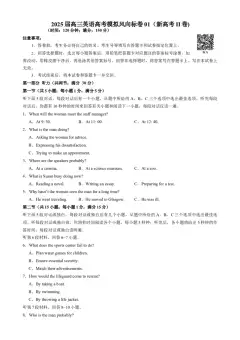
2025届高三英语高考模拟风向标卷01(新高考I卷)
(时间:120分钟;满分:150分)
注意事项:
1.答卷前,考生务必将自己的姓名、考生号等填写在答题卡和试卷指定位置上。
2.回答选择题时,选出每小题答案后,用铅笔把答题卡对应题目的答案标号涂黑。如
需改动,用橡皮擦干净后,再选涂其他答案标号。回答非选择题时,将答案写在答题卡上
写在本试卷上无效。
3.考试结束后,将本试卷和答题卡一并交回。
第一部分 听力(共两节,满分 30 分)
第一节(共5小题;每小题1分,满分5分)
听下面5段对话。每段对话后有一个小题,从题中所给的A、B、C三个选项中选出最佳选
项。听完每段对话后,你都有10秒钟的时间来回答有关小题和阅读下一小题。每段对话仅
读一遍。
1.When will the speakers leave for the subway station?
A.At 8:00. B.At 8:30. C.At 8:40.
2.Where is the woman probably?
A.In a restaurant. B.In a bookstore. C.In a post office.
3.What happened to the man?
A.He couldn’t play the game.
B.He failed the exam.
C.He felt sad for the woman.
4.How does the woman sound?
A.Annoyed. B.Excited. C.Unconcerned.
5.What does the woman think of cloning?
A.It has no side effect at all.
B.It may cause trouble for humans.
C.It should be strictly forbidden.
第二节(共15小题;每小题1分,满分15分)
听下面5段对话或独白。每段对话或独白后有几个小题,从题中所给的A、B、C三个选项
中选出最佳选项。听每段对话或独白前,你将有时间阅读各个小题,每小题 5秒钟;听完
后,各小题将给出5秒钟的作答时间。每段对话或独白读两遍。听第6段材料,回答6~7小题。
6.What does the woman want Peter to do?
A.Drive her to the airport.
B.Help her with the bag.
C.Call a taxi for her.
7.At what time will the woman’s flight take off?
A.2:00 pm. B.3:00 pm. C.4:00 pm.
听第7段材料,回答8~10小题。
8.When will the man go to the restaurant?
A.On Tuesday. B.On Wednesday. C.On Thursday.
9.Who will have dinner with the man?
A.A couple. B.Some friends. C.His family.
10.What will the man do next?
A.Provide personal information.
B.Tell the waitress his arriving time.
C.Ask for a table at the non-smoking area.
听第8段材料,回答11~13小题。
11.How did the speakers feel about visiting the park?
A.Tired. B.Happy. C.Disappointed.
12.What does Amy plan to do tomorrow?
A.Study for an exam. B.Attend a party. C.Go to the movies.
13.What kind of movie will the speakers watch?
A.A romantic movie. B.A comedy. C.A horror movie.
听第9段材料,回答14~17小题。
14.Who is the man probably?
A.A director. B.A host. C.A singer.
15.When should the fireworks go off as planned?
A.At the beginning of the concert.
B.In the middle of the concert.
C.In the end of the concert.
16.What was the highlight of the concert?
A.Giving away tickets to fans.B.Turning off the lights.
C.Throwing T-shirts to the crowd
17.Where will the band give their next tour?
A.In Boston. B.In Liverpool. C.In Manchester.
听第10段材料,回答18~20小题。
18.How does Sarah sound when speaking of her job?
A.Stressed.
B.Proud.
C.Regretful.
19.What does Sarah do before giving the weather report?
A.She calms herself down.
B.She recites her forecasts
C.She studies weather data.
20.Who might be the man in India?
A.A fan of Sarah’s.
B.A relative of Sarah’s.
C.The lover of Sarah’s.
第二部分 阅读(共两节, 满分50分)
第一节(共15小题:每小题2.5分, 满分37.5分)
阅读下列短文, 从每题所给的A、B、C、D四个选项中选出最佳选项。
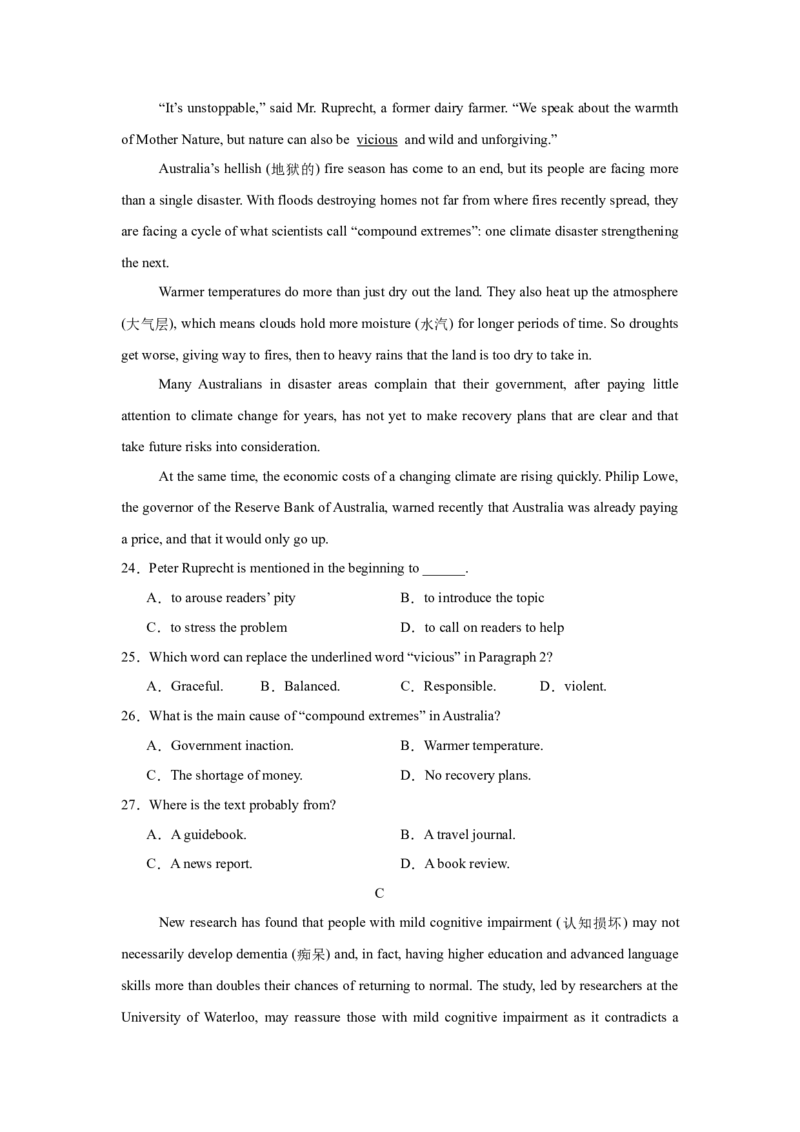
A
The China Daily Global Impact Writing Challenge
The China Daily Global Impact Writing Challenge (China Daily CIWS) reaches out to
young people of different ages, aiming to direct their attention to global issues, develop their
global insights and encourage them to take action. As for the future of the world, they should be
aware of the crises and opportunities it faces.
We sincerely invite young people from China and overseas students to participate in this
challenge, and to think about how to influence the world from the angle of being a global youth
after sufficient research.
Theme: Me & SDGs (Sustainable Development Goals)Organizer: China Daily USA
Schedule: Registration Open Date: August 15, 2024
Application Close Date: December 31, 2024
Regional Award Announcement: March 25, 2025
Global Award Announcement: June 25, 2025
Challenge Details;
●Category: The challenge is open to students worldwide, with three categories established:
Elementary (初级的) School Division; Junior High School Division; High School and Above
Division (High School Division and Global College Freshmen)
●Method: The challenge will be run online, facilitating the participation of young people
from around the world.
●Language: The language of the challenge is English, which will help participants
improve their English writing skills and share with young people from around the world.
●Entry Fee: ¥399
CLICK here to sign up for the challenge.
21.What is the main purpose of the China Daily GIWS?
A.To engage students in local events.
B.To improve students’ writing skills.
C.To inspire students’ initiative in global issues.
D.To assess students’ knowledge of sustainability.
22.When is the submission deadline for the challenge?
A.August 15, 2024. B.June 25, 2025.
C.March 25, 2025. D.December 31, 2024.
23.How will the challenge be conducted?
A.Through traditional mail. B.Through online participation.
C.Through telephone conference. D.Through in-person workshops.
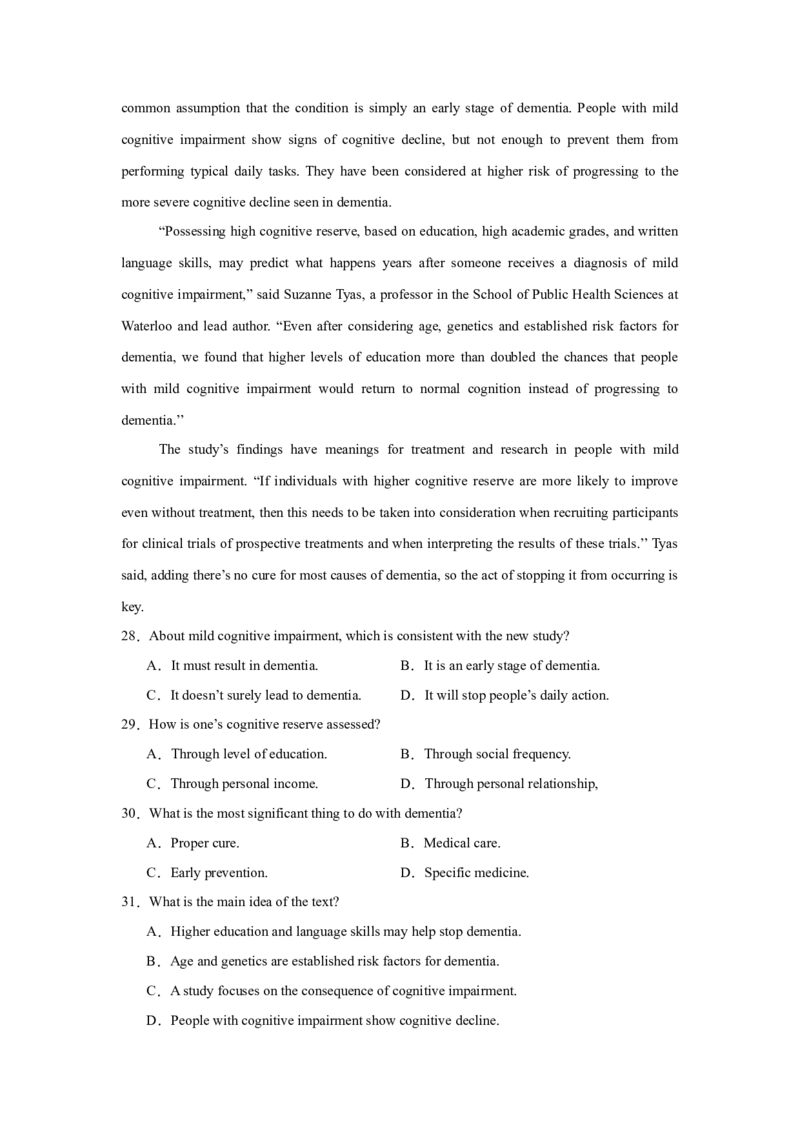
B
Standing on the ruins after the fire where his house had been, Peter Ruprecht recognized
that he was not sure how or when to rebuild. He was still shocked by what Australia’s increasingly
changeable climate had already delivered: first a drought, then a destructive bush fire, then heavy
rain from a storm.“It’s unstoppable,” said Mr. Ruprecht, a former dairy farmer. “We speak about the warmth
of Mother Nature, but nature can also be vicious and wild and unforgiving.”
Australia’s hellish (地狱的) fire season has come to an end, but its people are facing more
than a single disaster. With floods destroying homes not far from where fires recently spread, they
are facing a cycle of what scientists call “compound extremes”: one climate disaster strengthening
the next.
Warmer temperatures do more than just dry out the land. They also heat up the atmosphere
(大气层), which means clouds hold more moisture (水汽) for longer periods of time. So droughts
get worse, giving way to fires, then to heavy rains that the land is too dry to take in.
Many Australians in disaster areas complain that their government, after paying little
attention to climate change for years, has not yet to make recovery plans that are clear and that
take future risks into consideration.
At the same time, the economic costs of a changing climate are rising quickly. Philip Lowe,
the governor of the Reserve Bank of Australia, warned recently that Australia was already paying
a price, and that it would only go up.
24.Peter Ruprecht is mentioned in the beginning to ______.
A.to arouse readers’ pity B.to introduce the topic
C.to stress the problem D.to call on readers to help
25.Which word can replace the underlined word “vicious” in Paragraph 2?
A.Graceful. B.Balanced. C.Responsible. D.violent.
26.What is the main cause of “compound extremes” in Australia?
A.Government inaction. B.Warmer temperature.
C.The shortage of money. D.No recovery plans.
27.Where is the text probably from?
A.A guidebook. B.A travel journal.
C.A news report. D.A book review.
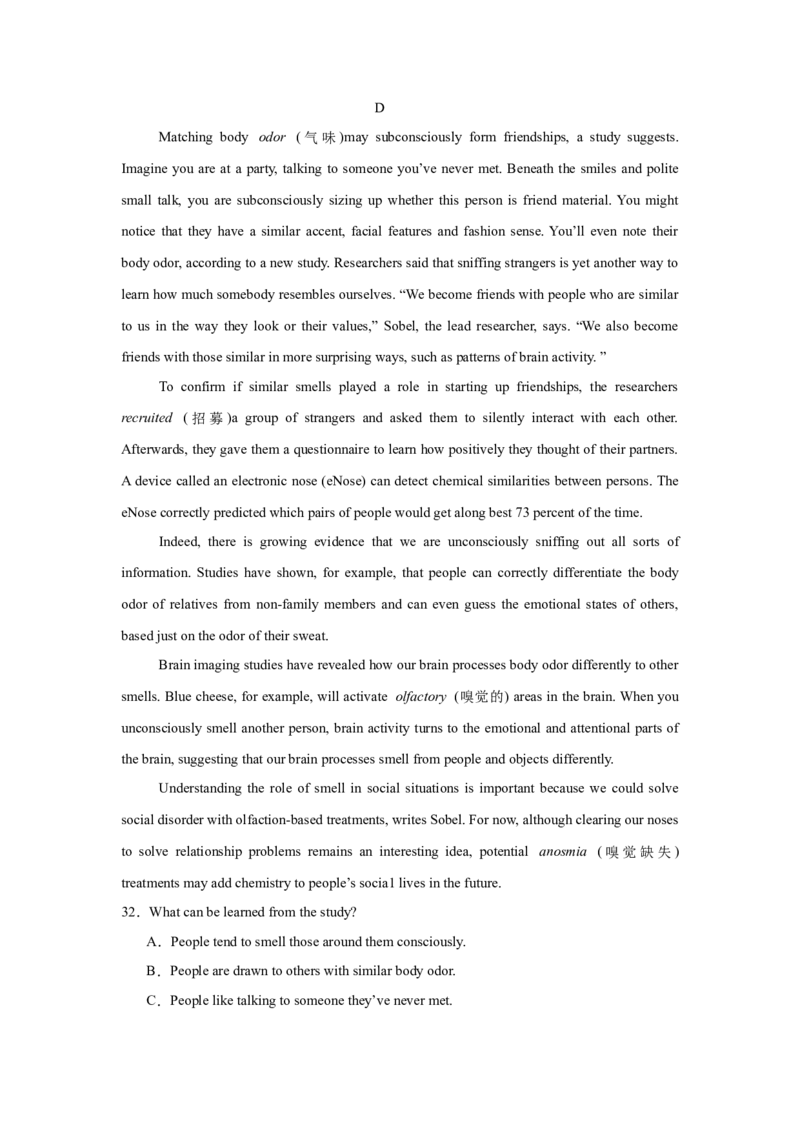
C
New research has found that people with mild cognitive impairment (认知损坏) may not
necessarily develop dementia (痴呆) and, in fact, having higher education and advanced language
skills more than doubles their chances of returning to normal. The study, led by researchers at the
University of Waterloo, may reassure those with mild cognitive impairment as it contradicts acommon assumption that the condition is simply an early stage of dementia. People with mild
cognitive impairment show signs of cognitive decline, but not enough to prevent them from
performing typical daily tasks. They have been considered at higher risk of progressing to the
more severe cognitive decline seen in dementia.
“Possessing high cognitive reserve, based on education, high academic grades, and written
language skills, may predict what happens years after someone receives a diagnosis of mild
cognitive impairment,” said Suzanne Tyas, a professor in the School of Public Health Sciences at
Waterloo and lead author. “Even after considering age, genetics and established risk factors for
dementia, we found that higher levels of education more than doubled the chances that people
with mild cognitive impairment would return to normal cognition instead of progressing to
dementia.’’
The study’s findings have meanings for treatment and research in people with mild
cognitive impairment. “If individuals with higher cognitive reserve are more likely to improve
even without treatment, then this needs to be taken into consideration when recruiting participants
for clinical trials of prospective treatments and when interpreting the results of these trials.’’ Tyas
said, adding there’s no cure for most causes of dementia, so the act of stopping it from occurring is
key.
28.About mild cognitive impairment, which is consistent with the new study?
A.It must result in dementia. B.It is an early stage of dementia.
C.It doesn’t surely lead to dementia. D.It will stop people’s daily action.
29.How is one’s cognitive reserve assessed?
A.Through level of education. B.Through social frequency.
C.Through personal income. D.Through personal relationship,
30.What is the most significant thing to do with dementia?
A.Proper cure. B.Medical care.
C.Early prevention. D.Specific medicine.
31.What is the main idea of the text?
A.Higher education and language skills may help stop dementia.
B.Age and genetics are established risk factors for dementia.
C.A study focuses on the consequence of cognitive impairment.
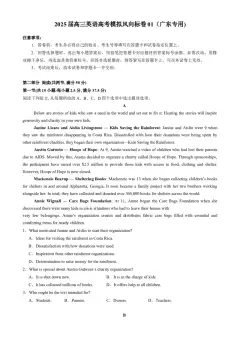
D.People with cognitive impairment show cognitive decline.D
Matching body odor (气味)may subconsciously form friendships, a study suggests.
Imagine you are at a party, talking to someone you’ve never met. Beneath the smiles and polite
small talk, you are subconsciously sizing up whether this person is friend material. You might
notice that they have a similar accent, facial features and fashion sense. You’ll even note their
body odor, according to a new study. Researchers said that sniffing strangers is yet another way to
learn how much somebody resembles ourselves. “We become friends with people who are similar
to us in the way they look or their values,” Sobel, the lead researcher, says. “We also become
friends with those similar in more surprising ways, such as patterns of brain activity. ”
To confirm if similar smells played a role in starting up friendships, the researchers
recruited (招募)a group of strangers and asked them to silently interact with each other.
Afterwards, they gave them a questionnaire to learn how positively they thought of their partners.
A device called an electronic nose (eNose) can detect chemical similarities between persons. The
eNose correctly predicted which pairs of people would get along best 73 percent of the time.
Indeed, there is growing evidence that we are unconsciously sniffing out all sorts of
information. Studies have shown, for example, that people can correctly differentiate the body
odor of relatives from non-family members and can even guess the emotional states of others,
based just on the odor of their sweat.
Brain imaging studies have revealed how our brain processes body odor differently to other
smells. Blue cheese, for example, will activate olfactory (嗅觉的) areas in the brain. When you
unconsciously smell another person, brain activity turns to the emotional and attentional parts of
the brain, suggesting that our brain processes smell from people and objects differently.
Understanding the role of smell in social situations is important because we could solve
social disorder with olfaction-based treatments, writes Sobel. For now, although clearing our noses
to solve relationship problems remains an interesting idea, potential anosmia (嗅觉缺失)
treatments may add chemistry to people’s socia1 lives in the future.
32.What can be learned from the study?
A.People tend to smell those around them consciously.
B.People are drawn to others with similar body odor.
C.People like talking to someone they’ve never met.D.People rely on their sense of smell to judge others.
33.What may people with similar body odor have in common?
A.Accent. B.Lifestyle. C.Living habits. D.Ways of thinking.
34.What were the participants asked to do during the research?
A.To distinguish between smells.
B.To find a partner for a game.
C.To get along with some strangers.
D.To monitor their mental conditions.
35.What do the researchers expect of the new finding?
A.It will be applied to the medical field.
B.It will play a role in the study of the brain.
C.It will help people make more friends in life.
D.It will make people improve their social lives.
第二节(共5小题:每小题2. 5分, 满分12. 5分)
阅读下面短文, 从短文后选项中选出可以填入空白处的最佳选项。选项中有两项为多余选
项。
What’s social jet lag (社交时差)? Social jet lag occurs when you stay up later and then
sleep in later on weekends than you do on weekdays. Changing the hours that you sleep from day
to day affects your body’s natural internal clock.
Social jet lag affects the body similarly to travel jet lag. When you shift your sleeping
hours, your body feels as if it were in a different time zone. 36 For example, if you stay up
late on Saturday night and then sleep in on Sunday morning, you will likely have a hard time
falling asleep on Sunday night. This is because your body has not been awake for enough hours to
feel tired at your usual Sunday bedtime. 37
Yet, frequently changing your body’s internal clock doesn’t just cause daytime sleepiness.
38 Social jet lag has been linked with several chronic (慢性的) health problems.
Changes in internal clock caused by inconsistent sleeping hours lead to changes in the circulatory
(循环) system and raise the risk of heart disease. Individuals who regularly experience social jet
lag are also more likely to smoke cigarettes and consume more caffeine. These habits can
significantly influence sleep.Sticking to your sleep schedule is an important part of addressing social jet lag. 39
A 2019 study found that when participants kept their sleep and wakeup times within 15 to 30
minutes of the same time each day, they reported better sleep, less depression, and less stress.
Study participants were also able to improve their cognitive reaction time scores.
40 If you usually change your regular sleep schedule on weekends, it may be time to
try to keep a more consistent one. While it may feel difficult to keep the same sleeping hours each
day, you will likely notice the health benefits right away.
A.It can significantly impact your health as well.
B.This can make falling and staying asleep difficult.
C.Moreover, establishing a regular sleep schedule is crucial.
D.Adjust your sleep schedule, and everything will be OK.
E.This likely makes waking up early on Monday morning difficult.
F.Aim to go to bed at the same time every day, even on weekends.
G.In general, social jet lag is a common problem that we may all experience.
第三部分语言运用(共两节,满分30分)
第一节(共15小题:每小题1分,满分15分)
阅读下面短文, 从每题所给的A、B、C、D四个选项中选出可以填入空白处的最佳选项。
During my first year in LA, I was a birthday-party clown (小丑). I struggled a lot with my
41 because though I viewed myself as a filmmaker, everyone viewed this ridiculous job as my
career.
For certain parties, I’d have to play a 42 character, such as Mickey Mouse or
Sponge Bob Square Pants. One night, they 43 me the clothes and said, “Tomorrow you’re
going to be Batman.” At the time I had a thick moustache. I didn’t want to change my physical
44 for that job, because I refused to admit I was more of a clown than an 45 .
The next day, on my way to the party, I started to 46 my choice, thinking, “Gosh,
this party isn’t going to go well.” Sure enough, when I got there, everyone burst into laughter. I
was so 47 that I wanted to turn back. But then the laughter changed into 48 . The
birthday boy’s dad laughed and said, “You see, son. I told you Batman has a 49 .”
They showed me the birthday cake with a moustached Batman drawn on it. I stared at itbeyond 50 .
When the cake was 51 brought out, all the kids teased, “Batman doesn’t have a
moustache.” 52 admitting the cake was messed up, the parents said, “No, Batman
always has a moustache. He just shaves it for his movies.” 53 , the kids were doubtful
until my moustache became the detail that 54 what the parents had said.
That day, there was no doubt in my mind about my identity — I was the hero they 55
.
41.A.ability B.fame C.identity D.ambition
42.A.local B.specific C.funny D.heroic
43.A.returned B.charged C.awarded D.handed
44.A.strength B.fitness C.appearance D.performance
45.A.actor B.artist C.author D.athlete
46.A.accept B.offer C.regret D.change
47.A.confused B.frightened C.embarrassed D.surprised
48.A.whispering B.yelling C.crying D.cheering
49.A.car B.moustache C.cake D.party
50.A.recognition B.question C.praise D.belief
51.A.constantly B.randomly C.initially D.temporarily
52.A.Instead of B.Regardless of C.In addition to D.By comparison with
53.A.Fortunately B.Gradually C.Incredibly D.Naturally
54.A.confirmed B.determined C.uncovered D.included
55.A.ordered B.needed C.imagined D.arranged
第三部分语言运用(共两节,满分30分)
第二节(共15小题:每小题1分,满分15分)
阅读下面短文,在空白处填入1个适当的单词或括号内单词的正确形式。
Mountain gorillas (大猩猩) spend most of their time sleeping, eating and 56
(clean) each other. They are mostly peaceful 57 (creature). Researchers recently studied
50 years of data from Rwanda. They found that as the number of gorilla family groups increased,
so did the violent fights between them. Most often, silverbacks led the fights, which are adult male
mountain gorillas 58 often have a white area across their backs. Some gorillas died,especially infants (幼儿), or babies. These deaths, 59 turn, slowed population growth.
The study found that the amount of fighting was not a result of the total number of
individuals in an area. 60 was important was the number of family groups in an area.
Since the 1960s, mountain gorillas have been 61 (careful) studied and protected in
central Africa. These animals almost died off in the 1970s. The scientists wanted to know how
many gorillas could live inside the 62 (protect) habitat area. 63 answer
depended partly on how they organized themselves socially. There were about 10 family groups in
the study area. The number of fights between them increased by three times. The population
growth 64 (fall) by half. The large family groups likely broke apart after the deaths of
65 (importance) silverback leaders. When these “elder statesman” gorillas got older and died,
the younger males weren’t able to keep the groups together.
第四部分 写作(共两节, 满分40分)
第一节(满分15分)
66.你校将举办题为Make Better Use of Digital Reading的英语演讲比赛。请你写一篇演讲
稿参赛,内容包括:
1. 分析优点与缺点;
2. 提出合理建议。
注意:1. 写作词数应为80左右;
2. 可以适当增加细节,以使行文连贯。
_______________________________________________________________________________
_______________________________________________________________________________
_______________________________________________________________________________
_______________________________________________________________________________
_______________________________________________________________________________
_____________________________________________________________
第二节(满分25分)
67.阅读下面材料,根据其内容和所给段落开头语续写两段,使之构成一篇完整的短文。
In a small and peaceful town, there lived a boy named Joey, who was different from theother kids.
At school, when the teacher asked simple maths questions, Joey would often stare blankly
at the blackboard, his brows knitted in confusion as he tried to make sense of the numbers. His
answers, more often than not, were incorrect, and it didn’t take long for a few classmates to start
laughing at him. During art class, while other kids were creating vivid masterpieces with ease,
Joey’s drawings looked more like scribbles (涂鸦). The moment he showed his work, whispers
spread across the room: “Look at what Joey drew! It’s so childish!”
Yes, Joey had some intellectual disabilities, which made it hard for him to learn and
communicate like his peers. Because of this, Joey suffered some prejudice, but he never minded
that and always wore a smile on his face.
One day in the PE class, when the teacher grouped the students, Tom, who was assigned to
Joey’s group, argued that Joey always misjudged the ball and would cause the team to lose
possession. “Why is Joey even on our team? He’s so useless!” Tom added. With a calm yet firm
voice, the teacher said, “Tom, we’re all here to learn and improve. Joey might struggle a bit more
than the rest of you, but that doesn’t mean he doesn’t deserve a chance to play.” Although the PE
teacher forced them into the same group, Joey was still not well treated.
After school, as fate would have it, dark clouds gathered overhead, and within minutes, a
downpour began. The streets of the small town were quickly slick(滑的)with rainwater, and
people ran hurriedly, seeking shelter. Joey was making his way home when suddenly he heard a
loud noise.
注意:1. 续写词数应为150个左右;
2. 请按如下格式在答题卡的相应位置作答。
On the street, an old woman fell down, groceries scattering(散落)all around her.
_______________________________________________________________________________
_______________________________________________________________________________
_______________________________________________________________________________
_______________________________________________________________________________
_______________________________________________________________________________
_________________________________________________________________
The next day at school, word of Joey’s heroic act spread like wildfire._______________________________________________________________________________
_______________________________________________________________________________
_______________________________________________________________________________
_______________________________________________________________________________
_______________________________________________________________________________
_________________________________________________________________