2025 届新高考基地学校第二次大联考
阅读下面材料,根据其内容和所给段落开头语续写两段,使之构成一篇完整的短文。
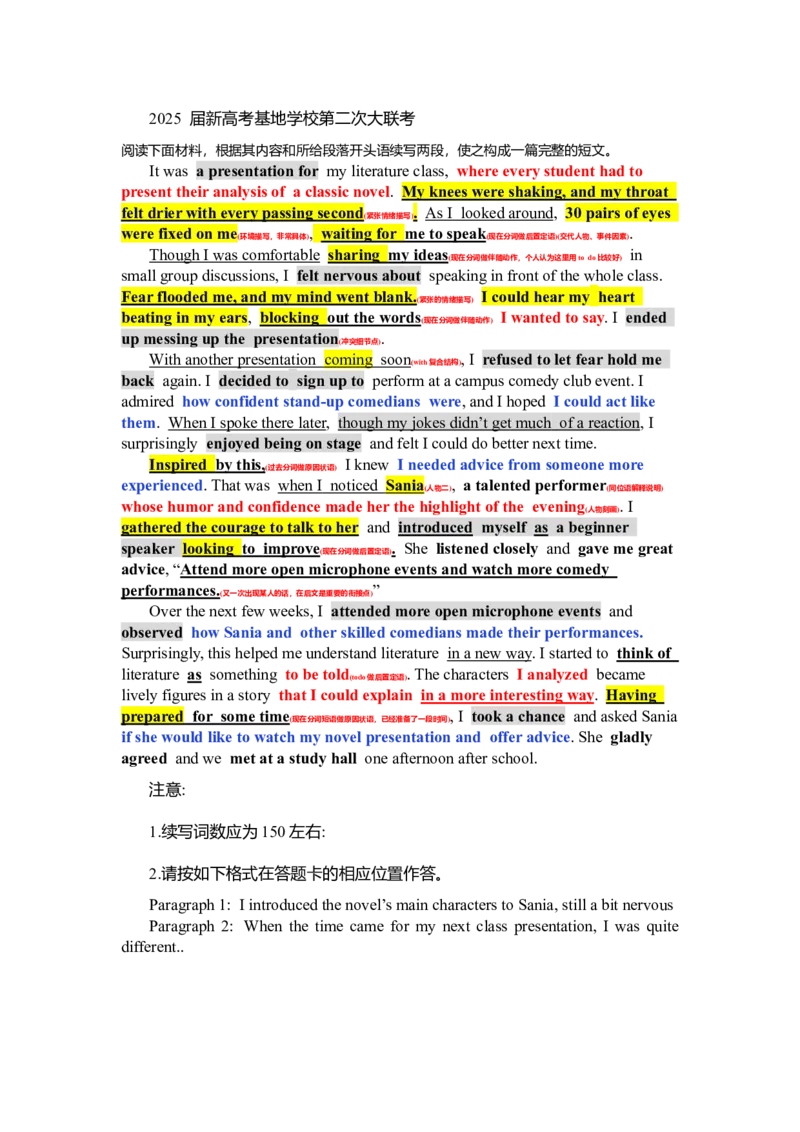
It was a presentation for my literature class, where every student had to
present their analysis of a classic novel. My knees were shaking, and my throat
felt drier with every passing second(紧张情绪描写). As I
looked around
, 30 pairs of eyes
were fixed on me(环境描写,非常具体), waiting for
me to speak
(现在分词做后置定语)(交代人物、事件因素).
Though I was comfortable sharing
my ideas
(现在分词做伴随动作,个人认为这里用to do 比较好) in
small group discussions, I felt nervous about speaking in front of the whole class.
Fear flooded me, and my mind went blank.(紧张的情绪描写) I could hear my heart
beating in my ears, blocking
out the words
(现在分词做伴随动作) I wanted to say. I ended
up messing up the presentation(冲突细节点).
With another presentation
coming
soon
(with 复合结构), I refused to let fear hold me
back again. I decided to sign up to perform at a campus comedy club event. I
admired how confident stand-up comedians were, and I hoped I could act like
them. When I spoke there later, though my jokes didn’t get much
of a reaction
, I
surprisingly enjoyed being on stage and felt I could do better next time.
Inspired
by this,
(过去分词做原因状语) I knew I needed advice from someone more
experienced. That was when I
noticed
Sania
(人物二), a talented performer(同位语解释说明)
whose humor and confidence made her the highlight of the evening(人物刻画). I
gathered the courage to talk to her and introduced myself as a beginner
speaker looking
to
improve
(现在分词做后置定语). She listened closely and gave me great
advice, “Attend more open microphone events and watch more comedy
performances.(又一次出现某人的话,在后文是重要的衔接点)”
Over the next few weeks, I attended more open microphone events and
observed how Sania and other skilled comedians made their performances.
Surprisingly, this helped me understand literature in a new way. I started to think of
literature as something to be told(todo 做后置定语). The characters I analyzed became
lively figures in a story that I could explain in a more interesting way. Having
prepared
for
some time
(现在分词短语做原因状语,已经准备了一段时间), I took a chance and asked Sania
if she would like to watch my novel presentation and offer advice. She gladly
agreed and we met at a study hall one afternoon after school.
注意:
1.续写词数应为150 左右:
2.请按如下格式在答题卡的相应位置作答。
Paragraph 1: I introduced the novel’s main characters to Sania, still a bit nervous
Paragraph 2: When the time came for my next class presentation, I was quite
different..
2025 届新高考基地学校第二次大联考
阅读下面材料,根据其内容和所给段落开头语续写两段,使之构成一篇完整的
短文。
It was a presentation for my literature class, where every student had to present
their analysis of a classic novel. My knees were shaking, and my throat felt drier with
every passing second. As I looked around, 30 pairs of eyes were fixed on me, waiting
for me to speak. Though I was comfortable sharing my ideas in small group
discussions, I felt nervous about speaking in front of the whole class. Fear flooded
me, and my mind went blank. I could hear my heart beating in my ears, blocking out
the words I wanted to say. I ended up messing up the presentation.
With another presentation coming soon, I refused to let fear hold me back again. I
decided to sign up to perform at a campus comedy club event. I admired how
confident stand-up comedians were, and I hoped I could act like them. When I spoke
there later, though my jokes didn’t get much of a reaction, I surprisingly enjoyed
being on stage and felt I could do better next time.
Inspired by this, I knew I needed advice from someone more experienced. That
was when I noticed Sania, a talented performer whose humor and confidence made
her the highlight of the evening. I gathered the courage to talk to her and introduced
myself as a beginner speaker looking to improve. She listened closely and gave me
great advice, “Attend more open microphone (麦克风) events and watch more
comedy performances.”
Over the next few weeks, I attended more open microphone events and observed
how Sania and other skilled comedians made their performances. Surprisingly, this
helped me understand literature in a new way. I started to think of literature as
something to be told. The characters I analyzed became lively figures in a story that I
could explain in a more interesting way. Having prepared for some time, I took a
chance and asked Sania if she would like to watch my novel presentation and offer
advice. She gladly agreed and we met at a study hall one afternoon after school.
注意:
1.续写词数应为150 左右:
2.请按如下格式在答题卡的相应位置作答。
Paragraph 1: I introduced the novel’s main characters to Sania, still a bit nervous
Paragraph 2: When the time came for my next class presentation, I was quite
different.
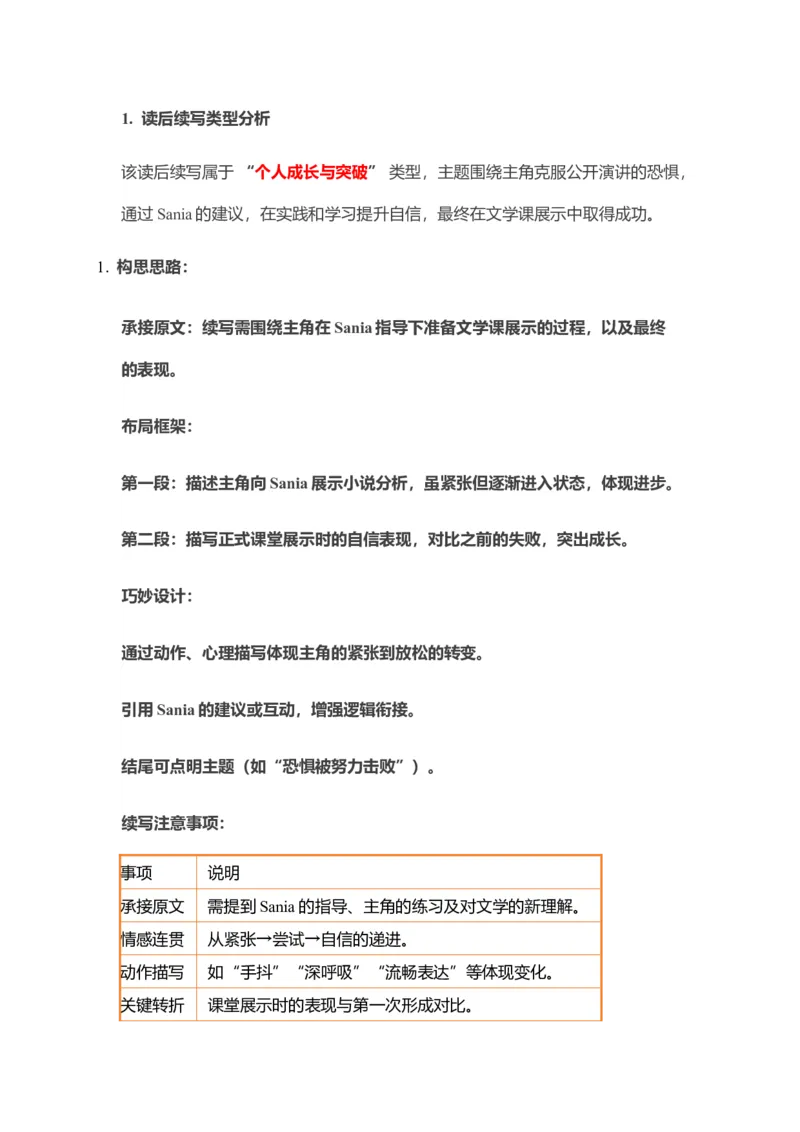
1. 读后续写类型分析
该读后续写属于 “个人成长与突破” 类型,主题围绕主角克服公开演讲的恐惧,
通过Sania 的建议,在实践和学习提升自信,最终在文学课展示中取得成功。
1. 构思思路:
承接原文:续写需围绕主角在Sania 指导下准备文学课展示的过程,以及最终
的表现。
布局框架:
第一段:描述主角向Sania 展示小说分析,虽紧张但逐渐进入状态,体现进步。
第二段:描写正式课堂展示时的自信表现,对比之前的失败,突出成长。
巧妙设计:
通过动作、心理描写体现主角的紧张到放松的转变。
引用Sania 的建议或互动,增强逻辑衔接。
结尾可点明主题(如“恐惧被努力击败”)。
续写注意事项:
事项
说明
承接原文
需提到Sania 的指导、主角的练习及对文学的新理解。
情感连贯
从紧张→尝试→自信的递进。
动作描写
如“手抖”“深呼吸”“流畅表达”等体现变化。
关键转折
课堂展示时的表现与第一次形成对比。
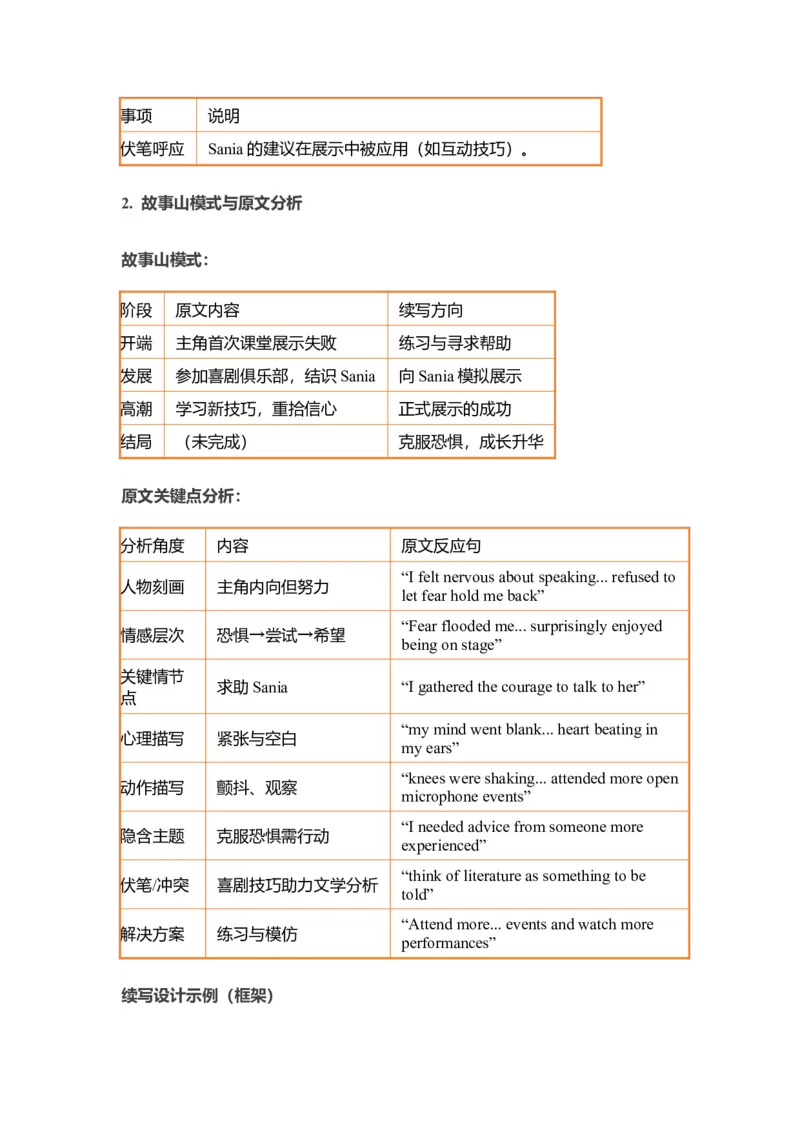
事项
说明
伏笔呼应
Sania 的建议在展示中被应用(如互动技巧)。
2. 故事山模式与原文分析
故事山模式:
阶段
原文内容
续写方向
开端
主角首次课堂展示失败
练习与寻求帮助
发展
参加喜剧俱乐部,结识Sania
向Sania 模拟展示
高潮
学习新技巧,重拾信心
正式展示的成功
结局
(未完成)
克服恐惧,成长升华
原文关键点分析:
分析角度
内容
原文反应句
人物刻画
主角内向但努力
“I felt nervous about speaking... refused to
let fear hold me back”
情感层次
恐惧→尝试→希望
“Fear flooded me... surprisingly enjoyed
being on stage”
关键情节
点
求助Sania
“I gathered the courage to talk to her”
心理描写
紧张与空白
“my mind went blank... heart beating in
my ears”
动作描写
颤抖、观察
“knees were shaking... attended more open
microphone events”
隐含主题
克服恐惧需行动
“I needed advice from someone more
experienced”
伏笔/冲突
喜剧技巧助力文学分析
“think of literature as something to be
told”
解决方案
练习与模仿
“Attend more... events and watch more
performances”
续写设计示例(框架)
Paragraph 1:
动作描写:手捧笔记,声音微颤,但Sania 的鼓励让主角放松。
关键句:“As I described the protagonist’s struggles, I realized they mirrored my
own.”
衔接:引用Sania 的反馈(如“互动观众”)。
Paragraph 2:
对比描写:课堂展示时眼神交流、流畅表达,同学的反应(微笑/点头)。
主题升华:“The applause echoed—not just for my analysis, but for the fear I’d
conquered.”
3. 动作、心理、环境描写的推荐英文例句及翻译
动作描写(Action Descriptions)
1.My hands trembled as I flipped through my notes.
(我的手颤抖着翻动笔记。)
2.I took a deep breath and steadied my voice.
(我深吸一口气,稳住声音。)
3.She nodded encouragingly, her eyes fixed on me.
(她鼓励地点点头,目光注视着我。)
4.I clenched my fists, trying to summon courage.
(我握紧拳头,试图鼓起勇气。)
5.My legs wobbled as I stepped onto the stage.
(我的双腿发抖,走上舞台。)
6.I fumbled with the microphone, adjusting it nervously.
(我笨拙地摆弄麦克风,紧张地调整。)
7.A few students leaned forward, listening intently.
(几个学生向前倾身,专注地听着。)
8.I gestured animatedly while explaining the plot.
(我生动地比划着,解释故事情节。)
9.My voice cracked slightly, but I pushed through.
(我的声音有点颤抖,但我坚持了下去。)
10.A slow smile spread across my face as I gained confidence.
(随着信心增强,我的脸上慢慢露出微笑。)
心理描写(Psychological Descriptions)
1. A wave of panic surged through me.
(一阵恐慌席卷了我。)
2. My mind raced, searching for the right words.
(我的大脑飞速运转,寻找合适的词语。)
3. Doubt gnawed at me—what if I failed again?
(疑虑啃噬着我——如果我再次失败怎么办?)
4. A strange calm settled over me as I began speaking.
(当我开始讲话时,一种奇怪的平静笼罩了我。)
5. I felt a flicker of hope—maybe I could do this.
(我感到一丝希望——也许我能行。)
6. The fear that had gripped me earlier slowly faded.
(先前困扰我的恐惧慢慢消散。)
7. My heart pounded, but this time, it was excitement, not fear.
(我的心砰砰直跳,但这次是兴奋,而非恐惧。)
8. I mentally rehearsed my lines one last time.
(我在脑海里最后排练了一遍台词。)
9. A sense of accomplishment washed over me.
(一种成就感涌上心头。)
10. For the first time, I believed in myself.
(第一次,我相信了自己。)
环境描写(Environmental Descriptions)
The classroom buzzed with quiet murmurs.
(教室里回荡着低低的私语声。)
The spotlight cast a warm glow on the stage.
(聚光灯在舞台上投下温暖的光芒。)
A hush fell over the room as I began speaking.
(当我开始讲话时,房间里一片寂静。)
The air was thick with anticipation.
(空气中弥漫着期待。)
Sunlight streamed through the windows, brightening the room.
(阳光透过窗户洒进来,照亮了房间。)
The faint hum of the projector filled the background.
(投影仪微弱的嗡嗡声在背景中回荡。)
A few scattered coughs broke the silence.
(零星的咳嗽声打破了沉默。)
The audience’s eyes were fixed on me, expectant.
(观众的目光聚焦在我身上,充满期待。)
The sound of pages turning echoed in the quiet hall.
(翻页的声音在安静的大厅里回荡。)
The clock ticked loudly, reminding me of the passing time.
(时钟滴答作响,提醒我时间的流逝。)
4. 高级替换词 & 常见搭配
高级替换词(按场景分类)
普通词
高级替换
适用场景
nervous
apprehensive (忧虑的)
心理描写
happy
elated (欣喜若狂的)
情感描写
sad
melancholic (忧郁的)
情感描写
look
gaze (凝视)
动作描写
walk
stride (大步走)
动作描写
1. 常见固定搭配 & 词法解析
Summon courage(鼓起勇气)近义词:gather bravery 反义词:succumb to fear
例句:I summoned courage and stepped forward./ She couldn’t summon the courage
to speak.
Break the silence(打破沉默)近义词:disrupt the quiet 反义词:maintain silence
例句:A cough broke the silence in the room./ His words finally broke the tense
silence.
Hold back(抑制,阻止)近义词:restrain 反义词:let go
例句:She refused to let fear hold her back./Tears welled up, but he held them back.
Gain confidence (获得信心)近义词:build self-assurance 反义词:lose
confidence
例句:With practice, she gradually gained confidence.
His encouragement helped me gain confidence.
Mess up(搞砸)近义词:botch, ruin 反义词:succeed 例句:
I didn’t want to mess up again. /He messed up his speech due to nerves.
可积累的生词短语
短语/单词
词义
词性
近义词
反义词
例句
Flood with
fear
充满恐
惧
动词短
语
overwhelm
with dread
calm
down
Fear flooded me as
I stepped on stage.
Go blank
大脑空
白
动词短
语
freeze up
think
clearly
My mind went
blank during the
speech.
Highlight of
the evening
晚会的
亮点
名词短
语
standout
moment
low
point
Her performance
was the highlight
of the evening.
Take a
chance
冒险尝
试
动词短
语
risk it
play safe
I took a chance and
asked for advice.
Echo in the
hall
在大厅
里回荡
动词短
语
resonate
fall
silent
His laughter
echoed in the
empty hall.
1. 总结
动作描写:多用具体动词(trembled, clenched, gestured)增强画面感。
心理描写:使用比喻(wave of panic, doubt gnawed)体现情绪变化。
环境描写:通过声音(buzzed, hush, hum)和光线(spotlight, sunlight)渲染
氛围。
高级替换:避免重复,提升语言层次(如apprehensive 代替nervous)。
固定搭配:积累自然表达(summon courage, break the silence)。
5. Possible Versions(3)
Version 1
Paragraph 1:
I introduced the novel’s main characters to Sania, still a bit nervous. My
fingers fidgeted with the edge of my notebook(刻画人物的紧张感), and my voice wavered
slightly as I spoke. Sania listened carefully, nodding
now and then
(现在分词做伴随动作),
her calm presence easing my tension(独立主格刻画人物). When I finished, she smiled
warmly. “You did well, but try to slow down and make your points clearer,” Sania
suggested. “And if you feel nervous, take a deep breath(祈使句). Focus on connecting
with your audience(祈使句), not just presenting
to them
(现在分词做伴随动作). Think of them as
friends(祈使句) who are curious to hear your story and see them in the eyes
properly.” Her words resonated with me(物理关注语句)—instead of fearing judgment, I
now saw my classmates as listeners eager to learn(adj 做后置定语). With renewed
determination, I practiced daily, refining
my delivery
(现在分词做伴随动作) until it
felt
natural.
Paragraph 2:
When the time came for my next class presentation, I was quite different.
Stepping
to the front
(现在分词做伴随动作), I took a deliberate breath, recalling Sania’s
advice about engaging the audience with proper eye contact. I scanned the room,
meeting
curious gazes
(现在分词做伴随动作), and began with a relaxed tone. Unlike before,
my words flowed smoothly(无灵主语句), punctuated
by natural pauses
(过去分词做后置定语) that
emphasized key points. Midway, I noticed nods of understanding—a stark
contrast to
the blank stares from last time
(衔接原文做对比). As I concluded, the room
erupted in applause(比赛、演讲等环境描写必须有的内容), affirming
my progress
(现在分词做伴随动作). This
time, I hadn’t just recited analysis; I’d told a story(递进句式). The experience taught
me that confidence isn’t innate—it’s built through preparation and
perspective especially with
a good
instructor
.
地道搭配 & 替换词
原文词/短语
升级替换
例句
nervous
apprehensive
Though still apprehensive, I maintained
steady eye contact.
listened
carefully
attentively
absorbed
Sania attentively absorbed every word,
offering thoughtful feedback.
smiled warmly
beamed
reassuringly
She beamed reassuringly, dispelling my
lingering doubts.
make points
articulate ideas
I learned to articulate ideas concisely,
原文词/短语
升级替换
例句
clearer
concisely
avoiding rambling.
loud applause
resounding ovation
The resounding ovation left me both
humbled and proud.
情绪 & 动作描写
情绪:
"My fingers fidgeted with the edge of my notebook" (anxiety)
"Her calm presence easing my tension" (relief)
"Renewed determination" (motivation)
动作:
"Scanned the room, meeting curious gazes" (confidence)
"Words flowed smoothly" (improvement)
Version 2
Paragraph 1:
I introduced the novel’s main characters to Sania, still a bit nervous. My
palms were damp(人物紧张刻画), and I stumbled over a few sentences, but Sania’s
patient demeanor kept me going. “Your analysis is insightful,” she remarked,
“but your delivery lacks rhythm(语境词汇和描写). Try
varying
your tone—like a
storyteller.” She demonstrated, her voice rising and falling dramatically(独立主格刻画人
物), and I mimicked her, gradually finding
my
own
pace
(现在分词做伴随动作). By the end, I
even managed a hesitant joke, which made her chuckle. “See? Humor disarms
fear(无灵主语句),” she said. Her mentorship transformed my perspective: public
speaking wasn’t a test—it was a conversation(递进句式).
Paragraph 2:
When the time came for my next class presentation, I was quite different. I
opened with the same joke I’d practiced with Sania, and laughter rippled
through the room(无灵主语句,刻画环境). Energized(过去分词做主语补语), I wove my analysis into a
narrative, pausing
for effect
and watching
my classmates lean in
( 现在分词做伴随动作).
Their engagement
fueled
my confidence
(无灵主语句), and for the first time, I enjoyed the
spotlight. As I
bowed
slightly
at the applause
, I caught Sania’s eye in the back—
she gave me a thumbs-up. The standing ovation wasn’t just for my content; it
was for the connection I’d forged.
高级替换词
普通词
升级词
nervous
jittery
damp palms
clammy hands
laugh
ripple of laughter
clapping
standing ovation
心理描写
"My palms were damp" → tactile nervousness
"Energized, I wove my analysis..." → shifting to confidence
固定搭配
"Disarms fear" (消除恐惧)
"Weave into a narrative" (融入叙述)
Version 3
Paragraph 1:
I introduced the novel’s main characters to Sania, still a bit nervous. My
voice trembled initially(紧张的描写), but her encouraging nods
steadied
me
(无灵主语句).
“You’re overthinking,” she observed. “Instead of memorizing,
feel
the story
.” She
had me act out a scene, and to my surprise, my gestures became fluid, my tone
passionate(可以理解为独立主格或省略句形式). “Literature breathes(场景词汇) when you do,” she said.
After many trials with her instruction, I left with a script covered
in her notes
(过
去分词做后置定语)—underline emotions, pause here, smile there(动词短语并列). Her guidance
turned mechanical recitation into performance art.
Paragraph 2:
When the time came for my next class presentation, I was quite different. I
began by performing the novel’s character, my voice rich with emotion(独立主格刻画人物).
The class, initially restless(对比描写), fell silent(环境描写). At the climax, I paused, letting
the tension hang(现在分词做伴随动作,让子弹飞一会儿!)—just as Sania had taught. The burst of
applause was thunderous(环境描写). My teacher praised my “dynamic
interpretation,” and even the usually aloof back-row students nodded
approvingly. Sania’s lessons had unlocked not just my voice, but my ability to
move others(递进描写).
语料补充
基础词
升级词
例句
nervous
trepidatious
Though trepidatious, I channeled it into energy.
improve
hone
I honed my skills through relentless practice.
clapping
applause crescendoed
The applause crescendoed as I bowed.