热点话题04  2026 年体验真正的北京——一座不
断自我重塑的城市
目录
时文精读------------------------------------------------------------精选外刊原创语法填空
  【原创·语法填空】
【课标词汇积累】
【课标词汇训练】
【参考译文】
好题精练----------------------------------------------------------精选名校及联考话题专练
【阅读理解】
【阅读7 选5】
【完形填空】
【语法填空】
【话题·导语】
How to experience the real Beijing in 2026—a city of constant reinvention
The city that has reinvented itself across dynasties has no shortage of new must-see attractions in 2026. Here’s
how to see the best of Beijing, from the Forbidden City to its hidden courtyards and alleyways.
2026 年如何体验真正的北京——一座不断自我重塑的城市
这座历经朝代更迭而焕然一新的城市,2026 年依然拥有众多不容错过的景点。本文将带您领略
北京的精华所在,从故宫到那些隐秘的庭院与巷弄。
【原文·时文阅读】
文章来源:https://www.nationalgeographic.com/travel/best-of-the-world-2026/article/beijing-china
Beijing’s story is a long arc of transformation—a city that has reinvented itself across dynasties and decades,
transforming from an imperial capital to a global metropolis. Beijing has sometimes fought for its image, but
anyone who has spent time here knows that the city’s appeal doesn’t lie in a flashy skyline or international
influence, but rather in its unassuming corner restaurants where hardworking chefs dish up specialities from every
读时文精读
part of the country, and in hutong alleyways where resting bicycles and hidden courtyards center you firmly in the
real China.
Once a Mongol stronghold known as Dadu, Beijing became the Ming dynasty’s capital in 1421, just after
the Forbidden City was completed as a symbol of absolute imperial authority. The city’s strict grid layout—still
used today—was devised under Kublai Khan in 1271 and refined by Ming planners, with remnants of the old city
wall and gates still visible in neighborhoods like Deshengmen and Chongwenmen.
In 2026, the Beijing Central Axis—a nearly five-mile strip of imperial and ceremonial buildings and gardens
—is a recent addition to UNESCO’s World Heritage List, and a new sightseeing bus makes it easier to get a look at
the highlights: the Temple of Heaven, Tiananmen Square, the Forbidden City, and the Drum and Bell Towers, all
stunning examples of ancient Chinese city planning.
Several previously closed imperial tombs near Changping on Beijing’s outskirts have been renovated and will
open to the public for the first time, and a new hiking trail and fleet of green-energy buses are leading Beijing
forward with its eyes on a sustainable future.
【原创·语法填空】(260words)
Beijing’s story is a long arc of transformation—a city that has reinvented itself across dynasties and decades,
1._______(transform) from an imperial capital to a global metropolis. Beijing has sometimes fought for its
image, but anyone who has spent time here knows that the city’s appeal doesn’t lie in a flashy skyline or
international influence, 2._______ rather in its unassuming corner restaurants where hardworking chefs dish up
specialities from every part of the country, and in hutong alleyways 3._______ resting bicycles and hidden
courtyards center you firmly in the real China.
Once a Mongol stronghold 4._______(know) as Dadu, Beijing became the Ming dynasty’s capital in
1421, just after the Forbidden City 5._______(complete) as a symbol of absolute imperial authority. The city’s
strict grid layout—still used today—was devised under Kublai Khan in 1271 and refined by Ming 6._______
(plan), with remnants of the old city wall and gates still visible in neighborhoods like Deshengmen and
Chongwenmen.
In 2026, the Beijing Central Axis—a nearly five-mile strip of imperial and 7._______(ceremony)
buildings and gardens—is a recent addition to UNESCO’s World Heritage List, and a new sightseeing bus makes it
8._______(easy) to get a look at the highlights: the Temple of Heaven, Tiananmen Square, the Forbidden City,
and the Drum and Bell Towers, all stunning examples of ancient Chinese city planning.
Several 9._______(previous) closed imperial tombs near Changping on Beijing’s outskirts have been
renovated and will open to the public for the first time, and a new hiking trail and fleet of green-energy buses are
leading Beijing forward 10._______ its eyes on a sustainable future.
【课标词汇积累】
1.transformation n.变化, 转换
The university library underwent a remarkable transformation, introducing digital resources and collaborative spaces
that revolutionized students' study experiences.大学图书馆经历了显著的转型,引入数字资源和协作空间,彻底改
变了学生的学习体验。
2.reinvent vt.重复发明,彻底改造,重新使用
The school festival was reinvented this year with virtual reality exhibits, attracting more participants than ever before.今
年的校园节日通过虚拟现实展览重新设计,吸引了比以往更多的参与者。
3.imperial adj.帝国的, 皇帝的
The imperial exam system in ancient China inspired modern students to value perseverance in their academic pursuits.
中国古代的科举制度激励现代学生在学术追求中重视坚持不懈的精神。
4.appeal v.呼吁,对…有吸引力n.呼吁,恳求, 吸引力,感染力
Campus clubs use creative posters to enhance their appeal to freshmen during orientation week.
校园社团在迎新周用创意海报增强对新生吸引力。
5.influence n.势力, 影响, 有影响的人/事物; v.影响, 支配
Peer influence plays a crucial role in shaping students' attitudes toward extracurricular activities.
同伴影响对塑造学生课外活动态度起关键作用。
6.stronghold n.要塞, 据点, 根据地
Traditional classrooms are losing their stronghold as primary learning spaces with the rise of MOOC platforms.
随着慕课平台兴起,传统教室正失去其作为主要学习空间的统治地位。
7.authority n.当权者, 职权, 权力, 权限, 威信, 影响力
Students should learn to question academic authority appropriately while maintaining respect for expertise.
学生应学会在尊重专业知识的同时适当质疑学术权威。
8.highlight v.突出,强调, (使)醒目, 挑染; n.最好的部分, 挑染的头发
Time management skills were highlighted as the most valuable takeaway from the freshman orientation program.时间
管理技能被强调为新生入学教育中最有价值的收获。
9.renovate vt.翻新,修复,整修, 革新,更新
The dormitory renovation project incorporated soundproof study pods to accommodate night owls.
宿舍翻新工程加入了隔音自习舱以适应熬夜学习的学生。
10.sustainable adj.可持续的, 可以忍受的, 可支撑的
Developing sustainable study habits is more effective than last-minute cramming for long-term academic success.培养
可持续的学习习惯对长期学术成功比临时抱佛脚更有效。
【课标词汇训练】
根据语境,从上面的“课标词汇”中选用合适的单词及其正确形式将句子补充完整。
1.The _____________ of teaching methods from traditional lectures to interactive online platforms has greatly
enhanced student engagement.教学方法从传统讲座转变为互动在线平台,极大地提高了学生的参与度。
2.To _____________ their study habits, many students are adopting time-management apps and personalized learning
strategies.为了重塑学习习惯,许多学生开始使用时间管理应用和个性化学习策略。
3.His _____________ attitude toward group projects often caused conflicts with classmates who preferred
collaborative decision-making.他对小组项目专断的态度常与偏好协作决策的同学发生冲突。
4. The professor's _____________ for original thinking rather than rote memorization resonated deeply with the
student body.教授对原创思维而非死记硬背的呼吁在学生群体中引起深刻共鸣。
5.The professor's research on learning psychology continues to_____________ educational reforms nationwide.
这位教授关于学习心理学的研究持续影响着全国教育改革。
6.The library remains the intellectual _____________ of the campus, where students gather for intensive study
sessions.图书馆仍是校园的知识堡垒,学生们聚集于此进行深度学习。
7.The dean's _____________ was challenged when new evidence emerged about the grading system's flaws.
当出现关于评分系统缺陷的新证据时,院长的权威受到挑战。
8.The research symposium _____________ undergraduate students' innovative contributions to renewable energy
studies.该研讨会突出了本科生对可再生能源研究的创新贡献。
9._____________ the curriculum to include AI literacy has become a priority for many universities.
将人工智能素养纳入课程改革已成为许多高校的优先事项。
10.Student organizations promote _____________ campus lifestyles through reusable utensil campaigns and bike-
sharing programs.学生组织通过可重复使用餐具活动和共享单车项目推广可持续校园生活方式。
【参考译文】
北京的故事是一段跨越朝代与岁月的蜕变长卷——这座历经沧桑的城市,从昔日的帝王都城蜕变为
举世瞩目的国际大都会。北京虽曾为城市形象奋力拼搏,但凡在此生活过的人皆知,这座城市的魅力不在
于炫目的天际线或国际影响力,而在于那些不起眼的街角餐馆里,勤勉的厨师们烹制着来自全国各地的特
色美食;更在于胡同小巷中,停放的自行车与隐秘的庭院,将你牢牢定格在中国的真实图景之中。
北京曾是蒙古人的要塞大都,1421 年明成祖忽必烈下令建造象征绝对皇权的紫禁城后,这里正式成
为明朝都城。城市至今沿用的严格网格布局,最初由忽必烈于1271 年规划,后经明朝规划者完善。如今在
德胜门、崇文门等街区,仍可见古城墙和城门的遗迹。
2026 年,北京中轴线——这条绵延近五英里(约8 公里)的皇家建筑群与园林带——正式入选联合
国教科文组织世界遗产名录。新增的观光巴士让游客更便捷地游览天坛、天安门广场、故宫及鼓楼与钟楼
等精华景点,这些中国古代城市规划的典范之作令人叹为观止。
北京郊区昌平区多处曾关闭的皇家陵墓近日完成修缮,将首次向公众开放。与此同时,一条全新徒步
步道与多辆新能源公交车的投入使用,正推动北京迈向可持续发展的未来。
Passage1 阅读理解
(2026·广东澳台侨二十校高三第一次联考)
The Best Places to Travel in 2026
Handpicked by National Geographic’s team, these 2026 must-visit destinations offer unique experiences
across the globe.
Milan and the Dolomites, Italy, will grab global attention as hosts of the 2026 Winter Olympic and
Paralympic Games in February and March. The most geographically dispersed Winter Games ever, competitions
and ceremonies will span 8,500 primarily mountainous square miles of northern Italy, with most events held in the
legendary Dolomites.
Québec, Canada, boasts Nibiischii Park — one of its newest national parks and the first managed by a First
Nation. The Cree Nation of Mistissini has protected over 4,000 square miles of lake country in northern Québec,
encompassing the province’s largest wildlife reserve. Accessible from Chibougamau, it’s a 90-minute flight from
Montréal via Air Creebec, owned by the Cree Nation.
Beijing, China, offers fresh exploration ways in 2026. The Beijing Central Axis, a nearly five-mile strip of
imperial buildings and gardens, has recently joined UNESCO’s World Heritage List. A new sightseeing bus
练好题精练
simplifies visits to highlights like the Temple of Heaven, Forbidden City, and Drum and Bell Towers —
masterpieces of ancient Chinese city planning.
Dominica is set to establish the world’s first sperm whale reserve by early 2026. Covering nearly 800 square
kilometers off its west coast, the reserve protects around 200 year-round resident sperm whales, reflecting the
nation’s commitment to marine conservation. Visitors can swim with or observe these creatures, with strict number
regulations by reserve staff.
1.When will the 2026 Winter Olympic and Paralympic Games be held in Italy?
A.In February and March.
B.In January and February.
C.In March and April.
D.In April and May.
2.What makes Nibiischii Park in Québec special?
A.It is managed by a First Nation.
B.It is Canada’s largest national park.
C.It is accessible only by ship.
D.It covers 8,500 square miles.
3.What recent change has happened to the Beijing Central Axis?
A.It was rebuilt with modern facilities.
B.It was added to UNESCO’s World Heritage List.
C.It became a popular shopping destination.
D.It was closed for historical preservation.
4.What is the main purpose of Dominica’s sperm whale reserve?
A.To promote whale-watching tourism.
B.To study sperm whale behavior.
C.To protect sperm whales and marine ecosystems.
D.To attract international scientific research teams.
【长难句分析】
【文章原句】Covering nearly 800 square kilometers off its west coast, the reserve protects around 200 year-round
resident sperm whales, reflecting the nation’s commitment to marine conservation.
【句式分析】 这个句子是一个简单句,但成分比较复杂。Covering nearly 800 square kilometers off its west
coast,是现在分词短语作状语,reflecting the nation’s commitment to marine conservation 现在分词短语作伴随状语。
【翻译】该保护区西海岸绵延近800 平方公里,守护着约200 头常年栖息的抹香鲸,彰显了国家对海洋保护
的坚定承诺。
Passage2 阅读理解
(2026·辽宁省七校协作体高三联考)
Long-legged and fair-haired, the Barbie doll has become a symbol of children’s toys in the West. But more
than 1,000 years ago, a doll that became popular in China was just as attractive.
Beijing silk figurines (北京绢人) are made from thin silk, gauze (纱罗) and damask (锦缎) and designed
with detailed facial expressions. With their delicate craftsmanship and cultural meaning, the art of making them was
listed as a national intangible cultural heritage in 2021.
Jiao Tianqi, 30, has spent six years learning and preserving the craft. “For many, these silk figurines are just
art pieces, but to me, they are like my children,” Jiao expressed.
Creating a silk figurine has complex steps, including designing, painting, making clothes and props (道具).
“Each step requires the greatest patience and love,” Jiao added.
Before making a figurine, the artist must design it and make sure the head-to-body ratio is correct.
“According to aesthetic standards, for a standing silk figurine, the head-to-body ratio is 1:7; for a seated position, it
is 1:5,” Jiao said. But since most traditional silk figurines are 80 to 100 centimeters tall, every part is small. “A
slight tremor (哆嗦) means starting over,” she said.
Because silk figurines often show noblewomen or characters from classic literature, artists try to express
their cultural spirit.
“When making Wang Xifeng from Dream of the Red Chamber , we referenced the 1987 TV adaptation for
her multiple hairpin (发簪) look to show her status as an important figure in the Jia family,” Jiao explained. “For
Lin Daiyu, we reflected her identity as a dependent through her gestures, such as lowering her head and frowning.”
This requires reading to understand the culture behind the characters.
Since making silk figurines takes time and effort, few continue the craft. “Due to expensive materials, silk
figurines are costly, and we often don’t know if they will sell,” Jiao said. “Nowadays, people prefer quick money,
so out of 100 people who come to learn, only one or two persist in carrying on the tradition.”
To address this, Jiao and her team work with people from all walks of life to raise awareness. They’re also
exploring AI technology to make design and material analysis more accurate and affordable.
5.What does paragraph 2 mainly tell us about Beijing silk figurines?
A.Their special qualities and cultural importance.
B.What has made them so popular in China.
C.The step-by-step process of creating them.
D.How they differ from Western Barbie dolls.
6.According to Jiao, what is extremely important when creating silk figurines?
A.Curiosity and creativity.
B.A basic sense of aesthetics.
C.Patience and passion.
D.A strong team spirit.
7.Why does the author mention Wang Xifeng and Lin Daiyu in paragraph 7?
A.To present typical characters represented in silk figurines.
B.To stress the cultural significance of silk figurines.
C.To show how TV adaptations influence traditional art.
D.To illustrate how silk figurines reflect cultural characteristics.
8.Why do few people continue the craft of making silk figurines?
A.The materials are difficult to find.
B.They lack interest in classic literature.
C.They fail to recognize its cultural value.
D.High costs and uncertain sales discourage them.
【词汇积累】
1.attractive adj.有魅力的, 好看的, 吸引人的, 悦耳的 2.facial n.面部护理,美容; adj.面部的 3.intangible
adj.触不到的, 难以理解的, 无法确定的 4.preserve v.保持, 保护 5.literature n.文学, 著作 6.seated adj.就座
的, 固定的, 有…座位的, 根深蒂固的 7.costly adj.昂贵的, 造成严重损失的 8.affordable adj.价格合理的,
买得起的
Passage 3 阅读七选五
阅读下面短文,在空白处填入1 个适当的单词或括号内单词的正确形式。(2026·江苏省徐州市部分学校高
三月考)
China’s Grand Canal Stretching over 1: 770 kilometers from Hangzhou to Beijing, China’s Grand Canal
holds the title of the world’s oldest and longest canal. The earliest parts of the canal were constructed around 500
BCE, when China was divided into numerous states.     1     The potential of connecting these disjointed parts
was first realized by the Sui Dynasty in the 6th and 7th centuries CE.


 2

  It was dug to transport grain from China’s agricultural centers in the south to its economic and
political centers in the north, above all the capital of Beijing. This new infrastructure (基础设施)enabled additional
urban growth, extended the government’s administrative control, and provided a quick and effective method of
communicating over large distances.
Among various improvements made over the years to increase the canal’s efficiency, the most notable one
was the invention of the pound lock in the 10th century by Qiao Weiyue, a skilled Chinese engineer.

 3
The system consists of a series of gated chambers ( 闸室)or “steps” where the water level is gradually raised or
lowered, lifting ships up or down the incline (斜坡). This clever device continues to be in heavy use over 1,000
years later, as a feature in almost every modern canal or river that has different water levels.
Today, only a small southern section of the canal is suitable for modern commercial ships to sail on.

 4
It is proving its importance yet again as a part of China’s massive South-to-North Water Diversion Project, bringing
fresh water to thirsty Beijing.
It is rare that a project that has stood for quite a few centuries can remain a relevant and world-famous
historical site.

 5
A.So, what was the canal built for?
B.But the rest of the canal is not inactive.
C.It allows boats to move between different levels easily.
D.Generally speaking, how many locks does each canal have?
E.That is why it’s viewed as one of mankind’s great achievements.
F.Many of them built their own canals for agricultural and military purposes.
G.The government joined the many canals into a new one between Beijing and Hangzhou.
Passage 4 完形填空
(2026·云南省多校联盟高三第二次联考模拟预测)
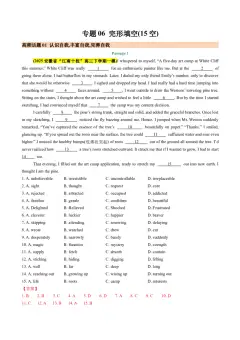
In 2022, I began learning Chinese. A year later, I found myself in Beijing. As you might expect, studying for
just one year wasn’t enough to claim

 1

 , but language capability is not necessary to immerse yourself in
the life here.
The one thing that truly

 2

  loneliness is making friends. Connecting with

 3

  through a
shared passion or leisure activities was incredibly enjoyable. It

 4

  language barriers and developed a sense
of

 5

 .
During breaks from study, I frequently hit the road to

 6

  around China. I never felt unwelcome as a
7

 . Chinese people are warm, and eager to engage in

 8

 . On the train from Beijing to Chongqing, I
talked with a Chinese couple for three hours. After I arrived, my friends took me on a

 9

  of the city. We
tasted the hot pot together while listening to the

 10


  between Chongqing and Chengdu, both famous for
their hot pot culture.
I once volunteered in Gansu to gain a deeper understanding of China’s rural areas. As teaching at a local
school, I told the students we could

 11


  connections between our cultures through our daily language
use. My favorite Chinese phrase is huxiang xuexi, which means “learning from each other”. While the students
12


  absorbed the stories of my life, I also

 13


  a great deal about China.
Everything has proved that acquiring fluent language skills is not an absolute

 14


 . I’ve met many
foreigners who have all found their own ways such as through food, sports, and games to

 15


  with and
appreciate Chinese culture.
1.A.creativity
B.efficiency
C.flexibility
D.fluency
2.A.sharpens
B.relieves
C.generates
D.accompanies
3.A.strangers
B.peers
C.locals
D.teens
4.A.got through
B.took the place of
C.went beyond
D.canceled out
5.A.unity
B.accomplishment
C.direction
D.pride
6.A.lecture
B.investigate
C.live
D.journey
7.A.visitor
B.student
C.friend
D.foreigner
8.A.conversations
B.exercise
C.activities
D.celebrations
9.A.survey
B.date
C.tour
D.ride
10.A.differences
B.features
C.highlights
D.advantages
11.A.describe
B.recall
C.revise
D.taste
12.A.casually
B.eagerly
C.slightly
D.randomly
13.A.taught
B.explored
C.explained
D.ignored
14.A.requirement
B.strength
C.trend
D.goal
15.A.compete
B.connect
C.deal
D.agree
Passage 5 语法填空
阅读下面短文,在空白处填入1 个适当的单词或括号内单词的正确形式。(2026·江西省赣州市十八县(市、
区)二十四校联考高三期中)
“Beijing Central Axis( 中轴线)”, which has been written on the UNESCO World Heritage List, became
China’s 59th World Heritage Site. It shows a whole of building complexes and archaeological sites that

 1


(govern) the overall layout of Beijing’s old city.
Stretching 7.8 kilometers north-south through

 2

  heart of Beijing, the carved property comprises 15
components,

 3

  the Bell and Drum Towers at its northern end and Yongdingmen Gate at the southern end.
The complex contains imperial palaces and gardens, ancient city management facilities, buildings for

 4
(nation) ceremonies and public use, and central axis roads remains.
This sample of city planning traces back to Kaogongji (Book of Diverse Crafts), written before 221 BCE,
5

  outlines the ceremonies and order in the planning of a capital city.
The book’s

 6

  (account) include “court in the front, market in the back”, corresponding to the
Forbidden City and the markets at the Bell and Drum Towers area, as well as “an ancestral temple on the left, an
altar(祭坛) of land and grain on the right”, indicating the Imperial Ancestral Temple and the Altar of Land and
Grain,

 7

  (locate) on the east and west sides of the Central Axis.


 8

  (construct) of the Beijing Central Axis began in the 13th century and took shape in the 16th
century. It

 9

  (undergo) constant improvement over the past seven centuries and continues

 10

(influence) Beijing’s urban development to this day.