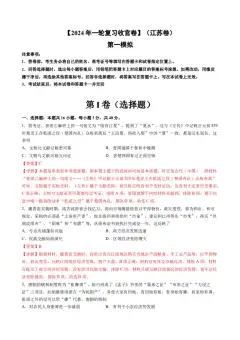
第一模拟(仿江苏卷)
2025 年高考英语一轮复习模拟卷
(原卷版)
注意事项: 1. 答题前, 考生先将自己的姓名、准考证号码填写清楚, 将条形码准确粘贴在考生信息条形码粘
贴区。
2. 选择题必须使用2B铅笔填涂; 非选择题必须使用0.5毫米黑色字迹的签字笔书写, 字体工整、笔迹清
楚。
3. 请按照题号顺序在答题卡各题目的答题区域内作答, 超出答题区域书写的答案无效; 在草稿纸、试卷上
答题无效。
4. 作图可先使用铅笔画出, 确定后必须用黑色字迹的签字笔描黑。
5. 保持卡面清洁, 不要折叠, 不要弄破、弄皱, 不准使用涂改液、修正带、刮纸刀。
第一部分 听力(共两节,满分30分)
第一节 (共5小题;每小题1.5分,满分7.5分)
听下面5段对话。每段对话后有一个小题,从题中所给的A、B、C三个选项中选出最佳选项。听完每段
对话后,你都有10秒钟的时间来回答有关小题和阅读下一小题。每段对话仅读一遍。
1.What does the woman mean?
A.She is full. B.She wants some cake. C.She doesn’t like the meal.
2.What happened to Josh’s sister yesterday?
A.She served the wrong dish.
B.She got lost with her brother.
C.She failed to behave herself in public.
3.What does the man think of Allan’s paintings?
A.Funny. B.Terrible. C.So- so.
4.Whose birthday is it today?
A.Cassie’s. B.John’s. C.Ashley’s.
5.When will the woman’s mother probably arrive?
A.At about 12:00 p.m. B.At about 3:00 p.m. C.At about 6:00 p.m.
第二节 (共15小题;每小题1.5分,满分22.5分)听下面5段对话。每段对话或独白后有一个小题,从题中所给的A、B、C三个选项中选出最佳选项。听
完每段对话后,你将时间阅读各个小题,每小题5秒钟;听完后,各小题将给出5秒钟的做答时间。每段
对话或独白读两遍。
【听第6段材料,回答第6、7题。】
6.What does the woman think the man’s problem is?
A.He refused to listen to her.
B.He’s disturbed by other things.
C.He stopped studying for long.
7.What’s the second thing the woman asks the man to avoid?
A.Music. B.The dog. C.The phone.
【听第7段材料,回答第8、9题。】
8.What are the speakers mainly talking about?
A.Danni’s mom. B.The man’s attitude. C.Doctors’ devotion.
9.How has the cat helped the woman’s mother?
A.By sending her flowers.
B.By providing company.
C.By regulating her a life.
【听第8段材料,回答第10至12题。】
10.Why is the apartment cheap?
A.It’s far from public transportation.
B.It doesn’t have a good view.
C.It doesn’t have much space.
11.What is included in the rental fee?
A.Telephone service. B.Electricity. C.Furniture.
12.What does the woman want to do next?
A.Clean the house. B.Complete the paperwork. C.Look at another apartment.
【听第9段材料,回答第13至16题。】
13.What is wrong with the leaflets?
A.It failed to convey contact information.
B.It contained many spelling mistakes.
C.It was not beautifully designed.14.What does the woman sell?
A.Furniture. B.Dogs. C.Cats.
15.Where does the conversation take place?
A.In the man’s studio. B.At the woman’s home. C.In the woman’s store.
16.What do we know about the man?
A.He is an animal lover. B.He is careless. C.He is a creative designer.
【听第10段材料,回答第17至20题。】
17.What is the main topic of the talk?
A.Yard sales. B.Chinese history. C.An ancient artwork.
18.In which city was the bowl found?
A.New Haven. B.London. C.Taipei.
19.What did the man do when he got the bowl?
A.He sent pictures of it to experts.
B.He passed it down to his children.
C.He argued with the owner over the price.
20.How much money did the bowl eventually sell for?
A.$20,000. B.$350,000. C.$721,800.
第二部分 阅读(共两节, 满分50分)
第一节(共15小题; 每小题2.5分, 满分37.5分)
阅读下列短文,从每题所给的A、B、C、D四个选项中选出最佳选项。
A
The Best Maldives Island for Your Travel Style
Every resort (度假地) in Maldives is its own private island but choosing the right one for you can be difficult. Want
to kick off your Indian Ocean holiday in style? Our guide will help you know what to look for in the hunt for your
ideal island.Waldorf Astoria Maldives Ithaafushi
You’ll never go hungry at the Waldorf Astoria Maldives Ithaafushi, which has 11 restaurants, including ones
specializing in garden-to-table cuisine. There are regular food-themed events, too — our favorites include Arabian
Night and the Twilight Seafood Barbecue.Four Seasons Resort Maldives
Considered one of the best spots in the Maldives for honeymoons, the Four Seasons Resort Maldives has a huge
range of room categories and offers a brilliant selection of packages, including Island Romance packages that
feature fantastic extras designed with couples in mind.Fairmont MaldivesThere are numerous reasons to visit the Fairmont Maldives, including the fact that it’s a great place to learn about
sustainability, whether it’s at the Sustainability Lab, where guests can turn discarded plastic bottles into jewelry or
during excursions with marine biologists from a charity created to protect sea turtles. Heritance Aarah
Heritance Aarah recently opened its Live Maldivian Village Museum, which focuses on 4,000 years of
Maldivian history. Guests can learn about the art of coral stone carving and find out why locals are known as some
of the world’s best boat builders.
To ensure you experience the Maldives’ best bits, schedule a holiday every month without fail. We’re joking,
but you get the point: think what you want to see and do, and brush up on the different areas’ seasonal selling
points.
21.Who are the target readers of the article?
A.Sports lovers. B.Travel enthusiasts. C.Wilderness explorers. D.Travel agents.
22.What do you know about the four islands recommended?
A.They are the first four most-visited sites.B.They have their own unique characteristics.
C.They are just tailored for young couples.D.They feature absolute peace and tranquility.
23.Why does the author make suggestions in the last paragraph?
A.To persuade you to journey to Maldives.B.To urge you to start a holiday early.
C.To remind you not to miss selling points.D.To help you choose the ideal island.
B
29-year-old Dim Nang Lao is a mother of a six-year-old boy in a mountainous and remote region in
northeastern Cambodia. Like many other parents in her village who marry and have children at a young age, she
used to have little knowledge about how she should look after her child to ensure he can grow healthy and strong
and reach his full potential.
But everything changed when she received Nurturing Care Parenting training from village volunteers.
Nurturing Care Parenting aims to help every child get the best possible start in life, including through healthcare,
early education and play. It also helps parents avoid violence or punishment to discipline their children.
“I learned a lot from Nurturing Care Parenting,” Dim Nang Lao says. “I learned how to care for my child’s
health, nutrition and education. I learned how to talk to him when he is wrong and comfort him when he is sad. I
learned that a child is a white paper. If I hit him, he will learn those actions from me.”
Dim Nang Lao is one of many who have benefited from the training. According to a local official named
Ang Chenda, the training has reached five villages and has improved the lives of many families. She says shewelcomes the training as many parents in the area did not fully understand what they needed to do to fully support
their children’s needs and development and often spent most of their time earning an income through farm work.
“After the training, their understanding of raising young children is far different,” Ang Chenda says. “They
are more aware of the importance of caring for their children. They take their children to the health center for
check-ups, issue birth certificates for their children and send their children to school. They also reduce violence and
use positive discipline instead.”
Dim Nang Lao says she is grateful for the opportunity to learn about positive parenting and apply it in her
daily life. “I hope that more parents in our country can receive this training and benefit from it as I do,” she adds.
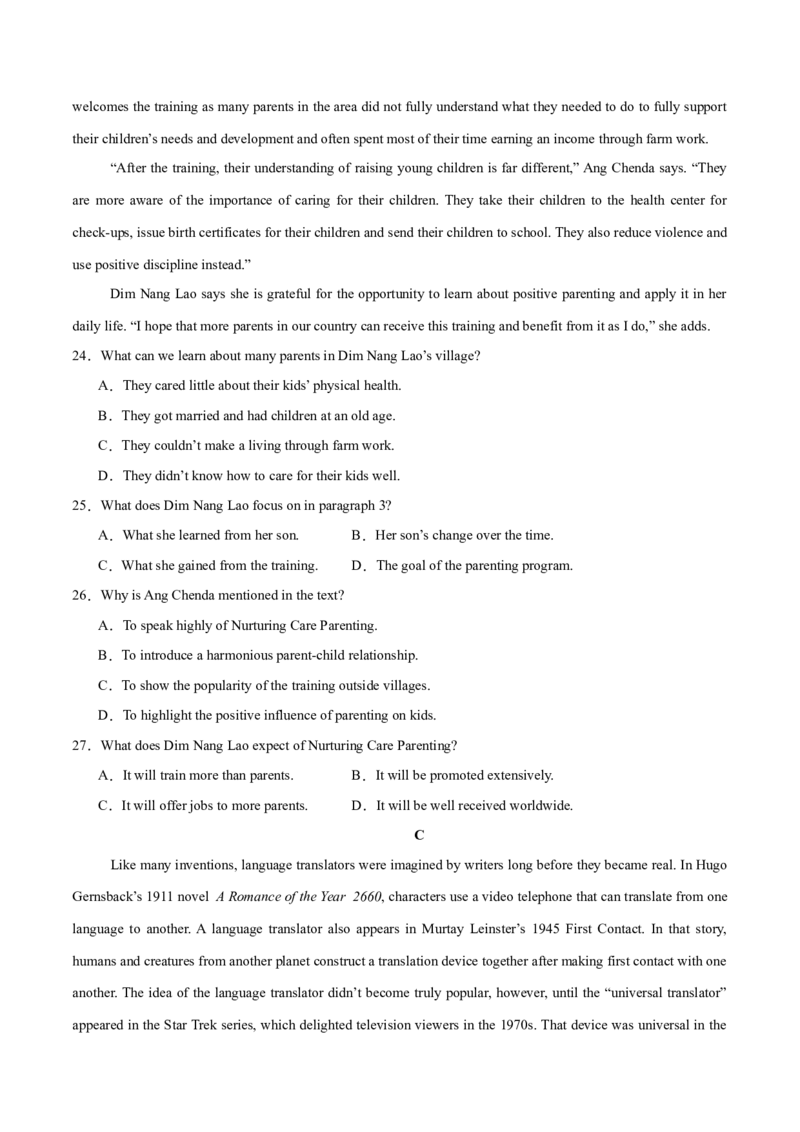
24.What can we learn about many parents in Dim Nang Lao’s village?
A.They cared little about their kids’ physical health.
B.They got married and had children at an old age.
C.They couldn’t make a living through farm work.
D.They didn’t know how to care for their kids well.
25.What does Dim Nang Lao focus on in paragraph 3?
A.What she learned from her son. B.Her son’s change over the time.
C.What she gained from the training. D.The goal of the parenting program.
26.Why is Ang Chenda mentioned in the text?
A.To speak highly of Nurturing Care Parenting.
B.To introduce a harmonious parent-child relationship.
C.To show the popularity of the training outside villages.
D.To highlight the positive influence of parenting on kids.
27.What does Dim Nang Lao expect of Nurturing Care Parenting?
A.It will train more than parents. B.It will be promoted extensively.
C.It will offer jobs to more parents. D.It will be well received worldwide.
C
Like many inventions, language translators were imagined by writers long before they became real. In Hugo
Gernsback’s 1911 novel A Romance of the Year 2660, characters use a video telephone that can translate from one
language to another. A language translator also appears in Murtay Leinster’s 1945 First Contact. In that story,
humans and creatures from another planet construct a translation device together after making first contact with one
another. The idea of the language translator didn’t become truly popular, however, until the “universal translator”
appeared in the Star Trek series, which delighted television viewers in the 1970s. That device was universal in thesense that it could translate any language that it encountered.
The first real language translator was demonstrated by engineers from the IBM company and Georgetown
University in 1954. Their machine could only translate Russian sentences into English.
Language translators have come a long way since then. Today, online translations can be accessed easily at
no cost to users. With translation apps like Google Translate or Translate, users sometimes don’t even have to look
things up. All they need to do is point their cellphone’s camera at some writing, and a translation instantly appears.
If users want to translate something being said aloud, they just turn on their phone’s microphone. All of these
features save time and effort.
Translation apps make foreign travel much easier than before. They are invaluable when it comes to
communicating with taxi drivers or hotel staff who don’t speak a traveler’s native language. But these apps are far
from perfect. Sometimes a translation makes no sense, forcing the user to guess what the translation means. At
other times, the user might not know that the translation has failed until he or she shows it to native speaker.
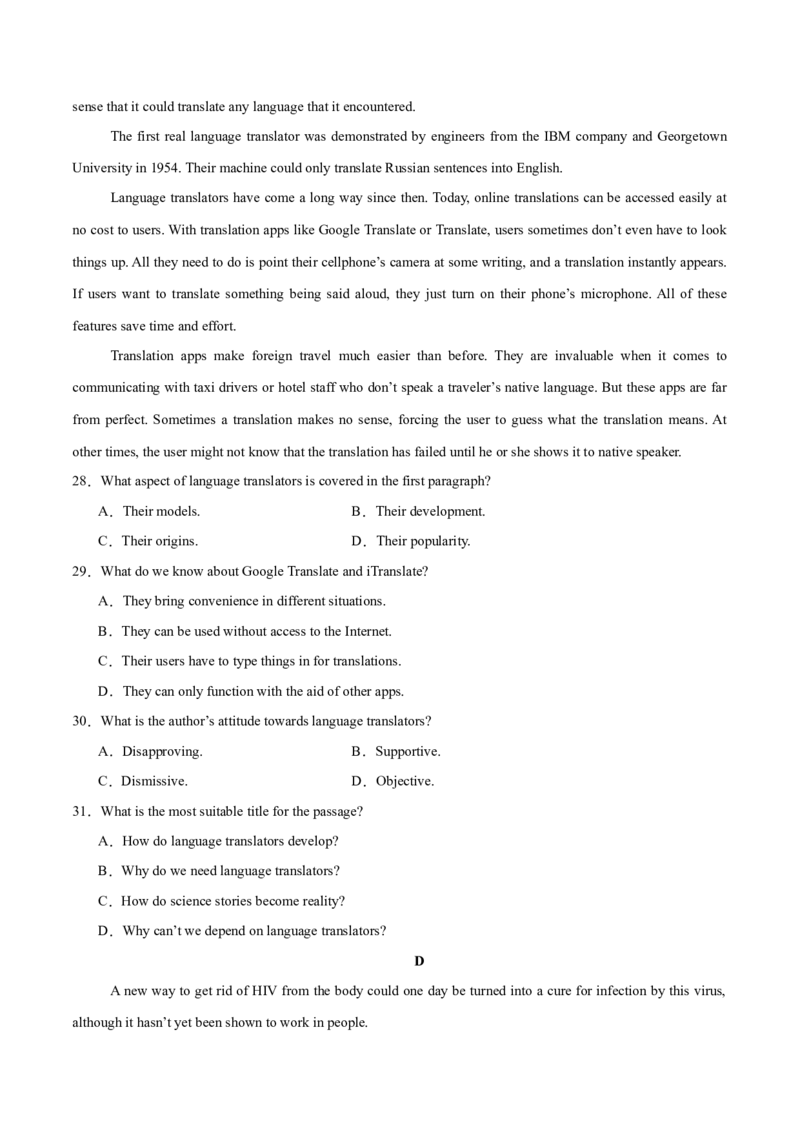
28.What aspect of language translators is covered in the first paragraph?
A.Their models. B.Their development.
C.Their origins. D.Their popularity.
29.What do we know about Google Translate and iTranslate?
A.They bring convenience in different situations.
B.They can be used without access to the Internet.
C.Their users have to type things in for translations.
D.They can only function with the aid of other apps.
30.What is the author’s attitude towards language translators?
A.Disapproving. B.Supportive.
C.Dismissive. D.Objective.
31.What is the most suitable title for the passage?
A.How do language translators develop?
B.Why do we need language translators?
C.How do science stories become reality?
D.Why can’t we depend on language translators?
D
A new way to get rid of HIV from the body could one day be turned into a cure for infection by this virus,
although it hasn’t yet been shown to work in people.The strategy uses a relatively recent genetic technique called CRISPR, which can make cuts in DNA to
introduce errors into viral genetic material within immune cells (免疫细胞). “These findings represent a key
advancement towards designing a cure strategy,” researcher Elena Herrera Carrillo at the University of Amsterdam
in the Netherlands said in a statement.
While infection with HIV was once nearly always fatal (致命的), those with the virus can now take drugs
that stop it from reproducing. This gives them a nearly normal lifespan, as long as they diligently take their
medicines every day.
But when people are first infected, some of the virus inserts its DNA into their immune cells, where it stays
dormant. If they stop taking their HIV medicines, this DNA “reawakens” and the virus starts spreading through
their immune systems again.
For a cure, we need some way of killing any dormant virus in the body. Several strategies have been tried,
but none have so far been found to work.
The latest approach uses a gene-editing system called CRISPR. Originally discovered in bacteria, this homes
in on a specific DNA sequence, making cuts in it. By changing the DNA sequence being targeted, the system can
potentially be turned into a form of gene therapy for many conditions, with the first such treatment having been
approved last year in the US and UK as a cure for sickle cell anemia.
Several groups are investigating using CRISPR which targets a gene in HIV as a way of disabling dormant
virus. Now, Carrillo and her team have shown that, when tested on immune cells in a dish, their CRISPR system
could disable all viruses, removing them from these cells. The work is due to be presented at the European
Congress of Clinical Microbiology and Infectious Diseases in Barcelona, Spain, next month.
Jonathan Stoye at the Francis Crick Institute in London says that although the results are encouraging, the
next step is trials in animals and eventually people to show the treatment can reach all the immune cells with
dormant HIV. Some of these cells are thought to reside in bone marrow, but there may be other body sites involved
too, he says. “There’s still a fair amount of uncertainty about whether there are other reservoirs in other parts of the
body,” he says.
A Californian firm called Excision BioTherapeutics has previously shown that a CRISPR-based approach
can reduce the amount of dormant virus in monkeys infected with a similar virus to HIV.
32.How does the CRISPR underlying logic?
A.Curing people who have HIV. B.Preventing virus breeding.
C.Unneeded to absorb drugs regularly. D.Changing DNA’s sequence.33.Which description is the most suitable for the underlined word “dormant” in paragraph 4?
A.Having biological activity suspended.
B.Represented on a cost of arms in a lying position with the head on the forefeet.
C.Marked by a suspension of external activity.
D.Associated with, carried out, or applied during a period of dormancy.
34.How does the group conduct their research in paragraph 7?
A.By erasing the virus into the cell. B.By testing outside the body.
C.By launching a clinical trial. D.By verifying CRISPR’s efficiency.
35.What can we infer from the last two paragraphs?
A.The treatment enables it to reach the system.
B.HIV is still living in human beings’ marrow.
C.Several functions should be investigated.
D.The strategy is still regarded as a prospect.
第二节(共5小题; 每小题2.5分, 满分12.5分)
阅读下面短文, 从短文后的选项中选出可以填入空白处的最佳选项。选项中有两项为多余选项。
Artificial Intelligence (AI) geolocation (互联网定位技术) solutions are changing the way researchers track
and monitor wildlife, enabling more powerful conservation efforts. These systems use advanced sensors, satellite
imagery, and machine learning algorithms ( 算 法 ) to gather real-time data on animal movements, habitat
preferences, and migration patterns. 36
Traditional tracking methods often rely on non-automatic tracking or inconvenient necklace-like systems,
which may cause stress and discomfort to the animals. 37 The devices can work as tags and the camera
traps can be set up remotely, which decreases human impact on wildlife.
In addition, AI-powered devices collect and analyze data precisely. Through their assistance, scientists can
gain insights into habitat choices and evaluate the effect of global warming on wild animal locations. 38
For example, by analyzing the collected data, conservationists can promote targeted habitat restoration efforts
according to the patterns and connections they discovered with the help of AI geolocation devices.
39 By monitoring animals’ behavioral changes in real-time, researchers can quickly detect signs of
environmental issues. Sudden changes in an animal’s movements could indicate threats or problems. Researchers
can then respond immediately, potentially saving the animal’s life.
Sharing geolocation data through online platforms can also help raise awareness about protecting endangeredspecies. 40 This help them feel more connected to the issues wildlife face in habitats. The bond promotes
a sense of responsibility among individuals and encourages them to contribute to wildlife conservation efforts
through various means, such as donations, volunteer work, and so on.
A.This knowledge enables them to make accurate and efficient decisions.
B.However, AI tracking does not require disturbing contact with the animals.
C.AI monitoring needs fewer battery replacements than the traditional methods.
D.The solutions have offered the following key benefits to wildlife conservation.
E.Directly engaging with conservation efforts gives people a first-hand experience.
F.The AI geolocation technology significantly reduces the need for massive fieldwork.
G.With real-time data, the AI solutions also function as an early warning for wildlife risks.
第三部分语言运用(共两节, 满分30分)
第一节(共15小题; 每小题1分, 满分15分)
阅读下面短文, 从每题所给的A、B、C、D四个选项中选出可以填入空白处的最佳选项。
In 2019, Thierry Henry, a bus driver, found there was a rise in bike thefts in his city, Reykjavik. Rather than
41 that the bike was gone forever, he decided to take matters into his own 42 . He set out to track
down the bikes and return them to their 43 owners.
The 44-year-old has helped return hundreds of stolen bikes in the past 4 years. His social media account has
over 14, 500 members and helps people track down more than just lost bikes. His page 44 to people who
have lost tools, cars and other items of high value. On top of his 45 act, Henry has helped the bike 46
to reform in the process.
Initially, Henry would deal with the thieves with anger. However, over time, he realized that most of the
thefts were driven out of 47 and other issues. He went from feeling 48 towards the thieves, to
developing empathy (同理心) for their situations. It was very tough at first. But Henry decided to try to 49
them and just talk to them.
From this moment onward, he reached out to the thieves, offering help and 50 . After the change
in his 51 , Henry found that the bike thieves began to often hand back the bikes to him. 52
, some former thieves that Henry helped now 53 him in looking for the stolen bikes.
“It’s like a 54 that has got bigger and bigger,”. says Henry. “It’s not only me. Many times,
someone spots a bike hidden in a bush and takes a picture. Then someone else 55 , ‘hey, that’s my
bike’.”Thanks to Henry, everyone’s looking out.
41.A.admit B.claim C.accept D.realize
42.A.hands B.eyes C.feet D.bodies
43.A.loyal B.honest C.rightful D.careless
44.A.belongs B.extends C.relates D.listens
45.A.cautious B.generous C.fearless D.noble
46.A.owners B.makers C.thieves D.sellers
47.A.hatred B.shame C.passion D.poverty
48.A.regretful B.negative C.guilty D.desperate
49.A.level with B.live with C.side with D.compromise with
50.A.guidance B.inspiration C.cooperation D.investment
51.A.plan B.occupation C.habit D.approach
52.A.Abruptly B.Naturally C.Unwillingly D.Amazingly
53.A.assist B.trust C.engage D.drag
54.A.dream B.snowball C.rainbow D.balloon
55.A.quotes B.writes C.comments D.announces
第二节(共10小题; 每小题1.5分, 满分15分)
阅读下面短文, 在空白处填入1个适当的单词或括号内单词的正确形式。
At my old school in Toronto, I was on the football and volleyball teams, so I was very popular and 56
(have) lots of friends. Everything changed when I was 16 years old because my parents decided to move to Florida.
The first few 57 (day) in my new school were very difficult. The class timetable was different, and the
teachers were 58 (strict) than those in my old school. Each teacher gave us a lot of homework every
night. As 59 result, my free time became limited (有限的). My homework kept me 60 busy
that I could only watch TV on Saturday nights. All the students were dressed in shorts and Tshirts instead of school
uniforms. Some kids tried to be nice 6 1 me, but I did not want to talk to 62 (they). To me,
they looked and acted funny! After a few weeks, no one even tried to talk to me anymore. I began to feel lonely.
Two months passed before I got the courage 63 (talk) to some classmates. 64 (final), I found
they were normal (正常的) people, just like me. I began to develop some relationships and even good friendships. I
learned a valuable lesson about 65 (make) friends that year.
第四部分 写作(共两节, 满分40分)
第一节(满分15分)假设你是李华,你的美国朋友Eric近期将来重庆参观三峡博物馆。请你给他写一封邮件告知参观博物馆的
安排,内容包括:
(1)博物馆近期的活动;
(2)参观的注意事项;
(3)对他到来的期待。
注意:
(1)写作词数应为80个左右;
(2)请按如下格式在答题卡的相应位置作答。
Dear Eric,
I am excited to hear about your upcoming trip to Chongqing!
____________________________________________________________________________________________
____________________________________________________________________________________________
____________________________________________________________________________________________
____________________________________________________________________________________________
___________________________
Yours,
Li Hua
第二节(满分25分)
阅读下面材料, 根据其内容和所给段落开头语续写两段, 使之构成一篇完整的短文。
I spent 15 years trying to make it in the music industry. When I was a teenager, I did any odd job to afford
time in a recording studio. I knocked at managers’ doors and sent out demo (录音样带) after demo, but I got
nowhere. In 2010, aged 27, I was doing a job in a restaurant when I wrote a song called Dream Goes On. It was a
song about never giving up. I just let out all of my frustrations at the keyboard.
Over the next five years, the music career never materialized but I persisted. Then, in 2019, I uploaded
Dream Goes On to a music-sharing website. I just wanted someone to notice my music.
Later that year, I received an email out of the blue from Music World from South Korea, requesting a license
for the song. They had chosen my song from the millions on the music-sharing website for a theme tune for one of
their shows. I was amazed and negotiated a contract for $5,000 for the use of the song and signed up straight away.
I was pretty excited, but didn’t think anything more would come of it, so I focused on my job in the restaurant.
This February, Music World organized a musical festival in Seoul and my song Dream Goes On was alsochosen as the theme tune for the festival. I watched on YouTube as my song was being played to a huge crowd of
people. It was amazing.
After three days of the festival, I was contacted by Music World and they asked if I’d like to go to Seoul to
sing Dream Goes On in a concert. They flew me out there the next day. I was welcomed like a celebrity—
everyone I met thought I was a big name in England. I had to break the news to them that I wasn’t a pop star.
注意:
1. 续写词数应为150左右;
2. 请按如下格式在相应位置作答。
I had never performed the song live, and hadn’t been on stage for years.
____________________________________________________________________________________________
____________________________________________________________________________________________
____________________________________________________________________________________________
____________________________________________________________________________________________
___________________________
After the concert, I had photographers and journalists battling to interview me.
____________________________________________________________________________________________
____________________________________________________________________________________________
____________________________________________________________________________________________
____________________________________________________________________________________________
___________________________