第1页/共12页
学科网(北京)股份有限公司
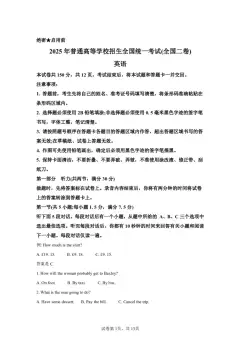
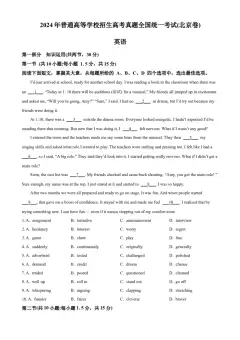
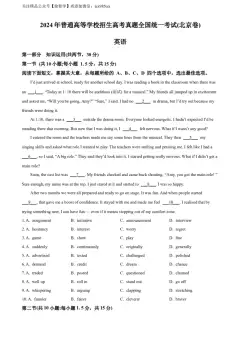
2024 年普通高等学校招生高考真题全国统一考试(北京卷)
英语
第一部分  知识运用(共两节,30 分)
第一节 (共10 小题;每小题 1. 5 分,共15 分)
阅读下面短文,掌握其大意,从每题所给的 A、B、C、D 四个选项中,选出最佳选项。
I’d just arrived at school, ready for another school day. I was reading a book in the classroom when there was
an ___1___. “Today at 1: 10 there will be auditions (面试) for a musical.” My friends all jumped up in excitement
and asked me, “Will you be going, Amy?” “Sure,” I said. I had no ___2___ in drama, but I’d try out because my
friends were doing it.
At 1:10, there was a ___3___ outside the drama room. Everyone looked energetic. I hadn’t expected I’d be
standing there that morning. But now that I was doing it, I ___4___ felt nervous. What if I wasn’t any good?
I entered the room and the teachers made me say some lines from the musical. They then ___5___ my
singing skills and asked what role I wanted to play. The teachers were smiling and praising me. I felt like I had a
___6___, so I said, “A big role.” They said they’d look into it. I started getting really nervous. What if I didn’t get a
main role?
Soon
 the cast list was ___7___. My friends checked and came back shouting, “Amy, you got the main
role! ” Sure enough, my name was at the top. I just stared at it and started to ___8___. I was so happy.
After two months we were all prepared and ready to go on stage. It was fun. And when people started
___9___, that gave me a boost of confidence. It stayed with me and made me feel ___10___. I realised that by
trying something new, I can have fun — even if it means stepping out of my comfort zone.
1. A. assignment
B. initiative
C. announcement
D. interview
2. A. hesitancy
B. interest
C. worry
D. regret
3
 A. game
B. show
C. play
D. line
4. A. suddenly
B. continuously
C. originally
D. generally
5. A. advertised
B. tested
C. challenged
D. polished
6. A. demand
B. credit
C. dream
D. chance
7. A. traded
B. posted
C. questioned
D. claimed
8. A. well up
B. roll in
C. stand out
D. go off
9. A. whispering
B. arguing
C. clapping
D. stretching


第2页/共12页
学科网(北京)股份有限公司
10. A. funnier
B. fairer
C. cleverer
D. braver
第二节(共10 小题;每小题1. 5 分,共15 分)
A
阅读下列短文,根据短文内容填空。在未给提示词的空白处仅填写1 个恰当的单词,在给出提示词的空白
处用括号内所给词的正确形式填空。
Slowing down can contribute significantly to personal growth. Taking the time ___11___ (rest) allows us to
develop a deeper sense of ___12___ (self-aware). When we slow down, we create space to reflect on our thoughts
and emotions, which helps us identify important areas of our lives and ___13___ (give) us the opportunity to
make right choices. To practise this, we need to establish clear ___14___ (boundary) in our personal and
professional life.
B
阅读下列短文,根据短文内容填空。在未给提示词的空白处仅填写1 个恰当的单词,在给出提示词的空白
处用括号内所给词的正确形式填空。
On April 5, 2024, John Tinniswood ___15___ (name) the world’s oldest living man. And when ___16___
(ask) about his new title, he shared the secret: moderation (适度). Tinniswood, ___17___ doesn’t smoke and
rarely drinks, credited moderation for helping him stay healthy during his long life. “If you eat too much or do too
much of anything, you’re going to suffer eventually,” he said.
C
阅读下列短文,根据短文内容填空。在未给提示词的空白处仅填写1 个恰当的单词,在给出提示词的空白
处用括号内所给词的正确形式填空。
One day, I saw a boy walking along George Street with an armful of books. I thought ___18___ myself,
“Why would he carry all his books? ” Just then, some kids ran at him, ___19___ (knock) his books out of his
arms. His glasses went flying and landed in the grass. My heart went out to him, and I ___20___ (jog) over to
him. As I handed him the glasses, he looked at me and said, “Thanks!”
第二部分  阅读理解(共两节,38 分)
第一节 (共14 小题;每小题2 分,共28 分)
阅读下列短文,从每题所给的 A、B、C、D 四个选项中,选出最佳选项。
A
The Language Exchange Programme allows students in pairs to communicate in two different languages they
wish to share and learn each week. Students record short entries after each partner meeting noting the language


第3页/共12页
学科网(北京)股份有限公司
skills practised and the topics discussed. Each pair of students meets three times throughout the term with a teacher
who decides if the exchange is effective. Students who successfully complete the programme will receive one
credit each.
Requirements for completion:
•One welcoming session on the second Friday of the term
•18 weekly one-hour pair meetings
•Weekly progress reports for all pair meetings
•At least three pair-teacher meetings
•One five-minute final video
Sign up!
The sign-up and registration process is as follows:
•Students sign up and indicate the languages they can share and languages they are interested in learning.
•Based on the information entered by each student, potential pairs are identified.
•Proficiency (熟练) levels are confirmed through coursework or placement tests.
•Once a pair has been determined to be suitable, the students will be contacted individually with a special
permission number to register for the programme.
Reminders:
Signing up for the programme does not automatically mean that you will be able to register and participate.
Pairs are matched by languages of interest and proficiency levels. Since there are many factors involved in the
pairing process
 not all students who sign up will be matched with a partner and be able to register for the
programme.
21. In the programme, students will _________.
A. chair daily meetings
B. evaluate the exchange
C. meet teachers each week
D. practise their language skills
22. To complete the programme, students are required to _________.
A. development tests
B. participate in pair meetings
C. welcome new students
D. work on weekly videos
23
 What do students need to do during the registration?
A. Indicate their languages of interest.
B. Select their own coursework.
C. Make individual contact.
D. Choose their partners.
B


第4页/共12页
学科网(北京)股份有限公司
When I was a little girl, I liked drawing, freely and joyously making marks on the walls at home. In primary
school, I learned to write using chalks. Writing seemed to be another form of drawing. I shaped individual letters
into repeating lines, which were abstract forms, delightful but meaningless patterns.
In secondary school, art was my favourite subject. Since I loved it so much I thought I was good at it. For the
art O-level exam I had to present an oil painting. I found it difficult, but still hoped to pass. I failed, with a low
grade. I’d been over-confident. Now I’d been declared talentless.
But other channels of creativity stayed open: I went on writing poems and stories. Still, I went to exhibitions
often. I continued my habitual drawing, which I now characterised as childish doodling (乱画). In my 30s, I made
painter friends and learned new ways of looking at art. However, I couldn’t let myself have a go at actually doing it.
Though these new friends were abstract painters using oil paints, or were printmakers or sculptors, I took oil
painting as the taboo (禁忌) high form I wasn’t allowed to practice.
     One night, in my early 40s, I dreamed that a big woman in red approached me, handed me a bag of
paints, and told me to start painting. The dream felt so authoritative that it shook me. It was a form of energy,
giving me back something I’d lost. Accordingly, I started by experimenting with water colours. Finally, I bought
some oil paints.
Although I have enjoyed breaking my decades-long taboo about working with oil paints, I have discovered I
now prefer chalks and ink. I let my line drawings turn into cartoons I send to friends. It all feels free and easy. Un-
anxious. This time around, I can accept my limitations but keep going.
Becoming a successful painter calls for being resolute. I realised I was always afraid of wanting too much.
That dream reminded me that those fears and desires could encourage me to take risks and make experiments.
24. How did the author feel about the result of the art exam?
A. Scared.
B. Worried.
C. Discouraged.
D. Wronged.
25. In her 30s, the author _________.
A. avoided oil painting practice
B. sought for a painting career
C. fancied abstract painting
D. exhibited child paintings
26. Which word would best describe the author’s dream?
A. Confusing.
B. Empowering.
C. Disturbing.
D. Entertaining.
27. What can we learn from this passage?
A. Actions speak louder than words.
B. Hard work is the mother of success.


第5页/共12页
学科网(北京)股份有限公司
C. Dreams are the reflections of realities.
D. Creative activities involve being confident.
C
The notion that we live in someone else’s video game is irresistible to many. Searching the term “simulation
hypothesis” (模拟假说) returns numerous results that debate whether the universe is a computer simulation — a
concept that some scientists actually take seriously. Unfortunately, this is not a scientific question. We will probably
never know whether it’s true. We can, instead, use this idea to advance scientific knowledge.
The 18th-century philosopher Kant argued that the universe ultimately consists of things-in-themselves that
are unknowable. While he held the notion that objective reality exists, he said our mind plays a necessary role in
structuring and shaping our perceptions. Modern sciences have revealed that our perceptual experience of the world
is the result of many stages of processing by sensory systems and cognitive (认知的) functions in the brain. No one
knows exactly what happens within this black box. If empirical (实证的) experience fails to reveal reality,
reasoning won’t reveal reality either since it relies on concepts and words that are contingent on our social,
cultural and psychological histories. Again, a black box.
So, if we accept that the universe is unknowable, we also accept we will never know if we live in a computer
simulation. And then, we can shift our inquiry from “Is the universe a computer simulation? ” to “Can we model
the universe as a computer simulation? ” Modelling reality is what we do. To facilitate our comprehension of the
world, we build models based on conceptual metaphors (隐喻) that are familiar to us. In Newton’s era, we
imagined the universe as a clock. In Einstein’s, we uncovered the standard model of particle (粒子) physics.
Now that we are in the information age
 we have new concepts such as the computer, information
processing, virtual reality, and simulation. Unsurprisingly, these new concepts inspire us to build new models of the
universe. Models are not the reality, however. There is no point in arguing if the universe is a clock, a set of
particles or an output of computation. All these models are tools to deal with the unknown and to make discoveries.
And the more tools we have, the more effective and insightful we can become.
It can be imagined that comparable to the process of building previous scientific models, developing the
“computer simulation” metaphor-based model will also be a hugely rewarding exercise.
28. What does the author intend to do by challenging a hypothesis?
A. Make an assumption.
B. Illustrate an argument.
C. Give a suggestion.
D. Justify a comparison.
29. What does the phrase “contingent on” underlined in Paragraph 2 probably mean?
A. Accepted by.
B. Determined by.
C. Awakened by.
D. Discovered by.


第6页/共12页
学科网(北京)股份有限公司
30. As for Kant’s argument, the author is _________.
A. appreciative
B. doubtful
C. unconcerned
D. disapproving
31. It is implied in this passage that we should _________.
A. compare the current models with the previous ones
B. continue exploring the classical models in history
C. stop arguing whether the universe is a simulation
D. turn simulations of the universe into realities up.
D
Franz Boas’s description of Inuit (因纽特人) life in the 19th century illustrates the probable moral code of
early humans. Here, norms (规范) were unwritten and rarely expressed clearly, but were well understood and taken
to heart. Dishonest and violent behaviours were disapproved of; leadership, marriage and interactions with other
groups were loosely governed by traditions. Conflict was often resolved in musical battles. Because arguing angrily
leads to chaos, it was strongly discouraged. With life in the unforgiving Northern Canada being so demanding, the
Inuit’s practical approach to morality made good sense.
The similarity of moral virtues across cultures is striking, even though the relative ranking of the virtues may
vary with a social group’s history and environment. Typically, cruelty and cheating are discouraged, while
cooperation, humbleness and courage are praised. These universal norms far pre-date the concept of any moralising
religion or written law. Instead, they are rooted in the similarity of basic human needs and our shared mechanisms
for learning and problem solving. Our social instincts (本能) include the intense desire to belong. The approval of
others is rewarding, while their disapproval is strongly disliked. These social emotions prepare our brains to shape
our behaviour according to the norms and values of our family and our community. More generally, social instincts
motivate us to learn how to behave in a socially complex world.
The mechanism involves a repurposed reward system originally used to develop habits important for self-care.
Our brains use the system to acquire behavioural patterns regarding safe routes home, efficient food gathering and
dangers to avoid. Good habits save time, energy and sometimes your life. Good social habits do something similar
in a social context. We learn to tell the truth, even when lying is self-serving; we help a grandparent even when it is
inconvenient. We acquire what we call a sense of right and wrong.
Social benefits are accompanied by social demands: we must get along, but not put up with too much. Hence
self-discipline is advantageous. In humans, a greatly enlarged brain boosts self-control, just as it boosts problem-
solving skills in the social as well as the physical world. These abilities are strengthened by our capacity for


第7页/共12页
学科网(北京)股份有限公司
language, which allows social practices to develop in extremely unobvious ways.
32. What can be inferred about the forming of the Inuit’s moral code?
A. Living conditions were the drive.
B. Unwritten rules were the target.
C. Social tradition was the basis.
D. Honesty was the key.
33. What can we learn from this passage?
A. Inconveniences are the cause of telling lies.
B. Basic human needs lead to universal norms.
C. Language capacity is limited by self-control.
D. Written laws have great influence on virtues.
34. Which would be the best title for this passage?
A. Virtues: Bridges Across Cultures
B. The Values of Self-discipline
C. Brains: Walls Against Chaos
D. The Roots of Morality
第二节(共5 小题;每小题2 分,共10 分)
根据短文内容,从短文后的七个选项中选出能填入空白处的最佳选项。选项中有两项为多余
选项。
If you want to develop maximum credibility (可信性), is it better to be a hedgehog (刺猬) or a fox? According
to Isaiah Berlin, the hedgehog knows one thing very well, and the fox knows a lot of things.
Is there a clear advantage of one style over the other? Hedgehog thinkers tend to answer yes. ___35___ And
they are usually very credible in doing so. According to Jim Hart, the “hedgehog concept” is one of the factors that
lead companies to greatness. They focus on one thing and do it really well. They figure out what they are good at.
___36___ The hedgehog concept makes perfect sense for companies.
___37___ Philip Tate has studied the track records of those folks on the Sunday talk shows who make
predictions about what will happen. He has found that hedgehogs are not only wrong more often than foxes, but
that they are less likely to recognise or admit that they are wrong when events do not match their predictions.
The advantage that foxes have is that they are more likely to seek out new information from a broader range of
sources, and are comfortable with uncertainty and new information. ___38___ They try to include it in their
viewpoint rather than to exclude it from their thinking. They also have a clearer estimation of what they know and
don’t know.
So, which is better? The question can be answered in a foxy hedgehog style. ___39___ The choice between
being a hedgehog or a fox is a false trade-off. The most effective way to go through life is to try to be that rare
mixture known as foxy hedgehog.
A. In other words, there are clear advantages for each.
B. They are more likely to remember people’s mistakes.


第8页/共12页
学科网(北京)股份有限公司
C. Hence, they have the advantage of clarity and confidence.
D. But there can be a downside to concentration on one big thing.
E. However, hedgehogs remain open to others’ reactions and inputs.
F. When something is contradictory to their view, they don’t treat it as exceptional.
G. They come down squarely on one side or the other and fully support their position.
第三部分  书面表达(共两节,32 分)
第一节 (共4 小题;第40、41 题各2 分,第42 题3 分,第43 题5 分,共12 分)
阅读下面短文,根据题目要求用英文回答问题。
Growing up, I idealised independence. I always wanted my own efforts to be enough. When I decided to
pursue a postgraduate degree, I wanted to develop a novel research programme and quickly establish myself as an
independent scientist. But I was unrealistically optimistic about what I could achieve.
As I began designing experiments, my committee members warned me about the challenges I would face. But
my need for independence drove me to push forward with my research plan. As a result, the first four years of my
postgraduate career were defined by a series of failures.
During my second year, I failed my comprehensive exam because my proposal was unclear. During my third
year, I discovered that after treating thousands of seeds, I obtained just one plant I could use for experiments. By
my fourth year, my desperation to succeed overshadowed my desire for independence.
My adviser and I devised (想出) a somewhat unusual solution: I would spend three months in a collaborating
(合作的) lab to obtain specialised training. I worked extensively with other students, constantly asked questions,
and helped with ongoing projects to learn everything I could. Finally, I conducted an elegant experiment that would
not have been possible without the help of the members in the lab.
My adviser saw this experience as a groundbreaking success, emphasising the collaborating skills I acquired.
A few months later, when I repeated the experiment in my home lab, I produced more publishable data. By learning
when to ask for help, I eventually found myself on the way to becoming an independent scientist.
40. In the beginning, what drove the author to push forward with the research plan?
____________________________________________________________________________________________
___
41. What was the solution by the adviser and the author after those repeated failures?
____________________________________________________________________________________________
___


第9页/共12页
学科网(北京)股份有限公司
42. Please decide which part is false in the following statement, then underline it and explain why.
> The adviser considered the author’s experience in the lab a groundbreaking success because publishable data
had been produced.
____________________________________________________________________________________________
___
43. From this story, what can you learn about “independence”? (In about 40 words)
____________________________________________________________________________________________
___
第二节 (20 分)
44. 假设你是红星中学高三学生李华。你的外国好友Jim 准备给其校报的Asia Today 栏目投稿。得知今年
新中国成立75 周年,他打算重点介绍中国的发展成就,发来邮件询问你的建议。请你用英文给他回复,内
容包括:
(1)建议投稿内容;
(2)就以上建议简要说明理由。
注意:(1)词数100 左右;
(2)开头和结尾已给出,不计入总词数。
Dear Jim,
____________________________________________________________________________________________
____________________________________________________________________________________________
____________________________________________________________________________________________
____________________________________________________________________________________________
____________________________________________________________________________________________
_______________
Yours,
Li Hua


第10页/共12页
学科网(北京)股份有限公司
2024 年普通高等学校招生高考真题全国统一考试(北京卷)
英语
第一部分  知识运用(共两节,30 分)
第一节 (共10 小题;每小题 1. 5 分,共15 分)
阅读下面短文,掌握其大意,从每题所给的 A、B、C、D 四个选项中,选出最佳选项。
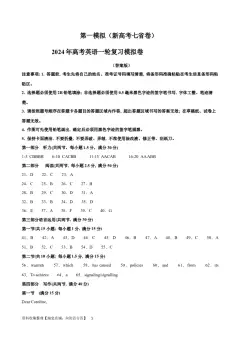
【1~10 题答案】
【答案】1. C    2. B    3. D    4. A    5. B    6. D    7. B    8. A    9. C    10. D
第二节(共10 小题;每小题1. 5 分,共15 分)
A
【11~14 题答案】
【答案】11. to rest
12. self-awareness
13. gives    14. boundaries
B
【15~17 题答案】
【答案】15. was named
16. asked    17. who
C
【18~20 题答案】
【答案】18. to    19. knocking
20. jogged
第二部分  阅读理解(共两节,38 分)
第一节 (共14 小题;每小题2 分,共28 分)
阅读下列短文,从每题所给的 A、B、C、D 四个选项中,选出最佳选项。
A
【21~23 题答案】
【答案】21. D    22. B    23. A
B
【24~27 题答案】


第11页/共12页
学科网(北京)股份有限公司
【答案】24. C    25. A    26. B    27. D
C
【28~31 题答案】
【答案】28. C    29. B    30. A    31. C
D
【32~34 题答案】
【答案】32. A    33. B    34. D
第二节(共5 小题;每小题2 分,共10 分)
根据短文内容,从短文后的七个选项中选出能填入空白处的最佳选项。选项中有两项为多余
选项。
【35~39 题答案】
【答案】35. G    36. C    37. D    38. F    39. A
第三部分  书面表达(共两节,32 分)
第一节 (共4 小题;第40、41 题各2 分,第42 题3 分,第43 题5 分,共12 分)
【40~43 题答案】
【答案】40. The need to be recognized as an independent scientist.
41. The author would spend three months in a collaborating lab to obtain specialised training.
42. The adviser considered the author’s experience in the lab a groundbreaking success because publishable data
had been produced.

    It is because the author had acquired the collaborating skills by working with others there so
that the adviser considered the author’s experience in the lab a groundbreaking success.
43. In the story, success in becoming an independent scientist was ultimately achieved through collaboration, adaptive
learning, and resilience in the face of setbacks. From the story, we learn that while independence is initially idealised
and pursued passionately, true independence often involves recognizing the value of collaboration and learning than
to seek help. (答案言之有理即可)
第二节 (20 分)
【44 题答案】
【答案】Dear Jim,
It’s great to hear you’re planning to write about China’s achievements on the occasion of the 75th anniversary
of the founding of this country. Here are a few suggestions for your article.
To begin with, talk about China’s economic growth and technological advancements, which are the highlights


第12页/共12页
学科网(北京)股份有限公司
in the past few decades. Then, projects like the Belt and Road Initiative make a good topic to discuss because it
showcases China’s determination to build a shared future with the world. In addition, you can also mention China’s
role in helping solving global issues such as the global warming, offering a more comprehensive view.
Looking forward to reading your article!
Yours,
Li Hua