高中英语重难点词汇辨析汇总(讲义)
Lesson 18 词汇 I
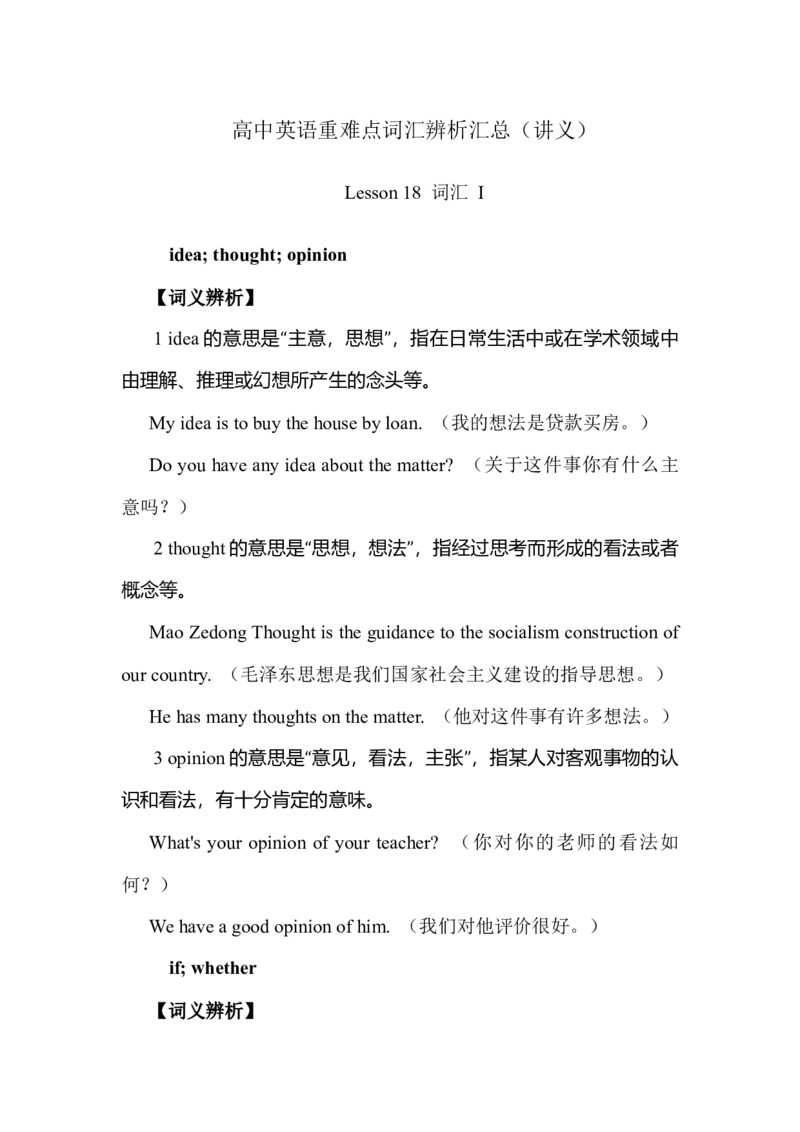
idea; thought; opinion
【词义辨析】
1 idea
“
”
的意思是主意,思想,指在日常生活中或在学术领域中
由理解、推理或幻想所产生的念头等。
My idea is to buy the house by loan. (我的想法是贷款买房。)
Do you have any idea about the matter? (关于这件事你有什么主
意吗?)
2 thought
“
”
的意思是思想,想法,指经过思考而形成的看法或者
概念等。
Mao Zedong Thought is the guidance to the socialism construction of
our country. (毛泽东思想是我们国家社会主义建设的指导思想。)
He has many thoughts on the matter. (他对这件事有许多想法。)
3 opinion
“
”
的意思是意见,看法,主张,指某人对客观事物的认
识和看法,有十分肯定的意味。
What's your opinion of your teacher? (你对你的老师的看法如
何?)
We have a good opinion of him. (我们对他评价很好。)
if; whether
【词义辨析】
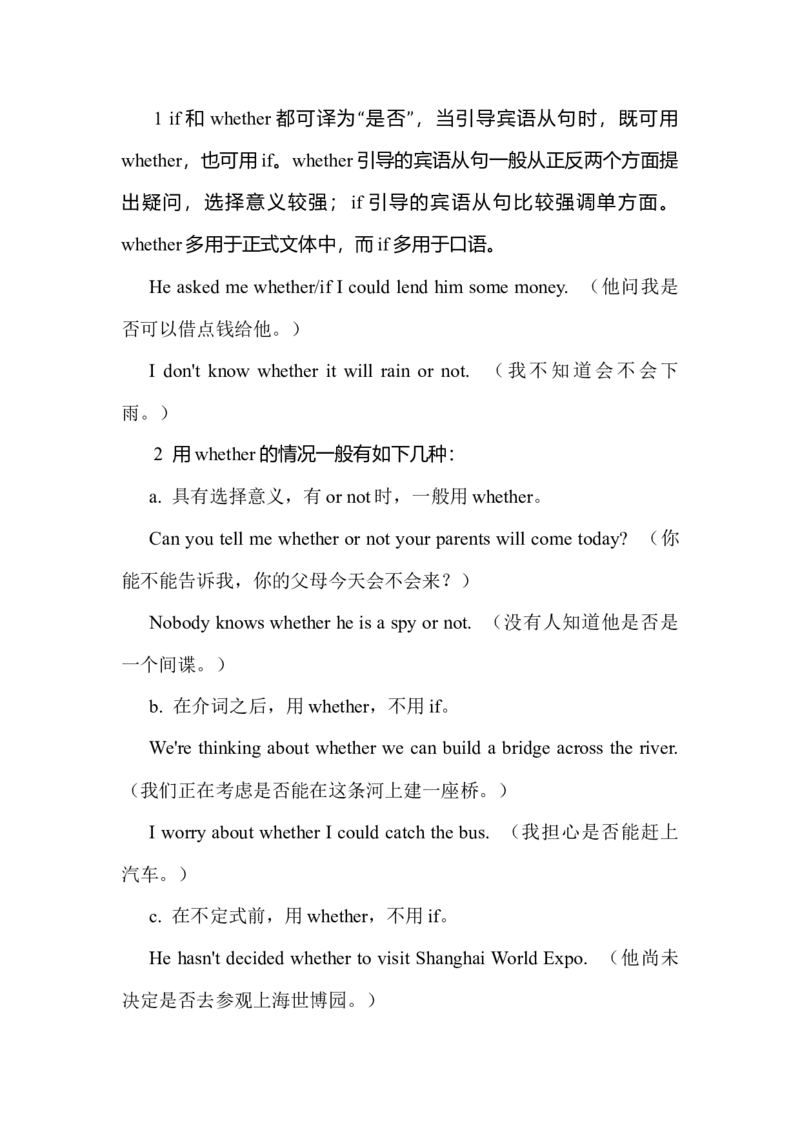
1 if 和whether
“
”
都可译为是否,当引导宾语从句时,既可用
whether,也可用if。whether 引导的宾语从句一般从正反两个方面提
出疑问,选择意义较强;if 引导的宾语从句比较强调单方面。
whether 多用于正式文体中,而if 多用于口语。
He asked me whether/if I could lend him some money. (他问我是
否可以借点钱给他。)
I don't know whether it will rain or not. (我不知道会不会下
雨。)
2 用whether 的情况一般有如下几种:
a. 具有选择意义,有or not 时,一般用whether。
Can you tell me whether or not your parents will come today? (你
能不能告诉我,你的父母今天会不会来?)
Nobody knows whether he is a spy or not. (没有人知道他是否是
一个间谍。)
b. 在介词之后,用whether,不用if。
We're thinking about whether we can build a bridge across the river.
(我们正在考虑是否能在这条河上建一座桥。)
I worry about whether I could catch the bus. (我担心是否能赶上
汽车。)
c. 在不定式前,用whether,不用if。
He hasn't decided whether to visit Shanghai World Expo. (他尚未
决定是否去参观上海世博园。)
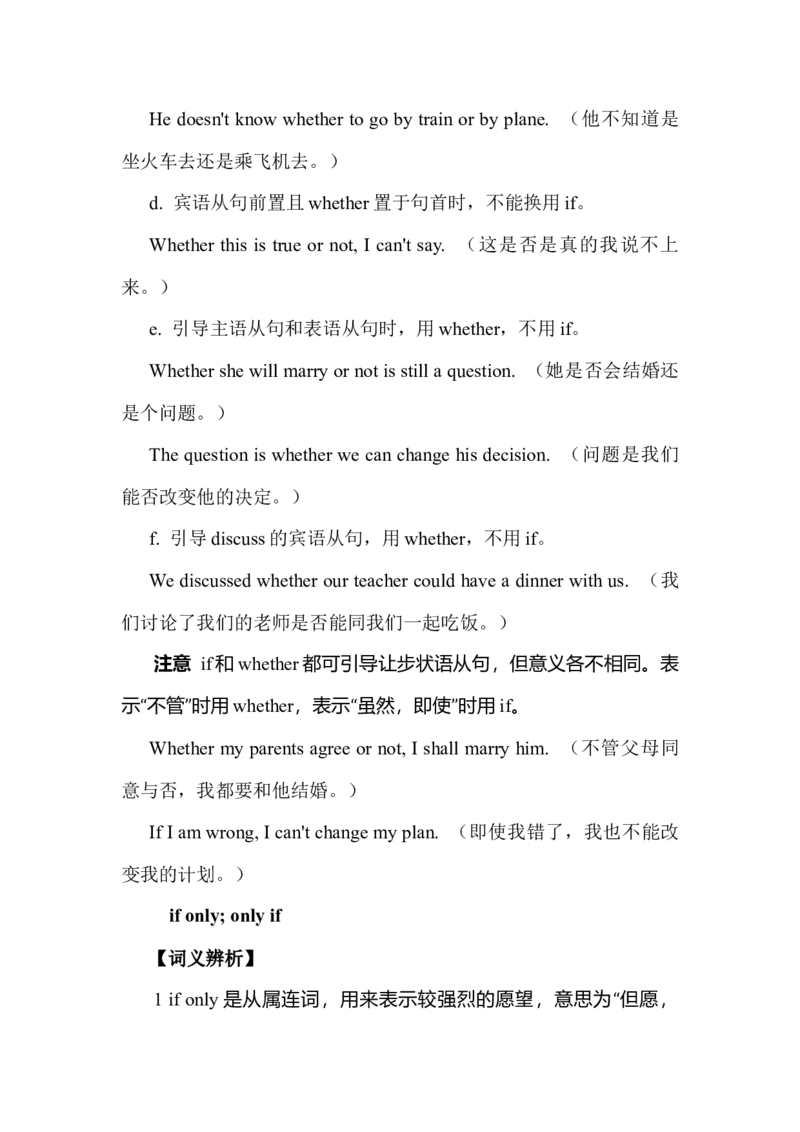
He doesn't know whether to go by train or by plane. (他不知道是
坐火车去还是乘飞机去。)
d. 宾语从句前置且whether 置于句首时,不能换用if。
Whether this is true or not, I can't say. (这是否是真的我说不上
来。)
e. 引导主语从句和表语从句时,用whether,不用if。
Whether she will marry or not is still a question. (她是否会结婚还
是个问题。)
The question is whether we can change his decision. (问题是我们
能否改变他的决定。)
f. 引导discuss 的宾语从句,用whether,不用if。
We discussed whether our teacher could have a dinner with us. (我
们讨论了我们的老师是否能同我们一起吃饭。)
注意 if 和whether 都可引导让步状语从句,但意义各不相同。表
“
”
示不管时用whether
“
”
,表示虽然,即使时用if。
Whether my parents agree or not, I shall marry him. (不管父母同
意与否,我都要和他结婚。)
If I am wrong, I can't change my plan. (即使我错了,我也不能改
变我的计划。)
if only; only if
【词义辨析】
1 if only
“
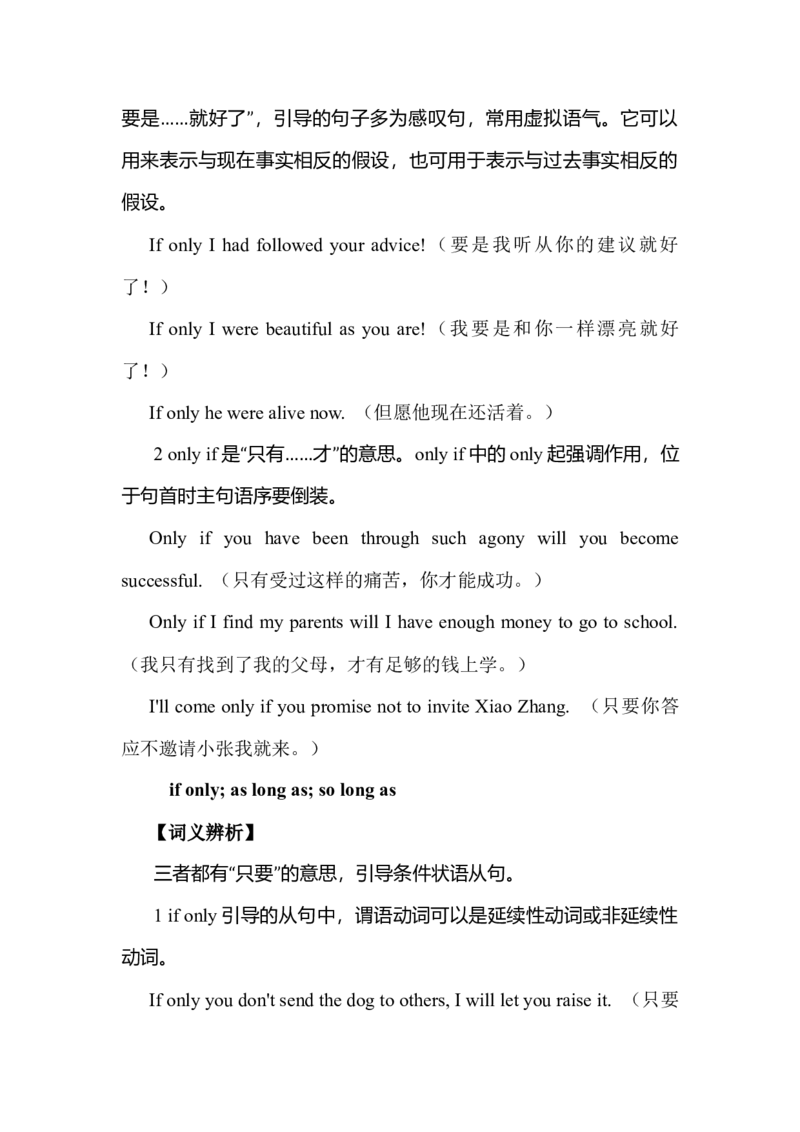
是从属连词,用来表示较强烈的愿望,意思为但愿,
……
”
要是
就好了,引导的句子多为感叹句,常用虚拟语气。它可以
用来表示与现在事实相反的假设,也可用于表示与过去事实相反的
假设。
If only I had followed your advice! (要是我听从你的建议就好
了!)
If only I were beautiful as you are!(我要是和你一样漂亮就好
了!)
If only he were alive now. (但愿他现在还活着。)
2 only if
“
……
”
是只有
才的意思。only if 中的only 起强调作用,位
于句首时主句语序要倒装。
Only if you have been through such agony will you become
successful. (只有受过这样的痛苦,你才能成功。)
Only if I find my parents will I have enough money to go to school.
(我只有找到了我的父母,才有足够的钱上学。)
I'll come only if you promise not to invite Xiao Zhang. (只要你答
应不邀请小张我就来。)
if only; as long as; so long as
【词义辨析】
“
”
三者都有只要的意思,引导条件状语从句。
1 if only 引导的从句中,谓语动词可以是延续性动词或非延续性
动词。
If only you don't send the dog to others, I will let you raise it. (只要
你不把这条狗送给别人,我就让你养它。)
If only I have any chance, I shall try again. (只要有机会,我将再
尝试一下。)
2 as long as 等于so long as,其引导的从句中,谓语动词必须是
延续性动词,可以与if only 替换。
As long as it doesn't rain we can go. (只要不下雨,我们就可以
去。)
As (So) long as you need me, I'll stay. (只要你需要我,我就留
下。)
As long as you do your best, we'll be happy. (只要你尽力,我们就
满意了。)
注意 as long as
“
……
”
还可以表示与
一样长(久)的意思。
This river is as long as that one. (这条河与那条河一条长。)
The elephant's nose is as long as that stick. (这头象的鼻子和那根
棍子一样长。)
ill; sick
【词义辨析】
“
”
两者都有生病的之意,但用法不完全相同。
1 ill
“
”
表示生病的,有病的时,一般用作表语,不能作定语; 而
sick 既可以作表语又可以作定语。
The nurse is looking after her sick mother. (护士正在照顾她生病
的母亲。)
He has been ill /sick for many years. (他已经患病多年。)
2 sick
“
”
有恶心的,厌倦的之意,而ill
“
作定语修饰名词时是坏
”
的,邪恶的。
The smell makes me sick. (这气味使我感到恶心。)
My neighbor has an ill name. (我的邻居名声很坏。)
His father is an ill man. (他的爸爸是一个邪恶的人。)
【正误比较】
他是一个病人。
【错误】 He is an ill man.
【正确】 He is a sick man.[ill
“
”
表示生病的意思时不能作定语。]
immediately; at once; right away; right now
【词义辨析】
“
”
四者都有立即,马上的意思,区别细微,有时可以互换。
1 immediately
“
”
经常用在口语中,并不含有现在就做的意思,可
以相对拖后一点点时间。
You must do it immediately after lunch. (你要在午饭后立刻去做
这件事。)[不是现在,而是在午饭后立刻去做。]
He wanted you to come to see him immediately after school. (他要
你放学后马上来见他。)[不是现在,而是一放学就去。]
2 at once 表示立即做,几乎没有任何拖延。
Come here at once!(马上来这!)
The teacher asked him to fetch some money at once. (老师要他立
即去取钱。)
3 right away

和right now
“
”
的用法几乎相同,强调现在就得做,
和at once 有时可以互换。
If you find the key to the door, let me know right away. (如果你找
到了门钥匙,请立即告诉我。)
Don't have any hesitation, please start to work right now. (不要犹
豫了,请立即开始工作。)
in a sense; in all senses; in no sense
【词义辨析】
1 in a sense
“
”
的意思是在某种意义上。
Failure is a good thing in a sense. (就某种意义而言,失败也是一
件好事。)
It is true that arithmetic is, in a sense, a language. (确实,算术在
某种意义上来说是一种语言。)
The computer is harmful to health in a sense. (就某种意义来说,
电脑对健康是有害的。)
2 in all senses
“
”
的意思是在任何意义上说。
It is quite necessary for a college student to master some skills in all
senses. (从任何意义上说,一个大学生学习一些技能是相当必要
的。)
My success is owing to you in all senses. (不论从哪一方面来说,
我的成功都得归功于你。)
3 in no sense
“
”
的意思是绝不是,决非。
He is in no sense a good kid. (他绝不是一个好孩子。)
He was in no sense a political prisoner, but a gangster and racketeer.
(他绝不是一个政治犯,而是一个歹徒和敲诈勒索犯。)
in a word; in words; in other words
【词义辨析】
1 in a word
“
”
的意思是总之,对前面的事情概括、总结,常位于
句首。
In a word, she is a good teacher. (总之,她是一位好老师。)
In a word, we must learn law well. (总之,我们必须学好法
律。)
2 in words
“
”
的意思是用语言。
I don't know how to express my thankfulness in words. (我不知如
何用言语来表达我的感激之情。)
He didn't express his idea in words. (他没有用语言表达观点。)
3 in other words
“
”
意思是换句话说,也就是说。
In other words, when the car is running at 120 kilometers per hour,
you must be very careful. (换句话说,当车速为每小时一百二十公
里时,你必须小心了。)
In other words, you must finish the plan before May Day. (换句话
说,你必须在五一前完成计划。)
in case; in case of; in the case of
【词义辨析】
1 in case
“
”
的意思是假使,以防万一,免得,后面引导条件状语
从句。
In case she doesn't come, let me know immediately. (假使她不来
了,立刻告诉我。)
Put the money into your bag in case it is stolen. (把钱放到你包
里,以防被偷。)
2 in case of
“
……
”
的意思是以防
,万一,后面接名词。
Take your umbrella in case of rain. (带上雨伞,以防下雨。)
Prepare a boat in case of flood. (准备一条船以防洪水。)
3 in the case of
“
……
……
”
的意思是就
来说,至于,在
情况下。
In the case of learning English, misconceptions persist. (在英语学
习方面,有些人还是存有错误观念。)
In the case of a college student, elementary training is easy. (就一
个大学生而言,初级训练并不难。)
in charge of; in the charge of; in charge
【词义辨析】
1 in charge of
“
”
的意思是负责,主管,主语一般为人。
He is in charge of the factory as an engineer. (作为一名工程师,
他负责这家工厂。)
He is in charge of the documents. (他负责这些文件工作。)
2 in the charge of
“
……
……
”
的意思是被
管理,在
管理之下,主语一
般为物。
The design of the railway is in the charge of John. (这条铁路的设
计由约翰负责。)
This class is in the charge of her. (这个班由她来负责。)
3 in charge
“
”
意为负责,看管,一般用作表语或后置定语,句子
的主语一般应是表示人的名词或代词,charge 可以受形容词修饰。
The old man was in complete charge while the manager was on
holiday. (那个老人在经理度假时负全责。)
The person in overall charge was Tom. (总负责人是汤姆。)
in class; in the class
【词义辨析】
1 in class 表示在课堂上或者在上课,指正在上课。
The students are all in class now. (现在,所有的学生都在上
课。)
Don't eat in class. (上课时不要吃东西。)
2 in the class 表示在班级里,指在教室里。
All the students were in the class when the explosion happened. (爆
炸发生时,所有的学生都在教室里。)
The children are all in the class because it is raining. (因为下雨,
孩子们都在教室里。)
in future; in the future; for the future
【词义辨析】
1 in future
“
”
的意思是今后,以后,常指离现在较近的一段将来
时间,相当于from now on。
Don't be late in future. (以后别再迟到了。)
You'd better not disturb him in future. (你今后最好别打扰他
了。)
2 in the future
“
”
的意思是将来,在将来,常指较远的一段将来时
间,在句中作时间状语。
He determines to become a doctor in the future. (他决心将来成为
一名医生。)
He'll get married in the near future. (在不久的将来他就会结
婚。)
3 for the future
“
”
“
”
的意思是为将来,作今后的意思时,可以与in
future 互换使用。
For the future, we shall have to read more books about information.
(今后,我们必须多读点信息方面的书籍。)
It is necessary to save some money for the future. (为未来存钱是
必要的。)
in hospital; in the hospital
【词义辨析】
1 in hospital
“
”
的意思是住院。
My teacher is in hospital. (我的老师生病住院了。)
The boss was in hospital, so his staff went to see him. (老板住院
了,所以员工们去看望他。)
2 in the hospital
“
”
指在医院里。
He lives in the hospital because his mother is ill. (他住在医院,因
为他妈妈病了。)
His mother works in the hospital. (他的妈妈在医院里工作。)
in order; in order that; in order to
【词义辨析】
1 in order
“
”
的意思是按顺序地,整齐地,常在句中作状语或表
语。
Everything is in bad order now. (现在一切都乱七八糟。)
Put all the shoes in order. (把所有的鞋子摆整齐。)
2 in order that
“
”
的意思是为了,以便,后面接从句,表示目的。
In order that we might get there on time, we should get up earlier
tomorrow morning. (为了准时赶到那里,我们明早应该早点起
床。)
I am saving money in order that I can buy a car. (我正在攒钱,为
了能买一辆车。)
3 in order to
“
”
的意思是为了,后面要接动词原形,表示目的,它
的否定形式为in order not to
“
”
,意思为以免。
He emigrated from China to America in order to get a better education
chance. (他从中国移居到美国,想获得更好的受教育机会。)
In order to earn enough money, he worked late into the night. (为了
赚到足够的钱, 他工作到深夜。)
He gets up early in order not to be late again. (他早早起床,以免
再次迟到。)
in time; on time
【词义辨析】
1 in time
“
”
“
”
的意思是及时,还可以表示总有一天的意思。
You're just in time for the dinner. (你正好赶上吃饭。)
The car came to a halt just in time to prevent an accident. (汽车及
时停下,避免了一场车祸。)
I will kill him in time. (总有一天我会杀了他。)
2 on time
“
”
的意思是准时,按时。
She always comes to the office on time. (她总是按时到办公
室。)
He will come on time even though it snows. (即使下雪,他还是会
准时来的。)
in the air; on the air; by air
【词义辨析】
1 in the air
“
”
指在空中,悬而未决,在流传中,不设防的意思。
The plan for going abroad is quite in the air. (出国的计划还尚未确
定。)
A plane is flying in the air. (一架飞机正在空中飞行。)
2 on the air
“
”
的意思是在播送,在广播。
What's on the air this evening? (今晚有什么广播节目?)
The football match is on the air. (足球赛正在转播。)
3 by air
“
”
的意思是乘飞机。
This is the first time for him to go to Beijing by air. (这是他第一次
坐飞机去北京。)
Few people like to send a letter by air nowadays. (如今,很少有人
愿意寄航空信。)
in the possession of; in possession of
【词义辨析】
1 in the possession of
“
……
……
”
指被
占有,为
所拥有,暗示着有被
动含义,主语为物。
The documents are in the possession of the schoolmaster. (所有的
文件都由校长掌管。)
This house is in the possession of Mr. Wang. (这栋房子由王先生
所有。)
2 in possession of
“
”
的意思是占有,拥有,暗示着主动含义,主
语为人。
Who is in possession of the zoo? (这是谁的动物园?)
His sister is in possession of the old building. (那栋老的建筑物归
他的妹妹所有。)
include; included; including
【词义辨析】
“
”
三者都有包含,包括的意思。
1 include
“
”
是及物动词,表示包含,包括的意思,是指包含内容
的一部分。
The price includes insurance charges. (这个价钱包括保险在
内。)
Your duties will include putting the potatoes into the boiler. (你的
任务包括把这些马铃薯放进锅里。)
2 included
“
”
是形容词,表示包括在内的,常置于名词或代词之
后,相当于including + n.。
The price is 600 yuan, service charge included. (这价格包括服务
费,是600 元。)
Everyone is going to a party, me included. (所有人,包括我在
内,都要去参加派对。)
3 including
“
”
是介词,指包含,包括,常引出一个解释性的短
语,与被解释的人或事物之间存在逻辑上的主谓关系。
He has bought dozens of watches, including a female omega. (他买
了很多手表,包括一个女式欧米茄手表。)
The terrorists killed at least 100 hostages, including 28 children.
(恐怖分子至少杀害了100 名人质,其中包括28 名儿童。)
income; pay; salary; wage
【词义辨析】
1 income
“
”
的意思是收入,收益,进款,所得,一般不强调来
源,只要是得到的钱都可以称为收入,如薪金、商业收益、投资所
获利润等。
Tree-planting is a major source of income for the farmers of the area.
(种树是这个地区农民的主要收入。)
DINK means “Double Income No Kids”. (“丁克”的意思是“双
份收入,但不要小孩”。)
2 pay
“
”
表示工资,薪水,是普通用语,指不论工作性质如何,
针对劳动所支付的报酬,为不可数名词。
You won't have to worry about your rank or pay. (你不必担心级别
和薪水。)
The waiter quitted his job because of the low pay. (那个服务员因
为薪水低辞掉了工作。)
3 salary 表示从事脑力劳动的人(如公务员、教师等)的工资,
一般是指每个月的薪水。
He finally got a job in a company paying good salaries. (他终于在
一家薪水高的公司里找到一份工作。)
The teachers' salary in this school is $5,000 a year. (这个学校老师
的薪水是每年5 000 美元。)
4 wage
“
”
一般指工人或者服务人员等体力劳动者的工资,工钱,
“
”
一般表示周薪,常用复数形式。
His wages could hardly support the family. (他的工钱很难维持全
家生活。)
His wage is 60 dollars a week. (他的工资为每周60 美元。)
inform; tell; notice
【词义辨析】
1 inform
“
”

的意思是通知,告诉,常用于短语inform sb. of sth.,
后面还可以接that 引导的宾语从句。
Our only resort is to inform the police. (我们唯一的办法就是向警
方报案。)
The nurse informed me that visiting hours were over. (护士告诉
我,已经过了探视时间。)
Please inform me by letter of your plans. (请来信把你的计划告诉
我。)
2 tell
“
”
的意思是告诉,讲述,吩咐,是及物动词,可以带双宾
语或复合宾语。
Tell me what happened. (告诉我发生了什么事。)
She told us an interesting story yesterday. (她昨天给我们讲了一个
有趣的故事。)
Don't tell others the secret. (不要把这个秘密告诉别人。)
3 notice
“
”
的意思是注意到,通知。
Did you notice anything peculiar? (你注意到有什么异常的事
吗?)
I didn't notice that he was waving hands to me. (我没有注意到他
在向我挥手。)
The teacher noticed us that tomorrow's classes were postponed. (老
师通知我们明天的课延期。)
information; message; news
【词义辨析】
1 information
“
”
的意思是信息,是不可数名词,使用范围比较广
一些,多指从电视、收音机、杂志等媒体获得的信息。
The police haven't got enough information to arrest the suspect. (警
方还未得到能抓捕这个嫌疑犯的足够情报。)
The dictionary contains much useful information. (这本字典包含
了许多有用的资料。)
2 news
“
”
的意思是新闻,消息,是不可数名词,常指通过广播、
电视、报纸等新闻媒体向大众发布的社会各方面的最新消息。
There's a piece of good news in today's newspaper. (在今天的报纸
上有一条好消息。)
As a news reporter in the war, she was exposed to many dangers.
(作为一个战地新闻记者,她经历过许多危险。)
3 message
“
”
的意思是消息,信息,是可数名词,多指口头的消
息或别人捎来的信息。
Would you take him a message for me? (你能为我给他带个口信
吗?)
I have sent mother a message to tell her I shall be home late. (我已
经给母亲捎了个信儿,告诉她我晚点儿回家。)
insist on; stick to; persist in; keep on
【词义辨析】
“
”
这几个词组都有坚持的意思,它们的含义相互交叉却各有侧
重。
1 insist on
“
”
的意思是坚决要求,坚持认为,指坚持要求、看
法、意见或主张等,后面可接名词、代词或动名词。
She insisted on her opinion at the meeting. (她在会上坚持自己的
意见。)
I insisted on her innocence. (我坚持认为,她是无罪的。)
2 stick to 是指坚持愿望、原则、决定、诺言、意见、理想或某种
理论,后常接名词或代词。
We should stick to the study of Deng Xiaoping Theory. (我们应当
坚持研究邓小平理论。)
No matter what you say, I will stick to my theory. (不管你说什
么,我都要坚持自己的理论。)
3 persist in 表示对某种活动坚持不懈或对某种信念固执不改,有
“
”
固执,坚持到底的意思。
She persists in using that old-fashioned mobile phone. (她坚持使用
那个过时的手机。)
Does he persist in saying so? (他仍坚持这么说吗? )
4 keep on
“
”
的意思是继续做某事,后接-ing 分词或代词宾格作宾
语,强调某一行为或动作一直没有停止。
The old women kept on studying English. (那个老太太坚持学习
英语。)
She kept on asking the same question. (她不停地问同一个问
题。)
注意
“
”
当表示坚持要求的意思时,insist 后接that 引导的宾语从
句要用虚拟式动词原形或者should + 动词原形。
They insisted that she (should) be invited. (他们坚决要求邀请
她。)
I insist that you (should) see a doctor. (我坚决要求你去看医
生。)
instead; instead of
【词义辨析】
1 instead
“
”
作副词,是代替,顶替的意思,通常位于句尾。位于
句首时常用逗号与后面隔开。instead
“
”
在句子中一般作代替讲,而
“
”
在转折(或逆转)句子中作然而讲。
First, we have planned to drive, but later we wanted to walk instead.
(开始,我们计划开车,但后来我们想以步行代替开车。)
She didn't answer me; instead, she asked me another question. (她
没有回答我,反而问了我另外一个问题。)
I didn't have a TV set, so I used a radio instead. (我没有电视机,
因此就用收音机代替。)
2 instead of 是介宾短语,其意与instead 相同,它后面常接名

词、代词、介词短语、动名词作宾语,但instead of 后面必须加上所
被代替的人或事。
We'll have tea in the garden instead of in the house. (我们将改在花
园喝茶,而不在屋里喝。)
I'll do the cooking instead of my husband. (我要代替我丈夫做
饭。)
institute; college; university
【词义辨析】
“
”
三者均含有学院,大学之意。
1 institute 指设有专门学科的学院,着重表示单科的或专科性的
院校,如外语学院、地质学院、建筑学院等。
Mary studies at the geology institute. (玛丽在地质学院学习。)
He is a teacher in an art institute. (他是艺术学院的老师。)
2 college 多指大学内的学院,它是university 的一个组成部分,
比如,一所综合大学里设有文学院、理学院、医学院等。
She studies at a medical college in Swiss. (她在瑞士的一所医学院
学习。)
The students are studying hard to prepare for College English Test
Band 4。(学生们正在刻苦学习,迎接大学英语四级考试。)
3 university 指综合大学,一般由多个学院组成,university 往往
是由多所较小的college 合并而成。
The University of Central Florida is the nation's third largest
university, it serves over 53,000 students. (中佛罗里达大学是美国第
三大大学,拥有53 000 多名学生。)
This university is composed of eleven colleges and three graduate
schools. (这所大学由11 个学院和3 个研究生院组成。)
intend; mean; propose
【词义辨析】
“
”
三者都有打算,想要的意思。
1 intend
“
用法比较正式,既可指心里已有做某事的目标或计
”
划,也可表示一种并不一定实行的临时想法,其后可接不定式、不
定式复合结构或从句,但从句的谓语动词要用虚拟语气,即
should+动词原形。
Today, I intend to finish drawing the picture. (今天我打算画完这
幅画。)
We intend to choose this law case as teaching material for freshmen.
(我们打算把这个法律案例选为新生教材。)
I intended that she (should) go there. (我打算让她去那里。)
2 mean
“
”
较口语化,表示意欲,指怀有做某事的想法或希望得到
某物,特别用于效果不好而动机良好的场合,后接不定式。后接动
“
”
名词时是意味着的意思。
I'm sorry I hurt you, but I didn't mean to. (对不起,我弄伤了你,
但我不是故意的。)
That means delaying more than three hours. (那意味着要耽误三个
多小时。)
I mean to go to bed earlier tonight. (今晚我想早些睡觉。)
【正误比较】
他决定天亮前赶到那里,这意味着要走上一整晚。
【错误】 He determined to get there before dawn; it means to walk
all night.
【正确】 He determined to get there before dawn; it means walking
all night.[mean doing sth.
“
”
的意思是意味着。]
2 propose 一般指公开明确地提出自己的目的或计划。
I proposed to speak for an hour. (我想讲一小时。)
They propose to begin tomorrow morning. (他们打算明早开
始。)
interest; interesting; interested
【词义辨析】
1 interest
“
”
可用作不可数名词,意思是兴趣,趣味,也可用作动
“
”
词,意思是使(人)发生兴趣,其主语多为事物。
The funny story interests me. (那个有趣的故事引起了我的兴
趣。)
He shows great interest in reading. (他对阅读很感兴趣。)
I have no interest in your book。(我对你的书没有兴趣。)
2 interesting
“
”
是形容词,意思是有趣味的,引起兴趣的,可作表
语或定语。能修饰人,也能修饰物。
Our coach is a most interesting man. (我们的教练是个很有趣的
人。)
The story sounds interesting. (这个故事听起来很有趣.。)
3 interested
“
……
也是形容词,有被动意味,意思是感兴趣的,对
”
感兴趣,主语通常是人,且多用于be/get/feel/become interested in 结
构中。
Are you interested in playing computer games? (你对打电脑游戏
感兴趣吗?)
When he was only a child, he got interested in playing chess. (当他
仅是一个孩子时,他就对国际象棋产生了兴趣。)
I am very much interested in playing golf. (我对打高尔夫球非常
感兴趣。)