2025年高考英语模拟卷(新高考I卷专用)
(考试时间:120分钟 试卷满分:150分)
注意事项:
1.答卷前,考生务必将自己的姓名、考生号等填写在答题卡和试卷指定位置 上。
2.回答选择题时,选出每小题答案后,用铅笔把答题卡对应题目的答案标号涂黑。如需改动,用橡
皮擦干净后,再选涂其他答案标号。回答非选择题时,将答案写在答题卡上。写在本试卷上无效。
3.考试结束后,将本试卷和答题卡一并交回。
第一部分 听力(共两节,满分 30 分)
第一节(共5小题;每小题1.5分,满分7.5分)
听下面5段对话。每段对话后有一个小题,从题中所给的A、B、C三个选项中选出最佳选项,并标在试卷
的相应位置。听完每段对话后,你都有10秒钟的时间来回答有关小题和阅读下一小题。每段对话仅读一
遍。
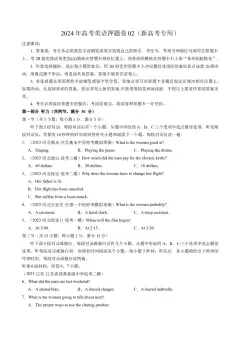
1. How will the woman probably go to the City Library? A.By bike. B.By car. C.By bus.
2. What will the speakers do next? A.Take a rest. B.Board the plane. C. Leave for the hotel.
3. Why does the man make the phone call?
A. To offer an invitation. B. To cancel a cooperation. C. To make an appointment.
4. How much did the man pay for the electric kettle?
A. 40 dollars. B. 20 dollars. C. 10 dollars.
5. Where are probably the speakers?
A. In a gym. B. In a clinic. C. In a workshop.
第二节(共 15 小题;每小题 1.5 分,满分 22.5 分)
听下面 5 段对话或独白。每段对话或独白后有几个小题,从题中所给的 A、B、C 三个选项中选出最佳
选项。听每段对话或独白前,你将有时间阅读各个小题,每小题 5 秒钟;听完后,各小题将给出 5 秒钟
的作答时间。每段对话或独白读两遍。
听第6段材料,回答第6、7题。
6. When did the man come back?
A. On Monday. B. On Saturday. C. On Sunday.
7. What did the man do in Leeds?
A. He visited a park. B. He designed a product. C. He made a presentation.
听第7段材料,回答第8至10题。
8. Why does the man come to the woman?A. To ask for leave. B. To make an apology. C. To report work progress.
9. Who will replace the man?
A. Nobody. B. Richard. C. Sally.
10. How does the man feel about finishing his work on time?
A. Doubtful. B. Hopeless. C. Confident.
M: Thanks, Mrs. West.
听第8段材料,回答第11至13题。
11. What is the woman’s concern about the man?
A. His idea of honesty. B. His absence from classes. C. His explanation of basics.
12. What does the woman suggest the man do?
A. Join a history club. B. Memorize some bricks. C. Read up on some books.
13. What’s the probable relationship between the speakers?
A. Classmates. B. Mother and son. C. Teacher and student.
听第9段材料,回答第14至17题。
14. What is the man doing?
A. Listening to a talk. B. Hosting a talent show. C. Conducting an interview.
15. What does Annie do?
A. She is a writer. B. She is a photographer. C. She is a journalist.
16. What does Annie value most in her job?
A. Curiosity. B. Generosity. C. Courage.
17. What does Annie think of her job?
A. Well-paid. B. Rewarding. C. Difficult.
听第10段独白,回答第18至20题。
18. Where does YangRui live?
In the suburbs. B. In the city center. C. In a remote village.
19. What’s YangRui’s main purpose of renting a small vegetable garden?
To reduce work stress. B. To have organic vegetables. C. To involve his kids in farmig.
20. What is the speaker mainly talking about?
A. A popular lifestyle. B. A low carbon farm. C. A monitoring systerm.
第二部分 阅读(共两节, 满分50分)
第一节(共15小题:每小题2.5分, 满分37.5分)
阅读下列短文, 从每题所给的A、B、C、D四个选项中选出最佳选项。A
Summer Reading Challenge
The Summer Reading Challenge, presented by the Reading Agency and funded by Arts Council England, is
the UK’s biggest reading for pleasure programme for primary school-aged children. 1 in 5 children cannot read
well by the age of 11. The Summer Reading Challenge, with the support of public libraries, is to change this!
The Challenge’s launching and finishing dates vary by location, so we recommend getting in touch with your
local library service to find out more about the Challenge in your area.
How the Summer Reading Challenge Works
Children sign up for free through their local library and receive a fun pack.
Children set a reading goal and borrow books of their choice during the summer.
Library staff and volunteers help children to discover new books that suit their interests and reading level and
run a programme of free themed activities in the library.
Children who meet their reading goal and complete the Challenge are presented with a certificate and a medal.
Get Involved
If you’re a parent or carer, join us on our Facebook page for all the latest news.
If you’re a teacher, visit our Resources page to download free materials to help you support children’s reading
for pleasure.
If you’re a young person, do you know that volunteering to support the Summer Reading Challenge in your
local library can count towards your Duke of Edinburgh Award? Get in touch with your local library to ask about
opportunities!
If you’re a teacher or librarian, grow your knowledge of children’s literature with the Teacher’s Reading
Challenge.
21. What is the mission of the Summer Reading Challenge?
A. Selecting outstanding talents. B. Improving the network of service.
C. The Reading Agency D. Developing kids’ reading ability.
22. Who hosts the themed activities in the Summer Reading Challenge?
A. The library staff. B. The official website.
C. The Reading Agency. D. Arts Council England.
23. What can teachers do in the Teacher’s Reading Challenge?
A. Receive a certificate and a reward.
B. Upload free materials for children.C. Volunteer for Duke of Edinburgh Award.
D. Read more works of children’s literature.
B
I have worked as a keeper at the National Zoo, Paris for 11 years. Spot and Stripe are the first tiger cubs that
have ever been born here. Globally, a third of Sumatran cubs in zoos don't make it to adulthood, so I decided to
give them round-the-clock care at home.
I've got two children—the younger one, Kynan, was extremely happy about the tigers arriving - but all of us
really looked forward to being part of their lives and watching them grow. I wasn't worried about bringing them
into my home with my wife and kids. These were cubs. They weighed about 2.5 kg and were so small that there
was absolutely no risk.
As they grew more mobile, we let them move freely around the house during the day, but when we were asleep
we had to contain them in a large room, otherwise they'd get up to mischief. We'd come down in the morning to
find they'd turned the room upside down, and left it looking like a zoo.
Things quickly got very intense due to the huge amount of energy required to look after them. There were some
tough times and I just felt extremely tired. I was grateful that my family was there to help. We had to have a bit of a
production line going, making up “tiger milk”, washing baby bottles, and cleaning the floors.
When Spot and Stripe were four months old, they were learning how to open doors and jump fences, and we
knew it really was time for them to go. It was hard for us to finally part with them. For the first few days, Kynan
was always a bit disappointed that the cubs weren't there.
I'm not sad about it. I'm hands-on with them every day at the zoo, and I do look back very fondly on the time
that we had them.
24. Why did the author bring the tiger cubs home?
A. To ensure their survival. B. To observe their differences.
C. To teach them life skills. D. To let them play with his kids.
25. What do the underlined words “get up to mischief” mean in paragraph 3?
A. Behave badly. B. Lose their way. C. Sleep soundly. D. Miss their mom.
26. What did the author think of raising the tiger cubs at home?
A. Boring. B. Tiring.C. Costly.D. Risky.
27. Why did the author decide to send Spot and Stripe back to the zoo?
A. They frightened the children. B. They became difficult to contain.
C. They annoyed the neighbours. D. They started fighting each other.C
Your morning coffee could be used to make a pair of sneakers, a Finnish startup says. Rens can make new
shoes from old coffee, cutting back on waste in terms of space in landfills and methane (甲烷) emissions.
5, 000 supporters promised to invest over $500, 000 to see the sneakers come to life. Up to 21 cups of coffee
and 6 recycled plastic bottles are used in each pair of shoes. The sneakers come in 9 different colors and are
waterproof and super comfortable. In addition, the sneakers can absorb a peculiar smell, and they are designed to be
taken off and put on easily.
Jesse Tran, the co-founder of Rens, wanted to do something to help reduce people’s carbon “footprint”, while
offering a pair of everyday shoes that is functional and fashion-forward. “With the improvement of environmental
awareness, the knowledge of the circular economy is also increasing. Shoes made from recycled coffee pieces may
seem novel to some people, but we wholeheartedly believe that this is just the beginning of a revolution in the
clothing technology and manufacturing industry,” said Tran.
So far, 250, 000 water bottles and 750, 000 cups of coffee have been turned into these shoes. The small coffee
solid pieces are combined in a low-heat environment with recycled plastic to create a coffee yarn in the upper
section of the shoes, while recycled plastic is made into the other parts, and the tree sap (液) that biodegrades (降
解) creates the outer sole (鞋底).
While the price is as high as $119 on Amazon, they offer free delivery everywhere, a l-year guarantee on the
waterproofing technology, and a 30-day money-back guarantee as well.
28. What is the advantage of the sneakers made from coffee?
A. Easy to wash. B. Able to afford. C. Comfortable to wear. D. Hard to damage.
29. What can we infer according to Jesse Tran?
A. Action must be taken for environmental protection.
B. Manufacturing industries are promising in recycling.
C. Shoes made from recycled coffee is out of date.
D. The circular economy is unfamiliar lo the public.
30. What can be made into the outer sole of the sneaker?
A. The small coffee pieces. B. The combined coffee yarn.
C. The recycled water bottles. D. The biodegraded tree sap.
31. What is the suitable title of the passage?
A. Shoes Made in a Green Way B. Coffee Recycled in a Creative Way
C. The Revolution of Manufacturing Industry D. The Improvement of Environmental AwarenessD
Recent rapid economic development, changes to agriculture and globalization have impacted the food and
drink we consume. At the same time, there have been declining numbers of manual jobs, changes to transport,
decreasing levels of physical activity and an increase in inactive habits(including screen time). Advances in
technology have also increased time spent using screens, both at work and during leisure time. Therefore, artificial
lighting is a modern wonder that we take for granted every day—for its convenience and its harmful effects.
According to a pair of recent studies, the problems extend beyond light pollution and into the region of
childhood obesity and perhaps even cancer. In a paper published in the journal PLOS ONE, researchers from the
Queensland University of Technology studied the sleep, activity and light exposure of 3 to 5-year-olds from six
childcare centres in Brisbane, Australia. When they recorded body mass index (指数) and checked back in 12
months later, they found that slimmer children received the most light exposure in the afternoon. Furthermore,
moderate light exposure early in the day(and greater exposure overall) correlated to increased body mass index a
year later.
The report found strong evidence that spending more time in front of the television or on a computer(at work
or at home) increases the risk of weight gain. This finding was particularly strong in children.
Obviously, just looking at a screen won’t lead to weight gain, but being inactive for long periods of time can
shift your “energy balance”. Sitting long can also affect your appetite, making it harder to recognise when you are
full.
Screen time can also increase exposure to junk food and drink ads targeting kids. It’s also quite common to
snack while watching screens—being distracted can lead to unconsciously eating more.
The findings in this report suggest that we should try to limit our screen time and maintain an energy balance. This
is something that we can make a conscious effort to be careful of with regular exercise and less screen time.
32. What does the author intend to do in the first paragraph?
A. To complain about a natural phenomenon.
B. To state the background of the study.
C. To question a newly-developed trend.
D. To criticize the speed of development.
33. How did researchers from the Queensland University of Technology perform the experiment?
A. By comparing data of the same group.
B. By referring to the former findings.
C. By tracking the habit of the objects.D. By consulting distinguished experts.
34. What may cause harmful impacts on teenagers when they are using screens?
A. The loss of balance.
B. Standing too long inactively.
C. Too much energy consumption.
D. The possibility of eating too much.
35. Where is the text most likely from?
A. A story-telling blog.
B. A historical novel.
C. A lifestyle magazine.
D. An entry of a diary.
第二节 (共5小题:每小题2. 5分, 满分12. 5分)
阅读下面短文, 从短文后的选项中选出可以填入空白处的最佳选项。选项中有两项为多余选项。
How to Study Less and Learn More
The first thing that you need to realize is that it does not matter how long you spend studying is flawed(有缺
陷的).Many people sit down and try to memorize facts over and over again. ____36___ If you properly link ideas
together to see the big picture, studying should only be a brief refresher.
There are ways to boost your studies and make yourself a more efficient student. You have to change the way you
look at studying. Here is how you can do it:
____37____. This is taking yourself beyond visualization and making use of your other senses as well. People
keep information better when they are in an emotionally aroused state, so use your emotions to make boring ideas
easier to remember.
When you are studying, practice explaining everything to yourself as if you are a ten-year-old child.
____38___ , so that they begin to seem obvious to you.
Scan through your text until you encounter an idea that you are not familiar with or are not entirely sure about.
When you find these ideas, link them to ideas that you already know. ____39___.
You do not need to spend hours and hours studying once you master the techniques that bring about real learning.
____40___. Our minds can only focus for so long before they start to blank out, take a break every hour mind sharp
and your muscles from getting sore.
A. You should be able to simplify most things
B. Write down all the casual facts or conceptsC. One last tip is to stand up and stretch every hour
D. Use all of your senses to connect the information
E. Many learners find it hard to concentrate on too many things
F. Use symbols, metaphors or your fingers to represent these ideas
G. However, too much studying just means you did not learn the information the first time
第三部分 语言运用(满分30分)
第一节(共15小题;每小题1分,满分15分)
阅读下面短文,从每题所给的A、B、C、D四个选项中选出可以填入空白出的最佳选项。
“What are you doing?” my fifth-grade teacher inquired as I was packing my backpack.
“The bell rings in a few minutes.” I responded.
“Unpack your assignments. We work until the time ___41___. The more you do here in class with me, the less
you have to do at home,” she warned with a small ___42___ as she walked back to her desk. She was a very kind
woman, but I knew she meant ___43__ , too.
I pulled my math assignment back out ___44___ and completed one problem at a time as the minutes ticked
away. The bell finally rang, and I ___45___ my homework in my schoolbag as ___46___ as possible and headed to
my next class. I cannot remember how many times per day she would ___47___ , “Use your time wisely. It
worked. It became second ___48___ for me to work until the bell rang.
I continued the ___49__ until my senior year in high school , having an entire year’s worth of college classes
___50__ before I even threw my mortarboard(学位帽) into the ___51__ . I used my time wisely in nearly every
aspect of my ___52__ : my education and my career.
At age ten, I didn’t ___53___ . I do now. Learning how to use your time wisely means learning what’s
___54__ to you. It’s not just a lesson in using the time you have, but in ___55__ those moments the time spent with
loved ones, and truly living life.
41. A. breaks down B. shuts up C. takes off D. runs out
42. A. joke B. smile C. puzzle D. pity
43. A. business B. maths C. homework D. class
44. A. happily B. anxiously C. unwillingly D. urgently
45. A. arranged B. transformed C. carried D. stuffed
46. A. quickly B. carefully C. skillfully D. quietly
47. A. wonder B. repeat C. recite D. promise
48. A. challenge B. benefit C. nature D. achievement49. A. review B. argument C. lesson D. practice
50. A. completed B. started C. ignored D. observed
51. A. backpack B. water C. air D. desk
52. A. position B. life C. profession D. program
53. A. experience B. remember C. recognize D. understand
54. A. important B. difficult C. unnecessary D. impossible
55. A. assessing B. treasuring C. expecting D. recommending
第二节 (共10小题:每小题1.5分,满分15分)
阅读下面短文,在空白处填入1个适当的单词或括号内单词的正确形式。
Chinese idiom is one of the priceless legacies(遗产)deeply rooted in traditional culture , making Chinese
language more ___56__ (power) , more functional and thus , more fascinating.
Pooling collective wisdom or “Ji Si Guang Yi”, one of Chinese ___57__ (idiom) , can better ensure success,
reminding people to humbly listen to others’ advice ___58___ they make major decisions. The idea was first
proposed by Zhuge Liang , ___59___ well-known military strategist during the Three Kingdom Period (220—280).
“One who ___60___ (hold) office should pool the ideas and wisdom of the people and ___61___ (wide) draw on
all well-intended and useful views ,” wrote Zhuge Liang in his article, Instructions to Subjects and Officials.
Today, the expression ___62___ (develop) into an effective way to improve working efficiency and show
respect for the opinions of the masses. All the opinions and ideas ___63___ (collect) from others can give the
decision maker a more comprehensive picture of the current situation and help him or her make a correct decision.
Listening humbly to others’ opinions, especially those ___64___ differ from one’s own, can help one improve
the initiative, wisdom and power of the masses. The method has been adopted by the Chinese people in their
decision-making in daily life ___65___ (secure) success.
第四部分 写作 (共两节, 满分40分)
第一节 (满分15分)
66.你校英语俱乐部将举办英语演讲比赛,请以Family Education Shapes Me 为主题,写一篇演讲稿,内
容包括:
1.良好的家庭教育方式;
2.成长的启示。
注意:
1.写作词数应为80左右;
2.请按如下格式在答题卡的相应位置作答。Good morning, boys and girls,
____________________________________________________________________________________________
____________________________________________________________________________________________
____________________________________________________________________________________________
____________________________________________________________________________________________
______________________________________________________________
第二节(满分25分)
67.阅读下面材料,根据其内容和所给段落开头语续写两段,使之构成一篇完整的短文。
On the first day of school, I stared in awe at the huge buildings. This high school was definitely bigger than
the one I had previously attended.
This was my second year of high school, but my first year of school in St. Louis. I had decided the night
before that I would be much happier in a new school if I made friends that were so-called “popular”. Getting in
with the right group of people would make my life a whole lot better. I even bought a new outfit and had my hair
styled just so the first day would be perfect.
Scared, yet anxious to begin my new life, I walked up the stairs to the front door. The halls were packed with
kids yelling and laughing and telling stories of their summer adventures. My first class was geometry, but where
was that?
I was standing in the hall looking confused, when a short, blond girl wearing glasses came up and asked, “Are
you new? You look lost. Do you need help? My name is Diane. What’s yours?” Even though she seemed a bit
strange, definitely not the kind of person I wanted to be associated with, I decided to answer her anyway. I was,
after all, lost.
After exchanging names. I followed her up the stairs and down a hallway on the right, making polite
conversation the whole way. When we reached my room she said, “Well, here you are. Welcome to JFK, and I hope
your day goes all right.”
I said thanks and waved good-bye. Once inside the classroom, I saw one big group of people huddled around
someone who seemed to be telling some sort of story. I walked over and got close enough to overhear. All eyes
were glued to the guy in the middle of the circle who was wearing a letter jacket covered with patches. I decided
that this guy was popular, so I managed to get a seat right next to him. I said, “Hi, my name is Lisa and I’m new
here.” He said, “Johnny.”
注意:1.所续写短文的词数应为150左右:2.请按如下格式在答题卡的相应位置答题。At the end of the class, I turned to him and asked, “I’m not sure where my next class is, could you help me?”
____________________________________________________________________________________________
____________________________________________________________________________________________
____________________________________________________________________________________________
____________________________________________________________________________________________
____________________________________________________________________________________________
____________________________________________________________________________________________
______________________________________
Just at that time, someone came up and tapped me on the shoulder.
____________________________________________________________________________________________
____________________________________________________________________________________________
____________________________________________________________________________________________
____________________________________________________________________________________________
____________________________________________________________________________________________
____________________________________________________________________________________________
______________________________________