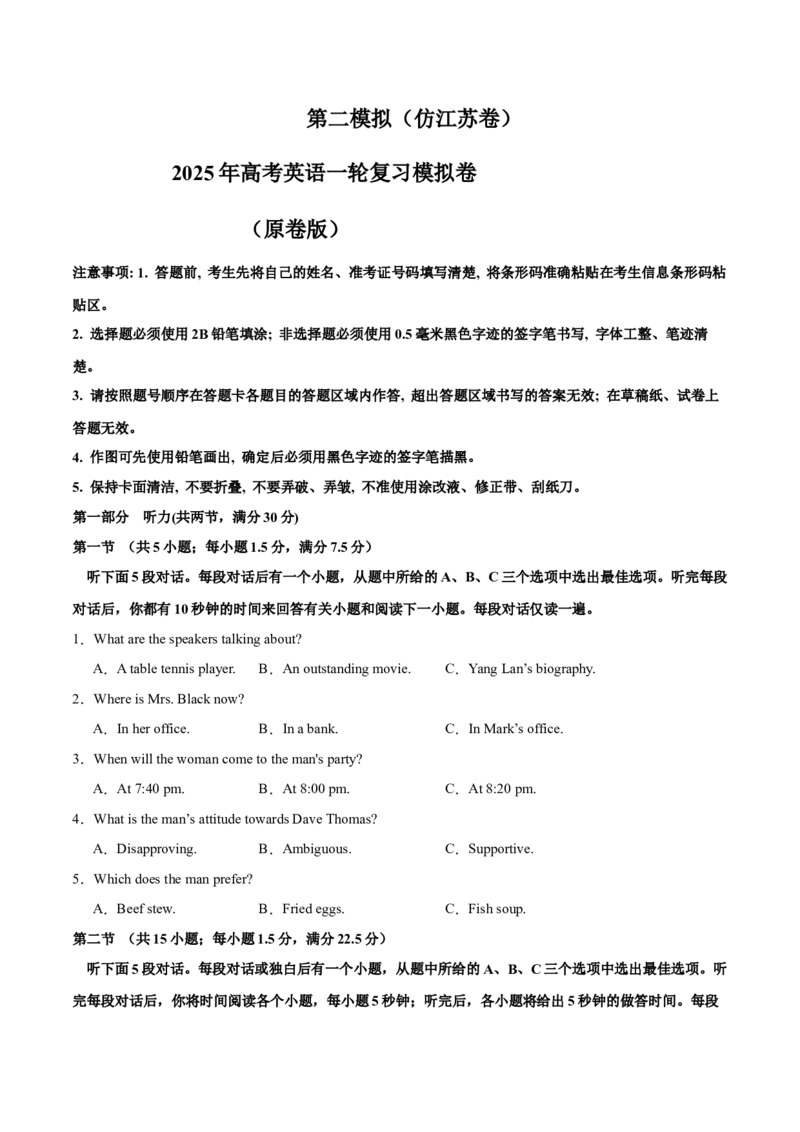
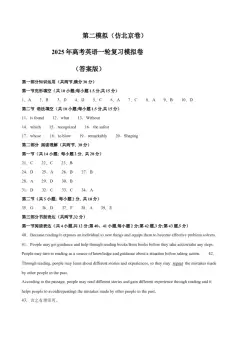
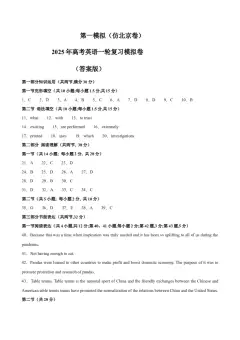
第二模拟(仿江苏卷)
2025 年高考英语一轮复习模拟卷
(原卷版)
注意事项: 1. 答题前, 考生先将自己的姓名、准考证号码填写清楚, 将条形码准确粘贴在考生信息条形码粘
贴区。
2. 选择题必须使用2B铅笔填涂; 非选择题必须使用0.5毫米黑色字迹的签字笔书写, 字体工整、笔迹清
楚。
3. 请按照题号顺序在答题卡各题目的答题区域内作答, 超出答题区域书写的答案无效; 在草稿纸、试卷上
答题无效。
4. 作图可先使用铅笔画出, 确定后必须用黑色字迹的签字笔描黑。
5. 保持卡面清洁, 不要折叠, 不要弄破、弄皱, 不准使用涂改液、修正带、刮纸刀。
第一部分 听力(共两节,满分30分)
第一节 (共5小题;每小题1.5分,满分7.5分)
听下面5段对话。每段对话后有一个小题,从题中所给的A、B、C三个选项中选出最佳选项。听完每段
对话后,你都有10秒钟的时间来回答有关小题和阅读下一小题。每段对话仅读一遍。
1.What are the speakers talking about?
A.A table tennis player. B.An outstanding movie. C.Yang Lan’s biography.
2.Where is Mrs. Black now?
A.In her office. B.In a bank. C.In Mark’s office.
3.When will the woman come to the man's party?
A.At 7:40 pm. B.At 8:00 pm. C.At 8:20 pm.
4.What is the man’s attitude towards Dave Thomas?
A.Disapproving. B.Ambiguous. C.Supportive.
5.Which does the man prefer?
A.Beef stew. B.Fried eggs. C.Fish soup.
第二节 (共15小题;每小题1.5分,满分22.5分)
听下面5段对话。每段对话或独白后有一个小题,从题中所给的A、B、C三个选项中选出最佳选项。听
完每段对话后,你将时间阅读各个小题,每小题5秒钟;听完后,各小题将给出5秒钟的做答时间。每段对话或独白读两遍。
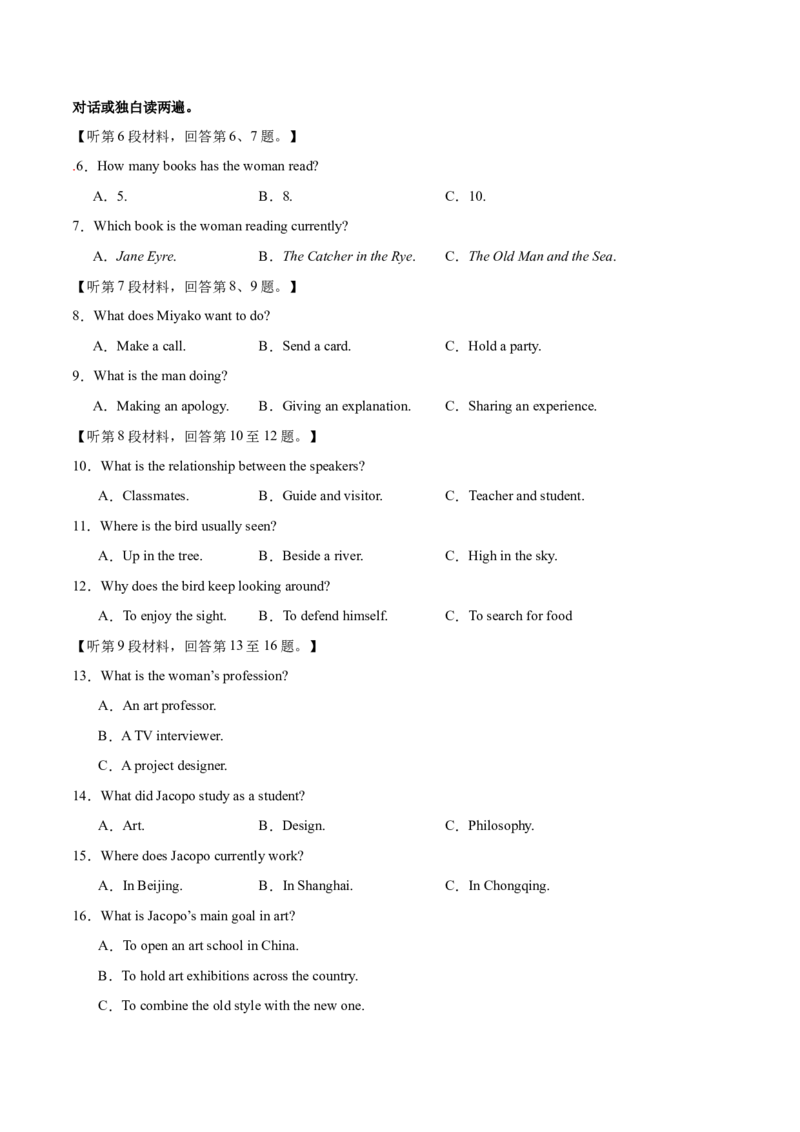
【听第6段材料,回答第6、7题。】
.6.How many books has the woman read?
A.5. B.8. C.10.
7.Which book is the woman reading currently?
A.Jane Eyre. B.The Catcher in the Rye. C.The Old Man and the Sea.
【听第7段材料,回答第8、9题。】
8.What does Miyako want to do?
A.Make a call. B.Send a card. C.Hold a party.
9.What is the man doing?
A.Making an apology. B.Giving an explanation. C.Sharing an experience.
【听第8段材料,回答第10至12题。】
10.What is the relationship between the speakers?
A.Classmates. B.Guide and visitor. C.Teacher and student.
11.Where is the bird usually seen?
A.Up in the tree. B.Beside a river. C.High in the sky.
12.Why does the bird keep looking around?
A.To enjoy the sight. B.To defend himself. C.To search for food
【听第9段材料,回答第13至16题。】
13.What is the woman’s profession?
A.An art professor.
B.A TV interviewer.
C.A project designer.
14.What did Jacopo study as a student?
A.Art. B.Design. C.Philosophy.
15.Where does Jacopo currently work?
A.In Beijing. B.In Shanghai. C.In Chongqing.
16.What is Jacopo’s main goal in art?
A.To open an art school in China.
B.To hold art exhibitions across the country.
C.To combine the old style with the new one.【听第10段材料,回答第17至20题。】
17.What kind of people are "early birds"?
A.The people getting up around 5:00 or 6:00 am.
B.The people going to bed around 9:00 or 10:00 pm.
C.The people going to bed around 10:00 or 11:00 pm.
18.When do most teenagers go to bed?
A.Around 9:00 pm. B.Around 10:00 pm. C.Around midnight or later.
19.How many teenagers sleep enough?
A.One-fifth. B.Two-fifths. C.One-fourth.
20.What are night owls better at?
A.Getting grades in school. B.Some intelligence tests. C.Getting good jobs.
第二部分 阅读(共两节, 满分50分)
第一节(共15小题; 每小题2.5分, 满分37.5分)
阅读下列短文,从每题所给的A、B、C、D四个选项中选出最佳选项。
A
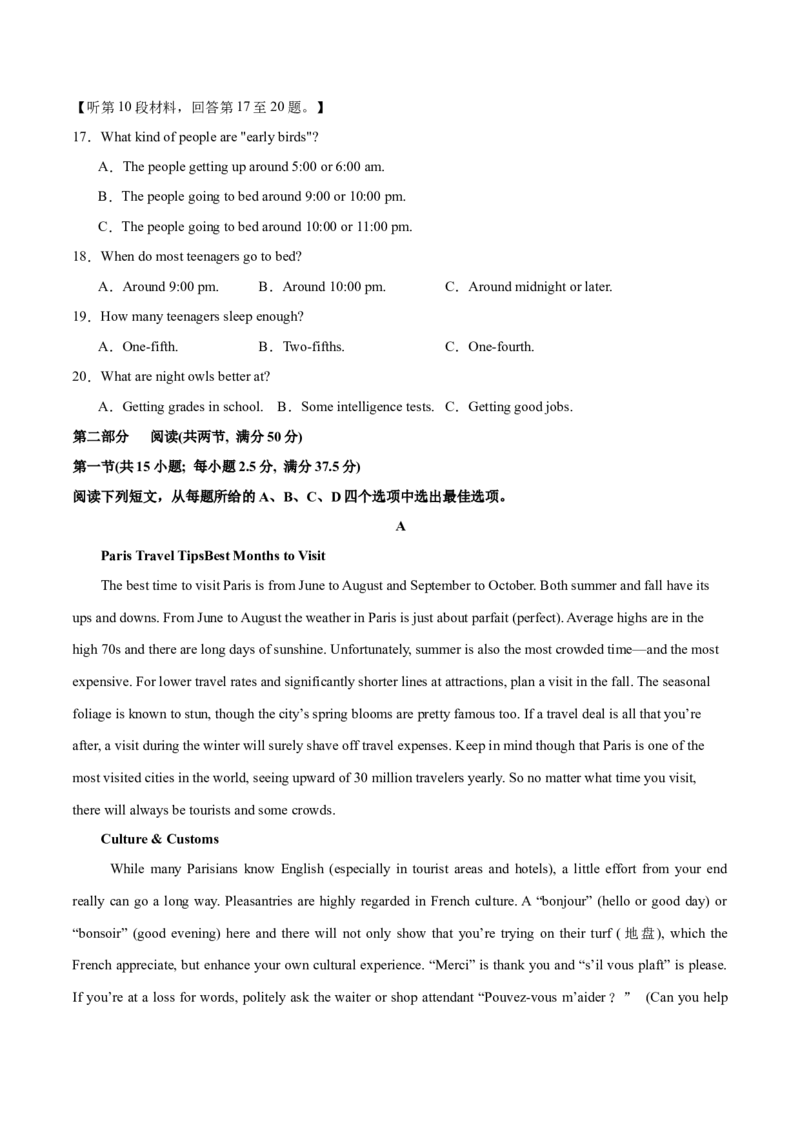
Paris Travel TipsBest Months to Visit
The best time to visit Paris is from June to August and September to October. Both summer and fall have its
ups and downs. From June to August the weather in Paris is just about parfait (perfect). Average highs are in the
high 70s and there are long days of sunshine. Unfortunately, summer is also the most crowded time—and the most
expensive. For lower travel rates and significantly shorter lines at attractions, plan a visit in the fall. The seasonal
foliage is known to stun, though the city’s spring blooms are pretty famous too. If a travel deal is all that you’re
after, a visit during the winter will surely shave off travel expenses. Keep in mind though that Paris is one of the
most visited cities in the world, seeing upward of 30 million travelers yearly. So no matter what time you visit,
there will always be tourists and some crowds.
Culture & Customs
While many Parisians know English (especially in tourist areas and hotels), a little effort from your end
really can go a long way. Pleasantries are highly regarded in French culture. A “bonjour” (hello or good day) or
“bonsoir” (good evening) here and there will not only show that you’re trying on their turf (地盘), which the
French appreciate, but enhance your own cultural experience. “Merci” is thank you and “s’il vous plaft” is please.
If you’re at a loss for words, politely ask the waiter or shop attendant “Pouvez-vous m’aider?” (Can you helpme?) or “Parlez-vous anglais?” (Do you speak English?). Another helpful phrase: “Excusez-moi” (Pardon or
excuse me). If you are introduced to French people in social situations, stick to a handshake unless the person you
are meeting initiates the les bises, or the greeting where people lightly kiss each other on the cheek once or twice. If
you aren’t comfortable, merely stick out your hand for a handshake.
21.Which is the cheapest travelling season in Paris?
A.Spring. B.Summer. C.Autumn. D.Winter.
22.What is appreciated in French culture?
A.Speaking English in tourist areas and hotels. B.Showing politeness in communication.
C.Enhancing the cultural experience. D.Going a long way around the city.
23.When are you supposed to greet a Frenchman with a kiss on the cheek?
A.When he greets you with the les bises. B.When you are at a loss for words.
C.When he sticks to a handshake. D.When you are uncomfortable.
B
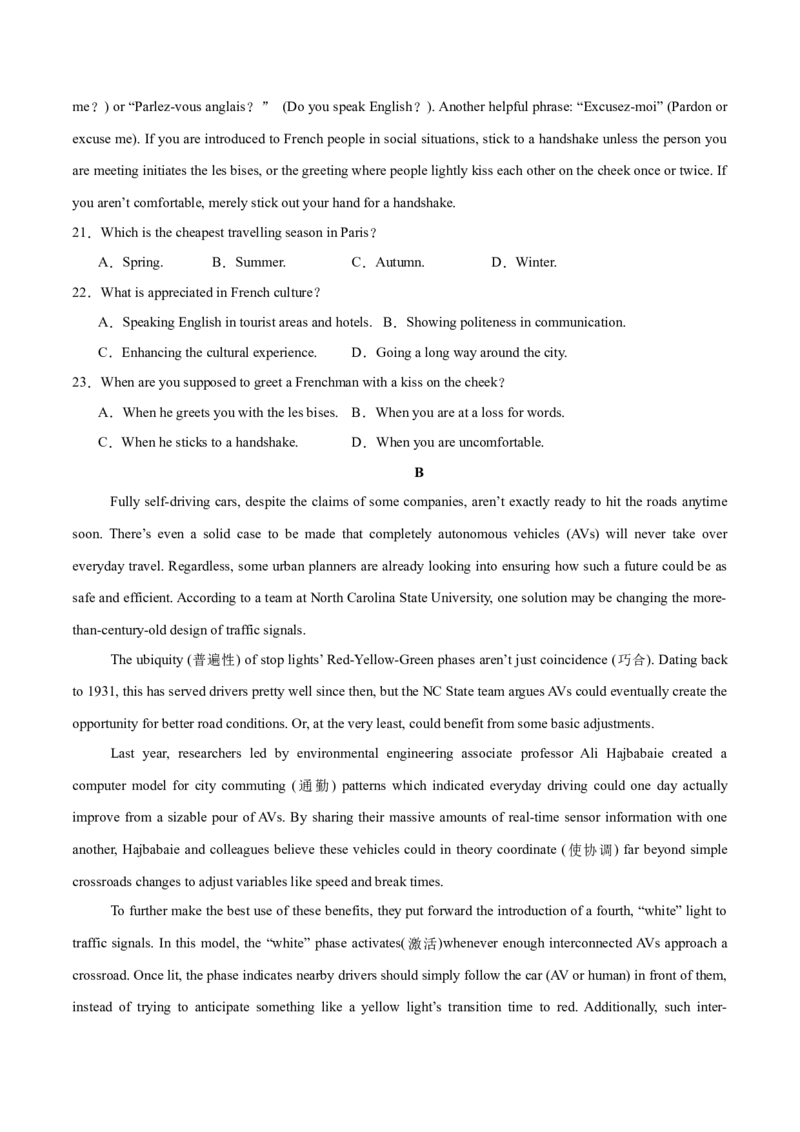
Fully self-driving cars, despite the claims of some companies, aren’t exactly ready to hit the roads anytime
soon. There’s even a solid case to be made that completely autonomous vehicles (AVs) will never take over
everyday travel. Regardless, some urban planners are already looking into ensuring how such a future could be as
safe and efficient. According to a team at North Carolina State University, one solution may be changing the more-
than-century-old design of traffic signals.
The ubiquity (普遍性) of stop lights’ Red-Yellow-Green phases aren’t just coincidence (巧合). Dating back
to 1931, this has served drivers pretty well since then, but the NC State team argues AVs could eventually create the
opportunity for better road conditions. Or, at the very least, could benefit from some basic adjustments.
Last year, researchers led by environmental engineering associate professor Ali Hajbabaie created a
computer model for city commuting (通勤) patterns which indicated everyday driving could one day actually
improve from a sizable pour of AVs. By sharing their massive amounts of real-time sensor information with one
another, Hajbabaie and colleagues believe these vehicles could in theory coordinate (使协调) far beyond simple
crossroads changes to adjust variables like speed and break times.
To further make the best use of these benefits, they put forward the introduction of a fourth, “white” light to
traffic signals. In this model, the “white” phase activates(激活)whenever enough interconnected AVs approach a
crossroad. Once lit, the phase indicates nearby drivers should simply follow the car (AV or human) in front of them,
instead of trying to anticipate something like a yellow light’s transition time to red. Additionally, such inter-connectivity could communicate with traffic signal systems to determine when it is best for “Walk” and “Do-Not-
Walk” pedestrian (行人) signals. Based on their modelling, it appeared that such a change could reduce crossroads
jam by at least 40 percent compared to current traffic system optimization software. In doing so, this could improve
overall travel times, fuel efficiency, and safety.
24.What can we learn about completely autonomous vehicles (AVs)?
A.They have settled traffic jam problems. B.They have become popular in urban areas.
C.They will take the place of other vehicles. D.They may not be widely used in the future.
25.What does the “white” light do?
A.It tells drivers to stop.
B.It helps drivers avoid traffic jams.
C.It allows drivers to go through crossroads faster.
D.It makes it easier for pedestrians to cross the street.
26.What is the author’s attitude towards the idea of a fourth “white” light?
A.Neutral. B.Worried.
C.Doubtful. D.Supportive.
27.What is probably the text?
A.A news report. B.A research paper.
C.A commercial ad. D.A science fiction.
C
Good friends and good physical health may be even more closely linked than previously thought, new
research has found. Researchers discovered that positive social experiences impact not only a person’s stress level
and ability to cope, but also markers of physical health, according to a study published Monday in the journal
Society for Personality and Social Psychology.
The study followed more than 4,000 people over three weeks as they completed check-ins every three days
on their smartphones or smartwatches regarding their positive and negative experiences with their closest social
relationships, as well as assessments of their blood pressure, heart rate, stress and coping. Having more positive
experiences in social relationships was generally associated with better coping, lower stress and lower blood
pressure, according to the study.
But having social relationships which bounce between good and bad often can be unhelpful. When there is a
lot of volatility, the negative experiences seemed to have a bigger impact on a person than the positive, said leadstudy author Brian Don of the University of Auckland.
Then, how to build good social relationships? Adam Smiley Poswolsky, a workplace belonging expert,
suggests starting small. Text a friend that you haven’t talked to in a long time, meet one new person a month, host a
dinner party, or join a class. “If you do just one thing, make a list of five people in your life that you care about, and
give one of them a phone call,” Poswolsky added.
There might not be just one definition of a good friendship, but most strong relationships share some similar
qualities, he said. They tend to prioritize laughter, joy, excitement, courage, and non-judgmental support. And good
friendships are often two people helping each other become better versions of themselves, he added. “You know
someone is a true friend when they have your back when you’re sick, when you lose your job, when you make a
mistake, when you’re stressed, when you’re sad,” Poswolsky said.
28.How was the study carried out?
A.By doing regular check-ins on devices.
B.By following the participants for three days.
C.By interviewing the closest friends of participants.
D.By monitoring the health conditions of participants.
29.What does the underlined word “volatility” in paragraph 3 mean?
A.Pressure. B.Association. C.Changeability. D.Certainty.
30.Which statement will Poswolsky probably agree with?
A.Friendship is about being always available.
B.Friendship is based on shared interests and hobbies.
C.Friendship begins with tiny moments of connection.
D.Friendship means always having positive interactions.
31.Where is the passage most likely to have been taken from?
A.A questionnaire survey. B.A personal diary.
C.A biology textbook. D.A news report.
D
It’s the start of a new era of AI at Google, says CEO Sundar Pichai: the Gemini era. Gemini is Google’s
latest large language model, which Pichai first mentioned at the I/O developer conference in June and is now
releasing to the public. This significant advance in AI will ultimately impact almost all of Google’s products.
Gemini is more than a single AI model. There’s a lighter version called Gemini Nano meant for offline
Android devices, a more powerful version called Gemini Pro that will power many Google AI services, and an evenmore capable model called Gemini Ultra — the most powerful LLM (大语言模型) Google has yet created. It
seems to be mostly designed for data centers and enterprise applications.
OpenAI launched ChatGPT in 2022. Now Google is ready to fight back. “We’ve done a very thorough
analysis of the systems side by side,” says CEO Sundar Pichai. Google ran 32 well- established criteria comparing
the two models, from overall tests to the Python code generation. “I think we’re substantially (大量地) ahead on 30
out of 32 of those criteria.” he adds.
Gemini’s clearest advantage comes from its ability to understand and interact with video and audio. This was
by design: multi- modality has been part of the plan from the beginning. Google built one multi- sensory model
from the beginning, unlike OpenAI’s separate models for images and voice.
Right now, Gemini’s most basic models are text- based , but more advanced models like Gemini Ultra can
work with images, video, and audio. “Over time,” Google DeepMind CEO Demis Hassabis says, “Gemini will gain
more senses, become more aware, accurate, and grounded. These models just sort of understand better about the
world around them.” These models still have other problems, but Hassabis says they will improve as they learn
more.
32.What is Gemini according to the text?
A.A new language model in development.
B.A light AI model designed for offline use.
C.A new language model developed by Google.
D.A light AI model created for specific enterprise applications.
33.What does Gemini Nano specialize in?
A.Generating Python code.
B.Running on offline Android devices.
C.Powering Google AI services.
D.Training separate models for images and voice.
34.What is a key advantage of Gemini over OpenAI’s ChatGPT?
A.The ability to write Pyth on code.
B.The ability to work with video and audio.
C.The understanding and interaction with textual data.
D.The ability to create separate models for images and voice.
35.What can be inferred from the last paragraph?
A.Google will bring the most advanced models.B.Gemini models outperform OpenAI’s ChatGPT.
C.Google will still work on the perfection of Gemini models.
D.Gemini models are launched without even a slight imperfection.
第二节(共5小题; 每小题2.5分, 满分12.5分)
阅读下面短文, 从短文后的选项中选出可以填入空白处的最佳选项。选项中有两项为多余选项。
Anger is the most destructive emotion. When you are in a temper, you make hasty ill-considered decisions
that you will probably regret. You will also regret reckless language spoken without thought. 36 Here are
some ways that you can combat the causes of anger.
37 You have to accept that sometimes things do go wrong and that people are not always lovely.
Try to accept that other people do behave in ways that will make you both frustrated and angry. Often, there might
be an excellent reason why a person acted in away that you found unacceptable.
Realizing that no one is perfect is a good start to avoiding getting angry. 38 Neither will they behave
in the same way that you would in a given situation.
Reacting angrily is a hard habit to break. The trick is to avoid reacting when faced with a situation that
usually angers. Anger is a negative reaction, but in this type of situation, there is no value in reacting by forming
positive thoughts. 39 This way,your anger will not get the emotional food it needs to survive.
Don’t take the easy way when you get angry. We all get tempted to throw something, hit something, or
scream when we are angry. You might say you feel better after an angry outburst, but that is just the after-effect of
the adrenalin (肾上腺素) your body released while you were angry. A reaction like that is the easy way. It is much
harder to stay calm, to walk away from conflict, or to take a deep breath and act normally. 40
A.Stop trying to manage your anger.
B.What can be done to control anger?
C.You need to learn not to respond at all.
D.That, however, is what you must do if you are to stop anger.
E.You need to change your attitude to the way the world works.
F.Taking positive steps will help you overcome feelings of anger.
G.Also, you need to accept that not everyone has the same standards as you.
第三部分语言运用(共两节, 满分30分)
第一节(共15小题; 每小题1分, 满分15分)
阅读下面短文, 从每题所给的A、B、C、D四个选项中选出可以填入空白处的最佳选项。
Mr. Dalton taught us plane geometry (平面几何) 37 years ago. I was a quiet kid. I neither got in muchtrouble nor got 41 . Somehow, plane geometry really 42 for me in his class.
Toward the end of the year, Mr. Dalton wanted to 43 our knowledge and gave us a 25-question
true/false nationally standardized test. The test presented each problem with a conclusion shown. We were required
to 44 the result using our theorems (定理).
I completed 24 problems quickly, but number seventeen was a 45 ! I spent thirty minutes on that
proof and 46 I made it with all my efforts. 47 , I marked the question true and handed in the test.
When the results came back the next day, my score was a 96, and number seventeen was 48 wrong!
When Mr. Dalton asked if there were any questions, for the first time, my hand 49 .
Instead of 50 that this was a nationally standardized test and there, couldn’t be anything wrong
with the answers, Mr. Dalton did the most powerful thing. I’ve ever seen a teacher do: he held out the 51
to me with an encouraging smile on his face.
I went to the board for the first time and 52 my proof, using the whole board and three different
colors of chalk. In the end, everyone clapped. Mr. Dalton gave 53 for my answer on number seventeen,
and I ended up with a grade of 104.
What I experienced that day has 54 me well. I have been 55 to Mr. Dalton for
empowering me to speak up as long as I think I’m right.
41.A.caught B.tired C.confused D.noticed
42.A.clicked B.appeared C.faded D.existed
43.A.expand B.check C.update D.improve
44.A.classify B.identify C.prove D.obtain
45.A.mystery B.purpose C.challenge D.comfort
46.A.immediately B.eventually C.gradually D.consistently
47.A.Encouraged B.Embarrassed C.Depressed D.Satisfied
48.A.assumed B.indicated C.marked D.approved
49.A.shot up B.reached out C.waved about D.drew back
50.A.suspecting B.arguing C.discussing D.admitting
51.A.board B.chalk C.paper D.book
52.A.understood B.explored C.reflected D.demonstrated
53.A.credit B.cause C.account D.evaluation
54.A.known B.suited C.served D.made
55.A.polite B.true C.open D.grateful第二节(共10小题; 每小题1.5分, 满分15分)
阅读下面短文, 在空白处填入1个适当的单词或括号内单词的正确形式。
Emotional eating is eating as a way 56 (ease) negative emotions, such as stress, anger, fear,
boredom, sadness and loneliness. Major life events or, more 57 (common), the troubles of daily life can
arouse negative emotions that lead to emotional eating and disturb your weight-loss 58 (effort).
Although some people eat less in the face 59 strong emotions, if you’re in emotional distress you
might turn to impulsive or binge (暴饮暴食) eating, quickly consuming whatever is convenient without 60
(enjoy).
In fact, your emotions can become so tied to your eating habits that you automatically reach for a treat
whenever you’re angry or 61 (stress) without thinking about what you’re doing.
Food also 62 (serve) as a distraction. If you’re worried about an upcoming event or 63
conflict, for instance, you may focus on eating comfort food instead of dealing with the painful situation.
Whatever emotions drive you to eat more, the end result is often the same. The effect is temporary, the
emotions return 64 you likely then bear the additional burden of guilt about 65 (set) back
your weight-loss goal. This can also lead to an unhealthy cycle.
第四部分 写作(共两节, 满分40分)
第一节(满分15分)
社会发展到了2040年,照顾老年人成了一个突出的社会问题。你公司顺应社会需求适时推出了家用机器
人。该机器人的主要功能有:
1. 可以在固定的时间做饭。
2. 可以陪老人聊天、下棋、做运动等。
3. 及时处理突发事件等。
请你根据以上内容写一篇发言稿,在新闻发布会上向大家推荐你公司的这一新产品。
注意:1. 词数80左右
2. 可以适当增加细节,以使行文连贯;
3. 发言稿的开头和结尾已给出,不计入总词数。
Ladies and gentlemen,
Thank you for attending our company’s news conference.
____________________________________________________________________________________________
____________________________________________________________________________________________
________________________________________________________________________________________________________________________________________________________________________________________
____________________________________________________________________________________________
_______________
Thank you.
第二节(满分25分)
阅读下面材料, 根据其内容和所给段落开头语续写两段, 使之构成一篇完整的短文。
Michael saw the trouble coming. There standing in the hallway was Frank, the boy who enjoyed making fun
of anyone at any given moment. Frank was tall and strong, so few of his victims stood up to him. Michael hated the
idea that Frank always got away with his wrongdoing. Yet like most kids who were picked on, he just took it
quietly and waited for the unpleasant to pass.
Frank walked up, his eyes locked on the books in Michael’s arms. When they met, Frank stopped
unexpectedly, “Hey, let me see those books!” Some students watched as Michael held out the books he was
carrying, trying not to give away his nervousness.
Frank took a book, looked inside for a second, and then threw the book at Michael, who dropped all the other
books. “Hey, those are school property,” Frank barked, “Be careful!” Then he walked away, laughing loudly.
Michael, his cheeks turning red, half kicked the fallen books. Suddenly a hand picked up one book. “You
look like you could use a p ally (盟友),” a friendly voice said. It was Ramon, the most athletic boy in the high
school. Michael couldn’t believe Ramon was stopping to help him as they barely spoke.
“Thanks,” Michael sighed with relief. “It’s confusing. I don’t know what his problems is.”
“Well, as I see it,” Ramon said, “you need to find a way to end this.” Michael nodded, stuck for what to say.
Ramon continued, “You know my grandmother used to tell me whenever I had a problem with someone. She’d say,
‘You can catch more flies with honey than with vinegar (醋).’”
Looking puzzled, Michael asked, “What does that mean?”
“It means kindness may be more effective than anger,” Ramon explained.
“Can you just tell Frank to stop picking on me?” Michael suggested.
“That’s vinegar,” Ramon laughed as he walked away. “Try honey instead.”
Ramon’s words left Michael thinking.
The next school day brought Michael’s usual pain. There stood Frank, and Michael knew it would be just
seconds before he had to face him in the middle of the hall. Frank came nearer.
注意:
(1)续写词数应为150个左右;(2)请按如下格式在答题卡的相应位置作答。
Then, suddenly, the unexpected happened.
____________________________________________________________________________________________
____________________________________________________________________________________________
____________________________________________________________________________________________
____________________________________________________________________________________________
____________________________________________________________________________________________
Michael bent down and quickly picked up Frank’s books on the floor.
_____________________________________________________________________________________________
_____________________________________________________________________________________________
_____________________________________________________________________________________________
_____________________________________________________________________________________________
________________________________________________________________________________________