文档文本内容
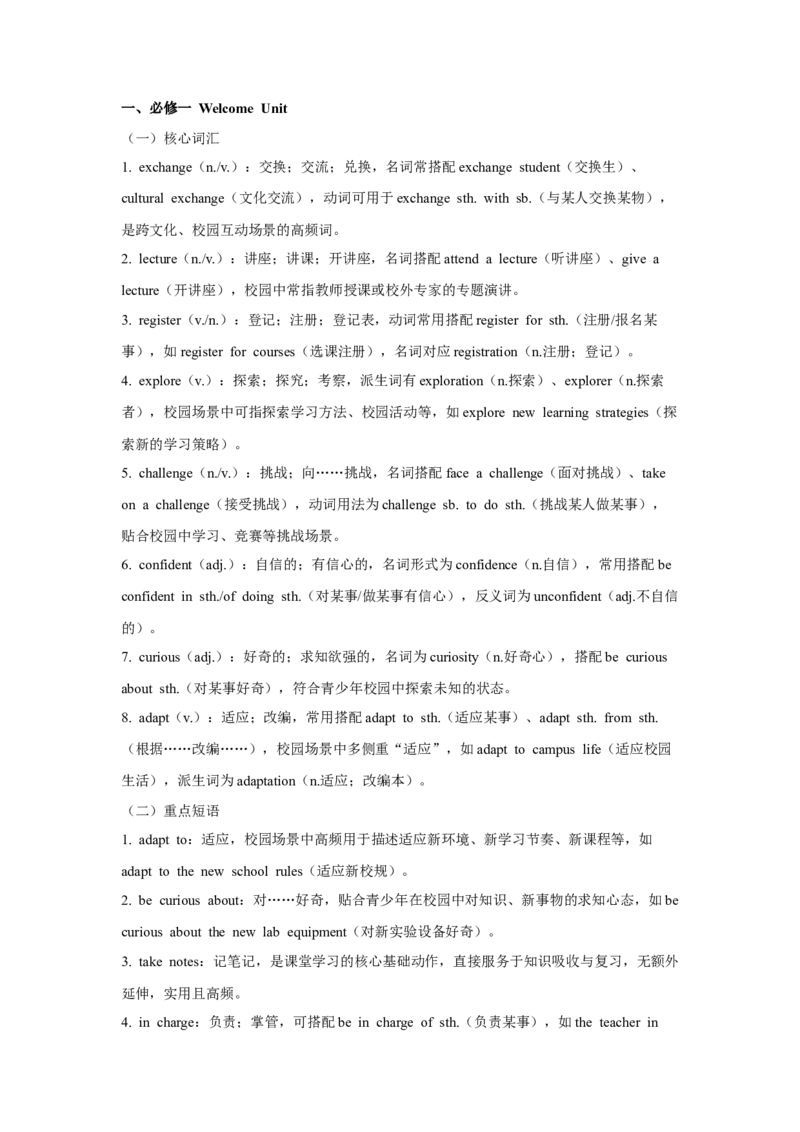
一、必修一 Welcome Unit
(一)核心词汇
1. exchange(n./v.):交换;交流;兑换,名词常搭配exchange student(交换生)、
cultural exchange(文化交流),动词可用于exchange sth. with sb.(与某人交换某物),
是跨文化、校园互动场景的高频词。
2. lecture(n./v.):讲座;讲课;开讲座,名词搭配attend a lecture(听讲座)、give a
lecture(开讲座),校园中常指教师授课或校外专家的专题演讲。
3. register(v./n.):登记;注册;登记表,动词常用搭配register for sth.(注册/报名某
事),如register for courses(选课注册),名词对应registration(n.注册;登记)。
4. explore(v.):探索;探究;考察,派生词有exploration(n.探索)、explorer(n.探索
者),校园场景中可指探索学习方法、校园活动等,如explore new learning strategies(探
索新的学习策略)。
5. challenge(n./v.):挑战;向……挑战,名词搭配face a challenge(面对挑战)、take
on a challenge(接受挑战),动词用法为challenge sb. to do sth.(挑战某人做某事),
贴合校园中学习、竞赛等挑战场景。
6. confident(adj.):自信的;有信心的,名词形式为confidence(n.自信),常用搭配be
confident in sth./of doing sth.(对某事/做某事有信心),反义词为unconfident(adj.不自信
的)。
7. curious(adj.):好奇的;求知欲强的,名词为curiosity(n.好奇心),搭配be curious
about sth.(对某事好奇),符合青少年校园中探索未知的状态。
8. adapt(v.):适应;改编,常用搭配adapt to sth.(适应某事)、adapt sth. from sth.
(根据……改编……),校园场景中多侧重“适应”,如adapt to campus life(适应校园
生活),派生词为adaptation(n.适应;改编本)。
(二)重点短语
1. adapt to:适应,校园场景中高频用于描述适应新环境、新学习节奏、新课程等,如
adapt to the new school rules(适应新校规)。
2. be curious about:对……好奇,贴合青少年在校园中对知识、新事物的求知心态,如be
curious about the new lab equipment(对新实验设备好奇)。
3. take notes:记笔记,是课堂学习的核心基础动作,直接服务于知识吸收与复习,无额外
延伸,实用且高频。
4. in charge:负责;掌管,可搭配be in charge of sth.(负责某事),如the teacher in
charge of the class(班主任),适用于校园管理、活动组织等场景。
5. make friends with:与……交朋友,是校园社交的核心表达,描述学生间的人际关系建
立,如make friends with classmates from different cities(与来自不同城市的同学交朋
友)。
6. sign up for:报名参加,针对校园内的社团、竞赛、讲座、课程等报名场景,如sign up
for the English debate club(报名参加英语辩论社)。
(三)核心句型及仿写
1. 句型1:What + 主语 + think of...?(询问对某物的看法)
原句:What do you think of the new school?
仿写:你觉得我们的新英语老师怎么样?(What do you think of our new English
teacher?)
2. 句型2:Its + adj. + for sb. + to do sth.(对某人来说做某事是……的)
原句:It’s important for us to adapt to the new environment quickly.
仿写:对学生来说,按时完成作业很有必要。(It’s necessary for students to finish
homework on time.)
3. 句型3:I’m looking forward to (doing) sth.(期待做某事)
原句:I’m looking forward to meeting my new classmates.
仿写:我期待参加下周的校园艺术节。(I’m looking forward to taking part in the
school art festival next week.)
4. 句型4:There be + 主语 + 地点/时间状语(某地/某时有某物/某人)
原句:There are many interesting clubs in our school.
仿写:我们教室后面有一个大书架。(There is a big bookshelf at the back of our
classroom.)
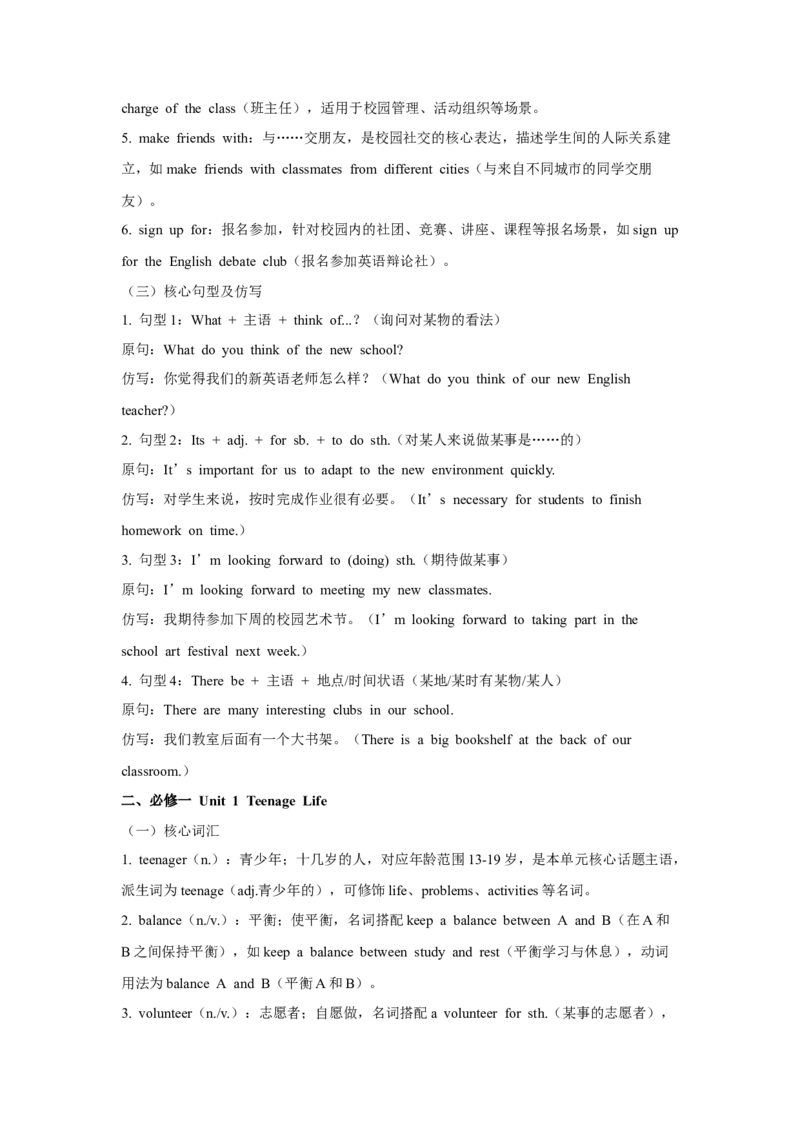
二、必修一 Unit 1 Teenage Life
(一)核心词汇
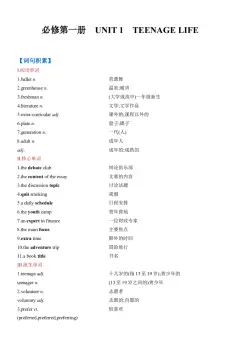
1. teenager(n.):青少年;十几岁的人,对应年龄范围13-19 岁,是本单元核心话题主语,
派生词为teenage(adj.青少年的),可修饰life、problems、activities 等名词。
2. balance(n./v.):平衡;使平衡,名词搭配keep a balance between A and B(在A 和
B 之间保持平衡),如keep a balance between study and rest(平衡学习与休息),动词
用法为balance A and B(平衡A 和B)。
3. volunteer(n./v.):志愿者;自愿做,名词搭配a volunteer for sth.(某事的志愿者),
动词常用volunteer to do sth.(自愿做某事),校园场景中对应志愿活动、公益服务等。
4. prefer(v.):更喜欢;宁愿,常用搭配prefer sth. to sth.(比起某物更喜欢某物)、
prefer to do sth.(更愿意做某事)、prefer doing sth. to doing sth.(比起做某事更喜欢做
某事),描述青少年的兴趣偏好。
5. schedule(n./v.):日程安排;计划;为……安排时间,名词搭配make a schedule(制
定日程表),动词用法为schedule sth. for sth.(为某事安排时间),如schedule a meeting
for Friday(把会议安排在周五),适配校园学习、活动规划场景。
6. stress(n./v.):压力;强调;使承受压力,名词搭配under stress(承受压力)、stress
on sth.(对某事的重视),动词用法为stress the importance of sth.(强调某事的重要性),
贴合青少年学习压力、课堂重点强调等场景。
7. organize(v.):组织;安排,派生词为organization(n.组织)、organized(adj.有条理
的),校园中可用于organize activities(组织活动)、organize study groups(组织学习小
组)。
8. struggle(v./n.):挣扎;努力;困难,动词搭配struggle with sth.(在某事上挣扎/努
力)、struggle to do sth.(努力做某事),名词搭配have a struggle with sth.(在某事上
遇到困难),如struggle with math problems(在数学题上挣扎)。
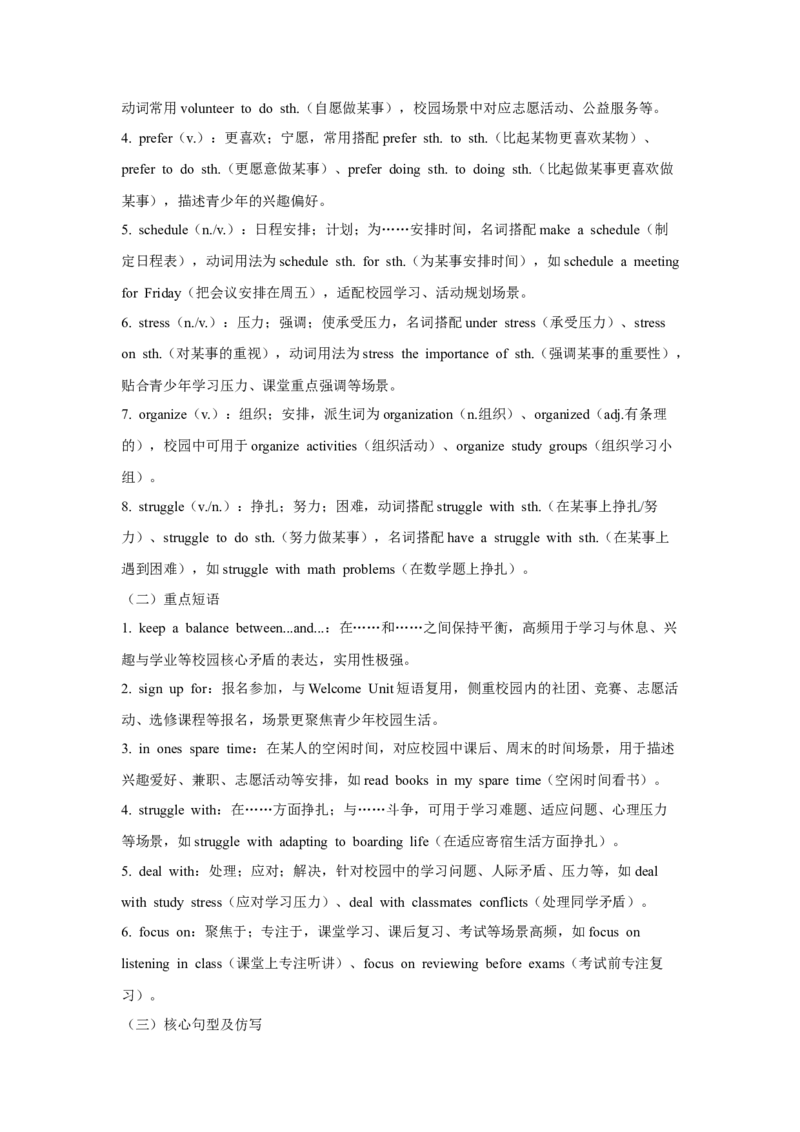
(二)重点短语
1. keep a balance between...and...:在……和……之间保持平衡,高频用于学习与休息、兴
趣与学业等校园核心矛盾的表达,实用性极强。
2. sign up for:报名参加,与Welcome Unit 短语复用,侧重校园内的社团、竞赛、志愿活
动、选修课程等报名,场景更聚焦青少年校园生活。
3. in ones spare time:在某人的空闲时间,对应校园中课后、周末的时间场景,用于描述
兴趣爱好、兼职、志愿活动等安排,如read books in my spare time(空闲时间看书)。
4. struggle with:在……方面挣扎;与……斗争,可用于学习难题、适应问题、心理压力
等场景,如struggle with adapting to boarding life(在适应寄宿生活方面挣扎)。
5. deal with:处理;应对;解决,针对校园中的学习问题、人际矛盾、压力等,如deal
with study stress(应对学习压力)、deal with classmates conflicts(处理同学矛盾)。
6. focus on:聚焦于;专注于,课堂学习、课后复习、考试等场景高频,如focus on
listening in class(课堂上专注听讲)、focus on reviewing before exams(考试前专注复
习)。
(三)核心句型及仿写
1. 句型1:While + 从句(让步/对比),主句(尽管/然而)
原句:While studying hard, we should also keep a balance between study and rest.
仿写:尽管学习很重要,但我们也不能忽视体育锻炼。(While study is important, we
shouldn’t ignore physical exercise.)
2. 句型2:I prefer to do sth. rather than do sth.(宁愿做某事也不愿做某事)
原句:I prefer to take part in sports rather than stay at home in my spare time.
仿写:比起玩手机,我宁愿花时间阅读。(I prefer to spend time reading rather than play
mobile phones.)
3. 句型3:It’s a good idea to do sth.(做某事是个好主意)
原句:It’s a good idea to make a daily schedule to manage time well.
仿写:加入学习小组一起讨论问题是个好主意。(It’s a good idea to join a study group
to discuss problems together.)
4. 句型4:The reason why...is that...(……的原因是……)
原句:The reason why I struggle with math is that I don’t understand the basic
concepts well.
仿写:我喜欢参加志愿活动的原因是它能让我学会合作。(The reason why I like taking
part in volunteer activities is that it can help me learn to cooperate.)
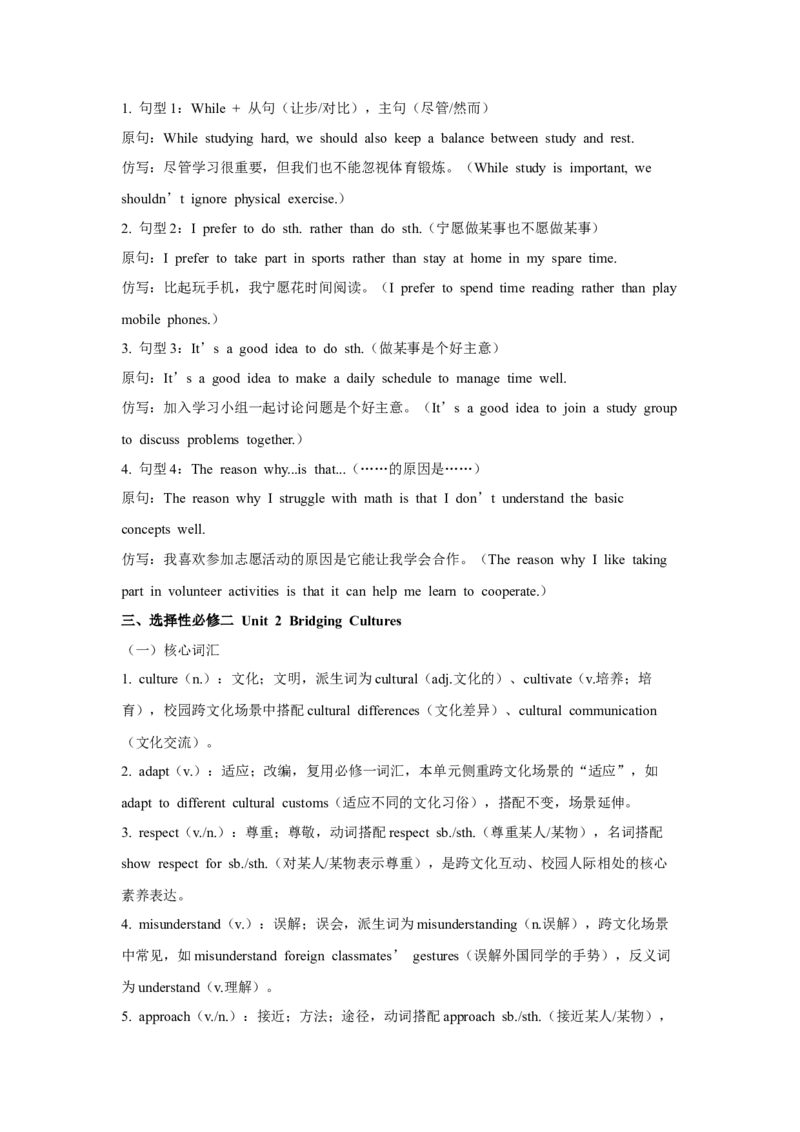
三、选择性必修二 Unit 2 Bridging Cultures
(一)核心词汇
1. culture(n.):文化;文明,派生词为cultural(adj.文化的)、cultivate(v.培养;培
育),校园跨文化场景中搭配cultural differences(文化差异)、cultural communication
(文化交流)。
2. adapt(v.):适应;改编,复用必修一词汇,本单元侧重跨文化场景的“适应”,如
adapt to different cultural customs(适应不同的文化习俗),搭配不变,场景延伸。
3. respect(v./n.):尊重;尊敬,动词搭配respect sb./sth.(尊重某人/某物),名词搭配
show respect for sb./sth.(对某人/某物表示尊重),是跨文化互动、校园人际相处的核心
素养表达。
4. misunderstand(v.):误解;误会,派生词为misunderstanding(n.误解),跨文化场景
中常见,如misunderstand foreign classmates’ gestures(误解外国同学的手势),反义词
为understand(v.理解)。
5. approach(v./n.):接近;方法;途径,动词搭配approach sb./sth.(接近某人/某物),
名词搭配an approach to sth.(做某事的方法/途径),如an approach to bridging cultural
gaps(弥合文化差异的途径)。
6. appreciate(v.):欣赏;感激;理解,派生词为appreciation(n.欣赏;感激),跨文化
场景中可指欣赏不同文化特色,如appreciate foreign cultures(欣赏外国文化),也可用于
日常感谢,如appreciate others’ help(感激他人的帮助)。
7. diversity(n.):多样性;差异,形容词为diverse(adj.多样的),搭配cultural diversity
(文化多样性),是跨文化话题的核心名词,体现对不同文化的包容态度。
8. overcome(v.):克服;战胜,侧重克服困难、障碍,跨文化场景中可指克服文化差异
带来的问题,如overcome cultural barriers(克服文化障碍),搭配overcome
difficulties/challenges(克服困难/挑战),适配多场景。
9. tolerate(v.):容忍;包容,名词为tolerance(n.容忍;包容),跨文化互动及校园人际
中必备,如tolerate different cultural views(包容不同的文化观点),体现包容素养。
(二)重点短语
1. bridge the gap between...and...:弥合……和……之间的差距,本单元核心短语,侧重跨
文化场景中“文化、认知、沟通”等差距的弥补,如bridge the gap between Chinese and
Western cultures(弥合中西方文化差距),也可延伸到校园内不同群体的差距。
2. adapt to:适应,复用前两单元短语,场景聚焦跨文化环境,如adapt to the cultural
differences in the exchange program(适应交换项目中的文化差异)。
3. show respect for:对……表示尊重,跨文化互动的核心准则,如show respect for
foreign classmates’ living habits(尊重外国同学的生活习惯),也适用于校园日常人际。
4. in terms of:在……方面;就……而言,用于跨文化对比、校园事物描述,如in terms
of cultural customs, China and America have many differences(在文化习俗方面,中美有
很多不同)。
5. overcome difficulties:克服困难,本单元侧重克服跨文化相关困难,如overcome
difficulties in cross-cultural communication(克服跨文化沟通中的困难),场景延伸性强。
6. be aware of:意识到;知道,跨文化场景中用于提醒关注文化差异,如be aware of the
cultural differences when communicating with foreigners(与外国人沟通时意识到文化差
异)。
(三)核心句型及仿写
1. 句型1:When it comes to...,...(当提到……时,……)
原句:When it comes to bridging cultural gaps, respect and understanding are very
important.
仿写:当提到跨文化交流时,包容和沟通是关键。(When it comes to cross-cultural
communication, tolerance and communication are the keys.)
2. 句型2:It’s important/necessary for sb. to do sth.(对某人来说做某事是重要的/必要
的)
原句:It’s necessary for us to be aware of cultural differences in the exchange program.
仿写:对交换生来说,适应新的文化环境是很重要的。(It’s important for exchange
students to adapt to the new cultural environment.)
3. 句型3:Only by doing sth. can we do sth.(只有通过做某事,我们才能做某事,部分
倒装)
原句:Only by communicating more can we bridge the cultural gap better.
仿写:只有相互尊重,我们才能在跨文化互动中相处融洽。(Only by respecting each
other can we get along well in cross-cultural interaction.)
4. 句型4:As long as we do sth.,we can do sth.(只要我们做某事,就能做某事)
原句:As long as we show respect for different cultures, we can avoid misunderstandings.
仿写:只要我们多了解外国文化,就能更好地与外国同学交流。(As long as we learn
more about foreign cultures, we can communicate better with foreign classmates.)
四、选择性必修四 Unit 5 Launching Your Career
(一)核心词汇
1. career(n.):职业;事业,核心话题名词,搭配choose a career(选择职业)、develop
a career(发展事业)、launch a career(开启职业生涯),贴合校园生涯规划场景。
2. major(n./v./adj.):专业;主修;主要的,名词指大学专业,如choose a major in
English(选择英语专业),动词搭配major in(主修),如major in computer science(主
修计算机科学),是校园与职业衔接的核心词汇。
3. qualify(v.):(使)具备资格;(使)合格,派生词为qualified(adj.合格的;有资格
的)、qualification(n.资格;学历),搭配qualify for sth.(有资格做某事)、qualify sb.
to do sth.(使某人有资格做某事),如qualify for the job(有资格申请这份工作)。
4. apply(v.):申请;应用;适用,常用搭配apply for sth.(申请某事/某物),如apply
for a job(申请工作)、apply for a scholarship(申请奖学金),也可搭配apply sth. to
sth.(将某物应用于某物),适配校园求职、升学场景。
5. prepare(v.):准备;筹备,名词为preparation(n.准备),搭配prepare for sth.(为某
事做准备)、prepare to do sth.(准备做某事),如prepare for career interviews(为职业
面试做准备),是生涯规划的基础动作。
6. skill(n.):技能;技巧,搭配professional skills(专业技能)、practical skills(实用技
能)、develop skills(培养技能),校园中侧重学习技能、实践技能的积累,为职业打基
础。
7. demand(n./v.):需求;要求,名词搭配meet the demand of(满足……的需求)、the
demand for sth.(对某物的需求),动词搭配demand sth.(要求某物)、demand to do
sth.(要求做某事),如the demand for skilled workers(对技能型人才的需求),关联职
业市场需求。
8. explore(v.):探索;探究,复用必修一词汇,本单元侧重职业方向的探索,如explore
different career paths(探索不同的职业道路),场景延伸至生涯规划。
9. potential(adj./n.):潜在的;潜力,形容词搭配potential career(潜在的职业),名词
搭配tap ones potential(挖掘某人的潜力)、have potential(有潜力),如tap students’
career potential(挖掘学生的职业潜力),贴合校园生涯指导。
10. achieve(v.):实现;达到,名词为achievement(n.成就;成绩),搭配achieve goals
(实现目标)、achieve success in career(在事业上取得成功),是职业发展的核心目标
表达。
(二)重点短语
1. launch ones career:开启某人的职业生涯,本单元核心短语,直接对应话题,如launch
his career as a teacher(开启他的教师职业生涯),适配毕业求职场景。
2. major in:主修(专业),校园与职业衔接的核心短语,明确学业专业与职业方向的关
联,如major in medicine and launch a career as a doctor(主修医学,开启医生职业生
涯)。
3. apply for:申请,场景聚焦职业相关申请,如apply for a position(申请职位)、apply
for an internship(申请实习),复用前单元短语,场景延伸至求职。
4. prepare for:为……做准备,侧重职业相关准备,如prepare for career planning(为生
涯规划做准备)、prepare for job interviews(为求职面试做准备),实用性强。
5. develop skills:培养技能,关联校园学习与职业需求,如develop practical skills to
meet career demands(培养实用技能以满足职业需求),是生涯规划的核心动作。
6. meet the demand of:满足……的需求,侧重职业市场需求,如learn professional
knowledge to meet the demand of the job(学习专业知识以满足工作需求),衔接校园学
习与职业应用。
7. explore career paths:探索职业道路,生涯规划的基础环节,如explore different career
paths through internships(通过实习探索不同的职业道路),适配校园实践、生涯指导场
景。
(三)核心句型及仿写
1. 句型1:I plan to do sth. because...(我计划做某事,因为……)
原句:I plan to major in English because I want to launch my career as an English
teacher.
仿写:我计划主修计算机科学,因为现在市场对计算机人才的需求很大。(I plan to
major in computer science because the market has a high demand for computer talents
now.)
2. 句型2:In order to do sth.,we should do sth.(为了做某事,我们应该做某事)
原句:In order to launch a successful career, we should develop practical skills and
professional knowledge.
仿写:为了在求职面试中表现出色,我们应该提前做好充分准备。(In order to perform
well in job interviews, we should make full preparations in advance.)
3. 句型3:The more...,the more...(越……,越……)
原句:The more skills we develop, the more chances we will have to launch a good
career.
仿写:我们积累的职业相关经验越多,开启理想职业生涯的可能性就越大。(The more
career-related experience we accumulate, the greater the possibility we will have to launch
an ideal career.)
4. 句型4:It’s important for sb. to do sth. to do sth.(对某人来说,做某事以做某事是
重要的)
原句:It’s important for students to explore different career paths to find their suitable
careers.
仿写:对我们来说,培养专业技能以满足职业需求是很重要的。(It’s important for us
to develop professional skills to meet career demands.)