模拟预测卷01
(考试时间:120 分钟  试卷满分:150 分)
注意事项:
1.答卷前,考生务必将自己的姓名、考生号等填写在答题卡和试卷指定位置上。
2.回答选择题时,选出每小题答案后,用铅笔把答题卡对应题目的答案标号涂黑。如需改动,用橡
皮擦干净后,再选涂其他答案标号。回答非选择题时,将答案写在答题卡上。写在本试卷上无效。
3.考试结束后,将本试卷和答题卡一并交回。
第一部分 听力(共两节,满分 30 分)
第一节(共5 小题;每小题1.5 分,满分7.5 分)
听下面5 段对话。每段对话后有一个小题,从题中所给的A、B、C 三个选项中
选
出最佳选项。听完每段对话后,你都有10 秒钟的时间来回答有关小题和阅读下一小题。每段对话仅读一遍。
1.Where does the conversation probably take place?
A.In a hotel.
B.In a restaurant.
C.In a travel agency.
2.When was the man waken up?
A.At 6:00.
B.At 7:00.
C.At 8:00.
3.Where does the conversation probably take place?
A.In an apartment.
B.In a restaurant.
C.In a shop.
4.What does the man suggest the woman do?
A.Forget the pressure.
B.Work at the office.
C.Have a rest.
5.What does the man think about chewing gum?
A.It’s not graceful.
B.It’s good for dental health.
C.It does harm to the environment.
第二节(共15 小题;每小题1.5 分,满分22.5 分)
听下面 5 段对话或独白。每段对话或独白后有几个小题,从题中所给的A、B、C 三个选项中选出最佳
选项。听每段对话或独白前,你将有时间阅读各个小题,每小题5 秒钟;听完后,各小题将给出5 秒钟的
作答时间,每段对话或独白读两遍。
听第6 段材料,回答第6、7 题。
6.What is the woman doing now?
A.Selecting a dress.
B.Dancing with the man.
C.Buying clothes.
7.Where will the speakers go?
A.A wedding ceremony.
B.A dancing party.
C.A concert.
听第7 段材料,回到第8、9 题。
8.What did the man mainly discuss with his teacher?
A.His test results.
B.His illness.
C.His mood.
9.Why did the teacher apologize to the man?
A.She gave him little support.
B.She didn’t remind him of the test.
C.She forgot about his absence from class.
听第8 段材料,回答第10-12 题。
10.What is the woman doing?
A.Promoting a club.
B.Chairing a meeting.
C.Hosting a program.
11.What do we know about The Dragon’s Back race?
A.It lasts three days.
B.It is for beginners.
C.It takes place in the UK.
12.Which is the hardest for the man?
A.Running downhill.
B.Suffering certain injuries.
C.Keeping pace with others.
听第9 段材料,回答第13-16 题。
13.Whose speech did the speakers listen to?
A.A developer’s.
B.A student’s.
C.A doctor’s.
14.What is the man’s goal in the field?
A.To set up a research group.
B.To work on advanced AI projects.
C.To develop policies and guidelines.
15.What does the man plan to do first to realize his dream?
A.Focus on learning and practicing.
B.Cooperate with the woman on a project.
C.Study the policies in the field of technology.
16.What is the woman’s next step regarding her interests?
A.To start some AI projects.
B.To sign up for advanced courses.
C.To continue her work in the research group.
听第10 段材料,回答第17-20 题。
17.What can be seen in the image?
A.A lonely old polar bear.
B.A struggling polar bear.
C.A sleeping young polar bear.
18.Which word best describes the process of taking the image?
A.Challenging.
B.Joyful.
C.Disappointing.
19.What can the director’s words illustrate?
A.The beauty in nature.
B.The impact of the image.
C.The affection for photography.
20.What does Nima Sarikhani call on people to do?
A.Care about the safety of seafood.
B.Create new homes for polar bears.
C.Take action to prevent global warming.
第二部分  阅读(共两节,满分 50 分)
第一节(共15 小题;每小题2. 5 分,满分 37. 5 分)
阅读下列短文,从每题所给的A、B、C、D 四个选项中选出最佳选项。
A
Four Science Research Competitions for High Schoolers
Participating in a science research competition as a high schooler can allow you to explore one of your
passions, making you a more competitive candidate during the college admissions process. Here are four science
research competitions designed for high schoolers.
Breakthrough Junior Challenge
The Breakthrough Junior Challenge tasks students with creating a short two-minute video in which they
explain a complex scientific concept and demonstrate how it works in practice.
Awards include a $250,000 college scholarship, and a $50,000 award to a teacher of the winner’s choosing.
Eye on the Future Teen Video Contest
Participants are tasked with creating a video between 30 seconds and three minutes long, either on their own
or in teams of up to three members. Winners receive a paid trip to the National Institute of Health in Bethesda,
Maryland.
Regeneron International Science and Engineering Fair
This competition is the world’s largest international pre-college STEM competition. Students showcase
independent research and compete across 22 categories for awards ranging from $500 to $75,000.
This is not a group-based competition — individual students sign up for local school science fairs before
advancing to upper-level competitions.
American Academy of Neurology Neuroscience Research Prize
This competition challenges students to investigate problems regarding the brain or nervous system. It is
only open to individual students — group projects are excluded.
Winners receive a monetary prize and the chance to present their projects at the AAN Annual Meeting.
21.What is the aim of the competitions?
A.To ensure admission to college.
B.To fuel the passion for science.
C.To excel in high school exams.
D.To select outstanding talents.
22.What do the first two competitions have in common?
A.Winners will receive a paid trip.
B.The participants need to team up.
C.Presentation of a video is a must.
D.The winner’s teacher will be awarded.
23.Which competition might attract participants interested in medicine?
A.Breakthrough Junior Challenge.
B.Eye on the Future Teen Video Contest.
C.Regeneron International Science and Engineering Fair.
D.American Academy of Neurology Neuroscience Research Prize.
B
One winter, while skiing down snowy hills with fellow neighborhood kids, Ralph Samuelson had an idea, “If
you could ski on snow,” he wondered, “why not on water?”
In the summer of 1922, Samuelson, then 18, began his attempts to stand up on skis on Lake Pepin, just
several blocks from his house in Lake City, Minnesota. After numerous attempts, he eventually succeeded, and one
of the world’s most beloved water sports was born.
People living in Samuelson’s hometown wanted to ensure no one forgot his contribution to warm-weather
fun. On July 2, 2022, at 4:11 p.m. — the exact moment 100 years ago that Samuelson rose from the water on skis
behind his brother’s boat — Lake City leaders released a life-sized bronze statue of Samuelson at Ohuta Park and
Beach on the shores of Lake Pepin.
Samuelson first tried water skiing while riding his aquaplane, a large, flat board pulled behind his brother’s
boat. On June 28, 1922, he skied for several yards this way. In the days that followed, Samuelson tried different
approaches. In most of his attempts, he started with his skis level with or below the waterline; but by the time his
brother got the boat going, Samuelson was sinking. Eventually, he tried raising the tips of the skis out of the water
while he leaned back — and it worked. Then he began learning tricks on his skis, which drew crowds of onlookers
to the shoreline.
Sadly, his career as a water skier was short-lived. When he hurt his back in a construction accident in 1927,
he was forced to hang up his skis forever. He never patented his water skis, but so many people had watched him
ski that Samuelson was eventually recognized as the sport’s inventor. Samuelson died of cancer in 1977, but his
legacy lives on. There’s a historical marker at Lake Pepin proudly identifying it as the “Birthplace of Waterskiing”.
24.How did Samuelson learn waterskiing?
A.By learning from his brother.
B.By following instructions.
C.By trying many times himself.
D.By taking a specific course.
25.What do we know about Samuelson?
A.He became globally famous for waterskiing.
B.His waterskiing career lasted about five years.
C.His waterskiing tricks were acquired all by accident.
D.He got crazy about trying new sports at an early age.
26.Which of the following can best describe Samuelson?
A.Modest and generous.
B.Independent and responsible.
C.Creative and determined.
D.Hard-working and ambitious.
27.What is the purpose of the text?
A.To show honor to a man.
B.To introduce a water sport.
C.To stress the key to success.
D.To tell the history of skiing.
C
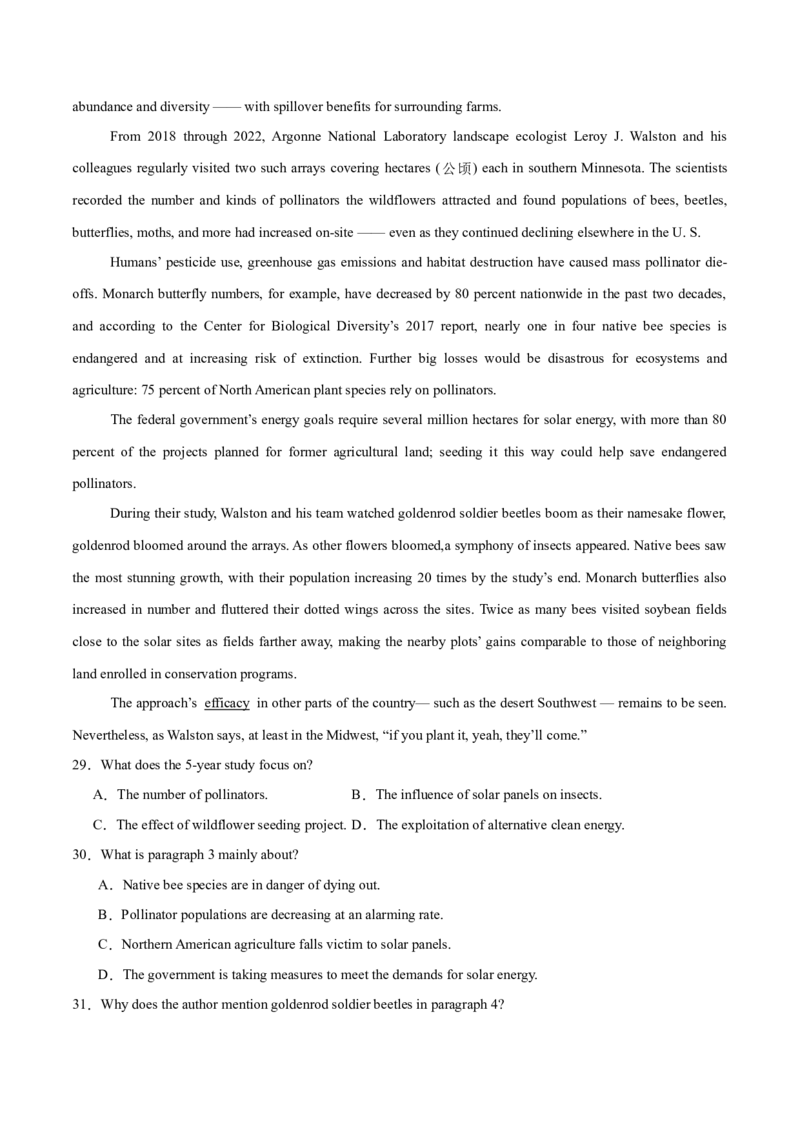
Vast plains of solar panels can help nature more than clean energy: As populations of crucial pollinators (虫
媒) decline, developers have been seeding the grounds of their solar arrays (阵列) with native wildflowers. Now a
five-year study published in Environmental Research Letters, confirms that this approach boosts the pollinators’
abundance and diversity —— with spillover benefits for surrounding farms.
From 2018 through 2022, Argonne National Laboratory landscape ecologist Leroy J. Walston and his
colleagues regularly visited two such arrays covering hectares (公顷) each in southern Minnesota. The scientists
recorded the number and kinds of pollinators the wildflowers attracted and found populations of bees, beetles,
butterflies, moths, and more had increased on-site —— even as they continued declining elsewhere in the U. S.
Humans’ pesticide use, greenhouse gas emissions and habitat destruction have caused mass pollinator die-
offs. Monarch butterfly numbers, for example, have decreased by 80 percent nationwide in the past two decades,
and according to the Center for Biological Diversity’s 2017 report, nearly one in four native bee species is
endangered and at increasing risk of extinction. Further big losses would be disastrous for ecosystems and
agriculture: 75 percent of North American plant species rely on pollinators.
The federal government’s energy goals require several million hectares for solar energy, with more than 80
percent of the projects planned for former agricultural land; seeding it this way could help save endangered
pollinators.
During their study, Walston and his team watched goldenrod soldier beetles boom as their namesake flower,
goldenrod bloomed around the arrays. As other flowers bloomed,a symphony of insects appeared. Native bees saw
the most stunning growth, with their population increasing 20 times by the study’s end. Monarch butterflies also
increased in number and fluttered their dotted wings across the sites. Twice as many bees visited soybean fields
close to the solar sites as fields farther away, making the nearby plots’ gains comparable to those of neighboring
land enrolled in conservation programs.
The approach’s efficacy in other parts of the country— such as the desert Southwest — remains to be seen.
Nevertheless, as Walston says, at least in the Midwest, “if you plant it, yeah, they’ll come.”
29.What does the 5-year study focus on?
A.The number of pollinators.
B.The influence of solar panels on insects.
C.The effect of wildflower seeding project. D.The exploitation of alternative clean energy.
30.What is paragraph 3 mainly about?
A.Native bee species are in danger of dying out.
B.Pollinator populations are decreasing at an alarming rate.
C.Northern American agriculture falls victim to solar panels.
D.The government is taking measures to meet the demands for solar energy.
31.Why does the author mention goldenrod soldier beetles in paragraph 4?
A.To highlight the ecological crisis.
B.To illustrate a mutually beneficial relationship.
C.To prove the success of conservation programs.
D.To indicate the outcome the wildflower planting.
32.What does the underlined word “efficacy” in paragraph 5 most probably mean?
A.Effectiveness. B.Limitation.
C.Response.
D.Risk.
D
Socrates declared that the unexamined life wasn’t worth living for a human being, implying that we should
attempt to know ourselves, to think through our actions, choices, prejudices, and attitudes. But when it comes to
thinking about our own happiness and what makes our lives go well, it really does seem that this reflective attitude
can ruin our chances of finding what we seek.
Perhaps it’s not surprising that we are better designed for engaging in other activities than reflecting on how
best to achieve our own happiness and well-being. Doing things that enhance our growth in physical, social and
intellectual areas tends to bring the reward of feeling good, and so stimulates us further to pursue those activities.
Sitting around reflecting on what will make us happy is a lot less efficient than chasing the things that make us
happy, and if we think too much, there is an opportunity cost — time that we could have spent in a worthwhile
activity has gone while we were thinking deeply about the best way to develop.
The philosopher David has written about the role of reflective thinking in sports. One of his observations is
that while sportspeople need to think about the basic actions they are performing, it can be counterproductive to
start thinking about the elements making up those actions. A footballer needs to think about kicking the ball low
and hard to the left of the goalkeeper, but not to overthink the mechanics of the precise small movements of legs
and feet that produce that outcome. If he or she does start this sort of thought process, it very often leads to a poorer
shot. What’s needed is a kind of automatic response to the situation.
Perhaps something similar is going on in our life. Those people who start detailed programs of self-
development in various dimensions, focusing on diet, habits, exercise, mental activity, work output, and so on, are
like the footballer thinking through the small muscle movements. Perhaps their well-meaning self-reflection on
their own development and how they want to achieve it, is the very thing that will make a high level of
development forever unobtainable for them.
32.What may cause an opportunity cost?
A.Spending time on worthy activities.
B.Joining in social meetings actively.
C.Getting stuck in much self-reflection.
D.Doing physical exercises efficiently.
33.Why does the author mention David’s observations?
A.To praise a wise philosopher.
B.To teach readers football skills.
C.To cite a case of overthinking.
D.To argue for reflective thinking.
34.What does the author suggest readers do to achieve their goals?
A.Make a comprehensive plan.
B.Adopt a direct approach.
C.Think carefully before action.
D.Attach importance to details.
35.What is a suitable title for this text?
A.The Risk of Overthinking
B.The Key to Well-being
C.The Way to Think Reflectively
D.The Method to Develop Yourself
第二节(共5 小题;每小题2.5 分,满分12.5 分)
阅读下面短文,从短文后的选项中选出可以填入空白处的最佳选项。选项中有两项为多余选项。
Whether it’s woodworking, sewing or sculpting teeny cupcakes, making art is good for your mind and body.
36    And developing our creative side can give us a stronger sense of agency — the ability to solve problems by
imagining possible solutions.
But you don’t have to be a full-time artist to get in on those health benefits. All you need to do is just make
art. And the more you do it, the better.    37
You don’t need to be an artist with a capital “A”.
We tend to think that only people who are very skilled at art can call themselves artists, but really, anyone
can be an artist.    38    In fact, research has shown that there are no differences in health outcomes between
those who identify as experienced artists and those who don’t. That means that no matter your skill level, you’ll be
able to feel all the good things that come with making art.
Figure out your mode of creative expression.
Start with whatever you enjoy. But keep an open mind.    39    You can do that through many activities:
finger painting, cooking, baking, oil painting, weaving — the sky’s the limit. And don’t feel like you have to stick
to one thing. Mix it up — do whatever you’re in the mood for.
   40
Once you have your art materials, here comes the fun part. Mess around! Let yourself get lost in the process
and just play. Because it’s the physical act of making art that induces those feelings of stress relief and positive
energy — not what you make or how you make it.
A.Be ready to take others’ advice.
B.Take control of the waves of emotion.
C.Everyone is capable of creative expression.
D.Focus on the making and let go of expectations.
E.Anything that engages your creative mind is good for you.
F.The act of creation can reduce stress and anxiety and improve your mood.
G.Here are several things you need to know to kick-start your creative art habit.
第三部分  语言运用(共两节,满分30 分)
第一节  (共15 小题;每小题1 分,满分15 分)
阅读下面短文,从每题所给的A、B、C、D 四个选项中选出最佳选项。
Sophie Jones, 22, lives in Warrington, England. She has overcome her fear of     21     by creating a list
of challenges she has always     22    .
So far, she has completed 45 things, including     23     strangers to games of rock, paper, scissors and
asking to make pizza in a pizza kitchen. She said, “Doing things that frightened me     24     my life, and my
confidence has increased    25    .”
Sophie experienced a lot of rejection throughout her teenage years. She became     26     of
experiencing rejection and started     27     friendships and opportunities. She didn’t want to put herself
forward for things like new jobs or friendships due to low     28    . Later, she discovered a treatment called
“rejection therapy”. After     29     a woman online asking for a free coffee in a shop, she       30

her own “fear list”. Since discovering the       31      , Sophie has made her own ice cream in an ice cream
van (货车) and even climbed stairs on all fours.
Now Sophie receives fewer rejections. She has become more       32      . Without the anxiety of
rejection, she also       33       other people to try her method. She said, “I want everyone to       34

they can do anything they want. The greatest opportunities are just around the corner. Starting       35      ,
like asking for the bill at a restaurant, can be a good way to begin.”
41.A.failure
B.rejection
C.loss
D.punishment
42.A.faced
B.welcomed
C.fought
D.avoided
43.A.challenging
B.accompanying
C.attracting
D.leaving
44.A.darkened
B.threatened
C.changed
D.shortened
45.A.thoroughly
B.dramatically
C.occasionally
D.temporarily
46.A.scared
B.aware
C.tired
D.ashamed
47.A.waiting for
B.reflecting on
C.making use of
D.shying away from
48.A.self-discipline B.self-criticism
C.self-respect
D.self-doubt
49.A.seeing
B.hearing
C.stopping
D.getting
50.A.found
B.started
C.replaced
D.analyzed
51.A.opportunity
B.secret
C.instruction
D.method
52.A.sensitive
B.patient
C.confident
D.energetic
53.A.advises
B.requires
C.forces
D.allows
54.A.ensure
B.realize
C.promise
D.highlight
55.A.big
B.slow
C.quick
D.small
第二节(共10 小题;每小题1.5 分,满分15 分)
阅读下面短文, 在空白处填入1 个适当的单词或括号内单词的正确形式。
Mandarin is the official language of China and one of the official languages of the United Nations. It is
generally referred to as “Chinese”.
But in fact, Mandarin is just one of the Chinese dialects. China is

 5  6

  old and vast country and the
mountain ranges, rivers, and deserts create region

 5  7

  (border). In ancient times, it was difficult for people
in different places to communicate with each other and many regions

 5  8

  (develop) their own spoken
languages. There are over 80 Chinese dialects

 5  9

  existence now, including Wu, Xiang, Hakka,
Cantonese, Min and many other dialects. Classifying these Chinese languages as dialects or languages is a
controversial topic. A Cantonese

 6  0

  (speak) and a person speaking Min will not be able to communicate
with each other. Similarly, a person speaking Hakka will not be able to understand Xiang.

 6  1

  (give) these
major difference, they could be regarded as languages. However, they all share a common

 6  2

  (write)
system—Chinese characters. Even though the characters can

 6  3

  (pronounce) in completely different
ways depending on the dialect one speaks, the language on paper is

 6  4

  (understand) between people of
different regions. So from

 6  5

  is talked above, it is reasonable to say that they are all dialects of the
official Chinese language—Mandarin.
第四部分  写作(共两节,满分40 分)
第一节  (满分15 分)
假定你是李华,你校将于下周举办一个主题为“Science Changes Our Lives”的科技节(Science Festival)活动,
请你给留学生朋友Tom 写一封邮件,邀请他参加。
内容包括:1、活动目的;2、活动内容;3、报名方式。
注意:1、写作词数应为 80 左右;
2、请按如下格式在答题纸的相应位置作答。
Dear Tom,
____________________________________________________________________________________________
____________________________________________________________________________________________
____________________________________________________________________________________________
____________________________________________________________________________________________
___________________________
Yours,
Li Hua
第二节  (满分25 分)
阅读下面材料,根据其内容和所给段落开头语续写两段,使之构成一篇完整的短文。
As the school year came to an end, the seventh-grade teachers organized a two-week-long summer camp for
the students at a nearby camping site. All the children were happy to hear about the trip and immediately asked
their parents’ permission.
One of the scholars, a 13-year-old named Sam, came to the summer campsite in his dad’s old Lincoln. As he
was dropped off, all the other kids and parents looked at the very old car, especially against the array of luxury cars.
As the day progressed, the other students began using their phones and taking pictures together. Meanwhile,
Sam sat under a tree and read a book. He had a phone too, although it was old with big buttons. He rarely brought it
out, except in the morning and at night to call his parents. When he did use his phone, the other children would
whisper and laugh at him. Nevertheless, Sam did not mind them.
On the second day of camp, the instructor taught the kids how to light a fire from raw materials and set up a
tent. While everyone was having difficulty completing the tasks, Sam was able to light the fire and set up the tent
faster than the instructor. Everyone was shocked at his speed, and when one classmate asked why he learned it so
fast, Sam replied: “My dad and I went camping every Saturday since I was seven. So starting a fire and setting a
tent is normal to me.” Patrick Letter, one of Sam’s classmates was amazed at Sam’s skills. “That’s so cool! I wish I
went camping with my dad. He works every day, so we never really went anywhere together,” he said. Most of the
kids lowered their eyes, knowing that they, too, never had activities with their busy parents.
注意:
1.续写词数应为150 左右;
2.请按如下格式在答题卡的相应位置作答。
Paragraph 1: The following day, the instructor taught the kids how to catch fish and make fish soup.
____________________________________________________________________________________________
____________________________________________________________________________________________
____________________________________________________________________________________________
____________________________________________________________________________________________
_______________________________________________________________________________________
Paragraph 2: When Sam came with his crafted (精巧制作的) scarf, everyone was surprised to see it.
____________________________________________________________________________________________
____________________________________________________________________________________________
____________________________________________________________________________________________
____________________________________________________________________________________________
_______________________________________________________________________________________