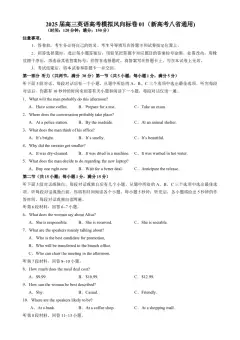
2025届高三英语高考模拟风向标卷01(广东专用)
注意事项:
1.答卷前,考生务必将自己的姓名、考生号等填写在答题卡和试卷指定位置上。
2.回答选择题时,选出每小题答案后,用铅笔把答题卡对应题目的答案标号涂黑。如
需改动,用橡皮擦干净后,再选涂其他答案标号。回答非选择题时,将答案写在答题卡上
写在本试卷上无效。
3.考试结束后,将本试卷和答题卡一并交回。
第二部分 阅读(共两节, 满分50分)
第一节(共15小题:每小题2.5分, 满分37.5分)
阅读下列短文, 从每题所给的A、B、C、D四个选项中选出最佳选项。
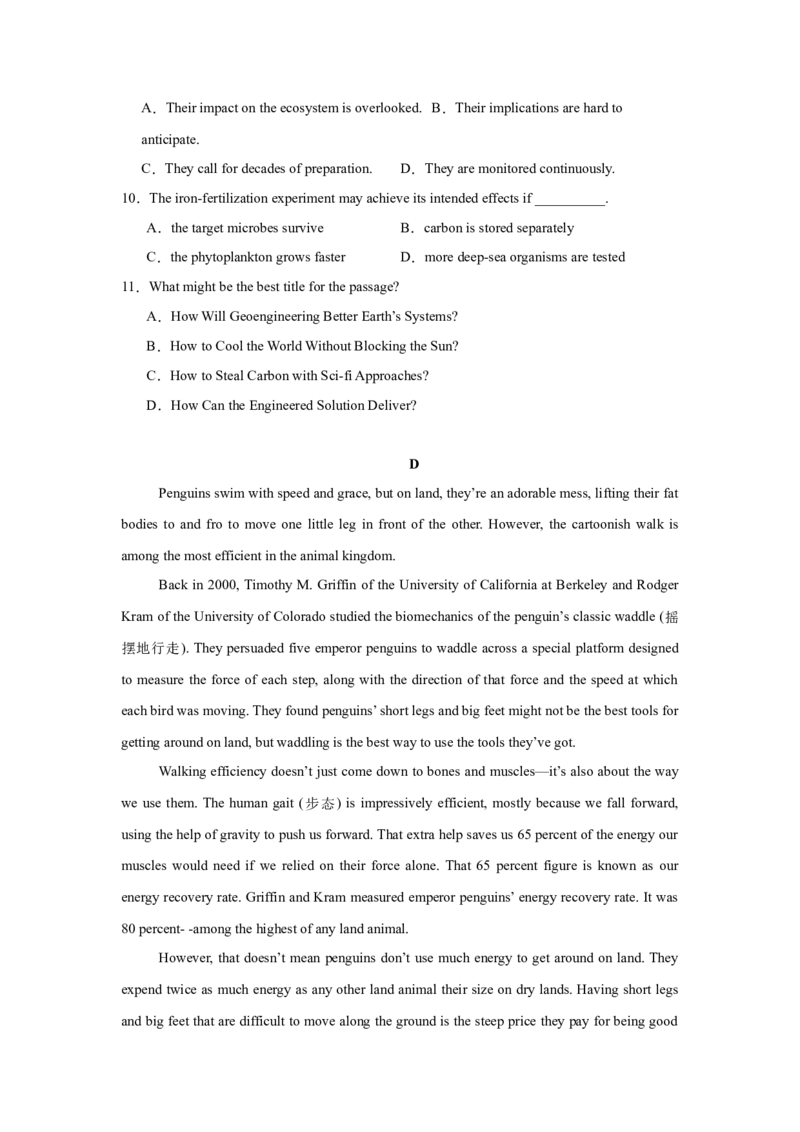
A
Below are stories of kids who saw a need in the world and set out to fix it. Hearing the
stories will inspire generosity and charity in your own kids.
Janine Licare and Aislin Livingstone — Kids Saving the Rainforest: Janine and Aislin
were 9 when they saw the rainforest disappearing in Costa Rica. Dissatisfied with how their
donations were being spent by other rainforest charities, they began their own organization—Kids
Saving the Rainforest.
Austin Gutwein — Hoops of Hope: At 9, Austin watched a video of children who had lost
their parents due to AIDS. Moved by this, Austin decided to organize a charity called Hoops of
Hope. Through sponsorships, the participants have raised over $2.5 million to provide those kids
with access to food, clothing and shelter. However, Hoops of Hope is now closed.
Mackenzie Bearup — Sheltering Books: Mackenzie was 13 when she began collecting
children’s books for shelters in and around Alpharetta, Georgia. It soon became a family project
with her two brothers working alongside her. In total, they have collected and donated over
360,000 books for shelters across the world.
Annie Wignall — Care Bags Foundation: At 11, Annie began the Care Bags Foundation
when she discovered there were many kids in crisis situations who had to leave their homes with
very few belongings. Annie’s organization creates and distributes fabric care bags filled withessential and comforting items for needy children.
1.What motivated Janine and Aislin to start their organization?
A.Ideas for visiting the rainforest in Costa Rica.
B.Dissatisfaction with how donations were used.
C.Inspiration from other rainforest organizations.
D.Determination to raise money for the rainforest.
2.What is special about Austin Gutwein’s charity organization?
A.It is shut down now. B.It is in the charge of kids.
C.It has collected millions of books. D.It offers help to all children.
3.Who might be the text intended for?
A.Students. B.Parents. C.Donors. D.Teachers.
B
In 2019, Polly Greenblatt set a professional goal to integrate the design thinking process
into classroom curriculums. This approach focuses on creating effective solutions for others
through deep understanding, rather than emphasizing success or money.
“I think it’s important to include understanding others in curriculums because we’ve
become such a global society, but we all still kind of live in our own little bubble. Some of our
kids don’t really go outside of our town,” said Greenblatt.
Greenblatt decided the best product to develop with this process would be a pair of shoes.
She noticed when first graders tried designing a backpack for a friend, they would focus on their
own needs. “Shoes weren’t too far out of the world of their own little reality, but they were
completely removed from themselves,” she said.
The concept was that students would research the journey to school children from different
regions of the world experienced, then create a shoe design for them.
The students watched documentaries, researched and even walked on Legos without shoes
to better understand the challenges children in other regions faced.
To help deepen the learning on a scientific level, Greenblatt encouraged kids to use animal
adaptability features. “Elementary kids don’t have the limitations in their brain of, ‘Oh, that’ s not
possible, ‘or’ That’s gonna cost too much money,” Greenblatt said. “One student came up with the
idea that like, starfish grow and if we made shoes out of a starfish type skin, that it could growwith the kid as their foot was growing. Ideas like that might not be possible now, but they’re going
to be.”
Once their ideas were generated, the students were able to put them to the test. If an idea
didn’t work toward their goal, they were encouraged not to give up, but instead to go back in the
process and adjust, or try a new idea.
“Now, our kids are able to care about kids around the world, and literally put them in their
shoes, we think our kids will make better global citizens for our world.” Greenblatt said proudly.
4.What did Greenblatt intend to do?
A.Distinguish her profession. B.Teach money-making methods.
C.Promote the school beyond the town. D.Develop students’ global awareness.
5.Why did Greenblatt choose shoes for her students to design?
A.To relate them to others.
B.To challenge them mentally.
C.To improve their design ability.
D.To draw their attention to real life.
6.How did the starfish idea sound to Greenblatt?
A.Absurd. B.Creative. C.Practical. D.Costly.
7.What were the students encouraged to do during testing?
A.Concentrate. B.Supervise. C.Persevere. D.Compete.
C
In 1993, a ship sailed into the Pacific Ocean carrying nearly 1,000 pounds of iron, then
dumped it all into the waves. The next morning, the water turned a little greenish due to newly
emerged phytoplankton (浮游生物). The microorganisms, which need iron to grow, draw CO₂ out
of the air.
Fertilizing the ocean with iron is a form of geoengineering, a set of technologies fascinating
for their potential to meaningfully impact Earth’s systems, and controversial for the same reason.
As the planet heats, geoengineering is employed to manipulate (控制) it in novel ways, whether
researchers mist the skies with sea salt to increase how much sunlight clouds reflect or invent
machines to suck greenhouse gases out of the atmosphere. Engineering home-grown plankton
sounds like a less dramatic approach. But the field is so new that scientists don’t yet know whethergeoengineering with microorganisms would really be a gentler form of climate intervention.
Microbes, after all, play enormously consequential roles in the world around us and within us. For
the best chance of keeping Earth liveable, scientists need to understand exactly how the
microscopic creatures might be useful, and perhaps even preferable to the more sci-fi approaches
to cooling off the world.
One favored approach centers on methane, a greenhouse gas accounting for 30% of the rise
in global temperature. Mary Lidstrom, a professor, is working on genetically modifying bacteria
that naturally consume methane, so that the microbes pull even more gas from the air. The bacteria
would live inside facilities known as bioreactors. They could be positioned near known methane
sources — landfills and wetlands — to minimize the amount of methane that makes it into the air.
Scaling up any kind of climate engineering is tricky. Significantly slowing warming caused
by methane would require about 300,000 bioreactors to be active for 20 years. And the
downstream effects are difficult to predict, let alone contain. For example, the iron put into the
Pacific Ocean could have consequences for other regions of the world’s seas.
Also, there’s nearly as much uncertainty about intended effects. Scientists don’t know for
sure how effective these concepts will prove to be. The 1993 ship expeditions, for example, didn’t
stick around very long; the journeys were expensive, and scientists couldn’t remain at sea to
determine what exactly was happening in the depths. Carbon stolen out of the atmosphere should
remain buried for at least a century for maximum impact Yet it’s entirely possible that if the
phytoplankton doesn’t sink to deep enough waters, it just gets eaten by the organisms in the
surface ocean, and that CO₂ just returns to the atmosphere.
The hotter the planet gets, the more attractive geoengineering will likely seem. Short of
large-scale behavioral changes globally, we do seem to be committing ourselves to an engineered
solution on our current routes. We might have to decide, sooner than we think, which levers we
need to pull, large or small.
8.What can we learn about geoengineering?
A.Ocean iron-fertilization is on the horizon.B.Sunlight-reflection method is cost-effective.
C.Methane-eating bacteria are being improved. D.Gas-sucking machine is a theoretical
concept.
9.What can we infer from Paragraph 4 about the geoengineering approaches?A.Their impact on the ecosystem is overlooked. B.Their implications are hard to
anticipate.
C.They call for decades of preparation. D.They are monitored continuously.
10.The iron-fertilization experiment may achieve its intended effects if __________.
A.the target microbes survive B.carbon is stored separately
C.the phytoplankton grows faster D.more deep-sea organisms are tested
11.What might be the best title for the passage?
A.How Will Geoengineering Better Earth’s Systems?
B.How to Cool the World Without Blocking the Sun?
C.How to Steal Carbon with Sci-fi Approaches?
D.How Can the Engineered Solution Deliver?
D
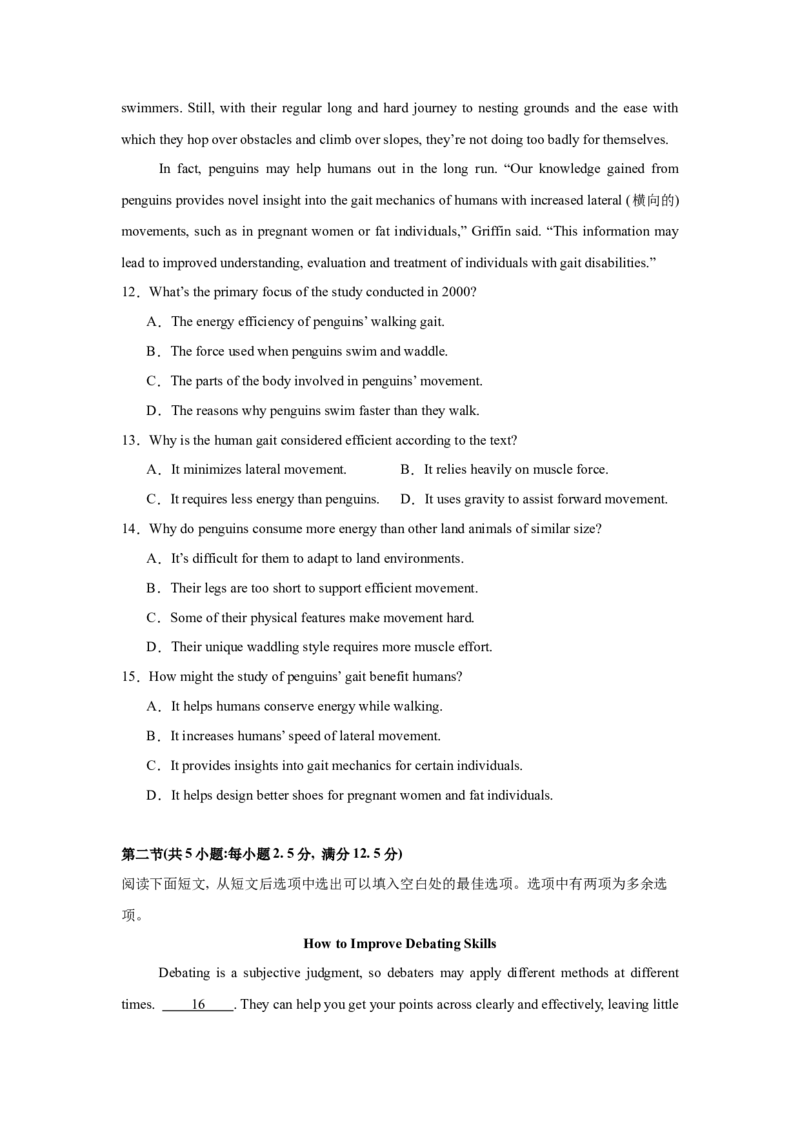
Penguins swim with speed and grace, but on land, they’re an adorable mess, lifting their fat
bodies to and fro to move one little leg in front of the other. However, the cartoonish walk is
among the most efficient in the animal kingdom.
Back in 2000, Timothy M. Griffin of the University of California at Berkeley and Rodger
Kram of the University of Colorado studied the biomechanics of the penguin’s classic waddle (摇
摆地行走). They persuaded five emperor penguins to waddle across a special platform designed
to measure the force of each step, along with the direction of that force and the speed at which
each bird was moving. They found penguins’ short legs and big feet might not be the best tools for
getting around on land, but waddling is the best way to use the tools they’ve got.
Walking efficiency doesn’t just come down to bones and muscles—it’s also about the way
we use them. The human gait (步态) is impressively efficient, mostly because we fall forward,
using the help of gravity to push us forward. That extra help saves us 65 percent of the energy our
muscles would need if we relied on their force alone. That 65 percent figure is known as our
energy recovery rate. Griffin and Kram measured emperor penguins’ energy recovery rate. It was
80 percent- -among the highest of any land animal.
However, that doesn’t mean penguins don’t use much energy to get around on land. They
expend twice as much energy as any other land animal their size on dry lands. Having short legs
and big feet that are difficult to move along the ground is the steep price they pay for being goodswimmers. Still, with their regular long and hard journey to nesting grounds and the ease with
which they hop over obstacles and climb over slopes, they’re not doing too badly for themselves.
In fact, penguins may help humans out in the long run. “Our knowledge gained from
penguins provides novel insight into the gait mechanics of humans with increased lateral (横向的)
movements, such as in pregnant women or fat individuals,” Griffin said. “This information may
lead to improved understanding, evaluation and treatment of individuals with gait disabilities.”
12.What’s the primary focus of the study conducted in 2000?
A.The energy efficiency of penguins’ walking gait.
B.The force used when penguins swim and waddle.
C.The parts of the body involved in penguins’ movement.
D.The reasons why penguins swim faster than they walk.
13.Why is the human gait considered efficient according to the text?
A.It minimizes lateral movement. B.It relies heavily on muscle force.
C.It requires less energy than penguins. D.It uses gravity to assist forward movement.
14.Why do penguins consume more energy than other land animals of similar size?
A.It’s difficult for them to adapt to land environments.
B.Their legs are too short to support efficient movement.
C.Some of their physical features make movement hard.
D.Their unique waddling style requires more muscle effort.
15.How might the study of penguins’ gait benefit humans?
A.It helps humans conserve energy while walking.
B.It increases humans’ speed of lateral movement.
C.It provides insights into gait mechanics for certain individuals.
D.It helps design better shoes for pregnant women and fat individuals.
第二节(共5小题:每小题2. 5分, 满分12. 5分)
阅读下面短文, 从短文后选项中选出可以填入空白处的最佳选项。选项中有两项为多余选
项。
How to Improve Debating Skills
Debating is a subjective judgment, so debaters may apply different methods at different
times. 16 . They can help you get your points across clearly and effectively, leaving littleroom for your opponents to question and inspiring responses and participation of the audience.
Strategic Arguments
Organize your thoughts before you speak. Before you start, think through the chronological
order (时间顺序) in which you want to present your statements. Then, start with a powerful
statement and support your comments with research and viewpoints from professionals in the
field. 17 . So the listeners and opponents will examine what might happen if they choose
not to support your arguments.
18
Focus on ways you might improve your body language. Signs of confidence might include
a firm standing posture with few movements. Make eye contact with your opponent when
possible, but don’t stare him down. Stand straight, so your opponent doesn’t think you’re bored or
lazy. Signs of nonconfidence might include running your hands through your hair, touching your
face and staring at your notes without looking up or tapping your pencil on the podium.
Respectful Tones
19 . Always avoid whispering, complaining and yelling since they inform others
you’re overwhelmed by emotion and can’t present logical arguments. Increase your volume
slightly to stress extremely important details. When responding to your opponent’s arguments, use
a firm, respectful tone.
Opposing Viewpoints
Address your opponent’s viewpoints head-on and don’t beat around the bush. Prove to the
judges and the audience that you are willing to analyze viewpoints from all angles. You might
politely mention flaws in your opponent’s line of reasoning or address factual errors. You can also
agree with part of your opponent’s argument. 20 .
On the whole, how to persuade the audience, invoking intelligent responses and enthusiastic
participation are debating skills worth mastering.
A.Appropriate Gestures.
B.Confident Body Language.
C.Conclude your argument with convincing details.
D.An effective debate is organized, strategic and persuasive.
E.However, some skills generally apply to all forms of debate.
F.Meanwhile, show ways that the argument doesn’t hold up as a whole.G.Create and maintain a tone that is respectful and easy to listeners’ ears.
第三部分语言运用(共两节,满分30分)
第一节(共15小题:每小题1分,满分15分)
阅读下面短文, 从每题所给的A、B、C、D四个选项中选出可以填入空白处的最佳选项。
Over 200 residents of Beckenham, southeast London, had raised nearly £ 3 000 to send
Paul Spiers, a well-liked street cleaner, on a summer break to Portugal. However, he couldn’t go
on a crowdfunded (众筹) holiday because his 21 , Veolia, had rules against accepting
gifts. But then, the travel company On the Beach 22 a special “competition” with very
23 entry requirements: You must be 64 years old, have the last name Spiers, be a street
cleaner in Beckenham, and be 24 by your community. Not surprisingly, Paul won.
Finally, Veolia 25 him to accept the£ 3 000 holiday voucher (代金券) as a“prize”.
Paul’s 26 to his job was evident in the little things he did every day. For instance,
he once found a lost wallet while 27 the streets and went out of his way to return it to its
owner, who then expressed great 28 . His friendly greetings and cheerful spirits 29
brought smiles to the residents he served.
A company 30 said, “We have no objection to him accepting his win. We are
very thankful for the support and 31 shown by the community to Paul, who, along with
a hardworking street cleaning team, 32 in keeping Bromley’s streets clean.”
Paul’s story is an example to the 33 one person can have on a community
through devotion. The residents’ 34 to reward him show how much they 35
his hard work and positive attitude.
21.A.colleague B.assistant C.employer D.partner
22.A.canceled B.created C.conveyed D.completed
23.A.secret B.essential C.specific D.familiar
24.A.respected B.accompanied C.evaluated D.declared
25.A.advised B.directed C.appealed D.permitted
26.A.dedication B.combination C.preference D.appetite
27.A.wandering B.sweeping C.appreciating D.introducing
28.A.impression B.promotion C.gratitude D.cooperation
29.A.obviously B.constantly C.approximately D.exactly30.A.scholar B.participant C.committee D.representative
31.A.achievement B.recognition C.commitment D.reputation
32.A.comes to light B.has a good time C.gives a hand D.cuts above the rest
33.A.impact B.favor C.justice D.power
34.A.tendencies B.requests C.efforts D.struggles
35.A.persuade B.encourage C.analyze D.appreciate
第三部分语言运用(共两节,满分30分)
第二节(共15小题:每小题1分,满分15分)
阅读下面短文,在空白处填入1个适当的单词或括号内单词的正确形式。
Due to visa-free policies and optimized (优化的) measures, more and more international
travelers are coming to China. Anna Bondarenko, from Russia, had a blast (狂欢) in Tianjin. 36
(study) business administration in Shanghai for almost two years, Bondarenko has traveled to
several places around China. “I love traveling to big cities like Beijing and Shanghai and smaller
destinations like Zhuzhou and Changsha in China. I think every city has its 37 (distinct)
atmosphere,” she says. As she shares her travels around China on popular social media platforms
like Instagram, she finds that many of her 30 000 followers are amazed by the 38
(diverse) of the country’s tourism resources. “They leave comments saying that Suzhou, in Jiangsu
Province, looks like Venice 39 has unique characteristics,” says Bondarenko.
Bondarenko is among more than 100 travel influencers from 40 the world who
were invited to attend the Global Traveler (Tianjin) Conference in mid-September. The event
41 (host) by major domestic travel agency Trip.com Group and global travel review platform
TripAdvisor, 42 sought to boost the country’s culture and tourism industries. The goal
was 43 (have) the attendees record and share what they saw in the country. This was
intended to continue to fuel the “China Travel” craze, which has become 44 buzzword
(流行词) on overseas social media where an increasing number of international travelers have
posted photos and videos that offer fresh 45 (perspective) of the country.
第四部分 写作(共两节, 满分40分)
第一节(满分15分)
46.假定你是李华,就读于某国际学校。你校图书馆招募志愿者,需要协助管理员完成图书馆日常工作。请你给负责人Mr. Harris写一封邮件申请该职位,内容包括:
(1)自我介绍与个人优势;
(2)希望获得职位。
注意:
(1)写作词数应为80个左右;
(2)请按如下格式在答题卡的相应位置作答。
Dear Mr. Harris,
I’m Li Hua, a student in Grade 10.
_______________________________________________________________________________
_______________________________________________________________________________
_______________________________________________________________________________
_______________________________________________________________________________
_______________________________________________________________________________
___________________________________________________________
Yours,
Li Hua
第二节(满分25分)
47.阅读下面材料,根据其内容和所给段落开头语续写两段,使之构成一篇完整的短文。
Sophia, a college student, had always been close to her grandmother, Lily. They shared a
special bond, and despite the distance, they remained in constant communication through letters
and phone calls. Lily had been a constant source of inspiration and encouragement for Sophia,
guiding her through the challenges of her academic journey. As Sophia was busy preparing for her
final exams, she received a letter from her mother, informing her that Lily had been hospitalized
due to a sudden illness. The news struck Sophia with a mixture of concern and sadness, as she had
always looked up to her grandmother as a source of strength.
Feeling concerned and anxious, Sophia decided to make the long journey back home to
visit her grandmother. She knew that her exams were important, but she also understood that her
family needed her support during this difficult time. When she arrived at the hospital, she was
relieved to see Lily in stable condition but visibly weakened. Over the next few days, Sophia spentevery spare moment at her grandmother’s bedside, offering her support and comfort. The hospital
staff and other family members were amazed at the strong bond between them, which seemed to
transcend (超越) their generational differences.
As they spent time together, Lily shared stories from her youth, recounting her own
experiences in college and the challenges she had faced. She spoke of her passion for learning, the
friendships she had established, and the importance of resilience (韧性) in overcoming obstacles.
She also offered valuable life lessons and wisdom, reminding Sophia of the importance of
maintaining a balance between her academic pursuits and personal relationships. Their
conversations deepened the connection between them, and Sophia felt grateful for the opportunity
to learn from her grandmother’s experiences.
Throughout her stay, Sophia also took on the responsibility of helping her mother care for
Lily, assisting with her medical appointments and ensuring that her needs were met. The
experience allowed her to develop a newfound appreciation for the sacrifices her mother and
grandmother had made for their family. As she returned to college, she carried with her a deep
sense of gratitude and determination to make them proud.
注意:
1.续写词数应为150左右;
2.请按如下格式在相应位置作答。
Inspired by her grandmother’s words, Sophia made a promise to herself.
_______________________________________________________________________________
_______________________________________________________________________________
_______________________________________________________________________________
_______________________________________________________________________________
_______________________________________________________________________________
_________________________________________________________________
A few weeks after returning to college, Sophia received a package from her grandmother.
_______________________________________________________________________________
_______________________________________________________________________________
_______________________________________________________________________________
______________________________________________________________________________________________________________________________________________________________
_________________________________________________________________