2025届高三英语高考模拟风向标卷01(新高考II 卷)
(时间:120分钟;满分:150分)
注意事项:
1.答卷前,考生务必将自己的姓名、考生号等填写在答题卡和试卷指定位置
上。
2.回答选择题时,选出每小题答案后,用铅笔把答题卡对应题目的答案标号涂黑。如
需改动,用橡皮擦干净后,再选涂其他答案标号。回答非选择题时,将答案写在答题卡上
写在本试卷上无效。
3.考试结束后,将本试卷和答题卡一并交回。
第一部分 听力(共两节,满分 30 分)
第一节(共5小题;每小题1分,满分5分)
听下面5段对话。每段对话后有一个小题,从题中所给的A、B、C三个选项中选出最佳选
项。听完每段对话后,你都有10秒钟的时间来回答有关小题和阅读下一小题。每段对话仅
读一遍。
1.When will the woman meet the staff manager?
A.At 9: 30. B.At 11: 00. C.At 12: 40.
2.What is the man doing?
A.Asking the woman for advice.
B.Expressing his dissatisfaction.
C.Trying to make an appointment.
3.Where are the speakers probably?
A.At a cinema. B.At a science museum. C.At a zoo.
4.What is Susan busy doing now?
A.Reading a novel. B.Writing an essay. C.Preparing for a test.
5.Why hasn’t the woman seen the man for a long time?
A.He went traveling. B.He moved to Glasgow. C.He was ill.
第二节(共15小题;每小题1分,满分15分)
听下面5段对话或独白。每段对话或独白后有几个小题,从题中所给的A、B、C三个选项
中选出最佳选项。听每段对话或独白前,你将有时间阅读各个小题,每小题 5秒钟;听完
后,各小题将给出5秒钟的作答时间。每段对话或独白读两遍。
听第6段材料,回答6~7小题。6.What does the sports center fail to do?
A.Plan water games for children.
B.Ensure essential security.
C.Match their advertisements.
7.How would the lifeguard come to rescue?
A.By taking a boat.
B.By swimming.
C.By throwing a life jacket.
听第7段材料,回答8~10小题。
8.Who is the man probably?
A.An actor. B.An editor. C.A company owner.
9.Where does the conversation take place?
A.At a cinema. B.At a bookshop. C.At a newspaper office.
10.What will happen to the woman’s story?
A.It will be published on the front page.
B.It will be read by Tom Cruise.
C.It will be turned into a movie.
听第8段材料,回答11~13小题。
11.Which of the following appeals to the woman most?
A.Shaolin kung fu.
B.Wing Chun.
C.Tai chi.
12.What does the man appreciate about drunken boxing?
A.Its health benefits.
B.Its interesting effects.
C.Its graceful movements.
13.What do the speakers talk about in the end?
A.The significance of Chinese martial arts.
B.The new concept of Chinese philosophy.
C.Different forms of self-defense.
听第9段材料,回答14~17小题。
14.Why did the girl fail to attend today’s English class?A.She was badly ill.
B.She had an operation.
C.She had to accompany her father.
15.What did the students do at the beginning of the class?
A.They talked about their weekend plans.
B.They fixed mistakes in their writing.
C.They watched a movie about English.
16.What did the teacher give to the students in the last five minutes?
A.An English test paper.
B.A book with reading exercises.
C.A form about how they are learning.
17.How will the boy help the girl?
A.He will teach her the lesson again.
B.He will let her borrow his notes.
C.He will send her a video of the class.
听第10段材料,回答18~20小题。
18.What is the speaker mainly talking about?
A.The benefits of reading.
B.Ways to increase one’s vocabulary.
C.The sense of achievement from reading.
19.How does the speaker feel about finishing reading something?
A.Astonished. B.Motivated. C.Significant.
20.What does the speaker want to do eventually?
A.Have an interaction with the listeners.
B.Recommend reading websites to the listeners.
C.Promote a book about reading to the listeners.
第二部分 阅读(共两节, 满分50分)
第一节(共15小题:每小题2.5分, 满分37.5分)
阅读下列短文, 从每题所给的A、B、C、D四个选项中选出最佳选项。
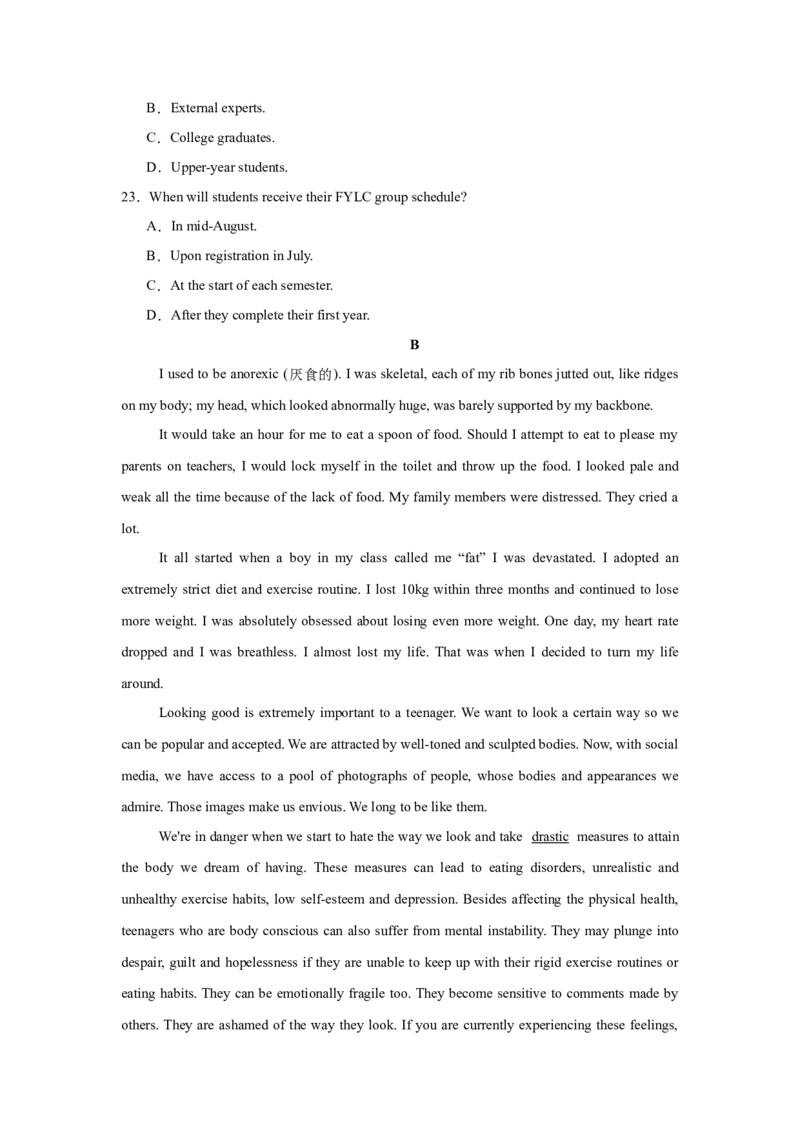
AFirst-Year Learning Community
Making the jump from high school to university is exciting but sometimes a little
challenging. To make university life easier, all first-year Rotman Commerce students are
automatically involved in a First-Year Learning Community, or FYLC for short.
Learning Community Structure
FYLC is a co-curricular program—meaning that it’s not for credits. There’s no homework
and no pressure. It’s just a way for us to support your success in first year by helping you develop
skills and make connections. Even though it’s not for credits, it is an essential part of your first
year at Rotman Commerce and you will receive a notation (评注) on your academic record upon
completion!
Each FYLC has between 25 to 30 members and is a great way to meet your classmates,
staff and external experts, make friends, form study groups and develop academic and personal
skills. You’ll also get an introduction to the resources, opportunities, culture and benefits of the
campus and its surrounding community—all in a relaxed, student-led atmosphere.
The mentors (导师) lead the FYLC — they’re third and fourth-year Rotman Commerce
students who have been in your shoes and know what it’s like to be in first year. They want to help
you make friends in your classes, so you’ll always know people who can support you in your
studies!
Schedule
Your FYLC group will meet every other week. After you’ve registered for your courses in
July, we will arrange a FYLC group for you that does not conflict with any of your chosen
courses. We’ll send you your schedule on 15th August. Most FYLCs take place on Tuesday/
Thursday/ Friday from 2:00-3:30 pm.
Have questions? Email us at rotmancommerce.flc@utoronto.ca.
21.What is the purpose of the First-Year Learning Community?
A.To provide academic credits.
B.To offer extracurricular activities.
C.To help students adjust to university life.
D.To replace traditional classroom learning.
22.Who are in charge of the FYLC program?
A.University staff.B.External experts.
C.College graduates.
D.Upper-year students.
23.When will students receive their FYLC group schedule?
A.In mid-August.
B.Upon registration in July.
C.At the start of each semester.
D.After they complete their first year.
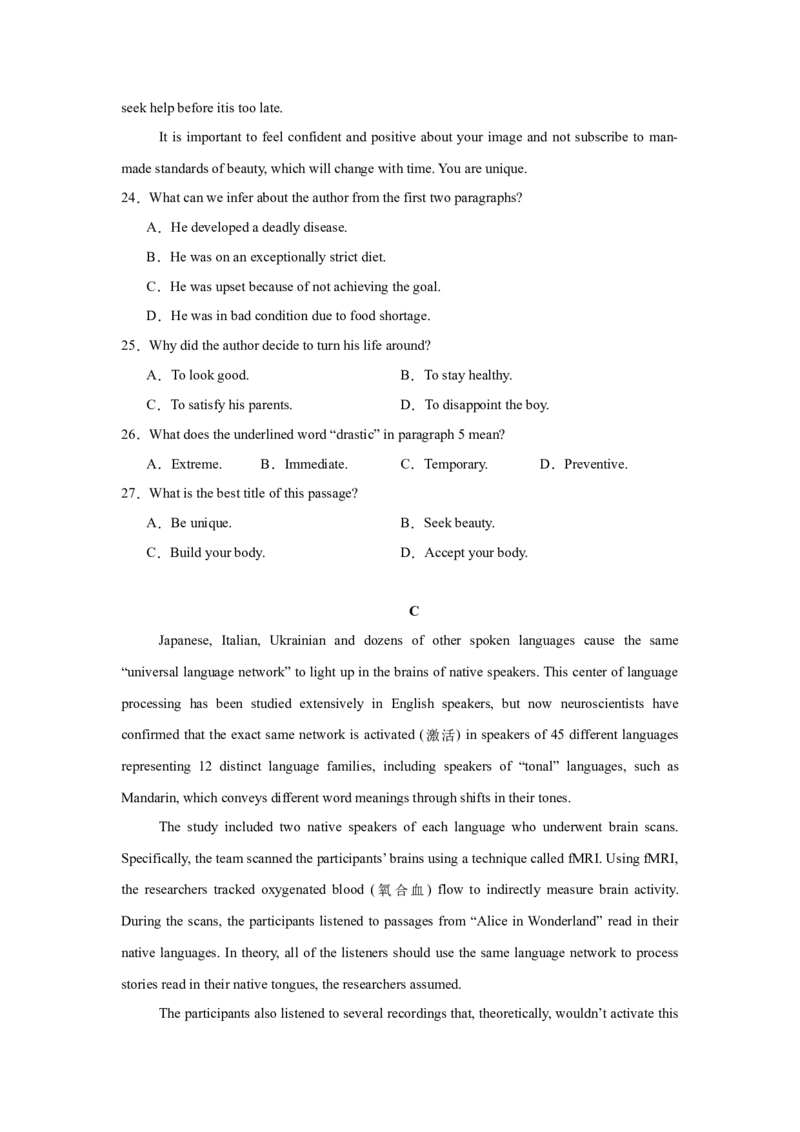
B
I used to be anorexic (厌食的). I was skeletal, each of my rib bones jutted out, like ridges
on my body; my head, which looked abnormally huge, was barely supported by my backbone.
It would take an hour for me to eat a spoon of food. Should I attempt to eat to please my
parents on teachers, I would lock myself in the toilet and throw up the food. I looked pale and
weak all the time because of the lack of food. My family members were distressed. They cried a
lot.
It all started when a boy in my class called me “fat” I was devastated. I adopted an
extremely strict diet and exercise routine. I lost 10kg within three months and continued to lose
more weight. I was absolutely obsessed about losing even more weight. One day, my heart rate
dropped and I was breathless. I almost lost my life. That was when I decided to turn my life
around.
Looking good is extremely important to a teenager. We want to look a certain way so we
can be popular and accepted. We are attracted by well-toned and sculpted bodies. Now, with social
media, we have access to a pool of photographs of people, whose bodies and appearances we
admire. Those images make us envious. We long to be like them.
We're in danger when we start to hate the way we look and take drastic measures to attain
the body we dream of having. These measures can lead to eating disorders, unrealistic and
unhealthy exercise habits, low self-esteem and depression. Besides affecting the physical health,
teenagers who are body conscious can also suffer from mental instability. They may plunge into
despair, guilt and hopelessness if they are unable to keep up with their rigid exercise routines or
eating habits. They can be emotionally fragile too. They become sensitive to comments made by
others. They are ashamed of the way they look. If you are currently experiencing these feelings,seek help before itis too late.
It is important to feel confident and positive about your image and not subscribe to man-
made standards of beauty, which will change with time. You are unique.
24.What can we infer about the author from the first two paragraphs?
A.He developed a deadly disease.
B.He was on an exceptionally strict diet.
C.He was upset because of not achieving the goal.
D.He was in bad condition due to food shortage.
25.Why did the author decide to turn his life around?
A.To look good. B.To stay healthy.
C.To satisfy his parents. D.To disappoint the boy.
26.What does the underlined word “drastic” in paragraph 5 mean?
A.Extreme. B.Immediate. C.Temporary. D.Preventive.
27.What is the best title of this passage?
A.Be unique. B.Seek beauty.
C.Build your body. D.Accept your body.
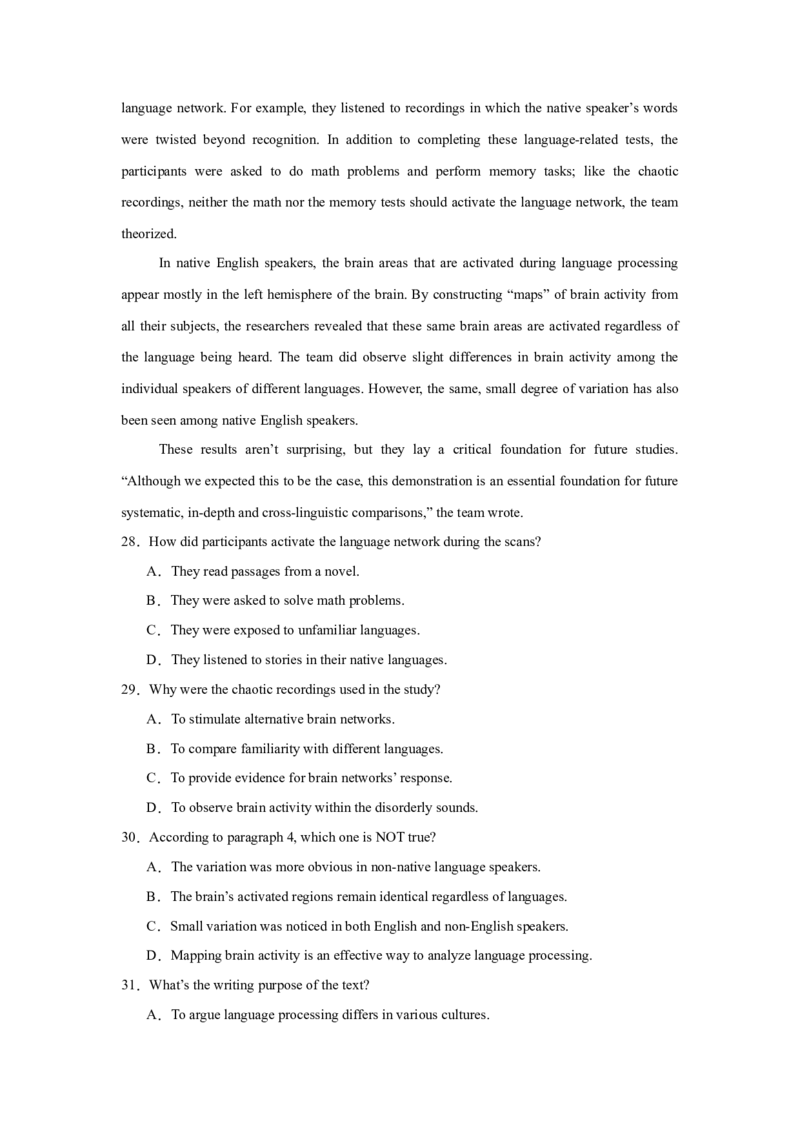
C
Japanese, Italian, Ukrainian and dozens of other spoken languages cause the same
“universal language network” to light up in the brains of native speakers. This center of language
processing has been studied extensively in English speakers, but now neuroscientists have
confirmed that the exact same network is activated (激活) in speakers of 45 different languages
representing 12 distinct language families, including speakers of “tonal” languages, such as
Mandarin, which conveys different word meanings through shifts in their tones.
The study included two native speakers of each language who underwent brain scans.
Specifically, the team scanned the participants’ brains using a technique called fMRI. Using fMRI,
the researchers tracked oxygenated blood (氧合血) flow to indirectly measure brain activity.
During the scans, the participants listened to passages from “Alice in Wonderland” read in their
native languages. In theory, all of the listeners should use the same language network to process
stories read in their native tongues, the researchers assumed.
The participants also listened to several recordings that, theoretically, wouldn’t activate thislanguage network. For example, they listened to recordings in which the native speaker’s words
were twisted beyond recognition. In addition to completing these language-related tests, the
participants were asked to do math problems and perform memory tasks; like the chaotic
recordings, neither the math nor the memory tests should activate the language network, the team
theorized.
In native English speakers, the brain areas that are activated during language processing
appear mostly in the left hemisphere of the brain. By constructing “maps” of brain activity from
all their subjects, the researchers revealed that these same brain areas are activated regardless of
the language being heard. The team did observe slight differences in brain activity among the
individual speakers of different languages. However, the same, small degree of variation has also
been seen among native English speakers.
These results aren’t surprising, but they lay a critical foundation for future studies.
“Although we expected this to be the case, this demonstration is an essential foundation for future
systematic, in-depth and cross-linguistic comparisons,” the team wrote.
28.How did participants activate the language network during the scans?
A.They read passages from a novel.
B.They were asked to solve math problems.
C.They were exposed to unfamiliar languages.
D.They listened to stories in their native languages.
29.Why were the chaotic recordings used in the study?
A.To stimulate alternative brain networks.
B.To compare familiarity with different languages.
C.To provide evidence for brain networks’ response.
D.To observe brain activity within the disorderly sounds.
30.According to paragraph 4, which one is NOT true?
A.The variation was more obvious in non-native language speakers.
B.The brain’s activated regions remain identical regardless of languages.
C.Small variation was noticed in both English and non-English speakers.
D.Mapping brain activity is an effective way to analyze language processing.
31.What’s the writing purpose of the text?
A.To argue language processing differs in various cultures.B.To explore the brain activity variation among languages.
C.To discuss how language families influence brain activity.
D.To demonstrate common brain parts for language processing.
D
There are about 537 million people living with diabetes (糖尿病) today. It’s predicted that
by 2045, 700 million people will have the disease worldwide. Type l and type 2 diabetes are both
conditions that affect how the body regulates blood sugar, but they have different causes and
treatments. In type 1 diabetes, the body produces little or no insulin (胰岛素). This means that
patients have to obtain insulin externally to regulate their blood sugar levels. Nowadays, this is
mostly done via insulin pumps that are attached directly to the body. These biomedical devices
require a reliable energy supply, which at present is met primarily by power from either single-use
or rechargeable batteries.
Now, a team of researchers led by Martin Fussenegger have put a new idea into practice.
They developed an implantable fuel cell that uses excess blood sugar from tissue to generate
electrical energy. They combined the fuel cell with Artificial Beta Cells (ABCs) developed by
their group years ago. These help produce insulin at the touch of a button and effectively lower
blood sugar levels much like their natural role models in the pancreas (胰腺).
“Many people, especially in the Western industrialized nations, consume more
carbohydrates (碳水化合物) than they need in everyday life,” Fussenegger explains. This leads to
diseases such as diabetes, fatness, etc. “This gave us the idea of using this excess energy to
produce electricity to power these devices,” he says.
The system combines sustained power generation and controlled insulin delivery. Once the
fuel cell indicates excess sugar, it starts to generate power. This electrical energy is then used to
stimulate ABCs to produce and release insulin into the blood. As a result, blood sugar drops to a
normal level. Once it falls below a certain level, the production of electricity and insulin stops.
The electrical energy provided by the fuel cell can also enable the implanted system to
communicate with external devices. This allows potential users to adjust the system via a certain
app. A doctor could also access it remotely and make adjustments. “The new system could be used
to treat diabetes. However, bringing such a device to the market is far beyond our financial andhuman resources. So there is still a long way to go,” Fussenegger says.
32.What do the team of researchers aim to do?
A.To find an alternative power source for biomedical devices.
B.To make a kind of effective insulin for diabetes sufferers.
C.To work out a way to prevent the spread of diabetes.
D.To investigate the exact cause of type 1 diabetes.
33.What does Fussenegger want to tell us in paragraph 3?
A.Why people in the industrialized nations enjoy carbohydrates.
B.What inspired his team to develop the invention.
C.What can easily result in diabetes and fatness.
D.Why ABCs can function effectively.
34.What is special about the new system?
A.It is powered by an artificial pancreas.
B.It requires doctors’ real-time monitoring.
C.It constantly releases insulin in the blood.
D.It can automatically adjust blood sugar levels.
35.What can be inferred about the future of the new system?
A.It has the potential to root out diabetes.
B.It has gained recognition from clinical experts.
C.It takes time to become commercially available.
D.It needs little investment when mass-produced.
第二节(共5小题:每小题2. 5分, 满分12. 5分)
阅读下面短文, 从短文后选项中选出可以填入空白处的最佳选项。选项中有两项为多余选
项。
With all the new findings on the effects of bad lifestyles, it is no wonder that so many
people are eager to start changing their lifestyles for the better. 36 Once you get into the
habit of maintaining a healthy routine, you will be able to experience the benefits of a healthy
lifestyle.
Improve your physical appearance. Leading a healthy lifestyle can make you bring out thebest version of yourself. To be specific, it helps you develop good habits and these habits make it
easier for you to participate in healthy activities. 37
Promote better mental health. When you enjoy a healthy lifestyle, you do several activities
which have some direct or indirect effects on improving your mood or emotional side. 38
These types of activities will also help you have more social interactions and interesting
conversations with people who share similar interests.
39 Having a healthy lifestyle can act as protection against illnesses. According to
research, it reduces the risks of chronic diseases like diabetes and heart disease. Nevertheless,
when risk factors are present and you’re leading a bad lifestyle, it dramatically increases the
likelihood that you’ll eventually develop one of any possible illnesses.
Quite literally, there are infinite benefits one will receive by pursuing a healthy lifestyle.
40 However, having a healthy lifestyle will contribute significantly to a more fulfilling life
over time. So drink water, eat well, move the body and choose to be grateful for the gift of life!
A.Slow ageing process.
B.These benefits may not be seen immediately.
C.Lower the risk of developing health problems.
D.A healthy lifestyle can improve your sleep quality.
E.Activities like swimming help your mind to relax and refresh.
F.In return, you will be fit and your body posture will also improve.
G.A healthy lifestyle should be a way of living instead of a temporary fix.
第三部分语言运用(共两节,满分30分)
第一节(共15小题:每小题1分,满分15分)
阅读下面短文, 从每题所给的A、B、C、D四个选项中选出可以填入空白处的最佳选项。
Finding the Good
Days ago, my 91-year-old grandfather called me to test his new hearing aid. For the first
time in years, he could hear my voice clearly again. It 41 us both.
I soon found out there was another reason 42 my grandfather being so happy—
the new hearing aid service provider, Anna. As a senior, my grandfather became anxious easilywhenever his device broke down. However, Anna gave time and attention and visited 43
to ensure that the new hearing aid 44 properly. She went beyond the call of 45
and refused to accept any reward but words as thanks.
Living in a world flooded with negative news, such kindness might sound 46
nowadays, and I wondered whether it’s more common than we think. Then I came across a study
suggesting people often underestimate the 47 of strangers to engage with, or even
befriend them. It explains that news coverage of current affairs tends to 48 more on the
negative because humans give negative events more attention and become more 49 of
the world and less hopeful than we need to be.
From my grandfather’s experience, I find sometimes what we hear, see or even know might
not be the 50 picture. The truth might be hidden from us, requiring us to notice and
51 it. We could start by asking ourselves whether we’re laying too much 52 on
negative news and letting them 53 us. We’re supposed to shift our attention and
engage ourselves in sharing good news. So, why not 54 ourselves, for all of the bad
in news, behind the scenes, in people’s ordinary lives, lie untold stories of extraordinary 55
?
41.A.terrified B.amused C.thrilled D.puzzled
42.A.accounting for B.pointing out C.making up D.turning to
43.A.regularly B.formally C.occasionally D.secretly
44.A.played B.worked C.sounded D.developed
45.A.duty B.freedom C.spirit D.adventure
46.A.reasonable B.normal C.rare D.interesting
47.A.complexity B.willingness C.ability D.risk
48.A.insist B.depend C.focus D.research
49.A.critical B.empty C.confident D.positive
50.A.ideal B.whole C.similar D.relevant
51.A.change B.acknowledge C.spot D.believe
52.A.burden B.doubt C.demand D.emphasis
53.A.embarrass B.serve C.leave D.surround
54.A.motivate B.remind C.warn D.challenge
55.A.gift B.vision C.insight D.good第三部分语言运用(共两节,满分30分)
第二节(共15小题:每小题1分,满分15分)
阅读下面短文,在空白处填入1个适当的单词或括号内单词的正确形式。
The fruit fly is a major pest species that reduces the yield of commercial fruits, vegetables
and nuts. Passion fruit, native to South America, 56 (introduce) to South China in 2012 for
large-scale commercial 57 (plant).The scientists observed that passion fruit attracted
native fruit flies to lay eggs in the fruits, 58 most of the eggs did not hatch.
According to Wu Weijian at South China Agricultural University, the lead researcher of the
study, when a fruit fly penetrates into (刺入) the middle layer of the fruit wall to lay eggs, 59
causes the plant tissue to break down and release hydrogen cyanide, 60 kills most of the
eggs.Wu said this is the first instance of finding a living plant which can 61 (direct) kill
the eggs of pests in the study of interaction between plants and herbivorous insects.
Passion fruit can be recommended as a pest trap crop to plant at the border of an orchard or
melon field 62 (control) fruit flies, said Liao Yonglin at Guangdong Academy of
Agricultural Sciences, one of the researchers.Although 63 (ecology) traps can usually be
offset (抵消) by the learning ability or evolution of herbivorous insects, these particular traps 64
(provide) by passion fruit may be permanent 65 the case of fruit flies, according to the
study which was published in the journal Pest Management Science.
第四部分 写作(共两节, 满分40分)
第一节(满分15分)
66.假定你是李华,你校外教 Ryan 经常帮助你练习口语,请你给 Ryan老师写封电子邮
件表示感谢,同时,你亲手制作了一套中国剪纸送他以表谢意。邮件内容包括:
(1) 对 Ryan 老师表示感谢;
(2) 介绍你即将送他的剪纸。
注意:
(1) 词数80左右;
(2) 请按如下格式在答题纸的相应位置作答。
Dear Ryan,
______________________________________________________________________________________________________________________________________________________________
_______________________________________________________________________________
_______________________________________________________________________________
_______________________________________________________________________________
_________________________________________________________________
Yours,
Li Hua
第二节(满分25分)
67.阅读下面材料,根据其内容和所给段落开头语续写两段,使之构成一篇完整的短文。
Ten years ago, I was a primary school student and we started to learn to swim in the new
semester. One day, we packed together on a school bus and headed for the downtown to go
swimming. There were fifty 10-year-old boys in the mid-winter cold. Though we had just learned
to swim for a few months, we all wanted to prove ourselves and eagerly anticipated the arrival at
our destination. The atmosphere on the bus was charged with excitement, an energy that could
hardly be contained.
Soon, we arrived at the swimming pool, and out of the bus, we ran through the cold,
keeping up with each other’s speed, into the sounds and wet warmth of the building. We could
smell the pool and hear it echo to us as we entered the building. How excited we were!
Before jumping into the water, the coach, Mr. Black took us through a 10-minute warm-up.
Then he warned us that one could surface three times before they would lose consciousness (意识),
reminding us to shout for help if something was wrong. However, I had no plan to do that, for I
was quite confident with my swimming skills and often boasted (吹嘘) about them in front of my
classmates. If I did that, what a shame it would be for someone like me.
I still remember that feeling of excitement, as if it were yesterday. It had been five weeks
since Mr. Black had announced the pool swim session, and all we could do then was run and jump
into the water. And run we did. We actually flew into the water, eager to test our swimming skills.
But as I hit the deep end, I felt the weight of the water pull me down. I knew I was drowning (溺
水). Oh, how scared I was!
注意:(1)续写词数应为150左右;
(2)请按如下格式在答题卡的相应位置作答。
I surfaced for the first time.
_______________________________________________________________________________
_______________________________________________________________________________
_______________________________________________________________________________
_______________________________________________________________________________
_______________________________________________________________________________
________________________________________________________
On the third rise, I finally committed to shouting for help.
_______________________________________________________________________________
_______________________________________________________________________________
_______________________________________________________________________________
_______________________________________________________________________________
_______________________________________________________________________________
________________________________________________________