绝密★考试结束前
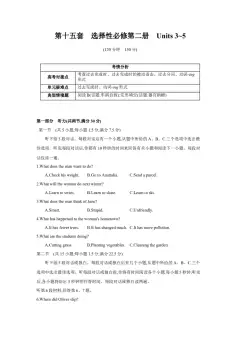
必修第二册单元提升卷
英语
(考试时间:120分钟 试卷满分:150分)
注意事项:
1.本试卷分第Ⅰ卷(选择题)和第Ⅱ卷(非选择题)两部分。答卷前,考生务必将自己的姓名、准
考证号填写在答题卡上。
2.回答第Ⅰ卷时,选出每小题答案后,用 2B铅笔把答题卡上对应题目的答案标号涂黑。如需改
动,用橡皮擦干净后,再选涂其他答案标号。写在本试卷上无效。
3.回答第Ⅱ卷时,将答案写在答题卡上。写在本试卷上无效。
4.考试结束后,将本试卷和答题卡一并交回。
第一部分 听力(共两节,满分 30 分)
做题时,请先将答案标在试卷上。录音内容结束后,你将有两分钟的时间将试卷上的答案转涂到答
题卡上。
第一节(共5小题;每小题1.5分,满分7.5分)
听下面5段对话。每段对话后有一个小题,从题中所给的A、B、C三个选项中选出最佳选项。听完每段
对话后,你都有10秒钟的时间来回答有关小题和阅读下一小题。每段对话仅读一遍。
1.What did the man do yesterday?
1.What does the woman mean?
A.She refuses to buy new curtains.
B.She accepts Susie’s suggestion.
C.She objects to moving the bed.
2.What did the woman and her sister often do during summer vacations?
A.They flew kites. B.They watched TV. C.They camped in the field.
3.How does the man sound?
A.Grateful. B.Caring. C.Scared.
4.Where does the man intend to go this evening?
A.To a bar. B.To the woman’s house. C.To a supermarket.
5.What might Barbara be?
A.A reporter. B.A travel blogger. C.A web designer.第二节(共15小题;每小题1.5分,满分22.5分)
听下面 5 段对话或独白。每段对话或独白后有几个小题,从题中所给的A、B、C三个选项中选出最佳
选项,并标在试卷的相应位置。听每段对话或独白前,你将有时间阅读各个小题,每小题 5 秒钟;听完
后,各小题将给出 5 秒钟的作答时间。每段对话或独白读两遍。
听下面一段较长对话,回答以下小题。
6.How many rooms does the woman book?
A.One. B.Two. C.Three.
7.Which of the following does the woman need?
A.A pick-up service. B.Parking coupons. C.Wake-up calls.
听下面一段较长对话,回答以下小题。
8.What does the woman say about Alisa?
A.She is responsible. B.She is reserved. C.She is sociable.
9.What are the speakers mainly talking about?
A.Who is the best candidate for promotion.
B.Who will be transferred to the branch office.
C.Who can chair the meeting in the afternoon.
听下面一段较长对话,回答以下小题。
10.What makes the woman different today?
A.The lipstick. B.The glasses. C.The haircut.
11.Who will go to Hawaii next month?
A.Emily. B.Emma. C.Alex.
12.What did the man plan to do tonight?
A.Do some shopping. B.Take exercise. C.Eat out.
13.How will the woman go home?
A.By car. B.By bus. C.By subway.
听下面一段较长对话,回答以下小题。
14.Why is Shakespeare-style writing mentioned in the conversation?
A.To show the difference between AI and the human brain.
B.To state writers’ worry caused by ChatGPT.C.To indicate the charm of ChatGPT.
15.What is Bard?
A.A game. B.A chatbot. C.A tech company.
16.What is Satya Nadella’s attitude towards ChatGPT?
A.Ambiguous. B.Approving. C.Critical.
17.What does the man suggest doing in the era of AI?
A.Being adaptive and using AI fully.
B.Developing one’s own creativity.
C.Avoiding heavy reliance on AI.
听下面一段独白,回答以下小题。
18.What is Nadine Hamdy in charge of?
A.Mapping out marketing strategies.
B.Teaching dogs to swim.
C.Giving a show to pet owners.
19.What do we know about Adam Kilani?
A.He has a three-year-old pet dog.
B.He is from Matrouh Governorate.
C.He found pleasure in learning pet care.
20.What did Lina Kamal attach importance to?
A.The benefits of hosting various events in tourist resorts.
B.The promotion of the culture of pet ownership.
C.The protection of homeless animals.
第二部分 阅读(共两节,满分50分)
第一节(共15小题;每小题2.5分,满分37.5分)
阅读下列短文,从每题所给的A、B、C、D四个选项中选出最佳选项。
A
The holidays are for spending time with friends and family, including your dog. If you are traveling this year,
think of going to a place you and your dog can enjoy equally.
Crowds
When you are planning on celebrating the holidays with a large crowd of family and friends, be aware of how thisaffects your dog. Many dogs are not comfortable around large crowds, especially when they are not used to it.
Cats and dogs both get nervous when they are surrounded by lots of unfamiliar people. In order to keep your dog
comfortable during this time of year, make sure your pet has a quiet place to escape to when the crowds become
noisy.
Food
Many of the delicious foods we eat during the holiday season are simply not good for our dogs. If you want to
make sure your pet gets to have as many tasty treats as we do during the holiday season, prepare some of your
dog’s favorite doggy treats in advance. Apples and carrots make great dog snacks. Learn what foods are harmful
to dogs.
Decorations
Holiday decorations can also be a problem for dogs. Curious by nature, your pet may be interested in the
holiday decorations at their eye level. Your pet may eat these decorations, which can be a major danger. When you
decorate your tree, make sure the decorations are out of reach of the dog, especially tinsel (金属线), which can
cause health problems for animals if they eat it.
The best holiday you can give your pet is one you spend with it. If you are planning on traveling, take your
dog with you.
21.What should you do for your pet in the holiday?
A.Buy just apples and carrots as its snacks.
B.Keep dangerous decorations beyond its reach.
C.Invite as few guests as possible to your home.
D.Try to make it surrounded by people all the time.
22.Which of the following can give your dog the best holiday?
A.Keeping it in a quiet room. B.Staying with it personally.
C.Providing enough healthy food. D.Decorating its home beautifully.
23.Who is the text probably written for?
A.Pet owners. B.Parents. C.Inexperienced tourists. D.Animals.
B
Retired army officer and Parkinson’s (帕金森) sufferer Guy Deacon traveled 18,000 miles down Africa
across 25 countries to raise awareness about the condition of the disease in Africa.
It was at school when Deacon received a Wexas traveler’s handbook and on the front cover, there’s a
picture of a couple of Land Rovers (路虎车) in the desert with the sun setting behind them. “And I thought, that’swhat I want to do when I grow up. I’ve always had this idea to do this when I got the time and money put
together.”
Traveling down Africa is a massive challenge for anyone, let alone someone with stage 3 Parkinson’s. It’s
an incredibly dangerous journey due to the conflicts, road conditions, lack of services and crime. “Much of the
journey I was traveling by myself, I had nobody to be responsible to besides myself. That was a little bit lonely,
but I had a sense of achievement when I made it.”
Parkinson’s is the fastest growing illness worldwide and there are many people suffering with the condition
in Africa. Deacon kept a boot (后备箱) full of pills in his car which he had intended to give away. Traveling there
for months, he realized he couldn’t do that. Other travelers had shared their pills, but the quantity of pills was not
enough. “It wouldn’t help for a short period of time, because they need continual pills.”
The experience in Africa left a deep impression on Deacon. He knew what life was like with Parkinson’s
without pills. Going back to UK, he had a plan to appeal to more people to fund a foundation which can donate
more pills to people with Parkinson’s in Africa.
24.What inspired Deacon to travel down Africa?
A.Instructions in a traveler’s handbook. B.A scene in a picture on a book cover.
C.His former experience in the desert. D.His concern about people with Parkinson’s.
25.What do we know about Deacon’s journey?
A.The extreme weather made it dangerous.B.He met someone with stage 3 Parkinson’s.
C.He enjoyed the feeling of challenging himself. D.He completed it thanks to the assistance of locals.
26.Why didn’t Deacon give away pills to people?
A.Deacon needed the pills himself. B.Other travelers didn’t share their pills before.
C.His pills didn’t work on people in Africa.D.The quantity of pills couldn’t meet the need.
27.Which of the following can best describe Deacon?
A.Skillful and tough. B.Responsible and talented.
C.Thrill- loving and frank. D.Warm- hearted and determined.
C
“A fish out of water.” “A bike without a chain.” There are many metaphors for culture shock, all of which
attempt to describe the unique experience of being far from one’s home country and culture.
Scientists have studied culture shock for over a century. Rather than focus on the purely negative aspects,
psychologists describe it as a process of stress and adjustment. The first stage is the honeymoon phase, when we
are filled with excitement about being in another country. Eventually, as daily challenges arise, we enter a state ofcrisis and anxiety, harboring unfriendly feelings about the host culture. The longer we are immersed in the culture,
we adjust and recover from those negative feelings. Finally, after some time we adjust even more and fully accept
the new culture.
One of the factors that determines how we react to cultural stress is our personality. Not surprisingly,
extraverts (外向者) tend to have an easier time adjusting to new cultures. That is because being in a new country
means meeting many new people and spending a lot of time around them, and extraverts thrive in these situations.
But introverts simply prefer to be alone after spending time in groups, and only have limited energy to spend in
social settings.
Cultural intelligence, or CQ, also plays its part. Cultural intelligence is defined as the capability of an
individual to function effectively in situations characterized by cultural diversity. It has to do with our interest in
interacting with people from culturally diverse backgrounds, and our ability to adapt to new cultural context. It is
argued that the higher our CQ, the lesser the effect of culture shock on our ability to cope in new situations.
Many effective coping strategies are interpersonal. A recent study found that relating to others with
empathy is significantly associated with lower stress levels abroad. The more we are able to take on other people’s
points of view, the more positive our interpersonal relationships and thus our adaptation to the stress of culture
shock.
28.What is the function of the first paragraph?
A.Explaining the quotes. B.Raising an argument.
C.Introducing the topic. D.Presenting an example.
29.How will a person feel the moment he arrives in a foreign country?
A.Anxious. B.Thrilled. C.Shocked. D.Grateful.
30.Who will most probably be affected by the cultural shock?
A.An active boy interested in anything new.
B.A shy boy unwilling to socialize with strangers.
C.A quiet girl open to diverse cultural backgrounds.
D.A communicative girl fluent in the local language.
31.What is important for dealing with the cultural shock?
A.Lowering the stress level. B.Developing self-awareness.
C.Analyzing the cause of discomfort. D.Understanding others with sympathy.
D
At a recycling center, two team members spend all day pulling items from a conveyor belt covered ingarbage. One pulls out juice cartons and plastic bottles that can be reprocessed, while the other searches for
pollutants in the stream of paper products. They are AI-powered robots that each look like a supercharged
mechanical arm. Yes, even recycling has gotten involved in the AI revolution.
In theory, materials recovery facilities (MRFs) gather the wastes, sort them out, and then sell the materials
to companies that can reuse them. In practice, the MRFs aren’t all that good. The issue is that it’s long been too
hard for recycling plants to sort materials with the level of specificity needed to reuse them. The traditional
recycling methods succeed in separating waste into broad categories of paper, glass, and metal. But finer layers of
detail often go unnoticed, especially with plastic. It’s hard for recyclers to determine whether, say, a container is a
milk container or a pesticide (杀虫剂) container.
AI stands to make a change, giving recycling plants a far more detailed view into packaging. The AI-
powered recycling robots are “vision systems”: In the same way ChatGPT is trained, they ingest lots of
photographs of thrown- away items in various states of damage. The robots are then able to identify even tiny
differences in a product’s color, shape, texture, or logo. Recycling operators said that traditional systems tend to
be 85 to 95 percent accurate, while robotics companies claim up to 99 percent accuracy.
That is not to say that the turn to AI has already fixed recycling. The high- tech systems won’t come cheap
— an individual robot can cost as much as $300,000. Even if costs eventually decrease, recycling robots can’t
change the fact that recycling, even at its best, is just not a particularly efficient way of dealing with single-use
products. From a plastics- pollution standpoint, what’s better than a recyclable single-use cup is not using one at
all.
32.What is described in the first paragraph?
A.A common sight of a recycling center. B.The application of AI tools in recycling.
C.The power of AI to change an industry. D.A display of difficulties in waste sorting.
33.What is the challenge faced by recycling plants?
A.The accuracy of waste sorting.
B.The low profit from selling reusable materials.
C.The efficiency of waste management.
D.The unnoticeable danger in collecting waste materials.
34.What does the underlined word “ingest” in Paragraph 3 mean?
A.Edit. B.Copy. C.Absorb. D.Download.
35.What can be inferred from the last paragraph?
A.Single- use products should be restricted. B.Costs of high- tech systems will increase.C.Recyclable products should be advocated. D.AI will be the final frontier of recycling.
第二节(共5小题;每小题2.5分,满分12.5分)
阅读下面短文,从短文后的选项中选出可以填入空白处的最佳选项。选项中有两项为多余选项。
Sustainable travel is now one of the fastest-growing movements. Its goal is to meet the needs of the tourism
industry without harming natural and cultural environments. 36 Here are some concrete ways to reduce
your environmental impact as a traveler.
37 Travel doesn’t have to be about going somewhere far away. It’s the art of exploration,
discovery and getting out of your comfort zone, all of which can just as well be nearby. Find somewhere nearby
you haven’t been, get in your car, and go for a visit. You never know what you’ll come across.
Make greener transportation choices. After walking, public transportation is the next best way to explore
new destinations. 38 When it comes to longer distances, buses and trains are your best way of getting
around, both of which can be quite an experience in and of itself.
Avoid over-visited destinations. If you can, avoid places with over-tourism. You’ll find fewer crowds and
lower prices, and you also won’t be putting as much pressure on local communities struggling to keep up. And,
from a personal-enjoyment point of view, who wants to deal with crowds or long lines? No one. 39
Take a nature-related trip. If you want to better understand and appreciate the natural world, try taking a trip
with the single purpose of connecting with nature. 40 I promise that when you come home, you’ll have
a new viewpoint on why we’re all so focused on being environmentally friendly these days.
A.Stay close to home.
B.Find an ideal place to explore.
C.Sustainable travel can be useful to support communities.
D.Not only is it better for the environment, but it’s cheaper as well.
E.Get in touch with the world in a way that sitting at home doesn’t.
F.If not managed properly, tourism can have incredibly negative impacts.
G.Visiting less-visited destinations can be much more enjoyable and rewarding.
第三部分 语言运用(共两节,满分30分)
第一节 (共15小题;每小题1分,满分15分)
阅读下面短文,从每题所给的A、B、C、D四个选项中选出可以填入空白处的最佳选项。
My daughter’s dog, “Thunder”, has been in declining health for months now. He is eating less, sleeping
more, and 41 not doing well. Sadly, it is a 42 I have seen too many times as my own dogs havegotten older. Thunder is 12 years old or 84 in people years. It has always seemed so 43 to me that our dogs
live such short lives compared to ours.
Seeing that Thunder’s time was coming to an end, my daughter tried to 44 a new puppy to 45
her weak dog. Unfortunately, things didn’t 46 as she hoped. Her dog didn’t enjoy having a high energy
puppy around. So “Hank” the puppy 47 me. Thankfully, my sons took him as their own. Each day Hank
runs and plays with them until everyone is 48 but him.
49 lovely Hank bark, chew, and play all day makes me wish that I also had the 50 of a
puppy. In terms of 51 , I am much closer to old Thunder than Hank. My body tends to be 52
every day and I just can’t do all the things I used to.
As I watch both Thunder and Hank, however, my heart fills with love for them. Dogs are such a 53
from Nature. They teach us so much about life. They play with abandon, not caring about what’s happening
around — just live each day 54 . And they love unconditionally. If we all could just live with the 55
our dogs do, this world would be a better place.
41.A.barely B.generally C.naturally D.occasionally
42.A.view B.choice C.pattern D.surprise
43.A.unfair B.immoral C.significant D.realistic
44.A.pursue B.fetch C.adopt D.carry
45.A.accompany B.bother C.admire D.replace
46.A.fit B.continue C.stop D.work
47.A.broke away from B.came back to C.ended up with D.dropped in on
48.A.motivated B.exhausted C.relieved D.embarrassed
49.A.Watching B.Making C.Helping D.Feeling
50.A.confidence B.curiosity C.courage D.energy
51.A.age B.build C.attitude D.character
52.A.adjusting B.aching C.sweating D.relaxing
53.A.challenge B.gift C.concern D.discovery
54.A.gratefully B.faithfully C.joyfully D.wisely
55.A.hope B.goal C.interest D.love
第二节(共10小题;每小题1. 5分, 满分15分)
阅读下面材料,在空白处填入适当的内容(1个单词)或所给单词的正确形式。The village homes sit partially hazy (朦胧的) , with their white walls and black roofs 56 (stand) out
among the greens of the trees. The hazy 57 (reflect) of the sunlight off the leaf creates a clear texture (纹
理) reminding people 58 the Impressionists' approach to light and shadow, yet the stillness of the colours
and the lines is altogether Eastern in its charm.
The painting, Autumn Haze, is the work of Lin Fengmian, one of the 59 (master) of 20th century
art. Featured alongside other works by Lin and his student Wu Guanzhong as part of a recent special exhibition at
the China Art Museum in Shanghai, it seemed to pose a question: Is it possible to redefine what makes a painting,
especially a landscape painting. “Chinese” ? Lin, 60 was born in 1900, thought the answer 61
(lie) neither in looking back at traditional landscape paintings nor in the complete acceptance of Western art, 62
rather in the integration (融合) of East and West. Lin believed that Chinese art should combine the forms of
expression in the West and the 63 (emotion) needs of Eastern art.
Lin also argued that basic art training should take nature as its subject and apply scientific methods to
reproduce objects 64 (correct) as the basis for creation. To that end, he asked his students to be among
nature and draw there. Such practice was meant not to force them to make naturalistic art but to allow artists
unrestricted creativity as they tried 65 (grasp) the essence (本质) of things.
第四部分 写作(共两节, 满分40分)
第一节(满分15分)
66.随着中国影响力的提升,国外掀起了 “汉语热”。假如你是李华,你在美国的朋友Mr. James想找
一个人教他中文,请你给他写信推荐你的朋友—在美交换生王明。
内容包括:1、写信目的;2、推荐理由。
注意:1、词数80词左右;2、可适当增加细节,以使行文连贯。
___________________________________________________________________________________________
___________________________________________________________________________________________
___________________________________________________________________________________________
_______________________________________________________________________________________
第二节(满分25分)
67.阅读下面材料,根据所给情节进行续写,使之构成一篇完整的故事。
As the golden sun was sailing higher and higher in the east, casting its warm glow over the town, Emily, akeen photographer, started a solo journey to the famed Old Pine Scenic Area, well known for its centuries-old pine
forests and winding paths. She anticipated a day filled with peaceful beauty and the opportunity to touch nature in
its purest form.
Upon arrival, Emily was charmed by the quietness and splendidness of the overgrown pines that towered
above, their branches whispering tales of old in the gentle morning breeze. With her camera in hand, she ventured
deeper into the heart of the forest, each step further immersing her in the lively picture of greens and earthy
browns.
The paths of Old Pine were many, weaving through the forest like threads of a vast, tangled (缠结的) web.
Initially, Emily followed the marked trails, snapping photos of dew-kissed (带着露珠的) spider webs and
squirrels dashing through the underbrush. However, as the morning turned into afternoon, she decided to stray
from the beaten path to explore a more hidden area, rumored to house the eldest and most majestic pine in the
reserve.
The deeper she wandered, the quieter the forest grew, except for the occasional rustle of leaves and distant
birds. Focused intently on her photography, Emily scarcely noticed the shifting shadows and the subtle change in
the forest. She then realized it was getting late but she had not yet found the eldest pine. And she had not only
strayed off the path but was now thoroughly lost.
Panic fluttered in her chest. She attempted to backtrack, hoping to find familiar landmarks, but the forest
seemed to have rearranged itself behind her. The trees stood pitiless, their trunks like silent guards that offered no
guidance. With her phone’s signal frustratingly absent in the thick forest, Emily felt a surge of helplessness.
注意:1. 续写词数应为150左右;
2. 请按如下格式在答题卡的相应位置作答。
Emily remembered reading about the importance of staying calm when lost.
___________________________________________________________________________________________
___________________________________________________________________________________________
___________________________________________________________________________________________
___________________________________________________________________________________________
_______________________________________________________________________________________
Nodding eagerly, Emily explained her situation to the local man.
___________________________________________________________________________________________
______________________________________________________________________________________________________________________________________________________________________________________
___________________________________________________________________________________________
______________________________________________________________________________________