南京市2026
届高三年级学情调
研考试(零模)英
语试题
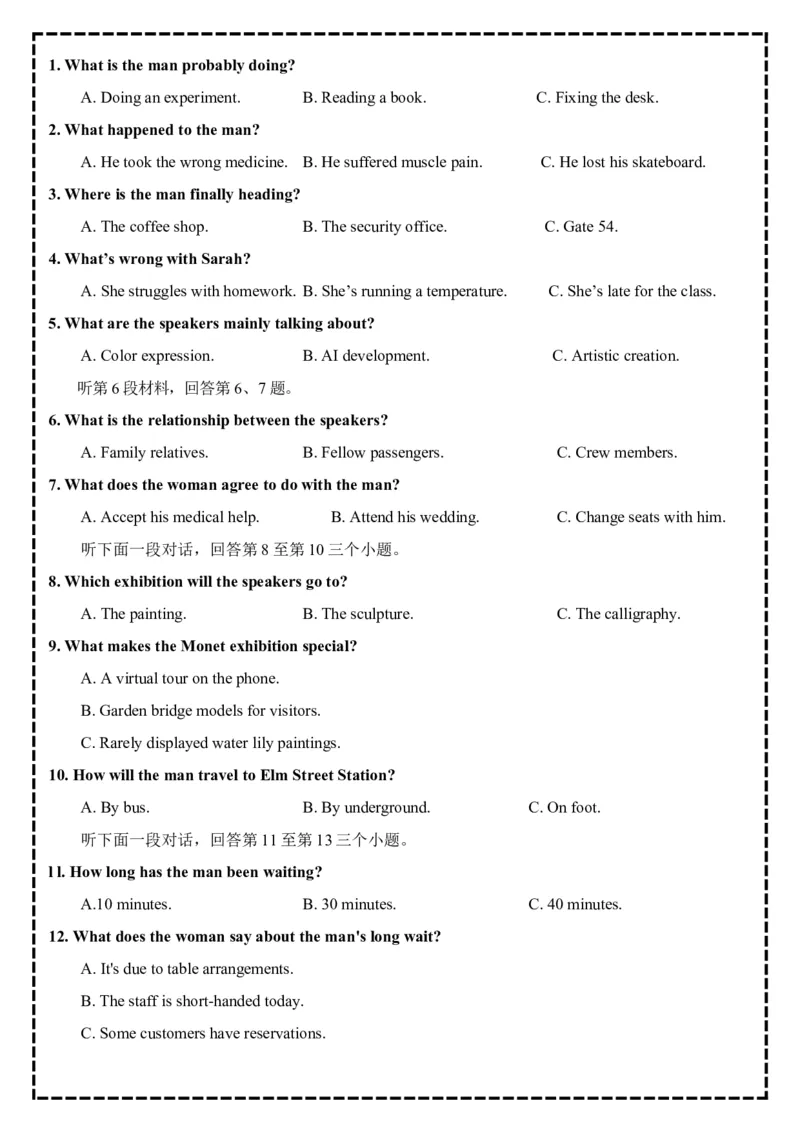
1. What is the man probably doing?
A. Doing an experiment.
B. Reading a book.
  C. Fixing the desk.
2. What happened to the man?
A. He took the wrong medicine.
B. He suffered muscle pain.
   C. He lost his skateboard.
3. Where is the man finally heading?
A. The coffee shop.
B. The security office.
    C. Gate 54.
4. What’s wrong with Sarah?
A. She struggles with homework. B. She’s running a temperature.
     C. She’s late for the class.
5. What are the speakers mainly talking about?
A. Color expression.
B. AI development.
      C. Artistic creation.
听第6 段材料,回答第6、7 题。
6. What is the relationship between the speakers?
A. Family relatives.
B. Fellow passengers.
C. Crew members.
7. What does the woman agree to do with the man?
A. Accept his medical help.
B. Attend his wedding.
C. Change seats with him.
听下面一段对话,回答第8 至第10 三个小题。
8. Which exhibition will the speakers go to?
A. The painting.
B. The sculpture.
C. The calligraphy.
9. What makes the Monet exhibition special?
A. A virtual tour on the phone.
B. Garden bridge models for visitors.
C. Rarely displayed water lily paintings.
10. How will the man travel to Elm Street Station?
A. By bus.
B. By underground.
C. On foot.
听下面一段对话,回答第11 至第13 三个小题。
l l. How long has the man been waiting?
A.10 minutes.
B. 30 minutes.
C. 40 minutes.
12. What does the woman say about the man's long wait?
A. It's due to table arrangements.
B. The staff is short-handed today.
C. Some customers have reservations.
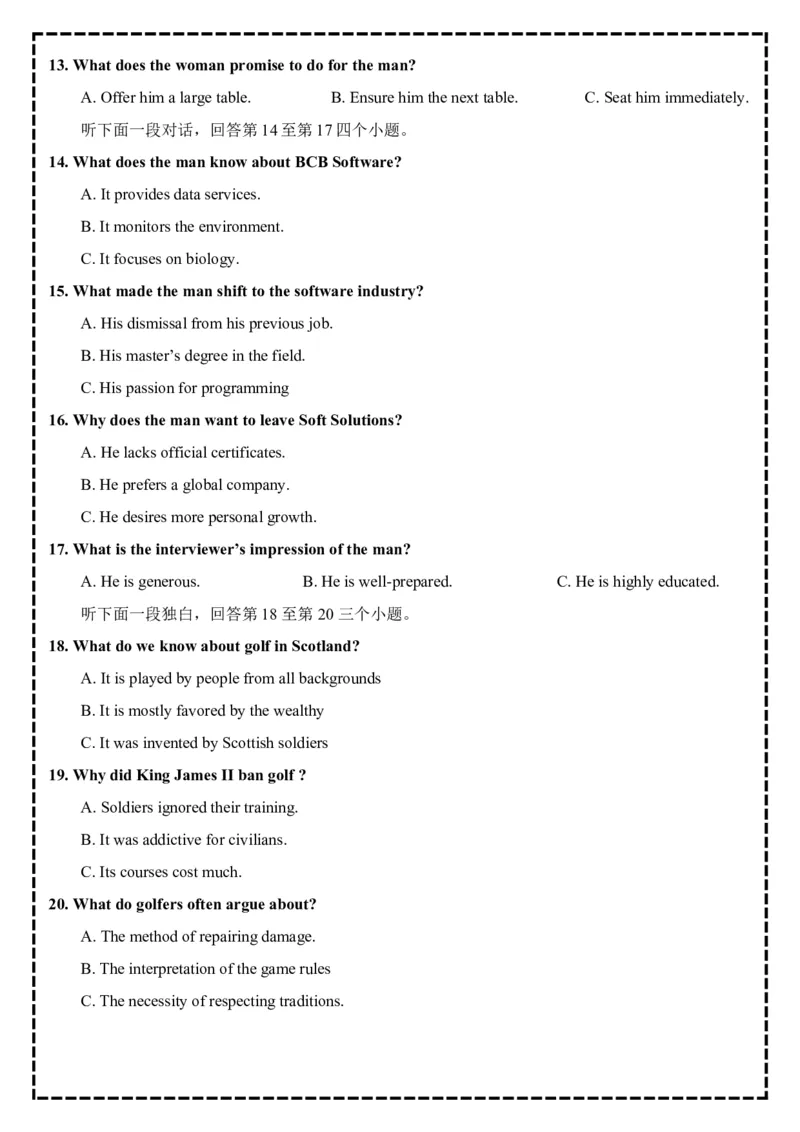
13. What does the woman promise to do for the man?
A. Offer him a large table.
B. Ensure him the next table.
C. Seat him immediately.
听下面一段对话,回答第14 至第17 四个小题。
14. What does the man know about BCB Software?
A. It provides data services.
B. It monitors the environment.
C. It focuses on biology.
15. What made the man shift to the software industry?
A. His dismissal from his previous job.
B. His master’s degree in the field.
C. His passion for programming
16. Why does the man want to leave Soft Solutions?
A. He lacks official certificates.
B. He prefers a global company.
C. He desires more personal growth.
17. What is the interviewer’s impression of the man?
A. He is generous.
B. He is well-prepared.
C. He is highly educated.
听下面一段独白,回答第18 至第 20 三个小题。
18. What do we know about golf in Scotland?
A. It is played by people from all backgrounds
B. It is mostly favored by the wealthy
C. It was invented by Scottish soldiers
19. Why did King James II ban golf ?
A. Soldiers ignored their training.
B. It was addictive for civilians.

C. Its courses cost much.
20. What do golfers often argue about?
A. The method of repairing damage.
B. The interpretation of the game rules
C. The necessity of respecting traditions.
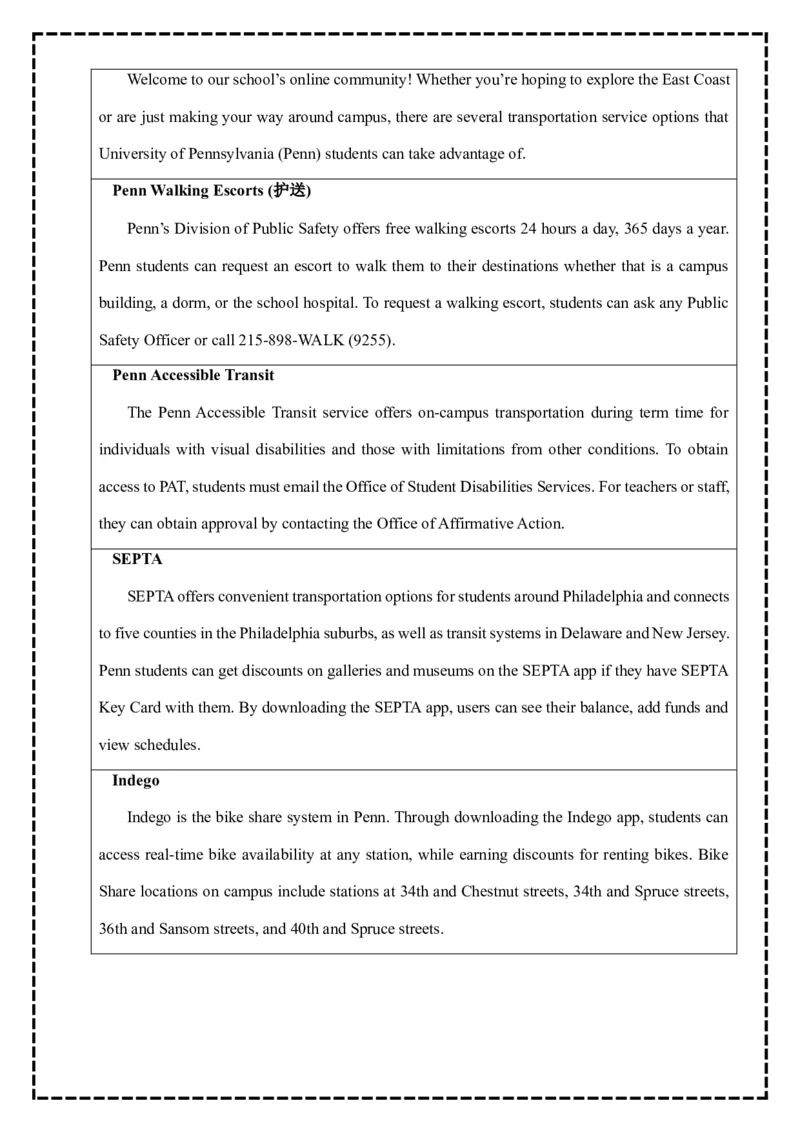
Welcome to our school’s online community! Whether you’re hoping to explore the East Coast
or are just making your way around campus, there are several transportation service options that
University of Pennsylvania (Penn) students can take advantage of.
Penn Walking Escorts (护送)
Penn’s Division of Public Safety offers free walking escorts 24 hours a day, 365 days a year.
Penn students can request an escort to walk them to their destinations whether that is a campus
building, a dorm, or the school hospital. To request a walking escort, students can ask any Public
Safety Officer or call 215-898-WALK (9255).
Penn Accessible Transit
The Penn Accessible Transit service offers on-campus transportation during term time for
individuals with visual disabilities and those with limitations from other conditions. To obtain
access to PAT, students must email the Office of Student Disabilities Services. For teachers or staff,
they can obtain approval by contacting the Office of Affirmative Action.
SEPTA
SEPTA offers convenient transportation options for students around Philadelphia and connects
to five counties in the Philadelphia suburbs, as well as transit systems in Delaware and New Jersey.
Penn students can get discounts on galleries and museums on the SEPTA app if they have SEPTA
Key Card with them. By downloading the SEPTA app, users can see their balance, add funds and
view schedules.
Indego
Indego is the bike share system in Penn. Through downloading the Indego app, students can
access real-time bike availability at any station, while earning discounts for renting bikes. Bike
Share locations on campus include stations at 34th and Chestnut streets, 34th and Spruce streets,
36th and Sansom streets, and 40th and Spruce streets.
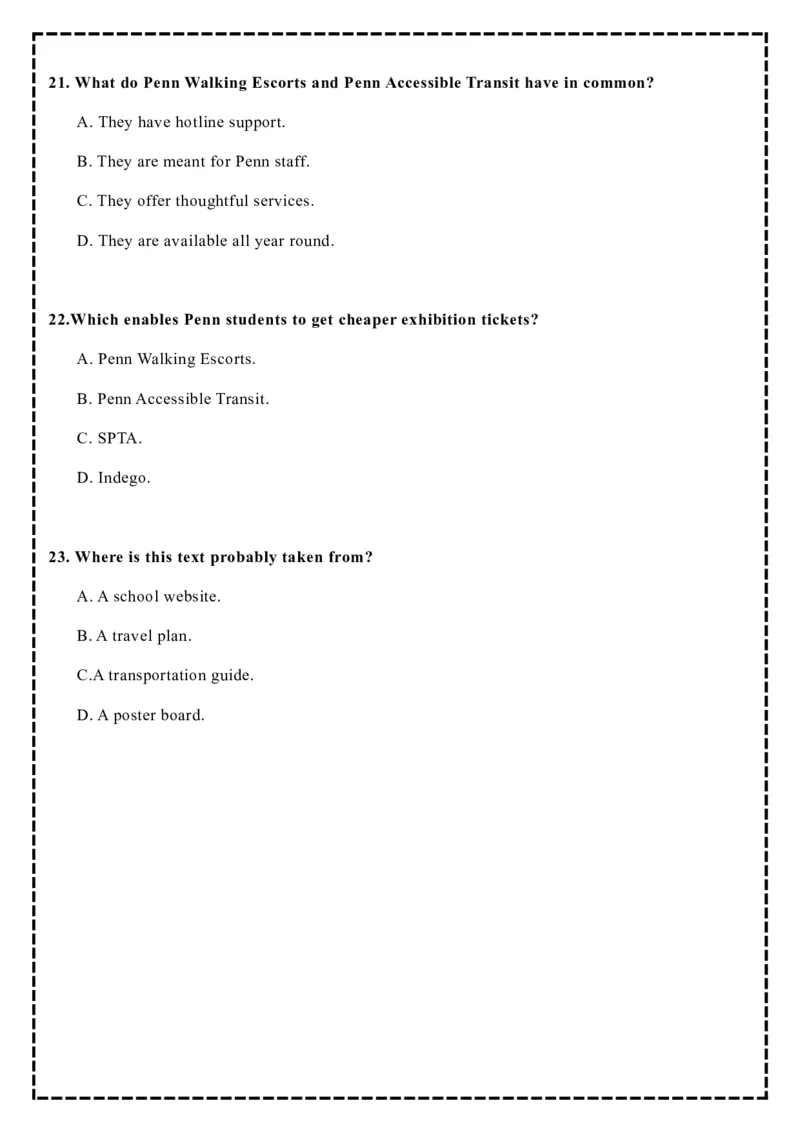
21. What do Penn Walking Escorts and Penn Accessible Transit have in common?
A. They have hotline support.
B. They are meant for Penn staff.
C. They offer thoughtful services.
D. They are available all year round.
22.Which enables Penn students to get cheaper exhibition tickets?
A. Penn Walking Escorts.
B. Penn Accessible Transit.
C. SPTA.
D. Indego.
23. Where is this text probably taken from?
A. A school website.
B. A travel plan.
C.A transportation guide.
D. A poster board.
First, a sincere thank you to the neighbors who have reached out over the past few months. We’ve
heard from many of you—even a note tied to a rock thrown through our window! Now, a quick
update: we’ve taken our new year lights down.
It wasn’t easy. Our lights had been up since December, nearly six months as part of our
household. We were touched by the heartfelt concerns like, “ARE YOU KEEPING THEM UP
FOREVER??!!!”
We hoped these lights, bought on a sale, would inspire us and find their forever home. But there
were problems: the sizzle, the smell, the mosquitoes, and one green bulb (灯泡) that went on and off
for no reason. We sought help, but Shiny Brite Light Installations wanted to charge us an arm and a
leg. Luckily, we discovered we could simply remove it. We knew it would upset the color
arrangements by having two red bulbs together, but it was the only option. Dealing with the messy
wires was another tiring challenge. We asked ourselves, “What are we doing wrong?” I remembered
falling into bed one night and saying to my husband, “Is it us?” His answer: “No. It’s those lights.
We should take them back.”
Returning them? Unthinkable. Mainly because I’d lost the receipt, or because what kind of people
would return a used item? Actually, neither. The lights were up, they were part of us now, and up
they would stay.
Eventually, we relaxed and enjoyed the days as time passed. As temperatures rise, colorful
flowers are perfect decorations now, but what about the lights still playing new year songs when
sensing every Amazon delivery truck? Not so much.
Contrary to your whispers, we haven’t returned the lights. They’ve been rehomed in the
basement, for now. Don’t worry. We remain committed to these lights. They are part of our family,
even if they’re no longer on display—at least until late November.
24. How do the writer’s neighbors find her new year lights?
A. Artistic.
B. Annoying.
C. Traditional.
D. Inspiring.
25.According to paragraph 3, which was a problem with the lights?
A. A part posed a safety risk.
B. Their colors were boring.
C.A bulb flashed unpredictably.
D. Their wires were exposed.
26. Why did the writer decide not to return the lights?
A. She regarded it a tiring challenge.
B. She lost the receipt for them.
C. She considered it impolite.
D. She grew attached to them.
27. What can be inferred from the last two paragraphs?
A. This November will witness new lights delivered
B. The basement will be the lights’ forever home.
C. Lights are perfect symbols of season changes
D. The writer still plans on putting the lights up.
When it comes to navigating (导航) areas, past studies showed that the abilities don’t truly kick
in until 12. However, a new study has revealed that children aged 5 can find their way around larges
paces.
The researchers involved with this study previously concentrated on three regions of the adult
brain that help navigation: PPA, which lets us recognize places and assign them to different
categories, RSC, which maps these places within a larger space and OPA, which keeps us from
running into objects. In 2024, they found that the system associated with OPA doesn't fully develop
until the age of 8. However, they theorized that younger children must still be able to create a map
of their surroundings, even before they can walk well.
The new study confirmed that RSC is already well-developed in children younger than 8. The
results come from an interesting experiment involving five-year-old participants who became
familiar with a virtual location called “Tiny Town” full of entertaining landmarks like ice cream
stores, playgrounds and fire stations. “We want to get answers, but it’s also important that participants
have a good time and a good impression of science,” said Yaelan Jung, first author of the study.
Then the researchers conducted fMRI scans ( 磁共振扫描) on the children, during which they
participated in a game-like task where they were shown images from Tiny Town and pressed a button
if the images accurately related. Data from the scans proved that the children were able to create a
map in their minds, using RSC in their brains to facilitate navigation in larger spaces.
The next step, the researchers say, is to look into the brain development of toddlers ( 学步孩童)
with cleverer strategies. “It’s stimulating to explore how humans use different parts of the brain for
complex behaviors and how that changes with age and experiences,” Jung said in a press release.
“We’re also laying the groundwork for clinical applications.”
28. According to the new study, why can five-year-olds navigate large areas?
A. They can mentally map a large environment.
B. Their OPA region has developed to the full.
C. Their PPA region helps them avoid objects.
D. They can walk well by recognizing places.
29. Why did the researchers design Tiny Town?
A. To confirm the accuracy of fMRI scans.
B. To improve kids’ scientific competence.
C. To make the experiment engaging for kids.
D. To adjust kids’ emotion before the experiment.
30. What are Yaelan Jung’s words in the last paragraph mainly about?
A. Influence of research strategies.
B. Possible direction for further study.
C. Demand for a larger sample size.
D. Solid evidence of the findings.
31. What can be a suitable title for the text?
A. Brain Development: A Magic Solution
B. Young Children: Natural Navigators at Age 5
C. Tiny Town: A Key to Unlocking Brain Secrets
D. Three Regions: Core Parts for Mapping Places
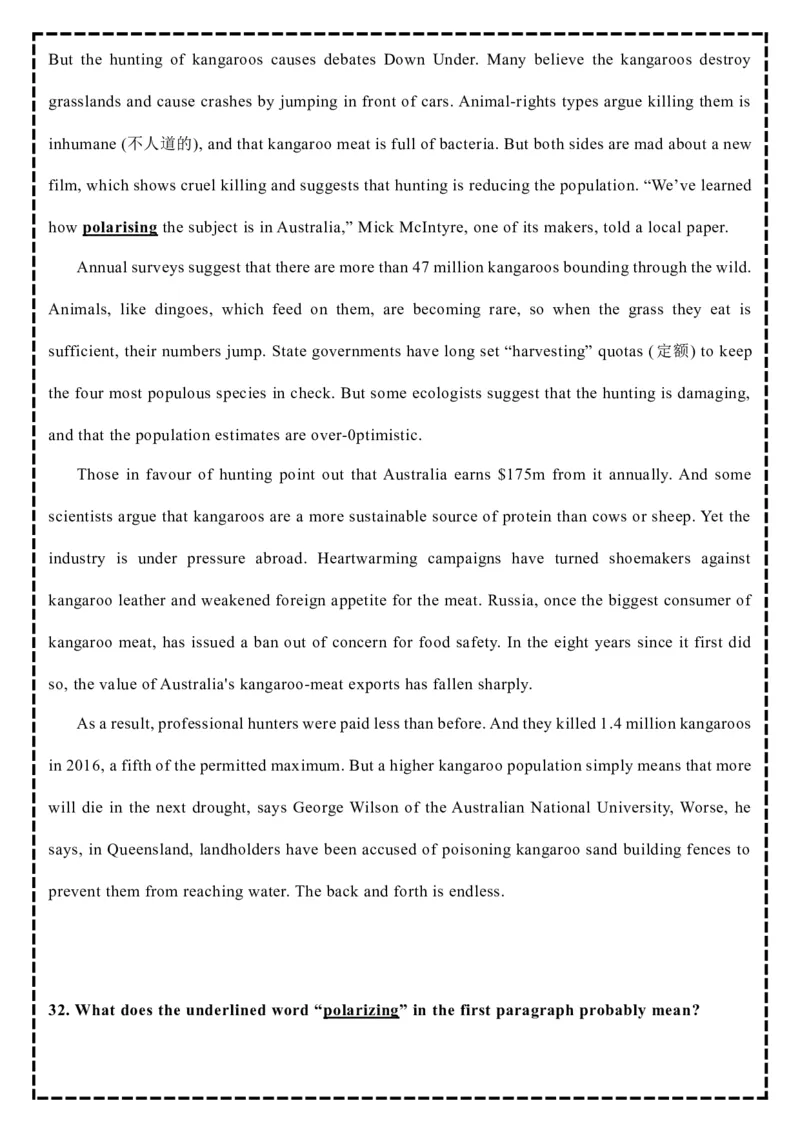
Australians are not, as they sometimes joke, the only people to eat their symbolic national animal.
But the hunting of kangaroos causes debates Down Under. Many believe the kangaroos destroy
grasslands and cause crashes by jumping in front of cars. Animal-rights types argue killing them is
inhumane (不人道的), and that kangaroo meat is full of bacteria. But both sides are mad about a new
film, which shows cruel killing and suggests that hunting is reducing the population. “We’ve learned
how polarising the subject is in Australia,” Mick McIntyre, one of its makers, told a local paper.
Annual surveys suggest that there are more than 47 million kangaroos bounding through the wild.
Animals, like dingoes, which feed on them, are becoming rare, so when the grass they eat is
sufficient, their numbers jump. State governments have long set “harvesting” quotas (定额) to keep
the four most populous species in check. But some ecologists suggest that the hunting is damaging,
and that the population estimates are over-0ptimistic.
Those in favour of hunting point out that Australia earns $175m from it annually. And some
scientists argue that kangaroos are a more sustainable source of protein than cows or sheep. Yet the
industry is under pressure abroad. Heartwarming campaigns have turned shoemakers against
kangaroo leather and weakened foreign appetite for the meat. Russia, once the biggest consumer of
kangaroo meat, has issued a ban out of concern for food safety. In the eight years since it first did
so, the value of Australia's kangaroo-meat exports has fallen sharply.
As a result, professional hunters were paid less than before. And they killed 1.4 million kangaroos
in 2016, a fifth of the permitted maximum. But a higher kangaroo population simply means that more
will die in the next drought, says George Wilson of the Australian National University, Worse, he
says, in Queensland, landholders have been accused of poisoning kangaroo sand building fences to
prevent them from reaching water. The back and forth is endless.
32. What does the underlined word “polarizing” in the first paragraph probably mean?
A. Abstract.
B. Divided.
C. Innovative.
D. Amazing.
33. According to the text, what is a reason for kangaroo population increase?
A. The ban on hunting quotas.
B. Their diverse species.
C. Their bounding abilities.
D. The decline of natural enemies.
34. What does paragraph 3 mainly talk about?
A. Why kangaroo development should be sustainable.
B. How kangaroo goods market expands abroad.
C. Why some people support kangaroo hunting.
D. How exports of kangaroo products suffer.
35. How would George Wilson describe the situation kangaroos face?
A. Out of the frying pan, into the fire.
B. The survival of the fittest.
C. While the cat is away, the mice will play.
D. Let sleeping dogs lie.
It started with a whisper. “Everyone else got one,” my daughter said to me, her eyes locked on
the floor. “I was the only one who didn’t.”
       36      The one everyone was talking about in the lunch line and on the walk home. The one
that she heard would have unlimited cupcakes. The one she didn’t get an invitation to.
There’s a particular kind of heartbreak that happens when your child feels excluded ( 排除在外
的). You don’t just witness their disappointment; you absorb it.      37     “I’m sure it wasn’t personal,”
I said softly. “Sometimes kids are only allowed to invite a few people.” But the words felt weak, like
a Band-Aid on a big and deep cut. This experience could have easily been about how to handle
exclusion as a parent—how to build resilience (韧性). But what I've learned is less clean than that.
38     You can’t smooth every rough edge. Sometimes, your job is just to sit beside your kid in the
thick of it. To let them cry.to let yourself feel angry, and to know that fixing it isn’t always the
assignment.
        39

   She wrote a little note for the birthday kid. “Happy birthday,” it read. “Hope you have
fun.” No bitterness. Just kindness. My daughter, in all her smallness, did what I hadn’t even figured
out how to do yet: move forward without letting the hurt define her.
And maybe that's the only real takeaway I have. That sometimes, our kids teach us the wisdom
we’re still trying to learn.
She never got that invitation. But what we gained quietly was something else: the chance to walk
through disappointment together, hand in hand.      40
A. After all, honesty is the best policy.
B. Part of parenting is being powerless.
C. At first, I tried to say something to comfort her.
D. I encouraged her to show forgiveness to the kid.
E. And that, to me, feels like something worth celebrating.
F. The birthday party was definitely to be one to remember.
G. What surprised me most was what happened the next day.
Towards the end of our baseball training, Arnold found a pebble (鹅卵石) on the ground. “How
far do you think this will go if I connect?” He threw the pebble in the air, and then    41     it with his
baseball bat. Up, up and it    42

     . With laughter, we wondered where it    43    . We soon found
out.
We saw an ambulance headed in the same direction as the     44    had traveled. Proceeding     45
  through the woods and across 12th Street, we then hurried to the     46    with unease. A group of
about five people stood over a figure face down on the sidewalk. When the rescuers    47    he victim,
we were    48    to discover it was our friend Benny. People around were looking up into a big tree
for the    49    as to what had hit the    50    kid, who now had a lump (肿块) on his forehead about
the size of a pebble.
At the time, and for years, Arold and I were    51    by guilt and anxiety to    52    the whole thing
to Benny. But it wasn’t until 25 years later that we had Benny to dinner and        53
        everything.
He touched his forehead, but he didn’t     54    us. He thought, and still thinks. Obviously, he forgot
everything! If Benny reads this account, Arnold and I would like to offer him    55    , saying
something we should have said long ago: Sorry!
41.A. hit
B. blocked
C. caught
D. moved
42. A. rolled back
B. flew away
C. came up
D. broke down
43.A. slipped
B. flowed
C. landed
D. exploded
44.A. victim
B. crowd
C. car
D. stone
45. A. regularly
B. cautiously
C. happily
D. proudly
46.A. spot
B. hospital
C. field
D. school
47.A. blamed
B. consulted
C. pleased
D. lifted
48.A. curious
B. confident
C. shocked
D. disappointed
49.A. witness
B. solution
C. clue
D. excuse
50.A. poor
B. humble
C. familiar
D. energetic
51. A. inspired
B. consumed
C. amazed
D. separated
52. A. return
B. assign
C. prove
D. explain
53. A. ruled out
B. poured out
C. looked up
D. messed up
54.A. charge
B. remind
C. comfort
D. believe
55.A. apology
B. appreciation
C. sympathy
D. suggestion
After exploring every corner of their native city, Hu Sisi and her travel partners wanted to
experience something different. So, they     56     (direct) headed to a distillery (酿酒厂).
During their tour of the Shazhou Youhuang Cultural Park in Zhangjiagang, the group learned
about the techniques for making huangjiu, a type of Chinese rice wine traditionally    57    (serve)
warm.
“Traveling while gaining knowledge is a whole new experience for me,” said Hu, a 29-year-old
from Suzhou. “All the huangjiu-related products here    58     (be) very unique to the scenic area and
unavailable online, which only heightens my desire to buy them.”
After first emerging as     59     concept in Europe around the mid-20th century, industrial tourism,
60     involves visiting factories and other sites of industrial heritage, began taking root in China in
the late 1990s. Over the years, it has grown into a     61    (profit) section, thanks to growing
investment and government support.
The country now has more than l,000 industrial tourism sites nationwide, ranging from the
century-old steel plants in the northeast     62    shiny, high-tech electric-vehicle plants in south.
Many cities and provinces have included industrial tourism in their    63   (policy) to boost the
local tourism market. For example, Shanghai’s three-year tourism development plan, which     64
(release) last February, highlights the potential for transforming abandoned factories into cultural
attractions, helping local businesses through ticket sales and spin-offs ( 周边产品) while        65

(preserve) the city’s industrial heritage.
假定你是李华,外教Janet 想融入其他学科的内容来丰富英语课堂教学,现征求同学们的意见。
请给她写一封邮件,内容包括:
(1)你的想法
 (2)说明理由。
注意:
(1)写作词数应为80 个左右:
(2)请按如下格式在答题卡的相应位置作答
     Dear Janet,
     I’m glad to hear you are trying to enrich your class by integrating other subjects.
Yours,
Li Hua
It all began with a “fun” indoor hockey tournament ( 曲棍球锦标赛) for U1l,U12, and U13kids. The
organizers even encouraged U10 players to join, so naturally, the boys and girls I coached jumped at the chance.
They loved hockey, but most had never played indoors before—not even once. They didn’t even have a
goalkeeper. “No problem,” the organizers promised us. “You can put an extra player on the field.”
On the day of the tournament, we found out our U10 team was drawn into a group with U13 players—many
of them were provincial-level stars. It was going to be a mismatch, to say the least. But our kids? They were
excited. They wanted to try, and they were ready to face whatever came their way.
That was, until the first whistle (哨声) blew. When the older kids, skilled and confident, began flicking (挑
击) the ball with incredible force our kids had to dive and duck because they had no protective masks (面罩) on
their faces. With no goalkeeper to protect the net, they had no choice but to block the shots (射门) with whatever
they had—arms, legs, and pure willpower. But still, it was a one-sided killing, with my little players struggling to
fight a losing battle.
I looked at the organizers, hoping they would step in. But their response was cold. “This is just a fun
tournament,” they said, “but there are prizes. Flicking stays.”
And so, our young team faced wave after wave of nonstop shots from players much older and stronger. Each
time the ball slipped past them and a goal was scored, I saw something in their eyes-although they didn't look for
sympathy, that eager search for hope was clearly weakening. None of the parents, teachers, or schoolmates seated
aside was making a sound. It seemed the entire arena (竞技场) was in dead silence.
 I couldn’t just stand there, doing nothing.
The atmosphere shifted after the timeout (暂停).