模拟预测卷02
(考试时间:120 分钟  试卷满分:150 分)
注意事项:
1.答卷前,考生务必将自己的姓名、考生号等填写在答题卡和试卷指定位置上。
2.回答选择题时,选出每小题答案后,用铅笔把答题卡对应题目的答案标号涂黑。如需改动,用橡
皮擦干净后,再选涂其他答案标号。回答非选择题时,将答案写在答题卡上。写在本试卷上无效。
3.考试结束后,将本试卷和答题卡一并交回。
第一部分 听力(共两节,满分 30 分)
第一节(共5 小题;每小题1.5 分,满分7.5 分)
听下面5 段对话。每段对话后有一个小题,从题中所给的A、B、C 三个选项中选
出最佳选项。听完每段对话后,你都有10 秒钟的时间来回答有关小题和阅读下一小题。每段对话仅读一遍。
1.What is the man worried about?
A.He can’t get his money back.
B.He can’t record the information.
C.He can’t keep up with the course.
2.Which film does Mary want to see?
A.Ordia Age.
B.Bob Marley: One Love.
C.Kung Fu Panda
3.Why did Camila go to Mary’s house yesterday?
A.To play ball.
B.To borrow a book.
C.To have strawberries.
4.Why did the man learn about photography?
A.To teach the woman a new skill.
B.To share the woman’s interests.
C.To start a new career.
5.What is the book about?
A.Popular eating habits.
B.Food production’s history.
C.The young’s hobby.
第二节(共15 小题;每小题1.5 分,满分22.5 分)
听下面 5 段对话或独白。每段对话或独白后有几个小题,从题中所给的A、B、C 三个选项中选出最佳
选项。听每段对话或独白前,你将有时间阅读各个小题,每小题5 秒钟;听完后,各小题将给出5 秒钟的
作答时间,每段对话或独白读两遍。
听第6 段材料,回答第6、7 题。
6.What is Emily’s impression of the university?
A.It’s quite new.
B.It’s big enough.
C.It’s crowded.
7.What do the speakers have in common?
A.They are college freshmen.
B.They come from the same city.
C.They are interested in psychology.
听第7 段材料,回到第8、9 题。
8.Which course will Alice take?
A.A fitness course.
B.A programming course.
C.A writing course.
9.When will Alice attend her first class?
A.In mid-September.
B.In late September.
C.In early October.
听第8 段材料,回答第10-12 题。
10.Where does the woman come from?
A.Britain.
B.America.
C.Australia.
11.What do we know about the man?
A.He once traveled in Melbourne.
B.He lives in a dry and hot area.
C.His relatives live in Australia.
12.What areas in Australia would the man like to visit?
A.Urban areas.
B.Coastal areas.
C.Rural areas.
听第9 段材料,回答第13-16 题。
13.What does the woman’s job involve?
A.Inviting the guests.
B.Booking the venue.
C.Preparing the clothing.
14.Why do most people hire a planner for their wedding?
A.To lower the costs.
B.To make it attractive.
C.To save time and get help.
15.What did the woman do before becoming a wedding planner?
A.She ran a restaurant.
B.She planned open-air events.
C.She volunteered for an organization.
16.How did the woman attract customers?
A.By presenting beautiful pictures.
B.By giving them wedding courses.
C.By showing them written references.
听第10 段材料,回答第17-20 题。
17.Who is the speaker most probably talking to?
A.Fitness coaches.
B.Sports enthusiasts.
C.Market watchers.
18.Why does the speaker take Trevor Hofbauer for example?
A.To show fitness trackers are popular.
B.To prove running watch-free is beneficial.
C.To demonstrate wearing fitness trackers helps.
19.What does the speaker recommend at the end of the talk?
A.Setting up exercise goals.
B.Analyzing data from fitness watches.
C.Reducing reliance on fitness watches.
20.What does the speaker mainly talk about?
A.The downsides of fitness trackers.
B.The applications of fitness trackers.
C.The development of fitness trackers.
第二部分  阅读(共两节,满分 50 分)
第一节(共15 小题;每小题2. 5 分,满分 37. 5 分)
阅读下列短文,从每题所给的A、B、C、D 四个选项中选出最佳选项。
A
Festivals in Sydney are a major attraction for tourists. They offer a unique opportunity for visitors to
experience the vibrant culture, diverse entertainment and the warm spirit of Sydney, adding an extra layer of charm
to this beautiful city.
Sydney Festival
When: January
The Sydney Festival is a major cultural event that transforms the city each summer. It showcases a diverse
range of performances, including theater, dance, music, and visual arts. There are outdoor concerts in beautiful
parks, thought-provoking plays in historic theaters, and innovative art equipment in unexpected locations.
Biennale of Sydney
When: March — une
This biennial event is one of the leading contemporary art festivals in the Asia-Pacific region. It features
works by local and international artists in various venues across the city. The artworks often challenge conventional
ideas and push the boundaries of creativity.
Vivid Sydney
When: May — June
Vivid Sydney is known for its spectacular light displays and projections that illuminate the city's iconic
buildings and landmarks. The festival also includes music performances and creative discussions.
Art & About Sydney
When: October
This festival brings art to the streets, with public artworks, exhibitions, and events throughout the city. It
encourages people to engage with art in their everyday surroundings.
21.What is special about Vivid Sydney?
A.It has outdoor concerts.
B.It has appealing artworks.
C.It has light displays.
D.It has creative performances.
22.What does Art & About Sydney encourage people to do?
A.Watch plays in theaters.
B.Create artworks at home.
C.Perform on the streets.
D.Get involved with art in daily life.
23.What type of writing is the text?
A.A review.
B.A report.
C.A paper.
D.An advertisement.
B
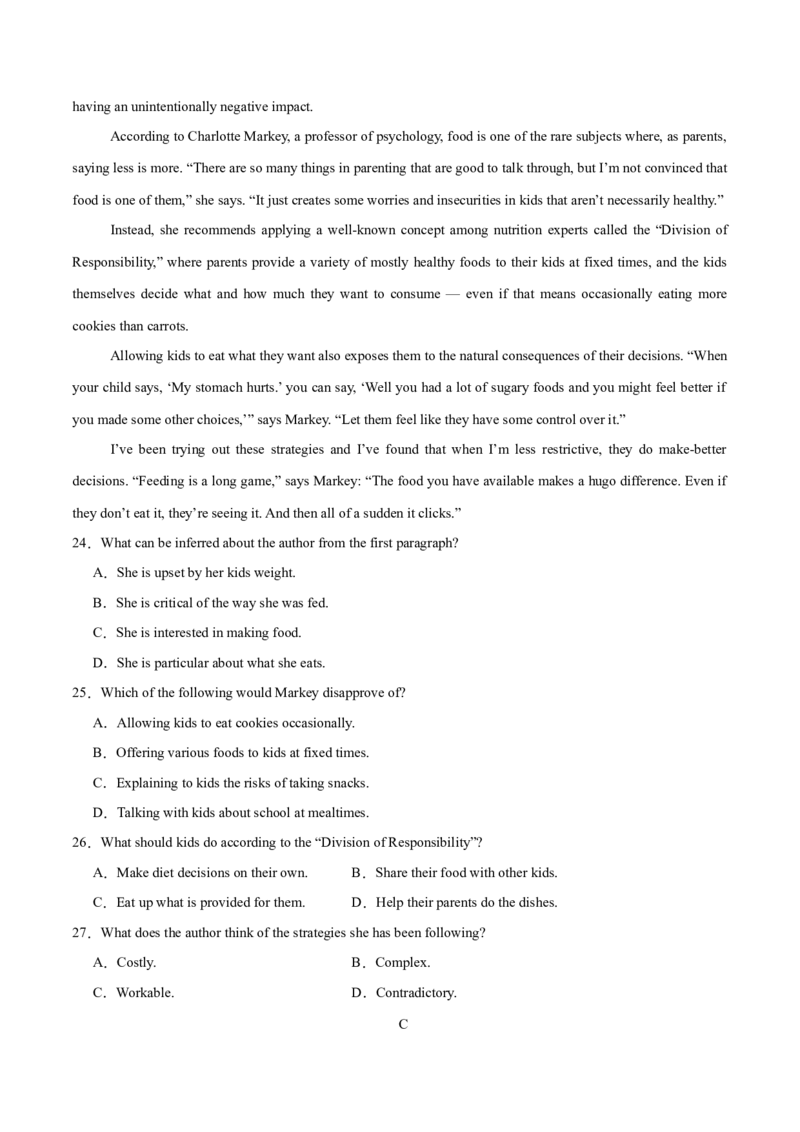
When I was a child I was often told what not to eat. “You don’t want to get fat” was on constant repeat
throughout my childhood. It really messed up my relationship with food — something that took me years to
overcome. Because of this, I’m careful not to connect what my kids weigh with their worth as people. I encourage
my daughter to make healthy snack choices and often dissuade (劝阻) her from a second dessert. But one day when
I heard her saying “I think I’m too fat,” my heart sank. It made me wonder if giving her advice on snacks was
having an unintentionally negative impact.
According to Charlotte Markey, a professor of psychology, food is one of the rare subjects where, as parents,
saying less is more. “There are so many things in parenting that are good to talk through, but I’m not convinced that
food is one of them,” she says. “It just creates some worries and insecurities in kids that aren’t necessarily healthy.”
Instead, she recommends applying a well-known concept among nutrition experts called the “Division of
Responsibility,” where parents provide a variety of mostly healthy foods to their kids at fixed times, and the kids
themselves decide what and how much they want to consume — even if that means occasionally eating more
cookies than carrots.
Allowing kids to eat what they want also exposes them to the natural consequences of their decisions. “When
your child says, ‘My stomach hurts.’ you can say, ‘Well you had a lot of sugary foods and you might feel better if
you made some other choices,’” says Markey. “Let them feel like they have some control over it.”
I’ve been trying out these strategies and I’ve found that when I’m less restrictive, they do make-better
decisions. “Feeding is a long game,” says Markey: “The food you have available makes a hugo difference. Even if
they don’t eat it, they’re seeing it. And then all of a sudden it clicks.”
24.What can be inferred about the author from the first paragraph?
A.She is upset by her kids weight.
B.She is critical of the way she was fed.
C.She is interested in making food.
D.She is particular about what she eats.
25.Which of the following would Markey disapprove of?
A.Allowing kids to eat cookies occasionally.
B.Offering various foods to kids at fixed times.
C.Explaining to kids the risks of taking snacks.
D.Talking with kids about school at mealtimes.
26.What should kids do according to the “Division of Responsibility”?
A.Make diet decisions on their own.
B.Share their food with other kids.
C.Eat up what is provided for them.
D.Help their parents do the dishes.
27.What does the author think of the strategies she has been following?
A.Costly.
B.Complex.
C.Workable.
D.Contradictory.
C
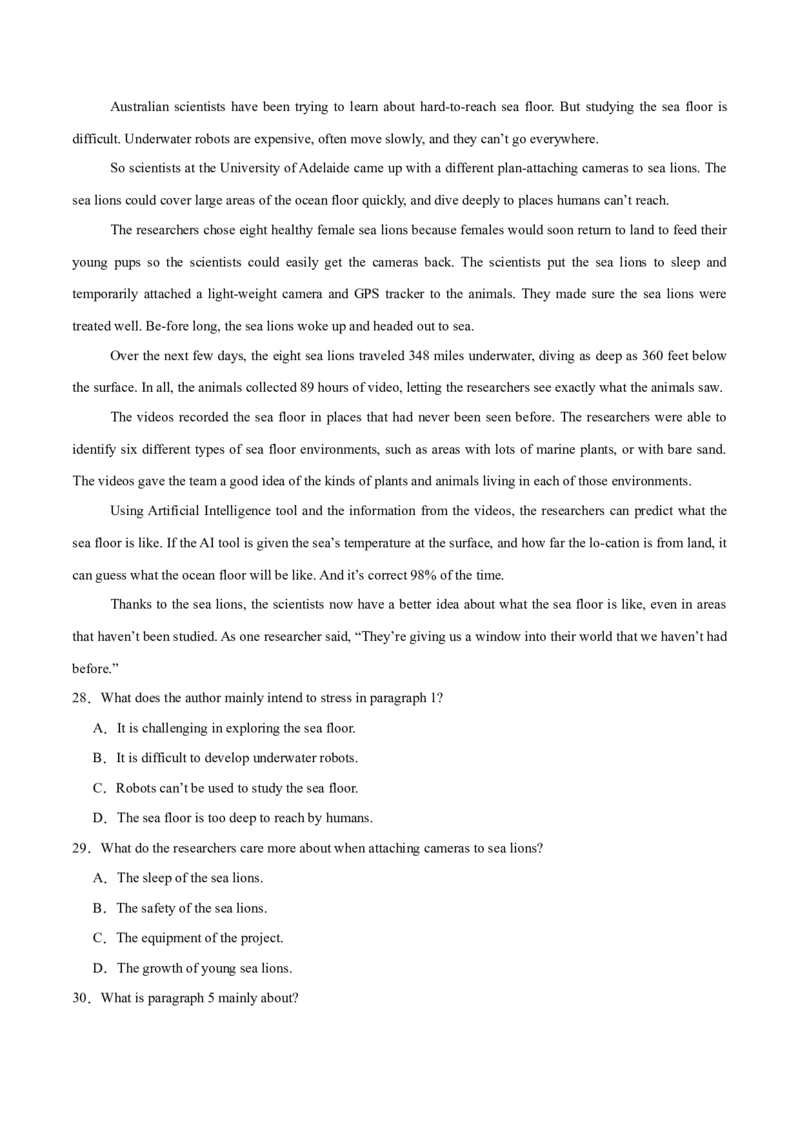
Australian scientists have been trying to learn about hard-to-reach sea floor. But studying the sea floor is
difficult. Underwater robots are expensive, often move slowly, and they can’t go everywhere.
So scientists at the University of Adelaide came up with a different plan-attaching cameras to sea lions. The
sea lions could cover large areas of the ocean floor quickly, and dive deeply to places humans can’t reach.
The researchers chose eight healthy female sea lions because females would soon return to land to feed their
young pups so the scientists could easily get the cameras back. The scientists put the sea lions to sleep and
temporarily attached a light-weight camera and GPS tracker to the animals. They made sure the sea lions were
treated well. Be-fore long, the sea lions woke up and headed out to sea.
Over the next few days, the eight sea lions traveled 348 miles underwater, diving as deep as 360 feet below
the surface. In all, the animals collected 89 hours of video, letting the researchers see exactly what the animals saw.
The videos recorded the sea floor in places that had never been seen before. The researchers were able to
identify six different types of sea floor environments, such as areas with lots of marine plants, or with bare sand.
The videos gave the team a good idea of the kinds of plants and animals living in each of those environments.
Using Artificial Intelligence tool and the information from the videos, the researchers can predict what the
sea floor is like. If the AI tool is given the sea’s temperature at the surface, and how far the lo-cation is from land, it
can guess what the ocean floor will be like. And it’s correct 98% of the time.
Thanks to the sea lions, the scientists now have a better idea about what the sea floor is like, even in areas
that haven’t been studied. As one researcher said, “They’re giving us a window into their world that we haven’t had
before.”
28.What does the author mainly intend to stress in paragraph 1?
A.It is challenging in exploring the sea floor.
B.It is difficult to develop underwater robots.
C.Robots can’t be used to study the sea floor.
D.The sea floor is too deep to reach by humans.
29.What do the researchers care more about when attaching cameras to sea lions?
A.The sleep of the sea lions.
B.The safety of the sea lions.
C.The equipment of the project.
D.The growth of young sea lions.
30.What is paragraph 5 mainly about?
A.The process to explore the sea floor.
B.The exciting result of the research.
C.The unique living creatures in the ocean.
D.The different types of sea floor environments.
21.What can be inferred from the researcher’s words in the last para-graph?
A.The sea lions are providing them with food.
B.The sea lions are teaching them how to use AI tools.
C.The sea lions are showing them a new way to swim.
D.The sea lions are helping map the sea floor in a new way.
D
Imagine journeying down the highway when you notice your fuel tank running low. Your GPS indicates 10
gas stations. Naturally, you want the cheapest option. You pass the first handful and observe their prices before
approaching one with a seemingly good deal. Do you stop, without knowing how sweet the bargains could get up
the road? Or do you continue exploring and risk regret for rejecting the bird in hand? How do you decide when to
explore further and when to decide on a choice?
As a fascinating recent Big Think article explains in detail, no matter what choice you’ re making,
mathematicians claim the 37 percent rule applies. Spend the first 37 percent of your decision-making process
gathering information and committing to nothing. After that, choose the next option that comes along that’s better
than everything you’ve seen before. This rule gives you the highest probability of making the superior choice.
Applying this precise rule will simplify messy reality. If you’ve given yourself a month to hunt for a most
comfortable apartment, the 37 percent rule suggests you spend the first third or so of that surveying the market and
making no decisions. If you’re hiring an assistant and plan to interview 10 candidates, let the first three go by. Then
choose the next person who beats that first bunch.
What if an absolutely brilliant candidate just happens to be the first one you come across? Following this rule
might end up complaining and wondering, “What if?” It is true that matters of the heart aren’t logical, and this rule
only maximizes probabilities. It doesn’t guarantee success. So if lightning strikes or the angels sing and you’ re
absolutely sure you’ve found the perfect match for you, don’t let inflexible rules stand in the way.
But even if it’s unwise to blindly follow the 37 percent rule in every instance, that doesn’t make it unhelpful.
Spending roughly the first third of your decision-making process gathering information can help you resist fear of
missing out. Knowing that you should secure the first candidate who beats the options you previously explored can
help you gather the courage to make decisions.
32.What does the underlined phrase “the bird in hand” in paragraph 1 refer to?
A.A sweeter bargain ahead.
B.The first GPS recommendation.
C.The previous cheaper gas station.
D.A more suitable route on the journey.
33.Which of the following is an example of the 37 percent rule?
A.Choosing the 1st from 100.
B.Choosing the 36th from 100.
C.Choosing the 37th from 100.
D.Choosing the 38th from 100.
34.What is the writing purpose of paragraph 4?
A.To offer a reminder.
B.To give an example.
C.To prove a conclusion.
D.To make an assumption.
35.How does the 37 percent rule benefit us?
A.It boosts our self-confidence.
B.It enhances our ability to analyze data.
C.It strengthens our links with the society. D.It improves our decision-making efficiency.
第二节(共5 小题;每小题2.5 分,满分12.5 分)
阅读下面短文,从短文后的选项中选出可以填入空白处的最佳选项。选项中有两项为多余选项。
How to improve the taste of your drinking water
Like many people, you may drink less plain water than you did when you were younger. There are a lot of
possible reasons for this: Your sense of thirst may become weaker with age.    36    Therefore, hydration (水合
作用) is crucial for good health, and there are plenty of ways to improve the taste of your drinking water.
Try a water filter pitcher
A water filter pitcher can improve the taste and smell of what comes out of your tap. Consumer Reports tests
these products by adding water with nontoxic additives that copy the odor and flavor of rotten vegetables, damp
soil, metal or moldy compost (发霉的堆肥).    37
    38
You might also think about buying an under-the-sink water filter. We’ve found that the under-the-sink filters
in Consumer Reports’ tests improve water’s taste and odor slightly better than water pitcher filters do.
Add flavor
If even filtered water doesn’t taste great, you can doctor it a bit.    39    Or fill a pitcher with fruits and
herbs you like: Citrus, cucumber, berries, melons, basil and mint are a few possibilities.
Make it sparkle
    40    Dissolve it yourself with seltzer (苏打水) makers from brands like SodaStream and Drinkmate.
A.Consider an upgrade.
B.Check your water quality.
C.And some older adults may no longer find the taste of water appealing.
D.Leave your pitcher or glass out on the countertop or microwave it briefly to warm it.
E.A splash of 100 percent fruit juice can be a good way to add a little flavor to a glass of water.
F.Then a panel of professional tasters evaluates how well each filter removes unpleasant tastes and smells.
G.If you find bubbly water appealing, carbonation (炭化作用) is another way to improve water’s taste.
第三部分  语言运用(共两节,满分30 分)
第一节  (共15 小题;每小题1 分,满分15 分)
阅读下面短文,从每题所给的A、B、C、D 四个选项中选出最佳选项。
After completing high school, I had the hope of continuing my education at a university. But the    41
kept piling up. I had no money despite working three jobs, so I had to    42    from the community college. Still,
I held on to a lesson my parents had    43    in me: everything bad comes with something good.
As the eldest daughter of five children of an immigrant family to the US, I worked at    44    jobs and at
16 became    45    independent. Through it all, my education meant everything to me. I thought if I did well in
my    46    work, everything else would fall into place. But when I gained    47    to many top public
universities across the state, my heart    48    since I couldn’t afford it. I couldn’t take out large amounts of
student loan debt given my family’s economic    49   . Besides, being first generation from an immigrant
household, I didn’t understand what scholarships were and how to     50     - and even if I did, scholarships
wouldn’t replace my     51     as my family’s economic provider if I left.
I spent 7 years working many jobs while slowly     52     community college credits. Then, as my sisters
were older, I moved on to a 4-year university. I     53     organic chemistry with Dr. Farmer. In his office hours,
I discovered my     54    . Within 6 months, I was running columns in his lab. Now I’m close to getting my
Ph.D.degree in organic chemistry. I am so glad I never     55     my childhood dream.
41.A.opportunities
B.functions
C.challenges
D.consequences
42.A.benefit
B.withdraw
C.borrow
D.slide
43.A.planted
B.delivered
C.assessed
D.arranged
44.A.positive
B.multiple
C.adorable
D.efficient
45.A.technically
B.normally
C.visually
D.financially
46.A.reasonable
B.academic
C.elegant
D.familiar
47.A.reputation
B.recognition
C.admission
D.adoption
48.A.beat
B.stopped
C.failed
D.sank
49.A.situation
B.recovery
C.policy
D.system
50.A.compare
B.observe
C.apply
D.avoid
51.A.advantage
B.desire
C.behavior
D.role
52.A.marking
B.earning
C.donating
D.decreasing
53.A.viewed
B.mentioned
C.took
D.designed
54.A.mood
B.standard
C.disadvantage
D.curiosity
55.A.gave up
B.picked up
C.kept up
D.cleared up
第二节(共10 小题;每小题1.5 分,满分15 分)
阅读下面短文, 在空白处填入1 个适当的单词或括号内单词的正确形式。
Chinese archaeologists have discovered an ancient path of the Silk Road in northwest China’s Xinjiang
Uygur Autonomous Region

 5  6

 was recorded in ancient books. The path is located in Xinjiang’s Yecheng
County, which once served

 5  7

 an important  passage on the southern route of the Silk Road. Investigations
showed that the path was about three kilometers long, with an average

 5  8

  (wide) off 2 to 3.5 meters.
It was observed that the road was

 5  9

  (basic) constructed with a stone foundation. The road was
actually a branch road

 6  0

  (lead) from Yecneng County to other locations. According to

 6  1

  ancient
book, it could reach southwest China’s Xizang Autonomous Region,India through the Karakoram Pass to the south,
and Pamir by following the Yarkand River to the west.
Xinjiang has a rich and diverse history, which is very

 6  2

  (notice) through the discoveries of many
ancient relics. For example, Jiaohea, 37.6-hectare ruined city in Turpan, can date back about 2,300 years. The
ancient city of Jiaohe is one of the most visually spectacular

 6  3

  (ruin) of the Silk Road.The city was built
as a fortress (要塞) atop a steep cliff

 6  4

 (defend) against outside attacks by digging the ground rather than
building up. Unfortunately, it

 6  5

  (abandon) in the 13th century.
第四部分  写作(共两节,满分40 分)
第一节  (满分15 分)
假如你是李华。你校报社拟开设一个英文专栏,旨在介绍各地的风土人情。因此,你写信给美国的朋友
Peter 约稿。要点如下:
1. 栏目介绍;
2. 稿件内容;
3. 稿件长度:约400 词汇
4. 交稿日期:6 月28 日前
注意:
(1) 写作词数应为80 个左右;
(2) 请按如下格式在答题纸的相应位置作答。
Dear Peter,
____________________________________________________________________________________________
____________________________________________________________________________________________
____________________________________________________________________________________________
____________________________________________________________________________________________
____________________________________________________________________________________________
_______________
Yours,
Li Hua
第二节  (满分25 分)
阅读下面材料,根据其内容和所给段落开头语续写两段,使之构成一篇完整的短文。
Last Sunday afternoon, I was reading a book and had just come to the most interesting part when my little
brother, Tex, rushed into my room. “Look at these cool paper airplanes I made!” Tex exclaimed, throwing one
directly at my head.
Annoyed, I asked him for some peace and quiet so I could continue reading. “Ooh! I want to read!” said Tex.
He climbed onto my bed and eagerly asked if I could read the book out loud to him. I replied that I didn’t want to
read out loud.
Sensing my bad mood, Tex decided to cheer me up. He dashed out of my room and returned a minute later,
dumping a basket full of stuffed animals all over me. “A teddybear picnic!”
“No, Tex, not today.” I got up, dragged myself to the living room and flopped into the chair, feeling grumpy
(暴躁的). Tex stood in the doorway, a disappointed look on his face.
Although I knew Tex was just trying to help, I couldn’t shake off my bad feelings. Just then, my friend Ollie
arrived, excitedly holding a brand-new basketball. He suggested that we head to the park and try it out.
Feeling too absorbed in my bad mood, I sighed and told Ollie that I was too busy being in the world’s worst
mood to do anything at all. Curious about my annoyance, Ollie asked what had happened. I told him Tex had
interrupted my reading and for some unknown reason, it had put me in a really grumpy mood. Ollie then mentioned
that when he was in a bad mood, he liked to move his body.
“I’d love to move,” I said. “To a tropical island!”
“Not that kind of move!” Ollie said “I move my body. You know, skateboard, basketball, go for a walk, and
do jumping jacks. Exercise makes me feel better. Come on!”
I sighed, thinking that exercise was the last thing I wanted to do in my grumpy state. But Ollie’s words
echoed in my mind, and I realized that maybe he was right.
注意:
1.续写词数应为150 左右;
2.请在答题卡的相应位置按如下格式作答。
Unwillingly, I agreed to go to the park with him.
____________________________________________________________________________________________
____________________________________________________________________________________________
____________________________________________________________________________________________
____________________________________________________________________________________________
____________________________________________________________________________________________
At sunset, I was on my way back home, tired but no longer in a grumpy mood.
____________________________________________________________________________________________
____________________________________________________________________________________________
____________________________________________________________________________________________
____________________________________________________________________________________________
____________________________________________________________________________________________