2026 年高考临考冲刺卷(全国一卷)
高三英语·全解全析
(考试时间:120 分钟  试卷满分:150 分)
注意事项:
1.答卷前,考生务必将自己的姓名、准考证号等填写在答题卡和试卷指定位置上。
2.回答选择题时,选出每小题答案后,用铅笔把答题卡上对应题目的答案标号涂黑。如需改动,用橡皮
擦干净后,再选涂其他答案标号。回答非选择题时,将答案写在答题卡上。写在本试卷上无效。
3.考试结束后,将本试卷和答题卡一并交回。
第一部分 听力(共两节,满分30 分)
做题时,先将答案标在试卷上,录音内容结束后,你有两分钟的时间将试卷上的答案转涂到答题卡上。
第一节(共5 小题:每小题1.5 分,满分7.5 分)
听下面5 段对话。每段对话后有一个小题,从题中所给的A、B、C 三个选项中选出最佳选项。听完每段对
话后,你都有10 秒钟的时间来回答有关小题和阅读下一小题。每段对话读两遍。
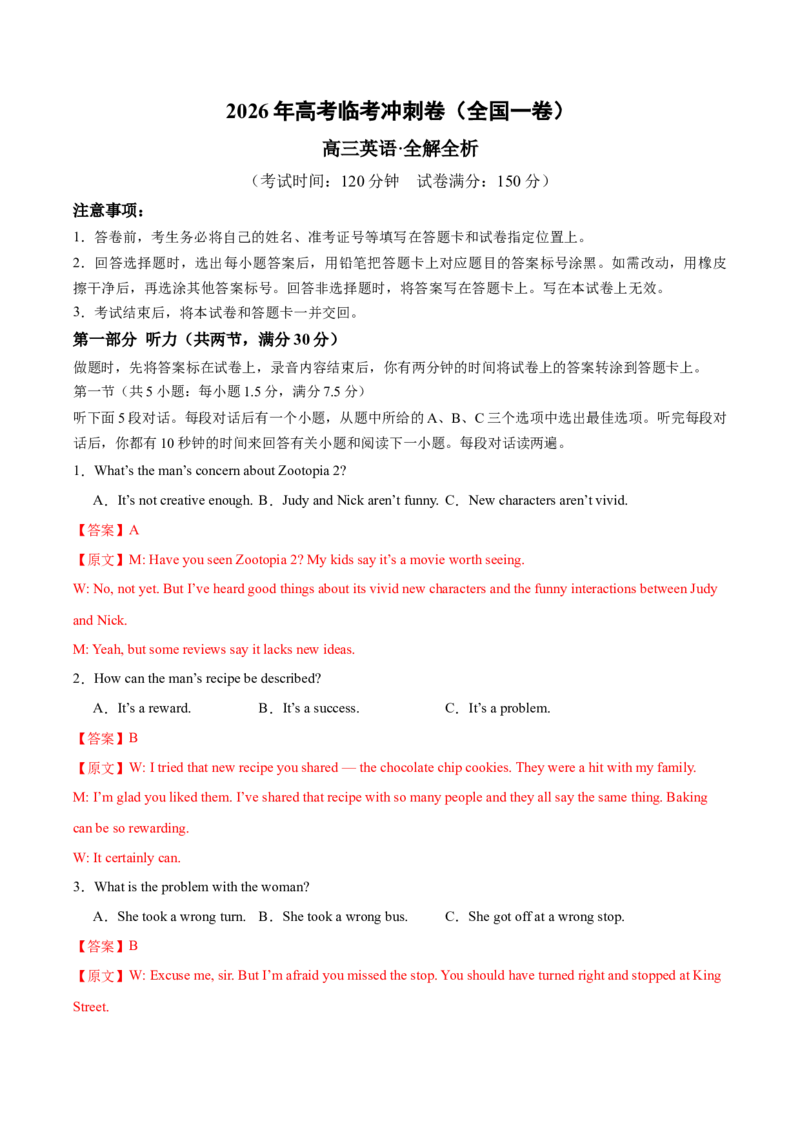
1.What’s the man’s concern about Zootopia 2?
A.It’s not creative enough. B.Judy and Nick aren’t funny. C.New characters aren’t vivid.
【答案】A
【原文】M: Have you seen Zootopia 2? My kids say it’s a movie worth seeing.
W: No, not yet. But I’ve heard good things about its vivid new characters and the funny interactions between Judy
and Nick.
M: Yeah, but some reviews say it lacks new ideas.
2.How can the man’s recipe be described?
A.It’s a reward.
B.It’s a success.
C.It’s a problem.
【答案】B
【原文】W: I tried that new recipe you shared — the chocolate chip cookies. They were a hit with my family.
M: I’m glad you liked them. I’ve shared that recipe with so many people and they all say the same thing. Baking
can be so rewarding.
W: It certainly can.
3.What is the problem with the woman?
A.She took a wrong turn.
B.She took a wrong bus.
C.She got off at a wrong stop.
【答案】B
【原文】W: Excuse me, sir. But I’m afraid you missed the stop. You should have turned right and stopped at King
Street.
M: Our bus runs directly to Town Hall.
W: But No. 818 does stop at King Street. I take it every day.
M: Oh, it’s No. 816.
4.How does the woman probably feel?
A.Curious.
B.Excited.
C.Annoyed.
【答案】C
【原文】W: Could you please read the instructions carefully first? They are hard to understand.
M: Sorry, that’s my fault. I will put them together again in simple words. Just wait a moment and you’ll soon get a
new version.
5.What is the main topic of the conversation?
A.Gifts for a friend.
B.A literature event.
C.A going-away party.
【答案】A
【原文】M: Have you heard about Angela’s farewell (告别)?
W: Oh yes, her desk is overflowing with presents. I got her a literary book.
M: How thoughtful! I’ll have to find something by the end of the day.
W: I’m sure you’ll find something perfect.
第二节(共15 小题;每小题1.5 分,满分22.5 分)
听下面5 段对话或独白。每段对话或独白后有几个小题, 从题中所给的A、B、C 三个选项中选出最佳选项。
听每段对话或独白前, 你将有时间阅读各个小题, 每小题5 秒钟; 听完后,各小题将给出5 秒钟的作答时间。
每段对话或独白读两遍。
听下面一段对话,回答第6 和第7 两个小题。
6.Where are the speakers?
A.At Tom’s house.
B.In a meeting room.
C.At a train station.
7.How does the woman probably feel in the end?
A.Worried.
B.Relieved.
C.Angry.
【答案】6.C    7.B
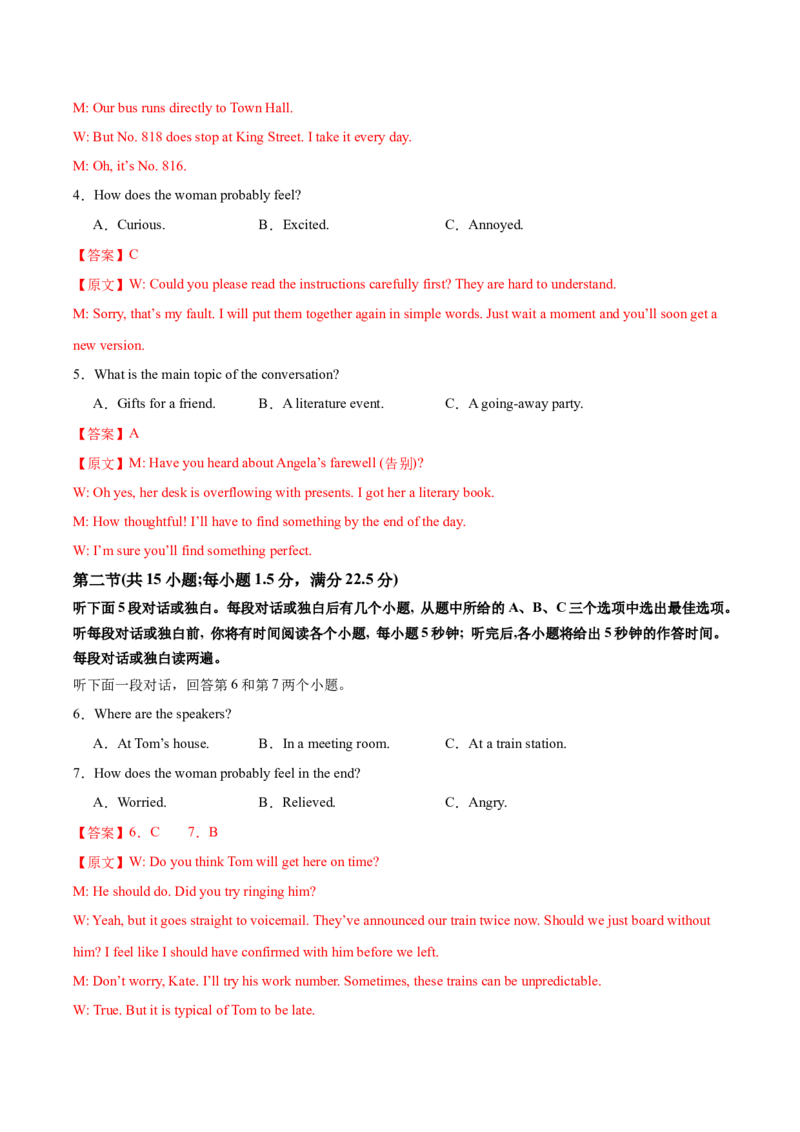
【原文】W: Do you think Tom will get here on time?
M: He should do. Did you try ringing him?
W: Yeah, but it goes straight to voicemail. They’ve announced our train twice now. Should we just board without
him? I feel like I should have confirmed with him before we left.
M: Don’t worry, Kate. I’ll try his work number. Sometimes, these trains can be unpredictable.
W: True. But it is typical of Tom to be late.
M: Exactly, but he knows this meeting is important. Look, if he misses this one, it’ll be the third time this quarter.
It’s not a great record for him.
W: Agreed. Ah, there he is. He’s running towards the platform
听下面一段对话,回答第8 至第10 三个小题。
8.Where does the conversation take place?
A.In a classroom.
B.In a library.
C.In a bookstore.
9.When should Jack finish the article?
A.On Wednesday.
B.On Tuesday.
C.On Monday.
10.What will Jack write about?
A.His favorite book.
B.His favorite play.
C.His favorite movie.
【答案】8.B    9.A    10.C
【原文】W: Hi, Jack, what a busy Monday. You are spending a lot of time in the library today. What’s up? Are you
becoming a hardworking boy?
M: Hi, Cindy, you’re joking. I’m thinking about my article for our school magazine. I have to finish it the day after
tomorrow. The title is my favorite book, but I can’t decide what to write about.
W: Well, what’s your favorite book then?
M: It’s hard to say. In fact, I don’t really enjoy reading.
W: I see. Can you write about something else, a film or a play, for example?
M: I don’t think so. I promised Betty to write about a book.
W: I’m sure Betty will be pleased if you write an article, even if it’s not about a book.
M: I think you have got it right. I’ll write about my favourite film instead. Thanks, Cindy.
W: You’re welcome.
听下面一段对话,回答第11 至第13 三个小题。
11.What did the woman probably try to do?
A.Replace the door.
B.Open a bookcase.
C.Find the headmaster.
12.What do we know about the headmaster?
A.He is off on vacation.
B.He has lost the key.
C.He’ll send for the key.
13.What will the man most likely do next?
A.Contact Rachel.
B.Phone the headmaster.
C.Call in a repairman.
【答案】11.B    12.A    13.A
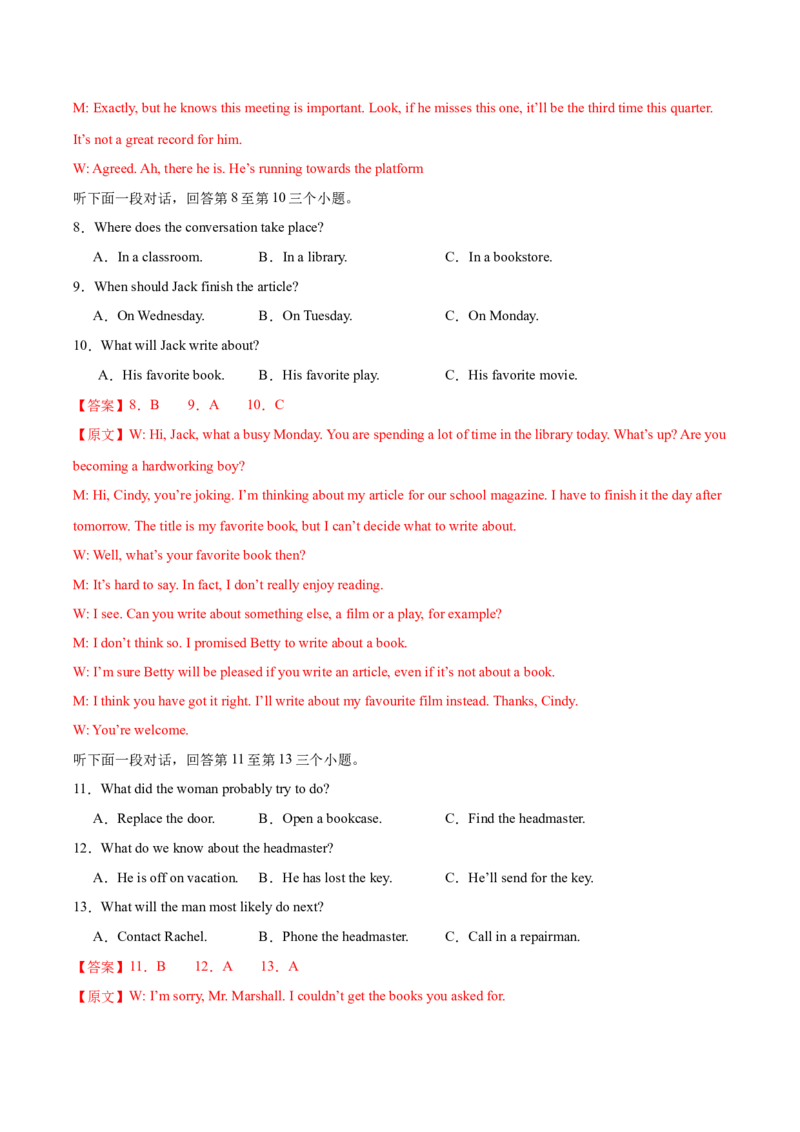
【原文】W: I’m sorry, Mr. Marshall. I couldn’t get the books you asked for.
M: Why not? I’m sure they’re over there.
W: But I think the bookcase is locked or stuck.
M: OK, sit back down and I’ll go and try to open it myself.
W: I’m almost sure it’s locked. The door just wouldn’t move at all.
M: If it is, I’ll have to get the key from the headmaster. Oh, but he’s not in today, is he?
W: No, I think he’s gone on holiday. He might have taken the key with him.
M: No, he wouldn’t do that — but he might have left it with Rachel.
W: She was in school today. I saw her this morning.
听下面一段对话,回答第14 至第17 四个小题。
14.Why is Emily doing unpaid work in the new season of the show?
A.To help raise the crew's pay.
B.To support the post-production.
C.To follow the practice in show business.
15.What enables Emily to try different things in her field?
A.Her college education.
B.The television industry.
C.Her teaching experience.
16.What does Emily think of her work at the Film Centre?
A.Entertaining.
B.Demanding.
C.Rewarding.
17.What is the man doing?
A.Hosting a workshop.
B.Declaring a new season.
C.Conducting an interview.
【答案】14.B    15.A    16.C    17.C
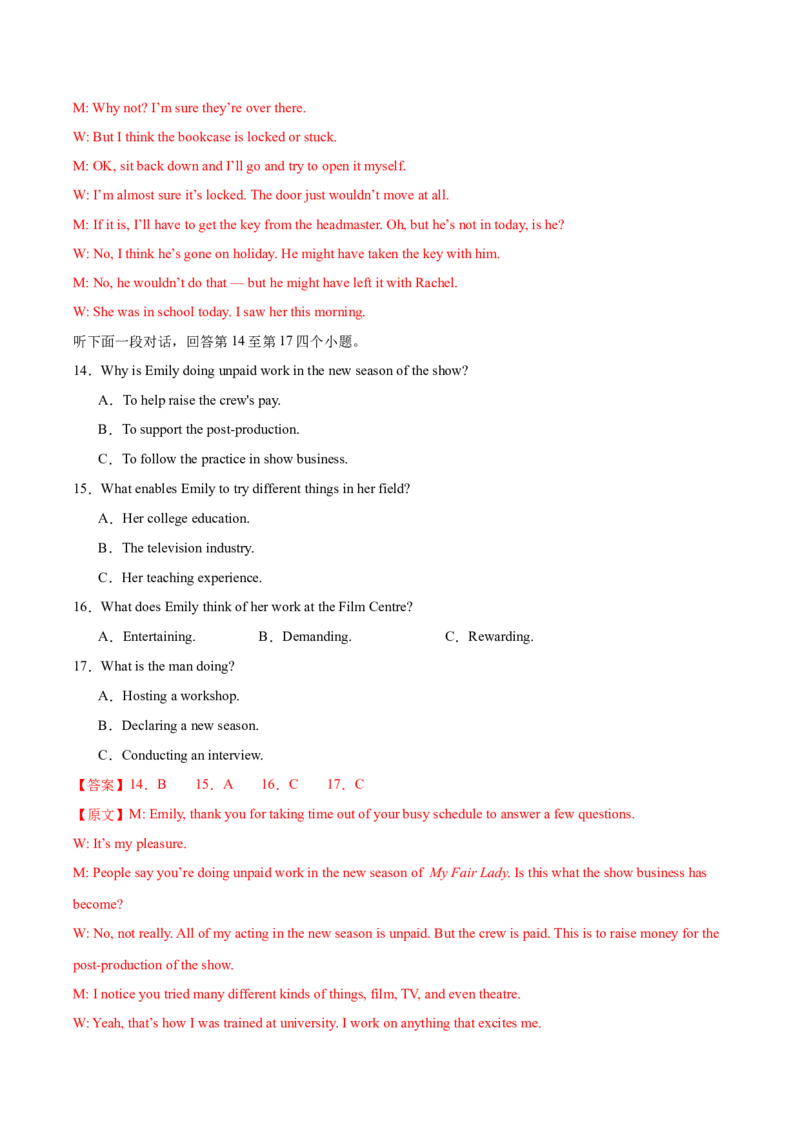
【原文】M: Emily, thank you for taking time out of your busy schedule to answer a few questions.
W: It’s my pleasure.
M: People say you’re doing unpaid work in the new season of My Fair Lady. Is this what the show business has
become?
W: No, not really. All of my acting in the new season is unpaid. But the crew is paid. This is to raise money for the
post-production of the show.
M: I notice you tried many different kinds of things, film, TV, and even theatre.
W: Yeah, that’s how I was trained at university. I work on anything that excites me.
M: Tell us about the six months you recently spent at the workshop of the Film Centre.
W: It was an unbelievable experience, teaching young actors and actresses, and working with some great acting
artists. It was also great to work in various labs, such as directors, writers, and so on. It’s very helpful for making
you a really well-rounded and active member of the film and television industry.
M: Thank you very much, Emily. We look forward to your new season.
听下面一段独白,回答第18 至第20 三个小题。
18.What is the main focus of the program?
A.Scientific exploration. B.Artistic appreciation.
C.Management skills
19.What will students need to do at the start of the program?
A.Sit an exam.
B.Give a report.
C.Design an experiment.
20.What is special about the program?
A.It stresses theoretical study.
B.It organizes activities outside school.
C.It specializes in computer-assisted research.
【答案】18.A    19.A    20.B
【原文】Good morning, everyone. Welcome to the fascinating world of our university’s Science and Innovation
Program. This program is specifically designed for those who are passionate about exploring the depths of
scientific research. Covering a variety of fields from biology to computer science, it offers an enriching journey
into the world of science. Including six levels from basic to advanced research, the program provides options for
students with different scientific interests and skill sets. Each level is designed to gradually deepen students’
understanding and practical abilities in scientific research. Our program is known for involving different scientific
areas to create a rich educational experience. Students are required to engage in around fifteen hours of coursework
each week. The program begins with a test to determine each student’s starting level. Progress is evaluated through
regular examinations, project presentations, and hands-on experiments. Successful students advance through the
levels, facing new challenges and opportunities at each stage. One of the program’s highlights is the “Beyond the
Classroom Series”. This series provides students with opportunities, which are not available in classes, to visit
scientists’ labs and participate in innovative science conferences.
第二部分  阅读(共两节, 满分50 分)
第一节(共15 小题;每小题2.5 分, 满分37.5 分)
阅读下列短文, 从每题所给的A、B、C 和D 四个选项中选出最佳选项。
A
(创新题)
Composition of E-Waste
Nowadays, e-waste is one of the world’s fastest-growing waste streams. Waste electronics contain harmful
substances like lead and mercury, posing serious environmental and health risks.
However, e-waste also represents a valuable “urban mine”. It holds an estimated 31 million tonnes of metals,
17 million tonnes of plastics, and 14 million tonnes of glass. One tonne of circuit boards can contain up to 800
times more gold than a tonne of gold-bearing rocks. Despite this, less than 1% of rare earth elements are recycled.
Recycled e-waste is a valuable resource for sustainable manufacturing ( 制造业). Its metals, e.g. gold and
copper, are reused in electronics, vehicles, and renewable energy systems. Recovered plastics find new life in
durable products, while glass is processed into building materials. This circular (循环的) approach cuts energy use,
reduces mining demand, and transforms waste into industrial resources, supporting both the economy and the
environment.
The e-waste management market is projected to more than double by 2027. While 81 countries have adopted
Extended Producer Responsibility laws, collection rates still fall behind policy goals.
To improve recycling, governments should strengthen EPR laws, and invest in facilities. Institutions can
promote research and public awareness. Individuals should properly drop off e-waste at collection points, fix items
rather than throw them away, and support brands with strong environmental commitments.
21.What percentage do screens and cables account for in all e-waste compositions?
A.12%.
B.14%.
C.17%.
D.60%.
22.What is a key advantage of e-waste compared to natural mines?
A.It contains a greater variety of rare elements.
B.It provides more recoverable non-metals.
C.It can be richer in precious metals.
D.It works better as building materials.
23.What is suggested for individuals to help recycle e-waste?
A.Invest in formal recycling facilities.
B.Launch public awareness campaigns.
C.Set clear personal take-back plans.
D.Choose repair over replacement.
【答案】21.B    22.C    23.D
【解析】本文是一篇说明文。介绍电子垃圾的危害、回收价值及各方提升回收效率的举措。
21.细节理解题。根据饼状图可知, screens 在电子垃圾中的占比12%,cables 的占比为2%,因此两者占
比为14%。故选B 项。
22.细节理解题。根据第二段中的“One tonne of circuit boards can contain up to 800 times more gold than a
tonne of gold-bearing rocks. (一吨电路板的含金量是一吨含金矿石的800 倍之多。)”可知,电子垃圾相比天
然矿山,关键优势在于贵金属含量可能更高。故选C 项。
23.细节理解题。根据最后一段中的“Individuals should properly drop off e-waste at collection points, fix
items rather than throw away (个人应将电子垃圾妥善送至回收点,修理物品而非丢弃)”可知,针对个人的建
议是选择维修而非更换电子产品。故选D 项。
B
A few years ago, we bought a Lego Taj Mahal (泰姬陵) for my dad’s birthday, hoping to combine his love
for architecture with family time.
Each evening, my dad and I gathered around the large dining table to build the model. We faced thousands of
tiny white pieces, each packaged with precision in numbered plastic bags, accompanied by a thick instruction book.
The evenings passed quickly, and the building rose before our eyes. We could see our efforts producing good
results, and as we turned to the boring task of ordering the colored bricks on the building’s floor, our conversation
too took a turn.
We were amazed by how complex the model was and its instruction book. We realized the book itself was a
work of art, beautiful, but also surprisingly detailed and clear. It provided us with the comfort of certainty. We knew
if we followed all the instructions, we would end up with a model that looked exactly like the picture on the box. If
we made a mistake, all we had to do was to repeat our steps and start again.
Life, however, does not fit together so neatly and rarely provides us with such clear instructions. We talked
over our respective lives, decisions made, and actions and choices never taken. Dad reflected on a life well lived,
and I, in my mid-thirties, on the uncertain path that lay ahead
Here, we were the expert architects doing the assembling, but out in the world, we were the ones being
assembled. We think we’re in control, but our choices are shaped by forces beyond our control. In the face of
uncertainty, we have to proceed, trusting both in the process and the end result.
Sometimes, on the days I return home, I go to the spare room to look at the completed Lego model, which
brings forth a sense of happiness and comfort. It reminds me that life is built slowly, with mistakes, an element of
uncertainty and no instruction book. It shows that consideration, warmth and faith will result in a life well lived.
Life itself is not about what we materially create or leave behind, but rather how we lived it.
24.Which can best describe the author’s experience of building the Lego model?
A.Simple and uninteresting.
B.Imaginative and enjoyable.
C.Complicated and rewarding.
D.Challenging and discouraging.
25.What does the author learn from assembling the Lego model?
A.Life requires to be planned carefully.
B.Life doesn’t come with clear guidance.
C.Mistakes in life can always be corrected.
D.Life’s uncertainty makes it more exciting.
26.How does the author suggest we deal with uncertainty in life?
A.By avoiding making any choice.
B.By focusing on instant end results.
C.By seeking instructions from others.
D.By moving forward with confidence.
27.Which of the following can be the best title for the text?
A.Lego: A Symbol of Family Bond
B.Building with Lego: Lessons for Life
C.The Complexity of Architectural Models
D.Life: A Journey Without Instructions
【答案】24.C    25.B    26.D    27.B
【解析】本文是一篇记叙文。文章通过作者与父亲组装乐高泰姬陵的经历,阐述了对人生哲理的深刻感悟。
24.推理判断题。根据第二段中的“We faced thousands of tiny white pieces, each packaged with precision in
numbered plastic bags, accompanied by a thick instruction book. The evenings passed quickly, and the building
rose before our eyes. We could see our efforts producing good results (我们面对着成千上万块白色小零件,每一
块都精准地装在编号塑料袋里,还有一本厚厚的说明书。夜晚过得很快,建筑在我们眼前拔地而起。我们
能看到自己的努力产生了好的结果)”可知,搭建过程复杂但成果显著,充满成就感。故选C 项。
25.细节理解题。根据第四段中的“Life, however, does not fit together so neatly and rarely provides us with
such clear instructions (然而,人生并非如此规整,也很少为我们提供如此清晰的指导)”可知,作者意识到人
生没有像乐高说明书那样清晰的指导。故选B 项。
26.细节理解题。根据第五段中的“In the face of uncertainty, we have to proceed, trusting both in the process
and the end result. (面对不确定性,我们必须继续前行,既要相信过程,也要相信最终结果)”可知,作者认
为面对不确定性,我们应带着信心前行,相信过程和结果。故选D 项。
27.主旨大意题。全文通过作者与父亲组装乐高泰姬陵的经历,引申出对人生的深刻感悟:生活没有说明
书,充满不确定性,但需要用心、温暖和信念去慢慢构建。由此可知,B 项“Building with Lego: Lessons
for Life (用乐高搭建:人生一课)”最能概括文章由具体经历到人生哲理升华的主旨。故选B 项。
C
Have you ever wondered what sets successful people apart? Could it be the way how they use their minds?
Dr. Joseph Murphy believes the secret lies in the subconscious mind ( 潜意识). His book, The Power of Your
Subconscious Mind, shows how this hidden force can help you reach your full potential and change your life.
The book is structured in an easy-to-read format, with short, clear chapters that explain complex ideas in
everyday language. Murphy, who studied religion, philosophy, and psychology, uses simple words to describe how
the subconscious works. Each chapter covers a different topic — like picturing goals, saying positive things, or
improving health — and gives practical steps with real-life examples.
Murphy begins by drawing a clear distinction between the two parts of the brain: the conscious and the
subconscious. Murphy then argues that the subconscious mind is an unlimited source of creativity that influences
our habits and health, and by uniting mentally and emotionally with the good you wish to embody ( 体现), the
creative power of your subconscious will respond accordingly. However, the book’s real strength is its practical
application. Murphy provides case studies and examples that demonstrate how real people have used these
principles to achieve personal success. Whether it’s financial stability, career advancement, or personal
relationships, the techniques can be applied universally.
However, the book isn’t perfect. Murphy’s friendly style and wide knowledge — from religion to science —
make it interesting, but some ideas, like the law of attraction, don’t have strong evidence. This might bother readers
who want facts. Even so, the practical tips stand out. Whether you want a better job, health, or relationships, The
Power of Your Subconscious Mind can give you tools to shape your life with your thoughts — a powerful idea
worth trying.
28.What characterizes Murphy’s writing style?
A.Long chapters on theories.
B.Big ideas in simple language.
C.Practical steps without examples.
D.Complex theories in academic language.
29.How could people achieve personal success according to Murphy?
A.By working hard.
B.By visualizing goals daily.
C.By building a positive mindset.
D.By changing habits and reactions.
30.Who might be the least interested in the book?
A.Evidence-driven readers.
B.Positive mindset seekers.
C.Success strategy learners.
D.Personal growth enthusiasts.
31.What is the author’s main purpose of writing the text?
A.To present a self-help book.
B.To list methods for success.
C.To encourage optimistic thinking.
D.To explain subconscious mechanisms.
【答案】28.B    29.C    30.A    31.A
【解析】这是一篇说明文。本文介绍了约瑟夫
墨菲博士的著作《潜意识的力量》,探讨其核心观点及价
・
值。墨菲认为成功的关键在于潜意识的运用,书中通过简明易懂的语言和日常案例,阐述了潜意识如何帮
助人们挖掘潜能、改变生活。
28.细节理解题。根据文章第二段中“The book is structured in an easy - to - read format, with short, clear
chapters that explain complex ideas in everyday language. Murphy, who studied religion, philosophy, and
psychology, uses simple words to describe how the subconscious works.(这本书的结构是一个易于阅读的格式,
用简短,清晰的章节,用日常语言解释复杂的想法。研究过宗教、哲学和心理学的墨菲用简单的语言描述
了潜意识是如何工作的。)” 可知,Murphy 的写作风格是用简单的语言解释复杂的思想。故选B 项。
29.细节理解题。根据第三段提到“by uniting mentally and emotionally with the good you wish to embody (体
现), the creative power of your subconscious will respond accordingly(通过在精神上和情感上与你希望体现的
美好结合起来,你潜意识的创造力就会相应地做出反应。)”,结合第二段提到的“saying positive things(说
积极的事情)”等内容可知,Murphy 认为人们可以通过建立积极的心态(将精神和情感与想要体现的美好
事物相结合,说积极的话等都属于建立积极心态的范畴)来实现个人成功。故选C 项。
30.推理判断题。根据文章最后一段“but some ideas, like the law of attraction, don’t have strong evidence.
This might bother readers who want facts.( 但是有些观点,比如吸引力法则,并没有强有力的证据。这可能
会困扰那些想要了解事实的读者。)”可知,一些像吸引力法则这样的观点没有强有力的证据,这可能会使
追求事实的读者困扰。所以以证据为导向的读者(Evidence - driven readers)可能对这本书最不感兴趣。故
选A 项。
31 .推理判断题。通读全文可知,文章主要介绍了 Dr. Joseph Murphy 的书《The Power of Your
Subconscious Mind》,包括书的内容、写作风格、优点和不足等,这本书是关于自我提升的(self -
help)。B 选项“To list methods for success”(列出成功的方法)只是书中的部分内容;C 选项“To
encourage optimistic thinking”(鼓励乐观思考)也只是书的部分作用;D 选项“To explain subconscious
mechanisms(解释潜意识机制)”同样只是书的部分内容。所以作者写这篇文章的主要目的是介绍一本自助类
书籍。故选A 项。
D
A few days ago, I watched a video of myself talking in perfect Chinese. I’ve been studying the language on
and off for only a few years, and I’m far from fluent. But there I was, pronouncing each character just as a native
speaker would. “My favorite food is sushi,” I said — wo zui xihuan de shiwu shi shousi.
I’d created the video using software from a Los Angeles-based artificial-intelligence start-up called HeyGen.
The technology, which only needs a single selfie and a script to generate deepfake videos of real people “saying”
almost anything, is a testament (证明) to the advancements in AI language tools. This got me thinking about the
declining interest in language learning with fewer students enrolling in foreign language courses and the decrease
of English proficiency among young people in some places.
AI translation, integrated into social media and messaging platforms, seems to be everywhere. Even
language-learning apps are using AI-generated content in their marketing. However, language translation is an art
rather than a science. Something enormous will be lost in exchange for that convenience. As Anne, a Chinese
translator said, “Building a ladder between widely different languages, such as Chinese and English, is sometimes
as difficult as a doctor building a bridge in a patient’s heart,”
Language learning fosters cultural competency, a skill that AI cannot simply copy. Learning a different way
to speak, read, and write helps people discover new ways to see the world. No machine can replace such a profound
human experience. Deborah Cohn, a language professor, emphasizes that language learning is actually about
understanding and connecting with different cultures; Instead of abandoning language courses in favor of AI, some
educators advocate for emphasizing the intercultural aspects of language learning. Paula Krebs of the MLA points
out that even with a “universal translator”, sometimes, the greater meaning of people’s utterance (言辞) remains a
mystery.
In essence, while AI language tools offer convenience, they lack the depth and cultural insight that comes
from human language learning. The challenge and beauty of learning a language are in understanding the cultural
tapestry (织锦) that weaves through words, something AI has yet to achieve.
32.Why does the author give the example in paragraph 1?
A.To promote the language software.
B.To show off his Chinese language skills.
C.To prove learning a language is a wasted effort.
D.To encourage critical thinking about AI language tools.
33.What can we learn from paragraph 3?
A.AI translation deserves more attention.
B.Language apps play a key role in marketing.
C.Language translation is far beyond technology.
D.Learning a different language is an uphill battle.
34.What is the key benefit of learning a language according to the passage?
A.Better digital literacy.
B.Improved translation skills.
C.Deeper cultural confidence.
D.Effective intercultural interaction.
35.What does the author imply in the last paragraph?
A.AI language tools offer convenience.
B.AI facilitates language learning in terms of culture.
C.AI is far from perfect in helping language understanding.
D.AI has achieved success in the development of language learning tools.
【答案】32.D    33.C    34.D    35.C
【解析】这是一篇说明文。文章主要讨论了人工智能语言工具的便利性与语言学习的文化深度之间的差异,
作者引导我们对人工智能语言工具进行批判性思考然后得出结论:人工智能在帮助语言理解方面远非完美。
32.推理判断题。由文章第一段“A few days ago, I watched a video of myself talking in perfect Chinese. I’ve
been studying the language on and off for only a few years, and I’m far from fluent. But there I was, pronouncing
each character just as a native speaker would. ‘My favorite food is sushi,’ I said — wo zui xihuan de shiwu shi
shousi.(几天前,我看了一段我自己说一口流利汉语的视频。我断断续续地学习这门语言才几年,还远谈不
上流利。但我就这样,每个字的发音就像母语人士一样。‘我最喜欢的食物是寿司,’我说——我最喜欢
吃寿司。)”以及下文,尤其是最后一段中“In essence, while AI language tools offer convenience, they lack the
depth and cultural insight that comes from human language learning.(从本质上讲,虽然人工智能语言工具提供
了便利,但它们缺乏人类语言学习所带来的深度和文化洞察力。)”可知,文章第一段以作者自己的体验引
出AI 语言工具,然后鼓励对AI 语言工具进行批判性思考。故选D 项。
33.推理判断题。由文章第三段中“However, language translation is an art rather than a science. Something
enormous will be lost in exchange for that convenience.(然而,语言翻译是一门艺术,而不是一门科学。为了
换取这种便利,将失去一些巨大的东西。)”以及“Building a ladder between widely different languages, such
as Chinese and English, is sometimes as difficult as a doctor building a bridge in a patient’s heart,(在广泛不同的语
言(如中文和英文)之间建立一个阶梯,有时就像医生在病人心中架起一座桥梁一样困难,)”可知,语言
翻译并不是技术能解决的问题,它远远超出了技术范畴。故选C 项。
34.细节理解题。由文章第四段中“Deborah Cohn, a language professor, emphasizes that language learning is
actually about understanding and connecting with different cultures; Instead of abandoning language courses in
favor of Al, some educators advocate for emphasizing the intercultural aspects of language learning. (语言教授黛
博拉·科恩强调,语言学习实际上是关于理解和联系不同的文化;一些教育工作者主张强调语言学习的跨文
化方面,而不是放弃语言课程而选择人工智能。)”可知,学习语言的主要好处是有效的跨文化互动。故选
D 项。
35.推理判断题。由文章最后一段“In essence, while AI language tools offer convenience, they lack the depth
and cultural insight that comes from human language learning. The challenge and beauty of learning a language are
in understanding the cultural tapestry(织锦)that weaves through words, something AI has yet to achieve.(本质上,
虽然人工智能语言工具提供了便利,但它们缺乏人类语言学习的深度和文化洞察力。学习一门语言的挑战
和美妙之处在于理解通过单词编织的文化挂毯,这是人工智能尚未实现的。)”可知,作者在最后一段表明
人工智能在帮助语言理解方面远非完美,因为人工智能语言工具缺乏人类语言学习的深度和文化洞察力。
故选C 项。
第二节(共5 小题;每小题2. 5 分, 满分12. 5 分)
阅读下面短文, 从短文后的选项中选出可以填入空白处的最佳选项。选项中有两项为多余选
项。
In February 2017, I was just emerging from a decade-long struggle with a mysterious illness that had
gradually narrowed my world.

 3  6

  That was an online Qi Gong course.
To the untrained eye, Qi Gong may seem similar to its better-known cousin, Tai Chi, the ancient art that
combines gentle movement with mental focus.

 3  7

  It’s even integrated into treatment plans in Chinese
hospitals.
My daily practice that year brought such noticeable improvements that I set myself a reward: if I stuck with
it all year, I’d head to Master Anthony’s annual training camp in Costa Rica’s cloud forest the following February.
3  8

  It was my first journey abroad in over a decade. I booked the trip to San Jose, where I met Master Anthony
and a dozen strangers. We boarded a tiny bus and rode up winding mountain roads to “La Montana Azul” for a
week-long camp.


 3  9

  There was no Internet or distractions here, just organic vegetarian meals shared under an open-
air shelter. Forest birds sang, and my roofless room even housed a surprisingly large spider, which added a touch of
unexpected adventure to the experience.
Online practice had given me slight energy movement, but that week, doing moves like Lifting the Sky, I
could distinctly feel my body filling with Qi — the vital life force energy. I felt energized and joyful. That was
when everything changed for me. At home, I had a successful career as a self-employed writer.

 4  0

  Soon
after I returned, at 53, I launched my travel blog.
Dreams do come true. They’re just waiting for you to claim them.
A.And I did!
B.I long to explore the world.
C.The place was perfect for the camp.
D.Yet it’s actually energy medicine for recovery.
E.Many people turn to Tai Chi for its physical benefits.
F.But in the cloud forest, I decided I wanted more from life.
G.A key thing finally helped me recover during the previous year.
【答案】36.G    37.D    38.A    39.C    40.F
【解析】本文是一篇记叙文。文章主要讲述了作者通过练习气功恢复健康,并决定出国参加训练营,最终
改变人生追求,开启旅行博客的故事。
36.由上文“In February 2017, I was just emerging from a decade-long struggle with a mysterious illness that had
gradually narrowed my world. (2017 年2 月,我刚刚从一场长达十年的怪病中挣扎出来,这场疾病逐渐缩小
了我的世界。)”及下文“That was an online Qi Gong course. (那是一个在线气功课程。)”可知,上文说明作
者在经历一场疾病,下文引出在线气功课程,本空应说明在线气功课程帮助作者恢复健康。G 选项“A key
thing finally helped me recover during the previous year. (在前一年,一件关键的事情最终帮助我恢复了健
康。)”能承上启下,符合语境。故选G。
37.由上文“To the untrained eye, Qi Gong may seem similar to its better-known cousin, Tai Chi, the ancient art
that combines gentle movement with mental focus. (在未经训练的人看来,气功可能与其更为知名的表亲太极
相似,太极是一种将轻柔的动作与精神集中相结合的古老艺术。)”及下文“It’s even integrated into treatment
plans in Chinese hospitals. (它甚至被纳入中国医院的治疗计划中。)”可知,上文说明气功和太极相似,下文
说明气功被纳入中国医院的治疗计划中,本空应说明气功和太极的不同之处。D 选项“Yet it’s actually
energy medicine for recovery. (然而,它实际上是一种用于康复的能量医学。)”能承上启下,符合语境。故选
D。
38.由上文“My daily practice that year brought such noticeable improvements that I set myself a reward: if I
stuck with it all year, I’d head to Master Anthony’s annual training camp in Costa Rica’s cloud forest the following
February. (那一年,我的日常练习带来了显著的进步,我给自己设定了一个奖励:如果我坚持一整年,第二
年二月我会去哥斯达黎加的云雾森林参加安东尼大师的年度训练营。)”及下文“It was my first journey
abroad in over a decade. (这是我十多年来的第一次出国旅行。)”可知,上文说明作者设定了一个奖励,即去
参加安东尼大师的年度训练营,下文说明这是作者十多年来的第一次出国旅行,本空应说明作者实现了自
己的奖励计划。A 选项“And I did! (我做到了!)”能承上启下,符合语境。故选A。
39.由下文“There was no Internet or distractions here, just organic vegetarian meals shared under an open-air
shelter. Forest birds sang, and my roofless room even housed a surprisingly large spider, which added a touch of
unexpected adventure to the experience. (这里没有互联网,也没有干扰,只有在露天遮蔽处共享的有机素食。
森林里的鸟儿在歌唱,我无顶的房间里甚至住着一只大得出奇的蜘蛛,这给这次经历增添了一丝意想不到
的冒险。)”可知,下文说明训练营的环境,本空应说明训练营的环境很适合。C 选项“The place was perfect
for the camp. (这个地方非常适合举办训练营。)”能引出下文,符合语境。故选C。
40.由上文“At home, I had a successful career as a self-employed writer. (在家里,我是一名成功的自由撰稿
人。)”及下文“Soon after I returned, at 53, I launched my travel blog. (回国后不久,53 岁的我开设了自己的旅
游博客。)”可知,上文说明作者在家时是一名成功的自由撰稿人,下文说明作者回国后开设了自己的旅游
博客,本空应说明作者在训练营中决定改变自己的生活,想要更多。F 选项“But in the cloud forest, I
decided I wanted more from life. (但在云雾森林里,我决定要从生活中得到更多。)”能承上启下,符合语境。
故选F。
第三部分 语言运用(共两节,满分30 分)
第一节(共15 小题,每小题1 分,满分15 分)
(新情景)阅读下面短文, 从每题所给的A、B、C 和D 四个选项中选出可以填入空白处的最佳选项。
I still remember the day I bought my “nice” notebook. It was a leather-bound journal with cream-colored
pages. I was sure it would make me the type of person who journals regularly, and who

 41


  beautiful
thoughts. But it didn’t work.
That gorgeous notebook sat

 42


  for months. When I finally opened it, I hesitated. The pages felt too
delicate and too

 43


  to waste on my messy handwriting and ideas. So I

 44


  it. Instead, I grabbed an
old, ugly composition notebook with a

 45


  cover and dog-eared corners. I started to

 46


  it with
everything: morning pages, random thoughts and reminders. This is surprisingly

 47


 . I actually wrote. Every
day. Without exception.
The psychology is real. When we

 48


  something too much, we place limits around it, feeling it is “too
good”. But the ugly notebook carries no such

 49


  . It has been used. It tells me, “This is a

 50


  for
thinking and living, not a museum piece.”
Here’s the thing:

 51


  notebooks are idea incubators (孵化器) . With the pressure off, you experiment
more. You try things that might

 52


 . And in that freedom, bad ideas I was

 53


  embarrassed about
gradually evolved into work I’m proud of. And that’s where the real work of creation happens.
The best notebook is never the most beautiful one. It’s the one you’ll actually

 54


 . Because the magic
happens in the

 55


 , not in perfect pages.
Your ugly notebook is waiting.
41.A.changes
B.captures
C.follows
D.lacks
42.A.unfinished
B.unclaimed
C.undiscovered
D.untouched
43.A.secret
B.smart
C.precious
D.personal
44.A.closed
B.decorated
C.delivered
D.fixed
45.A.torn
B.hard
C.hidden
D.fancy
46.A.guard
B.surround
C.fill
D.serve
47.A.annoying
B.freeing
C.demanding
D.convincing
48.A.plan
B.doubt
C.control
D.admire
49.A.luck
B.warning
C.promise
D.pressure
50.A.tool
B.test
C.guide
D.reason
51.A.incomplete
B.impractical
C.imperfect
D.irregular
52.A.cheat
B.fail
C.hurt
D.disappear
53.A.slightly
B.initially
C.hardly
D.consequently
54.A.run into
B.refer to
C.look at
D.reach for
55.A.preparing
B.thinking
C.writing
D.reading
【答案】
41.B    42.D    43.C    44.A    45.A    46.C    47.B    48.D    49.D    50.A

51.C    52.B    53.B    54.D    55.C
【解析】本文是一篇夹叙夹议文,主要讲述了作者买了一个精美的笔记本,结果却因为太过珍惜而没有使
用它,反而作者在破本子上写下了许多灵感。这件事让作者明白,真正的奇迹发生在实际的写作中,而非
完美的纸页里。
41.考查动词词义辨析。句意:我确信这会让我成为那种经常写日记、捕捉美好想法的人。A. changes 改
变;B. captures 捕捉,记录;C. follows 跟随;D. lacks 缺乏。根据上文“journals regularly”和空后
“beautiful thoughts”可知,这里指写日记记录美好想法。故选B。
42.考查形容词词义辨析。句意:那本漂亮的笔记本几个月没动过。A. unfinished 未完成的;B. unclaimed
无人认领的;C. undiscovered 未被发现的;D. untouched 原封未动的。根据上文“But it didn’t work.(但它没
有起作用。)”和下文“When I finally opened it, I hesitated.(当我终于打开它时,我犹豫了一下。)”可知,作
者买完笔记本就没用过,一直没动它。故选D。
43.考查形容词词义辨析。句意:这些页面感觉太精致、太珍贵,不能浪费在我凌乱的笔迹和想法上。A.
secret 秘密的;B. smart 聪明的;C. precious 珍贵的;D. personal 个人的。根据空前“The pages felt too
delicate”可知,笔记本的页面非常精美、珍贵。故选C。
44.考查动词词义辨析。句意:于是我合上了它。A. closed 关闭、合上;B. decorated 装饰;C. delivered 递
送;D. fixed 使固定。根据上文“The pages felt too delicate and too _____ to waste on my messy handwriting
and ideas.”可知,笔记本太精美了,作者不想乱写乱划糟蹋它,所以合上笔记本,不再用它。故选A。
45.考查形容词词义辨析。句意:相反,我抓起了一本破旧丑陋的作文笔记本,封面破了,角也折了。A.
torn 撕裂的;B. hard 坚硬的;C. hidden 隐藏的;D. fancy 精致的。根据空前“an old, ugly composition
notebook”和空后“dog-eared corners”可知,笔记本破旧丑陋,有折角,说明笔记本的外观不好,这里应是
说封面破了。故选A。
46.考查动词词义辨析。句意:我开始在上面写满各种东西:晨间书写、随机的想法和提醒。A. guard 守
卫;B. surround 围绕;C. fill 使充满;D. serve 服务。根据空后“it with everything: morning pages, random
thoughts and reminders”可知,作者在破旧笔记本上写了各种各样的东西,也就是用内容填满它。故选C。
47.考查形容词词义辨析。句意:这是令人惊讶的自由。A. annoying 令人恼怒的;B. freeing 使人自由的;
C. demanding 要求高的;D. convincing 有说服力的。根据上文“I started to ______ it with everything:
morning pages, random thoughts and reminders.”和下文“in that freedom”可知,作者在破旧笔记本上随意书写,
感觉很自由。故选B。
48.考查动词词义辨析。句意:当我们过于欣赏某个东西时,我们会对它加以限制,觉得它“太好了”。
A. plan 计划;B. doubt 怀疑;C. control 控制;D. admire 欣赏。根据下文“feeling it is “too good””可知,感
觉这个东西“太好”,那就是非常欣赏它。故选D。
49.考查名词词义辨析。句意:但丑陋的笔记本没有这样的压力。A. luck 运气;B. warning 警告;C.
promise 承诺;D. pressure 压力。根据上文“we place limits around it”和下文“With the pressure off”可知,笔
记本太好,我们会有许多书写压力,而对破笔记本则没有这样的压力。故选D。
50.考查名词词义辨析。句意:它告诉我,“这是一个思考和生活的工具,而不是博物馆的作品。”A.
tool 工具;B. test 测试;C. guide 指南;D. reason 原因。根据空后“for thinking and living”可知,笔记本是
用来思考和生活的书写工具。故选A。
51.考查形容词词义辨析。句意:事情是这样的:不完美的笔记本是创意孵化器。A. incomplete 不完整的;
B. impractical 不切实际的;C. imperfect 不完美的;D. irregular 不规则的。根据上文“an old, ugly
composition notebook with a _____ cover and dog-eared corners”可知,笔记本破旧丑陋,还有缺陷,这里指
不完美的笔记本。故选C。
52.考查动词词义辨析。句意:你尝试可能会失败的事情。A. cheat 欺骗;B. fail 失败;C. hurt 伤害;D.
disappear 消失。根据上文“_____ notebooks are idea incubators (孵化器)”和空前“You try things that might”
以及下文“bad ideas”可知,既然破旧的笔记本是创意孵化器,那么在上面可以随意尝试书写想法,而这些
想法不一定都会成功。故选B。
53.考查副词词义辨析。句意:在这种自由中,我最初感到尴尬的坏想法逐渐演变成我引以为豪的作品。
A. slightly 轻微地;B. initially 最初;C. hardly 几乎不;D. consequently 因此。根据下文“gradually evolved
into work I’m proud of”可知,最初的坏想法可能最终变成好作品。故选B。
54.考查动词短语辨析。句意:它是你真正伸手拿过来用的东西。A. run into 遇到;B. refer to 参考;C.
look at 看;D. reach for 伸手去拿。根据上文“The best notebook is never the most beautiful one.(最好的笔记
本永远不会是最漂亮的。)”和前文作者用破旧笔记本自由写作而不是用精致笔记本的描述可知,最好的笔
记本不在于精致外观,而在于拿起来使用。故选D。
55.考查动词词义辨析。句意:因为奇迹发生在写作中,而不是在完美的页面中。A. preparing 准备;B.
thinking 思考;C. writing 写作;D. reading 阅读。根据上文“I started to _____ it with everything: morning
pages, random thoughts and reminders.”和“I actually wrote.(我确实在写作。)”可知,文章核心是写日记,奇
迹发生在实际书写中,而非完美的空白纸页。故选C。
第二节(共10 小题;每小题1.5 分 ,满分15 分)
(创新题)阅读下面短文,在空白处填入1 个适当的单词或括号内单词的正确形式。
I grew up proud of America’s wild places, who cherished hiking in Yellowstone as a child. My trip

 56

China’s Shennongjia National Park, however, showed me a powerful new story of protecting nature. It

 57

(profound) changed my view of a nation on a serious and determined green mission.
When I walked an ancient forest trail in the mist, the deep quiet surprised me. The air,

 58


  (scent)
with damp earth and pine, was clear and cool. My guide, Mr. Li, once cut trees here. Now, he pointed with great
respect to rare golden monkeys moving through the canopy (树冠). Their survival shows a real change — loggers
becoming

 59


  (protect). This personal transformation felt deeply important.
He told me how the government’s “green development” idea,

 60


  took root locally, grew into a
shared wish to heal the land, his voice, once used to command work crews, now softened with a different kind of
authority. Where machines once

 61


  (roar), a clean river now flows silently. I saw more than
conservation; I saw a quiet cultural rebirth happening in the forest.
Far from huge cities, this showed China trying to balance

 62


  (grow) with caring for nature. It is a
difficult task that makes us rethink the West’s own history. In a scientist’s calm eyes, as he carefully recorded data
on a clipboard, I saw a reflection of the urgent challenge

 63


  whole world now faces.
Leaving, I carried a strong belief: the most important walls are not between countries, but those we build
64


  (preserve) our shared planet. China’s lesson, seen in its healing forests, is that real wealth is a currency of
clean air, pure water, and thriving biodiversity. It

 65


  (measure) not just in money, but in our deep, active
respect for the Earth that sustains us all.
【答案】
56.to    57.profoundly    58.scented    59.protectors    60.which    61.roared    62.growth
63.the    64.to preserve    65.is measured
【解析】本文是一篇记叙文。文章主要讲述了作者游览中国神农架国家公园的经历,见证了中国在保护自
然与平衡发展方面所做的努力及成效。
56.考查介词。句意:然而,我游览中国神农架国家公园的经历,给我展现了保护自然的一个极具影响力
的新故事。根据空后“China’s Shennongjia National Park”可知,空处需用介词to,表示“去……的旅行”。
故填to。
57.考查副词。句意:它深刻地改变了我对一个肩负严肃且坚定绿色使命的国家的看法。根据空后动词
changed 可知,空处需用副词作状语修饰动词,profound 的副词为profoundly“深刻地”。故填profoundly。
58.考查非谓语动词。句意:空气中弥漫着潮湿的泥土和松树的气息,清新而凉爽。本句已有谓语动词
was,且空处没有连词,所以空处需用非谓语动词作后置定语修饰名词air,空处动词scent“散发……气
味”与空前名词air 之间是被动关系,所以空处需用过去分词scented。故填scented。
59.考查名词。句意:它们的生存展示了一个真正的变化——伐木工人变成了保护者。根据空前loggers
becoming 可知,空处需用名词作表语,根据句意,使用protect 的名词protector“保护者”,此处表示泛指,
所以空处名词需用复数。故填protectors。
60.考查非限制性定语从句。句意:他告诉我,政府的“绿色发展”理念如何在当地扎根,并成为治愈土
地的共同愿望,他曾经用来指挥工作队伍的声音,现在带着一种不同的权威而柔和。空处需用关系词引导
非限制性定语从句,先行词是idea,指物,关系词在定语从句中作主语,所以空处需用关系代词which 引
导定语从句。故填which。
61.考查时态。句意:在曾经机器轰鸣的地方,现在一条清澈的河流静静地流淌着。空格处是where 引导
的地点状语从句的谓语动词,根据once 可知,空处描述的是过去的情况,所以空处谓语动词需用一般过去
时,roar 的过去式为roared。故填roared。
62.考查名词。句意:远离大城市,这表明中国试图在发展与保护自然之间取得平衡。balance 是及物动词,
后接名词作宾语。grow 的名词是growth,意为“发展”。故填growth。
63.考查冠词。句意:在一位科学家冷静的眼睛里,当他仔细地在剪贴板上记录数据时,我看到了整个世
界现在面临的紧迫挑战的反映。根据空后whole world 可知,空处需用定冠词the,特指整个世界。故填
the。
64.考查动词不定式。句意:离开时,我坚信:最重要的墙不是国家之间的墙,而是我们为保护我们共同
的星球而建造的墙。preserve 意为“保护”,空处需用动词不定式作目的状语。故填to preserve。
65.考查时态和语态。句意:它不仅以金钱来衡量,而且以我们对养育我们所有人的地球的深刻、积极的
尊重来衡量。根据空后not just in money, but in...可知,空处描述的是客观事实,所以空处谓语动词需用一
般现在时态,主语是第三人称单数it,
与measure 之间是被动关系,所以空处谓语动词需用一般现在时
态的被动语态。主谓一致,故填is measured。
第一节(满分15 分)
假定你是李华,你班的交换生Peter 打算邀请其他班的交换生一起聚餐,他写信向你询问合适的餐厅。
请给他写一封回信,内容包括:
(1)你的推荐:
(2)说明理由。
注意:
(1)写作词数应为80 左右:
(2)可适当增加细节,使内容充实、行文连贯。
Dear Peter,
_____________________________________________________________________________________________
_____________________________________________________________________________________________
_____________________________________________________________________________________________
_____________________________________________________________________________________________
________________________________________________________________________________________
Yours,
Li Hua
【参考范文】
Dear Peter,
I’m glad to receive your letter asking for a suitable restaurant for your gathering. I’d highly recommend East
China Flavor, a prestigious eatery situated right opposite our school.
As a time-honored Chinese restaurant, it boasts a cozy and relaxed ambience with elegant interior decor,
making it ideal for group dinners. More importantly, it serves an array of authentic delicacies, such as steamed
dumplings and melt-in-your-mouth braised pork, offering exchange students like you a glimpse into China’s
profound culinary culture. What is also worth mentioning is its impeccable service and student-friendly prices.
I’m sure you and your friends will have a pleasant time there.
Yours,
Li Hua
【解析】本篇书面表达属于应用文,要求考生给班的交换生Peter 写一封回信,推荐合适聚餐的餐厅。
第二节(满分25 分)
阅读下面材料,根据其内容和所给段落开头语续写两段,使之构成一篇完整的短文。(新情境)
Li Yue, a Chinese high school exchange student in London, felt a little nervous when Mr. White said to the
class, “This Thursday, I want each of you to bring something that matters to you and share it with the class.” Li Yue
sat quietly, thinking hard about what to bring. Suddenly, she remembered that the Lantern Festival would be the
following Tuesday. A bright idea struck her, making her eyes light up instantly.
Thursday came quickly, and the classroom was filled with joy and laughter. Most students brought snacks
and small toys to share. When it was Li Yue’s turn, she stood up, holding a beautifully decorated wooden box. She
opened it gently and took out a flat, folded piece of red paper. With a few quick, skillful folds and pulls, the paper
magically turned into a delicate lantern frame. She placed a candle inside and lit it carefully. The gentle flame came
alive, bathing the red lantern in warm light that spread throughout the classroom.
“It’s incredible! What is it?” Emma, Li Yue’s deskmate, asked eagerly. Li Yue smiled and held up the lantern,
introducing the Lantern Festival, its traditions of hanging lanterns, guessing riddles and eating a kind of sweet
glutinous rice (糯米) balls called yuanxiao, and how red lanterns symbolize hope and reunion in Chinese culture.
“And this year, the Lantern Festival is exactly next Tuesday,” she said.
Seeing how interested the whole class was, Mr. White walked over with a smile. “This is a wonderful way to
connect different cultures,” he said to Li Yue. “Would you like to host a Lantern Festival party for the whole grade
next Tuesday night? I’m sure it will be fantastic.”
Li Yue nodded firmly, her face bright with excitement. “I’d love to!” she replied. The class broke into
applause, but as she sat down, a little worry set in — how could she make the party fun and unforgettable?
注意:
(1)续写词数应为150 个左右;
(2)请按如下格式在答题卡的相应位置作答。
Li Yue realized that the key solution was getting everyone involved.
____________________________________________________________________________________________
____________________________________________________________________________________________
____________________________________________________________________________________________
____________________________________________________________________________________________
______________________________________________________________________________________
The party took place as scheduled in the school cafeteria.
____________________________________________________________________________________________
____________________________________________________________________________________________
____________________________________________________________________________________________
____________________________________________________________________________________________
______________________________________________________________________________________
【参考范文】
Li Yue realized that the key solution was getting everyone involved. Without hesitation, she turned to Emma
for help, whose eyes lit up at once. They announced to the whole class that volunteers were needed. To their
delight, all the students raised their hands eagerly, their faces shining with enthusiasm. Greatly relieved, Li Yue
wasted no time dividing them into two groups: one led by her to craft lanterns with riddles attached, and the other
led by Emma to prepare the ingredients and tools for making yuanxiao. With clear roles assigned, everyone
immediately set to work. On Tuesday afternoon, everything was ready.
The party took place as scheduled in the school cafeteria. Red lanterns decorated the space, creating a
festive atmosphere. Guided by Li Yue, the whole grade made yuanxiao together. Soon, bowls of steaming yuanxiao
were served, and everyone savored their handmade delicacies. The highlight was the riddle-guessing activity, which
filled the cafeteria with bursts of laughter and cheers. To deepen everyone’s understanding, Li Yue introduced each
tradition in detail and even taught the students to say some Chinese blessings. Bathed in the warm lantern light, the
students shared not just food and fun, but a profound sense of connection, making it an unforgettable night for
everyone.
【解析】本文以人物活动为线索展开。李悦作为在伦敦的交换生,在分享课上展示并介绍了中国元宵节及
红灯笼,老师提议她下周二为全年级举办元宵节派对,李悦欣然应允,坐下后却开始担忧如何让派对有趣
难忘。
1.段落续写
①由第一段句首内容“李悦意识到关键在于让每个人都参与进来。”可知,第一段可以描写李悦想到解决
办法后的果断,向Emma 求助的过程,两人发起志愿号召的场景,以及同学们积极响应的状态,最后写李
悦分工安排,大家投入准备的画面。
②由第二段句首内容“派对如期在学校食堂举行。”可知,第二段可以描写派对现场的布置的氛围,同学
们一起制作元宵、品尝元宵的细节,重点刻画猜灯谜活动的热闹场景,再写李悦介绍传统、教说祝福的环
节,最后升华主题,描写同学们在温暖氛围中收获的情感联结。
2.续写线索:李悦想到解决办法——向Emma 求助并发起志愿号召——同学们积极响应,李悦分工安排
——大家投入准备工作——派对如期举行,开展系列活动——同学们收获温暖与联结,留下难忘回忆