2026 届山东省济南市高三年级英语
开学摸底考试
(题型二次开发)
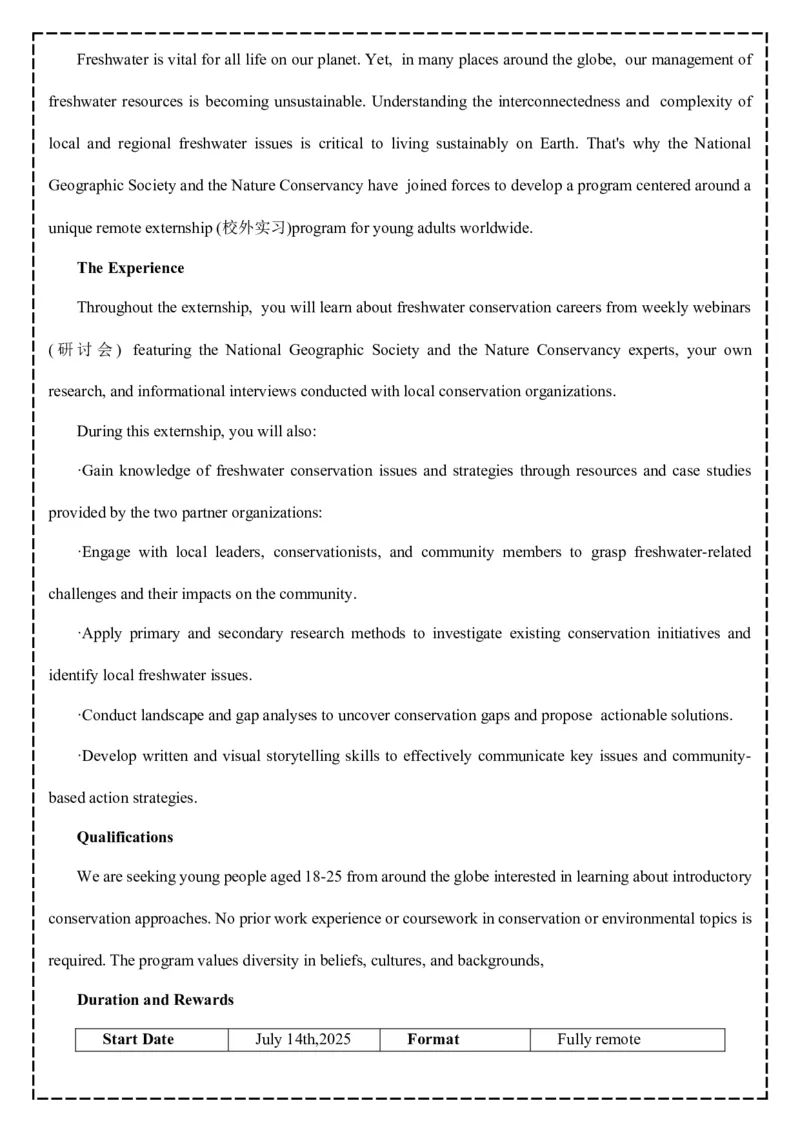
Freshwater is vital for all life on our planet. Yet, in many places around the globe, our management of
freshwater resources is becoming unsustainable. Understanding the interconnectedness and complexity of
local and regional freshwater issues is critical to living sustainably on Earth. That's why the National
Geographic Society and the Nature Conservancy have  joined forces to develop a program centered around a
unique remote externship (校外实习)program for young adults worldwide.
The Experience
Throughout the externship, you will learn about freshwater conservation careers from weekly webinars
( 研讨会) featuring the National Geographic Society and the Nature Conservancy experts, your own
research, and informational interviews conducted with local conservation organizations.
During this externship, you will also:
·Gain knowledge of freshwater conservation issues and strategies through resources and case studies
provided by the two partner organizations:
·Engage with local leaders, conservationists, and community members to grasp freshwater-related
challenges and their impacts on the community.
·Apply primary and secondary research methods to investigate existing conservation initiatives and
identify local freshwater issues.
·Conduct landscape and gap analyses to uncover conservation gaps and propose actionable solutions.
·Develop written and visual storytelling skills to effectively communicate key issues and community-
based action strategies.
Qualifications
We are seeking young people aged 18-25 from around the globe interested in learning about introductory
conservation approaches. No prior work experience or coursework in conservation or environmental topics is
required. The program values diversity in beliefs, cultures, and backgrounds,
Duration and Rewards
Start Date
July 14th,2025
Format
Fully remote
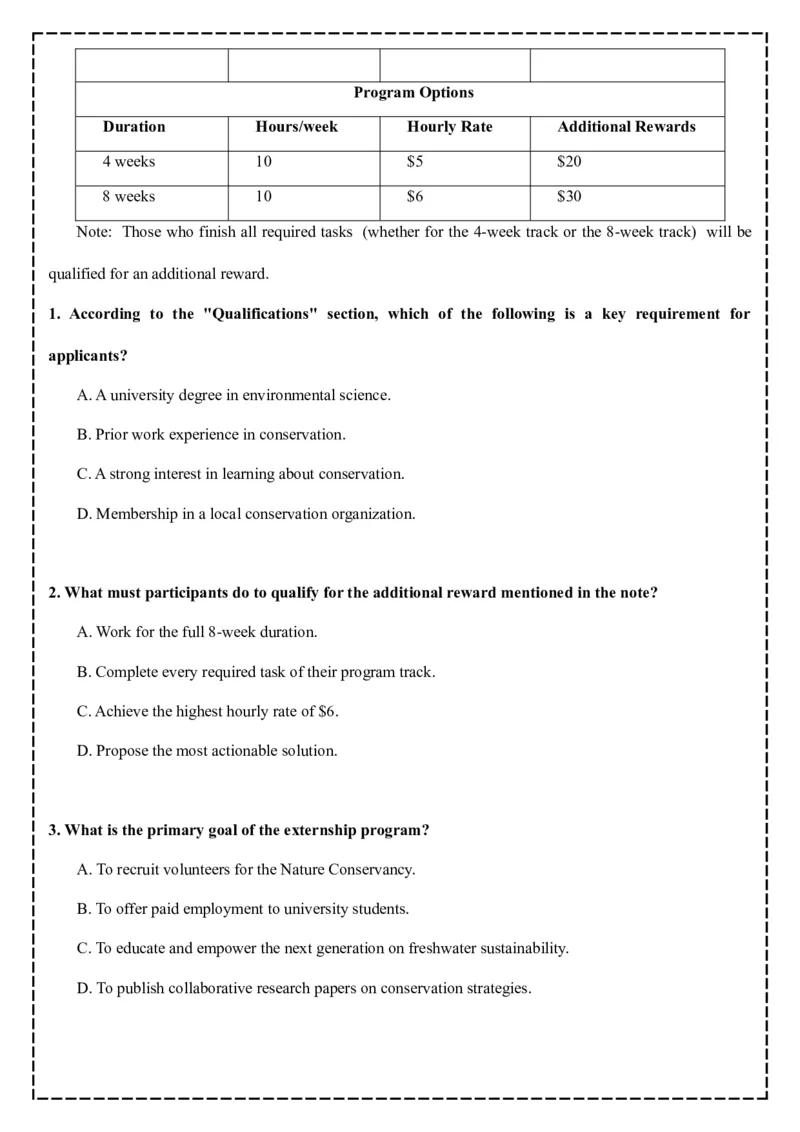
Program Options
Duration
Hours/week
Hourly Rate
Additional Rewards
4 weeks
10
$5
$20
8 weeks
10
$6
$30
Note: Those who finish all required tasks (whether for the 4-week track or the 8-week track) will be
qualified for an additional reward.
1. According to the "Qualifications" section, which of the following is a key requirement for
applicants?
A. A university degree in environmental science.
B. Prior work experience in conservation.
C. A strong interest in learning about conservation.
D. Membership in a local conservation organization.
2. What must participants do to qualify for the additional reward mentioned in the note?
A. Work for the full 8-week duration.
B. Complete every required task of their program track.
C. Achieve the highest hourly rate of $6.
D. Propose the most actionable solution.
3. What is the primary goal of the externship program?
A. To recruit volunteers for the Nature Conservancy.
B. To offer paid employment to university students.
C. To educate and empower the next generation on freshwater sustainability.
D. To publish collaborative research papers on conservation strategies.
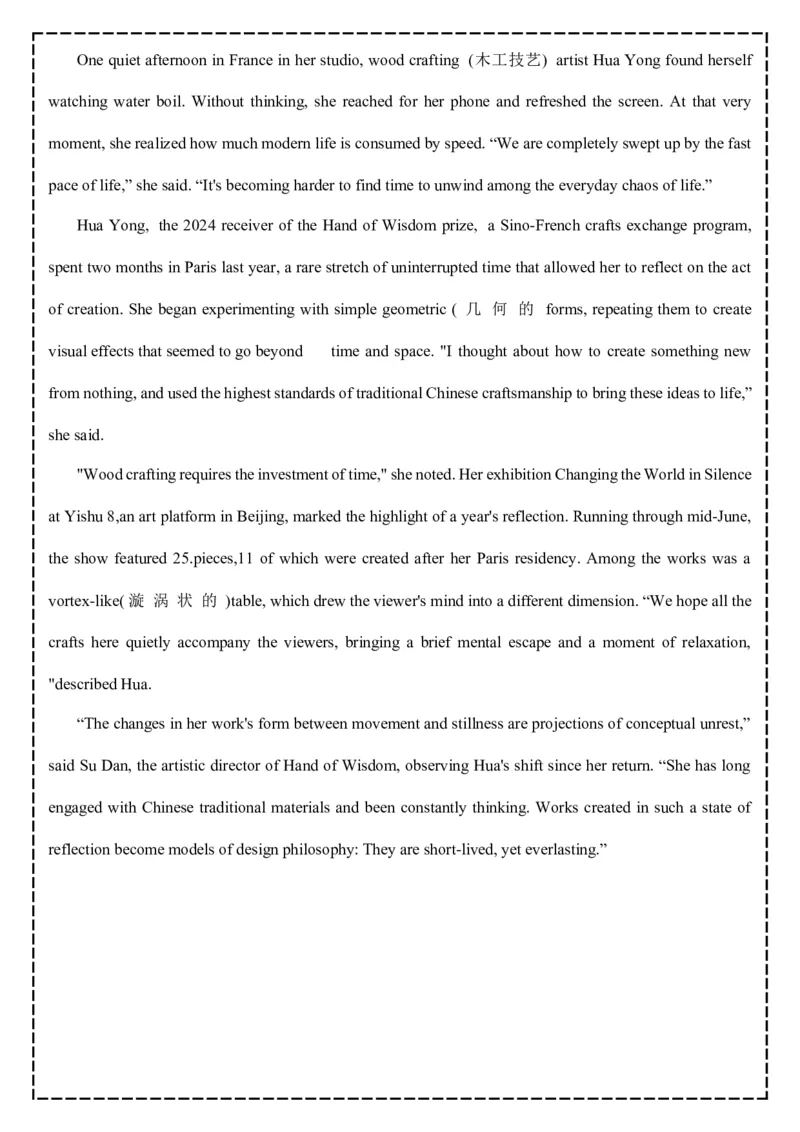
One quiet afternoon in France in her studio, wood crafting (木工技艺) artist Hua Yong found herself
watching water boil. Without thinking, she reached for her phone and refreshed the screen. At that very
moment, she realized how much modern life is consumed by speed. “We are completely swept up by the fast
pace of life,” she said. “It's becoming harder to find time to unwind among the everyday chaos of life.”
Hua Yong, the 2024 receiver of the Hand of Wisdom prize, a Sino-French crafts exchange program,
spent two months in Paris last year, a rare stretch of uninterrupted time that allowed her to reflect on the act
of creation. She began experimenting with simple geometric ( 几 何 的 forms, repeating them to create
visual effects that seemed to go beyond
time and space. "I thought about how to create something new
from nothing, and used the highest standards of traditional Chinese craftsmanship to bring these ideas to life,”
she said.
"Wood crafting requires the investment of time," she noted. Her exhibition Changing the World in Silence
at Yishu 8,an art platform in Beijing, marked the highlight of a year's reflection. Running through mid-June,
the show featured 25.pieces,11 of which were created after her Paris residency. Among the works was a
vortex-like( 漩 涡 状 的 )table, which drew the viewer's mind into a different dimension. “We hope all the
crafts here quietly accompany the viewers, bringing a brief mental escape and a moment of relaxation,
"described Hua.
“The changes in her work's form between movement and stillness are projections of conceptual unrest,”
said Su Dan, the artistic director of Hand of Wisdom, observing Hua's shift since her return. “She has long
engaged with Chinese traditional materials and been constantly thinking. Works created in such a state of
reflection become models of design philosophy: They are short-lived, yet everlasting.”
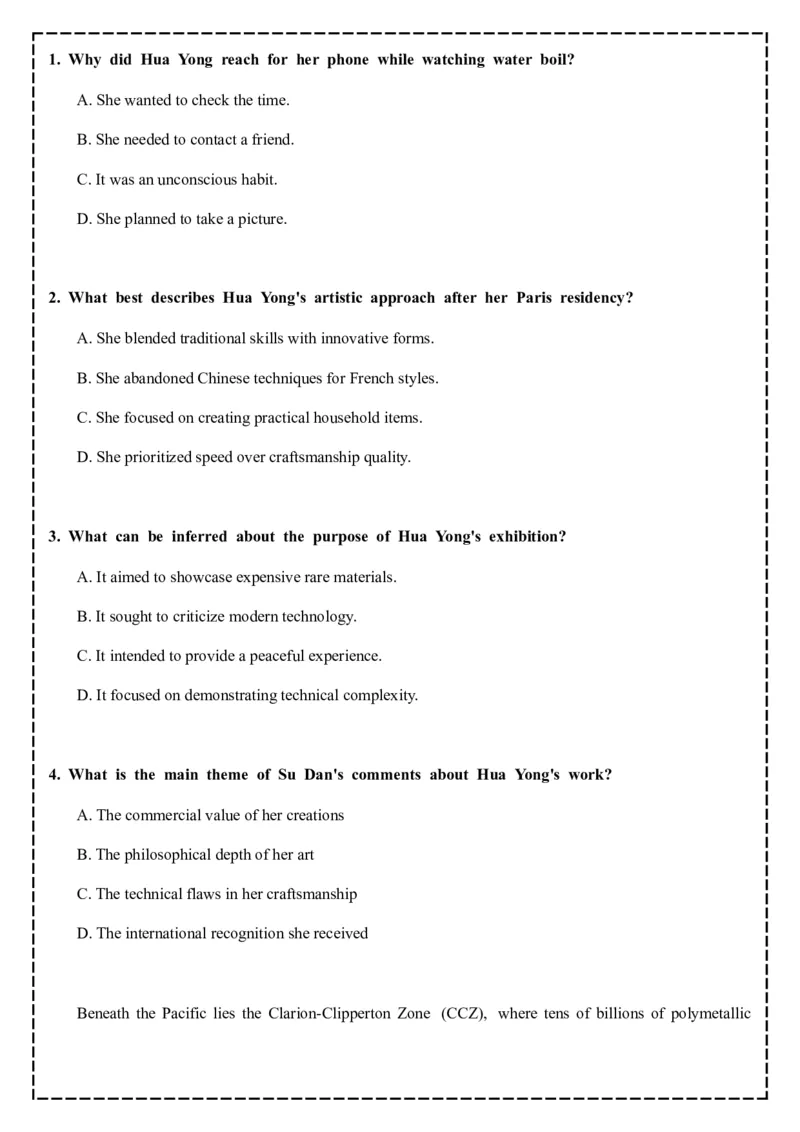
1. Why did Hua Yong reach for her phone while watching water boil?
A. She wanted to check the time.
B. She needed to contact a friend.
C. It was an unconscious habit.
D. She planned to take a picture.
2. What best describes Hua Yong's artistic approach after her Paris residency?
A. She blended traditional skills with innovative forms.
B. She abandoned Chinese techniques for French styles.
C. She focused on creating practical household items.
D. She prioritized speed over craftsmanship quality.
3. What can be inferred about the purpose of Hua Yong's exhibition?
A. It aimed to showcase expensive rare materials.
B. It sought to criticize modern technology.
C. It intended to provide a peaceful experience.
D. It focused on demonstrating technical complexity.
4. What is the main theme of Su Dan's comments about Hua Yong's work?
A. The commercial value of her creations
B. The philosophical depth of her art
C. The technical flaws in her craftsmanship
D. The international recognition she received
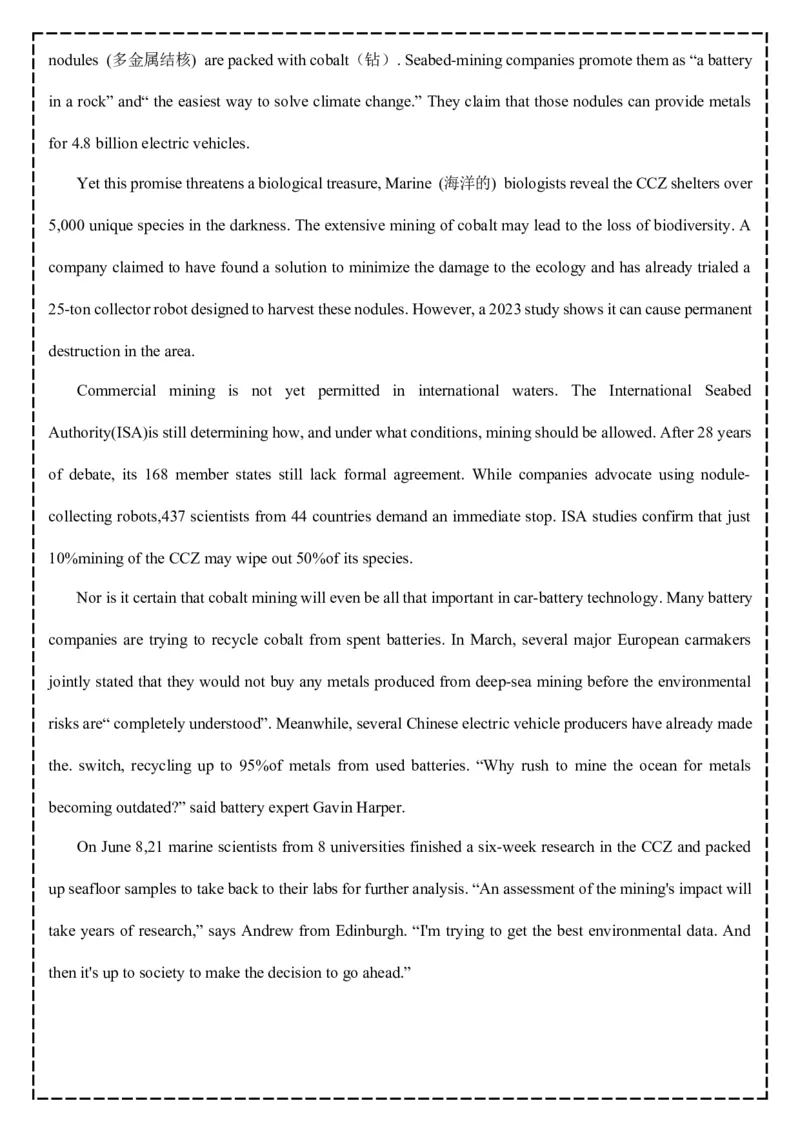
Beneath the Pacific lies the Clarion-Clipperton Zone (CCZ), where tens of billions of polymetallic
nodules (多金属结核) are packed with cobalt(钻). Seabed-mining companies promote them as “a battery
in a rock” and“ the easiest way to solve climate change.” They claim that those nodules can provide metals
for 4.8 billion electric vehicles.
Yet this promise threatens a biological treasure, Marine (海洋的) biologists reveal the CCZ shelters over
5,000 unique species in the darkness. The extensive mining of cobalt may lead to the loss of biodiversity. A
company claimed to have found a solution to minimize the damage to the ecology and has already trialed a
25-ton collector robot designed to harvest these nodules. However, a 2023 study shows it can cause permanent
destruction in the area.
Commercial mining is not yet permitted in international waters. The International Seabed
Authority(ISA)is still determining how, and under what conditions, mining should be allowed. After 28 years
of debate, its 168 member states still lack formal agreement. While companies advocate using nodule-
collecting robots,437 scientists from 44 countries demand an immediate stop. ISA studies confirm that just
10%mining of the CCZ may wipe out 50%of its species.
Nor is it certain that cobalt mining will even be all that important in car-battery technology. Many battery
companies are trying to recycle cobalt from spent batteries. In March, several major European carmakers
jointly stated that they would not buy any metals produced from deep-sea mining before the environmental
risks are“ completely understood”. Meanwhile, several Chinese electric vehicle producers have already made
the. switch, recycling up to 95%of metals from used batteries. “Why rush to mine the ocean for metals
becoming outdated?” said battery expert Gavin Harper.
On June 8,21 marine scientists from 8 universities finished a six-week research in the CCZ and packed
up seafloor samples to take back to their labs for further analysis. “An assessment of the mining's impact will
take years of research,” says Andrew from Edinburgh. “I'm trying to get the best environmental data. And
then it's up to society to make the decision to go ahead.”
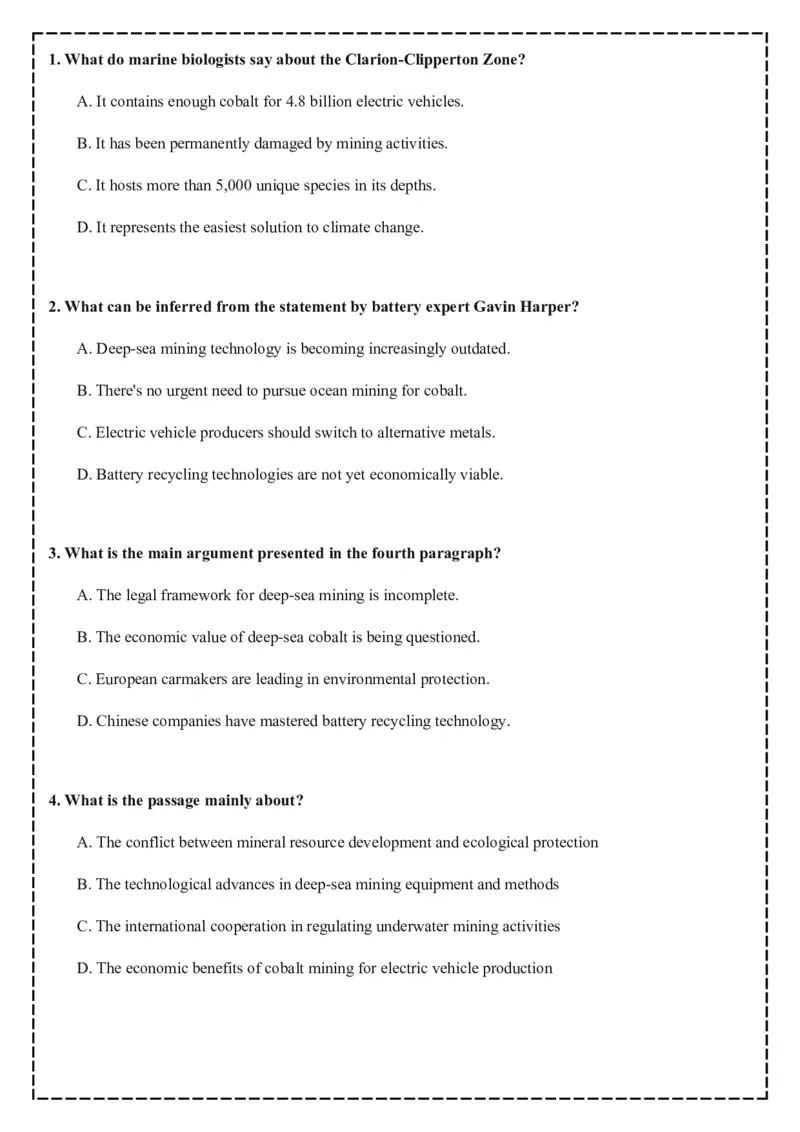
1. What do marine biologists say about the Clarion-Clipperton Zone?
A. It contains enough cobalt for 4.8 billion electric vehicles.
B. It has been permanently damaged by mining activities.
C. It hosts more than 5,000 unique species in its depths.
D. It represents the easiest solution to climate change.
2. What can be inferred from the statement by battery expert Gavin Harper?
A. Deep-sea mining technology is becoming increasingly outdated.
B. There's no urgent need to pursue ocean mining for cobalt.
C. Electric vehicle producers should switch to alternative metals.
D. Battery recycling technologies are not yet economically viable.
3. What is the main argument presented in the fourth paragraph?
A. The legal framework for deep-sea mining is incomplete.
B. The economic value of deep-sea cobalt is being questioned.
C. European carmakers are leading in environmental protection.
D. Chinese companies have mastered battery recycling technology.
4. What is the passage mainly about?
A. The conflict between mineral resource development and ecological protection
B. The technological advances in deep-sea mining equipment and methods
C. The international cooperation in regulating underwater mining activities
D. The economic benefits of cobalt mining for electric vehicle production
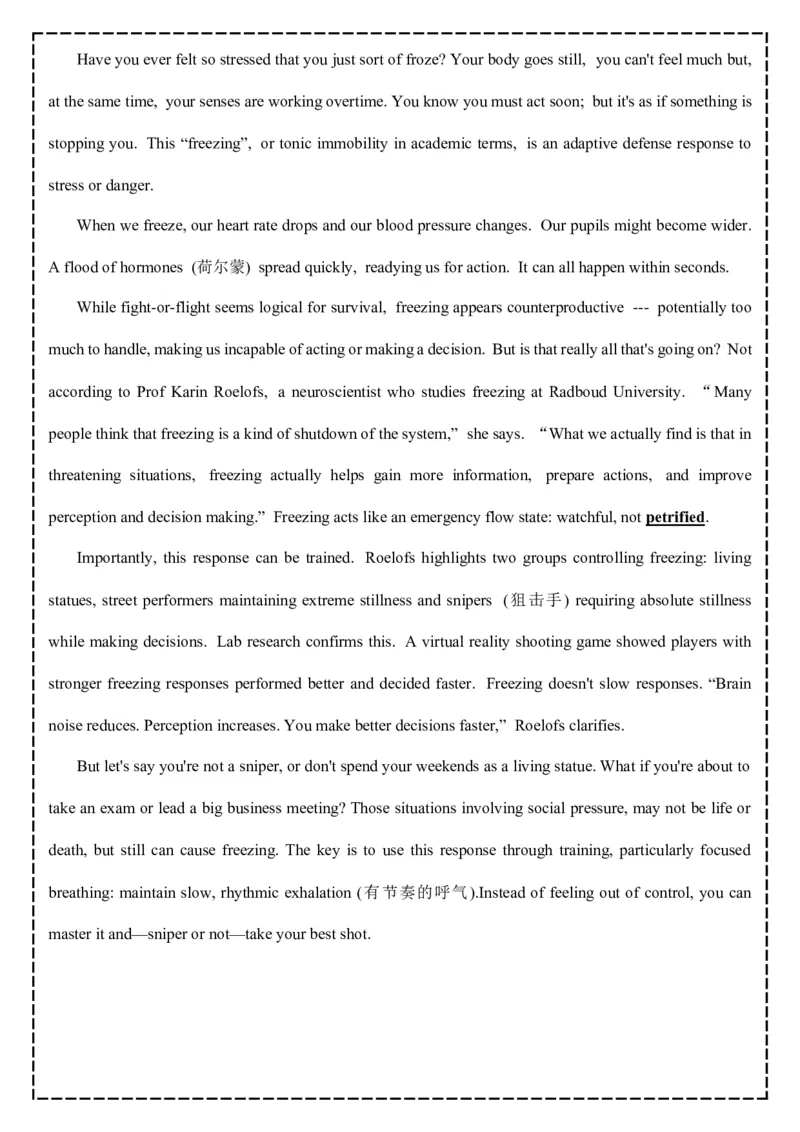
Have you ever felt so stressed that you just sort of froze? Your body goes still, you can't feel much but,
at the same time, your senses are working overtime. You know you must act soon; but it's as if something is
stopping you. This “freezing”, or tonic immobility in academic terms, is an adaptive defense response to
stress or danger.
When we freeze, our heart rate drops and our blood pressure changes. Our pupils might become wider.
A flood of hormones (荷尔蒙) spread quickly, readying us for action. It can all happen within seconds.
While fight-or-flight seems logical for survival, freezing appears counterproductive --- potentially too
much to handle, making us incapable of acting or making a decision. But is that really all that's going on? Not
according to Prof Karin Roelofs, a neuroscientist who studies freezing at Radboud University. “Many
people think that freezing is a kind of shutdown of the system,” she says. “What we actually find is that in
threatening situations, freezing actually helps gain more information, prepare actions, and improve
perception and decision making.” Freezing acts like an emergency flow state: watchful, not petrified.
Importantly, this response can be trained. Roelofs highlights two groups controlling freezing: living
statues, street performers maintaining extreme stillness and snipers (狙击手) requiring absolute stillness
while making decisions. Lab research confirms this. A virtual reality shooting game showed players with
stronger freezing responses performed better and decided faster. Freezing doesn't slow responses. “Brain
noise reduces. Perception increases. You make better decisions faster,” Roelofs clarifies.
But let's say you're not a sniper, or don't spend your weekends as a living statue. What if you're about to
take an exam or lead a big business meeting? Those situations involving social pressure, may not be life or
death, but still can cause freezing. The key is to use this response through training, particularly focused
breathing: maintain slow, rhythmic exhalation (有节奏的呼气).Instead of feeling out of control, you can
master it and—sniper or not—take your best shot.
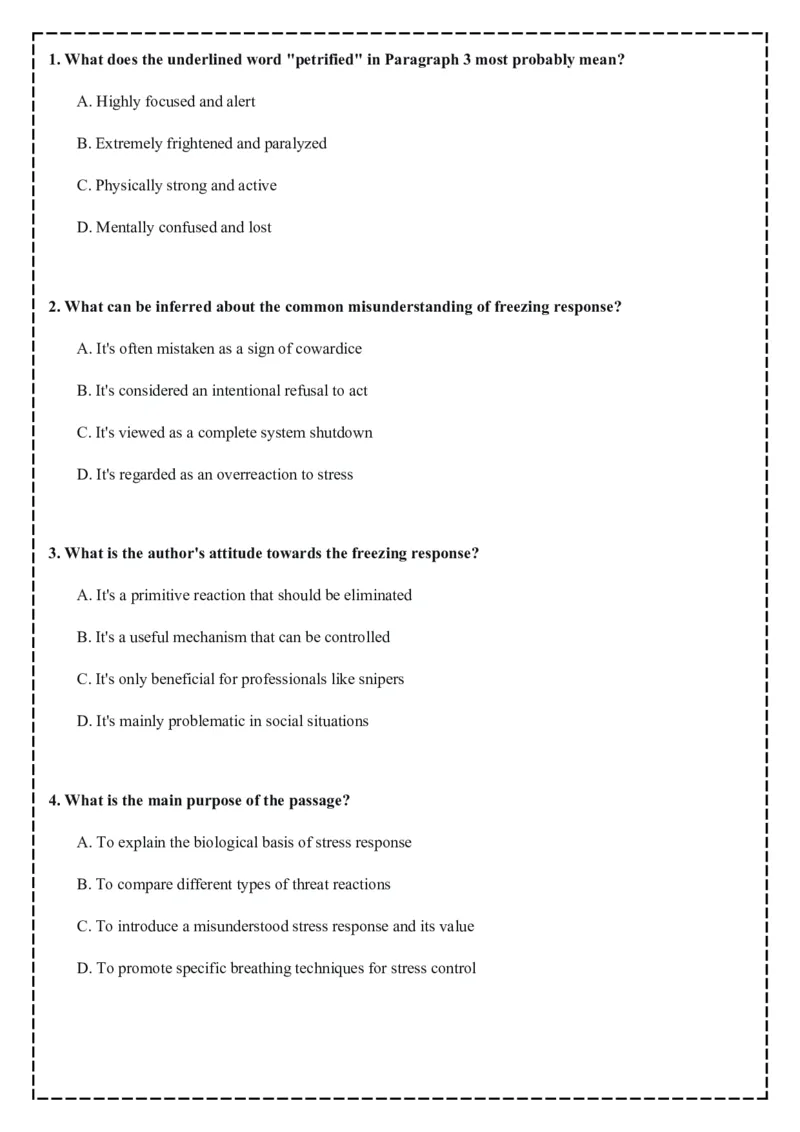
1. What does the underlined word "petrified" in Paragraph 3 most probably mean?
A. Highly focused and alert
B. Extremely frightened and paralyzed
C. Physically strong and active
D. Mentally confused and lost
2. What can be inferred about the common misunderstanding of freezing response?
A. It's often mistaken as a sign of cowardice
B. It's considered an intentional refusal to act
C. It's viewed as a complete system shutdown
D. It's regarded as an overreaction to stress
3. What is the author's attitude towards the freezing response?
A. It's a primitive reaction that should be eliminated
B. It's a useful mechanism that can be controlled
C. It's only beneficial for professionals like snipers
D. It's mainly problematic in social situations
4. What is the main purpose of the passage?
A. To explain the biological basis of stress response
B. To compare different types of threat reactions
C. To introduce a misunderstood stress response and its value
D. To promote specific breathing techniques for stress control
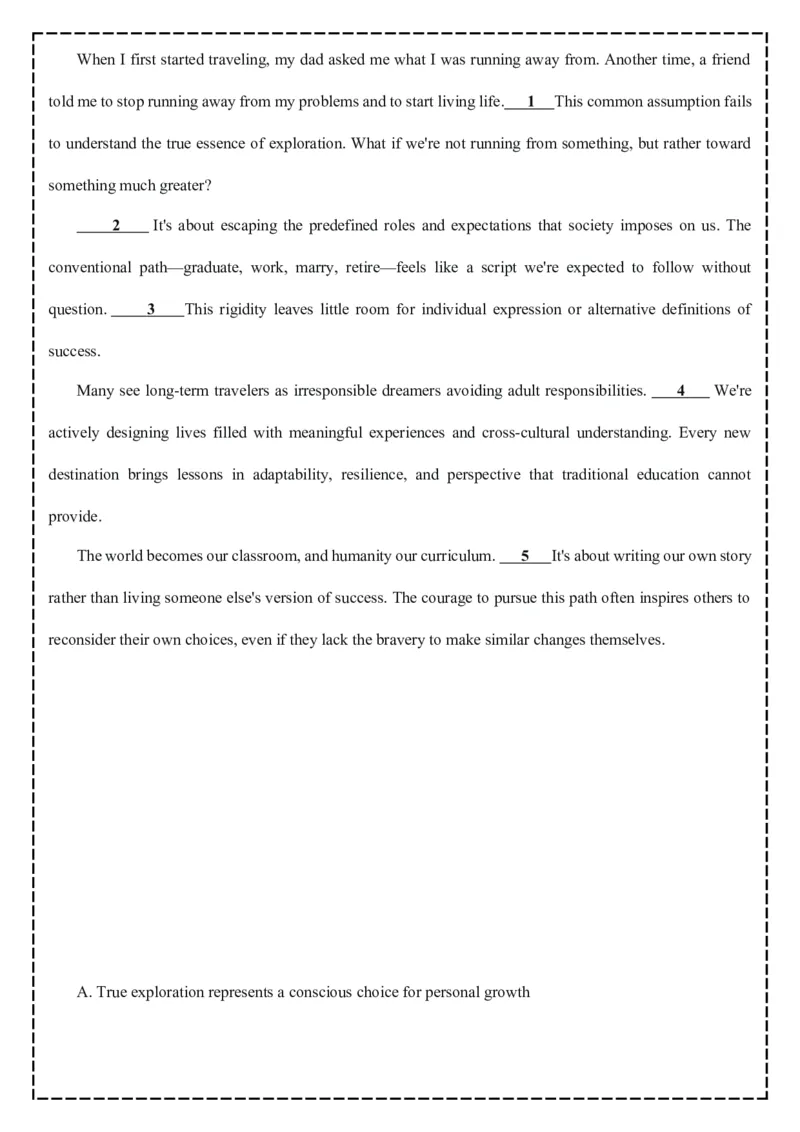
When I first started traveling, my dad asked me what I was running away from. Another time, a friend
told me to stop running away from my problems and to start living life.
  1
  This common assumption fails
to understand the true essence of exploration. What if we're not running from something, but rather toward
something much greater?


 2

  It's about escaping the predefined roles and expectations that society imposes on us. The
conventional path—graduate, work, marry, retire—feels like a script we're expected to follow without
question.

 3

 This rigidity leaves little room for individual expression or alternative definitions of
success.
Many see long-term travelers as irresponsible dreamers avoiding adult responsibilities.
  4
   We're
actively designing lives filled with meaningful experiences and cross-cultural understanding. Every new
destination brings lessons in adaptability, resilience, and perspective that traditional education cannot
provide.
The world becomes our classroom, and humanity our curriculum.
  5
  It's about writing our own story
rather than living someone else's version of success. The courage to pursue this path often inspires others to
reconsider their own choices, even if they lack the bravery to make similar changes themselves.
A. True exploration represents a conscious choice for personal growth
B. This narrow worldview limits our understanding of human potential
C. Such comments reflect society's limited perspective on life choices
D. The real value lies in developing empathy and global consciousness
E. Modern society often equates stability with conformity and compliance
F. However, this journey requires careful planning and financial responsibility
G. Genuine travelers seek not escape but engagement with the world's diversity

Marcus was the student who always sat in the back, never participated in class discussions, and
disappeared immediately after lessons. Naturally, I thought he was      1


  and unfriendly because I prided
myself on being able to       2

   people accurately.
Everything changed when our teacher       3

  us together for a team assignment. When our       4

  were
called as partners, he glanced my way and gave a slight       5


  . No words, just this simple gesture. I       6


my eyes, expecting the worst collaboration experience. To my       7


  , Marcus arrived at our first meeting
fully prepared with research materials, thoughtful questions, and practical      8

   for task distribution. "Are
you always this       9

  ?" I asked. He smiled weakly and said, "Only when something matters." That's when
I understood that silence wasn't his weakness but his way of being. When he spoke, his words       10


  .
During our two-week collaboration, I discovered the real Marcus. He didn't dislike people; he simply
struggled to       11


 . He wasn't arrogant; he was remarkably humble. During our final presentation, he
spoke       12


  and even cracked a joke that made everyone laugh. When our teacher commended our work, I
told Marcus, "I'm really glad we worked together." He looked down, then met my eyes and said, "Likewise."
That day I learned how easily we        13


  others when we don't        14


  to see beyond surface
impressions. Now I always remind myself to       15


   less and observe more, allowing people to reveal their
true selves in their own time.
1. A. clumsy
B. proud
 C. anxious
D. cold
2. A. sense
B. impress
C. comfort
D. entertain
3. A. paired
B. brought
C. forced
D. invited
4. A. numbers
B. names
C. roles
D. grades
5. A. wave
B. nod
C. bow
D. wink
6. A. closed
B. rubbed
C. rolled
D. widened
7. A. disappointment
B. amusement
C. astonishment
D. relief
8. A. solutions
B. suggestions
C. theories
D. excuses
9. A. competitive
B. critical
C. serious
D. organized
10. A. mattered
B. echoed
C. inspired
D. confused
11. A. speak up
B. reach out
C. fit in
D. show off
12. A. confidently
B. quietly
C. formally
D. urgently
13. A. hurt
B. blame
C. ignore
D. judge
14. A. attempt
B. bother
C. promise
D. learn
15. A. complain
B. talk
C. worry
D. assume
答案与解析
阅读A 篇
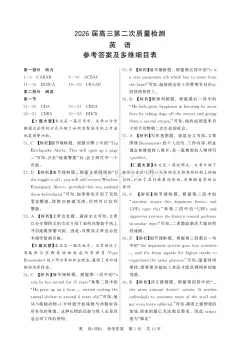
【答案】1.C   2. B     3. C
1.解析: 本题为细节理解题。解题关键在于定位“Qualifications”部分。文中明确说明:“No
prior work experience or coursework in conservation or environmental topics is required.”(不需要
有保护或环境相关主题的工作经验或课程学习)。同时,项目寻找的是“interested in learning about
introductory conservation approaches”(对学习入门级保护方法感兴趣的年轻人)。因此,兴趣
(interest) 是核心要求,而A、B、D 选项提到的学历、经验和会员身份都是项目不要求(not
required) 的。故C 选项正确。
2. 解析: 本题为细节理解题。解题关键在于理解表格下方的注释(Note)。注释原文为:
“Those who finish all required tasks (whether for the 4-week track or the 8-week track) will be
qualified for an additional reward.”(完成所有必需任务(无论是4 周还是8 周项目)的人将有资格
获得额外奖励)。因此,获得额外奖励的唯一条件是完成所有规定任务(finish all required
tasks),与项目时长(A 选项)、时薪高低(C 选项)或方案评比(D 选项)无关。故B 选项正确。
3. 解析: 本题为主旨大意题。需要综合全文信息判断项目的主要目的。文章开篇指出理解淡水问
题的复杂性对可持续生活“至关重要(critical)”,并由此引出该项目。后续“The Experience”部
分详细说明的活动——如学习知识、与研究、发现问题、提出解决方案、培养沟通技能——都围绕
教育(educate) 年轻人并赋予他们能力(empower) 去理解和应对淡水挑战这一核心。A 选项“招
募志愿者”和B 选项“提供有偿工作”是项目运行的方式和激励手段,而非其根本目的。D 选项
“发表研究论文”在文中未被提及,项目更侧重于实践应用和社区参与,而非学术输出。C 选项最
准确地概括了项目的深层目标和宗旨。
阅读B 篇
【答案】1. C    2. A     3. C    4.B
 1. 解析: 本题为细节理解题。定位第一段第二句:"Without thinking, she reached for her
phone and refreshed the screen." 关键词"without thinking"(未加思索)表明这是一个无意识的、习
惯性的动作。后文她对此行为的反思"how much modern life is consumed by speed"进一步说明这是
被快节奏生活裹挟的下意识行为,而非有特定目的。因此C 选项"这是一种无意识的习惯"正确。
2. 解析: 本题为人物特点题。第二段描述了她巴黎驻留后的创作变化:"used the highest
standards of traditional Chinese craftsmanship to bring these ideas to life"(用最高标准的中国传统
工艺实现这些想法)与"experimenting with simple geometric forms"(尝试简单的几何形态)相结合。
这体现了她将传统工艺(traditional skills)与创新形式(innovative forms)相融合的特点。B 选项与
文意相反;C、D 选项在文中均未体现。
3.解析: 本题为推理判断题。根据第三段华勇自己对展览的描述:"bringing a brief mental
escape and a moment of relaxation"(带来短暂的精神逃离和片刻放松),以及作品"draw the
viewer's mind into a different dimension"(将观众的思绪带入一个不同的维度),可以推断展览旨在
提供一个宁静、放松的体验。A、B、D 选项的内容均未在文中得到支持。
4. 解析: 本题为主旨大意题。苏丹的评价集中在作品的概念层面:"projections of conceptual
unrest"(概念性不安的投射),并指出这些作品成为"models of design philosophy: They are short-
lived, yet everlasting"(设计哲学的典范:它们是短暂的, yet 永恒的)。这些评论聚焦于作品的艺
术哲学和思想深度,而非技术、商业或声誉方面。因此B 选项"她艺术的哲学深度"最符合苏丹评论
的主旨。
阅读C 篇
【答案】1. C 2. B 3. B 4. A
 1. 解析: 本题为细节理解题。定位文章第二段开头:"Marine biologists reveal the CCZ shelters
over 5,000 unique species in the darkness." 海洋生物学家明确揭示CCZ 庇护着5000 多种独特物种。
A 选项是采矿公司的宣传,不是生物学家的观点;B 选项中的"永久破坏"是2013 年研究显示的潜在
风险,并非既定事实;D 选项是采矿公司的宣传语。
2. 解析: 本题为推理判断题。根据第四段最后专家的话:"Why rush to mine the ocean for
metals becoming outdated?"(为什么要急于开采海洋获取那些正在过时的金属?)结合前文提到电池
公司正在回收钴、车企拒绝购买深海金属等事实,可以推断出专家认为没有必要急于进行海洋采矿。
A 选项中的"采矿技术过时"文中未提及;C 选项"转向其他金属"过度推断;D 选项与文中95%回收率
的事实矛盾。
3. 解析: 本题为段落大意题。第四段通过多个角度质疑深海钴矿的经济价值:电池技术中钴的重
要性不确定、电池回收技术的发展、车企拒绝购买深海金属、专家质疑金属过时等,都是在质疑深
海钴矿开采的经济合理性。A 选项是第三段的内容;C、D 选项只是段落中的具体例子,不能概括段
落主旨。
4. 解析: 本题为主旨大意题。全文围绕深海采矿的争议展开:一方面是多金属结核的经济价值
(解决气候变化、提供电动汽车材料),另一方面是对深海生态系统的破坏风险(5000 多种物种、
生物多样性丧失、永久破坏)。文章通过呈现正反两方面的观点和事实,展现了资源开发与生态保
护之间的冲突。B 选项"技术进步"只是文中提到的细节;C 选项"国际合作"不全面;D 选项只体现了
其中一个方面。
阅读D 篇
【答案】1. B 2. C 3. B 4. C
 1. 解析: 本题为词义猜测题。定位第三段最后一句:"Freezing acts like an emergency flow
state: watchful, not petrified." 此处"watchful"(警惕的)与"petrified"通过"not"形成对比关系。结合前
文教授的观点:冻结不是系统关闭,而是帮助"获得更多信息、准备行动、提升感知和决策",说明
这是一种积极警觉的状态。因此"petrified"应表示与之相反的"因恐惧而僵住"的状态。B 选项"极度恐
惧和瘫痪"最符合此意。
2. 解析: 本题为推理判断题。根据第三段教授的话:"Many people think that freezing is a kind
of shutdown of the system"(很多人认为冻结是系统的一种关闭)。这表明公众普遍误解冻结反应
是彻底的机能 shutdown,而研究证明这实际上是一个信息收集和准备的过程。A、B、D 选项的内容
在文中均未明确提及。
3. 解析: 本题为观点态度题。通过全文可以看出作者对冻结反应持积极态度:第二段解释其生理
机制,第三段引用专家观点说明其积极作用,第四段强调"可以被训练",最后一段提供具体的控制
方法。特别是最后一句"你可以掌握它"明确表达了作者认为这是一个可控制的有用机制的观点。A
选项与文意相反;C 选项过于绝对;D 选项只反映了部分内容。
4. 解析: 本题为主旨大意题。文章通过解释冻结反应的生理机制(第一、二段),纠正公众误解
(第三段),说明其可训练性和实用性(第四段),直到最后给出具体应用建议(第五段),全面
介绍了这种被误解的压力反应及其价值。A 选项只是部分内容;B 选项中的比较不是文章重点;D
选项中的呼吸技巧只是最后提到的具体方法之一。
阅读七选五
【答案】1. C 2. A 3. E 4. G 5. D
 1. 解析: 此题位于首段中间。空前提到父亲和朋友对旅行动机的质疑,空后提出反问"如果我们
不是逃避,而是追求更伟大的东西呢?"因此需要填入一个能承接他人质疑、引出下文新观点的过渡
句。C 选项"这样的评论反映了社会对人生选择的局限看法"完美衔接了具体事例与下文要展开的深
层讨论。
2. 解析: 此题位于第二段段首。空后具体说明"逃避社会强加的角色和期望",因此段首需要一个
总领句来定义旅行的本质。A 选项"真正的探索代表着对个人成长的主动选择"从更高维度概括了旅
行的意义,与后文的"逃避 predefined roles"形成呼应,且比原题的选项更具深度。
3. 解析: 此题位于第二段中间。前文提到传统路径像"不容质疑的剧本",后文说"这种僵化几乎
不给个人表达留空间"。此处需要解释为什么传统路径会变得如此僵化。E 选项"现代社会常常将稳
定与顺从和服从等同起来"深刻揭示了现象背后的社会观念根源,解释了前文并引出后文。
4. 解析: 此题位于第三段中间。前文是他人的误解(逃避责任),后文是作者的正面回应(积极
设计人生)。需要填入一个转折句来直接反驳前文观点。G 选项"真正的旅行者寻求的不是逃避,而
是与世界多样性的接触"用"not...but..."的强烈对比结构完美实现了观点转折,与后文形成顺畅衔接。
5. 解析: 此题位于末段段中。前文说"世界成为课堂,人性成为课程",后文讨论"书写自己的故
事"。需要填入一个具体解释"课程价值"的句子。D 选项"真正的价值在于培养共情能力和全球意
识"恰当地阐述了从这个世界课堂中学到的具体内容,承上启下。
完形填空
1. 答案: D
解析: 根据上下文,Marcus 坐在后排、不参与讨论、课后立即离开,这些行为容易让人认为
他"冷淡、不友好"。A 选项clumsy(笨拙的)与上下文描述不符。B 选项proud(骄傲的)、C 选项
anxious(焦虑的)、D 选项cold(冷淡的)最符合这种第一印象。
2. 答案: A
解析: 固定搭配"sense people"表示"理解/看透别人",与prided myself on being able to(自豪于
能够)形成合理搭配。B 选项impress(留下印象)、C 选项comfort(安慰)、D 选项entertain(娱
乐)均不符合"准确理解他人"的语义。
3. 答案: A
解析: pair together 表示"配对,分成一组",是教育场景中分组活动的常用表达。B 选项brought
(带来)、C 选项forced(强迫)、D 选项invited(邀请)都不如paired 准确描述分组情况。
4. 答案: B
解析: 老师宣布分组时通常呼叫学生的"names"(名字)。A 选项numbers(数字)、C 选项roles
(角色)、D 选项grades(成绩)都不符合教室分组的常见做法。
5. 答案: B
解析: nod(点头)是一个轻微、沉默的认可或打招呼的方式,符合Marcus 安静的性格特征。A
选项wave(挥手)、C 选项bow(鞠躬)、D 选项wink(眨眼)都过于明显或正式,不符合上下文。
6. 答案: C
解析: roll one's eyes 是固定短语,表示"翻白眼",形象地表达出叙述者当时的不屑和失望情绪。
A 选项closed(闭上)、B 选项rubbed(揉)、D 选项widened(睁大)都无法传达这种负面情绪。
7. 答案: C
解析: astonishment(惊讶)最符合上下文——叙述者原本期望很糟,但Marcus 的准备充分出乎
意料。A 选项disappointment(失望)与后文矛盾;B 选项amusement(好笑)和D 选项relief(宽
慰)程度不够强烈。
8. 答案: B
解析: suggestions(建议)与for task distribution(任务分配)搭配合理,表示他提出了分工建议
A 选项solutions(解决方案)过于正式;C 选项theories(理论)和D 选项excuses(借口)不符合积
极合作的语境。
9. 答案: D
解析: organized(有条理的)最能概括Marcus 准备充分、有规划的特点。B 选项critical(批判
的)、C 选项serious(严肃的)、A 选项competitive(好竞争的)都无法准确描述前文提到的准备
工作。
10. 答案: A
解析: mattered(重要,有分量)与原文"when he did, they mattered"一致,表示他说话简洁但很
有分量。B 选项echoed(回荡)、C 选项inspired(激励)、D 选项confused(困惑)都不如
mattered 准确。
11. 答案: B
解析: reach out 表示"主动接触、交往",符合"他不讨厌人,只是不擅交往"的语境。A 选项
speak up(大声说)、C 选项fit in(融入)、D 选项show off(炫耀)都不如reach out 贴切。
12. 答案: A
解析: confidently(自信地)与后文"甚至讲了个让所有人发笑的玩笑"相呼应,表明他演讲时的
自信状态。B 选项quietly(安静地)、C 选项formally(正式地)、D 选项urgently(急切地)都不
符合上下文。
13. 答案: D
解析: judge(评判)与全文主题"不要以貌取人"直接相关。B 选项blame(责备)、C 选项
ignore(忽视)、A 选项hurt(伤害)虽然也可能发生,但不如judge 切合主题。
14. 答案: B
解析: bother to do sth.表示"费心去做某事",与see beyond surface impressions(看到表面印象
之外)搭配,表示"不愿意费心去深入了解"。A 选项attempt(尝试)、C 选项promise(承诺)、D
选项learn(学习)都不如bother 准确。
15. 答案: D
解析: assume(假设)与observe more(更多观察)形成对比,表示"少做假设,多观察",符合
文章主旨。B 选项talk(说话)、C 选项worry(担心)、A 选项complain(抱怨)都不如assume 切
题。