1
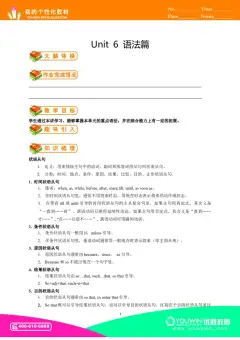
Module 12 语法篇
__________________________________________________________________________________
__________________________________________________________________________________
熟练掌握本模块语法知识。
  祈使句
· 定义
  用于表达命令、请求、劝告、警告、禁止等的句子叫做祈使句。祈使句因对象(即主语)是第
二人称,
  所以通常都省略,祈使句的动词都为一般现在时。
  祈使句的肯定形式
  1. 实意动词的祈使句要用动词原形开头。
  Come to the party!
  来晚会吧!
  Do it now!
  现在就做!
  2. be 动词的祈使句要用be 开头。
  Be careful next time!
  下次注意!
  Be quiet!
  安静!
  3. let 祈使句采用“let sb do sth”的形式。
  Let me help you.
  让我帮你吧。
  Let’s dance.
  我们跳舞吧。
  祈使句的否定形式
  1. 直接在句首加don’t 或do not。
  Do not come in unless asked.
  非请莫入。
  Don’t make noise.
  别出噪音。
  2. Let's 开头的祈使句的否定:直接加not do
  Let's not go home.
2
  我们别回家。
  但是Let 开头的祈使句的否定:直接在前面加Don't 或在sb 后面加not
  例如:Let him come in.变为Don't let him come in 或Let him not come in.
  3. no 开头的祈使句表示“禁止,不要”,语气较强硬。
  No smoking!
  禁止吸烟。
 情态动词can/must/could 表推测
  情态动词表推测的三种句式
  1.在肯定句中一般用must (一定),may(可能),might (也许,或许)。
  The photo must be Miss Lu’s, those must be their parents.
  照片肯定是陆小姐的,那肯定是她的父母。
  The policeman may know the way to that school.
  警察可能知道去那所学校的路。
  If you have any idea where it might be, please call me.
  如果你知道它可能在哪儿,请给我打电话。
  2. 否定句中用can’t / couldn’t(不可能), may not/might not(可能不)。
  It can’t/couldn't be the headmaster. He has gone to America.
  这不可能是校长,他去美国了。
  The doctor may not/might not be in the hospital now, It’s nearly six o’clock.
  医生可能现在不在医院了,快6 点了。
  注意:can/could 表推测时一般用于否定句和疑问句,但是could 可以用于肯定句、否定句和疑
问句中,表示
  事情可能发生。
  3. 疑问句中用can/could (能...?)。
  Could he have finished the task?
  他可能把任务完成了吗?
  Can he be at home now?
  他现在能在家吗?
  情态动词表推测的三种时态
  1. 对现在正在进行的动作推测时,用“情态动词 + be +doing”。
  He must / may / might / could be listening to the radio now.
  他一定/可能/也许正在听收音机。
  2. 对一般情况的推测,“情态动词 + 动词原形”。
  He can’t ( couldn't ) / may ( might ) not be at home at this time.
  这个时候他不可能/可能不在家。
  Mr. Bush is on time for everything,he can’t (couldn’t) be late for the meeting
  布什先生一向准时,这次会议他不可能迟到。
  3. 对过去情况的推测,用“情态动词 + have +过去分词”。
  It must / may / might / could have rained last night .The ground is wet.
  地湿了,昨晚肯定/可能/也许下雨了。
  The door was locked. He can ( could ) not / may ( might ) not have been at home.
  门锁着,他不可能/可能不在家。
3
(   )1.— Whose shoes are these?
— They     be Mike’s. They’re a little larger for him.

A. might
B. can’t

C. will
D. can
(   )2. Please     look outside. Look at the blackboard.
A. not
B. don’t
C. can’t
D. can
3.—Pass me that ball please.
—Here you are.______!
A.Forget
B.Listen
C.Catch
D.Throw
4. Cars, buses and bikes           stop when the traffic light is red.
A. can
B. must

C. may
D. need
5.          buy your ticket from a ticket machine. There are lots of people.
A. No

B. Not to

C. Don’t

D. Don’t to
解析:
1. 考查情态动词的用法。Might 可能,can’t  不可能,t 根据句意“他们对于Mike 来讲有点大,故
选B。
2. 本题考查祈使句的用法。根据句意“不要看窗外,看黑板”,故选B。
3. 本题考查祈使句用法,根据句意“那球传过来,给你,接着”,故选C。
4. 根据句意:当红灯亮时,汽车、公交车和自行车必须要停下。must 用在肯定句中,表示“一
定;必须”,故选B。
5. 本题考查 祈使句的否定形式在谓语动词前加don’t,故选C。
基础演练
1. The cup is__________ (break). Who broke it?
2. The astronauts need lots of__________ (train) before going into space.
3. I have great trouble in__________ (learn) math and I am so worried.
4. Hello, everyone. Today’s topic is about__________ (make) friends on the Internet.
5. Tom isn’t at home. He could__________ (be) on the playground.
6. I think this book is__________ (help) to your English study. You’d better buy it.
7. The doctor advised my uncle to stop__________ (work) immediately and have a rest.
8. It’s impossible__________ (learn) English well in a short time.
9. Please be careful of__________ (fall) stones during an earthquake.
10. __________ (not smoke) here, Rick. Smoking is not allowed in public places.
4
答案:1. broken 2. training 3. learning 4. making
5. be
6. helpful 7. working 8. to learn  9. falling 10. Don’t smoke
巩固提高
选择填空
1.—Do we have to finish our homework this afternoon?
—Yes, you ______.
A.must
B.can
C.may
D.need

2.It doesn't look like rain, so you ______ bring your umbrella with you.
A.shouldn't
B.mustn't
C.can't
D.needn't

3.—Let's go dancing tonight!
—Sorry, I ______.I have to go to a meeting.
A.mustn't
B.may not
C.needn't
D.can't
4.—Whose bike is this?
—It ________ Tom’s, but I am not sure.
A. must be
B. could be
C. can’t be
 D. mustn’t be
5. It is a good idea ________ Alaska for the summer holiday.
A. to go
B. go
C. to go to
D. going to
6. —May I take the food to the reading room?
—No, you can’t. You _________ eat it outside. It’s the rule.
A. must
B. would
C. may
D. might
7.The lady in this photo _______ be over fifty! She looks so young!
A. mustn’t
B. must
C. can’t
D. can
 答案: ADDBC  AC
一.单项选择.
1. On the way ______ the mountain village, we found the local houses different from ours. 6
A. to
B. by
C. at
D. on
2. Keep ______ of the fire; it’s too dangerous.
A. clean
B. cleaning
C. clear
D. clearly
3. ______ get off the bus before it stops.
A. Don’t

B. Doesn’t
C. Didn’t
D. Can’t
5
4. When an earthquake happens, please ______ from the windows and heavy furniture.
A. look up
B. stay away
C. stay up
D. look for
5. Ask Jim. He ______ know about Tony because they are good friends.
A. might
B. can’t
C. mustn’t
D. must
6.—Must we clean the classroom right now?
—No, you needn’t, but you ________ do it today.
A. must
B. mustn’t
C. may
D. needn’t
7.—Whose is the notebook?
—I’m not sure. It ________ be Mary’s.
A. must
B. mustn’t
C. needn’t
D. could
8.—Who’s the boy under the tree? Is he Jim?
—No, it ________ be him. Jim is much taller.
A. mustn’t
B. may not
C. can’t
D. needn’t
9.He warned me ________ in the river.
A. not to swim
B. not swim
C. to not swim
D. don’t swim
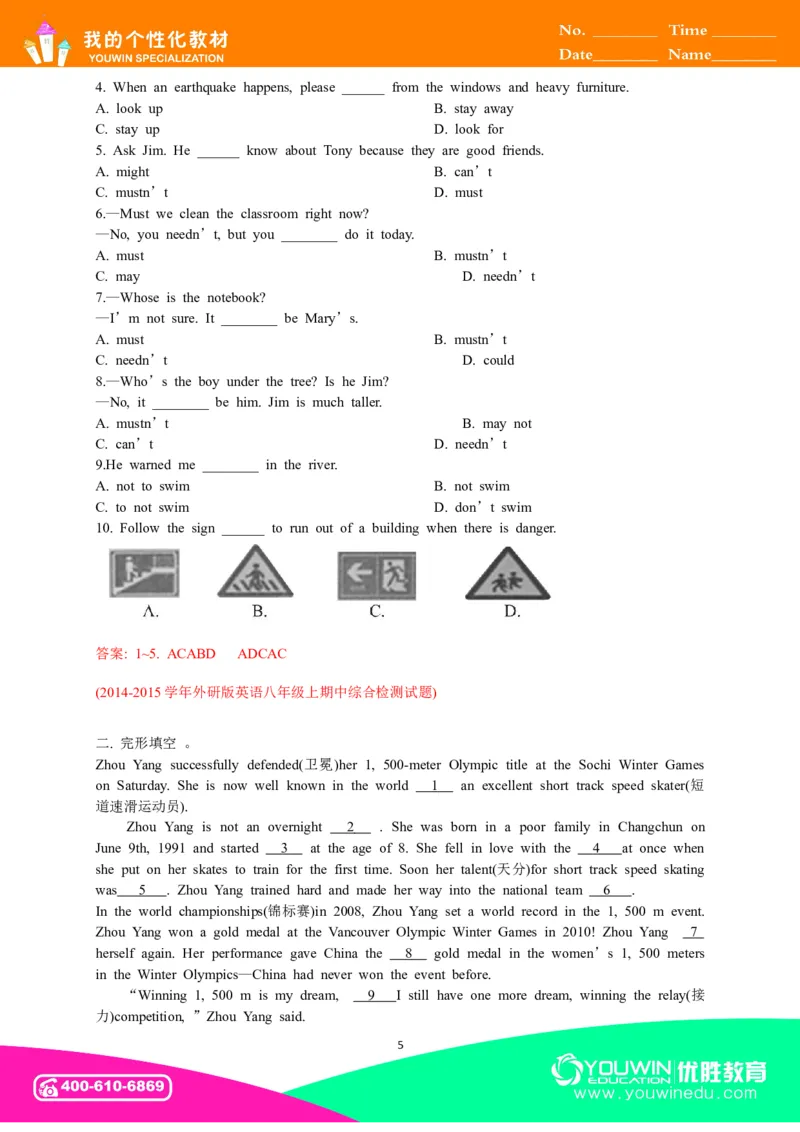
10. Follow the sign ______ to run out of a building when there is danger.
答案: 1~5. ACABD   ADCAC
(2014-2015 学年外研版英语八年级上期中综合检测试题)
二. 完形填空 。
Zhou Yang successfully defended(卫冕)her 1, 500-meter Olympic title at the Sochi Winter Games
on Saturday. She is now well known in the world
  1
   an excellent short track speed skater(短
道速滑运动员).
  Zhou Yang is not an overnight
  2
   . She was born in a poor family in Changchun on
June 9th, 1991 and started
  3
   at the age of 8. She fell in love with the
  4
  at once when
she put on her skates to train for the first time. Soon her talent(天分)for short track speed skating
was
  5
  . Zhou Yang trained hard and made her way into the national team
  6
  .
In the world championships(锦标赛)in 2008, Zhou Yang set a world record in the 1, 500 m event.
Zhou Yang won a gold medal at the Vancouver Olympic Winter Games in 2010! Zhou Yang   7
herself again. Her performance gave China the
  8
   gold medal in the women’s 1, 500 meters
in the Winter Olympics—China had never won the event before.
  “Winning 1, 500 m is my dream,
  9
  I still have one more dream, winning the relay(接
力)competition, ”Zhou Yang said.
6
We hope that her “one more dream” will
  10

  .
1. A. as
B. like
C. for
D. with
2. A. problem
B. fan
C. success
D. prize
3. A. skiing
B. swimming
C. running
D. skating
4. A. season
B. sport
C. movie
D. book
5. A. noticed
B. refused
C. received
D. forgotten
6. A. some day
B. as well
C. at first
D. at last
7. A. taught
B. proved
C. allowed
D. accepted
8. A. first
B. second
C. third
D. last
9. A. so
B. but
C. or
D. if
10. A. see off
B. grow up
C. come true
D. run away
答案:1—5 ACDBA   6—10 DBABC
_________________________________________________________________________________
_________________________________________________________________________________
补全对话。
从方框中选择最佳选项完成对话, 有两项多余。
A. How did the accident happen?
B. Where were you going at that moment?
C. The other person covered me with his coat.
D. How are you feeling today?
E. You’re welcome.
F. Sounds great!
G. Then I fell off my bike and hurt my leg.
A: Hi, Jane.

 1
B: Hi, Mary. I’m much better now. Thank you for coming to see me.
A:
  2
B: While I was riding along the street, suddenly a car hit me.
  3
A: Terrible! What happened then?
B: Thanks for two walkers. One of them called the First Aid Centre.
  4
  The ambulance(救护
车)came five minutes later.
A: How kind they are!
7
B: Yes. I don’t know what their names are.
A: I hope that you are getting better and better soon.
B: Thank you.
A:
  5
1. ______2. ______3. ______4. ______5. ______
 答案:DAGCE
二.阅读理解。
A
Doherty was a policeman. He liked boiled( 煮熟的)eggs. He often had one for breakfast. One
morning in December, he was on duty on the road in his police car. At ten o’clock, he went
into a small café by the roadside for breakfast. He ordered a boiled egg, a drink and a sandwich.
When the waiter brought them to him, he found that the egg was not cooked enough. He looked
around the café and saw a microwave oven(微波炉)on the table beside the wall. He decided to
cook his egg a little longer. He put the egg inside the microwave oven and turned it on. He let
the egg cook for one minute, then he took it out. He took the egg back to his table, picked up
his spoon and pushed it into the egg.
Suddenly there was a loud explosion(爆炸). For a moment, all the other people rushed to hide
under the table in the café as they thought someone had thrown a bomb(炸弹)into the building.
But when they saw Doherty’s face, they all laughed because he had the egg all over it. Doherty
had made a big mistake as eggs must never be cooked in a microwave oven.
1. Doherty’s favourite food for breakfast was______.
A. a sandwich
B. a hot dog
C. chips
D. a boiled egg
2. Why did he cook the egg with a microwave oven?
B. They didn’t cook the egg enough.
C. They didn’t cook the egg with a microwave oven.
D. He often cooked eggs with a microwave oven.
3. Where was the explosion?
A. On Doherty’s table.
B. In the microwave oven.
C. In the kitchen.
D. In Doherty’s car.
4. Doherty had the egg all over______.
A. his feet
B. his face
C. the café
D. the waiter
5. People felt ______ as soon as they heard the explosion.
A. excited
B. funny
C. frightened
D. Pleased
 答案:DBABC
                                  B

8
Fire can help people in many ways. But it can be very dangerous. Fire can heat water, warm
houses, give light and cook. But fire can burn things, too. It can burn trees, houses, animals or
people. Sometimes big fires can burn forests.
Nobody knows for sure how people began to use fire. But there are many interesting stories about
the first time a man or a woman started a fire. One story from Australia tells about a man very,
very long time ago. He went up to the sun by a rope(绳子)and brought fire down.
Today people know how to make a fire with matches(火柴). Children sometimes like to play with
them. But matches can be very dangerous. One match can burn a piece of paper, and then it
might burn a house. A small fire can become a big fire very fast. Fire kills many people every
year. So you must be careful with matches. You should also learn to put out a fire. Fire needs
oxygen(氧气). Without oxygen it will die. Cover fire with water, sand or sometimes with your
coat. This keeps the air away from fire and kills it. Be careful with fire, and it will help you. Be
careless with fire, and it will burn you.
1. How did people begin to use fire?
A. Not everybody knows how people began to use fire.
B. Nobody knows how to make a fire.
C. It is an Australian who started a fire first.
D. We are not sure how people began to use fire.
2. Children mustn’t play with matches because______.
A. matches burn paper
B. it isn’t interesting
C. they can be dangerous
D. they can burn a house
3. When you are going to put out a fire, you______.
A. may be careless
B. should keep air away from it
C. know it is not dangerous
D. should only use water
4. We must be careful with fire, or it______.
A. will die
B. will warm our houses
C. might burn us
D. won’t help us
5. Which of the following is the main idea of this passage?
A. Fire can help people in many ways.
B. Fire can be both helpful and dangerous.
C. Fire can burn things and people.
D. We must be careful with matches.
答案:DCBCB
C
A big earthquake happened in Japan a few months ago. It was 9.0 on the Richter scale(里氏).It
caused a tsunami(海啸) and a nuclear leak(核泄漏).Thousands of people died and millions of
Japanese lost their homes.
However, the disaster didn’t cause panic(恐慌) among Japanese people. When the earthquake
happened, people left dangerous places in an orderly way. After the shock, they waited in line for
food and water. There was no robbing or stampeding(惊逃).
The Japanese are ready for an earthquake at any time. Almost every family has a survival kit(救
9
生包),which has a flashlight, a radio, water and enough food for a few days. It can keep people
alive(活着) after an earthquake.
Many earthquakes happen in China, too. Are you ready for the next earthquake?
When an earthquake happens, protect yourself first. The life is the most important because where
there is a life there is hope. Don’ t go back to get your money or computers. When an
earthquake has ended, be careful because aftershocks(余震) may still happen. Make sure you wear
shoes after an earthquake. There may be broken glass on the ground.
We should always hope for the best but prepare for the worst.
阅读短文,判断正(T)误(F)。
(  )1.The earthquake in March,2011 in Japan caused a tsunami and a nuclear leak.
(  )2.The earthquake made the Japanese fear.
(  )3.Few Japanese people lost their homes and their lives.
(  )4.When the earthquake happens, you should go back to get your money.
(  )5.There are few earthquakes in China.
答案:TFFFF
课程顾问签字:                        教学主管签字: