专题17 阅读理解(清单+专项训练)
目录
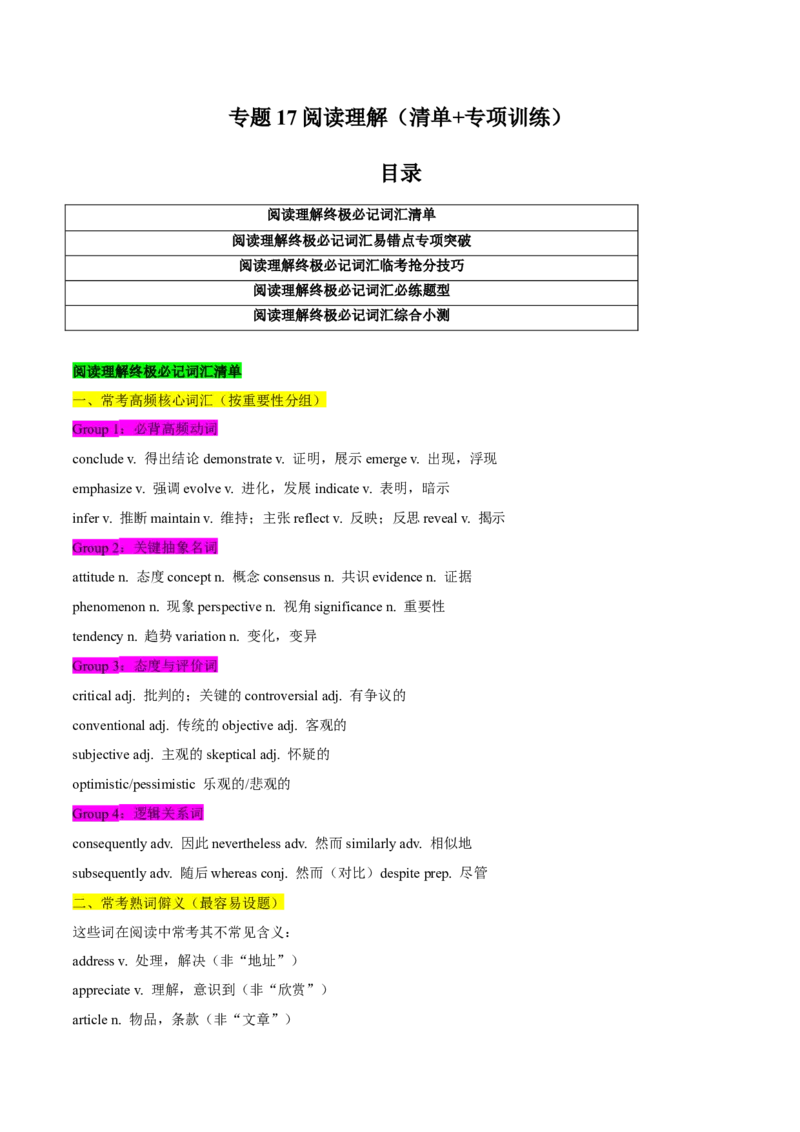
阅读理解终极必记词汇清单
阅读理解终极必记词汇易错点专项突破
阅读理解终极必记词汇临考抢分技巧
阅读理解终极必记词汇必练题型
阅读理解终极必记词汇综合小测
阅读理解终极必记词汇清单
一、常考高频核心词汇(按重要性分组)
Group 1:必背高频动词
conclude v. 得出结论demonstrate v. 证明,展示emerge v. 出现,浮现
emphasize v. 强调evolve v. 进化,发展indicate v. 表明,暗示
infer v. 推断maintain v. 维持;主张reflect v. 反映;反思reveal v. 揭示
Group 2:关键抽象名词
attitude n. 态度concept n. 概念consensus n. 共识evidence n. 证据
phenomenon n. 现象perspective n. 视角significance n. 重要性
tendency n. 趋势variation n. 变化,变异
Group 3:态度与评价词
critical adj. 批判的;关键的controversial adj. 有争议的
conventional adj. 传统的objective adj. 客观的
subjective adj. 主观的skeptical adj. 怀疑的
optimistic/pessimistic 乐观的/悲观的
Group 4:逻辑关系词
consequently adv. 因此nevertheless adv. 然而similarly adv. 相似地
subsequently adv. 随后whereas conj. 然而(对比)despite prep. 尽管
二、常考熟词僻义(最容易设题)
这些词在阅读中常考其不常见含义:
address v. 处理,解决(非“地址”)
appreciate v. 理解,意识到(非“欣赏”)
article n. 物品,条款(非“文章”)
conduct v. 进行,实施 n. 行为
engage v. 从事;吸引
fuel v. 刺激,加剧(非“燃料”)
stem v. 起源于(n. 茎)
yield v. 产生;屈服(n. 产量)
三、主题分类词汇
科技类
innovation n. 创新breakthrough n. 突破application n. 应用artificial intelligence 人工智能
sustainable adj. 可持续的
社会文化类
globalization n. 全球化diversity n. 多样性conventional adj. 传统的ethical adj. 伦理的
环境类
conservation n. 保护 renewable adj. 可再生的  emission n. 排放
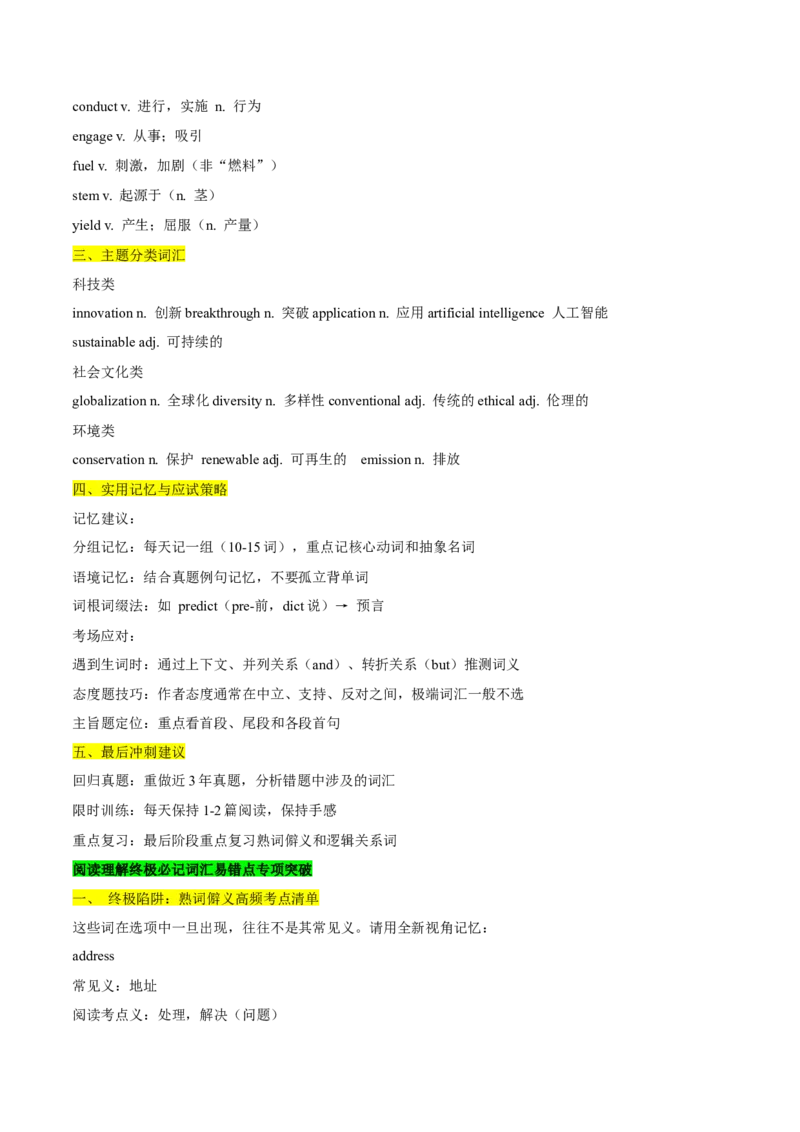
四、实用记忆与应试策略
记忆建议:
分组记忆:每天记一组(10-15 词),重点记核心动词和抽象名词
语境记忆:结合真题例句记忆,不要孤立背单词
词根词缀法:如 predict(pre-前,dict 说)→ 预言
考场应对:
遇到生词时:通过上下文、并列关系(and)、转折关系(but)推测词义
态度题技巧:作者态度通常在中立、支持、反对之间,极端词汇一般不选
主旨题定位:重点看首段、尾段和各段首句
五、最后冲刺建议
回归真题:重做近3 年真题,分析错题中涉及的词汇
限时训练:每天保持1-2 篇阅读,保持手感
重点复习:最后阶段重点复习熟词僻义和逻辑关系词
阅读理解终极必记词汇易错点专项突破
一、 终极陷阱:熟词僻义高频考点清单
这些词在选项中一旦出现,往往不是其常见义。请用全新视角记忆:
address
常见义:地址
阅读考点义:处理,解决(问题)
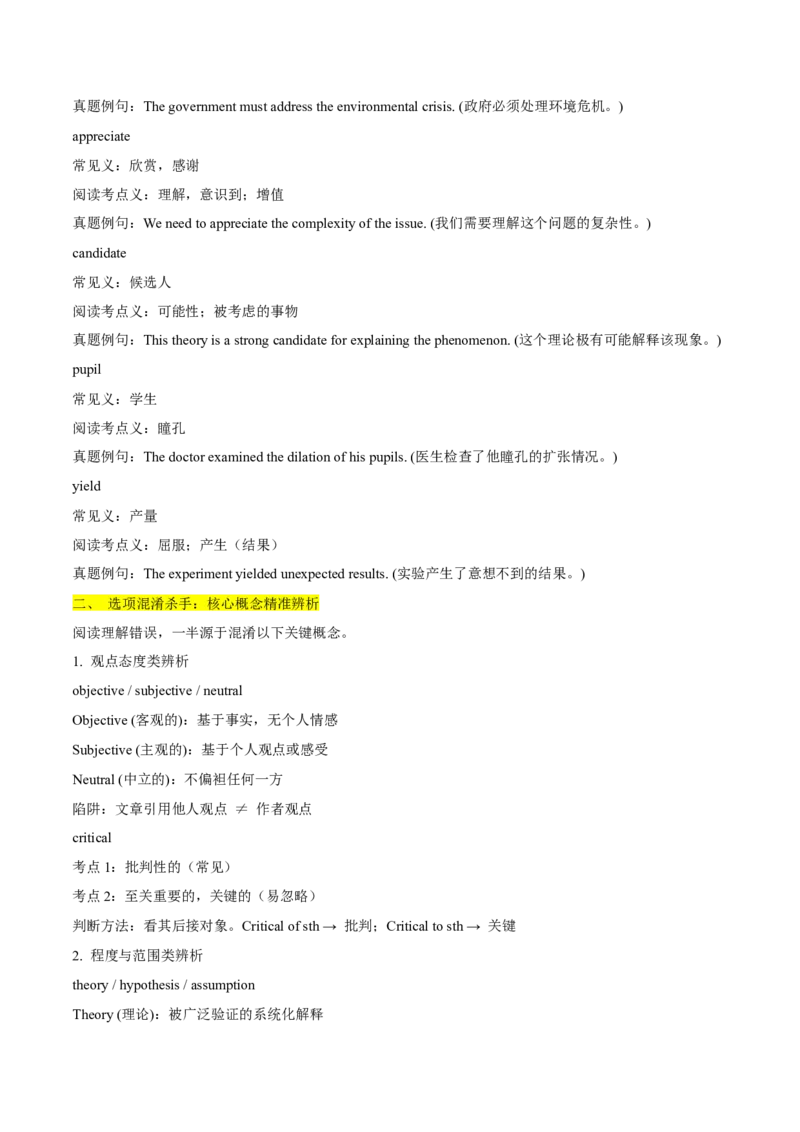
真题例句:The government must address the environmental crisis. (政府必须处理环境危机。)
appreciate
常见义:欣赏,感谢
阅读考点义:理解,意识到;增值
真题例句:We need to appreciate the complexity of the issue. (我们需要理解这个问题的复杂性。)
candidate
常见义:候选人
阅读考点义:可能性;被考虑的事物
真题例句:This theory is a strong candidate for explaining the phenomenon. (这个理论极有可能解释该现象。)
pupil
常见义:学生
阅读考点义:瞳孔
真题例句:The doctor examined the dilation of his pupils. (医生检查了他瞳孔的扩张情况。)
yield
常见义:产量
阅读考点义:屈服;产生(结果)
真题例句:The experiment yielded unexpected results. (实验产生了意想不到的结果。)
二、 选项混淆杀手:核心概念精准辨析
阅读理解错误,一半源于混淆以下关键概念。
1. 观点态度类辨析
objective / subjective / neutral
Objective (客观的):基于事实,无个人情感
Subjective (主观的):基于个人观点或感受
Neutral (中立的):不偏袒任何一方
陷阱:文章引用他人观点 ≠ 作者观点
critical
考点1:批判性的(常见)
考点2:至关重要的,关键的(易忽略)
判断方法:看其后接对象。Critical of sth → 批判;Critical to sth → 关键
2. 程度与范围类辨析
theory / hypothesis / assumption
Theory (理论):被广泛验证的系统化解释
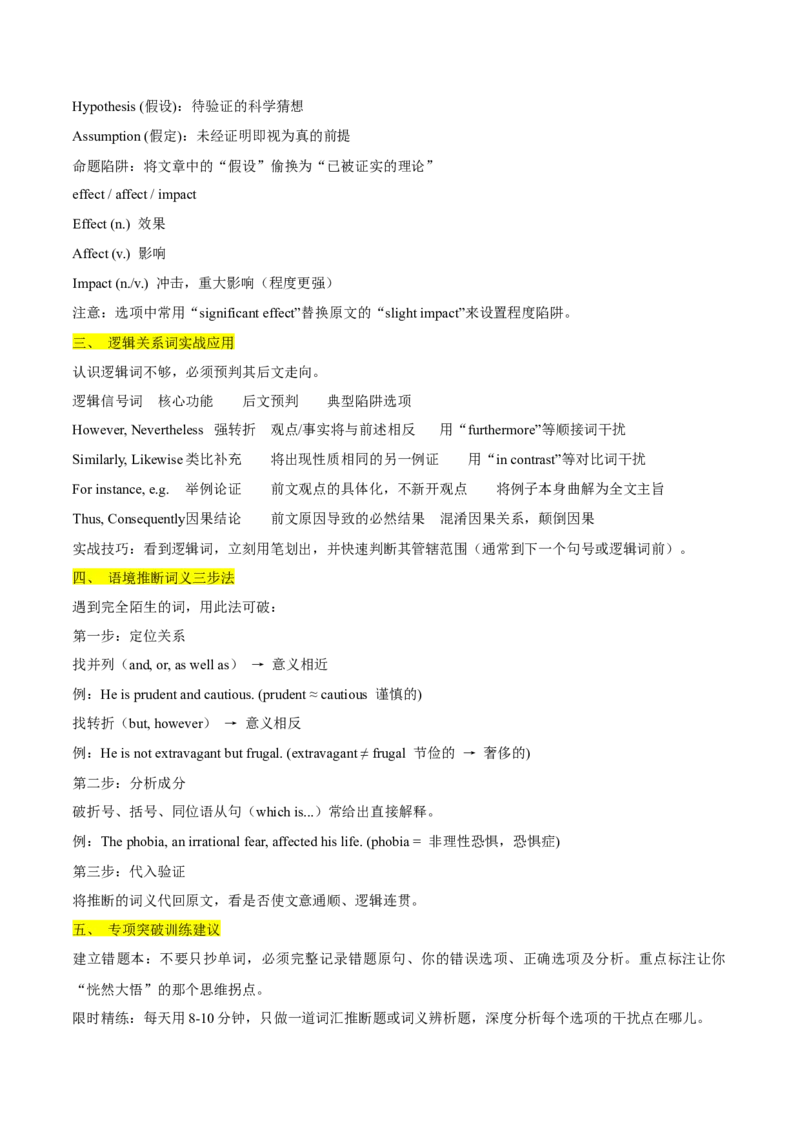
Hypothesis (假设):待验证的科学猜想
Assumption (假定):未经证明即视为真的前提
命题陷阱:将文章中的“假设”偷换为“已被证实的理论”
effect / affect / impact
Effect (n.) 效果
Affect (v.) 影响
Impact (n./v.) 冲击,重大影响(程度更强)
注意:选项中常用“significant effect”替换原文的“slight impact”来设置程度陷阱。
三、 逻辑关系词实战应用
认识逻辑词不够,必须预判其后文走向。
逻辑信号词
核心功能
后文预判
典型陷阱选项
However, Nevertheless 强转折
观点/事实将与前述相反
用“furthermore”等顺接词干扰
Similarly, Likewise 类比补充
将出现性质相同的另一例证
用“in contrast”等对比词干扰
For instance, e.g.
举例论证
前文观点的具体化,不新开观点
将例子本身曲解为全文主旨
Thus, Consequently因果结论
前文原因导致的必然结果
混淆因果关系,颠倒因果
实战技巧:看到逻辑词,立刻用笔划出,并快速判断其管辖范围(通常到下一个句号或逻辑词前)。
四、 语境推断词义三步法
遇到完全陌生的词,用此法可破:
第一步:定位关系
找并列(and, or, as well as) → 意义相近
例:He is prudent and cautious. (prudent ≈ cautious 谨慎的)
找转折(but, however) → 意义相反
例:He is not extravagant but frugal. (extravagant ≠ frugal 节俭的 → 奢侈的)
第二步:分析成分
破折号、括号、同位语从句(which is...)常给出直接解释。
例:The phobia, an irrational fear, affected his life. (phobia = 非理性恐惧,恐惧症)
第三步:代入验证
将推断的词义代回原文,看是否使文意通顺、逻辑连贯。
五、 专项突破训练建议
建立错题本:不要只抄单词,必须完整记录错题原句、你的错误选项、正确选项及分析。重点标注让你
“恍然大悟”的那个思维拐点。
限时精练:每天用8-10 分钟,只做一道词汇推断题或词义辨析题,深度分析每个选项的干扰点在哪儿。
真题回顾:拿出近五年真题,将所有阅读理解题的选项部分单独审视,圈出其中的抽象名词、态度动词和
逻辑连接词,你会发现命题的高频重复区。
最后叮嘱:词汇的终极战场在句子和篇章中。你现在要做的,不是盲目扩大词汇量,而是深化对高频考点
词的敏感度,并锤炼在复杂语境中瞬间判断词义的能力。
阅读理解终极必记词汇临考抢分技巧
一、 考前24 小时:“过电影”式唤醒记忆
不要背新单词! 只做一件事:快速唤醒最高频、最易错的记忆。
10 分钟过核心清单:
只看你之前整理的“熟词僻义”(如 address, appreciate, yield, critical)和逻辑关系词(however, thus,
similarly)。
默念其考点义,确保条件反射。
5 分钟默写态度词:
在草稿纸上快速写下三组词:正面 (positive, supportive, optimistic),负面 (negative, critical, skeptical),中
立/客观 (neutral, objective, impartial)。
这是态度题的“坐标尺”。
二、 考场实战:四步拆解法(20-25 分钟内完成一篇)
拿到一篇阅读,按此流程操作,步步为营。
第一步:黄金90 秒——预判与定位 (Before Reading)
读标题/首段首句:确定文章主题(科技、文化、环保等)。
速览题干(不看选项):划出所有题干中的 人名、地名、数字、大写词 以及 核心名词/动词。
预判:圈出题干里的“What can we infer...”、“The author's attitude...”、“The main purpose...”等,
立刻明白此题是推断题、态度题还是主旨题。
第二步:靶向阅读——抓主干,略枝叶 (While Reading)
紧盯逻辑路标:看到 But, However, Yet 立刻划出来,后面必出考点。看到 For example 知道前面是观点,
例子本身细节可速读。
长难句切割:遇到长句,用“/”快速划分主谓宾。核心是找 谁(主语)做了什么(谓语),修饰成分
(定语从句、插入语)第一次可暂时跳过。
生词处理原则:一个生词不要卡超过3 秒。是人名/地名/专有名词?直接用首字母代替(如“PTSD”记为
“P 症”)。是形容词/动词?根据上下文正负色彩判断(是“好”还是“坏”)即可。
第三步:选项对决——排除法为王 (While Choosing)
使用 “三叉戟”排除法,逐一验证选项:
无中生有 (Not Mentioned):选项关键词在原文完全未出现,或拼接了不同部分的信息。
偷换概念 (Distortion):
偷换主语/宾语:A 做的事,安到B 头上。
改变程度/范围:原文是“some”(一些),选项是“all”(全部);原文是“may”(可能),选项是
“must”(一定)。
颠倒关系:因果倒置、主次颠倒。
表面文章 (Literal Meaning):选项是原文单词的字面意思,但忽略了上下文中的引申义或比喻义(特别是
熟词僻义)。
第四步:终极复核——聚焦“题眼” (Final Check)
检查时,不要重读全文。直接定位到该题答案的出处句子,进行 “两点一线”核对:
点A(题干关键词) 在原文的哪里?
点B(选项核心意思) 是否与原文该处意思 同义替换?
连接A 和B 的逻辑线是否与原文一致?
三、 三大必考题型的“秒杀”技巧
1. 主旨题 (The main idea/purpose is to...)
技巧:重点看首段、尾段、各段首句,将其意思串联。绝对不选:细节信息(某一段的例子)、过度延伸
(文章未涉及的未来)、片面观点。
高频正确选项特征:常包含 “explain...”, “discuss...”, “analyze...” 等概括性动词。
2. 推断题 (It can be inferred that... / What can we learn?)
黄金法则:推断必须是“一步之遥”。原文明确说的,不叫推断;需要结合原文两处信息进行合理推演的,
才是答案。
技巧:答案往往是原文信息的 “同义转述” 或 “逻辑推论”,而不是原词照抄。
3. 猜词题 (The word “...” most probably means...)
三步法:
回原文定位该词所在句子。
看其前后相邻的句子,找解释(同位语、破折号、举例)、对比(but)或并列(and)关系。
将选项逐个代入原句,看哪个能使文意最通顺。
四、 应急情况处理方案
文章完全看不懂?:直接跳读每段首句和尾句,勾勒文章大意框架,然后直接看题,根据题干关键词回文
定位找答案。阅读是“解题”,不是“赏析”。
时间只剩10 分钟,还有一篇没做?:
(2 分钟) 先做主旨题和段落大意题(通常需通览全局)。
(8 分钟) 其余题目,使用“题干定位法”:带着一个题干关键词,去文中快速扫描定位,找到就细读该句
及前后句,做出选择。做完一题再下一题。
在两个选项间反复纠结?:
回原文,找出每个选项的支持句。
哪个选项与原文的同义替换更直接、更贴近?选它。
哪个选项的表述更客观、更少绝对化词汇(如 all, never, must)?可能是它。
阅读理解终极必记词汇必练题型
第一部分:阅读理解终极必记词汇(按功能分类)
阅读理解的词汇考查侧重于逻辑关系与态度情感。以下词汇是解题的 “题眼”,需达到 “见词知义,快
速反应” 的程度。
模块一:逻辑衔接词(解题核心)
这部分词汇直接决定句子间的关系,是做推理题和词义猜测题的关键。
逻辑关系
核心词汇(必记)
功能解析
转折 / 对比however, yet, nevertheless, whereas, instead, conversely
作者真正观点往往在转折之后。
因果
therefore, consequently, hence, due to, attribute to, account for
区分原因(因)和结果(果),避免
因果倒置。
并列 / 递进moreover, furthermore, in addition, additionally, likewise
前后语义一致,可通过已知推未知。
让步
although, though, despite, in spite of, even if 前半句是干扰,后半句是重点。
模块二:作者态度词(情感色彩)
高考阅读题常考查作者对某事物的态度,需准确判断褒贬。
态度类型
正向词汇
负向词汇
中立 / 客观
情感
positive, optimistic, approval, supportive, appreciative negative, pessimistic, critical, disapproval,
concerned
neutral, objective, impartial
模块三:高频学术动词(说明文 / 议论文)
说明文和议论文中描述研究、观点的动词。
表示 “认为 / 主张”: argue, claim, assert, maintain, contend
表示 “表明 / 证明”: indicate, demonstrate, reveal, confirm, illustrate
表示 “反对 / 质疑”: challenge, question, doubt, oppose, contradict
第二部分:必练题型与解题技巧(一题一解)
高考阅读理解主要考查四大题型。以下选取典型真题改编,严格遵循一题一解格式,解析中提炼通用解题
模板。
题型一:细节理解题(事实定位)
解题逻辑:题干关键词 → 原文定位 → 同义替换 → 排除干扰。
【真题改编】
(2025
全国甲卷改编
・
) What can we learn about the new library?
A. It is located in the city center.
B. It offers free Wi-Fi to visitors.
C. It was built last year with government support.
D. It has the largest collection of books in the country.
原文定位:The new community library, which opened its doors to the public last month, has quickly become a
popular spot. Funded by local businesses, it provides free high-speed internet access and a quiet environment for
study.
【答案】B
【解析】
定位:根据题干关键词 “new library” 定位到原文第一句和第二句。
对比:
A 选项 “city center” 原文未提及,属于无中生有。
B 选项 “free Wi-Fi” 是原文 “free high-speed internet access” 的同义替换,正确。
C 选项 “last year” 与原文 “last month” 时间不符,偷换概念;“government support” 与 “local
businesses” 不符。
D 选项 “largest” 原文无此表述,夸大事实。
技巧:细节题答案必须在原文有依据,警惕绝对化词汇(如 largest, only)。
题型二:推理判断题(深层含义)
解题逻辑:原文信息 → 合理推断 → 不选原文原句 → 不选过度推断。
【真题改编】
(2025
全国乙卷改编
・
) What can we infer from the author's description of the old café?
A. It will be closed soon.
B. It holds precious memories for the author.
C. It is the most popular café in the town.
D. It has changed a lot over the years.
原文定位:Every time I pass by the old café on the corner, I can't help but stop for a while. The wooden tables and
chairs, the smell of freshly baked bread, and the soft music take me back to my childhood. It hasn't changed a bit
since my parents first brought me here.
【答案】B
【解析】
分析:推理题考查言外之意。原文描述了咖啡馆的细节(木桌椅、面包香、音乐)让作者想起童年,且
“从未改变”。
推断:这些细节流露出作者对咖啡馆的怀念之情,因此 B 选项 “承载了珍贵回忆” 是合理推断。
排除:
A 选项 “即将关闭” 原文无依据。
C 选项 “最受欢迎” 原文未提及,属于过度推断。
D 选项 “变化很大” 与原文 “hasn't changed a bit” 直接矛盾。
技巧:正确选项通常是原文情感或细节的归纳总结,而非字面意思。
题型三:主旨大意题(篇章结构)
解题逻辑:串读首尾段 → 找高频词 → 概括全文 → 避免以偏概全。
【真题改编】
(2024
新课标
・
I 卷改编) What is the main idea of the text?
A. The history of paper-making in China.
B. The environmental benefits of using recycled paper.
C. A new technology that turns plastic waste into paper.
D. The differences between plastic and paper products.
原文结构:
Para 1: Scientists have developed a new method to convert plastic waste into a paper-like material.
Para 2: The process of the new technology.
Para 3: The advantages of this material over traditional paper.
Para 4: The future application of the technology.
【答案】C
【解析】
找主题:文章首段即提出核心话题 ——“新技术将塑料垃圾转化为类纸材料”。
验证:后续段落分别介绍了技术流程、优势和应用,均围绕这一主题展开。
排除:
A 选项 “中国造纸史” 偏离主题。
B 选项 “环保益处” 只是文章部分内容,以偏概全。
D 选项 “塑料与纸的区别” 非文章重点。
技巧:主旨题答案通常包含核心名词(如 new technology, plastic waste, paper)。
题型四:词义猜测题(语境分析)
解题逻辑:利用上下文逻辑(转折、因果、并列) → 代入验证。
【真题改编】
(2024
新课标
・
II 卷改编) The word "reluctant" in Paragraph 2 probably means ______.
A. willing B. unwilling C. excited D. afraid
原文定位:Tom was reluctant to try the new food at first. He thought it would taste strange. However, after taking
a small bite, he found it surprisingly delicious and asked for more.
【答案】B
【解析】
找逻辑:句中 “However” 表示转折。后半句说 Tom 尝了之后觉得美味并想要更多,说明前半句他不愿
意尝试。
猜词义:“reluctant” 意为 “不情愿的”,与 B 选项 “unwilling” 同义。
代入:将 B 选项代入原文,符合逻辑。
技巧:转折词(however, but, yet)前后的词义通常相反。
第三部分:考前冲刺策略(2026 专属)
回归真题:近 5 年全国卷真题是最好的复习资料,重点分析错题的逻辑错误。
限时训练:每篇阅读严格控制在7-8 分钟,模拟考场节奏。
词汇复习:重点复习上述逻辑词和态度词,而非孤立背诵生僻词。
关注热点:2026 年可能涉及的话题包括人工智能、环保科技、文化传承、心理健康。
阅读理解终极必记词汇综合小测
一、单项选择(每题2 分,共60 分)
从A、B、C、D 四个选项中选出最佳答案。
1. The government has decided to ______ new policies to promote economic growth.
A. implement B. investigate C. negotiate D. appreciate
答案:A
解析:implement 意为“实施,执行”,与policies 搭配,表示“实施新政策”。investigate 调查;negotiate
谈判;appreciate 欣赏/感激,均不符合语境。
2. The research ______ that regular exercise can significantly improve mental health.
A. concludes B. confesses C. confuses D. condemns
答案:A
解析:conclude 意为“得出结论”,主语research 常用该词。confess 坦白;confuse 使困惑;condemn 谴责,
均与research 的语境不符。
3. His rude behavior at the party was ______ by all the guests.
A. commended B. condemned C. comprehended D. compromised
答案:B
解析:condemn 意为“谴责”,符合“粗鲁行为被谴责”的语境。commend 表扬;comprehend 理解;
compromise 妥协。
4. The company will ______ a full investigation into the accident.
A. conduct B. reduce C. introduce D. produce
答案:A
解析:conduct an investigation 是固定搭配,意为“进行调查”。其他选项搭配不当。
5. The old bridge is not strong enough to ______ heavy trucks.
A. sustain B. contain C. obtain D. attain
答案:A
解析:sustain 在此意为“承受,支撑”,指桥梁承重。contain 包含;obtain 获得;attain 达到。
6. She ______ her success to hard work and perseverance.
A. attributes B. contributes C. distributes D. attracts
答案:A
解析:attribute to 意为“把……归因于”。contribute to 促成;distribute 分发;attract 吸引。
7. The manager tried to ______ the conflict between the two employees.
A. resolve B. revolve C. involve D. evolve
答案:A
解析:resolve 意为“解决(冲突、问题)”。revolve 旋转;involve 涉及;evolve 进化。
8. The new evidence could ______ the suspect’s alibi.
A. verify B. clarify C. testify D. identify
答案:A
解析:verify 意为“证实,核实”,指证据可以核实不在场证明。clarify 澄清;testify 作证;identify 识别。
9. Many species are on the ______ of extinction due to habitat loss.
A. verge B. edge C. margin D. border
答案:A
解析:on the verge of 是固定短语,意为“濒临”。edge 边缘(物理概念);margin 页边空白;border 边界。
10. The teacher ______ the importance of critical thinking to the students.
A. emphasized B. accomplished C. accompanied D. announced
答案:A
解析:emphasize 意为“强调”。accomplish 完成;accompany 陪伴;announce 宣布。
11. The novel ______ the life of a young artist in Paris.
A. depicts B. deprives C. declines D. deserts
答案:A
解析:depict 意为“描绘,描写”,常指文学艺术上的刻画。deprive 剥夺;decline 下降/拒绝;desert 遗弃。
12. He was ______ from the competition for breaking the rules.
A. eliminated B. illuminated C. estimated D. motivated
答案:A
解析:eliminate 意为“淘汰,排除”。illuminate 照亮;estimate 估计;motivate 激励。
13. The government plans to ______ taxes on small businesses.
A. reduce B. deduce C. induce D. produce
答案:A
解析:reduce taxes 是常见搭配,意为“减税”。deduce 推断;induce 引诱/导致;produce 生产。
14. Her argument was so ______ that no one could refute it.
A. convincing B. confusing C. conflicting D. compelling
答案:A
解析:convincing 意为“有说服力的”。confusing 令人困惑的;conflicting 冲突的;compelling 强制性的/引
人入胜的,但在此convincing 更贴切。
15. The two companies decided to ______ in order to expand their market share.
A. cooperate B. operate C. tolerate D. generate
答案:A
解析:cooperate 意为“合作”。operate 操作;tolerate 容忍;generate 产生。
16. The report ______ the potential risks of the new technology.
A. highlights B. underlines C. overlooks D. undermines
答案:A
解析:highlight 意为“突出,强调”。underline 在下面划线/强调;overlook 忽视;undermine 破坏。
17. The museum ______ a collection of ancient artifacts.
A. houses B. house C. houseful D. housing
答案:A
解析:house 作动词意为“收藏,容纳”,常用主动语态。houseful 是名词;housing 是名词或动名词。
18. The drug has several possible side ______.
A. effects B. affects C. defects D. infects
答案:A
解析:side effects 是固定短语,意为“副作用”。affects 是动词affect 的单三形式;defects 缺陷;infects 传
染。
19. The committee will ______ the applications and select the best candidates.
A. review B. preview C. interview D. viewpoint
答案:A
解析:review 意为“审查,复审”。preview 预习/预演;interview 面试;viewpoint 观点。
20. His theory was initially ______ by the scientific community.
A. rejected B. projected C. subjected D. ejected
答案:A
解析:reject 意为“拒绝,不接受”。project 投射/规划;subject 使遭受;eject 弹出。
21. The company needs to ______ its production to meet increasing demand.
A. expand B. expend C. extend D. intend
答案:A
解析:expand 意为“扩大(规模)”。expend 花费;extend 延长/延伸;intend 打算。
22. The judge warned the witness not to ______ evidence.
A. conceal B. reveal C. appeal D. heal
答案:A
解析:conceal 意为“隐瞒(证据)”。reveal 揭露;appeal 呼吁/上诉;heal 治愈。
23. The team managed to ______ a difficult victory in the final minutes.
A. secure B. assure C. ensure D. insure
答案:A
解析:secure a victory 是常见搭配,意为“获得胜利”。assure 向人保证;ensure 确保某事发生;insure 保
险。
24. The results of the experiment were ______, requiring further research.
A. ambiguous B. ambitious C. obvious D. notorious
答案:A
解析:ambiguous 意为“模棱两可的,不明确的”。ambitious 有野心的;obvious 明显的;notorious 臭名昭
著的。
25. The company’s profits have ______ steadily over the past five years.
A. declined B. inclined C. defined D. refined
答案:A
解析:decline 意为“下降”。incline 倾斜/倾向于;define 定义;refine 精炼。
26. The new law will ______ stricter penalties for environmental pollution.
A. impose B. compose C. propose D. suppose
答案:A
解析:impose 意为“施加(惩罚、限制)”。compose 组成;propose 提议;suppose 假设。
27. He showed great ______ in dealing with the difficult situation.
A. integrity B. intensity C. curiosity D. generosity
答案:A
解析:integrity 意为“正直,诚信”。intensity 强度;curiosity 好奇心;generosity 慷慨。
28. The project was ______ due to lack of funding.
A. abandoned B. abandonedly C. abandonment D. abandoning
答案:A
解析:abandoned 是动词过去分词,构成被动语态。其他选项词性不当。
29.The study aims to ______ the causes of the disease.
A. identify B. justify C. modify D. purify
答案:A
解析:identify 意为“识别,确定”。justify 证明合理;modify 修改;purify 净化。
30. Her speech ______ a wide range of topics, from education to technology.
A. covered B. discovered C. recovered D. uncovered
答案:A
解析:cover 在此意为“涵盖,涉及”。discover 发现;recover 恢复;uncover 揭露。
二、短语搭配选择(每题2 分,共20 分)
选出与划线部分意思最接近的短语。
1. The plan turned out to be a great success.
A. resulted in B. proved to be C. ended up D. came out
答案:B
解析:turn out 意为“结果是,证明是”,与prove to be 同义。result in 导致;end up 最终成为;come out
出版/结果是(但prove to be 更贴近“被证明是”的含义)。
2. He came across an old friend in the supermarket.
A. met by chance B. ran over C. went across D. passed by
答案:A
解析:come across 意为“偶然遇见”,与meet by chance 同义。run over 碾过;go across 穿过;pass by 经过。
3. The meeting was called off due to bad weather.
A. cancelled B. postponed C. held D. organized
答案:A
解析:call off 意为“取消”,与cancel 同义。postpone 推迟;hold 举行;organize 组织。
4. She looks up to her elder sister as a role model.
A. respects B. looks after C. looks for D. looks into
答案:A
解析:look up to 意为“尊敬”,与respect 同义。look after 照顾;look for 寻找;look into 调查。
5. The company needs to cut down unnecessary expenses.
A. reduce B. cut off C. cut in D. cut out
答案:A
解析:cut down 意为“减少”,与reduce 同义。cut off 切断;cut in 插嘴;cut out 停止/剪下。
6. The fire broke out in the middle of the night.
A. started suddenly B. broke down C. broke in D. broke up
答案:A
解析:break out 意为“突然发生”,常指火灾、战争等。break down 出故障/崩溃;break in 闯入;break up
分手/解散。
7. He promised to make up for the lost time.
A. compensate for B. make out C. make for D. make of
答案:A
解析:make up for 意为“弥补”,与compensate for 同义。make out 理解/辨认;make for 走向;make of
用…制造。
8. The committee will look into the complaint.
A. investigate B. overlook C. look over D. look after
答案:A
解析:look into 意为“调查”,与investigate 同义。overlook 忽视;look over 检查;look after 照顾。
9. The students carried out the experiment carefully.
A. conducted B. carried on C. carried away D. carried through
答案:A
解析:carry out 意为“执行,进行”,与conduct 同义。carry on 继续;carry away 冲昏头脑;carry through
完成。
10. It took her years to get over the loss of her pet.
A. recover from B. get across C. get through D. get along
答案:A
解析:get over 意为“从…中恢复”,与recover from 同义。get across 传达;get through 完成/接通电话;
get along 相处。
三、语境词汇填空(每题2 分,共20 分)
从所给选项中选择最恰当的单词填入空白处。
Passage 1
Climate change poses a significant (1)______ to global food security. Rising temperatures and extreme weather
events can (2)______ crop yields. To (3)______ this challenge, scientists are developing new crop varieties that are
more (4)______ to drought and heat.
1. A. threat B. thread C. thrill D. throne
答案:A
解析:threat 意为“威胁”,符合“气候变化构成威胁”的语境。thread 线;thrill 兴奋;throne 王座。
2. A. reduce B. deduce C. induce D. produce
答案:A
解析:reduce 意为“减少”,指极端天气导致减产。deduce 推断;induce 导致;produce 生产。
3. A. address B. stress C. distress D. press
答案:A
解析:address 在此意为“处理,应对”。stress 强调/施加压力;distress 使痛苦;press 按压。
4. A. resistant B. persistent C. consistent D. assistant
答案:A
解析:resistant to 意为“抵抗…的”,符合“抗旱耐热”的语境。persistent 持久的;consistent 一致的;
assistant 助手。
Passage 2
Effective communication is (5)______ in the workplace. It helps to (6)______ misunderstandings and promotes
teamwork. However, communication barriers such as cultural differences can (7)______ the flow of information.
Regular training can (8)______ employees with the skills needed to overcome these barriers.
5. A. crucial B. casual C. visual D. usual
答案:A
解析:crucial 意为“至关重要的”,符合语境。casual 随意的;visual 视觉的;usual 通常的。
6. A. avoid B. void C. avail D. invade
答案:A
解析:avoid 意为“避免”,与misunderstandings 搭配。void 空的;avail 利用;invade 入侵。
7. A. hinder B. hinderance C. hint D. hunt
答案:A
解析:hinder 是动词,意为“阻碍”。hinderance 是名词;hint 暗示;hunt 打猎。
8. A. equip B. equity C. equal D. equation
答案:A
解析:equip with 意为“装备,提供(技能)”。equity 公平;equal 相等的;equation 方程式。
Passage 3
Artificial intelligence is (9)______ transforming various industries. While it brings efficiency, it also raises ethical
(10)______ about privacy and employment. It is important to establish regulations to guide its development.
9. A. rapidly B. rarely C. readily D. rudely
答案:A
解析:rapidly 意为“迅速地”,描述AI 快速变革。rarely 很少;readily 乐意地;rudely 粗鲁地。
10. A. concerns B. concerts C. concepts D. contracts
答案:A
解析:concerns 意为“担忧,关切的问题”。concerts 音乐会;concepts 概念;contracts 合同。