南京市2026
届高三年级学情调
研考试(零模)英
语试题
Welcome to our school’s online community! Whether you’re hoping to explore the East Coast
or are just making your way around campus, there are several transportation service options that
University of Pennsylvania (Penn) students can take advantage of.
Penn Walking Escorts (护送)
Penn’s Division of Public Safety offers free walking escorts 24 hours a day, 365 days a year.
Penn students can request an escort to walk them to their destinations whether that is a campus
building, a dorm, or the school hospital. To request a walking escort, students can ask any Public
Safety Officer or call 215-898-WALK (9255).
Penn Accessible Transit
The Penn Accessible Transit service offers on-campus transportation during term time for
individuals with visual disabilities and those with limitations from other conditions. To obtain
access to PAT, students must email the Office of Student Disabilities Services. For teachers or staff,
they can obtain approval by contacting the Office of Affirmative Action.
SEPTA
SEPTA offers convenient transportation options for students around Philadelphia and connects
to five counties in the Philadelphia suburbs, as well as transit systems in Delaware and New Jersey.
Penn students can get discounts on galleries and museums on the SEPTA app if they have SEPTA
Key Card with them. By downloading the SEPTA app, users can see their balance, add funds and
view schedules.
Indego
Indego is the bike share system in Penn. Through downloading the Indego app, students can
access real-time bike availability at any station, while earning discounts for renting bikes. Bike
Share locations on campus include stations at 34th and Chestnut streets, 34th and Spruce streets,
36th and Sansom streets, and 40th and Spruce streets.
1. What is required for Penn students to use Penn Accessible Transit?
A. Contacting specific offices for approval.
B. Downloading a mobile application.
C. Making a phone call to request service.
D. Showing a student ID card during term time.
2. How can students benefit from using Indego bikes?
A. They can access free bike rentals at any station.
B. They can get discounts by using the Indego app.
C. They can travel to five counties with the bikes.
D. They can request bike escorts on campus.
3. What is the main purpose of the text?
A. To compare different transportation services.
B. To encourage students to explore Philadelphia.
C. To inform students about available transportation options.
D. To promote safe travel within the campus.
First, a sincere thank you to the neighbors who have reached out over the past few months. We’ve
heard from many of you—even a note tied to a rock thrown through our window! Now, a quick
update: we’ve taken our new year lights down.
It wasn’t easy. Our lights had been up since December, nearly six months as part of our
household. We were touched by the heartfelt concerns like, “ARE YOU KEEPING THEM UP
FOREVER??!!!”
We hoped these lights, bought on a sale, would inspire us and find their forever home. But there
were problems: the sizzle, the smell, the mosquitoes, and one green bulb (灯泡) that went on and off
for no reason. We sought help, but Shiny Brite Light Installations wanted to charge us an arm and a
leg. Luckily, we discovered we could simply remove it. We knew it would upset the color
arrangements by having two red bulbs together, but it was the only option. Dealing with the messy
wires was another tiring challenge. We asked ourselves, “What are we doing wrong?” I remembered
falling into bed one night and saying to my husband, “Is it us?” His answer: “No. It’s those lights.
We should take them back.”
Returning them? Unthinkable. Mainly because I’d lost the receipt, or because what kind of people
would return a used item? Actually, neither. The lights were up, they were part of us now, and up
they would stay.
Eventually, we relaxed and enjoyed the days as time passed. As temperatures rise, colorful
flowers are perfect decorations now, but what about the lights still playing new year songs when
sensing every Amazon delivery truck? Not so much.
Contrary to your whispers, we haven’t returned the lights. They’ve been rehomed in the
basement, for now. Don’t worry. We remain committed to these lights. They are part of our family,
even if they’re no longer on display—at least until late November.
1. According to the text, how long had the lights been up before they were taken down?
A. For about six months.
B. Since late November.
C. Until temperatures rose.
D. Until the flowers bloomed.
2. What can be inferred about the neighbors’ attitude toward the lights?
A. They were indifferent.
B. They were curious and concerned.
C. They helped take down the lights.
D. They offered to pay for the removal.
3. Which of the following best describes the author’s family?
A. Practical and efficient.
B. Sensitive and easily discouraged.
C. Careless and irresponsible.
D. Humorous and persistent.
4. What is the main purpose of the text?
A. To complain about the high cost of maintaining holiday lights.
B. To explain why the family decided to return the lights.
C. To share a humorous story about keeping holiday lights up too long.
D. To encourage neighbors to be more tolerant of each other’s decorations.
When it comes to navigating areas, past studies showed that the abilities don’t truly kick in until
12. However, a new study has revealed that children aged 5 can find their way around larges paces.
The researchers involved with this study previously concentrated on three regions of the adult
brain that help navigation: PPA, which lets us recognize places and assign them to different
categories, RSC, which maps these places within a larger space and OPA, which keeps us from
running into objects. In 2024, they found that the system associated with OPA doesn't fully develop
until the age of 8. However, they theorized that younger children must still be able to create a map
of their surroundings, even before they can walk well.
The new study confirmed that RSC is already well-developed in children younger than 8. The
results come from an interesting experiment involving five-year-old participants who became
familiar with a virtual location called “Tiny Town” full of entertaining landmarks like ice cream
stores, playgrounds and fire stations. “We want to get answers, but it’s also important that participants
have a good time and a good impression of science,” said Yaelan Jung, first author of the study.
Then the researchers conducted fMRI scans ( 磁共振扫描) on the children, during which they
participated in a game-like task where they were shown images from Tiny Town and pressed a button
if the images accurately related. Data from the scans proved that the children were able to create a
map in their minds, using RSC in their brains to facilitate navigation in larger spaces.
The next step, the researchers say, is to look into the brain development of toddlers ( 学步孩童)
with cleverer strategies. “It’s stimulating to explore how humans use different parts of the brain for
complex behaviors and how that changes with age and experiences,” Jung said in a press release.
“We’re also laying the groundwork for clinical applications.”
1. What was the primary purpose of the "game-like task" during the fMRI scans?
A. To observe whether children could recognize and relate to the virtual environment.
B. To test children's reaction speed to virtual images.
C. To compare navigation abilities between children and adults.
D. To measure emotional responses to familiar landmarks.
2. What can be inferred about the researchers' approach in studying toddlers in the future?
A. They will focus solely on the RSC region.
B. They plan to use more innovative methods to explore younger children's brain development.
C. They intend to abandon virtual environments for real-world settings.
D. They believe clinical applications are currently impossible.
3. Which of the following best describes the organizational structure of the passage?
A. Presenting a problem, analyzing causes, and proposing solutions.
B. Focusing only on the technical aspects of fMRI scanning.
C. Comparing children's and adults' brain functions in detail.
D. Introducing a traditional view, presenting new findings, and outlining future research.
4. What is the main idea of the passage?
A. Children under 5 cannot navigate large spaces due to underdeveloped brain regions.
B. Tiny Town is a crucial virtual tool for studying brain development in adults.
C. A new study shows that children as young as 5 use the RSC brain region to mentally map large
spaces.
D. The PPA region is the most important brain area for navigation in young children.
Australians are not, as they sometimes joke, the only people to eat their symbolic national animal.
But the hunting of kangaroos causes debates Down Under. Many believe the kangaroos destroy
grasslands and cause crashes by jumping in front of cars. Animal-rights types argue killing them is
inhumane (不人道的), and that kangaroo meat is full of bacteria. But both sides are mad about a new
film, which shows cruel killing and suggests that hunting is reducing the population. “We’ve learned
how polarising the subject is in Australia,” Mick McIntyre, one of its makers, told a local paper.
Annual surveys suggest that there are more than 47 million kangaroos bounding through the wild.
Animals, like dingoes, which feed on them, are becoming rare, so when the grass they eat is
sufficient, their numbers jump. State governments have long set “harvesting” quotas (定额) to keep
the four most populous species in check. But some ecologists suggest that the hunting is damaging,
and that the population estimates are over-0ptimistic.
Those in favour of hunting point out that Australia earns $175m from it annually. And some
scientists argue that kangaroos are a more sustainable source of protein than cows or sheep. Yet the
industry is under pressure abroad. Heartwarming campaigns have turned shoemakers against
kangaroo leather and weakened foreign appetite for the meat. Russia, once the biggest consumer of
kangaroo meat, has issued a ban out of concern for food safety. In the eight years since it first did
so, the value of Australia's kangaroo-meat exports has fallen sharply.
As a result, professional hunters were paid less than before. And they killed 1.4 million kangaroos
in 2016, a fifth of the permitted maximum. But a higher kangaroo population simply means that more
will die in the next drought, says George Wilson of the Australian National University, Worse, he
says, in Queensland, landholders have been accused of poisoning kangaroo sand building fences to
prevent them from reaching water. The back and forth is endless.
1. What does the underlined word "harvesting" in the second paragraph most likely mean in
context?
A. Culling and utilizing
B. Protecting and breeding
C. Studying and monitoring
D. Relocating and releasing
2. Which factor has most directly contributed to the growth of kangaroo populations according
to the text?
A. The implementation of strict hunting bans
B. The reduction of their natural predators
C. The expansion of grassland areas
D. The improvement of road safety measures
3. What is the author's primary purpose in presenting the information in paragraph 3?
A. To demonstrate the economic benefits of kangaroo hunting
B. To highlight the declining international market for kangaroo products
C. To argue for the sustainability of kangaroo as a food source
D. To show the conflicting economic pressures on the industry
4. Which statement best summarizes George Wilson's perspective on the kangaroo situation?
A. Natural population controls are preferable to human intervention
B. Current management approaches may lead to worse outcomes
C. Commercial hunting should be expanded to control numbers
D. Drought represents the most serious threat to kangaroo survival
I still remember the day my son came home from school, his backpack dragging on the floor. "They're all
going," he mumbled without looking up. "The entire class got invited except me."
1           The soccer match everyone was discussing during breaks. The event that promised unlimited
snacks and professional players' appearances. The one he hadn't been included in.
There's a unique pain that strikes when your child experiences exclusion. You don't merely observe their
sadness; you embody it.        2       "Maybe they had limited tickets," I suggested gently. "These things often
have capacity restrictions." But my consolation felt inadequate, like placing a small bandage on a major
wound. This moment could have been about teaching resilience—about bouncing back stronger. Yet what I
discovered was messier than that.       3       You cannot solve every problem. Sometimes, your role is simply
to be present with your child in their pain. To allow them to express their emotions, to acknowledge your own
frustration, and to understand that immediate solutions aren't always required.
      4       He took out his favorite soccer card. "For your game," he wrote. "Hope you score lots of goals."
No resentment. Just genuine generosity. My son, in his youthful wisdom, demonstrated what I was still
struggling to learn: how to advance without being anchored by disappointment.
Perhaps this is the most valuable lesson. That sometimes, our children become our teachers in the very
wisdom we're attempting to master.
The invitation never arrived. But what we gradually discovered was something different: the opportunity
to navigate disappointment together, supporting each other.        5
A. Surprisingly, he suggested we watch his favorite movie instead.
B. The next morning, however, brought an unexpected development.
C. Initially, I attempted to rationalize the situation to ease his pain.
D. I advised him to focus on his own strengths and friendships.
E. And this, I believe, represents something truly meaningful.
F. The tournament was apparently the season's biggest event.
G. Being a parent means accepting you can't control everything.

During our final baseball practice, Leo picked up a smooth stone from the field. "Watch how far
this goes with a perfect hit!" He tossed the stone into the air and swung his bat, making solid contact.
The stone soared high and disappeared from view. Chuckling, we speculated about where it might
have landed.      1      .
      2      We noticed emergency vehicles heading precisely where the stone had vanished. Moving
cautiously through the thick trees and crossing Oak Avenue, we approached the gathering crowd with
growing dread.       3      Paramedics were carefully lifting the injured person onto a stretcher. To our
horror, we recognized our teammate Thomas lying unconscious with a distinct pebble-sized swelling
on his forehead.
     4       For decades, Leo and I carried this secret burden, tormented by guilt yet unable to
confess our accidental role in Thomas's injury. It took us twenty-five years to finally invite Thomas
to dinner and share the complete story.       5       He gently touched his forehead but showed no
recognition of our story. Amazingly, he had no memory of the incident at all! If Thomas ever reads
this story, we want to offer our deepest apologies for what happened that day.
A. The truth revealed itself sooner than expected.
B. Our laughter died when we heard sirens approaching.
C. He listened patiently as we recounted every detail.
D. What happened next changed our lives forever.
E. The memory of that day haunted us for years.
F. We never imagined our game would have consequences.
G. At the scene, a small crowd surrounded the fallen figure.
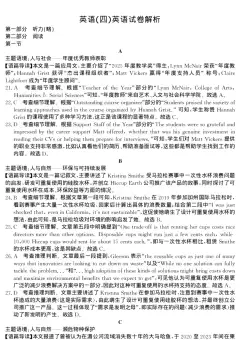
答案与解析
阅读A 篇
【答案】21.A 22. B 23. C
答案:A
解析:本题为细节理解题。题目问“宾大无障碍交通服务(Penn Accessible Transit)对学生有
什么使用要求”。根据原文中“Penn Accessible Transit”部分明确提到:“students must email the
Office of Student Disabilities Services” 以及 “For teachers or staff, they can obtain approval by
contacting the Office of Affirmative Action”,即学生必须通过邮件联系学生残疾服务办公室
(Office of Student Disabilities Services)来获得使用许可。因此正确答案为C(联系特定办公室获
得批准)。选项C(打电话要求服务)是Penn Walking Escorts 的服务方式;选项B(下载移动应
用)是SEPTA 和Indego 的要求;选项D(在学期时间内出示学生证)在文中未提及。
答案:B
解析:本题为细节理解题。题目问“学生如何使用Indego 自行车受益”。原文在“Indego”部
分指出:“through downloading the Indego app, students can... earn discounts for renting bikes”,
即通过下载Indego 应用程序,学生可以赚取租车折扣。因此正确答案为B(通过使用Indego 应用程
序获得折扣)。选项A(在任何站点免费租车)错误,文中未提及免费;选项C(骑车前往五个
县)是SEPTA 的服务范围,与Indego 无关;选项D(在校园内请求自行车护送)文中未提及,护送
服务由Penn Walking Escorts 提供。
答案:C
解析:本题为主旨大意题。全文开篇点题,介绍了宾大为学生提供的多种交通服务选项(several
transportation service options),并逐一详细说明了Penn Walking Escorts, Penn Accessible Transit,
SEPTA, Indego 这四种服务的具体内容、使用方法和适用人群。其核心目的是信息性的,旨在告知学
生这些可用的交通选择。因此正确答案为C(告知学生可用的交通选项)。选项A(比较不同的交
通服务)错误,因为文章是并列介绍各项服务,并未进行对比;选项B(鼓励学生探索费城)和选
项D(推广校园内安全出行)虽在文中部分提及,但均不是全文的核心写作目的。
阅读B 篇
【答案】 1. A 2. B 3. D 4. C
1.A(细节理解题)解析:本题为细节理解题。根据原文第二段开头:"Our lights had been up
since December, nearly six months..." 明确说明灯饰从12 月起保留了近六个月。选项B(11 月下旬)
是计划重新悬挂的时间,选项C(气温升高时)和D(开花时)是文中提到的季节变化,但非拆除
的具体时间依据。
2. B(推理判断题)解析:本题为推理判断题。原文开头提到邻居通过多种方式联系(包括“扔
石头绑纸条”的极端方式),且质问“你们要永远留着它们吗??!!!”,结合后文“contrary to
your whispers”可知邻居持续关注并私下讨论,推断出邻居的态度是好奇且担忧的。选项A(冷漠)
与主动联系的行为矛盾;选项C(帮忙拆除)和D(付费拆除)均未在文中体现。
3. D(人物性格题)解析:本题为人物性格题。作者用自嘲语气描述困境(如“note tied to a
rock”“sizzle, smell, mosquitoes”),面对问题尝试解决(联系安装公司、手动拆除单颗灯泡),
最终以幽默方式处理(将灯饰移至地下室并承诺11 月再挂),且强调“它们已是家庭一部分”,体
现了幽默感与执着。选项A(务实高效)与纠结过程不符;选项C(粗心不负责任)和B(敏感易
气馁)与主动应对和最终乐观保留的态度相悖。
4. C(主旨大意题)解析:本题为主旨大意题。全文以轻松幽默的口吻讲述灯饰保留过久引发的
邻里趣事和家庭应对过程,并未聚焦抱怨成本(选项A)、解释退货(选项B,且文中明确说未退
货)或呼吁邻里宽容(选项D)。贯穿全文的调侃语气(如“灯饰是家庭成员”“亚马逊卡车触发
音乐”)表明核心是分享幽默经历。
阅读C 篇
【答案】 1. A 2. B 3. D 4. C
1. A 推理判断题。解析:本题为推理判断题。根据第三段研究人员设计"Tiny Town"时所
述:"'We want to get answers, but it's also important that participants have a good time...'"以及描
述该虚拟环境"full of entertaining landmarks",可推断其主要目的是在保证科学性的同时让儿童参与
者保持参与兴趣。选项B(确认fMRI 准确性)并非设计该环境的主要目的;选项C(提升科学能
力)和选项D(调整情绪)虽部分相关,但不如A 项全面准确地体现研究者的双重意图。
2. B 推理判断题。解析:本题为推理判断题。根据末段首句"The next step...is to look into the
brain development of toddlers with cleverer strategies" 以及Jung 所言"explore how humans use
different parts of the brain...and how that changes with age",可推断后续研究将采用新策略探索更
年幼群体的大脑发育模式。选项A(研究策略的影响)未准确捕捉到"未来方向"的核心;选项C(要
求更大样本)和选项D(证据坚实性)均与末段聚焦未来研究的内容不符。
3. D 写作手法题。解析:本题考查文章结构分析。全文采用"传统观点—新研究发现—实验验证
—未来展望"的递进结构:首段通过过去研究引出新发现;第二段介绍大脑区域功能背景;第三、四
段详细描述实验方法与结果;末段展望未来研究方向。选项A(问题-原因-解决方案)与本文的实证
研究性质不符;选项C(成人与儿童对比)仅局部涉及;选项B(纯技术聚焦)未能涵盖研究背景
与展望等完整结构。
4. C 主旨大意题。解析:本题为主旨大意题。全文核心围绕新研究发现"5 岁儿童通过RSC 脑区
实现大型空间导航"展开,并通过实验证据支持这一结论。选项A(5 岁以下不能导航)与研究发现
相反;选项B(Tiny Town 的重要性)虽提及但属于论证细节,并非全文核心;选项D(PPA 区域最
重要)与文中强调RSC 关键作用的结论不符。
阅读D 篇
【答案】 1. A 2. B 3. D 4. B
1. A 词义猜测题。解析:本题为词义猜测题。根据第二段上下文,政府设定"harvesting" quotas
是为了"keep the four most populous species in check"(控制四种数量最多的物种),且后文讨论狩
猎是否造成破坏,可知"harvesting"在此特定语境中委婉指代为控制数量而进行的"捕杀和利用"。选
项B(保护繁殖)、C(研究监测)和D(迁移放生)均与上下文所述的数量控制目的及争议不符。
2. B 推理判断题。解析:本题为推理判断题。根据第二段"Animals, like dingoes, which feed on
them, are becoming rare, so when the grass they eat is sufficient, their numbers jump"可知,以袋
鼠为食的动物(如野狗)减少,加上草料充足,直接导致袋鼠数量增长。选项A(狩猎禁令)与文
中长期存在配额管理的事实矛盾;选项C(草地扩张)和D(道路安全改进)文中未提及。
3. D 观点态度题。解析:本题考查作者写作目的。第三段先提出支持狩猎的观点(年收入1.75 亿
美元、更可持续的蛋白质来源),但转而通过"Yet the industry is under pressure abroad"引出相反事
实:国际抵制导致出口价值大幅下降。这种对比结构主要旨在展示该行业面临的国内外经济压力冲
突,而非单方面论证 benefits(选项A)、market decline(选项B)或sustainability(选项C)。
4. B 主旨大意题。解析:本题考察对专家观点概括。根据最后一段Wilson 所说"a higher
kangaroo population simply means that more will die in the next drought"(数量增多意味着下次干
旱中死亡更多),以及土地所有者毒杀、筑栏阻水等更恶劣手段,可知他认为当前管理方式(减少
商业狩猎)可能引发更严重的自然死亡和人类冲突,即陷入更糟境地。选项A(自然控制更好)未
准确反映其担忧;选项C(扩大商业狩猎)和D(干旱最主要威胁)均片面解读其观点。
阅读七选五
【答案】 1. F 2. C 3. G 4.B 5. E
1. F 段首题。解析:该空位于段落开头,需要起到引入主题和衔接下文的作用。后文连续三
句"The soccer match..."、"The event..."、"The one..."运用排比结构具体说明这是一个重要的体育活
动,F 选项"该赛事显然是本赛季最重要的活动"恰好作为总起句,概括了下文要描述的活动性质。其
他选项中,A 提到看电影,与体育主题无关;D 讨论个人优势,与后文内容不衔接;G 谈论育儿理
念,放入段首显得突兀。
2. C 段中题。解析:该空位于情感描写段落中,需要与上下文形成逻辑衔接。下文直接引
语"Maybe they had limited tickets"体现母亲试图用合理的解释来安慰孩子,与C 选项"最初我试图合
理化情况来减轻他的痛苦"完全吻合。下句"But my consolation felt inadequate"形成明显转折关系,
进一步验证C 选项的正确性。B 选项提到第二天发生的事,与当前时间线不符;E 选项是总结性语
句,与后文解释性内容不匹配。
3. G 段中题。解析:该空位于作者感悟部分,需要承上启下。上文提到"what I discovered was
messier than that",暗示将要阐述一个更复杂的现实,G 选项"为人父母意味着接受你无法控制一
切"恰好引出下文的具体阐释"You cannot solve every problem"和"your role is simply to be present"。
D 选项建议关注优势,与后文接受无力的主题相悖;F 选项描述活动重要性,与当前讨论的育儿哲
学无关。
4. B 段中题。解析:该空需要连接情感过渡部分。上文讨论接受无力感,下文"He took out his
favorite soccer card"描述具体行为,B 选项"然而第二天早上带来了意想不到的进展"完美衔接这两部
分,其中"unexpected development"准确呼应了儿子出乎意料的慷慨行为。A 选项建议看电影,与后
文写卡片的行为不符;D 选项强调个人优势,与后文表现出的宽容相矛盾。
5. E 段尾题。解析:该空位于文章结尾,需要起到升华主题的作用。前文"the opportunity to
navigate disappointment together"总结经历带来的积极意义,E 选项"而这,我认为代表着真正有意义
的东西"中的"this"指代前文内容,"truly meaningful"进一步深化主题,符合段落结尾的总结特征。A
选项提出具体活动建议,与文章哲理升华的基调不符;G 选项虽然涉及育儿理念,但未能体现从具
体经历到抽象感悟的升华过程。
阅读七选五
【答案】 1. D 2. A 3. G 4.E 5. C
36. D 段首题。解析:该空位于首段结尾,需要承上启下。上文描述石头消失和大家的猜测,D
选项"接下来发生的事永远改变了我们的生活"既总结前文的行为后果,又为下文的意外事件埋下伏
笔。F 选项虽然提到后果,但语气过于直接,不如D 选项自然过渡。
37. A 段中题。解析:该空位于第二段开头,需要连接发现真相的过程。下文描述看到救护车前
往石头消失的方向,A 选项"真相比预期更早地显现出来"完美衔接上下文,表明他们的猜测很快得
到了验证。B 选项提到警报声,虽然相关但不如A 选项直接点明"真相揭示"这个核心。
38. G 段中题。解析:该空位于情景描述中间,需要具体化现场情况。下文提到医护人员抬起伤
者,G 选项"现场,一小群人围着倒下的身影"直接描绘了到达现场后看到的场景,与下文形成顺承
关系。其他选项要么提前揭示了结果,要么与现场描述不匹配。
39. E 段中题。解析:该空位于情感转折段落开头,需要总结长期影响。下文讲述 decades of
guilt(数十年的内疚),E 选项"那天的记忆困扰了我们多年"正好引出后面的心理描写。F 选项虽然
相关,但已经在前文有所暗示,不如E 选项直接切入情感主题。
40. C 段尾题。解析:该空位于结尾段中间,需要衔接坦白过程。下文描述Thomas 触摸额头但
没有认出这个故事,C 选项"他耐心地听我们叙述每个细节"正好解释了他们是如何分享故事的,为
下文的反应做铺垫。其他选项要么已经在前文体现,要么与当下的坦白场景不匹配。