文档文本内容
综合训练15
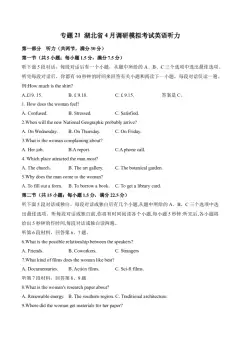
第一部分:听力(共两节,满分30 分)
做题时,先将答案标在试卷上,录音内容结束后,有两分钟时间将试卷上的答案转涂到答题卡上。
第一节(共5 小题;每小题1.5 分,满分7.5 分)
听下面5 段对话。每段对话后有一个小题,从题中所给的A、B、C 三个选项中选出最佳选项,并标在
试卷的相应位置。听完每段对话后,你都有 10 秒钟的时间来回答有关小题和阅读下一小题。每段对话仅
读一遍。
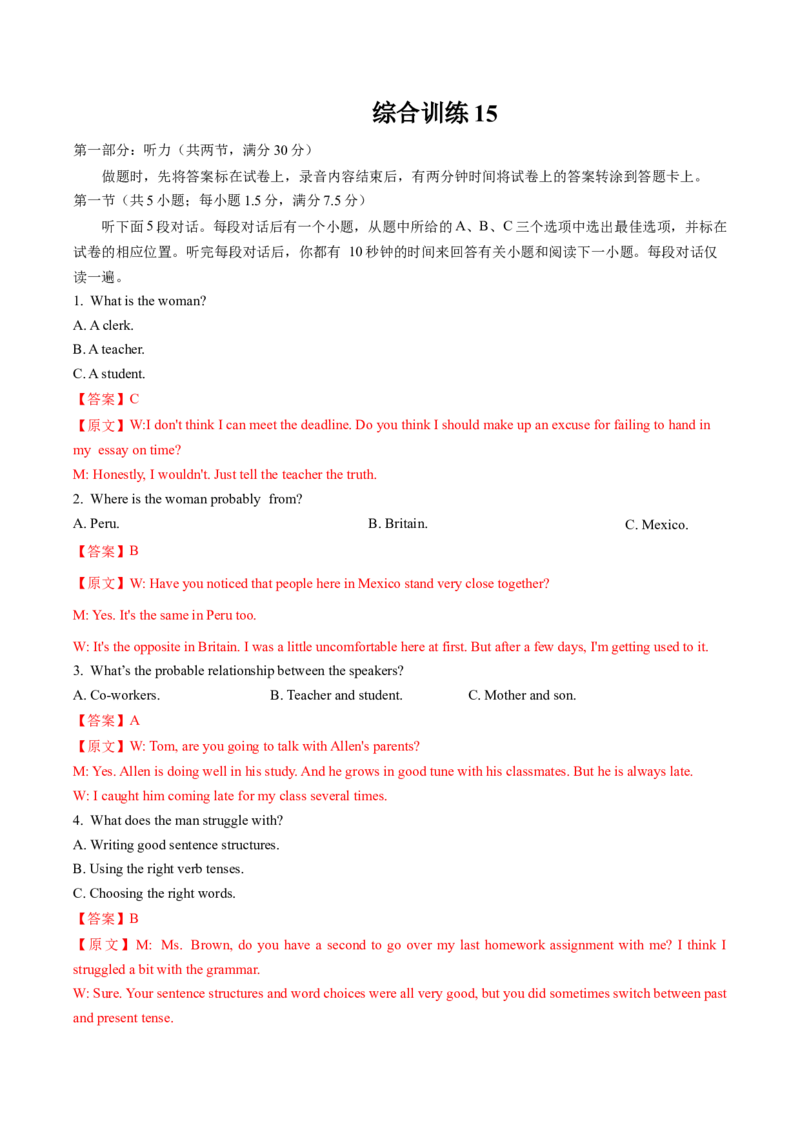
1. What is the woman?
A. A clerk.
B. A teacher.
C. A student.
【答案】C
【原文】W:I don't think I can meet the deadline. Do you think I should make up an excuse for failing to hand in
my essay on time?
M: Honestly, I wouldn't. Just tell the teacher the truth.
2. Where is the woman probably from?
A. Peru.                                   B. Britain.                            C. Mexico.
【答案】B
【原文】W: Have you noticed that people here in Mexico stand very close together?
M: Yes. It's the same in Peru too.
W: It's the opposite in Britain. I was a little uncomfortable here at first. But after a few days, I'm getting used to it.
3. What’s the probable relationship between the speakers?
A. Co-workers.
B. Teacher and student.
C. Mother and son.
【答案】A
【原文】W: Tom, are you going to talk with Allen's parents?
M: Yes. Allen is doing well in his study. And he grows in good tune with his classmates. But he is always late.
W: I caught him coming late for my class several times.
4. What does the man struggle with?
A. Writing good sentence structures.
B. Using the right verb tenses.
C. Choosing the right words.
【答案】B
【原文】M: Ms. Brown, do you have a second to go over my last homework assignment with me? I think I
struggled a bit with the grammar.
W: Sure. Your sentence structures and word choices were all very good, but you did sometimes switch between past
and present tense.
5. Why did the woman get fined?
A. For speeding.
B. For running a red light.
C. For driving the wrong way.
【答案】A
【原文】M: I can’t believe you got a ticket. Did you run a red light?
W: Not exactly. I was driving at 40 miles an hour in a school zone. The fine is huge! It’s a lot more than the fine for
going the wrong way on a one-way street.
第二节(共15 小题;每小题1.5 分,满分22.5 分)
听下面 5 段对话或独白。每段对话或独白后有几个小题,从题中所给的 A、B、C 三个选项中选出最佳
选项,并标在试卷的相应位置。听每段对话或独白前,你将有时间阅读各小题,每小题 5 秒钟;听完后,
各小题将给出 5 秒钟的作答时间。每段对话或独白读两遍。
听第 6 段材料,回答第 6 至 7 题。
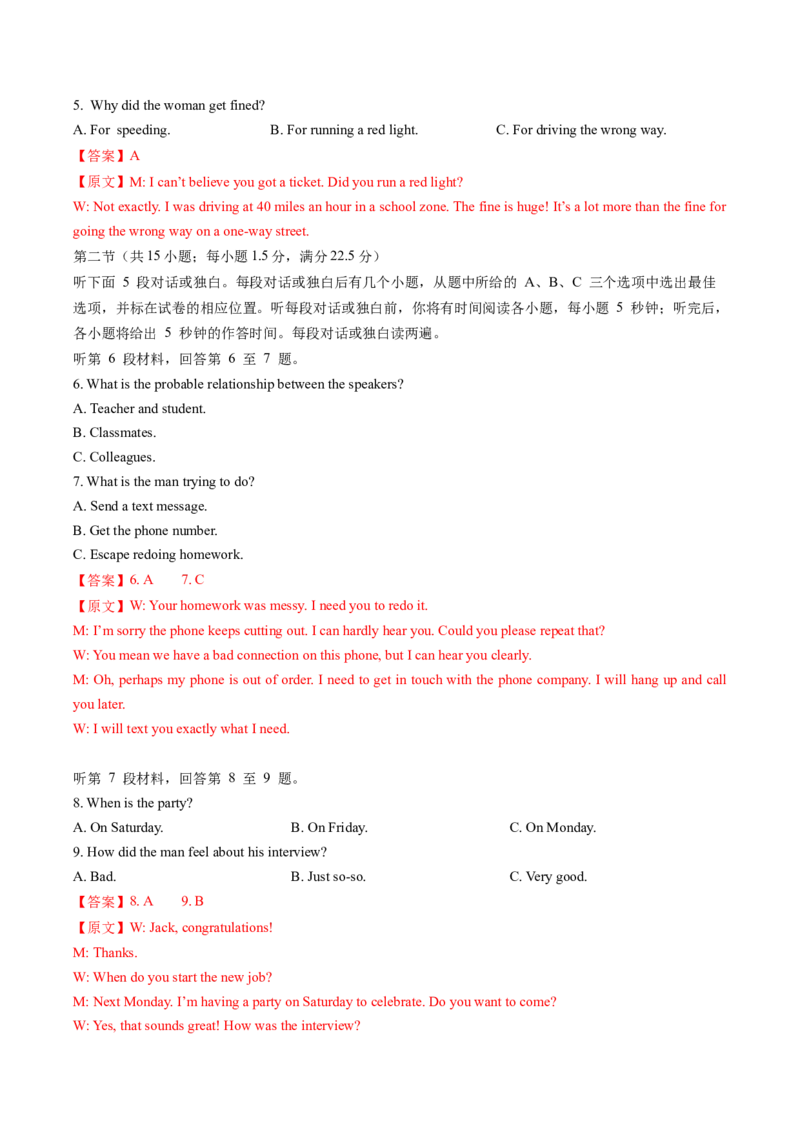
6. What is the probable relationship between the speakers?
A. Teacher and student.
B. Classmates.
C. Colleagues.
7. What is the man trying to do?
A. Send a text message.
B. Get the phone number.
C. Escape redoing homework.
【答案】6. A    7. C
【原文】W: Your homework was messy. I need you to redo it.
M: I’m sorry the phone keeps cutting out. I can hardly hear you. Could you please repeat that?
W: You mean we have a bad connection on this phone, but I can hear you clearly.
M: Oh, perhaps my phone is out of order. I need to get in touch with the phone company. I will hang up and call
you later.
W: I will text you exactly what I need.
听第 7 段材料,回答第 8 至 9 题。
8. When is the party?
A. On Saturday.
B. On Friday.
C. On Monday.
9. How did the man feel about his interview?
A. Bad.
B. Just so-so.
C. Very good.
【答案】8. A    9. B
【原文】W: Jack, congratulations!
M: Thanks.
W: When do you start the new job?
M: Next Monday. I’m having a party on Saturday to celebrate. Do you want to come?
W: Yes, that sounds great! How was the interview?
M: I didn’t think it went so well, but they called me back in later and said the job was mine.
W: I knew you’d get it. You’re the perfect person for the job.
M: I felt nervous throughout the interview. My hands were shaking.
W: But you got it. Well done.
听第 8 段材料,回答第 10 至 12 题。
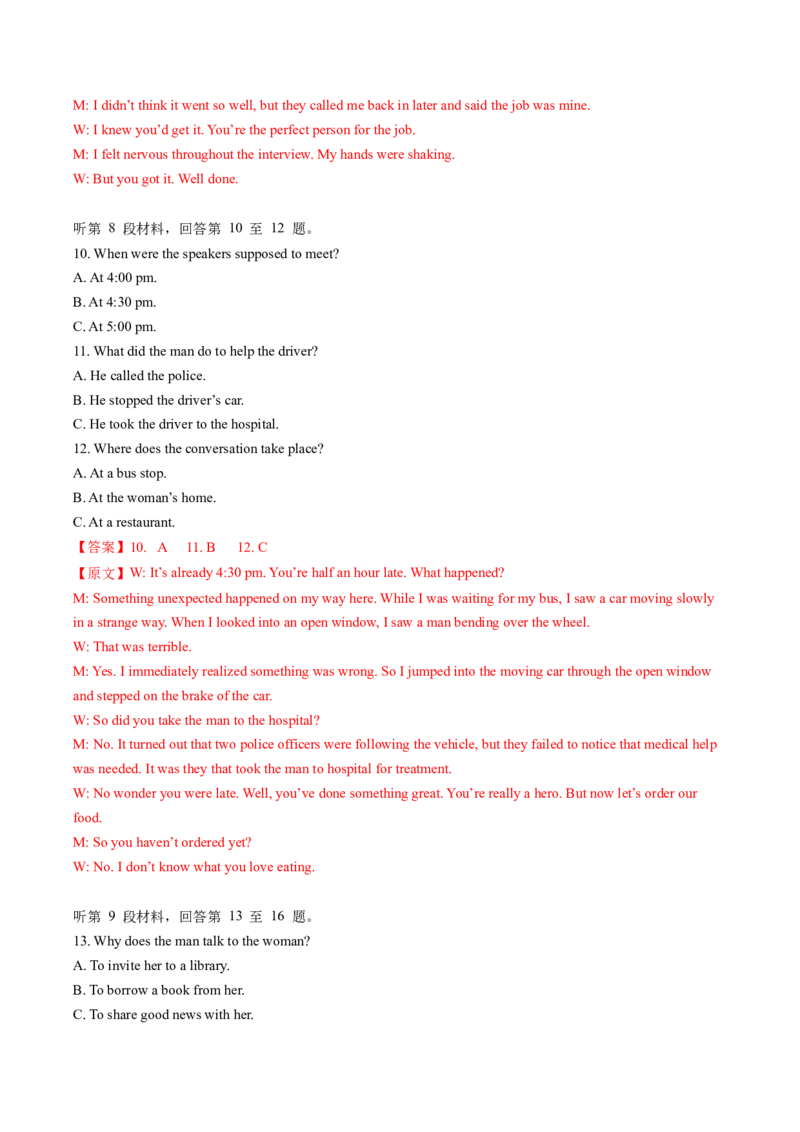
10. When were the speakers supposed to meet?
A. At 4:00 pm.
B. At 4:30 pm.
C. At 5:00 pm.
11. What did the man do to help the driver?
A. He called the police.
B. He stopped the driver’s car.
C. He took the driver to the hospital.
12. Where does the conversation take place?
A. At a bus stop.
B. At the woman’s home.
C. At a restaurant.
【答案】10. A
11. B   12. C
【原文】W: It’s already 4:30 pm. You’re half an hour late. What happened?
M: Something unexpected happened on my way here. While I was waiting for my bus, I saw a car moving slowly
in a strange way. When I looked into an open window, I saw a man bending over the wheel.
W: That was terrible.
M: Yes. I immediately realized something was wrong. So I jumped into the moving car through the open window
and stepped on the brake of the car.
W: So did you take the man to the hospital?
M: No. It turned out that two police officers were following the vehicle, but they failed to notice that medical help
was needed. It was they that took the man to hospital for treatment.
W: No wonder you were late. Well, you’ve done something great. You’re really a hero. But now let’s order our
food.
M: So you haven’t ordered yet?
W: No. I don’t know what you love eating.
听第 9 段材料,回答第 13 至 16 题。
13. Why does the man talk to the woman?
A. To invite her to a library.
B. To borrow a book from her.
C. To share good news with her.
14. What does the man think of Whispers in the Shadows?
A. It's appealing.
B. It's uninteresting
C. It's heartbreaking.
15. What kind of book is Echoes of Eternity?
A. A thriller.
B. A fiction book.
C.A non-fiction book
16. What will the speakers do this afternoon?
A. Buy books.
B. Attend class.
C. Explore the library.
【答案】13. C    14. A    15. B    16. B
【原文】M: Sarah, the City Library has just got some brand-new books. They gave me that fresh book smell.
W: That's good news! What kinds of books are they?
M: A bit of everything, actually. There's a new mystery thriller that's been getting fantastic reviews. It's
called Whispers in the Shadows. I'm sure it could keep you on the edge of your seat until the very last page.
W: Sounds interesting. What else caught your eye?
M: In the fiction section, there's a beautiful display of newly published novels. I picked one called Echoes of
Eternity. It should be a heartbreaking story that unfolds against the background of a war. It's about science, love,
and sacrifice.
W: I might check that one out. Anything else?
M: Yes! There's a non-fiction book called The Science of Happiness. It explores the psychology behind what makes
us happy.
W: Sounds nice. Let's go to the library right now.
M: Have you forgotten we have four classes this afternoon? We won't have enough time to read there. We can go
there this Wednesday afternoon instead.
W: Alright. I'm looking forward to exploring the library the day after tomorrow.
听第 10 段材料,回答第 17 至 20 题。
17. What is the common belief about our brain’s processing speed?
A. It reaches its peak at the age of 20.
B. It doesn’t decrease before 40.
C. It remains constant until 60.
18. What was the age range of the people included in the study?
A. From 10 to 60.
B. From 20 to 80.
C. From 10 to 80.
19. Why do older people make decisions more slowly according to Dr. von Krause?
A. They become more careful.
B. They process information slower.
C. They need more time to get information.
20. What benefit can people get from the study?
A. It may help increase the mental processing speed.
B. It may improve people’s ability to concentrate.
C. It may contribute to the research on diseases.
【答案】17. A    18. C    19. A    20. C
【原文】M: Scientists in Germany have cast doubt on a previously believed assumption that the processing speed
of our brain starts to decline from the age of 20. Until now, it has been thought that our level of understanding
peaks when we are 20 and declines thereafter. Lead researcher doctor Mischa von Krause, of Heidelberg
University, offered hope to older people who worry about increasing forgetfulness or reduced brainpower. He said
mental abilities were still powerful at the age of 60 and do not decrease before then. The study was based on data
from over 1.1 million people aged between 10 and 80 years old. The results showed that our mental processing
speed remains relatively constant until the age of 60, but does start to decline from our seventh decade. The
researchers said people’s mental processing speed actually increases in their 20s and remains high until 60. Dr. von
Krause said until older adulthood, the speed of information processing in the task they studied hardly changed. He
added that older people do take longer to make decisions, but said this was because we become more cautious and
responsible as we age. The study could cast light on diseases such as Alzheimer’s.