江西省南昌
市2026 届高三年
级9 月测试(零
模)
1. What will the woman probably do next?
A. Buy a battery.
B. Visit a bank.
C. Charge her laptop.
2. Where is the man heading?
A. The city museum.
B. The central library.
C. The science building.
3. Why does Henry ask for leave?
A. To see a doctor.
B. To attend a wedding.
C. To take a test.
4. What does the woman think of the market?
 A. The opening hours were short.
 B. The prices were unreasonable.
 C. The live music was not good.
5. What does Luke worry about?
A. The total expense.
B. A training course.
C. His personal safety.
听第6 段材料,回答第6、7 题。
6. What is the problem ?
 A. The final bill was wrong.
 B. The concert stamp was missing.
 C. The parking ticket was damaged.
7. How much should the man pay ?
 A.$4.
B.$8.
C.$10.
听第7 段材料,回答第8 至10 题。
8.What is the probable relationship between the speakers?
A. Fellow workers.
B. Former schoolmates.
C. Family relatives .
9. What do we learn about Alice?
 A. She is furthering her studies.
 B. She is working in a library.
 C. She is dining with Ben.
10. What will they most likely order ?
A. Iced tea.
B. New juice.
C. Black coffee .
听第8 段材料,回答第11 至13 题。
11. What does the man say about funny short videos?
 A. They are full of ads.
B. They are getting much longer.
 C. They are becoming less creative.
12. What kind of short videos does the woman like?
A. Skill-teaching videos.
B. Joke-telling videos.
C. Dance-performing videos.
13. How does the man expect short videos to be?
A. Entertaining.
B. Relaxing.
C. Inspiring.
听第9 段材料,回答第14 至17 题。
14.Who is Jane?
A. A program host.
B. A garden organizer.
C. A student volunteer.
15.What do the student volunteers do in the garden?
A. Grow their own vegetables.
B. Take care of the public areas.
C. Interview the local residents.
16. What benefit do senior residents get from the program?
 A. Lessons on soil preparation.
 B. Help with using new technology.
 C. More time for their hobbies.
17. What is the main goal of the community garden?
A. To offer professional training.
 B. To promote lifelong learning.
 C. To strengthen the community bond.
听第10 段材料,回答第18 至20 题。
18. What is the reason for the project "Fading Away"?
 A. The rapid city development.
 B. The unseen wildlife loss.
 C. The polluted local rivers.
19. What is special about the paint?
A. It reacts to heat.
B. It shines at night.
C. It disappears in water .
20. What does the success of this project indicate?
A. Art can inspire community action.
B. Environmental problems are solvable.
C. The local government should support artists.
Shared mobility: Making travel easier for all
In major cities across Europe and the US, shared bikes and cars seem to be everywhere. Yet for
disabled, elderly, low-income individuals, or those without a smartphone or credit card, these
services are practically out of reach. Such services tend to gather in wealthy urban areas, leaving
users largely young, wealthy, and able-bodied.
Shared mobility could be a key part of a more sustainable transportation system. But to be most
effective, it needs to include everyone. For-profit shared mobility providers have largely failed to
deliver on this, but various initiatives and projects are finding creative solutions to reach under-
served communities.
● Buffalo's E-Bike Library: Organizes training, group rides and educational events to familiarize
people with cycling culture and safety, with 71% of members being first-time riders.
● Mobitwin's car-share service: Prioritizes email --- and phone --- based bookings over apps to
extend reach to a wider share of the population lacking digital literacy, helping them access the
service more easily.
● U. S. bike-sharing policy: Provides fare reductions for low-income groups, with cash payment
options and non-smartphone access as key measures to broaden adoption, which has shown promise
in increasing the use of shared bikes while decreasing the use of personal vehicles.
● Graz's car-share initiatives: Add wheelchair --- accessible vehicles, child seats, and station-
based booking to suit diverse users' trip-chaining needs, such as mid-route pickups and multi-
destination trips.
 The future of shared mobility relies on making inclusive design a top priority. As Esen Köse,
project manager at Mpact, puts it, "It's about starting with people’s needs.”
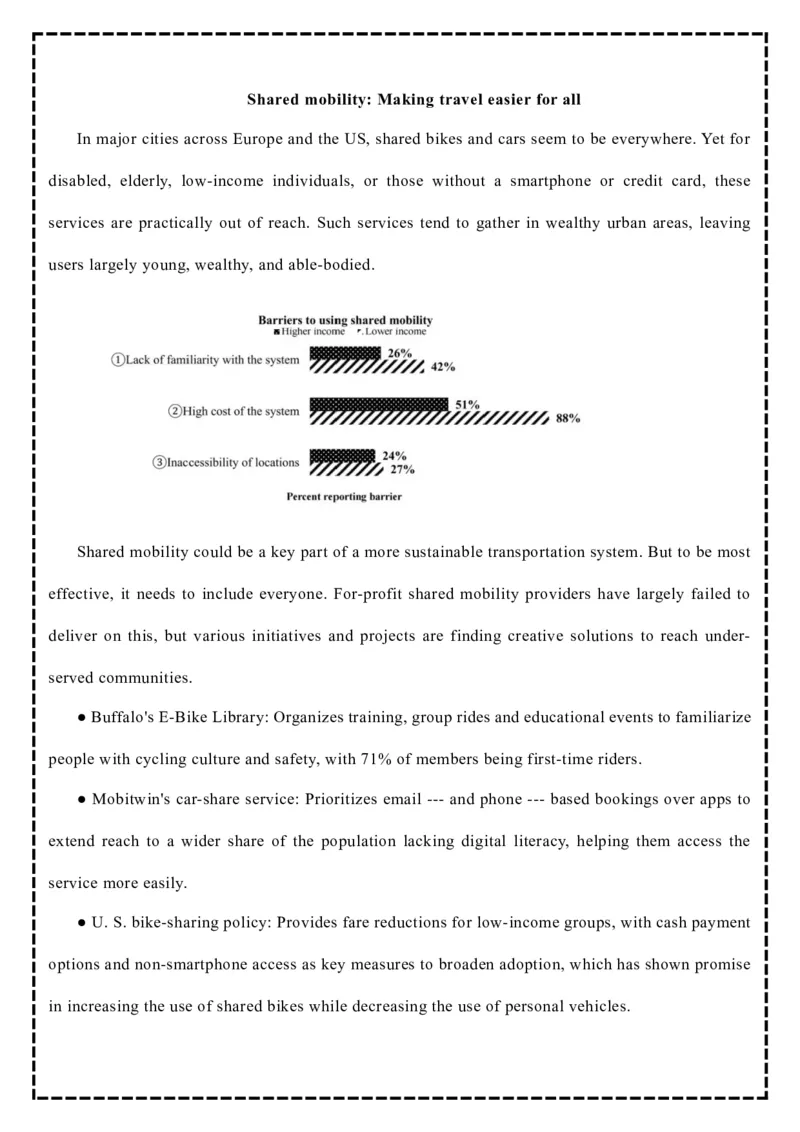
21. What is the percentage gap between lower and higher income users in Barrier 1?
A.3%.
B.16%.
C.26%.
D.71%.
22. Which solution targets Barrier 2?
A. Buffalo's E-Bike Library.
B. Graz's car-share initiatives.
C. U. S. bike-sharing policy.
D. Mobitwin's car-share service .
23.What will shape the future of shared mobility according to Esen Köse?
A. Tech-based priority.
B. Charity-run initiatives.
C. Profit-driven providers.
D. User-centered accessibility.
You don't have to be rich to travel well. For my husband and I, this rings especially true: he's
retired early and I work part-time as an editor, which gives us plenty of time and freedom but not
much in the way of funds. We've happily chosen free time over money, yet we love to travel, and
travel usually costs a lot. Still, we've managed to take a lot of affordable trips by house trading.
 House trading isn't the same as Airbnb or renting a room in someone's home: there's no exchange
of money, no check-in desks or strict rules, which makes it feel more like staying as guests in each
other's houses. Living in someone else's space builds a unique closeness --- admiring their bookshelf
picks, the way they arrange potted plants, or family photos on the fridge turns virtual strangers into
familiar faces. We've even grown repeat trades into real friendships.
On our very first trade, our partner welcomed us with a bottle of wine and some cheese in the
fridge, and we've kept that gracious tradition going with our own "guests". Since then, we've
encountered all kinds of thoughtful acts --- from the young couple who left the keys in their mailbox
along with a note that said "Enjoy!" to the family who provided piles of maps, brochures, and local
restaurant menus. With these small "insider" tips, we don't just visit a city --- we slip into its daily
flow, free from the rush of moving from one landmark to another.
 Yes, house trading did begin with our desire to travel on the cheap, but it's become so much
more than just a way to save money. It let us get glimpses of places we might never have explored
otherwise, grew our belief in the warmth of strangers, and confirmed our decision to choose a
lifestyle that values time over money. We all learned to share by the time we were in kindergarten,
right? It's not too late to rediscover that simple truth on a whole new level.
24.What first made the author try house trading ?
A. To reduce travel expenses.
B. o earn retirement funds.
C. To upgrade accommodations.
D. To meet interesting people.
25. What is the feature of house trading ?
A. It involves money exchange.
B. It offers long-term stay.
C. It creates personal connection.
D. It ensures hotel-like service.
26. Why does the author mention hosts' thoughtful acts?
A. To suggest travel tips.
B. To show local customs.
C. To instruct hosting skills.
D. To highlight special gains.
27. What message does the author convey in the last paragraph ?
A. Trust requires shared values.
B. Sharing bears lasting worth.
C. Budget travel cuts living costs.
D. Early habits shape adulthood.
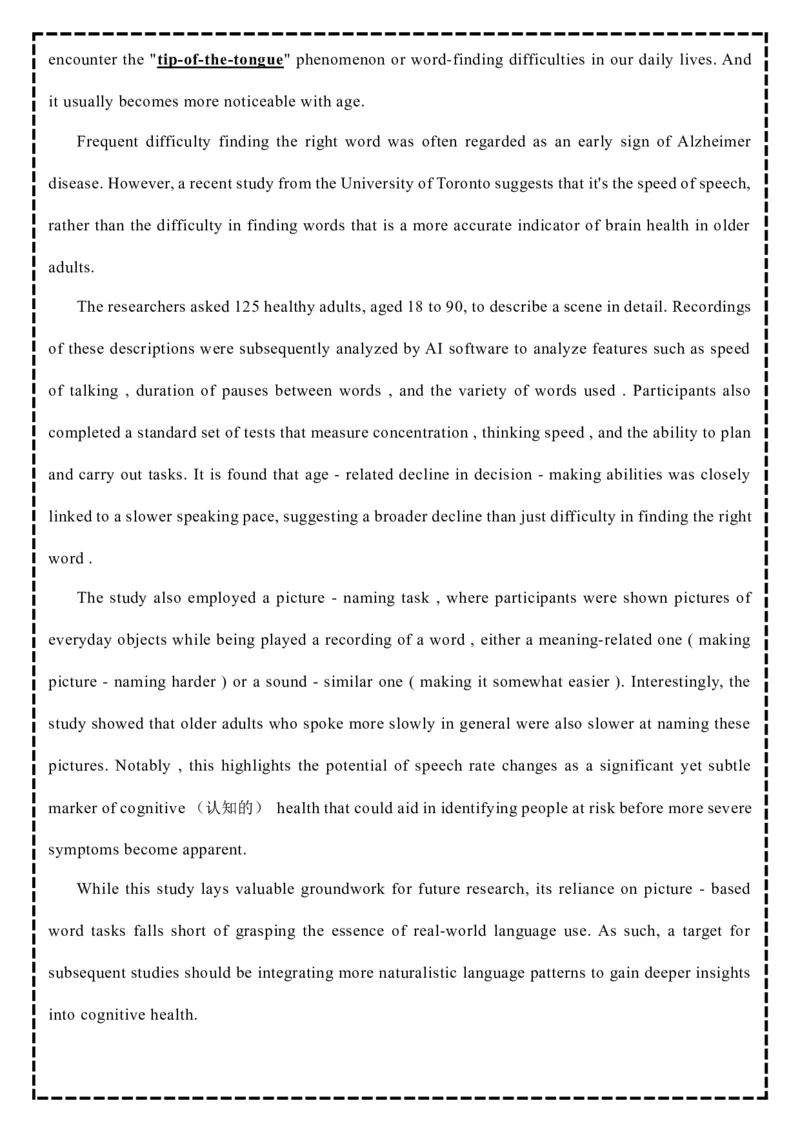
Can you pass me the whatchamacallit? It's right over there next to the thingamajig. Many of us
encounter the "tip-of-the-tongue" phenomenon or word-finding difficulties in our daily lives. And
it usually becomes more noticeable with age.
Frequent difficulty finding the right word was often regarded as an early sign of Alzheimer
disease. However, a recent study from the University of Toronto suggests that it's the speed of speech,
rather than the difficulty in finding words that is a more accurate indicator of brain health in older
adults.
The researchers asked 125 healthy adults, aged 18 to 90, to describe a scene in detail. Recordings
of these descriptions were subsequently analyzed by AI software to analyze features such as speed
of talking , duration of pauses between words , and the variety of words used . Participants also
completed a standard set of tests that measure concentration , thinking speed , and the ability to plan
and carry out tasks. It is found that age - related decline in decision - making abilities was closely
linked to a slower speaking pace, suggesting a broader decline than just difficulty in finding the right
word .
The study also employed a picture - naming task , where participants were shown pictures of
everyday objects while being played a recording of a word , either a meaning-related one ( making
picture - naming harder ) or a sound - similar one ( making it somewhat easier ). Interestingly, the
study showed that older adults who spoke more slowly in general were also slower at naming these
pictures. Notably , this highlights the potential of speech rate changes as a significant yet subtle
marker of cognitive (认知的) health that could aid in identifying people at risk before more severe
symptoms become apparent.
While this study lays valuable groundwork for future research, its reliance on picture - based
word tasks falls short of grasping the essence of real-world language use. As such, a target for
subsequent studies should be integrating more naturalistic language patterns to gain deeper insights
into cognitive health.
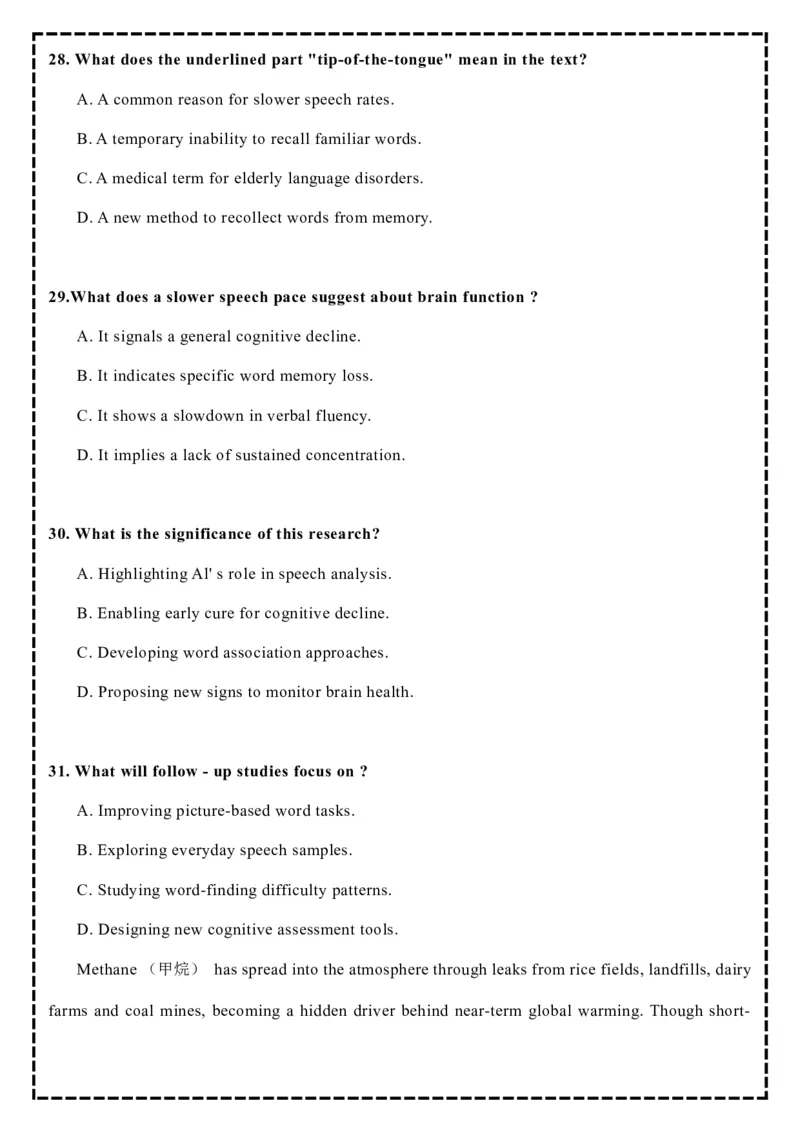
28. What does the underlined part "tip-of-the-tongue" mean in the text?
A. A common reason for slower speech rates.
B. A temporary inability to recall familiar words.
C. A medical term for elderly language disorders.
D. A new method to recollect words from memory.
29.What does a slower speech pace suggest about brain function ?
A. It signals a general cognitive decline.
B. It indicates specific word memory loss.
C. It shows a slowdown in verbal fluency.
D. It implies a lack of sustained concentration.
30. What is the significance of this research?
A. Highlighting Al' s role in speech analysis.
B. Enabling early cure for cognitive decline.
C. Developing word association approaches.
D. Proposing new signs to monitor brain health.
31. What will follow - up studies focus on ?
A. Improving picture-based word tasks.
B. Exploring everyday speech samples.
C. Studying word-finding difficulty patterns.
D. Designing new cognitive assessment tools.
Methane (甲烷) has spread into the atmosphere through leaks from rice fields, landfills, dairy
farms and coal mines, becoming a hidden driver behind near-term global warming. Though short-
lived in the atmosphere for just 7-12 years, methane traps much more heat than CO2. Cutting its
emissions is therefore a key route to slowing near-term warming of the climate, especially as these
emissions have been increasing recently.
New research suggests that a specially grown methane-eating bacteria ( 细菌) called
methanotrophs may offer a solution to control these methane leaks. Originally found in a lake in
Russia, these tiny organisms work by "eating" methane . When air with methane flows through a
large container holding the bacteria, they turn the methane into proteins, which will be harvested and
sold for animal feed. While this does release small amounts of greenhouse gas, the net effect is less
warming power in the air. Tests show they could reduce methane by 60 to 80 percent in air that has
been treated.
Lidstrom and her colleagues at the University of Washington have been working to improve the
bacteria's ability to harvest methane even at relatively low levels. "Since existing bacteria are
designed by nature to carry out this work, the vision is to use this inborn ability as a flexible
technology worldwide," says Mary Lidstrom. " Once it becomes profitable, this solution can grow
to handle millions of tons of methane every year, providing a nature-based solution to reducing
methane in the atmosphere," she adds. It's an exciting approach, but she warns that this method is
not a silver bullet for all methane emissions.
Still, the potential is significant: when expanded, it could remove 24 million tonnes of CO2
equals by mid- century. Similar work by Canada's Lisa Stein, who uses methanotrophs in wetlands,
highlights the broader promise." Methanotrophs have huge potential to address real-world methane
emissions," she notes, with a landfill pilot and an agricultural trial set to roll out this year to build
on that progress.
32.Why is methane's nature highlighted in the first paragraph ?
A. To detail its human-related sources.
B. To explain its short-lived consequences.
C. To show the urgency of its reduction.
D. To emphasize its uncommon existence.
33.How do methanotrophs work?
A. They harvest methane for animal feed.
B. They remove CO2 from the atmosphere.
C. They transform methane into protein.
D. They absorb methane as an energy source.
34. What does "not a silver bullet" imply in paragraph 3?
 A. It is not a universal fix for every case.
B. It fails to reduce methane emissions.
 C. Its efficiency isn't proven by field tests.
D. Its long-term effects remain unknown.
35. Which can be a suitable title for the text?
A. Bacteria: A Source of Methane Feed
B. CO2: A Less Harmful Greenhouse Gas
C. Methane: A Global Warming Hidden Threat
D. Methanotrophs: A Prospective Methane Treatment
Finding My True Path
 My journey began with struggle. After graduating with psychology and art degrees, I expected
to become a psychologist or artist.            36

  Holding two degrees, I realized I was
exhausted from forcing myself into roles that never fit-like wearing shoes two sizes too small.


  3 7

             I came to accept my stress limits after repeated
burnout. Albert Einstein's words hit hard: expecting different results from repeated failures is unwise.
I stopped wasting energy on unsustainable paths I didn't truly want. My compass reset: Only pursue
what I can sustain and truly value.
 It was during this period of reflection that a long-buried passion quietly resurfaced-writing.
When I shared this with Elena, an artist friend, her eyes lit up. "True passion turns discipline into
joy, never duty." she emphasized.             38


  I realized true passion is written in
the soul; when accepted, regular practice flows naturally, becoming the true path to mastery.
 Fueled by this clarity, I took concrete steps. I carved out precious, daily writing time, starting
small and manageable.             39

  Then came the real test: when a high-paying job
demanded overtime that would steal my writing time, I firmly decline. It wasn’t sacrifice; it was
claiming my truth. I wrote with focus I never knew in offices.
 Making space for what mattered transformed everything. Regular writing brought peace and
direction. Though money remains a necessity, working with passion unlocks hidden doors within.
Purpose isn't found in distant dreams.             40

  When you swim in the right direction,
the stream of life will carry you where you're meant to be.

A. These words struck me deeply.
B. This requires exceptional talent.
C. It grows through daily chosen actions.
D. Years of exhaustion became my wake-up call.
E. I landed a dream job as a school mental health adviser.
F. This meant a daily routine of putting down 500 words.
G. The reality was years of bouncing from one office job to another.
Bonnie forever remembered her mother's kindness through the handmade sweaters Bonnie grew
up in. That same warmth extended beyond their home --- her mother often volunteered to   41
clothes for the needy. Every stitch(针脚)witnessed her mother's

 42

 to the community. When
an accident claimed her mother 's

 43

  Bonnie felt something was missing in her heart.
While sorting through her late mother's belongings, Bonnie found an       44       sweater labeled
with "Bonnie". Her heart ached the instant she recognized its

 45

  . The warmth of her mother's
sweaters urged her not to cast it aside.

  46

 to finish it, she searched for solutions online and
47      on Loose Ends, a nonprofit

 48

 partly finished projects with skilled volunteer knitters.
Through Loose Ends, Bonnie was linked to a nearby       49     Anna, who took great pleasure in
50       her mother's work. Anna spent weeks knitting into small hours and

  51

 to finish the
project. When the sweater was passed to her, Bonnie threw her arms around it, jumping at the chance
to

 52

  with her mother across time. Hugging the finished piece, Bonnie realized the beauty
and


  53

 in the finisher's rhythm of knitting. It's not just about being kind, but about making
sure people have

  54

  objects they can hug when missing someone. For Bonnie, holding that
completed sweater finally filled the emptiness in her heart with genuine

 55

  .
41.A. store
B. buy
C. sew
D. wash
42.A. reaction
B. commitment
C. adjustment
D. promise
43.A. possessions
B. damages
C. freedom
D. life
44.A. unprepared
B. unpacked
C. unfolded
D. uncompleted
45.A. influence
B. intention
C. history
D. choice
46.A. Determined
B. Astonished
C. Curious
D. Confused
47.A. commented           B. relied
C. chanced
D. reflected
48.A. replacing
B. matching
C. comparing
D. rewarding
49.A. coworker
B. shopkeeper
C. teacher
D. finisher
50.A. looking into
B. preparing for
C. taking over
D. figuring out
51.A. managed
B. pretended
C. happened
D. offered
52.A. argue
B. compete
C. engage
D. negotiate
53.A. courage
B. challenge
C. profit
D. value
54.A. well-documented B. on-trend
C. physical
D. complex
55.A. warmth
B. truth
C. depth
D. growth
Wu Man , an         56       (impress) pipa player, recently performed in Beijing, presenting tunes
based on ancient scores discovered within the Mogao Caves at Dunhuang, a UNESCO World Heritage
site which         57      (house)  invaluable cultural treasures and receives millions of visitors every
year.
The original pipa scores date back to the Tang Dynasty, a period widely      58
(acknowledge) as China's cultural golden age. Unlike modern music language, the ancient scores
employ special symbols to show how the pipa should be played. Performing them is         59
(incredible) challenging and requires deep knowledge of old Chinese music and its history.
With a strong responsibility to preserve this cultural treasure, Wu Man spent three years making
her new album. She carefully studied various versions of the 25 Dunhuang scores translated by
scholars. She stays true to these interpretations in her performance while       60          (add) her own
artistic expression, breathing new life             61            the ancient works. Drawing inspiration from
the old scores, seven new pipa pieces created by her are also featured in     62           album. This
shows her skill in connecting past traditions with For Wu Man,      63         career has highlighted the
pipa's artistic beauty and             64      (flexible), this project forms an essential chapter.             65
matters most to her is that each generation rediscovers the cultural roots through this music.
校英文报正在举办征文活动请同学们用一个关键词描述自己过去一年中最珍贵的回忆。请你写一
篇短文投稿。内容包括:
(1)选择的关键词;
(2)选择的理由。
注意:
(1)写作词数应为80 左右:
(2)可适当增加细节,以使行文连贯。
          If I have to use a word to define my previous year, it will be
For years, my family hadn't had a proper vacation, our lives consumed by busy schedules. This year, I
was determined to plan a perfect getaway. My research led me to The Manor, a grand, historic hotel. As I
studied a local tourist brochure, I saw it listed the hotel's main attractions --- an award-winning restaurant and
a grand lighthouse. Simple activities like walking coastal paths and searching for unique sea glass were also
mentioned. For this special vacation, I focused only on what I considered the best experiences. A simple walk
on the beach? We could do that anywhere. I wanted the lighthouse climb and the luxury of a fancy dinner.
Just before we left, my father gave me a hug. "Remember," he said softly," we can't control the
circumstances, but we can always choose our attitude." I thought of how he always managed to turn rainy
days into opportunities for simple games, finding joy no matter what. I smiled, but confident in my mind that
our trip would be so perfect that we would never need his wisdom.
Unfortunately, our journey began with an unexpected storm. A steady, cold rain poured down so heavily
that we could barely see the landscape outside our car. Arriving at the hotel, our hopes for an afternoon swim
were greeted by a sign on the locked pool door:" Closed for Renovation (翻修) . Our next thought, a drink at
the hotel bar, was met with another sign:" Closed on Mondays ". Defeated, we went to bed early, pinning all
our remaining hopes on visiting the lighthouse the next morning.
The following day, the sky was still gray and cold, but at least the rain had softened. We drove to the
lighthouse, our spirits lifting as we saw the grand structure rising before us. From the parking lot, we could
see a small, unmarked path winding through the tall grass into the distance, but our focus was entirely on the
lighthouse. "The view from the top will be amazing!" I shouted. I ran from the car to the gate, ready to start
the climb. My heart sank as I read the large, metal sign posted there: CLOSED           FOR RENOVATIONS.
 I turned and looked at my husband in disbelief.
The path led to a silent beach.