文档文本内容
文化类词汇对应语法填空
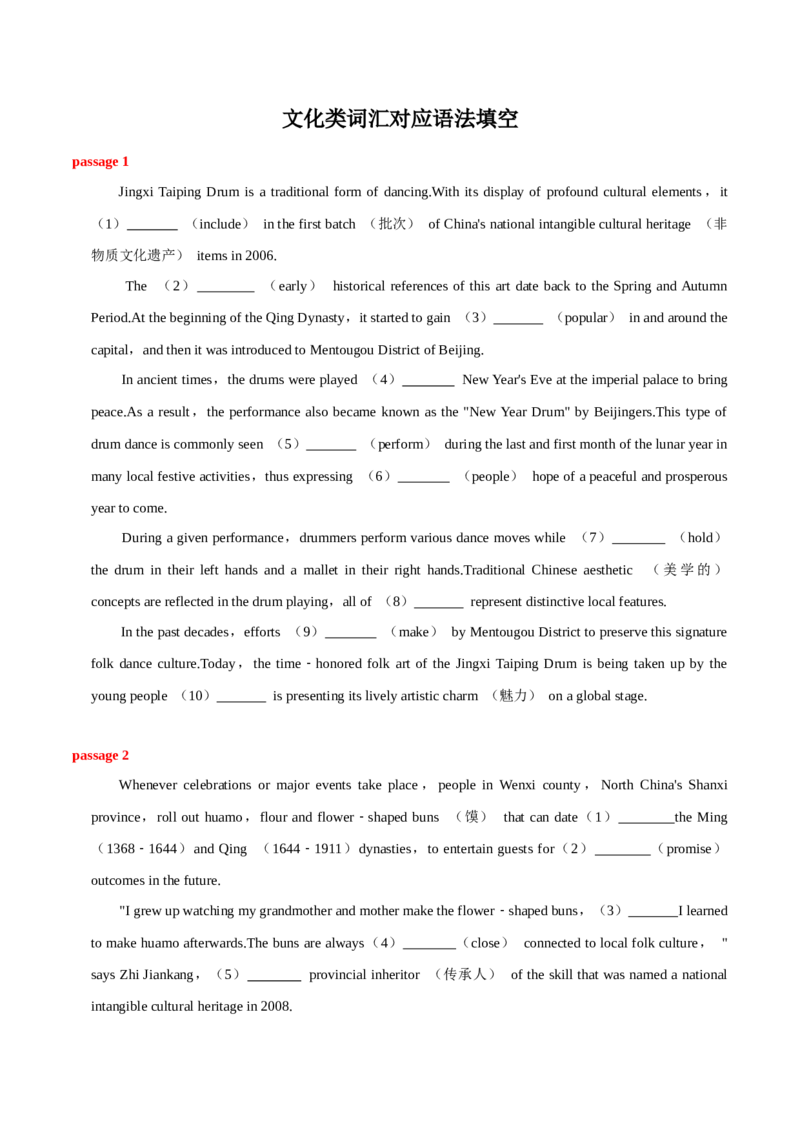
passage 1
Jingxi Taiping Drum is a traditional form of dancing.With its display of profound cultural elements,it
(1) (include) in the first batch (批次) of China's national intangible cultural heritage (非
物质文化遗产) items in 2006.
The (2) (early) historical references of this art date back to the Spring and Autumn
Period.At the beginning of the Qing Dynasty,it started to gain (3) (popular) in and around the
capital,and then it was introduced to Mentougou District of Beijing.
In ancient times,the drums were played (4) New Year's Eve at the imperial palace to bring
peace.As a result,the performance also became known as the "New Year Drum" by Beijingers.This type of
drum dance is commonly seen (5) (perform) during the last and first month of the lunar year in
many local festive activities,thus expressing (6) (people) hope of a peaceful and prosperous
year to come.
During a given performance,drummers perform various dance moves while (7) (hold)
the drum in their left hands and a mallet in their right hands.Traditional Chinese aesthetic (美学的)
concepts are reflected in the drum playing,all of (8) represent distinctive local features.
In the past decades,efforts (9) (make) by Mentougou District to preserve this signature
folk dance culture.Today,the time﹣honored folk art of the Jingxi Taiping Drum is being taken up by the
young people (10) is presenting its lively artistic charm (魅力) on a global stage.
passage 2
Whenever celebrations or major events take place,people in Wenxi county,North China's Shanxi
province,roll out huamo,flour and flower﹣shaped buns (馍) that can date(1) the Ming
(1368﹣1644)and Qing (1644﹣1911)dynasties,to entertain guests for(2) (promise)
outcomes in the future.
"I grew up watching my grandmother and mother make the flower﹣shaped buns,(3) I learned
to make huamo afterwards.The buns are always(4) (close) connected to local folk culture, "
says Zhi Jiankang,(5) provincial inheritor (传承人) of the skill that was named a national
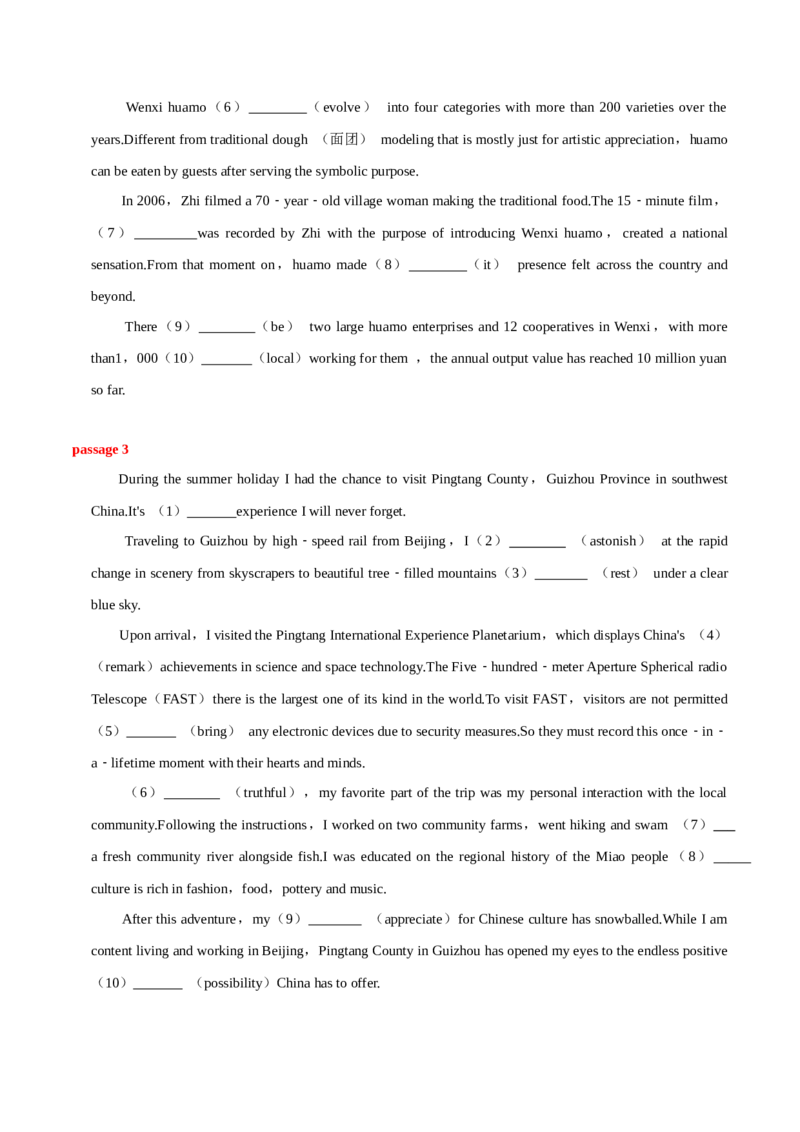
intangible cultural heritage in 2008.Wenxi huamo(6) (evolve) into four categories with more than 200 varieties over the
years.Different from traditional dough (面团) modeling that is mostly just for artistic appreciation,huamo
can be eaten by guests after serving the symbolic purpose.
In 2006,Zhi filmed a 70﹣year﹣old village woman making the traditional food.The 15﹣minute film,
(7) was recorded by Zhi with the purpose of introducing Wenxi huamo,created a national
sensation.From that moment on,huamo made(8) (it) presence felt across the country and
beyond.
There(9) (be) two large huamo enterprises and 12 cooperatives in Wenxi,with more
than1,000(10) (local)working for them ,the annual output value has reached 10 million yuan
so far.
passage 3
During the summer holiday I had the chance to visit Pingtang County,Guizhou Province in southwest
China.It's (1) experience I will never forget.
Traveling to Guizhou by high﹣speed rail from Beijing,I(2) (astonish) at the rapid
change in scenery from skyscrapers to beautiful tree﹣filled mountains(3) (rest) under a clear
blue sky.
Upon arrival,I visited the Pingtang International Experience Planetarium,which displays China's (4)
(remark)achievements in science and space technology.The Five﹣hundred﹣meter Aperture Spherical radio
Telescope(FAST)there is the largest one of its kind in the world.To visit FAST,visitors are not permitted
(5) (bring) any electronic devices due to security measures.So they must record this once﹣in﹣
a﹣lifetime moment with their hearts and minds.
(6) (truthful),my favorite part of the trip was my personal interaction with the local
community.Following the instructions,I worked on two community farms,went hiking and swam (7)
a fresh community river alongside fish.I was educated on the regional history of the Miao people(8)
culture is rich in fashion,food,pottery and music.
After this adventure,my(9) (appreciate)for Chinese culture has snowballed.While I am
content living and working in Beijing,Pingtang County in Guizhou has opened my eyes to the endless positive
(10) (possibility)China has to offer.passage 4
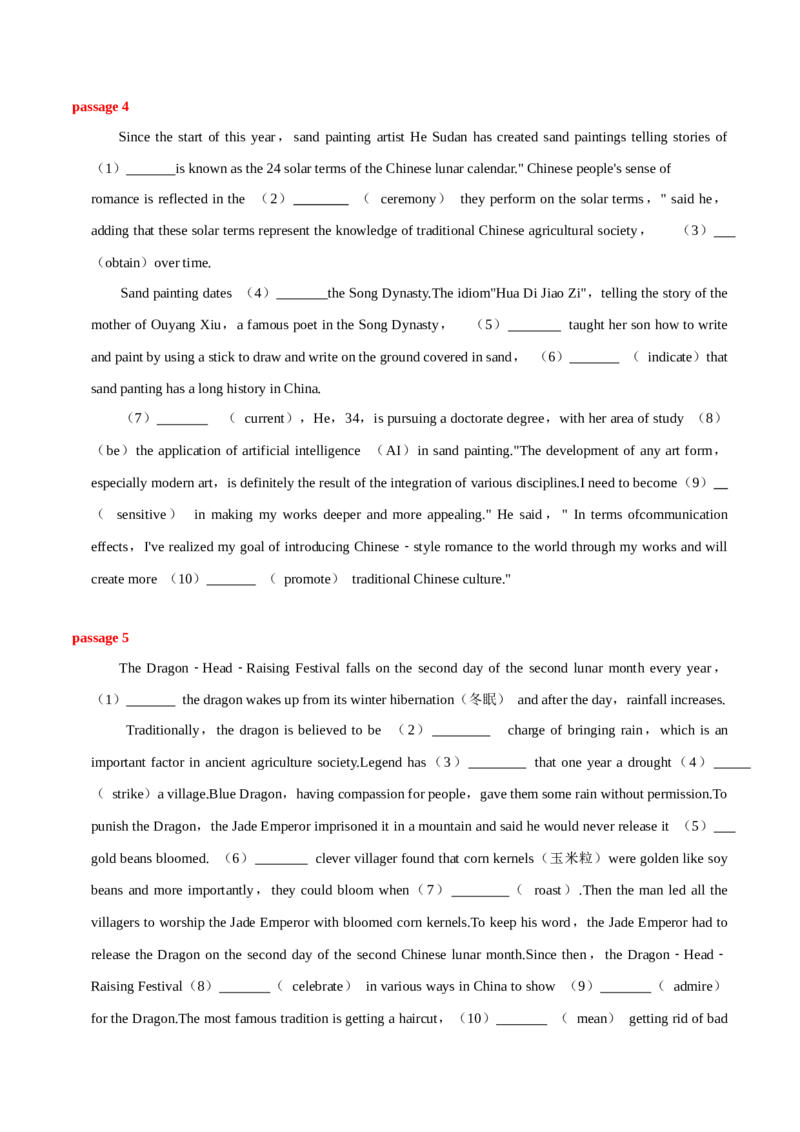
Since the start of this year,sand painting artist He Sudan has created sand paintings telling stories of
(1) is known as the 24 solar terms of the Chinese lunar calendar." Chinese people's sense of
romance is reflected in the (2) ( ceremony) they perform on the solar terms," said he,
adding that these solar terms represent the knowledge of traditional Chinese agricultural society, (3)
(obtain)over time.
Sand painting dates (4) the Song Dynasty.The idiom"Hua Di Jiao Zi",telling the story of the
mother of Ouyang Xiu,a famous poet in the Song Dynasty, (5) taught her son how to write
and paint by using a stick to draw and write on the ground covered in sand, (6) ( indicate)that
sand panting has a long history in China.
(7) ( current),He,34,is pursuing a doctorate degree,with her area of study (8)
(be)the application of artificial intelligence (AI)in sand painting."The development of any art form,
especially modern art,is definitely the result of the integration of various disciplines.I need to become(9)
( sensitive) in making my works deeper and more appealing." He said," In terms ofcommunication
effects,I've realized my goal of introducing Chinese﹣style romance to the world through my works and will
create more (10) ( promote) traditional Chinese culture."
passage 5
The Dragon﹣Head﹣Raising Festival falls on the second day of the second lunar month every year,
(1) the dragon wakes up from its winter hibernation(冬眠) and after the day,rainfall increases.
Traditionally,the dragon is believed to be (2) charge of bringing rain,which is an
important factor in ancient agriculture society.Legend has(3) that one year a drought(4)
( strike)a village.Blue Dragon,having compassion for people,gave them some rain without permission.To
punish the Dragon,the Jade Emperor imprisoned it in a mountain and said he would never release it (5)
gold beans bloomed. (6) clever villager found that corn kernels(玉米粒)were golden like soy
beans and more importantly,they could bloom when(7) ( roast).Then the man led all the
villagers to worship the Jade Emperor with bloomed corn kernels.To keep his word,the Jade Emperor had to
release the Dragon on the second day of the second Chinese lunar month.Since then,the Dragon﹣Head﹣
Raising Festival(8) ( celebrate) in various ways in China to show (9) ( admire)
for the Dragon.The most famous tradition is getting a haircut,(10) ( mean) getting rid of badluck.
passage 6
In ancient China which was far away from modern medical technology,Chinese people(1)
(cure) themselves by a wide range of traditional Chinese medical practices,(2) (include)
herbal medicine,acupuncture,cupping,Qigong and so on.
According(3) research,Traditional Chinese Medicine (TCM) was very popular during the
Qin and Han dynasties and many books on TCM(4) (write),which are lost today.In the
following dynasties,more medical writings came out gradually,among(5) the "Sheng Nong's
Herbal Classic" and the "Compendium of Materia Medica" are the most famous ones.
Nowadays,TCM is still very popular among Chinese people even if the western medical technology
produces effect(6) (fast).The most important reason for that is Chinese people believe that TCM
makes less side﹣effects.For a long time,TCM makes(7) deep influence on Japanese,Korean
and Vietnamese medical science.Today,TCM is classified as alternative medicine.In China, (8)
(course) of both western medicine and TCM are(9) (common) provided in medical
colleges,and students can even choose a college of traditional Chinese medicine where they have a chance
(10) (study) more about TCM.
passage 7
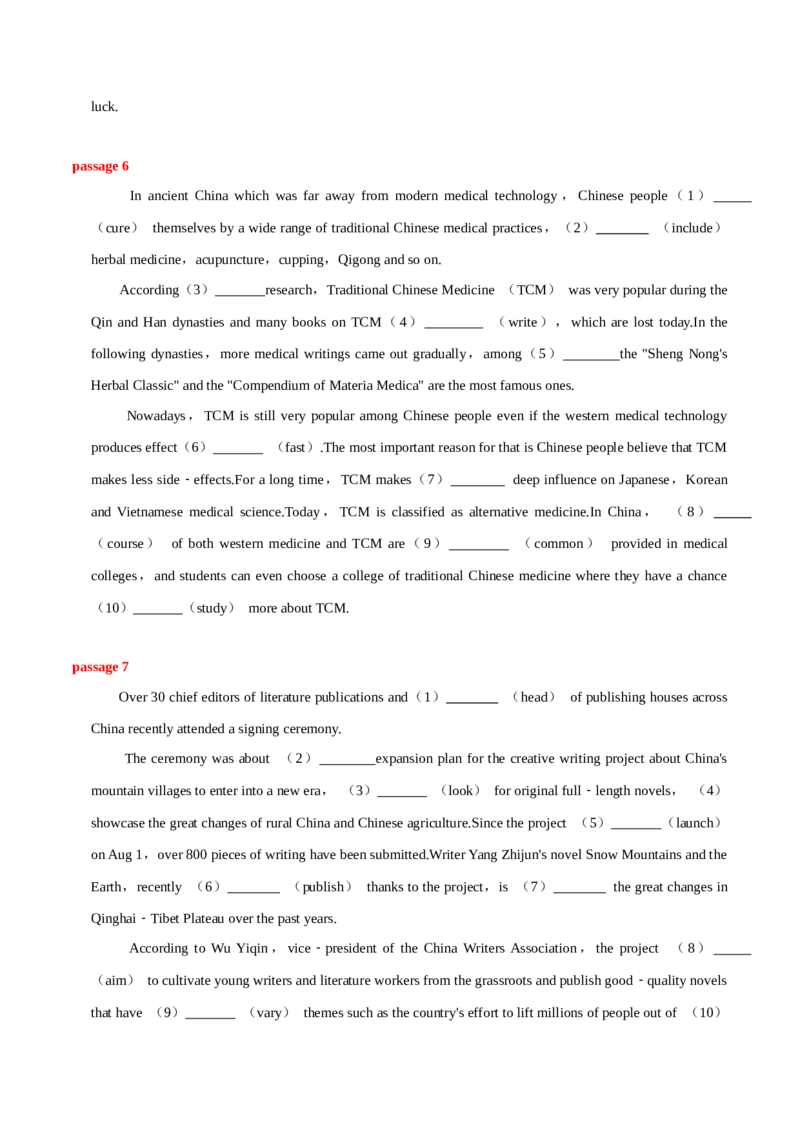
Over 30 chief editors of literature publications and(1) (head) of publishing houses across
China recently attended a signing ceremony.
The ceremony was about (2) expansion plan for the creative writing project about China's
mountain villages to enter into a new era, (3) (look) for original full﹣length novels, (4)
showcase the great changes of rural China and Chinese agriculture.Since the project (5) (launch)
on Aug 1,over 800 pieces of writing have been submitted.Writer Yang Zhijun's novel Snow Mountains and the
Earth,recently (6) (publish) thanks to the project,is (7) the great changes in
Qinghai﹣Tibet Plateau over the past years.
According to Wu Yiqin,vice﹣president of the China Writers Association,the project (8)
(aim) to cultivate young writers and literature workers from the grassroots and publish good﹣quality novels
that have (9) (vary) themes such as the country's effort to lift millions of people out of (10)(poor)and rural vitalization.
passage 8
The full moon lights up the sky on the evening of the Lantern Festival.The festival,which falls (1)
the 15th day of the first month in the Chinese lunar calendar,marks the end of more than two weeks of Chinese
New Year (2) (celebrate) each year.
Solving "lantern riddles" is among the many popular traditional activities for the festival,which include
eating tangyuan,enjoying the full moon,and (3) (lose) in colorful lighted
lanterns.These guessing games (4) (refer) to as lantern riddles because they involve riddles
written on lanterns or on slips of paper (5) (attach) to lanterns.They often contain messages
of great (6) (wise) and good fortune,and give children and others of all ages the
opportunity to have fun while practicing language and problem﹣analyzing skills.A good many of(7)
classic riddles connect with Chinese characters,historical figures,literary references,or names of cities and
other places in China.People must guess the answer by thinking about the(8) (variety) meanings
of the words and phrases that make up the riddle.(9) (basic),a tip may be provided,such as
indicating (10) the answer is a person,a place,or a thing.
passage 9
Diaojiaolou is a traditional residence of several ethnic minorities in China such as the Miao,Zhuang,
Buyi and Tujia people.You can find a group of these houses (1) (locate) beside a river or in the
mountainous areas of Yunnan , Guangxi , Hunan and Sichuan.The history of Diaojiaolou ( 2 )
(stretch) back 1400 years.
The traditional residence,typically two to three stories high,is a wooden house built on stilts (柱
子).The unusual structure is considered (3) masterpiece of clever carpentry.The high hanging
floors of the structure (4) (hold) up by wooden stilts,which give the house an unsteady
appearance from afar.But a Diaojiaolou is,in fact,firmly fixed because its stilts are further reinforced by
stone blocks at their bases.Even if one of the stilts were destroyed,the building would still have a strong
foundation.The ground floor tends (5) (use) as storage space for firewood and farming
equipment.Livestock stay on the ground floor,while people always live (6) it.
One of the (7) (benefit) of Diaojiaolou is that, (8) in ancient times,these
stilted buildings would provide protection from fierce beasts.Nowadays they continue to provide protectionfrom venomous snakes and insects that are not uncommon throughout China.These buildings also help prevent
humidity﹣related diseases that are common in southern China. (9) (additional),the cool
breeze blowing through the windows of the upper levels acts like a kind of natural air conditioner.In
mountainous regions,the level of humidity on the ground during summer is almost (10) (bear)
and potentially dangerous,so elevated living spaces are particularly necessary.
passage 10.
The Great Wall
As a symbol of ancient Chinese civilization,the Great Wall is one of the world's oldest and most
magnificent (壮丽的) man﹣made scenes, (1) has a long history.Given its out﹣standing
architectural achievement and remarkable historical influence,the Great Wall (2) (list) as a
UNESCO World Cultural Heritage site in 1987,the first of (3) (it) kind in China.
The Great Wall was (4) (original) built over 2,000 years ago during the West Zhou
Dynasty,and served (5) a functional military defence.It had been playing a crucial role in wars in
ancient Chinese history.Therefore,it was continually to be extended in the next 2,000 years,till the end of
Ming Dynasty.As a result,the Great Wall was expanded to many places in China and formed a beautiful shape.
Because its (6) (long) is 21,196.18 km,it is widely named "Wanli Changcheng".There
are Northern Great Wall and Southern Great Wall,according to the locations.
The Great Wall is a place steeped in history and has much (7) (offer) you.For those who
are fascinated (入迷的) by it and (8) (greed) for the knowledge of it,you will find
massive information about it , the historical development , the background stories and its facts and
figures.Whether you are a history﹣loving traveler (9) a lover of natural landscape,you will never
get tired of the Great Wall,one of the seven (10) (wonder) in the world.
passage 11
Xie Hongxing,a craftsman born and raised around Wuyi Mountain,Fujian Province,spent 46 days
trying to make another"orbiting Tiangong space station".His achievement of craftsmanship was more than
extraordinary when you realize that he was using a(1) ( nature) material,bamboo,to weave
(编) it.It took him seven hours to figure(2) how to weave a small national flag of China with
dyed bamboo strips." It's a new way to promote the intangible cultural heritage(非物质文化遗产),(3)
(combine)tradition and modernity,"said Xie.After years of hard work,Xie fulfilled his wish,getting
bamboo weaving of Wuyi Mountain (4) ( recognize) as a provincial intangible cultural heritage.
"The great reputation of Wuyi Mountain's tea overshadows its bamboo weaving tradition,(5)
used to be popular when I was a child,As the tea industry began to thrive,some craftsmen changed their
career,"he said.
He recalled that the local bamboo weaving(6) ( product) used to be exported abroad,
especially to Japan.Back then,many articles of everyday use were made from bamboo.How﹣ever,by now,
most of these(7) ( replace) by plastic.
Like other inheritors of intangible cultural heritage,Xie finds(8) is not easy to pass on the
craft,but he's trying his best." You have to tolerate much(9) ( hard) before achieving success.It
takes at least one or two years before you can make money.You may easily give up," he says.Every year,he
joins activities and contests(10) ( exchange) with other bamboo weavers from across the country
to spread the art form.
passage 12
Acrobatics,whose Chinese name is Zaji.Modern acrobatics mainly depends on performer's soft body
(1) ( complete)a series of highly difficult movement.It can(2) (find)in many of
the performing arts and many sports.Acrobatics is often associated with the activities(3) make
extensive use of gymnastic skills,such as circus and gymnastics,but many other athletic activities,such as
Wu shu,ballet and diving,may also employ(4) (element)of acrobatics.The items in Chinese
acrobatics include lion dance,oral stunts,pagoda of bowls,juggling,wire walking,etc.
Chinese Zaji can date back (5) Neolithic times.As one of the traditional art forms,acrobatics
has been popular among the Chinese people for more than 2,000 years.As early as the Warring States,there
appeared early stages of acrobatics.By (6) time of Han Dynas﹣ty,the acrobatics art further
developed both in content and form and there appeared superb performances with music accompaniment on the
stage.In the Tang Dynasty,the most flour﹣ishing period in ancient China,the number of acrobats increased
(7) ( significant) and their performing skills gained much improvement.
There is much (8) ( stable) involved in dangerous movements and quietness in actions.The
modern acrobatics aim at creating graceful stage images, (9) ( harmony)musicalaccompaniment,and good supporting effects,props and lighting.In the past 10 years,many Chinese
acrobatic troupes(表演团)(10) ( visit) more than one hundred countries and regions around
the world,winning dozens of prizes in the international acrobatic festivals and championships.
passage 13
An animated series featuring monster﹣like characters,or yao in Chinese,has won praise online(1)
adopting traditional Chinese culture and aesthetics (美学) in its animation and storytelling in a way that has
resonated (共鸣) with many.
Yao﹣Chinese Folktales (《中国奇谭》) is(2) eight﹣part series inspired by various
traditional Chinese literature titles and showcases a range of artistic(3) (style) such as paper
cutting,watercolor painting,and computer graphics (绘图).The first episode (集)(4)
(base) on the classic Chinese novel Journey to the West,with characters preparing to capture a Tang
dynasty Buddhist monk.
It is its plot which shows one of the characters being punished after their leader was dissatisfied with their
work(5) has resonated with a wide audience,(6) (remind) them of dilemmas and
suffering at the workplace.
The new series is part of the growing trend of Chinese animation turning to ancient Chinese legends and
folktales for(7) (inspire).Domestically produced animated films featuring classic figures such as
Monkey King,Ne Zha,and White Snake(8) (prove) to be big hits in recent years,with the
latest release New Gods:Yang Jian amassing (积累) 550 million yuan in ticket sales last year.
Yao﹣Chinese Folktales was(9) (joint) produced by Shanghai Animated Film Studio and
streaming site Bilibili.Since it aired Sunday,the first two episodes(10) (release) so far have
gathered over 10 million views and it currently has a score of 9.6 out of 10 on rating site Douban.
passage 14
The Grand Canal is the longest and(1) (old) canal in the world.It forms a vast inland
waterway system in China,running from the capital Beijing in the north (2) Zhejiang Province in
the south.
(3) (construct) in sections from the 5th century BCE and completed and maintained by
several (4) (dynasty),it formed the backbone of China's inland communications system,which enabled the supply of rice(5) (feed) the population.The Grand Canal reached a new peak
in the 13th century,providing an inland shipping network consisting of more than 2,000 km of artificial
waterways,(6) linked five of the most important river basins in China,including the Huanghe
River and the Changjiang River.Still(7) major means of internal communication today,it(8)
(play) an important role in ensuring the prosperity (繁荣) and stability of China over the ages.
The Grand Canal bears witness to a remarkable and early development of hydraulic engineering(水利工
程).It is an essential technological achievement (9) (date) from before the Industrial
Revolution.It is a perfect example of dealing with difficult natural conditions,as is reflected in the many
constructions that are(10) (full) adapted to the diversity and complexity of circumstances.It best
demonstrates the technical capabilities of Eastern civilizations.
passage 15
In 1998,an eco﹣museum was established in Suojia Miao,Yi and Hui Township,China's Guizhou
Province.Consisting of 12 villages,including Gaoxing Village,the eco﹣museum is different from traditional
ones.It isn't enclosed by walls and(1) it showcases is more than various collections.
Xiong Shaozhen,a 77﹣year﹣old resident of Gaoxing Village,weaves every day with a loom (织布
机) in a wooden house,her daughter﹣in﹣law busy(2) ( learn )the craft from her."The
costumes,language,music and even the way of production of the local community are all living (3)
(significance) exhibits," said Luo Gang,head of the museum.
A decade ago,Gaoxing Village(4) (list) in a traditional Chinese villages catalog (目录).
However,Luo found there were few looms left in the village.He(5) (apply) for a budget from
relevant departments and invited professional craftsmen to produce looms for the villagers.He asked each
villager that received the machine(6) (use)it and train an inheritor (继承者) of the local
weaving technique.In addition,most of the old folk houses with their(7) (roof) made of straw
needed regular replacement and Luo had their original appearance (8) (restore).
There are 25 such eco﹣museums in the province,which are in line (9) sustainable
development principles.Not only do they guide villagers to perform independent﹣management and activate
their passion for preserving their traditional cultures,but they create more jobs and give (10) boost
to local tourism.passage 16
Shanxi kuaiban is a(1) (tradition) Chinese form of storytelling in the Shaanxi local
language to the strong regular repeated sound of bamboo clappers.On June 10,2021,the Ministry of Culture
and Tourism (2) (recognize) a new group of 325 national intangible (非物质的) cultural
heritage items in Beijing,increasing the list established in 2006 to 1,557 items.Shaanxi kuaiban, (3)
can date back to the late Qing Dynasty ( 1644 — 1911 ) , has been included.It can ( 4 )
(perform) by a group or alone.With one or two pairs of kuaiban of different sizes in hand,the performers
speak in the local language while(5) (tell) stories,which are usually about sufferers or heroes.
Shanxi kuaiban is (6) popular that there are many professional artists and performers in
China.According to its performers,the art was originally used by farmers (7) (share) their
knowledge and earn money. (8) time going by,more and more people perform Shaanxi kuaiban in
different particular events — for example,at festival celebrations, (9) (party) and art
shows.Supported by the government,it has been one of the (10) (good) art forms in Shaanxi
and has been introduced to local schools as part of their art education.
passage 17
You've never heard songs quite like this before.In fact,it seems that Moyun of Hong Kong can transform
just about any song into something completely new (1) the help of the Guzheng.This traditional
Chinese instrument (2) (make) of 16 or more strings and movable bridges.Together,it produces
some of the sweetest sounds that pair surprisingly well with (3) was originally a rock song.
"Traditional Chinese instruments aren't suited for (4) (adapt) a band's entire sound,"
Moyun said. "Guzheng is like the bass.It's hard to create variations with it." Despite the ( 5 )
(limitation),Moyun has mastered the process of changing popular music for the Guzheng.In one of her
many videos (6) (share) on YouTube,she does this with "Thunderstruck" by AC/DC.During
her (7) (perform),Moyun is constantly moving both of her hands,each movement (8)
(effortless) methodical and fascinating to watch.When she's not plucking(弹拨) one of the instrument's
many stings,she is beating it like a drum.
By sharing videos like these,Moyun hopes that more people will come to appreciate this unique
instrument. "Chinese culture tends (9) (be) abstract," she said. "It's not really accessible.But
pop culture is accessible.By putting (10) two together,I hope the audience can appreciate mymusic."
passage 18
The Singing Sands Mountain,as a hot tourist attraction, (1) (locate) in Dunhuang in
Western China.As you walk through the quicksand or slide down a sand mountain,sometimes you can hear
loud noises from beneath your feet.This is how it got the name "The Singing Sands Mountain".
(2) (nest) between the tall sand mountains,there lies a spring.It has existed for thousands of
years and never dried up.The spring, (3) (shape) like a moon,is called the Crescent Spring
(月牙泉).
The formation and (4) (exist) of the spring are related to its landform.The flowing water
comes together here and overflows through a geological layer to form the Crescent Spring.It's (5)
(extreme) dry here,with the amount of annual evaporation (蒸发)being more than 60 times (6)
of the annual rainfall.However,the stable water source ensures a (7) (sustain) water supply
to the spring.
The Crescent Spring is also due to the low﹣lying terrain (地势).Whenever there is a sandstorm,it
forms (8) upward air flow between the surrounding sand mountains to send the sand at the foot
back to the top of the sand mountain and saves it (9) being swallowed by quicksand.The Crescent
Spring, (10) terrain and landscape are really distinctive,has become a romantic scenic spot.
passage 19
Decorated with Chinese﹣style red lanterns,the pavilion(展馆)of translated Chinese books saw a big
turnout of book lovers at the 54th edition of Cairo International Book Fair,the largest book fair in Egypt.
The pavilion(1) (display) during the fair about 1,000 book titles in Arabic and English on
Chinese culture,history,literature,economy,and among many others.Visitors(2) different ages
frequented the pavilion of Chinese books.Some parents picked children's books for their kids and some young
people(3) (attract) to books on Chinese culture,history and development.
A high school student,(4) was picking a book on Chinese history,said that China has
overcome numerous problems throughout its history while(5) Chinese wisdom is shown in their
literature,thoughts and philosophy.Noura Gamal,a junior student of Chinese,said(6) attracted
him most was the Chinese culture and people.He wanted (7) (learn)more about China,anancient civilization with a unique language,history,literature and culture.
The Chinese pavilion participates in the fair with many rich book titles that increase every year in a very
successful effort to bring the (8) (culture) of Egypt and China closer.It is (9)
( wide ) acknowledged that China's great development is one of the reasons for the ( 10 )
(grow) popularity of Chinese books.
passage 20
The Forbidden City,also (1) (refer) to as the Palace Museum in the modern days,is
located in the heart of Beijing.It is an ancient (2) (architecture) complex with a history of over
600 years.
The aerial view of the Forbidden City shows it is a symmetrical layout.The three main halls﹣the Hall of
Supreme Harmony,the Hall of Central Harmony and the Hall of Preserving Harmony comprise the Forbidden
City's central line, (3) is flanked (两侧有) by more than 70 palaces with over 9,000
rooms.The buildings are all covered with golden roofs with red columns and high walls beneath, (4)
(symbolize) the noble status of the royal family.In addition to (5) (it) magnificent
appearance,the Palace Museum also houses over one million pieces of cultural relics and treasures.
In recent years,the Forbidden City has become (6) Internet celebrity,launching thousands
of cultural and artistic products.These products are well enjoyed by (7) (consumer),combining
the traditional imperial elements with modern technology.Up to now,a "Digital Forbidden City" (8)
(create).The development of the Internet and AR technology has allowed people to visit the palace in an
immersive way and to observe the panorama and details of the imperial treasures.
As a new day begins,the ancient Forbidden City continues to welcome visitors at home and abroad.Be it
onsite or online,your visit (9) the Forbidden City may help you travel through time and space
and(10) (true) appreciate the time﹣honored Chinese culture.
passage 21
Inspired by Chinese jade ornaments(玉制品),the medals of the Beijing 2022 Olympic Winter Games
were announced (1) (official) on Oct.26,2021,100 days ahead of the opening of the sporting
event.After months of expectation and secrecy , the organizing committee of the Beijing 2022 Games
introduced the medals — named tong xin, (2) means togetherness — during a ceremony (3)(mark) the countdown to the opening of the event on February 4th.
The medals shave carvings of the Olympic rings (4) one side and are carved with the words
"XXIV Olympic Winter Games Beijing 2022".The concentric rings around the center represent the pursuit of
unity(5) harmony,while echoing the Olympic values of solidarity,inclusiveness and promoting
peace.The other side of the medals has the Beijing 2022 emblem(徽章) at the center.
Engravings(版画) of cloud patterns,an element (6) (use) on the torch of the 2008
Beijing Summer Olympics,snowflakes and ice markings fill the outer rings.The outer rings (7)
( decorate ) with 24 stars strung together by circles , representing the 24th edition of the Winter
Olympics.Visually,it looks quite simple and plain at first glance,while (8) (detail) such as
the carving of clouds and snowflake patterns as well as the uneven casting on the surface have made it special.
Designers' (9) (inspire) from jade for a second time honors the Chinese capital's unique
status﹣the first city (10) (host) both the Summer and Winter Olympics.
passage 22
The traditional Chinese lunar calendar divides the year into 24 solar terms( 节 气 ).Autumn Equinox
( 秋 分 ),the(1) (sixteen) solar term of the year,begins this year on September 23rd and
ends on October 7th.Autumn Equinox(2) (lie) at the midpoint of autumn,dividing autumn
into two equal parts.
As is said in(3) ancient book, "It is on Autumn Equinox day(4) the Yin and Yang
are in a balance of power.Thus,the day and night are of equal length,and (5) are the cold and hot
weather." After that day,the location of direct sunlight moves to the south,(6) (make) days
shorter and nights longer.
By Autumn Equinox,most of the areas in China have entered the cool autumn.When the cold air meets
the declining warm and wet air,rainfalls are the result.The temperature also drops(7) (frequent).
On Autumn Equinox day,thousands of people around the world try to make eggs stand on end.According
to(8) (expert),on the Spring Equinox and Autumn Equinox,the earth's axis is in a relative
balance of power with the earth's orbit around the sun.But some also say that standing the egg has nothing to do
with the time.The most important thing is to shift the egg' s center of gravity to the(9) (low) part
of the egg.(10) this way,the trick is holding the egg until the yolk sinks as much as possible.passage 23
The Silk Road seems rather familiar to people,but not everyone knows about the Hexi Corridor (河西
走廊) and the Qilian Mountains.
The(1) (long) of the Hexi Corridor is about 1,000 kilometers.It's(2) golden
channel in the history of cultural exchange between China and the West.In ancient times,the Silk Road passed
through here to Central and West Asia.The Qilian Mountains is the source of some rivers (3) flow
in the Hexi Corridor.
(4) (dominate) by the continental highland climate,the Qilian Mountains' climate is
mostly dry and cold with frequent winds.The glaciers (冰川) in the mountains are major water resources of
the Hexi Corridor.More than 3,000 glaciers(5) (exist) in the mountain range are equal(6)
tens of billions of cubic meters of water.The animals,plants and people along the Hexi Corridor highly depend
on the melting water from the Qilian Mountains(7) (survive).
However , due to climate change , glaciers in the Qilian Mountains are decreasing ( 8 )
(rapid).As the important source of water,the glaciers' change is crucial to the region's(9)
(sustain) development.The Qilian Mountain National Park,one of the country's first pilot national parks,
(10) (complete) in 2020 to better protect these areas.
passage 24
When it comes to ancient civilizations,most people think of the Greeks and Romans.It's understandable as
both(1) (shape) modern society in some way so far,whether it be their social,cultural,or
political influences.However,dozens of civilizations had been around long (2) the Greeks and
Romans,the lesser﹣known Jiahu people (3) (include).
The Jiahu settlement is located in the central plain of ancient China, (4) area known 1 today
as the Henan Province.The people created the country's oldest recognized civilization.The area is rich in
artifacts,(5) (make) it an archaeologist's dream.Apart from the usual finds,people have
uncovered records of the earliest examples of Chinese writing and proof (6) they were producers of
the world's oldest wine.Another remarkable discoveries was the oldest working bone flutes (长笛). (7)
(typical) carved from the wing bone of a crane,they were most likely used in special ceremonies.Rough
weaving tools and bone needles also (8) (unearth) from the site,indicating that Jiahu residents
may have possessed basic weaving and sewing skills 8,500 years ago.The settlement's end came around 5700 BCE when the nearby rivers overflowed and flooded the area.It is
assumed that the Jiahu people left their home (9) (settle) elsewhere,even though there is no
indication as to (10) that might have been.
passage 25
The Xi ' an City Wall,(1) is a symbol of the history and culture of Xi ' an,the capital of
Shaanxi Province,has become an important city brand after continuous improvements.
The Xi ' an City Wall(2) ( build) in the early Ming Dynasty(1368﹣1644)on the
foundation of the imperial city walls of the Sui(581﹣618)and Tang(618﹣907)dynasties.It is the(3)
( old),most well preserved,and largest ancient city wall in the world.
The city wall is more than 600 years old and suffers from cracks and flaky(薄片的) soil on a daily
basis.In addition to(4) (extreme) large amounts of manual work,technology also provides(5)
protective barrier for the city wall." We have installed 8,700 metal detectors on the city wall(6) (
monitor) various dynamic data such as the pH level(7) the soil,moat(护城河) water level and
daily soil moisture(水分) changes," said Wu,who is a worker of the Xi'an City Wall Management
Committee.
In addition to the Hanguang Gate Relic Site Museum,the watchtowers on the city wall have also been
transformed into public cułtural and art(8) ( site) such as the Jinhuidui Art Museum,Armor
Museum,and City Brick Museum.So far,the city wall(9) ( launch)a series of eultural and
creative products,mystery boxes,and digital collections,(10) (attract) many visitors.
passage 26
During China's dynastic period,emperors planned the city of Beijing (1) arranged the
residential areas according to social classes.The term "hutong", (2) (original) meaning "water
well" in Mongolian,appeared first during the Yuan Dynasty.
In the Ming Dynasty,the center was the Forbidden City, (3) (surround) in concentric
( 同 心 的 ) circles by the Inner City and Outer City.Citizens of higher social classes ( 4 )
(permit) to live closer to the center of the circles.The large siheyuan of these high﹣ranking officials and
wealthy businessmen often (5) (feature) beautifully carved and painted roof beams and pillars
(柱子).The hutongs they formed were orderly,lined by (6) (space) homes and walledgardens.Farther from the center lived the commoners and laborers.Their siheyuan were far smaller in scale and
(7) (simple) in design and decoration,and the hutongs were narrower.
Hutongs represent an important cultural element of the city of Beijing.Thanks to Beijing's long history
(8) capital of China,almost every hutong has its stories,and some are even associated with
historic(9) (event).In contrast to the court life and upper﹣class culture represented by the
Forbidden City,the Summer Palace,and the Temple of Heaven,the hutongs reflect (10) culture
of grassroots Beijingers.
passage 27
What will you think of when it comes (1) a mask?Is it the ancient Chinese bronze (青铜制
成的) mask or Chinese opera facial makeup?
The origin(起源) of facial makeup(2) (use) in Peking Opera can be traced back to the
Southern and Northern Dynasties Period, (3) leading actors used to wear masks.As the operatic
art developed,performers (4) (gradual) took off the masks and painted colorful patterns on the
faces,so people could see(5) (they) facial expressions.
Chinese opera facial makeup is a special technique with Chinese cultural characteristics.It combines
personalities and symbols together(6) has become an important part of Chinese culture.
There are four roles in facial makeup,sheng,dan,jing and chou.The painting technique is closely
related to the character's personality.Therefore,facial makeup plays a significant role in modeling of opera
(7) (figure) and has a strong appeal because of it.
Red is the color of loyalty and courage.Black(8) (suggest) a serious and uncommunicative
personality.White reveals a suspicious personality.Cold faces symbolize mysteriousness and stand for gods.
In China, (9) (vary) types of Chinese opera facial makeup enable the audience (10)
(know) a character's personality and get more involved in the appreciation of the performance.
passage 28
A 63﹣year﹣old Chinese grandpa's(1) (tradition) carpentry (木工) skills attract tens
of millions of viewers online as he creates woodwork without glue,screws( 改刀 ) or nails.The Chinese
master carpenter,Wang Dewen,(2) (know) as "Grandpa Amu" on YouTube,has
been considered as the modern﹣day Lu Ban.His most popular video,(3) shows him making afantastic wooden arch bridge( 拱 桥 ),rose to fame on the platform,(4) (gain) more
than 42 million views.
Grandpa Amu follows an ancient Chinese mortise and tenon ( 榫卯 ) technique,which means no
nails or glue are applied(5) the building of the arch bridge.
For (6) (year),Wang worked as a farmer and a carpenter,making furniture
for local building projects.Several years ago,Wang left Shandong(7) (live)with his
children in Mengshan county.It was a natural step to turn his skills into an opportunity to make all kinds of toys
for his young grandson,and it was not long(8) his son and daughter﹣in﹣law decided to video
Wang's efforts.The master carpenter(9) (attract) over 1.18 million viewers on YouTube so
far.Grandpa Amu insists that he isn't an Internet celebrity ( 名人 )(10) just an ordinary farmer.
passage 29
Camping was so popular as to even become a fashion across China during the just﹣concluded National
Day holiday,with some joking that "half of the friends (1) WeChat were camping.Outdoor
camping sites were popular during the holiday and had to (2) (book) several days in advance.
According to research firm iiMedia Research,the core market size of China's camping economy reached 74.75
billion yuan ($10.5 billion) in 2021, (3) was 62.5 percent up year﹣on﹣year.
More market﹣sensitive players are plowing into the industry.In 2021,more than 20,000 new camping
﹣related enterprises sprang up in China, (4) over 5,000 have been set up this year,according
to the information provider Tianyancha.
Huzhou, (5) popular tourist destination in East China's Zhejiang province,hosted the first
Camping Conference in the Yangtze River Delta in June.It also became one of the first to (6)
(official) regulate the construction standards and (7) (safe) supervision (监管)of
camping sites. (8) (follow) Huzhou,Beijing and Nanjing in Jiangsu province have also
introduced related policies for the healthy development of the industry.
"Consumers' demand for outdoor activities (9) (increase) in recent years.I believe (10)
(many) people will join in camping and other outdoor activities in the long run,'' said Liang Qidong,vice
president of the Liaoning Academy of Social Sciences.
passage 30(1) (admire) among youngsters brings China Chic (国潮) into sharp focus.According
to a report released on Feb 3,2021 by Bilibili,more than 177 million of the platform's users were in favor of
videos featuring traditional culture.The approval reflected the situation (2) the "China Chic"
phenomenon (3) (embrace) by the younger generation in recent years.
During the 2022 Winter Olympic Games in Beijing,young athletes wore sports clothing(4)
(bear) Chinese elements such as dragons,pandas and tigers,also competition venues like the Great
Wall and auspicious (吉祥的) patterns(5) (include) in the design.China Chic could also
be seen during the opening and closing ceremonies,and in the designs of gifts and medals.
A China Chic artist Yu Yang said, "China Chic represents a kind of pride and(6) (strong)
in our culture.We used to follow the lifestyle promoted by the West,one(7) does ignore Chinese
traditions and values.As China's economy is becoming stronger,the young generation gradually get to know
who they are and(8) they really want to follow." However,(9) this trend can go on
still hangs in the balance. "Some people just simply do 'copy﹣and﹣paste' jobs.That will hurt the consumers'
passion and(10) (ultimate) ruin the trend's development.We have to deeply understand and
love our culture first as designers," Yu said.