主题04  良好的人际关系与社会交往

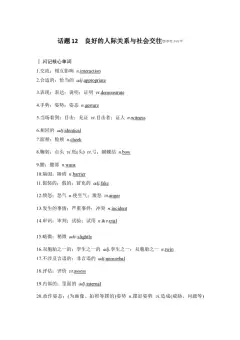
01 话题词汇佳句
02 时文热点阅读(全文翻译,词汇积累,长难句分析)
03 高考真题链接
04 话题阅读精练
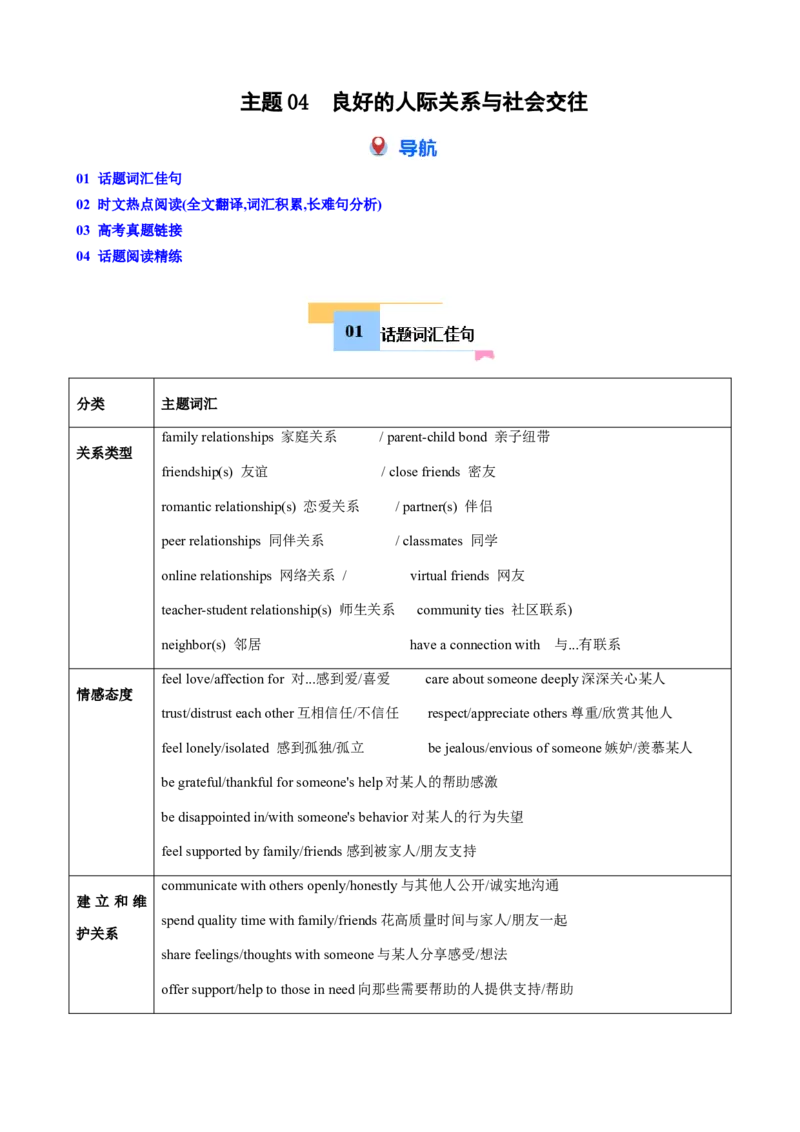
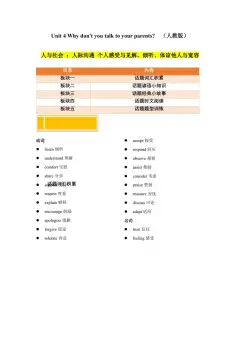
分类
主题词汇
关系类型
family relationships 家庭关系      / parent-child bond 亲子纽带
friendship(s) 友谊                / close friends 密友
romantic relationship(s) 恋爱关系     / partner(s) 伴侣
peer relationships 同伴关系          / classmates 同学
online relationships 网络关系 /         virtual friends 网友
teacher-student relationship(s) 师生关系   community ties 社区联系)
neighbor(s) 邻居                     have a connection with  与...有联系
情感态度
feel love/affection for 对...感到爱/喜爱     care about someone deeply 深深关心某人
trust/distrust each other 互相信任/不信任    respect/appreciate others 尊重/欣赏其他人
feel lonely/isolated 感到孤独/孤立         be jealous/envious of someone 嫉妒/羡慕某人
be grateful/thankful for someone's help 对某人的帮助感激
be disappointed in/with someone's behavior 对某人的行为失望
feel supported by family/friends 感到被家人/朋友支持
建立和维
护关系
communicate with others openly/honestly 与其他人公开/诚实地沟通
spend quality time with family/friends 花高质量时间与家人/朋友一起
share feelings/thoughts with someone 与某人分享感受/想法
offer support/help to those in need 向那些需要帮助的人提供支持/帮助
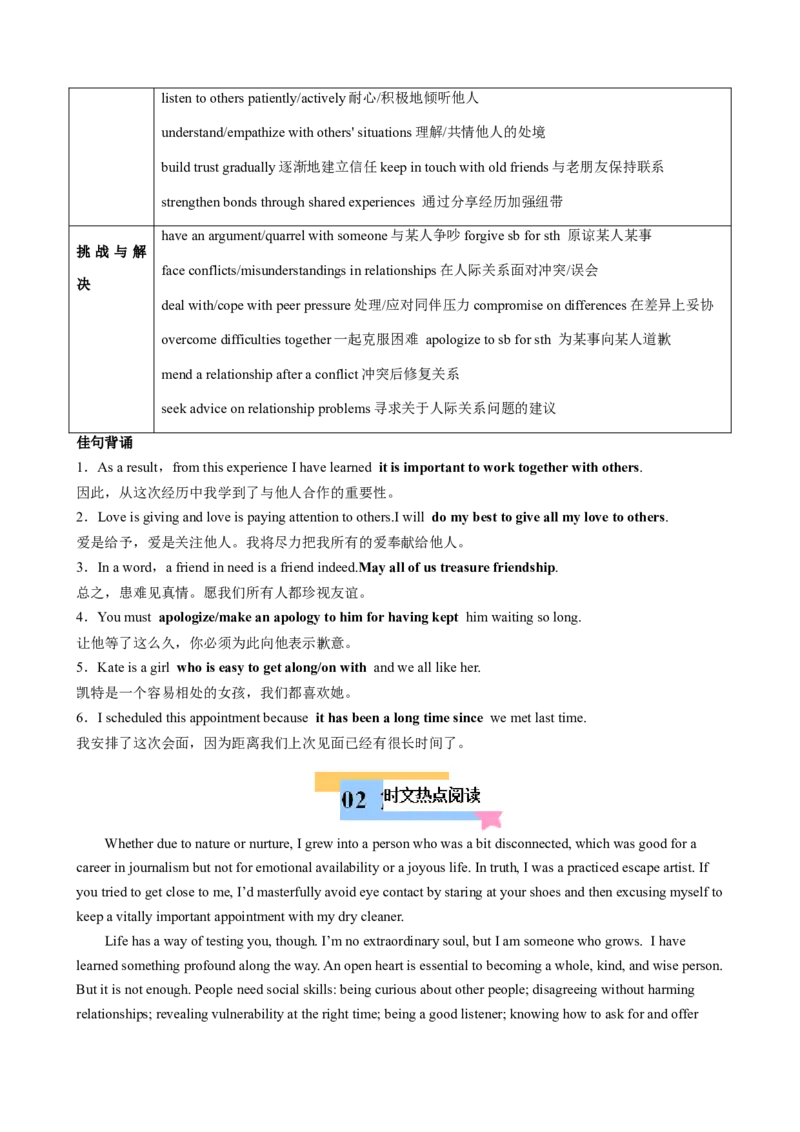
listen to others patiently/actively 耐心/积极地倾听他人
understand/empathize with others' situations 理解/共情他人的处境
build trust gradually 逐渐地建立信任keep in touch with old friends 与老朋友保持联系
strengthen bonds through shared experiences 通过分享经历加强纽带
挑战与解
决
have an argument/quarrel with someone 与某人争吵forgive sb for sth 原谅某人某事
face conflicts/misunderstandings in relationships 在人际关系面对冲突/误会
deal with/cope with peer pressure 处理/应对同伴压力compromise on differences 在差异上妥协
overcome difficulties together 一起克服困难 apologize to sb for sth 为某事向某人道歉
mend a relationship after a conflict 冲突后修复关系
seek advice on relationship problems 寻求关于人际关系问题的建议
佳句背诵
1.As a result,from this experience I have learned it is important to work together with others.
因此,从这次经历中我学到了与他人合作的重要性。
2.Love is giving and love is paying attention to others.I will do my best to give all my love to others.
爱是给予,爱是关注他人。我将尽力把我所有的爱奉献给他人。
3.In a word,a friend in need is a friend indeed.May all of us treasure friendship.
总之,患难见真情。愿我们所有人都珍视友谊。
4.You must apologize/make an apology to him for having kept him waiting so long.
让他等了这么久,你必须为此向他表示歉意。
5.Kate is a girl who is easy to get along/on with and we all like her.
凯特是一个容易相处的女孩,我们都喜欢她。
6.I scheduled this appointment because it has been a long time since we met last time.
我安排了这次会面,因为距离我们上次见面已经有很长时间了。
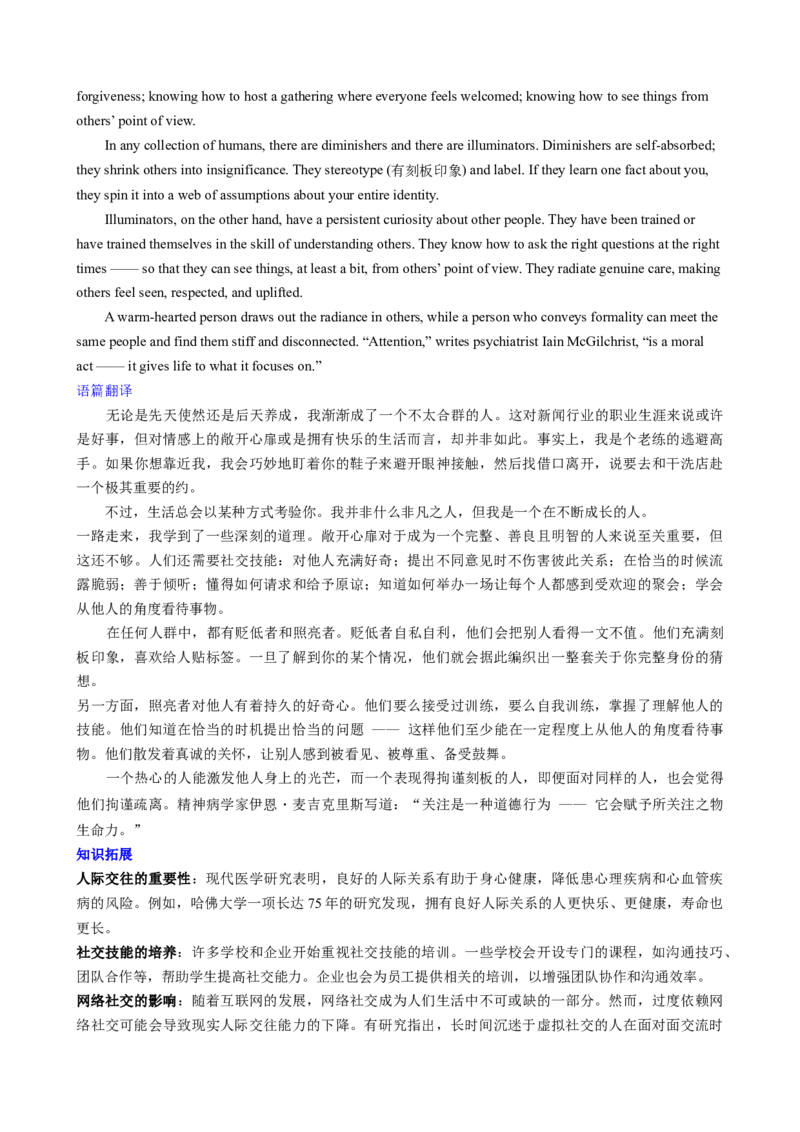
Whether due to nature or nurture, I grew into a person who was a bit disconnected, which was good for a
career in journalism but not for emotional availability or a joyous life. In truth, I was a practiced escape artist. If
you tried to get close to me, I’d masterfully avoid eye contact by staring at your shoes and then excusing myself to
keep a vitally important appointment with my dry cleaner.
Life has a way of testing you, though. I’m no extraordinary soul, but I am someone who grows. I have
learned something profound along the way. An open heart is essential to becoming a whole, kind, and wise person.
But it is not enough. People need social skills: being curious about other people; disagreeing without harming
relationships; revealing vulnerability at the right time; being a good listener; knowing how to ask for and offer
forgiveness; knowing how to host a gathering where everyone feels welcomed; knowing how to see things from
others’ point of view.
In any collection of humans, there are diminishers and there are illuminators. Diminishers are self-absorbed;
they shrink others into insignificance. They stereotype (有刻板印象) and label. If they learn one fact about you,
they spin it into a web of assumptions about your entire identity.
Illuminators, on the other hand, have a persistent curiosity about other people. They have been trained or
have trained themselves in the skill of understanding others. They know how to ask the right questions at the right
times —— so that they can see things, at least a bit, from others’ point of view. They radiate genuine care, making
others feel seen, respected, and uplifted.
A warm-hearted person draws out the radiance in others, while a person who conveys formality can meet the
same people and find them stiff and disconnected. “Attention,” writes psychiatrist Iain McGilchrist, “is a moral
act —— it gives life to what it focuses on.”
语篇翻译
    无论是先天使然还是后天养成,我渐渐成了一个不太合群的人。这对新闻行业的职业生涯来说或许
是好事,但对情感上的敞开心扉或是拥有快乐的生活而言,却并非如此。事实上,我是个老练的逃避高
手。如果你想靠近我,我会巧妙地盯着你的鞋子来避开眼神接触,然后找借口离开,说要去和干洗店赴
一个极其重要的约。
    不过,生活总会以某种方式考验你。我并非什么非凡之人,但我是一个在不断成长的人。
一路走来,我学到了一些深刻的道理。敞开心扉对于成为一个完整、善良且明智的人来说至关重要,但
这还不够。人们还需要社交技能:对他人充满好奇;提出不同意见时不伤害彼此关系;在恰当的时候流
露脆弱;善于倾听;懂得如何请求和给予原谅;知道如何举办一场让每个人都感到受欢迎的聚会;学会
从他人的角度看待事物。
    在任何人群中,都有贬低者和照亮者。贬低者自私自利,他们会把别人看得一文不值。他们充满刻
板印象,喜欢给人贴标签。一旦了解到你的某个情况,他们就会据此编织出一整套关于你完整身份的猜
想。
另一方面,照亮者对他人有着持久的好奇心。他们要么接受过训练,要么自我训练,掌握了理解他人的
技能。他们知道在恰当的时机提出恰当的问题 —— 这样他们至少能在一定程度上从他人的角度看待事
物。他们散发着真诚的关怀,让别人感到被看见、被尊重、备受鼓舞。
    一个热心的人能激发他人身上的光芒,而一个表现得拘谨刻板的人,即便面对同样的人,也会觉得
他们拘谨疏离。精神病学家伊恩・麦吉克里斯写道:“关注是一种道德行为 —— 它会赋予所关注之物
生命力。”
知识拓展
人际交往的重要性:现代医学研究表明,良好的人际关系有助于身心健康,降低患心理疾病和心血管疾
病的风险。例如,哈佛大学一项长达75 年的研究发现,拥有良好人际关系的人更快乐、更健康,寿命也
更长。
社交技能的培养:许多学校和企业开始重视社交技能的培训。一些学校会开设专门的课程,如沟通技巧、
团队合作等,帮助学生提高社交能力。企业也会为员工提供相关的培训,以增强团队协作和沟通效率。
网络社交的影响:随着互联网的发展,网络社交成为人们生活中不可或缺的一部分。然而,过度依赖网
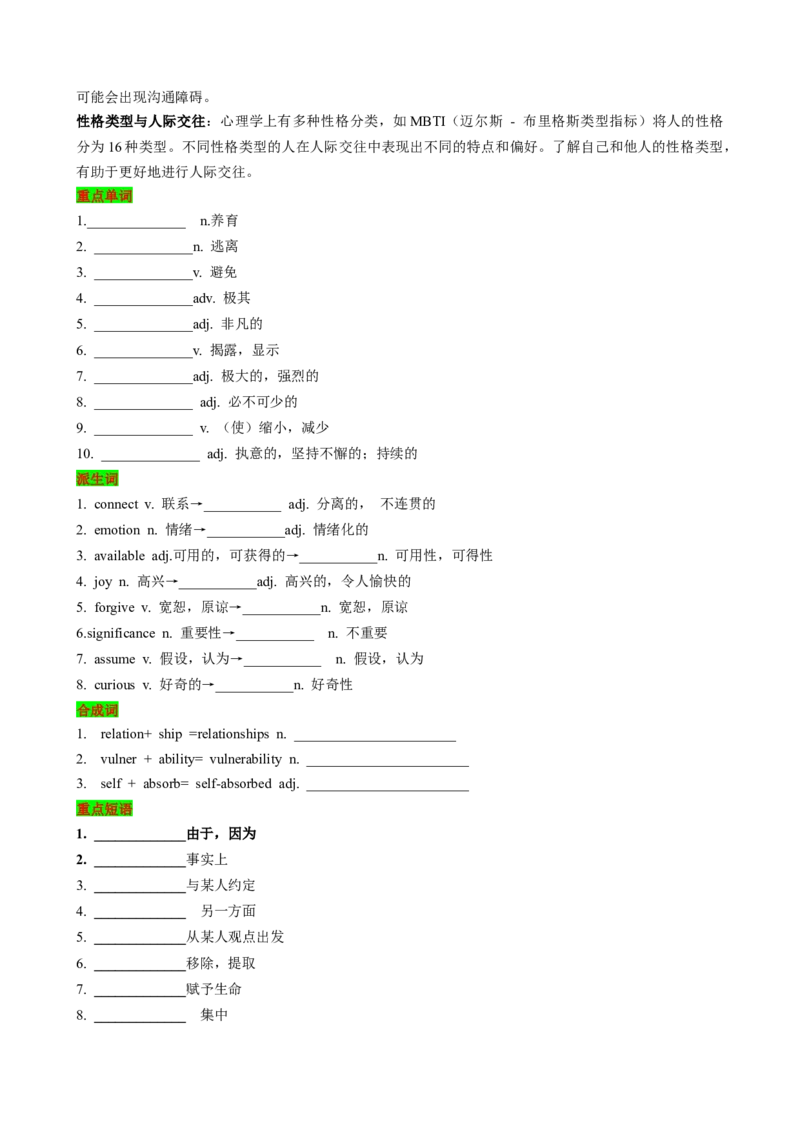
络社交可能会导致现实人际交往能力的下降。有研究指出,长时间沉迷于虚拟社交的人在面对面交流时
可能会出现沟通障碍。
性格类型与人际交往:心理学上有多种性格分类,如MBTI(迈尔斯 - 布里格斯类型指标)将人的性格
分为16 种类型。不同性格类型的人在人际交往中表现出不同的特点和偏好。了解自己和他人的性格类型,
有助于更好地进行人际交往。
重点单词
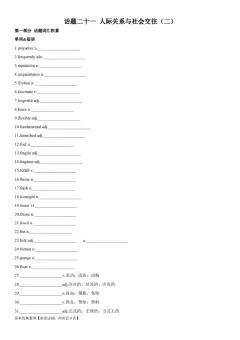
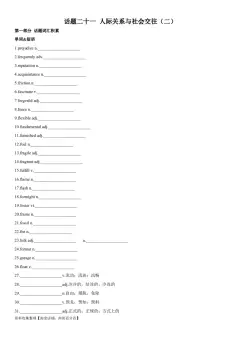
1.______________  n.养育
2. ______________n. 逃离
3. ______________v. 避免
4. ______________adv. 极其
5. ______________adj. 非凡的
6. ______________v. 揭露,显示
7. ______________adj. 极大的,强烈的
8. ______________ adj. 必不可少的
9. ______________ v. (使)缩小,减少
10. ______________ adj. 执意的,坚持不懈的;持续的
派生词
1. connect v. 联系→___________ adj. 分离的, 不连贯的
2. emotion n. 情绪→___________adj. 情绪化的
3. available adj.可用的,可获得的→___________n. 可用性,可得性
4. joy n. 高兴→___________adj. 高兴的,令人愉快的
5. forgive v. 宽恕,原谅→___________n. 宽恕,原谅
6.significance n. 重要性→___________  n. 不重要
7. assume v. 假设,认为→___________  n. 假设,认为
8. curious v. 好奇的→___________n. 好奇性
合成词
1.
relation+ ship =relationships n. _______________________
2.
vulner + ability= vulnerability n. _______________________
3.
self + absorb= self-absorbed adj. _______________________
重点短语
1. _____________由于,因为
2. _____________事实上
3. _____________与某人约定
4. _____________  另一方面
5. _____________从某人观点出发
6. _____________移除,提取
7. _____________赋予生命
8. _____________  集中
长难句分析
Whether due to nature or nurture, I grew into a person who was a bit disconnected, which was good for a career in
journalism but not for emotional availability or a joyous life.
分析:本句整体是主从复合句。“Whether due to nature or nurture”是省略结构的         从句,完整形
式可以是“Whether it was due to nature or nurture”; “who was a bit disconnected”是       从句,修饰先
行词“a person”;“which was good for a career in journalism but not for emotional availability or a joyous life”
是非限定性         从句,修饰前面整个主句内容。
译文: 不管是先天因素还是后天培养的结果,我成长为了一个有点冷漠疏离的人,这对从事新闻工作来
说是好事,但不利于情感交流,也不利于拥有快乐的生活。
(2025 年新课标I 卷B)In my ninth - grade writing class last year, I met a cowboy who saved his town, a
strict father who demanded his son earn straight A's, and a modern - day Juliet who died of heartbreak after her
parents rejected the love of her young life. More than once, I found myself wondering just how my students,
who'd created these people, knew their subjects so well.
But things were different for their first essay, which was about the question: “Why is writing important?”
Most of the essays filled less than one page, and few contained a sentence that could be interpreted as a thesis(论
点) statement. I was shocked. Then I realized that the problem was the question itself. They could have written
pages on the necessity of computers, but writing, in and of itself, simply didn't strike them as important. This
would have to change.
As a new unit started, I asked everyone to write a persuasive piece on a health - related topic of their choice.
This time they found the exercise much more interesting. For the next two assignments, a personal - narrative unit
followed by a creative - writing workshop, I only required that the piece meet the specifications of its genre(体裁)
and that it contain a thesis. The results were staggering. The students took on diverse topics and turned in stories,
10 to 20 pages each, with characters that broadened my view and touched my heart.
I walked into class believing that writing is important as a means of communication. However, my students
demonstrated something more important to me. When the final bell rang in June, I walked away with a yearbook
full of messages about writing's most powerful significance — the ability to connect people, to put us in another's
skin, to teach us what it means to be human.
24. Who are the people mentioned at the beginning of paragraph 1?
A. Ninth graders.

B. Students' parents.   C. Modern writers.

D. Fictional characters.
25. Why did the students perform poorly in writing their first essay?
A. They were not given enough time.
B. They had a very limited vocabulary.
C. They misunderstood the question.
D. They had little interest in the topic.
26. What does the underlined word “staggering” in paragraph 3 mean?
A. Mixed.
B. Amazing
C. Similar.
D. Disturbing.
27. What does the author's experience show?
 A. Teaching is learning. B. Still waters run deep.  C. Knowledge is power. D. Practice makes perfect.
重点单词
1. ________ v. 拒绝接受
2. ________ v. 包含
3. ________ adj. 多种多样的
4. ________ v. 表明
熟词生义
1. subject 熟义:主题,话题;文章义:n. ________
派生词
1. state v. 陈述→________ n. 陈述
2. necessary adj. 必要的→________ n. 必要性
3. persuade v. 劝说→________ adj. 有说服力的
4. assign v. 分派,布置→________ n. (学生的)作业
合成词
1. heart + break = heartbreak n. ________________
2. work+ shop= workshop n. ________________
3. year+ book = yearbook n. ________________
重点短语
1. ________________ 被理解为……
2. ________________ 本身,本质上
3. ________________ 给某人留下……印象
4. ________________ 呈现
5. ________________ 上交
6. ________________ 一种.....的方式
7. ________________ 最终收获
8. ________________ 设身处地,换位思考
Passage 1
(2025-2026 学年高三上·陕西咸阳·阶段练习)Humans are so hardwired to fit in with the crowd that
they often ignore potential risks.Following trends blindly isn’t a sign of character weakness or mental health
trouble. Instead, says psychologist Pamela B.Rutledge, it’s perfectly normal. That is linked with a psychological
concept that refers to humans’ core need to belong to a social group and bond with others. It’s considered to be
one of humans’ basic needs. Multiple psychological analyses argue that human connections are as important as
basics like food and shelter.
Though following a trend on social media isn’t exactly as important as outrunning a tiger, human evolution
(进化) has made our brains adapt themselves to social signals. Has social media changed how humans signal their
social condition to one another? Not exactly, says Rutledge. “Rather, it has certainly allowed certain trends to
circulate faster and farther than they would have otherwise. Take fashion: While trends once walked down from
fashion runways toward common use over years, social media now allows mini-trends to emerge and die out
within weeks.”
People all find that trends elicit a pull, and psychologists have figured out reasons. Blame evolution again,
Rutledge suggests. “Our brains are hardwired to notice things that are unusual,” she says. “If it’s not normal and
other people are all doing it, we have to check it out.” Thus, we notice attention grabbers, giving trends even more
reasons for people to follow them.
No one is free from noticing trends, but one group in particular is more likely to follow trends: Teens and
young adults. Older adults tend to feel more secure in their identity, a sense that may protect them from being as
sensitive to every passing craze. Indeed, social attention varies by age, with older adults not paying as much
attention to how they communicate and are linked with others as their younger counterparts. Individuals may be
more: sensitive to social reward — positive input from members of their social circles — during midlife.
1.How does the author present the issue in the first paragraph?
A.By providing a solution to a problem.
B.By giving an example from daily life.
C.By stating a fact and then explaining its cause.
D.By making a comparison with a common belief.
2.What role does social media play in the spread of trends according to the passage?
A.It makes trends spread more rapidly and widely.
B.It helps people better understand the nature of trends.
C.It weakens the influence of traditional fashion trends.
D.It changes the way humans signal their social condition.
3.What conclusion can be drawn about the relationship between age and following trends?
A.Older adults are more sensitive to social attention than teenagers.
B.Young people are less likely to be influenced by short-lived trends.
C.Teenagers’ identity security makes them follow trends more actively.
D.Middle-aged individuals may value social rewards from their circles more.
4.What is Rutledge’s suggestion about?
A.The way to resist the temptation of trends.
B.The reason why humans are attracted to trends.
C.The impact of social media on trend-following.
D.The psychological concept related to human behavior.
Passage 2
(2025-2026 学年高三上·上海·阶段练习)Do you have trouble recognising faces, or do you never forget
a face? According to a new study, if you are better at face recognition, you are likely to have more supportive
relationships. This is true regardless of our personality type.
An international research team ran several studies involving more than 3,000 people. Participants were
asked to memorise new faces or identify the faces of famous people. The results showed that those who scored
higher tended to have closer and more supportive relationships. For example, people who recognised more faces
reported having much more close friends. As lead researcher Dr. Laura noted, “People who identified more faces
typically had larger supportive social networks.”
Interestingly, the study found that facial recognition skill is not tied to how sociable a person is. Being
outgoing doesn’t guarantee a good memory for faces. “Our findings rule out the idea that being sociable means
you’ll probably be great at recognising faces. It also helps to dispel the common wrong idea that if you don’t
recognise someone, you are less sociable,” Dr. Laura explained.
Why does facial recognition skill matter? Recognising someone helps build trust and connection. If you
remember a person you’ve met before, it’s easier to continue your conversation and strengthen your relationship.
It also makes the other person feel valued. On the other hand, if you don’t recognise them, they may feel ignored.
You might lose the chance to deepen the relationship. Dr. Laura says that being recognised by someone also
develops a person’s self-worth.
The researchers suggest that small actions can make social events more open to everyone. For example,
using name tags at school activities or community gatherings can help those who find it hard to recognise faces. If
someone seems unsure of your name, a gentle reminder can also make communication smoother.
5.What did the research show about the high scorers of the test?
A.They had more famous friends.
B.They enjoyed larger social circles.
C.They showed better personality types.
D.They remembered every face they met.
6.What does the underlined word “dispel” in paragraph 3 mean?
A.Remove.
B.Confirm.
C.Challenge.
D.Strengthen.
7.What may happen if one fails to recognise someone?
A.It may build up one’s self-worth.
B.It may create unexpected connections.
C.It may set barriers to a deeper relationship.
D.It may keep things fresh for all participants.
8.What do the researchers suggest people do for social events?
A.Train people to remember names.
B.Use tools to help face-blind people.
C.Reduce social gatherings regularly.
D.Remind strangers of discussing topics.
Passage 3
(2025-2026 学年高三上·重庆·阶段练习)For individuals with social anxiety, entering a social gathering
can feel overwhelming, as if you are under the spotlight and might say something wrong. This fear can trigger
various physical and emotional symptoms. For some people, it might mean a racing heart and dizziness and
feeling flushed,” says Kirsten Hall-Baldwin, a licensed clinical professional counselor in Chicago. “    9    ”
Here, she and other experts share tips on how to carry a conversation when you have social anxiety.
Practice in low-stakes settings
Before attending a major event, try initiating brief chats with waiters or neighbors. These short interactions
can be a low-pressure way to build self-esteem. “Smaller, manageable social interactions don’t carry as much
emotional weight,” Hall-Baldwin says. “so it’s just trying to practice without feeling overwhelming pressure.”
10
Use the echo technique
Another powerful technique is to “echo” the speaker. Paraphrase what they’ve said and encourage them to
clarify. For example, if they mention they’re struggling at work, repeat back their words with a question in your
voice: “Struggling?”     11     Not only does this make them feel heard but also shifts the conversational
burden away from you, reducing pressure.
Find an anchor
When feeling anxious, find a physical “anchor.”     12     Holding a cold drink, pressing your feet
firmly into the floor, or touching a small object can give your nervous system something to anchor to when you’re
feeling anxious. Research indicates that such physical sensations can pull you back to the present and signal safety
to your brain, thereby curbing anxiety.
    13
The good news about social events is that they all eventually end — and your departure can arrive as soon
as you’d like. Informing friends beforehand of a hard leave time, or having a polite excuse to end a conversation
(e.g., “It was really nice talking to you — I’m going to check in with Jane.”) can significantly reduce the fear of
being trapped.
A.Have an exit strategy ready
B.Avoid social events politely
C.This simple response often leads them to share more.
D.It ensures you can keep the dialogue flowing without needing to flee.
E.The core principle is to engage your senses to stabilize yourself in the moment.
F.Others might be in a negative thought cycle, or feel like their mind is going blank or freezing.
G.Over time, you’ll gain a sense of comfort and confidence as you step into larger social settings.
Passage 4
(2025-2026 学年高三上·河北邢台·阶段练习)Entering a room full of people can be very stressful if
you have social anxiety. Your heart may race, your mind might go blank, and you could feel nervous, dizzy, or
overwhelmed. To manage these feelings, it helps to have a plan and some strategies ready. Here are some tips to
make conversations easier and more comfortable.
Practice in low-pressure settings
Before attending a big event, start with short chats with family members, neighbors, or classmates.     14
They are not meant to be deep conversations — just small talk. Over time, taking these small steps can gradually
increase your confidence and make you feel more comfortable in larger social gatherings.
Use the echo (附和) technique
Repeat or paraphrase what the other person says and encourage them to explain further. For instance, if
someone mentions being busy at work, you might respond: “busy?” Doing this shows that you are paying
attention and shifts some of the pressure away from yourself to think of new ideas.     15
Prepare go-to phrases
Think of two or three simple conversation starters to use before the event. Phrases like “That’s really
interesting — tell me more about that” are very helpful.     16     Having these ready can prevent awkward
silences and help the conversation continue naturally, even when you feel nervous or unsure of what to say.
Find a physical anchor (锚点)
Holding a drink, touching a small object, or pressing your feet to the floor can help calm your nerves.     17
Using a physical anchor can help you stay focused and reduce anxiety during conversations or social events.
Have an exit strategy
    18     You might let friends know in advance if you can stay only for a limited time, or prepare
phrases such as: “It was great talking to you — I need to check in with someone else.” Having an exit strategy can
reduce anxiety about feeling trapped and allow you to enjoy social situations more comfortably.
A.Plan how to leave conversations politely.
B.Make an exit to avoid meeting your friends.
C.This gives you a sense of being grounded and safe.
D.Talk about topics that you think will convince others.
E.These interactions let you practice without feeling pressured.
F.Questions about travel, food, or hobbies can also go a long way.
G.People generally like to feel heard, and this can make conversations easier.
Passage 5
(2025-2026 学年高三上·河北秦皇岛·阶段练习)Cliques are groups of people who spend a lot of time
together. Although you might think cliques are just for girls, they can vary in gender.     19     Typically,
people in a clique have things in common, such as what clothes they wear or what music they listen to.
When and why do cliques form?
    20     Being part of a group has been a way for people to stay safe and better access to important
resources, such as food and shelter in history. Belonging to a group can also make you feel safe and supported.
How do cliques affect members and outsiders?
Cliques can have both good and bad effects. If you’re in a clique with nice kids, you might feel relaxed and
confident. But if you’re in a clique with kids who are mean or break the rules, you might also start to act in
negative ways and have problems with friends.     21     Even though everyone wants to feel safe and
supported, some kids get really focused on being popular — in the process, they might exclude others. Kids who
aren’t in a clique or who are at the bottom of the clique structure might feel lonelier and sadder.
    22
Friendships are special because they’re all about shared respect and caring, not just trying to fit in. If you’re
struggling with cliques at school, keep in mind that having one or two close friends who know you really well and
are always there for you can be just as meaningful and fun as being in any clique.
Making friends can be hard, but remember, everyone is trying to find their own comfortable place in the
world. Hang out with people who make you feel good and who have your back. It’s not about having the biggest
or coolest group.     23
A.What is the number of a clique?
B.Why is friendship powerful?
C.Clique is a product of social development.
D.Cliques can sometimes make others feel left out.
E.It’s about finding the right people who support you.
F.It’s human nature for people to want to be part of group.
G.They can also range in size, with some including just a few kids and others with up to 10.
Passage 6
(2025-2026 学年高三上·河北衡水·开学考试)Sixteen-year-old Lin Xiaoyu never expected to find
friendship at a community center gardening event. The high school student, who had     24     from social
activities after losing his father in a car accident, found himself paired with 82-year-old Chen Weiguo, a retired
25     who had lost his only son to cancer a decade earlier.
    26    , Xiaoyu stood with arms crossed, maintaining     27     distance from others. But Grandpa
Chen, recognizing the boy’s     28    , began sharing stories from his sixty years of teaching. “Plants and
people both need time to     29    .” he remarked as they planted roses together. “The     30

remembers every fallen leaf, just as our hearts remember every     31    .”
Week after week, their gardening sessions became something more. Xiaoyu learned how to     32

rose bushes while Grandpa Chen learned about smartphone photography from his young friend. The community
noticed the     33     — where Xiaoyu once walked with his head down, he now     34     to help elderly
neighbors carry their groceries. His teachers reported his     35     improving, particularly in biology.
In his notebook, Grandpa Chen wrote, “At my age, I thought I had nothing left to teach. But this young man
has     36     me that friendship can blossom (开花) in the     37     places, and that even the deepest
wounds can mend with time and care.” The two still meet every Saturday, their flower beds thriving ( 繁荣) as
beautifully as their unexpected     38    .
24.A.withdrawn
B.benefited
C.recovered
D.suffered
25.A.farmer
B.doctor
C.engineer
D.teacher
26.A.Subsequently B.Initially
C.Gradually
D.Suddenly
27.A.close
B.fixed
C.careful
D.permitted
28.A.boredom
B.impatience
C.anger
D.pain
29.A.grow
B.rest
C.explore
D.search
30.A.cloud
B.sky
C.soil
D.pot
31.A.loss
B.joy
C.secret
D.dream
32.A.sell out
B.take care of
C.cut down
D.get away from
33.A.incident
B.transformation
C.issue
D.solution
34.A.refused
B.remembered
C.stopped
D.hesitated
35.A.habits
B.grades
C.moods
D.projects
36.A.reminded
B.warned
C.asked
D.promised
37.A.brightest
B.smallest
C.cruelest
D.unlikeliest
38.A.competition
B.exchange
C.friendship
D.cooperation
Passage 7
(2025·湖北·一模)Summer and I have not gotten along well ever since we quarreled over a chair in the
kindergarten. That’s why what happened last month was so     39    .
We were both cast as bunnies in our school’s winter play. Our     40    , Mr. Jackson, wrote a
humorous closing song. In the beginning, Summer and I did our best to     41     each other. Then, one day,
Mr. Jackson said, “I’d like to talk to you two privately after     42    .” Was I getting kicked out of the     43
? My heart started beating fast. Was it     44     that we were trying to stand as far apart as possible?… My
mind was     45     with a zillion nervous worries.
“I’d like you to     46     and sing the closing song…” he said. “Wow. Um…” we said     47

upon hearing it, but finally we both      48     . The second day, we had an actual      49     . Summer
said “What do you think was so special about that chair?” “I have no idea!” I said, “Maybe little      50

are really into chairs.” “This is my chair.” Summer said in a squeaky little kid voice. “No way!” I also said. We
went on like that for a long time, laughing so hard that we could barely      51      our breath. Suddenly, it hit
me that we could use these squeaky voices for that playful song.
After a bunch of practices, we really made it in the show and the      52      couldn’t stop applauding.
So, with a real talk and enough time going by, you might realize that “chairs” don’t      53      very much in
the end. Laughing instead of arguing, you might find a surprising new way into friendship.
39.A.moving
B.surprising
C.discouraging
D.appealing
40.A.player
B.actor
C.broadcaster
D.director
41.A.ignore
B.investigate
C.tease
D.greet
42.A.dinner
B.practice
C.school
D.discussion
43.A.club
B.production
C.play
D.film
44.A.intolerable
B.obvious
C.certain
D.terrible
45.A.spinning
B.withdrawing
C.processing
D.wandering
46.A.calm down
B.cheer up
C.hang out
D.team up
47.A.awkwardly
B.happily
C.sadly
D.interestingly
48.A.agreed
B.bowed
C.laughed
D.yelled
49.A.fight
B.conversation
C.meal
D.quarrel
50.A.babies
B.teens
C.kids
D.bunnies
51.A.save
B.hold
C.lose
D.catch
52.A.audience
B.staff
C.public
D.cast
53.A.exist
B.matter
C.work
D.cost
Passage 8
(2025-2026 学年高三上·安徽六安·阶段练习)
Nursena Burus, a 19-year-old from the historical city of Manisa on Türkiye’s Aegean coast,     54

(develop) a taste for Chinese culture thanks to its cuisine and her travels around the country in the past few
months. For Burus, coming to China was not just a language learning opportunity but a chance to experience a
culture     55     beauty attracted her from afar.
She arrived in China in February 2024, just before Chinese New Year, and immediately involved     56
(she) in the lively, celebratory atmosphere. Red lanterns swayed in the wind, papercuttings adorned windows
57     spirited couplets decorated doorways. While     58     (wander) in the streets, she would frequently
find the streets were filled with red, a color of celebration and good luck.
As classes began in March, Burus quickly adapted to learning and living at Tianjin University. She     59
(regular) explored the university’s cafeterias and discovered her favorite     60     (dish), including Peking
Duck. She often followed the recommended foods on the popular short video-sharing platform Douyin     61
(explore) new restaurants and shared photos of her culinary adventures on her WeChat Moments.
Burus says that Chinese cuisines are rich and     62     (taste), and the convenient digital payment
system amazes her.
Before leaving China earlier this year after she finished two semesters of a language-learning program, she
left behind a wish bottle buried on campus, containing her desire to become a bridge for cultural exchanges     63
Türkiye and China.
Passage 9
(2025-2026 学年高三上·宁夏银川·阶段练习)    假设你的英国朋友Henry 最近想在网络上结交新朋友,
但他对此有些担忧,于是给你发邮件征求意见。请你给他回复一封邮件,内容包括:
1. 对网上交友的看法;
2. 具体建议;
3. 表达祝愿。
注意:
1. 词数80 词左右;
2. 可以适当增加细节,以使行文连贯;
3. 邮件的开头和结尾已给出,不计入总词数。
Dear Henry,
I was glad to receive your email and learned that you’re considering making friends online.
___________________________________________________________________________________________
___________________________________________________________________________________________
___________________________________________________________________________________________
___________________________________________________________________________________________
___________________________________________________________________________________________
Best wishes,
Li Hua
Passage 10
(2026 届皖南八校高三上学期第一次大联考英语试卷)
During my final year of college, I shared a small dorm room with my classmate Kim. I was never a tidy
person — my side of the room always looked like a disaster area, covered with books, shirts, and single socks.
Kim, on the other hand, was extremely organized. She labeled each of her drawers and even color-coded her class
schedule. She arranged her pens by color and folded her sweaters according to the season; everything had its own
spot. Our contrasting habits often made us irritate (惹恼) each other.
One evening in the middle of October, things reached a breaking point. After evening self-study, I casually
kicked off my basketball shoes. One of them accidentally slid under Kim’s bed. When she found it, her face turned
bright red with anger. She picked up the shoe and threw it violently toward my side. It hit my desk lamp, knocking
it over. The lamp fell to the floor, and the light bulb broke into pieces all over the pile of T-shirts I had intended to
fold. I jumped up, shouting at her for being so disrespectful. She shouted back, complaining about my constant
mess. We both rushed toward the door, each determined to be the first to slam (砰地关上) it shut.
We might not have come back that night if the phone hadn’t rung just then. I sat on my bed, still angry. Kim
picked up the phone. From her brief, unsteady responses, I could tell something was wrong. After she hung up,
she crawled (匍匐) into her bed, pulled the covers over herself, and began to cry. The room suddenly fell into a
heavy silence, filled with a new kind of unease.
注意:
1.续写词数应为150 左右;
2.请按如下格式在答题卡的相应位置作答。
As Kim’s quiet crying reached my ears, something inside me shifted.
___________________________________________________________________________________________
___________________________________________________________________________________________
___________________________________________________________________________________________
___________________________________________________________________________________________
_______________________________
I was so focused that I didn’t notice Kim had been watching me cleaning.
___________________________________________________________________________________________
___________________________________________________________________________________________
___________________________________________________________________________________________
___________________________________________________________________________________________
_______________________________