文档文本内容
冀教版 六年级上册
Lesson 3 Making Breakfast
教学内容
a. 复习食物类单词,并能使用What would you like for breakfast? I’d
like ______. 来谈论自己想吃的早餐,进行口语交际。
b. 通过短文阅读了解中西方食物的差异,并进行简单的总结复述。

  c. 积极与同伴合作,能够运用所学的知识与他人讨论早餐。
  d. 能够在思维导图的帮助下进行简单的口语输出。
教学重点
1.学习四会单词(听懂、会说、认读,书写):breakfast, half, table, put.
2.掌握新句子(会听、会说):What would you like for breakfast? I’d
like...
教学难点: 中西文化对比的文章理解。
教具学具  食物类单词卡片,早餐制作食材。
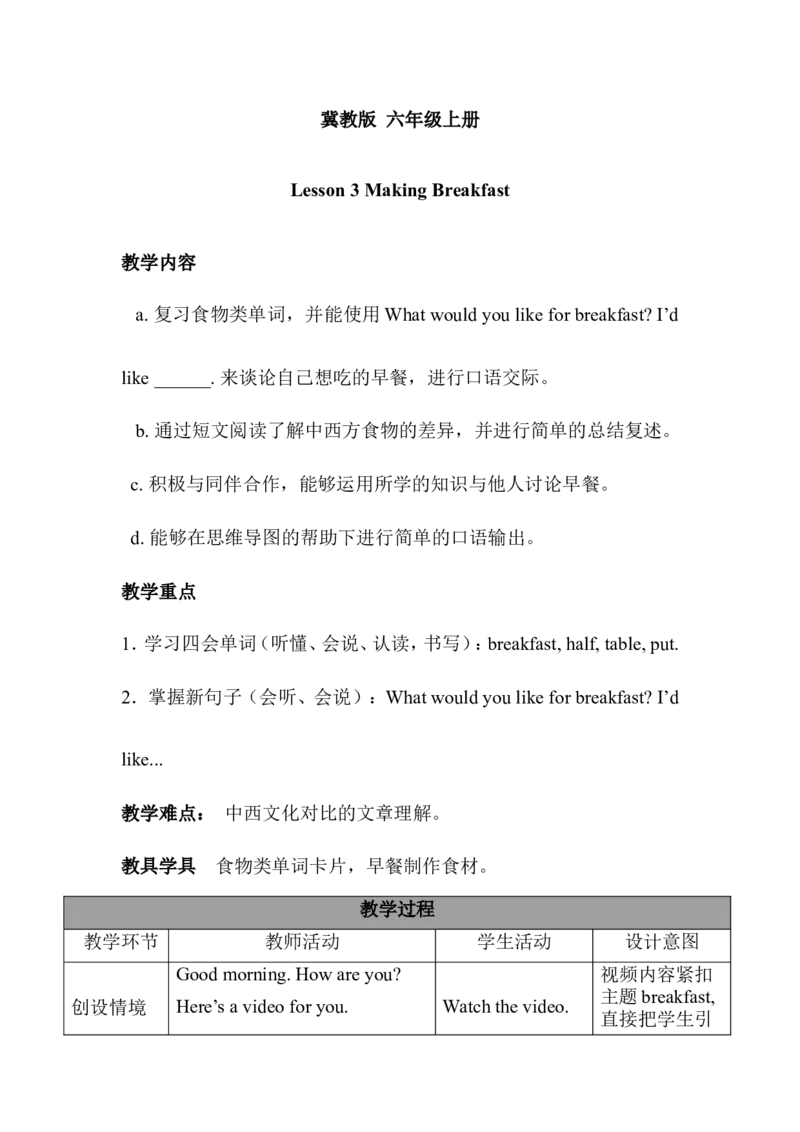
教学过程
教学环节
教师活动
学生活动
设计意图
创设情境
Good morning. How are you?
Here’s a video for you.
Watch the video.
视频内容紧扣
主题breakfast,
直接把学生引
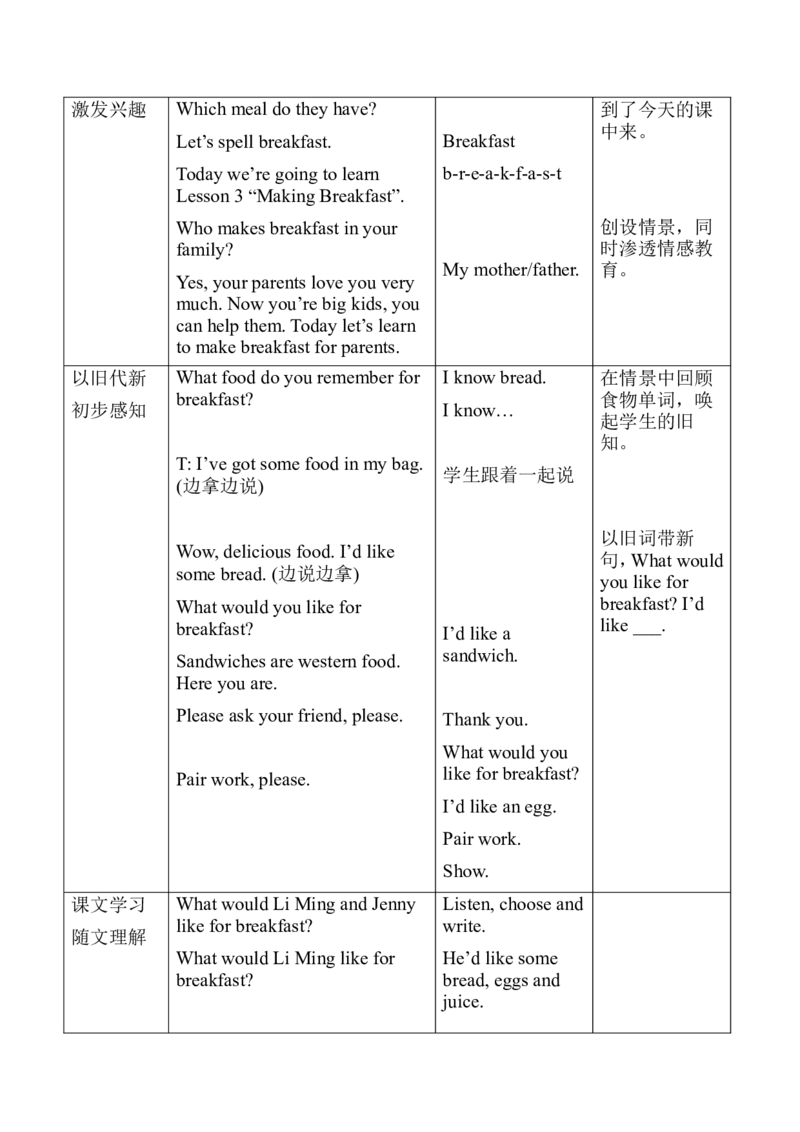
激发兴趣
Which meal do they have?
Let’s spell breakfast.
Today we’re going to learn
Lesson 3 “Making Breakfast”.
Who makes breakfast in your
family?
Yes, your parents love you very
much. Now you’re big kids, you
can help them. Today let’s learn
to make breakfast for parents.
Breakfast
b-r-e-a-k-f-a-s-t
My mother/father.
到了今天的课
中来。
创设情景,同
时渗透情感教
育。
以旧代新
初步感知
What food do you remember for
breakfast?
T: I’ve got some food in my bag.
(边拿边说)
Wow, delicious food. I’d like
some bread. (边说边拿)
What would you like for
breakfast?
Sandwiches are western food.
Here you are.
Please ask your friend, please.
Pair work, please.
I know bread.
I know…
学生跟着一起说
I’d like a
sandwich.
Thank you.
What would you
like for breakfast?
I’d like an egg.
Pair work.
Show.
在情景中回顾
食物单词,唤
起学生的旧
知。
以旧词带新
句,What would
you like for
breakfast? I’d
like ___.
课文学习
随文理解
What would Li Ming and Jenny
like for breakfast?
What would Li Ming like for
breakfast?
Listen, choose and
write.
He’d like some
bread, eggs and
juice.
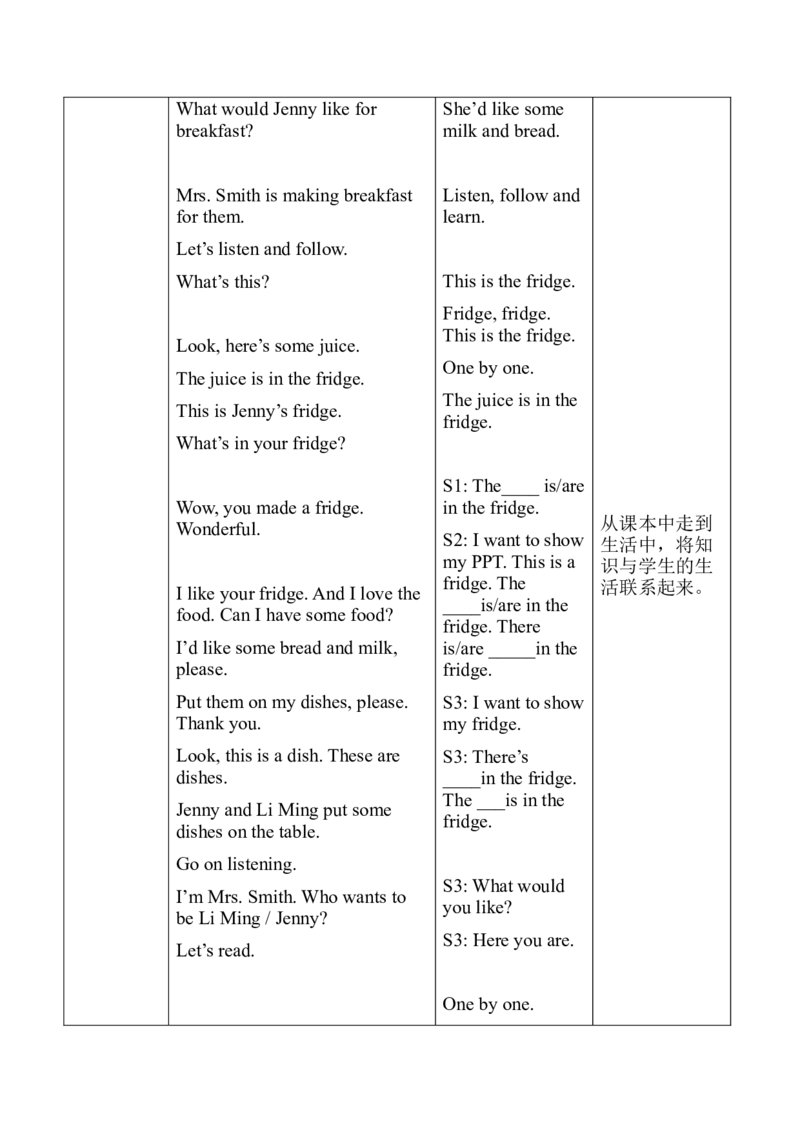
What would Jenny like for
breakfast?
Mrs. Smith is making breakfast
for them.
Let’s listen and follow.
What’s this?
Look, here’s some juice.
The juice is in the fridge.
This is Jenny’s fridge.
What’s in your fridge?
Wow, you made a fridge.
Wonderful.
I like your fridge. And I love the
food. Can I have some food?
I’d like some bread and milk,
please.
Put them on my dishes, please.
Thank you.
Look, this is a dish. These are
dishes.
Jenny and Li Ming put some
dishes on the table.
Go on listening.
I’m Mrs. Smith. Who wants to
be Li Ming / Jenny?
Let’s read.
She’d like some
milk and bread.
Listen, follow and
learn.
This is the fridge.
Fridge, fridge.
This is the fridge.
One by one.
The juice is in the
fridge.
S1: The____ is/are
in the fridge.
S2: I want to show
my PPT. This is a
fridge. The
____is/are in the
fridge. There
is/are _____in the
fridge.
S3: I want to show
my fridge.
S3: There’s
____in the fridge.
The ___is in the
fridge.
S3: What would
you like?
S3: Here you are.
One by one.
从课本中走到
生活中,将知
识与学生的生
活联系起来。
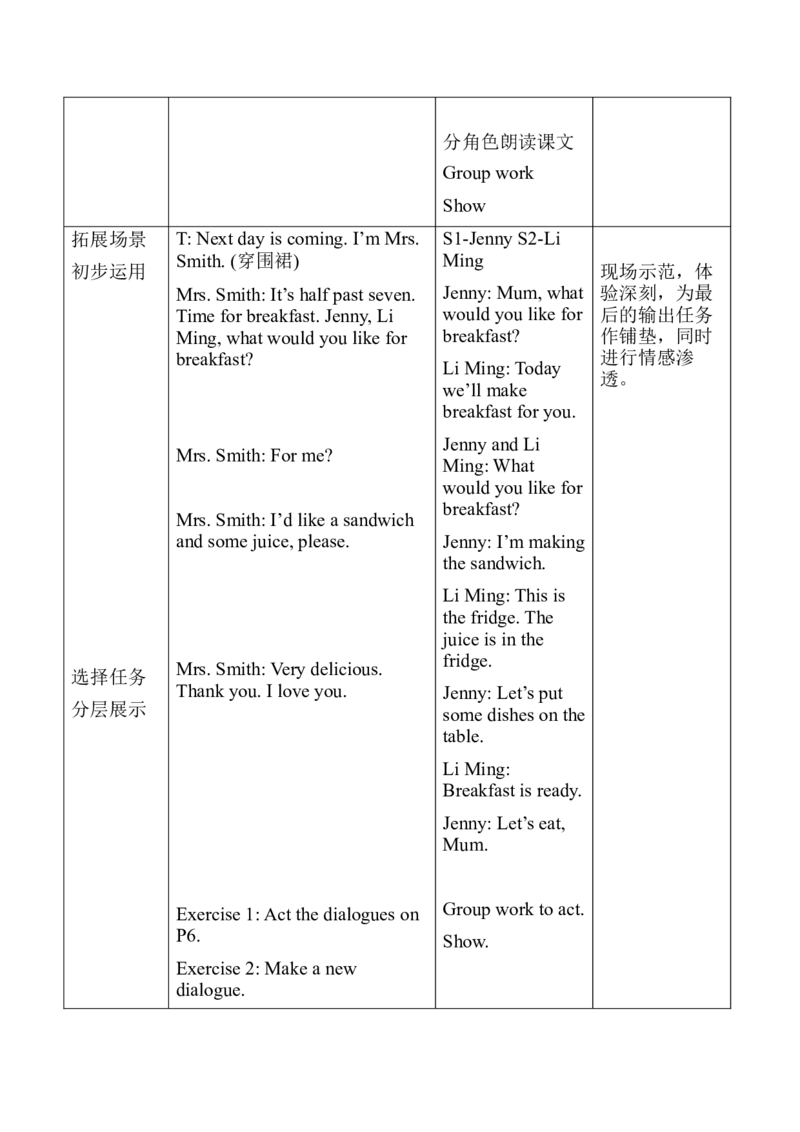
分角色朗读课文
Group work
Show
拓展场景
初步运用
选择任务
分层展示
T: Next day is coming. I’m Mrs.
Smith. (穿围裙)
Mrs. Smith: It’s half past seven.
Time for breakfast. Jenny, Li
Ming, what would you like for
breakfast?
Mrs. Smith: For me?
Mrs. Smith: I’d like a sandwich
and some juice, please.
Mrs. Smith: Very delicious.
Thank you. I love you.
Exercise 1: Act the dialogues on
P6.
Exercise 2: Make a new
dialogue.
S1-Jenny S2-Li
Ming
Jenny: Mum, what
would you like for
breakfast?
Li Ming: Today
we’ll make
breakfast for you.
Jenny and Li
Ming: What
would you like for
breakfast?
Jenny: I’m making
the sandwich.
Li Ming: This is
the fridge. The
juice is in the
fridge.
Jenny: Let’s put
some dishes on the
table.
Li Ming:
Breakfast is ready.
Jenny: Let’s eat,
Mum.
Group work to act.
Show.
现场示范,体
验深刻,为最
后的输出任务
作铺垫,同时
进行情感渗
透。
延伸拓展
文化渗透
Some people like Chinese food.
These are traditional Chinese
food for breakfast.
The Robin’s family are making
the traditional English food for
breakfast.
What food can you see?
English food is western food.
Chinese food and Western food
are different. Do you know the
differences between them?
Let’s read.
Check answer.
Read it again and complete the
thinking map.
Check answer.
Look at the mind map. Let’s talk
about the differences between
Chinese food and Western food.
steamed stuffed
bun
porridge
soybean milk
fried bread stick
Watch a video.
Cereal and milk
Toast and jam
Bacon, egg,
sausage,
tomato and fried
bread
Exercise 1: Read.
Tick or cross.
Exercise 2:
Complete the
thinking map.
Say with teacher.
There are more
vegetables in
Chinese food.
There is much
meat in Western
food. Chinese like
to eat cooked
vegetables.
Western people
like to eat
uncooked
第一遍速度,
通过判断正误
反馈文章理
解。
第二遍细读,
获取信息,把
思维导图填写
完整。
在思维导图的
帮助下复述文
章,即用自己
的话说一说中
餐和西餐的区
Practice to talk about the
differences between Chinese
food and Western food.
Who wants to have a try?
I think Chinese food is the best.
There is a TV program called A
Bite of China. It’s very famous.
It introduces Chinese food to
people all over the world. So the
national one is the international
one.
The winner is Team 2.
Congratulations.
Homework:
1. Listen and read the text on P6.
2. Make a breakfast for your
family.
(video, PPT or poster)
Class is over. Goodbye boys and
girls.
vegetables.
Chinese people
like to drink hot
water. Western
people like to
drink ice water.
Chinese people
use chopsticks to
eat. Western
people use knives
and forks to eat.
Talk about the
differences
between Chinese
food and Western
food with the help
of mind map.
Goodbye.
别。
课后反思
1.知识的学习过程:
第一阶段是知识的领会。创设情境,呈现新的语言知识,让学生
在情境中了解语言知识的音、形、义。
第二阶段是知识的巩固与转化。通过练习或任务,让学生巩固新
的语言知识。
第三阶段是知识的应用、迁移。启发学生对所学内容进行概括总
结,有意识地教学生学会如何运用所学知识,最后达成教学目标。
根据学生学习知识的过程,设计合理有效的教学环节,帮助学生
一步一步地学习、掌握、运用新知。
板书设计
Lesson 3 Making Breakfast
What would you like for breakfast?
I’d like _____________.
bread, eggs, sandwich, cake,
hamburger, milk, juice, vegetables…
2.关注学生,及时评价
教学设计在符合学生学习知识的过程的前提下,还要能激发学生
的情感,培养学生语用,给学生以语言思维和语言表现的空间。教师
要在教学过程中与学生保持眼神的交流、语言的交流和情感的交流,
对学生的反应做出恰当的评价。