2026 届高考英语语法填空分类强化100 题
专题40 语法填空之虚拟现实赋能专题16 篇  原卷版
(十五运开幕式VR+VR 书法+ +VR 庞贝古城++VR 莫高窟+VR 旅行)
01(2026 高三·全国·专题练习)阅读下面短文,在空白处填入1 个适当的单词或括号内单词的正确形式。
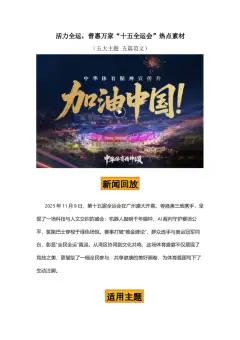
The opening ceremony of China's 15th National Games in the Greater Bay Area showcased how technology
drives innovation in spectacular fashion. The production team,   1   (use) artificial intelligence, AR, VR, and
robotics, masterfully brought the concept of "the sea" into the venue. A remarkable 5,000-square-meter ring-shaped
water stage became the centerpiece,   2   its surface acting as a mirror to reflect amazing visual effects.   3
(enhance) by nine special-shaped screens, the setup created vivid naked-eye 3D experiences that made digital dolphins
and cityscapes appear to leap toward the audience. Artificial intelligence played a crucial role throughout the ceremony.
All mascot(吉祥物)cartoons   4   (generate) using AIGC technology, significantly boosting creative efficiency.
Most   5   (impressive), a breathtaking 174-meter digital scroll was entirely AI-generated, requiring collaboration
among over 2,000 intelligent   6   (agent) that learned from famous paintings.
The technological advances also transformed traditional performances. As executive director Meng Ke noted,
"With technological advances, we can now create powerful effects with far   7   (few) people and greater
efficiency." This allowed over 3,000 performers to create visuals   8   would previously have required many more
participants.
Perhaps the most symbolic innovation was the main torch. For the first time in the Games' history, it was lit
not by a real flame,   9   by a "science and technology fire" powered by 100% green electricity. This symbolic
shift highlighted the commitment to a greener, more    10    (innovation) future, proving technology's power to
reimagine even the most established traditions.
02(25-26 高二上·辽宁沈阳·阶段练习)阅读下面短文,在空白处填入1 个适当的单词或括号内单词的正确
形式。
Chinese calligraphy, honored as a UNESCO Intangible Cultural Heritage since 2009, is no longer limited
1     paper and ink. With AI and virtual reality, this 3,000-year-old art form is now reaching     2     (globe)
audiences in groundbreaking ways.
In 2024, the “Digital Dunhuang” project introduced an AI system that can analyze ancient scripts from the
Tang Dynasty     3     generate new works in classical styles. Once faded due to time, historical documents are
being     4     (digital) restored, allowing researchers to study brushstrokes more clearly than before.
The     5     (integrate) goes beyond preservation. VR installations at the Louvre in Paris let visitors
“write” calligraphy mid-air using motion sensors, which     6     (cause) huge interest in Chinese culture to date
among European youth. Meanwhile, Chinese tech companies have developed AR apps that project famous poems
onto modern cityscapes since 2022.
Traditional masters also embrace innovation. Wang Wei,     7     works combine AI-generated patterns
with hand-painted characters, recently collaborated with MIT     8     (create) calligraphy-inspired coding fonts (字
体). “Technology isn’t replacing tradition,” he says, “it’s giving the oldest art     9     new language to speak to the
world.”
From bamboo slips to blockchain, China’s calligraphy revolution proves that      10      (respect) cultural
roots while exploring futuristic tools can build bridges across civilizations.
03(25-26 高二上·全国·课前预习)阅读下面短文,在空白处填入1 个适当的单词或括号内单词的正确形式。
VR (virtual reality), just like its name,      1     (mean) reality that is not real. Though you know the sensory
information     2     (surround) you is not real, part of your brain believes it is and acts      3     (according). VR
can be used in many fields, education, for example. It helps students understand many complex situations such as the
universe      4      micro world. In medicine, VR can help surgeons practice operating on a virtual “twin” before
operating      5      the real person. It can also help train new surgeons.
VR has a     6    (vary) of applications in our daily life. Some game systems allow players    7   (put)
on a special headset and they will enter virtual environments and play against either real or virtual     8    (opponent).
VR is being introduced to help people see exhibitions in museums, do shopping and selecting travel destinations. In
either case, VR will help people make more     9    (inform) choices.
Though there are some barriers for the development of VR, it is promising. Especially during this age     10
technology is developing fast, everything is possible.
04(24-25 高二下·福建泉州·期末)阅读下面短文,在空白处填入1 个适当的单词或括号内单词的正确形式。
Modern farms are increasingly automated — from GPS-controlled combine harvesters to machines that shake
apples from trees. One task, though, seems stubbornly    1      (resist) to being handed to robots: picking grapes.
Like all soft fruit, grapes have a narrow window of     2     (ripe), and are easy to being crushed if picked by
clumsy metallic fingers. Matters are worse if the fruit     3     (intend) for fine wine.
A project at Saffron Grange vineyard in Essex, however, aims to change some minds. Engineers working with
Extend Robotics, are building a grape-picking robot     4     (equip) with visual sensors powered by AI to tell
when fruit is ripe, and pressure sensitive fingers     5     (grasp) and cut bunches(串)from vines     6

having to shake any fruit loose.
The project is still in its early stages. The current version of the robot has to be awkwardly controlled in real-
time — by a pilot wearing a VR headset. The owners of Saffron Grange vineyard     7     (provide) leaf, grape
and juice samples to train the AI systems already and committed to planting half a field of vines(葡萄藤)

 8
the robot can run freely.
Robotic help would be a blessing for the vineyard. Harvest time is short and intense — a ten-day intensive
activity when     9     typical English vineyard's staff will swell five-fold. With a robot, Paul Harrison, the
vineyard's manager, imagines     10     (turn) grape-picking into a 24-hour operation by hiring skilled laborers
in Australia who could dial into the VR controls and pick grapes remotely, after his local workers have clocked off
for the day.
05(24-25 高三下·河南·阶段练习)阅读下面短文,在空白处填入1 个适当的单词或括号内单词的正确形式。
China’s Ministry of Culture and Tourism recently announced the official launch of eleven new technology
innovation centers, aiming     1     (drive) progress in the country’s cultural and tourism industries.
The initiative to establish these centers     2     (launch) as early as in 2023, said Liu Dongyan, deputy
director of the ministry’s science and education department. The initial group of centers are spread across eight
provincial-level regions, including Beijing, Liaoning. Zhejiang and Fujian,     3     together, they employ nearly
1,000 management and technical professionals, with a total investment exceeding (超过) 100 million yuan.
These innovation centers are intended to offer     4     comprehensive range of services to cultural and
tourism enterprises,     5     (guide) them through every stage from research and development to pilot testing
and,     6     (ultimate) , product commercialization. In terms of R&D, the centers concentrate on five key
areas within the cultural and tourism industries, such as performance     7     (equip) , amusement facilities,
smart tourism and scenic area development and so on.
    8     (significance) achievements include one center’s partnership with over 6,300 scenic spots,     9
has led to annual sales exceeding 300 million tickets.. Another center’s partner organizations are responsible for
producing more than 80 percent of the       10       (world) mid-to-high-end virtual reality (VR) headsets.
Liu also revealed that the selection process for the second batch of technology innovation centers is now
underway.
06(25-26 高二·福建莆田·期中)阅读下列短文,根据短文内容或括号内所给词的恰当形式填空。
The integration of traditional calligraphy with digital technology has become a focus in cultural preservation.
Calligraphy,     1     (date) back to ancient China, is not only an art form but also a carrier of cultural heritage.
However, with the     2     (popular) of digital devices, the practice of handwriting has declined. To address this,
museums and institutions are adopting innovative methods.
One approach is the use of 3D scanning to create     3     (detail) digital models of ancient calligraphy
works. These models allow scholars     4     (study) the brushstrokes and ink techniques without physical
contact.     5     (addition), virtual reality (VR) exhibitions enable visitors to experience the creation process
6    (interactive). By wearing VR headsets, they can “hold” a virtual brush and practice calligraphy in a simulated
ancient studio.
Furthermore, AI technology is being used to analyze and replicate classic calligraphic styles. Algorithms can
generate new characters     7     (base) on the strokes of famous masters, making it easier for beginners to
learn.     8     these advancements, traditional calligraphy is being revitalized and reaching a wider audience.
However, challenges remain. The     9     (preserve) of original works requires strict environmental control,
and the digitalization process demands high precision.     10     (balance) tradition and innovation is crucial to
ensure that calligraphy continues to thrive in the digital age.
07(2025·安徽淮北·模拟预测)阅读下面短文,在空白处填入1 个适当的单词或括号内单词的正确形式。
Artificial intelligence is being employed to safeguard the country’s oldest and tallest wooden pagoda ( 塔) in
North China’s Shanxi Province which has gone through natural and human disasters for 968 years. The technology
is being used     1     (improve) the understanding of the 67-meter-tall Sakyamuni Pagoda, visualize its states
over time and prepare for restoration work.
    2     (build) entirely out of wood without the use of nails in 1056 during the Liao Dynasty, the pagoda,
3     complicated structure features innumerable mortises and tenons (榫卯), has weathered earthquakes, wars and
other     4     (disaster) events. As tall as a 20-story building, and with a base diameter of about 30 meters, the
pagoda is a remarkable architectural wonder.
In April, 2024, a virtual reality program that copies the pagoda    5     (release) by Chinese technology
company Lenovo Group and Tsinghua University’s School of Architecture. Wearing VR glasses, visitors can
experience     6     it would be like to climb the pagoda.     7     program has been donated to the county
government to become part of its digital museum. February last year, they began conducting modeling work on the
wooden structure inside the pagoda,     8     (create) a database of parameters (参数) through structural research.
Meanwhile, Lenovo Group is employing its AI-generated computing technology, which     9     (perfect)
combines AI, neural radiance fields technology and extended reality technology to construct a digital “twin” of the
pagoda. Besides benefiting tourists, the     10     (technology) provide strong technical support for re-creating
the complete structure and details of the pagoda.
08(25-26 高三·江西·阶段练习)阅读下面短文,在空白处填入1 个适当的单词或括号内单词的正确形式。
While modern new technology is transforming and reshaping traditional     1     (industry), traditional
culture is also creating new business opportunities and helping drive China’s high-quality development. The rapid
development of information technologies     2     big data, cloud computing, 5G and artificial intelligence (AI)
in the new times has changed the way traditional culture     3     (experience).
New technologies     4     (apply) in digital museums and virtual reality (VR) exhibitions allow people
5     (go) beyond the limits of time and space while experiencing the charm of traditional culture. The Dunhuang
Academy, in charge of the Mogao Grottoes, Gansu Province, has developed          complete system combining the
digital cultural heritage collection with processing, storage and display technologies.
In fact, the revival (复兴) of traditional culture has given rise to new business models,     7     have greatly
satisfy people’s new cultural needs. The growing     8     (popular) of Chinese fashionable products of vintage
(古色古香的) brands in the consumer market reflects the country’s high-quality development. For example, many
young people love to wear hanfu when visiting scenic spots,     9     (obvious) seen in first-and second-tier cities
and cities with a rich history. The hanfu market was worth 14.47 billion yuan in 2023, and is expected to increase to
24.18 billion yuan by 2027.
Of course, more efforts should be made to     10     (far) boost traditional Chinese culture, and one way of
doing that is to effectively use more new technologies.
09(25-26 高二·安徽·阶段练习)阅读下面短文,在空白处填入1 个适当的单词或括号内单词的正确形式。
A 3D ancient wine vessel (酒杯) suddenly appears above a screen, floating in the air and moving in various
directions under the instructions of a controller. Members of the crowd     1     (stand) in front of a computer
screen at the eighth China Intangible Cultural Heritage Expo in Jinan, Shandong province, in mid-October let out
cries of delight and awe. The visual presentation     2     (conduct) to help visitors gain a better appreciation of
the artwork and its fine cloisonne craftsmanship (景泰蓝工艺). However, such     3     amazing view was
achieved without the help of wearable devices like VR glasses.
Thanks to 3D technology, viewers only need to adjust their position from the screen for built-in cameras     4
(get) their eye movements. The system uses algorithms (算法) to make the zun, an ancient wine vessel, come alive.
In the virtual world, the entire process of cloisonne production has been recreated,     5     makes it possible
for the public to experience it in a short amount of time. In the real world, the art form is still not     6     (access)
because of its high level of craftsmanship and the complex production processes     7     (involve).
Digital technology transforms visitors from passive viewers     8     active participants in passing on
cultural heritage, helping enhance public cultural involvement and awareness of     9     (preserve). At the same
time, it breaks the limits of time and space, offering more people the opportunity to learn as well as pass on these
traditional arts. It also stimulates the younger generations’ interest      10      promotes the development of
cultural heritage.
10(2025·广东广州·模拟预测)阅读下面短文,在空白处填入1 个适当的单词或括号内单词的正确形式。
Modern farms are increasingly automated — from GPS-controlled combine harvesters to machines that shake
apples from trees. One task, though, seems stubbornly resistant to    1    (hand) to robots: picking grapes. Like
all soft fruit, grapes have a narrow window of    2    (ripe), and are prone to being bruised or crushed if picked
by clumsy metallic fingers. Matters are worse if the fruit is intended for fine wine.
A project at Saffron Grange vineyard in Essex, however, aims to change some minds. Engineers at Queen Mary
University of London, working with Extend Robotics, are building a grape-picking robot    3    (equip) with
visual sensors powered by artificial intelligence  (AI) to tell when fruit is ripe, and pressure-sensitive fingers    4
(grasp) and cut bunches (串) from vines    5    having to shake any fruit loose.
The project is still in its early stages. The current version of the robot has to be awkwardly manipulated (操纵)
in real-time by a pilot wearing a VR headset. The owners of Saffron Grange vineyard    6    (provide) leaf, grape
and juice samples to train the AI systems already and committed to planting half a field of vines    7    the robot
can run freely.
Robotic help would be a boon for the vineyard. Harvest time is short and intense — a ten-day flurry ( 繁忙) of
activity when    8    typical English vineyard’s staff will swell five-fold. With a robot, Paul Harrison, the vineyard’s
manager, envisions    9    (turn) grape-picking into a 24-hour operation by hiring skilled labourers in Australia
who could dial into the VR controls and pick grapes remotely,     10     his local workers have clocked off for
the day.
11(25-26 高三上·江苏·期中)阅读下面短文,在空白处填入1 个适当的单词或括号内单词的正确形式。
In AD 79, the ancient Roman city of Pompeii, in southern Italy,     1     (destroy) by a volcanic eruption
that buried many of     2     (it) buildings. Archaeologists (考古学家) have been observing it for almost 300
years but now they have a new tool for     3     (understand) how Pompeii might once have looked — virtual
reality (VR).
Researchers Danilo Campanaro and Giacomo Landeschi, from Lund University in Sweden, used data collected
by drones (无人机) flying over the ruined Roman city to create a 3D computer reconstruction (重建) of one of its
most     4     (impress) buildings. They then fed the reconstruction into a video game system called Unity     5
(make) a VR model. The idea is not just to recreate the buildings     6     to understand a bit more about how
Roman people might have experienced them. Campanaro and Landeschi asked     7     (volunteer) to take a
virtual tour of the house in both summer and winter light.
The researchers used special eye-tracking technology to record     8     (exact) which areas people
looked at and for how long. From this, the team concluded that the building used clever design to draw attention     9
objects that showed off the wealth and status of its owner — perhaps a man called LuciusValenius Flaccus,     10
ring was found in the ruins.
12(2025·江苏扬州·模拟预测)阅读下面短文,在空白处填入1 个适当的单词或括号内单词的正确形式。
Dunhuang is famous for its ancient Mogao Caves,    1    treasure house of Buddhist art and texts. Over the past
30 years, the concept of Digital Dunhuang    2    (emerge).
Digital Dunhuang involves the use of modern technology such as 3D scanning and virtual reality (VR) to create
digital copies of the caves and their    3    (price) contents. By doing so, it breaks    4    geographical
barriers and allows people from anywhere to experience the beauty of these artworks without physically being
there.
One notable project within Digital Dunhuang is the creation of a virtual library where    5    (scan) Buddhist
texts are stored and can be accessed online. This not only aids in the    6    (preserve) of the delicate documents
but also facilitates research and education globally.
Furthermore, the VR headset offers such an authentic scene of the cave    7    users can have a close-up
view of the wall paintings and sculptures. This technology even permits a behind-the-scenes look at restoration
efforts,    8    (develop) an understanding of the challenges faced in protecting these ancient wonders.
In essence, Digital Dunhuang is a proof of    9    cutting-edge technology can serve as a powerful tool for
cultural conservation. It provides a bridge between ancient history and the modern world, ensuring that the legacy of
Dunhuang remains alive and accessible for generations     10     (come).
13(25-26 高二·安徽·期中)阅读下面短文,在空白处填入1 个适当的单词或括号内单词的正确形式。
Today, the advancement of technology has taken a front-row seat in the creation of smart campuses. In recent
years, many schools in China     1     (accept) technologies such as Al and big data to make school life     2
(simple) for students and teachers than before.
Using a smart campus system by the Chinese tech company iFlytek, Tianjin Eco-City School attached     3
Beijing Normal University has introduced     4     (innovate) applications to transform the educational experience.
In aerospace classes, students use simulation (模拟) devices and VR glasses for immersive (沉浸式的) learning,
enabling them     5     (find) out about rocket launches and a rocket’s internal structure through fun learning.
    6     (similar), in swimming classes, “by wearing smart earphones, children can receive real-time
instructions from the coach underwater, ensuring maximum safety, said Li Rui,     7     leader of the school.
For PE classes, Yuwen School in Wuhu, Anhui, has installed (安装) self-testing kits with AI visual analysis
technology for     8     (activity) such as long-distance running, standing long jump, sit-ups and skipping rope.
Students’ faces     9     (register) in a facial recognition system,     10     (allow) them to receive voice
reports and instant performance results after each exercise.
Smart campuses can reshape how and what students learn and how they study and interact with an institution.
14(25-26 高二上·云南昭通·期中)阅读下面短文,在空白处填入1 个适当的单词或括号内单词的正确形式。
Virtual Reality Travel
With the rapid development of technology, it is now possible for people     1     (explore) the world through
virtual reality (VR) . Using a VR headset, users can visit the Great Wall of China or the pyramids of Egypt without
leaving     2     (they) homes.
This new form of travel     3     (become) increasingly popular among young people in recent years. It is
regarded     4     a convenient and affordable way to experience different cultures.
However, nothing can     5     (true) compare with the feeling of standing in front of a real landmark. The
smell of the local air, the touch of ancient stones, and the conversations with local people     6     (miss) in a
virtual world.
     7     main advantage of VR travel is its accessibility for people with physical disabilities. It offers     8
(equal) in experiencing the wider world.
Looking ahead,     9     (combine) VR technology with real-world travel might create even more exciting
experiences. For now, it serves as a powerful tool     10     broadens our horizons and inspires real adventures.
15(24-25 高三上·河南·月考)阅读下面短文,在空白处填入1 个适当的单词或括号内单词的正确形式。
Artificial intelligence is being employed to safeguard the country’s oldest and tallest wooden pagoda (塔) in
North China’s Shanxi Province which has gone through     1    (nature) and human disasters for 968 years. The
technology is being used     2    (improve) the understanding of the 67-meter-tall Sakyamuni Pagoda, visualize
its states over time and prepare for restoration work.
    3    (build) entirely out of wood without the use of nails in 1056 during the Liao Dynasty, the pagoda,      4


complicated structure features innumerable mortises and tenons (榫卯), has weathered earthquakes, wars and other
5    (challenge). As tall as a 20-story building, and with a base diameter of about 30 meters,the pagoda is a
remarkable architectural wonder.
In April, 2024, a virtual reality program that copies the pagoda     6    (release) by Chinese technology
company Lenovo Group and Tsinghua University’s School of Architecture. Wearing VR glasses, visitors can
experience what it would be like to climb the pagoda.     7     program has been donated to the county
government to become part of its digital museum.     8     February last year, they began conducting modeling
work on the wooden structure inside the pagoda, creating a database of parameters (参数) through structural research.
Meanwhile, Lenovo Group is employing its AI-generated computing technology, which     9    (perfect) combines
AI,neural radiance fields technology and extended reality technology to construct a digital “twin” of the pagoda.
Besides      10     (benefit) tourists, the technologies provide strong technical support for re-creating the
complete structure and details of the pagoda.
16(2025·广西南宁·一模)阅读下面材料,在空白处填入适当的内容(1 个单词)或括号内单词的正确形式。
HTC Corp.     1     (introduce) its latest headset the Vive XR Elite in January, 2023. It combines mixed
reality (MR) and virtual reality (VR) to make a device with diverse functions, helping its users have     2     (good)
experiences on the Internet.
The device is intended     3     (support) mixed reality that combines the real world environment with the
one created by the computer. Charles Huang, vice president of HTC, said when     4     (develop) an MR product,
they have to think carefully. It’s not just about producing a hardware. It involves the development of an ecosystem,
and every point must be taken into     5     (consider).
HTC has revealed Viverse, an open platform     6     users can have a taste of the technology, ranging
7     VR, MR, high-speed connectivity to AI. HTC is also working with telecom operators (电信运营商) to make
VR more popular. “Telecom operators have     8     large number of users, and their participation can speed up
the development of the entire industry,” Huang said.
“Now, there is also a growing demand for VR devices in a wide range of industries, such as remote conferencing,
training and education,” Huang added. Now it     9     (predict) that up to $13.08 billion will be spent in
China’s AR and VR market in 2026, making     10     the second-largest market in the world.
17(25-26 高三上·四川攀枝花·阶段练习)阅读下面短文,在空白处填入1 个适当的单词或括号内单词的正
确形式。
According to Xinhua News Agency, the Palace Museum and Huawei signed a strategic cooperation agreement      1

March 15. The two sides will set an example for 5G application.
The Palace Museum received more than 17 million visitors in 2018,     2     (make) it the most visited
museum in the world. In the past 20 years, an office information network covering the whole museum    3

(build) gradually. The museum has developed an App that provides an in-depth     4     (explain) of cultural relic
information and cultural services. Also, the museum has research on the application of VR, AR, AI and other     5
(technique) in museums.
    6     signing of the agreement marks a new chapter in the strategic cooperation between the Palace
Museum and Huawei Technologies Co. So, Huawei will make efforts    7     (accelerate) the intelligent
construction of the Palace Museum.
“The 600-year-old Palace Museum has never been so close to science and technology.” Shan Jixiang said    8
(proud), director of the Palace Museum.
Shan shared many ideas about the SG Palace Museum. With the help of advanced technology,     9     is
expected is that in the future, audiences around the world will be able to experience and visit the Palace Museum,
whether it is a field trip or a virtual tour. Also, the use of AI technology provides a      10      (broad) platform and
stronger knowledge support for cultural relics among young people.