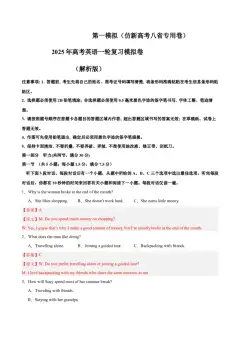
第一模拟(仿新高考 II 卷)
2025 年高考英语一轮复习模拟卷
(原卷版)
注意事项: 1. 答题前, 考生先将自己的姓名、准考证号码填写清楚, 将条形码准确粘贴在考生信息条形码粘
贴区。
2. 选择题必须使用2B铅笔填涂; 非选择题必须使用0.5毫米黑色字迹的签字笔书写, 字体工整、笔迹清
楚。
3. 请按照题号顺序在答题卡各题目的答题区域内作答, 超出答题区域书写的答案无效; 在草稿纸、试卷上
答题无效。
4. 作图可先使用铅笔画出, 确定后必须用黑色字迹的签字笔描黑。
5. 保持卡面清洁, 不要折叠, 不要弄破、弄皱, 不准使用涂改液、修正带、刮纸刀。
第一部分 听力(共两节,满分30分)
第一节 (共5小题;每小题1.5分,满分7.5分)
听下面5段对话。每段对话后有一个小题,从题中所给的A、B、C三个选项中选出最佳选项。听完每段
对话后,你都有10秒钟的时间来回答有关小题和阅读下一小题。每段对话仅读一遍。
1.What is Ailsa going to do?
A.Go for a pizza with Angelo.
B.Help Juliet with her project.
C.Invite her deskmate to the dining hall.
2.How will the man go to the Holiday Inn?
A.By taxi. B.On foot. C.By subway.
3.What is the woman doing?
A.Asking the way. B.Changing money. C.Making a phone call.
4.Where did the earthquake happen today?
A.In Japan. B.In the US. C.In China.
5.What does the woman think of the painting?
A.Abstract. B.Understandable. C.Imaginative.
第二节 (共15小题;每小题1.5分,满分22.5分)听下面5段对话。每段对话或独白后有一个小题,从题中所给的A、B、C三个选项中选出最佳选项。听
完每段对话后,你将时间阅读各个小题,每小题5秒钟;听完后,各小题将给出5秒钟的做答时间。每段
对话或独白读两遍。
【听第6段材料,回答第6、7题。】
6.What project is the study group working on?
A.The history of Qufu.
B.Shakespeare’s plays.
C.Confucius’ educational ideas.
7.What will the speakers do first?
A.Fix the watch.
B.Have a cup of tea.
C.Join the study group.
【听第7段材料,回答第8、9题。】
8.What does the man suggest to protect wildlife?
A.Stopping hunting. B.Raising awareness. C.Using technology.
9.What does the woman suggest to help protect wildlife?
A.Making more posters. B.Creating wildlife reserves. C.Ensuring clean air and water.
【听第8段材料,回答第10至12题。】
10.Why does Max think his holiday will be fun?
A.He’ll make new friends.
B.He can play many sports.
C.He’ll learn survival skills from experts.
11.What will Cao Jing’s speech be about?
A.Environmental protection.
B.Teenagers and teenage life.
C.Technology and innovation.
12.What is Cao Jing’s goal for the vacation?
A.To improve her cooking skills.
B.To make new friends.
C.To learn new sports.
【听第9段材料,回答第13至16题。】13.Why does Emily move away quickly?
A.She shows no interest in the show.
B.She wants to enjoy more works.
C.She is bored with the noise.
14.What can we know about the husband?
A.He was not born blind.
B.He couldn’t stand his wife.
C.He knows nothing about art.
15.How does Emily feel now?
A.Excited. B.Moved. C.Discouraged.
16.What do the speakers mainly talk about?
A.The importance of art.
B.Love between a couple.
C.Good behavior in public.
【听第10段材料,回答第17至20题。】
17.Who is the speaker?
A.A college student. B.An activity organizer. C.A participant in an activity center.
18.What activity do people do most time in the center?
A.Water sports. B.Rock climbing. C.Mountain biking.
19.What does the speaker value most about activity centers?
A.Different experience. B.Social interaction. C.Sports entertainment.
20.What do participants do on the last afternoon?
A.Watch TV. B.Sing songs together. C.Play team games.
第二部分 阅读(共两节, 满分50分)
第一节(共15小题; 每小题2.5分, 满分37.5分)
阅读下列短文,从每题所给的A、B、C、D四个选项中选出最佳选项。
A
Below are stories of kids who saw a need in the world and set out to fix it. Hearing the stories will inspire
generosity and charity in your own kids.
Janine Licare and Aislin Livingstone — Kids Saving the Rainforest: Janine and Aislin were 9 when
they saw the rainforest disappearing in Costa Rica. Being dissatisfied with how their donations were being spentwith other rainforest charities, they began their own organization—Kids Saving the Rainforest.
Austin Gutwein — Hoops of Hope: At 10, Austin watched a video of children who had lost their parents
due to AIDS. Austin decided to organize a charity called Hoops of Hope. Through sponsorships, participants have
raised over $2.5 million to provide those kids access to food, clothing and shelter. However, Hoops of Hope is now
closed.
Mackenzie Bearup — Sheltering Books: Mackenzie was 13 when she began collecting children’s books
for shelters in and around Alpharetta, Georgia. It soon became a family project with her 2 brothers working
alongside her. In total, they have collected and donated over 360,000 books for shelters across the world.
Annie Wignall — Care Bags 4 Kids: At 11, Annie began the Care Bags 4 Kids when she discovered there
were many kids in crisis situations who had to leave their homes. Annie’s organization creates and distributes fabric
care bags filled with essential and comforting items for needy children.
21.Which charity is concerned about environment protection?
A.Hoops of Hope. B.Sheltering Books.
C.Care Bags 4 Kids. D.Kids Saving the Rainforest.
22.What is special about Austin Gutwein’s charity organization?
A.It is inaccessible now. B.It is in the charge of kids.
C.It has collected millions of books. D.It offers help to needy children.
23.Who might be the intended readers of the text?
A.Students. B.Parents. C.Donors. D.Teachers.
B
Quiet Parks International (QPI) have got every reason to award Quiet Trail to the Niobrara National Scenic
River this year, making it the other Quiet Trail in the world after Cuifeng Lake Trail, Taiwan. Kalli Kieborz,
Director of Niobrara Council, received the award for their assistance in managing and protecting its natural
resources, including natural quiet, since 1997.
This Award concluded a two-year process that included exploring the full length of the river to collect
qualitative and quantitative acoustic (听觉的) data. Gordon Hempton, cofounder of QPI, stated, “Our testing
process is very exact. Beyond collecting standard acoustic data, each team member must agree unhesitatingly that
natural quiet existed throughout the testing period. The river’s splendid geologic landscape, unusual atmospheric
conditions and outstanding wildlife all contributed to a positive outcome.”
The Niobrara River is notable for its beauty, ecological importance, and recreational appeal in the northernGreat Plains, U.S.. Six major ecosystems meet in the Niobrara National Scenic River valley, resulting in a special
mix of more than 160 plant and animal species. “It is filled with unique, even one-of-a-kind opportunities for the
curious and adventurous visitors,” said John Ricks, Nebraska Tourism director.
“97% of the U.S. population faces noise pollution from sources like flights and highways. In fact, the more
quiet we have, the more we can see and hear about the world, so we are thrilled to be able to offer it at Niobrara
National Scenic River. From a quiet starry night to peaceful natural escapes, it uncovers what cannot be enjoyed in
many other places,” stated Susan Cook, another director.
Areas like the Niobrara National Scenic River offer an opportunity to showcase quiet, unspoiled areas in a
noisy world. Today, as people’s life is overloaded with noise, the intentional seeking-out of quiet areas is on the rise
and with it, the opportunity to engage new travelers in visiting the beautiful, yet still largely hidden treasure of the
wild.
24.Which of the following best describes the testing process?
A.Flexible. B.Reliable. C.Simple. D.Loose.
25.What is a consequence of ecosystems meeting in the valley?
A.Ecology imbalance. B.Biodiversity enrichment.
C.Species competition. D.Tourism boost.
26.What does Susan Cook highlight in paragraph 4?
A.The joy of winning the award. B.The outcome of noise pollution.
C.The activities of enjoying quiet. D.The value of natural quiet.
27.What is the author’s purpose in writing the text?
A.To call on efforts to reconnect with nature.
B.To inform the recognition of a quiet river.
C.To display the challenges of protecting ecosystem.
D.To stress the need to escape busyness of modern life.
C
Solar eclipses (日食) happen when the Moon passes between the Earth and the Sun. These events are always
spectacular. But total solar eclipses are extra special. One such eclipse was visible across large parts of North
America on April 8, 2024. During that time, sky watchers felt surprised at the view. They also took part in scientific
research.
The eclipse was a piece of exciting news for solar science. On April 8, the Sun neared its most active phasewhen the Sun gave off more radiation and a lot of charged particles from its surface. Such solar storms threatened
satellites orbiting the Earth. They even disrupted power grids on the ground. These are what the science pros found.
“Luckily, researchers now have more scientific instruments to study our star than ever before,” said Kelly
Korreck, who is an astrophysicist. “This provides a unique chance to learn about the Sun and its effects on our
planet and its atmosphere.”
But science pros aren’t the only ones getting in on the fun. Citizen scientists are members of the public who
help gather observations and analyze them. “There is a lot of emphasis on citizen science and having folks do solar
science projects,” Korreck said.
Scientists hoped to recruit as many phones as possible, which would spread out over the 2,000- mile- long
and 100- mile- wide path of the April 2024 eclipse. Korreck said, “That will offer views of the solar shape from a
very large number of vantage points. And it’s up to citizen scientists to do it.”
Citizen scientists were able to take part without interrupting their view of the eclipse. They just started an
app on their phone and propped it up facing the Sun at least five minutes before the Moon passed in front of the
Sun. The app handled the rest. They could get to keep copies of the pictures as a souvenir. “That was a good chance
for citizen scientists to contribute to eclipse research,” Korreck said. That’s true whether they set up a camera or
installed an app.
28.What can we learn from the first two paragraphs?
A.The total solar eclipse was visible in the entire America.
B.The total solar eclipse has some impact on the Earth.
C.The Earth gives off more radiation during solar eclipses.
D.Sky watchers contributed a lot to scientific research.
29.What did Korreck think of citizen scientists?
A.They are enthusiastic. B.They are creative.
C.They are optimistic. D.They are essential.
30.What did the scientists want to get from citizen scientists during the total solar eclipse?
A.Useful points about the total solar eclipse.
B.As many phones as possible with apps installed.
C.Observations of the total solar eclipse from different angles.
D.More scientific instruments to help observe solar eclipses.
31.What is the last paragraph mainly about?
A.What citizen scientists got from the eclipse research.B.How citizen scientists got involved in the eclipse research.
C.How much time citizen scientists spent in taking pictures.
D.Why the total solar eclipse was a good chance for the scientists.
D
Pick up any packaged processed food, and there’s a decent chance that one of its listed ingredients will be
“natural flavor”. The ingredient sounds good, particularly in contrast to “artificial flavor”. But what exactly does
natural flavor mean? It refers to extracts (提取物) got from natural sources like. When consumers see “natural
flavor” on a label, they are unlikely to assume that someone is squeezing the juice from oranges into their bottle.
They know even though natural flavor must come from natural sources, it needn’t all come from the plant or meat.
For example, orange flavor might contain not only orange extract, but also extracts from bark and grass. Nor is the
common belief true that ingredients extracted from nature are necessarily safer than something artificially made.
So if flavors like orange are needed, why not just use oranges? The answer comes down to “availability, cost
and sustainability”, according to flavor chemist Gary Reineccius of the University of Minnesota. “If you’re going to
use all your grapes on grape soda,” Reineccius says, “you don’t have any grapes for wine making; the products are
going to be exorbitant and most people can’t afford them.”
Actually, while chemists make natural flavors by extracting chemicals from natural ingredients, artificial
flavors are made by creating the same chemicals artificially. The reason why companies bother to use natural
flavors rather than artificial flavors is simple: marketing. “Many of these products have health titles,” says Platkin,
professor from Hunter College. “Consumers may be talked to believe products with natural flavors are healthier,
though they’re nutritionally no different from those with artificial flavors. Natural flavors may involve more forest
clear-cutting and carbon emissions from transport than flavors created in the lab.”
Platkin suggests getting more transparent labeling on packaging that describes exactly what the natural or
artificial flavors are, so consumers are not misled into buying one product over another because of “natural
flavors”. Reineccius also offers some simple guidance: “Don’t buy anything because it says ‘natural flavors’. Buy it
because you like it.”
32.Which is a misunderstanding about the “natural flavor” juice according to Paragraph 1?
A.It comes from 100% original fruit.
B.It is nothing but advertising tricks.
C.It is absolutely safer than juice with artificial flavors.
D.It certainly contains extracts made in the lab.33.What does the underlined word “exorbitant” in Paragraph 2 probably mean?
A.Suitable. B.Expensive. C.Official. D.Flexible.
34.Why do companies use natural flavors in their products?
A.To promote the sales. B.To cut the costs.
C.To advocate a healthy diet. D.To avoid food safety issues.
35.What can we conclude from the passage?
A.Cary and Platkin hold opposite perspectives.
B.Natural flavors are more environmentally-friendly.
C.Companies are banned to produce artificial flavor food.
D.Natural and artificial flavors are more alike than you think.
第二节(共5小题; 每小题2.5分, 满分12.5分)
阅读下面短文, 从短文后的选项中选出可以填入空白处的最佳选项。选项中有两项为多余选项。
I love learning foreign languages so much that I learn a new language every two years. When people find
I’m a polyglot(通晓多种语言的人),they always ask me,“How do you do that?” Honestly, my answer will be, “I
don’t know. I simply love learning languages.” 36 They want to know why they spend years learning
even one language, never achieving fluency, and what’s the secret of being polyglots.
37 And what do we have in common? I decided to find that out. I went to several events where
language lovers gather to practice their languages, asked dozens of polyglots about methods they use, and heard
dozens of approaches. Everybody seems to have a unique way to speak several languages fluently.
38 All these polyglots talked about language learning as if it was great fun. They found ways to
turn language learning from a boring subject into a pleasant daily activity. You should have seen their faces when
they were showing me their colorful grammar charts and handmade flash cards. 39 The methods are
various, but they make sure it’s something enjoyable.
I realized it’s actually how I learn. 40 Then interesting programs became my choice. So all is clear.
If you don’t like writing words down on paper, type them in an app. If you’re a shy person, apply self-talk at home.
This is how polyglots learn languages, and the best news is that it’s available to anyone willing to take the learning
into their own hands.
A.How can those with little talent be fluent?
B.But people are never happy with the reply.
C.There’s no shortcut to learning languages for anyone.D.One of them even made recipes in a foreign language.
E.That made me wonder, too, how other polyglots actually do it.
F.When learning Spanish last year, I was bored with textbooks.
G.Polyglots simply found ways to enjoy the language-learning process.
第三部分语言运用(共两节, 满分30分)
第一节(共15小题; 每小题1分, 满分15分)
阅读下面短文, 从每题所给的A、B、C、D四个选项中选出可以填入空白处的最佳选项。
In a small town lived Matthew, a diligent (勤奋的) youth with a passion for English. Nevertheless, he was
completely 41 of the online world, leading him to pay a heavy 42 in a case later.
One day, Matthew received an email from a stranger, claiming by 43 a special English learning
material, he could easily improve his grades. The email also 44 several success stories, which convinced
Matthew. He followed the instructions and transferred much money to the sender’s 45 . Receiving the
material, he found it worthless. Matthew felt 46 and regretful, yet powerless.
However, the story didn’t 47 there. After the setback, Matthew began to 48 the world
of online scams (诈骗). Discovering similar ones, he decided to use his English skills to expose them on social
media, and 49 people to be watchful of online scams.
Matthew’s story spread throughout the town. People expressed their 50 and support. With his
assistance, many people escaped online scams. Everyone needs to 51 learn about relevant knowledge so
as to enhance their awareness of 52 .
The Internet isn’t without risks. When we 53 setbacks, don’t give up. It’s these experiences that
make us more mature and cherish our 54 and privacy. Let’s unite to establish a safe and 55
online environment!
41.A.capable B.ignorant C.cautious D.suspicious
42.A.price B.fine C.rent D.debt
43.A.sharing B.reviewing C.developing D.purchasing
44.A.lacked B.deleted C.included D.translated
45.A.donation B.contract C.account D.document
46.A.cheated B.relieved C.rejected D.motivated
47.A.end B.occur C.progress D.transform
48.A.withdraw fromB.interact with C.push forward D.dig into
49.A.reminded B.permitted C.forbade D.hired50.A.anxiety B.admiration C.desire D.forgiveness
51.A.rapidly B.temporarily C.individually D.continuously
52.A.charity B.reform C.prevention D.participation
53.A.cause B.encounter C.witness D.bear
54.A.wisdom B.memory C.freedom D.property
55.A.accessible B.permanent C.harmonious D.complicated
第二节(共10小题; 每小题1.5分, 满分15分)
阅读下面短文, 在空白处填入1个适当的单词或括号内单词的正确形式。
Despite being 75 years old, Chai Tixia’s expertise in Jianzi is truly impressive. With quick kicks, he
effortlessly sends the Jianzi into the air and gracefully guides it to land 56 (gentle) on his head.
Jianzi, 57 game that dates back to the Han Dynasty, is surprisingly simple: players must keep the
Jianzi in the air, 58 (use) any part of their body except their hands and arms. However, to master this
game 59 (require) a lot of practice.
While enjoyed throughout China, Jianzi 60 (describe) by Chai as an important aspect of hutong
culture. The narrow alleyways, situated within Beijing’s inner city, provide the setting for the game’s 61
(popular). Each mormning, Chai and his fellow hutong residents gather for their shared passion for Jianzi.
Chai’s spirited matches with his neighbors have a big audience 62 (draw) to the artistry and
excitement of the game. The onlookers who watch them playing with great athleticism are amazed at 63
Chai and his fellow players can achieve.
Having practiced Jianzi for over 30 years, Chai cherishes the physical and social 64 (benefit) the
game brings. Engaging in lively matches with his neighbors energizes his body, enhances his flexibility, 65
promotes unity within the community. Through Jianzi, Chai harvests not only health but a sense of belonging and
friendship.
第四部分 写作(共两节, 满分40分)
第一节(满分15分)
为庆祝世界旅游日,让世界了解中国,你校英文报将以“中国魅力城市”为主题,举办征文比赛,请你选
择一个中国旅游城市并写一篇短文投稿。内容包括:
1.推荐城市;
2.推荐理由。
注意:
1.写作词数应为80左右;2.请按如下格式在答题卡的相应位置作答。
A Charming Tourist City in China
____________________________________________________________________________________________
____________________________________________________________________________________________
____________________________________________________________________________________________
____________________________________________________________________________________________
_____
第二节(满分25分)
阅读下面材料, 根据其内容和所给段落开头语续写两段, 使之构成一篇完整的短文。
As the school dress-up party was just around the corner, the school hall was full of children dressed in
different shapes and colors. Some walked in as princes and princesses, some stepped in as superheroes and some
made their dramatic entrance as astronauts and historical figures. But one little girl, whose name is Ellie, walked in,
hiding her face and hoping nobody would take notice of her grey pants and white T-shirt.
Ellie wanted to dress up as a princess that year. Her dad had promised her a few months earlier that her
costume would turn heads. But, her dad was so busy with all kinds of work that he forgot the small important things
while dealing with the big important ones. When Ellie’s dad forgot to save up for her princess costume for the
school dress-up party that year, she wasn’t mad at him. However, she couldn’t hold back her tears when the mean
kids from her class started making fun of her. “What are you supposed to be dressed as? Ugly Ellie?” one of the
boys laughed loudly. Ellie covered her ears and cried as she heard the kids crying out her latest name and laughing
over and over again. Every face around her was unkind and indifferent to her sadness, making the poor girl feel
more unconfident and alone.
“Follow me! Ellie!” an older voice whispered to her. It was Mr. Borges, her art teacher. He was trying to tell
her something. The girl managed to escape the crowd of children and walk past them, closely following her teacher.
“Wait here!” Mr. Borges told Ellie and walked away. A moment later, he returned and Ellie couldn’t help but
wonder why Mr. Borges was holding a few rolls of toilet paper.
注意:
1.续写词数应为150左右;
2.请按如下格式作答。
“What’s that for?” Ellie asked, confused.
________________________________________________________________________________________________________________________________________________________________________________________
____________________________________________________________________________________________
____________________________________________________________________________________________
_______________________________________________________________________________________
What Mr. Borges did meant everything to Ellie.
____________________________________________________________________________________________
____________________________________________________________________________________________
____________________________________________________________________________________________
____________________________________________________________________________________________
_______________________________________________________________________________________