2026 年高考一轮复习验收卷(广东卷02)
 英语·全解全析
注意事项:
1. 答题前,考生先将自己的姓名、准考证号码填写清楚,将条形码准确粘贴在条形码区域内。
2. 选择题必须使用2B 铅笔填涂;非选择题必须使用0. 5 毫米黑色字迹的签字笔书写,字体工整,笔迹清楚。
3. 请按照题号顺序在答题卡各题目的答题区域内作答,超出答题区域书写的答案无效;在草稿纸、试卷上
答题无效。
4. 作图可先使用铅笔画出,确定后必须用黑色字迹的签字笔描黑。
5. 保持卡面清洁,不要折叠、不要弄破、弄皱,不准使用涂改液、修正带、刮纸刀。
第一部分  听力(共两节,满分30 分)
做题时,先将答案标在试卷上。录音内容结束后,你将有两分钟的时间将试卷上的答案转涂到答题卡上。
第一节(共5 小题;每小题1. 5 分,满分7. 5 分)
听下面5 段对话。每段对话后有一个小题,从题中所给的 A、B、C 三个选项中选出最佳选项。听完每段
对话后,你都有10 秒钟的时间来回答有关小题和阅读下一小题。每段对话仅读一遍。
例: How much is the shirt?
A. £19. 15.         B. £9. 18.         C. £9. 15.
答案是C.
1.Who thinks highly of the film?
A.Sally.
B.Eric.
C.Liz.
2.What does the man need to do?
A.Put on a uniform.
B.Check the machines.
C.Fill in his information.
3.Why did the man clean the floor?
A.It had just been laid.
B.It had something spilled on it.
C.It had been painted by his kids.
4.Who is the man?
A.A ticket inspector.
B.A ticket seller.
C.A passenger.
5.What does the woman think of the man?
A.He’s clumsy.
B.He’s careless.
C.He’s responsible.
第二节(共15 小题;每小题1. 5 分,满分22. 5 分)
听下面5 段对话或独白。每段对话或独白后有几个小题,从题中所给的 A、B、C 三个选项中选出最佳选
项。听每段对话或独白前,你将有时间阅读各个小题,每小题5 秒钟;听完后,各小题将给出5 秒钟的作答
时间。每段对话或独白读两遍。
听第6 段材料,回答第6 和7 题。
6.Where is the woman’s final destination?
A.Los Angeles.
B.Chicago.
C.New York.
7.What will the speakers do next?
A.Watch a game.
B.Tour around the city.
C.Take the luggage out of the car.
听第7 段材料,回答第8 至10 题。
8.What’s the probable relationship between the speakers?
A.Friends.
B.Brother and sister.
C.Shop assistant and customer.
9.Which item will the man take?
A.The shirt.
B.The hat.
C.The belt.
10.What does the woman intend to do with the clothes?
A.Give them to charity.
B.Leave them to her sister.
C.Sell them in online shops.
听第8 段材料,回答第11 至13 题。
11.Which class are the speakers in?
A.Science.
B.History.
C.Writing.
12.Where are the speakers?
A.In New York.
B.In Washington.
C.In San Francisco.
13.What will the man probably do after answering the question?
A.Finish homework.
B.Take an exam.
C.Text Jemma.
听第9 段材料,回答第14 至17 题。
14.Why did the woman join the activities on the Healthy Living Day?
A.To do more exercise.
B.To make new friends.
C.To try something different.
15.What was the woman’s feeling at the end of the Healthy Living Day?
A.Thirsty.
B.Sick.
C.Tired.
16.When is the next Healthy Living Day?
A.On April 14th.
B.On May 28th.
C.On July 5th.
17.What sport has the woman chosen for her next Healthy Living Day?
A.Skateboarding.
B.Boating.
C.Cycling.
听第10 段材料,回答第18 至20 题。
18.What should you pay attention to when flying a kite?
A.Hidden caves.
B.Diving birds.
C.High waves.
19.What should you be careful of in rock pools?
A.The sand in your toes.
B.Water on your legs.
C.Dangerous fish.
20.What is the main topic of the talk?
A.The best places to go on the coast.
B.Things to do on the coast.
C.Scenery on the coast.
第二部分 阅读(共两节,满分 50 分)
第一节 (共 15 小题;每小题 2.5 分,满分 37.5 分) 阅读下列短文,从每题所给的 A、B、C、D 四
个选项中选出最佳选项。
A
The 2023 administration of the Community College Survey of Students Engagement investigated how
prepared the students were for meeting their career goals. What we learned is that over 90% of the students
reported that they had chosen a career path, but when asked more specific questions, many were missing vital
information.
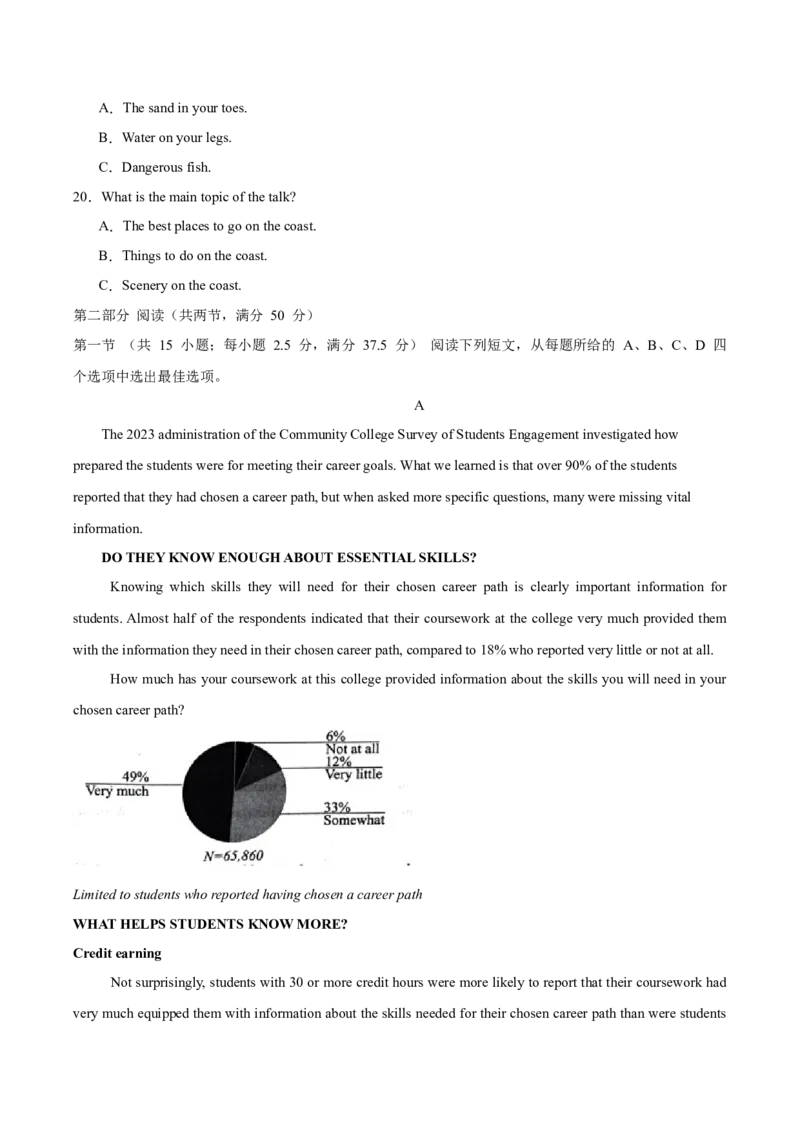
DO THEY KNOW ENOUGH ABOUT ESSENTIAL SKILLS?
Knowing which skills they will need for their chosen career path is clearly important information for
students. Almost half of the respondents indicated that their coursework at the college very much provided them
with the information they need in their chosen career path, compared to 18% who reported very little or not at all.
How much has your coursework at this college provided information about the skills you will need in your
chosen career path?
Limited to students who reported having chosen a career path
WHAT HELPS STUDENTS KNOW MORE?
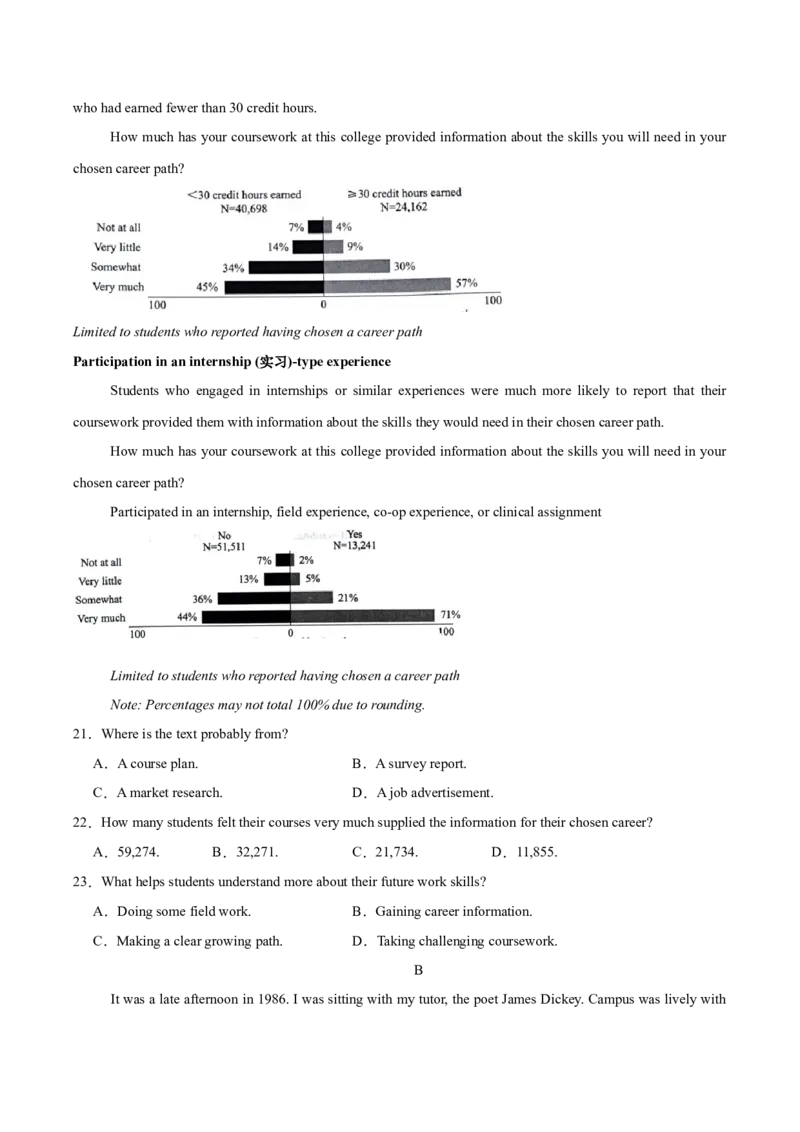
Credit earning
Not surprisingly, students with 30 or more credit hours were more likely to report that their coursework had
very much equipped them with information about the skills needed for their chosen career path than were students
who had earned fewer than 30 credit hours.
How much has your coursework at this college provided information about the skills you will need in your
chosen career path?
Limited to students who reported having chosen a career path
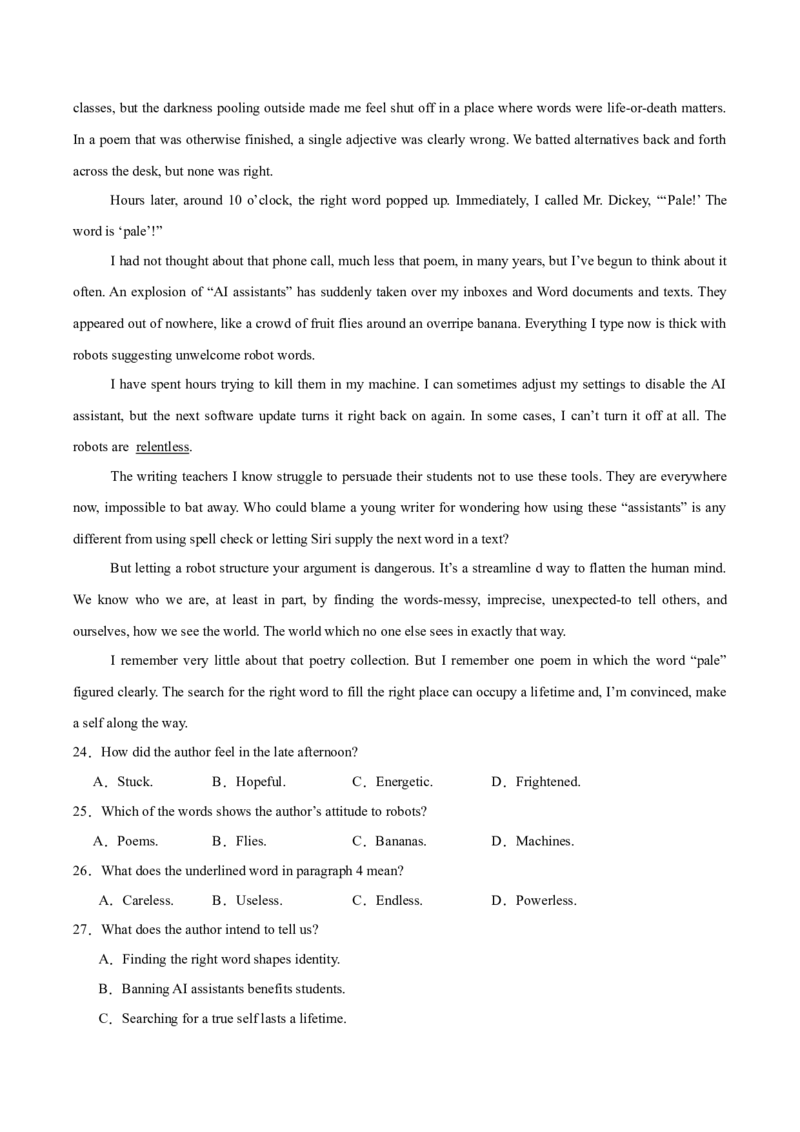
Participation in an internship (实习)-type experience
Students who engaged in internships or similar experiences were much more likely to report that their
coursework provided them with information about the skills they would need in their chosen career path.
How much has your coursework at this college provided information about the skills you will need in your
chosen career path?
Participated in an internship, field experience, co-op experience, or clinical assignment
Limited to students who reported having chosen a career path
Note: Percentages may not total 100% due to rounding.
21.Where is the text probably from?
A.A course plan.
B.A survey report.
C.A market research.
D.A job advertisement.
22.How many students felt their courses very much supplied the information for their chosen career?
A.59,274.
B.32,271.
C.21,734.
D.11,855.
23.What helps students understand more about their future work skills?
A.Doing some field work.
B.Gaining career information.
C.Making a clear growing path.
D.Taking challenging coursework.
B
It was a late afternoon in 1986. I was sitting with my tutor, the poet James Dickey. Campus was lively with
classes, but the darkness pooling outside made me feel shut off in a place where words were life-or-death matters.
In a poem that was otherwise finished, a single adjective was clearly wrong. We batted alternatives back and forth
across the desk, but none was right.
Hours later, around 10 o’clock, the right word popped up. Immediately, I called Mr. Dickey, “‘Pale!’ The
word is ‘pale’!”
I had not thought about that phone call, much less that poem, in many years, but I’ve begun to think about it
often. An explosion of “AI assistants” has suddenly taken over my inboxes and Word documents and texts. They
appeared out of nowhere, like a crowd of fruit flies around an overripe banana. Everything I type now is thick with
robots suggesting unwelcome robot words.
I have spent hours trying to kill them in my machine. I can sometimes adjust my settings to disable the AI
assistant, but the next software update turns it right back on again. In some cases, I can’t turn it off at all. The
robots are relentless.
The writing teachers I know struggle to persuade their students not to use these tools. They are everywhere
now, impossible to bat away. Who could blame a young writer for wondering how using these “assistants” is any
different from using spell check or letting Siri supply the next word in a text?
But letting a robot structure your argument is dangerous. It’s a streamline d way to flatten the human mind.
We know who we are, at least in part, by finding the words-messy, imprecise, unexpected-to tell others, and
ourselves, how we see the world. The world which no one else sees in exactly that way.
I remember very little about that poetry collection. But I remember one poem in which the word “pale”
figured clearly. The search for the right word to fill the right place can occupy a lifetime and, I’m convinced, make
a self along the way.
24.How did the author feel in the late afternoon?
A.Stuck.
B.Hopeful.
C.Energetic.
D.Frightened.
25.Which of the words shows the author’s attitude to robots?
A.Poems.
B.Flies.
C.Bananas.
D.Machines.
26.What does the underlined word in paragraph 4 mean?
A.Careless.
B.Useless.
C.Endless.
D.Powerless.
27.What does the author intend to tell us?
A.Finding the right word shapes identity.
B.Banning AI assistants benefits students.
C.Searching for a true self lasts a lifetime.
D.Using spell check flattens the human mind.
C
Imagine you’re writing a poem, rhymes must be paired up before you start a new line. It turns out that AI
does something similar! When Claude, a large language model (LLM), is given the first line “he saw a carrot and
had to grab it”, it begins thinking about words like “rabbit” almost immediately, writing the next sentence to end at
the appropriate rhyme.
Such forethought is unexpected. Scientists at Anthropic, the lab that developed Claude, built a tool and they
discovered some unexpected complexity.
The tool, a “digital microscope”, lets scientists look at which parts of the AI’s neural (神经的) network light
up when it’s working on different tasks. If a particular area of the LLM lights up whenever it produces words like
rabbit, then that gets marked as being related to rabbits.
This has let the team solve some open questions in AI research, for example, whether a multilingual (多语言
的) chatbot has awareness of concepts beyond language. When Claude is asked for the opposite of “big” in English,
or the same concept in Chinese, the same feature lights up in every case, before more language-specific circuits
kick in to “translate” the concept of smallness into a particular word. This suggests that AI might have a deeper
understanding of the world than we thought.
Other insights, though, are less encouraging. When Claude itself is asked to reason, printing out its chain of
thought to answer maths questions, the microscope suggests that the way the model says it reached a conclusion,
and what it actually thought, might not always be the same. Worse still, ask a leading question — suggesting that
the answer “might be 4”, and it will specifically add numbers that ultimately lead it to agree with the question, even
if the suggestion is wrong.
But being able to gain insight into the mind of an LLM provides clues as to how to stop it doing the same in
the future. The goal, after all, is not to have to do brain surgery, but to know what it’s thinking.
28.What does the writer intend to show through the example in paragraph 1?
A.AI can write texts as programmed.
B.AI can plan sentences in advance.
C.AI can deal with complex tasks.
D.AI can simplify rhyming lines.
29.How does “digital microscope” function in the research?
A.By tracking AI’s thinking activities.
B.By working on different jobs.
C.By activating AI’s “brain” potential.
D.By matching language patterns.
30.What can be inferred from paragraph 5 about Claude?
A.It may make stuff up.
B.It may skip chains of thought.
C.It may leave clues out.
D.It may give logical reasoning.
31.Which of the following titles best suits this text?
A.Why AI Still Gets It Wrong
B.Chatbots’ Language Magic
C.Looking Inside AI’s Mind
D.The Rise of AI Chatbots
D
Those who spent more time typing or speaking with ChatGPT each day tended to report higher levels of
emotional dependence on, and problematic use of, the chatbot, as well as heightened levels of loneliness, according
to new research from OpenAI in partnership with the Massachusetts Institute of Technology. The findings were part
of a pair of studies conducted by researchers at the two organizations.
The launch of ChatGPT in late 2022 helped kick off a craze for generative artificial intelligence. Since then,
people have used chatbots for everything from coding to therapy sessions. As developers like OpenAI push out
more sophisticated models and voice features that make them better at imitating the ways humans communicate,
there is arguably more potential for forming parasocial relationships with these chatbots.
To conduct the studies, the researchers followed nearly 1,000 people for a month. participants had a wide
range of prior experience with ChatGPT and were randomly assigned a text-only version of it or one of two
different voice-based options to use for at least five minutes per day. Some were told to carry out open-ended chats
about anything they wanted; others were told to have personal or non-personal conversations with the service.
The researchers found that people who tend to get more emotionally attached in human relationships and are
more trusting of the chatbot were more likely to feel lonelier and more emotionally dependent on ChatGPT. The
researchers didn’t find that a more engaging voice led to a more negative outcome, they said.
In the second study, researchers used software to analyze 3 million user conversations with ChatGPT and
also surveyed people about how they interact with the chatbot. They found very few people actually use ChatGPT
for emotional conversations.
Cathy Mengying Fang, a study co-author and MIT graduate student, said the researchers are cautious about
people using the findings to conclude that more usage of the chatbot will necessarily have negative consequences
for users. The study didn’t control for the amount of time people used the chatbot as a main factor, she said, and
didn’t compare to a control group that doesn’t use chatbots.
32.What is the main conclusion of the study?
A.Most users rely on ChatGPT for emotional support.
B.More ChatGPT use may cause emotional problems.
C.Frequent ChatGPT users may lose control of emotions.
D.Voice chat may lead to stronger emotional attachment.
33.Why are chatbots like ChatGPT becoming popular?
A.They offer free services.
B.Tech giants develop them.
C.Their functions are advanced.
D.They can replace human work.
34.What were the participants in the first study asked to do?
A.Test ChatGPT’s technical capabilities through specific tasks.
B.Regularly interact with ChatGPT using different modes and topics.
C.Complete surveys about their emotional experiences with ChatGPT.
D.Analyze their own conversations with ChatGPT for research purposes.
35.What can be inferred from Cathy Mengying Fang?
A.The study has some limitations.
B.She is critical of the study findings.
C.The study conclusion applies widely.
D.The study shows ChatGPT’s harm clearly.
第二节 (共5 小题;每小题2.5 分,满分12.5 分)
根据短文内容,从短文后的选项中选出能填入空白处的最佳选项。选项中有两项为多余选项。
Entering a room full of people can be very stressful if you have social anxiety. Your heart may race, your
mind might go blank, and you could feel nervous, dizzy, or overwhelmed. To manage these feelings, it helps to
have a plan and some strategies ready. Here are some tips to make conversations easier and more comfortable.
Practice in low-pressure settings
Before attending a big event, start with short chats with family members, neighbors, or classmates.     36
They are not meant to be deep conversations — just small talk. Over time, taking these small steps can gradually
increase your confidence and make you feel more comfortable in larger social gatherings.
Use the echo (附和) technique
Repeat or paraphrase what the other person says and encourage them to explain further. For instance, if
someone mentions being busy at work, you might respond: “busy?” Doing this shows that you are paying attention
and shifts some of the pressure away from yourself to think of new ideas.     37
Prepare go-to phrases
Think of two or three simple conversation starters to use before the event. Phrases like “That’s really
interesting — tell me more about that” are very helpful.     38     Having these ready can prevent awkward
silences and help the conversation continue naturally, even when you feel nervous or unsure of what to say.
Find a physical anchor (锚点)
Holding a drink, touching a small object, or pressing your feet to the floor can help calm your nerves.     39
Using a physical anchor can help you stay focused and reduce anxiety during conversations or social events.
Have an exit strategy
    40     You might let friends know in advance if you can stay only for a limited time, or prepare
phrases such as: “It was great talking to you — I need to check in with someone else.” Having an exit strategy can
reduce anxiety about feeling trapped and allow you to enjoy social situations more comfortably.
A.Plan how to leave conversations politely.
B.Make an exit to avoid meeting your friends.
C.This gives you a sense of being grounded and safe.
D.Talk about topics that you think will convince others.
E.These interactions let you practice without feeling pressured.
F.Questions about travel, food, or hobbies can also go a long way.
G.People generally like to feel heard, and this can make conversations easier.
第三部分:语言运用(共两节,满分 30 分)
第一节:(共15 小题;每小题 1 分,满分15 分)
阅读下面短文,从短文后各题所给的 A、B、C 和 D 四个选项中,选出可以填入空白处的最佳选项。
I’ve never met Mrs. Poddar, the owner of the house where I am living in this foreign country. I finished my
41     through a property agent. Mrs. Poddar is a complete     42     for me.
Yet, a few months later, Mrs. Poddar instructed my agent to     43     my rent, and the new rent is only
half of the original! Feeling     44    , I asked my agent about the reason. He told me that Mrs. Poddar     45
I was from abroad studying here alone and was still     46     the new environment. She did this just to offer
me some     47    .
Being away from my family to     48     my college degree, I have found the life here     49     in
the past few months: no friends, no familiar food…. But the      50      Mrs. Poddar showed me opened a new
world to me,      51      me not to indulge (沉湎) in negative feelings and to establish new relationships. So I
decided to      52      with people in my local area by first lending a hand to others. On one occasion, I
shopped for groceries for an old couple, who      53      me to a heavy meal they made. Actually, about half of
my spare time is      54      with offering help to people in my neighborhood.
We are indeed from different      55     , but that doesn’t loosen the ties between us.
41.A.moving
B.purchasing
C.selling
D.renting
42.A.newcomer
B.stranger
C.friend
D.helper
43.A.lower
B.cancel
C.collect
D.raise
44.A.motivated
B.confused
C.excited
D.annoyed
45.A.anticipated
B.suspected
C.discovered
D.argued
46.A.wondering at
B.adjusting to
C.looking into
D.working on
47.A.convenience
B.advice
C.comfort
D.freedom
48.A.pursue
B.change
C.polish
D.support
49.A.boring
B.adventurous
C.tough
D.eventful
50.A.trust
B.wisdom
C.respect
D.kindness
51.A.forcing
B.expecting
C.encouraging
D.commanding
52.A.negotiate
B.live
C.correspond
D.connect
53.A.treated
B.entitled
C.guided
D.welcomed
54.A.ready
B.occupied
C.stuck
D.consistent
55.A.neighborhoods B.families
C.generations
D.backgrounds
第二节:(10 个小题;每小题1.5 分,满分15 分)
阅读下面短文,在空白处填入1 个适当的单词或括号内单词的正确形式。
The vocabulary of tea tasting can seem abstract to the point of poetry. When

 56


  (season) tea lovers
comment on a cup of tea, they might comment on its qi and yun. In a 2021 paper, Zhang Jinghong notes that in
Chinese culture, food and drink are not judged only by taste or smell. When

 57


  (cite) the ancient saying,
“Medicine and food have the same origin”, she says that the impact of food and drink on the body remains

 58

important factor in how Chinese perceive taste and quality. Just to name one example, common food descriptors
like “hot” and “cold” do not describe specific temperatures,

 59


  how a dish is perceived to affect a
person’s inner temperature.
Keeping that

 60


  mind, what exactly do tea lovers mean when they talk about qi and yun? Deng
Shihai, an early expert on Pu’er tea, praised its “flavorless flavor” as the highest level Pu’er can attain. If that
sounds needlessly contradictory, you’re not alone, but to Deng, it was a way to distinguish beginners at tea,
61


  focus on taste, from experts who see tea more

 62


  (whole).
Qi and yun are thought to be more advanced than any simple description of taste, in part because they imply
an indescribable sense of connection between people and things, and even to the far

 63


  (expand) natural
world. As Zhang notes, “Qi and yun

 64


  (consider) to more accurately and thoroughly express what
people feel when they are touched by things, and to better reflect the

 65


  (unit) of people and things, and
people and nature.”
第四部分  写作(共两节,满分40 分)
第一节(满分 15 分) 假定你是李华。在当地书展上,你选购了几本自己感兴趣的不同类别的课外读物。请
给你的英国笔友Emma 写封邮件分享此事,内容包括:
(1)书籍类别;
(2)选择原因。
注意:
(1)写作词数应为80 个左右;
(2)请按如下格式在答题卡的相应位置作答。
Dear Emma,
The local book fair last weekend was amazing!
____________________________________________________________________________________________
____________________________________________________________________________________________
____________________________________________________________________________________________
____________________________________________________________________________________________
____________________________________________________________________________________________
I can’t wait to read them. What kinds of books inspire you most?
Best wishes,
Li Hua
第二节  (满分 25 分)
阅读下面材料,根据其内容和所给段落开头语续写两段,使之构成一篇完整的短文。
“I’m going to Boston!” I screamed to my running friends after finishing the Mount Lemmon Marathon.
Running in the Boston Marathon is on many runners’ bucket list, but you must qualify. I had trained hard in 2020,
but Covid canceled the race — and again in 2021. In the fall of 2021, a friend asked, “Did you run in Boston?”
“No, it was canceled,” I said. “Actually, they just held it.” “They don’t run it in the fall. No!” I was discouraged. I
had missed my chance, but in 2022, the marathon returned to April, inviting qualifiers in 2019 — and I was going!
Excited, I immediately continued my preparations.
Race weekend arrived. I felt a mix of anticipation and loneliness — no one had come to support me. The bad
weather ruined some sightseeing plans and made me feel emptier. Finally, race day came, and I joined the massive
sea of 30,000 runners. I should have been thrilled, but I focused only on how lonely I was. I ran fast at the start,
giving it everything I had. For the first few miles, I kept a strong pace, but soon my speed slowed, and more
runners passed me. Two years of training had led to this moment — why wasn’t I performing at my best?
“This is terrible,” I said to myself. “Why do I do this to myself? This isn’t fun. This is my last marathon.”
Negative thoughts weighed on me with every step. I had spent thousands of dollars to get to Boston, yet I wasn’t
enjoying it. The loneliness and slow pace seemed unbearable, and I wondered if it had all been for nothing.
Then, I noticed the crowd — over 500,000 spectators (观众) lined the course, cheering and celebrating. I
made eye contact with one man and raised my arm. “Yeah!” I shouted. I did it again at the next group, and joy
flooded through me. Social interaction, something I usually loved, transformed my run. I realized I had been
running all wrong. I began engaging with the crowd, giving high-fives, taking snacks, and laughing at their energy.
Their excitement became mine.
注意:(1)续写词数应为150 个左右;(2)请按如下格式在答题卡的相应位置作答。
I moved closer to the barriers, connecting with as many people as I could.
____________________________________________________________________________________________
____________________________________________________________________________________________
____________________________________________________________________________________________
____________________________________________________________________________________________
____________________________________________________________________________________________
That day, I learned a valuable lesson.
____________________________________________________________________________________________
____________________________________________________________________________________________
____________________________________________________________________________________________
____________________________________________________________________________________________
____________________________________________________________________________________________