2026 年高考一轮复习验收卷(浙江卷 02)
英语·全解全析
注意事项:
1. 答题前,考生先将自己的姓名、准考证号码填写清楚,将条形码准确粘贴在条形码区域内。
2. 选择题必须使用2B铅笔填涂;非选择题必须使用0. 5毫米黑色字迹的签字笔书写,字体工整,笔迹清楚。
3. 请按照题号顺序在答题卡各题目的答题区域内作答,超出答题区域书写的答案无效;在草稿纸、试卷上
答题无效。
4. 作图可先使用铅笔画出,确定后必须用黑色字迹的签字笔描黑。
5. 保持卡面清洁,不要折叠、不要弄破、弄皱,不准使用涂改液、修正带、刮纸刀。
第一部分 听力(共两节,满分30分)
做题时,先将答案标在试卷上。录音内容结束后,你将有两分钟的时间将试卷上的答案转涂到答题卡上。
第一节(共5小题;每小题1. 5分,满分7. 5分)
听下面5段对话。每段对话后有一个小题,从题中所给的 A、B、C三个选项中选出最佳选项。听完每段
对话后,你都有10秒钟的时间来回答有关小题和阅读下一小题。每段对话仅读一遍。
例: How much is the shirt?
A. £19. 15. B. £9. 18. C. £9. 15.
答案是C.
1.Where does the man prefer to go for further study?
A.Italy. B.France. C.Ireland.
2.What is the man going to do this Saturday?
A.Go swimming. B.Go hiking. C.Go to a library.
3.Who is the man talking to?
A.His aunt. B.The headmaster. C.A school bus driver.
4.Where were the speakers in the morning?
A.In a theatre. B.In a shopping center. C.In a restaurant.
5.What does the man think of the weather?
A.Relaxing. B.Satisfying. C.Upsetting.
第二节(共15小题;每小题1. 5分,满分22. 5分)
听下面5段对话或独白。每段对话或独白后有几个小题,从题中所给的 A、B、C三个选项中选出最佳选
项。听每段对话或独白前,你将有时间阅读各个小题,每小题5秒钟;听完后,各小题将给出5秒钟的作答时间。每段对话或独白读两遍。
听第6段材料,回答第6和7题。
6.When will the wedding cake be served?
A.At 4:00 p.m. B.At 8:00 p.m. C.At 8:30 p.m.
7.What will the man's cousin do at the wedding?
A.Organize the dinner. B.Play in the live band. C.Take care of the music.
听第7段材料,回答第8至10题。
8.Which class are the speakers doing the project for?
A.History. B.Science. C.Social studies.
9.Why does the man refuse to consider Benjamin Franklin as a good choice?
A.The class have known a lot about him.
B.Another group has chosen to study him.
C.His personal life is not attractive enough.
10.What do the speakers finally decide to write about?
A.Elon Musk. B.Nikola Tesla. C.Thomas Edison.
听第8段材料,回答第11至13题。
11.What's the man?
A.A radio host. B.A shop assistant. C.A supermarket manager.
12.Where did the woman meet the kind girl?
A.In a parking lot. B.At Sam's house. C.Outside a supermarket.
13.What's the woman going to do?
A.Find the girl. B.Pay for the bag. C.Pass on the kindness.
听第9段材料,回答第14至17题。
14.Where is the woman going to volunteer?
A.In Central America. B.In Europe. C.In South Africa.
15.What will the woman mainly do as a volunteer?
A.Take photos. B.Access information. C.Cook for the team.
16.What does the woman pay the charity for?
A.Flight tickets. B.Living expenses. C.Research equipment.
17.How does the woman feel?
A.Excited. B.Nervous. C.Bored.
听第10段材料,回答第18至20题。18.Why did Alpine farmers originally use cowbells?
A.To decorate the cattle. B.To track their cattle. C.To celebrate traditions.
19.What is mentioned about the tone of cowbells?
A.Farmers change the tone yearly.
B.Each cowbell has a different tone.
C.The tone represents the size of the cow.
20.Why are Swiss cowbells expensive?
A.They are made of costly metals.
B.They were produced long ago.
C.They are handmade and culturally significant.
第二部分 阅读(共两节,满分 50 分)
第一节 (共 15 小题;每小题 2.5 分,满分 37.5 分) 阅读下列短文,从每题所给的 A、B、C、D 四
个选项中选出最佳选项。
A
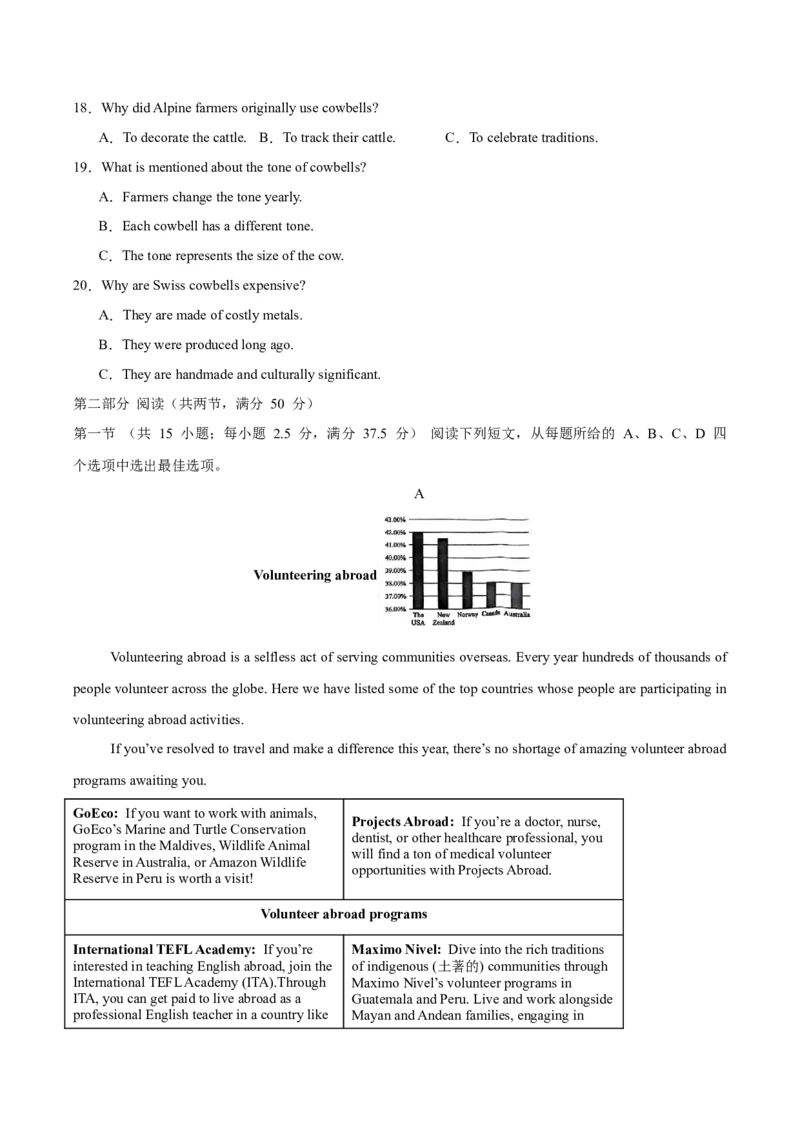
Volunteering abroad
Volunteering abroad is a selfless act of serving communities overseas. Every year hundreds of thousands of
people volunteer across the globe. Here we have listed some of the top countries whose people are participating in
volunteering abroad activities.
If you’ve resolved to travel and make a difference this year, there’s no shortage of amazing volunteer abroad
programs awaiting you.
GoEco: If you want to work with animals,
Projects Abroad: If you’re a doctor, nurse,
GoEco’s Marine and Turtle Conservation
dentist, or other healthcare professional, you
program in the Maldives, Wildlife Animal
will find a ton of medical volunteer
Reserve in Australia, or Amazon Wildlife
opportunities with Projects Abroad.
Reserve in Peru is worth a visit!
Volunteer abroad programs
International TEFL Academy: If you’re Maximo Nivel: Dive into the rich traditions
interested in teaching English abroad, join the of indigenous (土著的) communities through
International TEFL Academy (ITA).Through Maximo Nivel’s volunteer programs in
ITA, you can get paid to live abroad as a Guatemala and Peru. Live and work alongside
professional English teacher in a country like Mayan and Andean families, engaging indaily activities such as agriculture and
Spain, Thailand, or Costa Rica.
traditional weaving (编织).
For those who still haven’t experienced the joy and satisfaction of volunteering abroad, it’s never too late to
start! You can always make up your mind and be a part of it.
21.How much higher is the USA’s volunteering abroad rate than Australia’s?
A.3%. B.4%. C.38%. D.42%.
22.Which offers wildlife protection programs?
A.International TEFL Academy. B.Projects Abroad.
C.Maximo Nivel. D.GoEco.
23.What can the volunteers of Maximo Nivel gain?
A.Overseas teaching experience. B.Modern weaving techniques.
C.Deep cultural engagement. D.Chances for a health check-up.
B
It was a sunny winter day. I had gone up and down the tower when, outside the little door at the foot, a blind
man came toward me. He was a pale, thin man with dark glasses. He kept close to the inner wall of the courtyard.
On reaching the door, he touched it and sharply turned inside. In a moment, he disappeared up the staircase. I stood
still, looking at the little sign that said “To the Tower… ” I felt obliged to follow.
I didn’t follow closely. I caught up with him in the ticket office. There I was surprised to see the attendant
selling him a ticket as though he were any other visitor. With the ticket in one hand and touching the wall with the
other, he reached the staircase leading to the hallway.
“That man is blind,” I said to the attendant, but he showed no concern. “He’s blind,” I repeated. He didn’t
answer, looking at me vacantly.
“Perhans he wants to jump,” I said. But his chair was too comfortable. He didn’t stir. He still looked down at
a crossword puzzle he had begun. I turned toward the staircase.
“The ticket,” the attendant said, rising from his chair. It seemed the only thing that could move him. After
purchasing my ticket, I hurried up the staircase.
The man hadn’t gone as far as I imagined. After ten minutes, I approached him. “Excuse me,” I said as
politely as I could, “but I am very curious to know why you came up.”
“You’d never guess,” he said.
“Not the view, I take it, or the fresh air on this winter day,” I said.
He smiled. “Coming up the stairs, one can feel the change-the coo staircase suddenly becomes quite warm,—and how up here behind the wall there is shade, but as soon as one goes opposite a narrow window one finds the
sun. In all of Siena there is no place so good as here.”
He moved into the sunlight. Then he stepped into the shade. “Light, shade, light, shade,” he said, and seemed
as pleased as a child who, in a game of hopscotch, jumps from square to square.
We went down the tower together. I left him, gladdened as one can only be by the sunlight.
24.Why did the author follow the blind man?
A.To offer timely help. B.To satisfy his curiosity.
C.To teach him a lesson. D.To prevent him from climbing up.
25.What was the attendant’s attitude to visitors?
A.Enthusiastic. B.Concerned. C.Indifferent. D.Skeptical.
26.What encouraged the blind man to climb the tower?
A.The fresh air on the top. B.The pleasant childhood memories.
C.The fantastic view from the tower. D.The striking contrast between light and shade.
27.What message does the writer want to convey in the text?
A.Nature is the best gift for humanity.
B.When one door shuts, another opens in life.
C.Every individual can appreciate beauty in life.
D.The disadvantaged deserve care from the society.
C
We often find it hard to tear our eyes away from screens — an urge so intense that it messes with our focus
and our cognitive (认知的) health, which is known as “brain rot”. The Oxford Dictionary defines it as the
degradation of mental state due to overconsumption of online content. It refers to the dull stuff on social media and
its negative impact on brain health.
“There’s an arms race to develop digital content and platforms that can grab people’s attention and compete
in a digital market,” says Adam Leventhal, a professor at the University of Southern California. “Digital content
and platforms that win the arms race are increasingly addictive.” Dr. Leventhal adds, “They pull people into ‘digital
addiction’ and expose consumers to unhealthy content.”
Though not an official diagnosis (诊断), “brain rot” can cause cognitive and emotional problems. “Too
much screen time can negatively affect attention, concentration, learning, memory, emotional regulation, and social
functioning,” Dr. Manwell says. “Brain rot” occurs as screen time replaces activities beneficial to the brain, such as
exercise and socializing. Passive, rapid scrolling while multitasking or trying to work or study at the same time alsocontributes, resulting in divided and reduced attentional resources and leading to poorer learning and memory
capabilities. Manwell says, “There are often also corresponding effects on the brain such as reduced gray matter
and white matter, leading to damaged processing capacity and efficiency.”
To fight against “brain rot”, changes can be made. Manwell suggests altering digital media habits, like taking
screen breaks and limiting certain apps. There are apps to track screen time and enforce digital detox. For long-
term improvement, Manwell recommends replacing screen time with activities like meditation, exercise, and
learning new skills. If screen use is work-related, find alternatives like printing materials or having in-person
meetings. When on a screen, focus merely on the task to decline multitasking’s negative effects. Overall, being
aware and making lifestyle adjustments can help prevent and reverse (逆转) the impact of “brain rot”.
28.According to the text, what do we know about “brain rot”?
A.A kind of serious disease officially diagnosed by doctors.
B.The loss of cognitive abilities caused by using digital platforms.
C.The negative impact of overusing digital devices on physical health.
D.The decline of mental well-being due to overconsuming online materials.
29.What can we infer from Adam Leventhal’s words?
A.The competition among digital contents and platforms is fierce.
B.Digital platforms are developed to help people improve their mental health.
C.The digital content that wins the attention competition is usually less addictive.
D.The development of digital content and platforms leads to some negative effects.
30.What does the underlined phrase “digital detox” in paragraph 4 mean?
A.Using digital devices frequently. B.Taking a break from digital devices.
C.Giving up using digital technologies. D.Replacing with advanced digital products.
31.What is the main theme of the text?
A.The harms and solutions of “brain rot”. B.The effect of addictive digital platforms.
C.The importance of socializing in daily life. D.The impact of “brain rot” on digital device.
D
Researchers from the University of Florida studied what may cause people to choose unknown options over
known ones, and they found that where the information comes from is important: when what you know comes from
other people’s experiences, you’re more likely to explore new options.
They conducted a series of experiments. In one experiment, participants were asked to choose one of four
cards on a computer screen. Each card hid an amount of money from 1 cent to 40 cents, and participants were toldhow much money was behind one of the cards in order to help them determine whether to explore and try another
card in the hope of turning up more. Some participants were told the information came from another person taking
part in the experiment; others were told it came from the computer.
Participants were almost twice as likely to explore an unknown card when the information about the known
amount appeared to come from a player rather than the computer. As social beings, we consider other people’s
experiences as part of our own, so we’re less likely to want to repeat them, even if the experiences are positive, the
researchers find. It doesn’t seem to work the same way with computers.
Not surprisingly, the amount revealed also had an effect: participants were more willing to choose a different
card — to explore, so to speak — when the known amount was low and less willing when it was high, no matter
the source of the information. But when the revealed amount was in the middle, the human versus (对抗) computer
effect became particularly evident.
The idea that the individual decision about whether to venture out has a social component could have
practical implications, the researchers write. “For those seeking to encourage exploration in others, our findings
offer a simple intervention: highlight the fact that existing information is available because of previous explorers.”
32.What mainly influenced the participants’ decisions in the experiment?
A.The source of the information. B.The time reserved for each task.
C.The number of options provided. D.The reward for the correct choice.
33.At which known amount might the participants hesitate most?
A.5 cents. B.10 cents. C.20 cents. D.35 cents.
34.What is the function of the last paragraph?
A.To doubt an idea. B.To give a warning.
C.To note the study’s limitations. D.To suggest a practical application.
35.What is the best title for the text?
A.Why we prefer familiar over foreign B.How rewards make us avoid unknowns
C.Why we go where no one’s gone before D.How others help us make better choices
第二节 (共5小题;每小题2.5分,满分12.5分)
根据短文内容,从短文后的选项中选出能填入空白处的最佳选项。选项中有两项为多余选项。
I am a child of traditional book reading. I used to go through one book continuously from beginning to end,
taking notes or highlighting lines before going on to the next book. It was a slow but deeper way to absorb a book.
36 My struggle with Dostoevsky’ s The Brothers Karamazov early on is a good example.
After college, my job involved reading a lot of background materials for projects. Many nights I stayedawake till past midnight leafing through pages. 37 It helped me breeze through my reading requirements.
However, for books I was genuinely passionate about, I switched to a slower pace, and still read one book at a time.
38 I no longer stick to one book, but jump between them, spending about half an hour on each.
Currently, I’m reading six books in various stages, with more lined up to start soon. My speed reading skills help
me scan quickly without losing comprehension. I can easily switch to slow reading mode whenever needed.
Recently, I learnt from a journal that my previous reading method is known as “Blocked Practice”, which
involves studying one topic thoroughly before moving on to another. 39 However, it tends to restrict how
you apply knowledge in new and varied situations.
On the other hand, the “mixing it up” approach, also referred to as “Interleaved Practice”, could produce
dramatic, long-lasting learning benefits. By switching between topics, readers can make connections between ideas
and skills. 40 Over time, readers could be more capable of solving problems critically. If this is true, then
my evolution as a reader of books has been in the right direction all along.
A.It helps widen perspectives.
B.This method has its limitations.
C.That was when I took up speed reading.
D.I’m not great at trying out different reading styles.
E.That’s why it took me months to finish heavy books.
F.Nowadays I’ ve acquired the habit of multiple book reading.
G.This approach can be effective for mastering individual concepts.
第三部分:语言运用(共两节,满分 30分)
第一节:(共15小题;每小题 1分,满分15分)
阅读下面短文,从短文后各题所给的 A、B、C 和 D 四个选项中,选出可以填入空白处的最佳选项。
One ordinary afternoon, seeking an old novel for research, I wandered into a cluttered secondhand
bookstore. When I 41 the dusty shelves, a familiar spine (书脊) caught my eye. My heart 42 a
beat — it was a childhood 43 I hadn’t seen in decades — the very copy that had been stolen from my
school bag. 44 nostalgia (怀旧), I bought it immediately.
Back at my desk, I carefully opened the 45 cover. What I saw left me breathless. There, on the
first page, was my 46 childhood signature. But beneath it, unmistakable in its flowing writing, was my
grandfather’s 47 , written when he first 48 it to me: “I really hope at many years later this book
will once again fall into your hands, and you’ll read it again.”
A wave of 49 washed over me. I recalled my childish 50 when the book was lost, andGrandpa’s 51 words: “Don’t cry, little one. Perhaps it’s just on an adventure, learning new stories to
share.” Now, holding this tangible piece of my past, his hopeful wish felt like a 52 fulfilled. The book
had completed its long, unexpected 53 , guided by an 54 thread of love. Grandpa’s simple
words was no longer cannot 55 . Sometimes, love truly does find its way back home, even through the
yellowed pages of a forgotten book.
41.A.cleaned B.searched C.repaired D.painted
42.A.skipped B.ached C.raced D.stopped
43.A.favorite B.puzzle C.original D.annoyance
44.A.Overcome with B.Relieved from C.Burdened with D.Flooded into
45.A.new B.expensive C.worn D.colorful
46.A.clear B.faded C.bright D.large
47.A.note B.letter C.message D.diary
48.A.sold B.returned C.lent D.gifted
49.A.pride B.excitement C.laughters D.memories
50.A.joy B.despair C.shame D.calm
51.A.harsh B.cold C.strict D.gentle
52.A.story B.miracle C.dream D.problem
53.A.task B.secret C.journey D.mistake
54.A.invisible B.inappropriate C.inflexible D.invaluable
55.A.create B.maintain C.break D.strengthen
第二节:(10个小题;每小题1.5分,满分15分)
阅读下面短文,在空白处填入1个适当的单词或括号内单词的正确形式。
This summer, an immersive (沉浸式的) light show 56 (inspire) by the ancient Chinese myth The
Classic of Mountains and Seas has attracted young audiences at Beijing Fun, a cultural-commerce block in
downtown Beijing. It has led to a significant increase in visitors — especially families 57 children.
Beijing Fun is a model urban renewal project and integrates historic buildings, among 58 the
Quanyechang building is the most famous one. Constructed in the late Qing Dynasty as a commercial hall, it
59 (list) as part of a major historic and cultural site protected at the national level in 2006. Rather than being
changed into permanent commercial space, it now hosts short-term exhibitions 60 (preserve) its history
while restoring its function.
Another restored building houses Pageone bookstore, a place 61 readers can admire views ofZhengyangmen — part of Beijing Central Axis (轴). The bookstore owner cleverly takes advantage of this location
62 designs a themed zone, which has evolved into a social media hot spot. Meanwhile, Miniso, Luckin Coffee,
Manner Coffee and some other chain brands have also been brought in to help Beijing Fun become more 63
(economic) sustainable. Phase two, set to open this year, will feature live house and interactive opera performances,
aiming to offer immersive youth 64 (engage).
Liu Anning, 65 18-year-old student, says that Beijing Fun’s mix of historic architecture with
trendy shops makes it stylish and convenient.
第四部分 写作(共两节,满分40分)
第一节(满分 15 分) 假定你是李华,你的英国朋友Jim打算来中国旅游,他在两种旅行(Nature Tour和
Culture Tour)上比较纠结。请你给他写封电子邮件。内容包括:
1.推荐路线;
2.说明理由。
注意:1.写作词数应为80个左右;
2.请按如下格式在答题卡的相应位置作答。
Dear Jim,
____________________________________________________________________________________________
____________________________________________________________________________________________
____________________________________________________________________________________________
____________________________________________________________________________________________
____________________________________________________________________________________________
Yours,
Li Hua
第二节 (满分 25 分)
阅读下面材料,根据其内容和所给段落开头语续写两段,使之构成一篇完整的短文。
Lena was a 17-year-old girl who considered herself independent. For three years, her diary had been her only
trusted friend. Every night, she would record everything in life — the math teacher’s blame, the broken relationship
with deskmates, the crush (喜欢) on a boy, the stray dog, the leaking roof, even the way her mother talked to her.
The cold war began after that night — when Mom opened her schoolbag without warning, stuff fell out onto
the floor—a half-finished love poem, a present prepared for her deskmate, and her private drawing book.
“What’re you doing on earth?” screamed Lena.
“I just want to check and keep you safe!” Mom’s voice cracked, her hands shaking.“Safe? You just want to control me!” Lena cried, kicking the bag away. That night, Lena locked herself in
her room, scribbling angry words into her diary: “This is my Privacy! I hate her! I’ll never forgive her!”
For a week Lena wouldn’t speak to her mother. One rainy afternoon, Lena returned home to find her diary
missing from its usual spot under the pillow. Panic set in. Did Mom take it? She stormed into the kitchen, where her
mother was washing vegetables, hands trembling slightly.
“Give it back!” Lena demanded.
Mom wiped her hands slowly, avoiding eye contact. “The roof leaked. I was cleaning up the mess in your
room when I found your notebook lying on the wet floor. I was drying it.” She pointed to the balcony, where the
diary lay open under a hairdryer, pages fluttering.
Lena’s heart sank. Her deepest secrets — complaints about Mom, crushes on classmates — were now
exposed. She grabbed the diary and ran back to her room, tears blurring her vision. Flipping through the pages, she
noticed something strange: every angry entry was marked with a tiny red sticker (贴纸)。
注意:
1. 续写词数应为150左右;
2. 请按如下格式在答题卡的相应位置作答。
Curious, Lena turned to the page where she wrote “I hate you!” and found unfamiliar handwriting.
____________________________________________________________________________________________
____________________________________________________________________________________________
_________________________________________________________________________________________
That night, Lena tiptoed into her mother’s room, diary in hand.
____________________________________________________________________________________________
____________________________________________________________________________________________
____________________________________________________________________________________________
________________________________