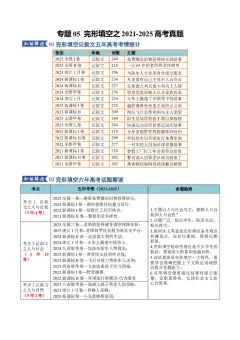
高考I 卷80 个
清单11 2025 高考完形填空专项词汇
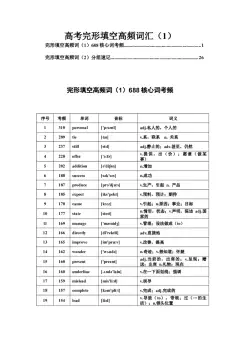
1. vase n. 花瓶
2. wedding n. 婚礼
3. beloved adj. 钟爱的
4. item n. 一件(物品)
5. donate v. 捐赠
6. supposedly adv. 据说,一般看来
7. particularly adv. 特别,尤其
8. additional adj. 附加的,额外的
9. repost v. 重新发布(帖子)
10. race v. 快速移动
11. chaos n. 混乱
12. exchange n. 交流,交谈
13. please v. (使)高兴/满意
14. otherwise adv. 否则,要不然
15. apartment n. 公寓
16. cottage n. 乡村小屋
17. store v. 储存
18. decorate v. 装饰
19. stuff v. 塞满
20. equip v. 装备,配备
21. conventional adj. 传统的,常规的
22. valuable adj. 有价值的,宝贵的
23. complicated adj. 复杂的;
24. tolerable adj. 可忍受的;
25. fee n. 费;
26. receipt n. 收据
27. spare v. 使免遭…. . .
28. investigate v. 调查
29. encounter v. 偶然碰到(某人)
30. recommend v. 推荐
31. giveaway n. 赠品
32. belongings n. 所有物,财产
33. anticipate v. 预料,预计
34. appreciate v. 欣赏,感激
35. deliver v. 递送
36. withdraw v. 撤回
37. paint over 用油漆覆盖
38. cottage n. 小屋,村舍
39. store v. 储存;n. 商店
40. display v. 展示
高考Ⅱ卷50 个
41. stuff v. 塞满,填满
42. equip v. 装备,配备
43. valuable adj. 有价值的
44. conventional adj. 传统的
45. complicated adj. 复杂的
46. tolerable adj. 可忍受的
47. receipt n. 收据
48. model n. 模型;模特
49. description n. 描述
50. warning n. 警告
51. confused adj. 困惑的
52. disappointed adj. 失望的
53. spare v. 使免遭;节省
54. encounter v. 遇见,遭遇
55. investigate v. 调查
56. recommend v. 推荐
57. giveaway n. 赠品;泄露
58. contribution n. 贡献;捐款
59. belongingsn. 所有物,财产
60. anticipate v. 预期,预料
61. appreciate v. 欣赏;感激
62. withdraw v. 撤回;退出
63. look around 环顾四周;参观
64. settle on 选定,确定
65. stare at 盯着,凝视;
66. see daylight (see the light of day) 拿出来,见天
日
67. fill up 装满;
68. decide on/upon sth. 选定某事物
69. a couple of 几个
70. come in 被收到
71. a price cut 减价
72. draw near 接近,靠近
73. settle on 决定,选定
74. in an instant 马上
75. a ray of light 一缕光线
76. take joy in 以. . . . . . 为乐
77. paint over 刷油漆覆盖
78. looks around 四下环顾,到处寻找
79. empty out 清空,腾空
80. pull down 拆毁
1. eating disorder n. 饮食功能失调
2. weightlifting n. 举重
3. impressive adj. 令人赞叹的
4. following n. 一群追随者
5. well-liked adj. 深受喜爱的
6. post v. 发布(帖子)
7. workout n. 锻炼,健身
8. goodwill n. 友善
9. timeout n. (比赛中的)暂停
10. wake-up call n. 警示
11. ultimately adv. 最终
12. automatically adv. 自动地
13. activate v. 激活
14. exercise v. 锻炼;n. 运动
15. recover v. 恢复
16. long-distance adj. 长途的
17. change n. 改变;v. 变化
18. fortune n. 财富;运气
19. healthy adj. 健康的
20. risky adj. 有风险的
21. passion n. 热情,酷爱
22. cure n. 治愈;疗法
23. fitness n. 健康;健身
24. reason n. 理由;v. 推理
25. difference n. 差异
26. stepping stone n. 垫脚石,跳板
浙江卷53 个
27. road block n. 路障
28. passing mark n. 及格线
29. forgive v. 原谅
30. consult v. 咨询
31. shared adj. 共享的
32. celebrate v. 庆祝
33. goal n. 目标;进球
34. duty n. 责任
35. doubter n. 怀疑者
36. admirer n. 仰慕者
37. inspiration n. 鼓舞;灵感
38. authority n. 权威;官方
39. turn one’s life around 彻底改变生活
40. work out
锻炼,健身
41. set out on 开始,着手
42. be down to归因于
43. stick to 坚持
44. lift others up 鼓励他人
45. laugh at 嘲笑
14. road block n. 路障,障碍
46. passing mark n. 及格分数
47. struggle with 与. . . . . . 争
48. lead sb. to sth. 致使某人遭遇某事
49. (be) determined to do sth. 决心做某事
50. hold on 坚持住
1. addiction n. 嗜好;
2. charge v. 收费;
3. course n. 一道菜;
4. pursue v. 追求;
5. pair v. 配对;
6. invaluable adj. 极宝贵的;
7. impersonal adj. 没有人情味儿的;
8. reserve v. 保留;
9. evaluate v. 评价,评估
10. career n. 职业,事业
11. degree n. 学位;程度
12. hobby n. 爱好
13. practical adj. 实际的,实用的
14. dangerous adj. 危险的
15. hire v. 雇佣
16. invite v. 邀请
17. cover v. 覆盖;报道
18. issue n. 问题;v. 发行
19. founder n. 创始人;v. 失败
20. adapt v. 适应;改编
21. prefer v. 更喜欢
22. refusev. 拒绝
23. apologize v. 道歉
24. panic v. 恐慌
25. regret v. 后悔
26. pretend v. 假装
27. admit v. 承认
28. supposedly adv. 据称
29. consequently adv. 因此
30. occupation n. 职业;占用
31. institution n. 机构;制度
32. solution n. 解决方案
33. regardless of prep. 不管,不顾
34. except for prep. 除了…… 之外
35. demand n. 需求;v. 要求
36. compete v. 竞争
37. reconnect v. 重新连接
38. take root
生根,扎根;(想法)确立
39. gain ground 取得进展,普及
40. work wonders
创造奇迹
41. raise concerns
引起担忧
42. let alone 更不用说
43. get the green light 获得批准
44. put sth. to good use 好好利用某事物;
北京卷27 个
45. sign up 注册;
46. as opposed to sth. 与某事物相反,而非某事物;
47. pass on 传递;
48. try out 试用,试验;
49. go over 仔细检查,反复研究;
50. take down 写下,记录;
51. in return for sth. 作为对某事物的回报或回应;
52. in honor of sth. 纪念某事物;
53. in line with sth. 与某事物一致
1. desire n. 渴望;v. 期望
2. hesitation n. 犹豫
3. curious adj. 好奇的
4. envious adj. 嫉妒的
5. distant adj. 遥远的
6. locked adj. 锁着的
7. abandoned adj. 被遗弃的
8. demonstrate v. 演示;证明
9. recommend v. 推荐
10. cloud v. 使模糊;n. 云
11. question v. 质疑;n. 问题
12. complain v. 抱怨
13. falsely adv. 错误地;虚假地
14. randomly adv. 随机地
15. shame n. 羞愧;耻辱
16. patience n. 耐心
17. tearfully adv. 含泪地
18. carelessly adv. 粗心地
19. attention n. 关注;注意力
20. tolerance n. 宽容;容忍
21. sympathy n. 同情
22. stand out
脱颖而出,引人注目
23. exchange looks 交换眼神
24. push sb. to the edge 把某人逼到崩溃边缘
25. mounting pressure
越来越大的压力
26. long for 渴望
27. listen attentively 认真倾听
(2025 年普通高等学校招生全国统一考试(1 月浙江卷)英语真题)One of the most common mistakes in
communication is trying to do too much. ___36___ There’s no value in delivering any kind of communication,
whether written, spoken, formal, or informal, if the message doesn’t come across clearly. Being clear and brief —
while maintaining interest and including everything your listeners need to know — is a high-level communication
skill.
Here are some tips worth following in order to communicate more effectively.
Keep your audience in mind.
Your audience will naturally be more interested and engaged when you tailor your communications to their
interests. ___37___ This will engage their desire to understand and interact with the information.
Don’t use ten words when one will do.
Even the most engaged and committed audience will eventually get bored. Keeping your message simple and
clear will make it easier for people to understand. ___38___ However, they’re hearing it for the first time. Keep it
simple.
___39___
If you’ve ever worked as an instructor, manager, trainer or coach, you’ll know that there are few better ways to
learn new information than to teach it. Ask the audience to contribute their ideas or to take a role in explaining new
concepts and policies to others. Allow them to lead discussions and meetings to develop their communication skills.
Consider the best method to deliver your message.
If the information you’re communicating isn’t urgent, consider sending an email. Written communication will
give your audience more time to review it, think it over, and follow up with questions. ___40___
Building effective communication skills takes time, but the effects are worth the effort.
A. Be patient.
B. Get the audience involved.
C. The best messages are often simple.
D. Speak directly to what matters to them.
E. You may be surprised by what your listeners offer.
F. It will also give them a handy record to refer back to.
G. As the speaker, you already know what you’re going to say.
重点词汇
1. ________ v. 传递
2. ________ adj. 紧急的
3. ________ adj. 简洁的
4. ________________被理解
5. ________________将. . . . . . 记在心中
6. tailor. . . to ________________
7. ________________与……互动
8. ________________仔细考虑
9. ________________对……取进一步行动
10. ________________查阅
熟词生义
tailor 熟义:n. 裁缝;文章义:v. ________
派生词
1. engage v. 引起,吸引→________ adj. 投入的
2. commit v. 犯罪,犯错→________ adj. 专注的,坚定的
3. instruct v. 指示,吩咐→________ n. 讲师
4. hand n. 手v. 传递→________ adj. 便利的
5. communicate v. 交流→________ n. 交流;沟通
6. effect n. 影响→________ adj. 有效的
长难句分析
1. There’s no value in delivering any kind of communication, whether written, spoken, formal, or informal, if the
message doesn’t come across clearly.
分析:本句是复合句。“There’s no value in doing sth. ”是固定句型,表示“________________”,其中in 后
接动名词短语delivering any kind of communication 作________ ;“ whether written, spoken, formal, or
informal”是省略结构,完整形式为“whether it is written, spoken, formal, or informal”,作插入语;“if the
message doesn’t come across clearly”是if 引导的________从句。
翻译: 如果信息传达不清晰,那么进行任何形式的交流,无论是书面的、口头的、正式的还是非正式的,
都没有价值。 、
2. Being clear and brief — while maintaining interest and including everything your listeners need to know — is a
high - level communication skill.
分析:本句是主系表结构。“Being clear and brief”是动名词短语作________;“while maintaining interest
and including everything your listeners need to know”是省略结构,完整形式为“while you are maintaining
interest and including everything your listeners need to know”,作________;“your listeners need to know”是
________,修饰先行词everything;“is”是系动词,“a high - level communication skill”是表语。
句意: 保持清晰简洁——同时保持趣味性并涵盖听众需要了解的所有内容——是一种高级的沟通技巧。
一.阅读理解
A
Parcel lockers, also called smart lockers or package lockers, are secure, automated storage units in
centralized locations. They are revolutionizing how goods can be delivered and received. People can pick
up a package from a locker at a time that suits them, in a convenient location near their residence or
workplace. Yet for all their advantages, parcel lockers are still far from being widely adopted by online
shoppers. Many consumers still opt to have their online shopping parcels delivered directly to their homes
instead of using parcel lockers, simply because they don’t know this delivery option when placing online
orders and thus have never tried it. Even though locker usage is still low, companies and government
agencies hope more shoppers will try it as they learn about the benefits. Using parcel lockers can help
reduce traffic from delivery vehicles and lower our carbon footprint, which is better for the Earth. So, why
not give easyLocker a try?
1. What keeps some shoppers from trying a parcel locker?
A. Inconvenient locations.
B. Environmental concerns.
C. Inefficiency of delivery.
D. Unawareness of its presence.
2. What must users of easyLockers do?
A. Collect their parcels within 24 hours.
B. Key in a unique access code to get parcels.
C. Leave the locker door open for the next user.
D. Inform the deliveryman of their home address.
3. Who are the targeted readers of the text?
A. Locker producers.
B. Delivery personnel.
C. Online purchasers.
D. Potential investors
B
For decades, treatment options for chronic(慢性) pain have been limited, expensive, or inaccessible. Decades
of neuroscience show that attention, expectation, and perception play a decisive role in how pain is experienced.
This insight has led researchers to unlikely testing grounds: virtual reality (VR) and imagining relief.
One of the earliest scientists to explore VR’s potential for pain relief is Hunter Hoffman, a psychologist at the
University of Washington. He developed an immersive environment called “Snow World” to help children
undergoing burn wound care. In the virtual landscape, patients threw snowballs while listening to music. The
program has been shown in many clinical studies to reduce both pain and anxiety during burn wound care.
“The driving factor is distraction. ” says Zina Trost, a VR pain researcher. “The visual system is so primary in
people. And if pain does not have your attention, you are not in pain. This kind of immersive distraction works
especially well for short-term pain.
Virtual reality isn’t the only way to tap into the brain’s pain-processing systems. Jian Kang, a researcher at
Harvard University, is exploring whether watching a video can ease chronic pain. In a November 2025 study, Kang
invited individuals with chronic lower back pain to participate and asked them to watch short videos. In one
version, a person underwent acupuncture(针灸). In another video, it showed a simple touch with cotton sticks on a
lower back. In both cases, participants were asked to imagine experiencing the same bodily experience
What surprised the researchers was that both videos helped. The effect was stronger in the video acupuncture
group — an average of 1. 7 points lower in perceived pain — but the cotton-stick videos also produced meaningful
relief. This is comparable to some results for real acupuncture. Neuroscience has found that sensory imagery and
real bodily experience often engage the identical brain regions — a finding that could explain how the video
produces its effect.
VR and video-based approaches are still being studied and their reach remains restricted by awareness and
access. But their relatively low cost and ease of use could make them easier to scale. These two approaches are
bringing fresh drive to the field.
4. What inspired researchers to test VR and imagining relief?
A. The low effectiveness of pain medicine.
B. Findings on pain-related mental factors.
C. Patients’ demand for cheaper pain care.
D. Lack of progress in pain research methods.
5. How does VR help with pain relief according to Zina Trost?
A. It reduces long-term pain via music.
B. It blocks pain signals in the brain.
C. It boosts visual system’s sensitivity.
D. It shifts people’s attention from pain.
6. Why can watching videos relieve pain?
A. The videos lower patients’ pain expectations.
B. Both videos distract patients with pleasant stories.
C. Real acupuncture effects are transferred through screens.
D. Imagined and real experiences involve the same brain areas.
7. What does the author think about the two approaches?
A. Limited but promising. B. Costly but reliable.
C. Novel but unsustainable.
D. Useful but
inflexible.
二.阅读理解七选五
At the end of the day, most of us find ourselves on the couch, eyes glued to the television or to our
smartphones, doing everything we can to conserve energy. ____1____ But are we hardwired(本能的) for it?
According to Michael Inzlicht, a social psychologist at the University of Toronto, we’re lazy and also, we’re
not.
All humans, given equal options, will take the easy way out. Does it mean we’re lazy? Maybe. ____2____ We
always minimize our effort and, at the same time, maximize the amount of reward we get for that effort. A study
published in the journal Neuropsychologia found that our brains may be hardwired for laziness. Even though we
know the benefits of exercise, we stay glued to the couch.
____3____ We can’t know for sure whether there is an evolutionary(进化的) purpose to it. But that would
make sense. After all, before we were able to go to the grocery store, calories were much more directly linked to
effort. Every calorie we burned meant more hunting, fishing, or gathering.
But there are the times when humans are the opposite of lazy and do very difficult things for no apparent
reason. Some rewards only come from extensive effort. ____4____ Running this far might even cause more harm
than good in terms of running injuries like stress fractures, back pain and so on. But we do it anyway because
putting in the effort makes us feel good, says Inzlicht. ____5____
So, in that sense, effort is worth the effort. While humans are economically aware of effort most of the time,
“in some cases, the effort itself is rewarding,” says Inzlicht.
A. Think about things like running a marathon.
B. It’s not completely clear why humans behave this way.
C. It seems that we humans are gifted in the way of laziness.
D. We similarly love to space out, our brain tired of focusing.
E. But it certainly means that we’re economic with our effort.
F. Some people who appear to be lazy are suffering from much more serious problems.
G. Likewise, we might get a sense of pleasure or mastery from doing a crossword puzzle.
三.完形填空
I majored in Mechanical Engineering in college and what I experienced during the job-hunting season in my
final year changed my life completely. At that time, I only had one ____1____: to join an automaker giant in my
country. I ____2____ other opportunities and poured all my energy into this company. I cleared the written test and
felt ____3____ about my interview performance, but the results hit me hard — I was ____4____.
For days, I couldn’t pull myself together, and I ____5____ the interviewers, my luck, everyone else but
myself. Everything ____6____ when I attended a seminar on the locus of control(控制源) — the idea that you are
____7____ for whatever happens to you, whether good or bad. This ____8____ me deeply and pushed me to look
inward.
I realized I had always shifted responsibility outward — My parents’ fault, my school’s issue — never mine.
When I reviewed my interview honestly, I saw the ____9____: I had knowledge gaps and communication
weaknesses. So I ____10____ them. In the next interview, with better ____11____ and real self-awareness, I
performed far better and ____12____a position in a company even better than the one I had originally dreamed of.
They say failure is a harsh (苛刻的) but far more ____13____ teacher than success. That season, I graduated
not just as an engineer, but as a student of life, learning that when you ____14____ blaming the world and start
owning your failures, you ____15____ the power to build a better version of yourself.
1. A. option
B. appointment
C. assignment
D. dream
2. A. dismissed
B. compared
C. seized
D. lacked
3. A. anxious
B. concerned
C. confident
D. curious
4. A. ignored
B. rejected
C. evaluated
D. promoted
5. A. blamed
B. forgave
C. analyzed
D. challenged
6. A. happened
B. worked
C. changed
D. failed
7. A. ready
B. grateful
C. responsible
D. qualified
8. A. terrified
B. moved
C. confused
D. struck
9. A. truth
B. hope
C. consequence
D. excuse
10. A. looked for
B. worked on
C. hid from
D. lived with
11. A. payment
B. preparation
C. reason
D. relation
12. A. regained
B. discovered
C. occupied
D. secured
13. A. powerful
B. patient
C. creative
D. devoted
14. A. delay
B. regret
C. stop
D. mind
15. A. prove
B. reclaim
C. need
D. understand
四. 语法填空
One’s fondest memories are often those spent 1 like-minded people. Memories are timeless
treasures of the heart. One’s fondest memories are often those spent. Xu Beihong (1895-1953), 2 pioneer
of 20th-century Chinese art, would tell stories from time to time of a trip he took to Huangshan Mountain in April
1936. While there, he 3 (unexpected) met two artist friends, Zhang Daqian (1899-1983) and Xie Zhiliu
(1910-1997). Together, they climbed the mountain, 4 is famous for its views of the clouds and oddly
shaped rocks and pine trees. In memory of the trip, Zhang later created a seal(印章) with Chinese characters 5
(declare), “Three incredible men atop Huangshan Mountain”.
Zhang 6 (regard) as a giant of 20th-century art. The friendship between Xu and Zhang is preserved
in the photos of their Huangshan trip and the paintings on which they worked together throughout the years. These
works 7 (be) now on show at Between the Thousand Years, an ongoing exhibition at Beijing’s Guardian
Art Center.
The exhibitionalso marks the close association between Xu and Qi Baishi (1864-1957). Despite an age gap
of 30 years, Xu was one of the key 8 (figure) who, in the late 1920s, introduced Qi to the art scene of
Beijing.
Kou Qin, general manager of the Guardian Art Center, says this rare gathering of great artists indicates “their
respect and understanding for each other, 9 (motivate) by a shared goal in art”. The close bonds among
them were grounded in full respect for the Chinese cultural spirit, which was delivered in their 10 (power)
ink strokes(笔触).
五. 读后续写
Eddie valued his family’s accordion(手风琴) — a treasure passed down from his grandfather to his father,
representing his Mexican-American family’s Tejano music tradition. Raised in San Antonio neighborhood filled
with Tejano rhythms, Eddie learned the instrument from his father and formed the band Las Estrellas (“The Stars”)
with childhood friends: Luis on drums and Ruben on guitar.
Each day, Eddie hurried to Luis’s house for practice, struggling with the heavy accordion case while worrying
about Ruben. Though a gifted guitarist who picked up songs quickly and loved playing with the band, Ruben hated
practicing alone. He was always late, and his lack of solo(单独的) practice led to constant mistakes — a growing
problem for the trio(三重奏).
Their lives changed when Luis handed Eddie an envelope from the Tejano Festival: an invitation to perform in
just two months. The boys celebrated wildly, but Eddie’s joy was mixed with anxiety, hoping the opportunity would
motivate Ruben to practice. That night, Eddie shared the news with his family. His father, a former festival winner,
presented a trophy(奖杯) with “First Place” written on it and encouraged him, “You belong there and will shine. ”
Eddie admitted his worry about Ruben, who was too talented and dear a friend to replace. His father advised, “Find
out why he won’t practice alone and help him. ”
At their next practice, Ruben messed up the festival song at the very beginning. He claimed sore fingers from
building a hut(简陋的小屋), but Luis accused him of skipping practice. Ruben got annoyed, and Eddie was angry.
Following his father’s advice, Eddie asked Ruben why he didn’t play at home as he should. Ruben admitted, “My
guitar sounds lonely alone, and I can’t focus. ”
Upon learning where Ruben’s problem lay, Eddie decided to take immediate action to make practice fun for
Ruben. On the way to Luis’s, Eddie came up with a plan: practice together at Ruben’s house daily. Luis agreed and
they ordered Ruben’s favorite pizza for a surprise.
注意:
1. 续写词数应为150 左右;
2. 请按如下格式在答题卡的相应位置作答。
With pizza in hand, Eddie and Luis arrived at Ruben’s door.
____________________________________________________________________________________________
____________________________________________________________________________________________
____________________________________________________________________________________________
____________________________________________________________________________________________
____________________________________________________________________________________________
Finally the big day came.
____________________________________________________________________________________________
____________________________________________________________________________________________
____________________________________________________________________________________________
____________________________________________________________________________________________
____________________________________________________________________________________________