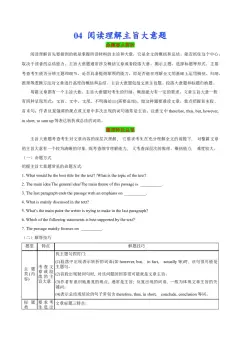
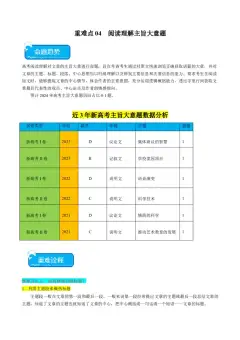
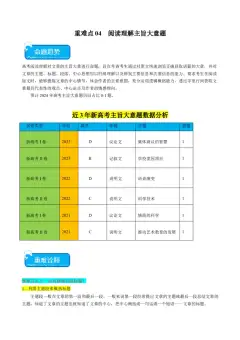
题型04 阅读理解主旨大意题
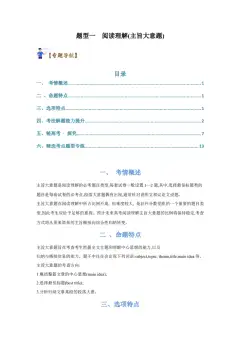
题型简介
主旨大意即作者在文章或段落中想要表达的主要内容,是文章或段落的核心思想,也是作者
通过行文逻辑和各种细节信息阐明的核心内容。把握主旨大意是英语阅读理解的一项关键能力,
对正确理解全文有重要意义。考生在解题时应通过略读捕捉文中的关键词句,把握篇章和段落结
构,梳理篇章和段落的行文脉络,从而弄清作者的写作思路,最终归纳出主旨大意。高考阅读理
解中,对该关键能力的考查主要有以下三种:归纳段落大意、理解全文主旨和选定最佳标题。
设题类型&命题方式
1. 段落大意题:段落大意题主要考查考生对段落核心信息的理解,要求考生在理解段落内容
的基础上提炼出核心信息,然后对比选项,选出最契合段落主要内容的选项。
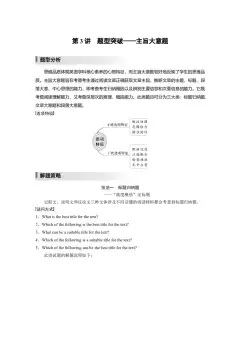
段落大意题常见设问形式:
What is the first/second/...paragraph mainly about?
What does paragraph. .. mainly talk about?
What does the writer try to express in paragraph...?
2. 文章大意题: 文章大意题主要考查考生对一篇文章的整体理解,要求考生具备在速读中准确
掌握全文主旨的能力。考生需要在理解全文内容的基础上,通过归纳概括、推理判断等逻辑思维活
动,概括出全文主旨大意。文章大意额常见设问形式:What is the text mainly about? What's the main idea
of the text? What is mainly talked about in the text?
3. 标题归纳题:标题是文章中心思想的精练表达。标题归纳题主要考查考生把握文章主旨,理
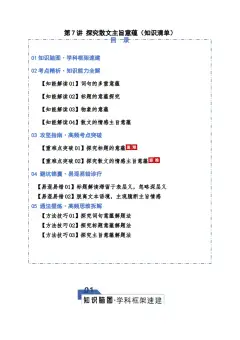
目录
第一部分 题型解码 高屋建瓴,掌握全局
第二部分 考向破译
解
微观
剖,精细教学
典例引领
方法透视
变式演练
考向01 段落大意题【常考】
考向02 文章大意题【常考】
考向03 标题归纳题【重难】
第三部分 综合巩固 整合应用,模拟实战
专题01 高考真题练
专题02 优秀模拟题
解文章中心思想的能力,要求考生在理解文章的基础上运用判断、归纳、概括等方法,对文章的主
题进行提炼或高度概括,最终准确地选出文章的标题。标题归纳题常见设问形式:Which is the most
suitable title for the text? What can be a suit-able title for the text? Which of the following would be the best
title for the passage? Which of the following can serve as the best title for the passage?

解题思路
1: 段落大意题解题思路
首先,逐句分析内容。通读段落中的每一句话,准确理解其字面意思,并用简短的关键词概
括每句的核心内容。
其次,串联逻辑关系。分析句子之间的逻辑衔接,如并列、转折、因果或例证关系。特别注
意区分观点句、论证句和例证句,这有助于识别信息的主次。
接着,提炼核心主旨。将各句的关键内容进行整合,合并表达相同或相似概念的要点。在此
过程中,需要去掉次要的细节信息、具体的数据或补充说明的例子,保留并突出段落最核心的论
述焦点。
最后,比对选项确定答案。将提炼出的核心主旨与题目选项进行仔细比对。排除那些只涉及
段落局部细节、过于宽泛或与段落内容明显不符的选项,选择最能全面、准确概括整段核心思想
的答案。
2. 文章大意题解题思路
第一步:分析各段落大意
这是解题的基石。首先,逐段阅读文章,重点捕捉每一段的中心思想。关键在于定位段落的
主题句。主题句通常出现在段首句或段尾句,这些位置常常是作者提出观点或总结结论的地方。
同时,要特别关注转折词(如but, however)后面的句子以及设问句的答语,这些部分往往承载了
段落的真实意图。此外,一些表示总结或结论的信号词(如therefore, thus, in conclusion)引出的句
子也至关重要。通过这一步,将一篇长文章分解为几个核心的段落大意。
第二步:提炼文章主旨
在厘清各段落核心意思的基础上,进入整合阶段。首先,留意在全文反复出现的高频词和核
心词,这通常是文章讨论的核心话题。接着,串联各段落大意,审视它们之间的逻辑关系——是
并列阐述不同方面,是递进深入,还是对比论证?在此基础上,合并相同或相似的内容,将它们
归类为文章主旨的几个核心维度。同时,要果断地去掉次要内容,如具体的例子、详细的数据或
补充说明,确保焦点集中在主干思想上。
第三步:对比分析选项,确定答案
将你通过以上步骤提炼出的文章主旨与题目选项进行仔细比对。排除那些只涉及文章局部细
节、某一段落内容的选项,以及那些范围过于宽泛或与文章核心思想不符的选项。最终选择的答
案,必须能够全面、准确地涵盖全文的核心论点,而非只是部分内容的重述。
3. 标题归纳题解题思路
第一步:分析段落,提炼文章主旨
这是解答所有主旨大意题的基础,标题题也不例外。标题必须是全文核心思想最集中的体现
1. 定位主题句:逐段阅读,重点分析每一段的段首句和段尾句,这些位置通常是观点或结论
所在。同时,务必关注转折词(如but, however)之后的句子以及疑问句的答语,这些部分往往揭
示了作者的真正意图。由总结性信号词(如therefore, in conclusion)引出的句子也至关重要。
2. 捕捉高频词与核心词:留意在全文反复出现的词汇或概念,它们是文章讨论的中心话题,
常常会成为标题的关键词。
3. 串联与提炼:在概括各段大意后,将它们串联起来,找出其内在逻辑关系。合并相同或相
似内容,并果断去掉次要的细节和例子,从而凝练出全文唯一且核心的论点或说明对象。
第二步:把握正确标题的核心特征
一个最佳标题,其选项通常具备以下特点:
概括精准:标题必须准确地覆盖全文的核心内容,范围既不能太宽也不能太窄。
统领全文:标题所表述的内容应能统领全文各个段落,是所有段落共同服务的主旨。
醒目新颖:在准确的基础上,好的标题应具备一定的吸引力和概括性,能够引起读者兴趣。
第三步:对比分析选项,排除干扰
将你提炼出的文章主旨与各个选项进行严谨比对。此时,要重点识别和排除干扰项:
以偏概全:选项只对应文章某个段落或细节,无法代表整体。
概括过度:选项范围过大,超出了文章实际讨论的范畴。
无中生有:选项涉及了文章中未曾提及的信息或观点。
考向01 段落大意题
【例1-1】(2026 届云南省云南民大附中高三第三次联考模拟预测英语试题节选)
Researchers have created a new nanogenerator that collects and turns the energy from everyday movements
into electricity. It uses materials that become electrically charged when in contact. Think of how rubbing a balloon
on someone’s hair makes it stick to each other because of static electricity (静电). Instead of one electrode (电极)
passing energy by itself, the new device has a relay of workers who shift mechanical energy, like running, into
electricity. Each electrode collects a charge and then passes it on to the next electrode. The accumulating charge
creates more energy in a process known as the charge regeneration effect.
1. What does paragraph 4 mainly talk about?
A.How the nanogenerator works.
B.Why the device needs electrodes.
C.When static electricity works in balloons.
D.What the charge regeneration effect is.
【答案】A
【详解】主旨大意题,根据第四段内容,尤其是“ Instead of one electrode (电极) passing energy by
itself, the new device has are lay of workers who shift mechanical energy, like running, into electricity.
Each electrode collects a charge and then passes it on to the next electrode. The accumulating charge
creates more energy in a process known as the charge regeneration effect(新的设备不是由一个电极单独传
递能量,而是由一系列接力工作的电极将跑步等机械能转化为电能。每个电极收集电荷,然后将其传递给
下一个电极。累积的电荷在一个被称为电荷再生效应的过程中产生更多的能量。”可知,第四段主要介绍
了纳米发电机的工作原理。故选A。
【例1-2】(2026 届浙江省宁波市海曙区等5 地高三一模英语试题节选)
The real issue, however, goes deeper than misinformation. It points to a fundamental problem in urban innovation:
the difficulty of imagining a life less dependent on the private car. For decades, the car has symbolized personal
freedom and status. Any policy that seems to reduce car use, even if it aims to enhance overall quality of life, can
make people feel emotionally upset. This reflects what transport experts call “car dependency”, a cultural and deep-
rooted habit that is hard to break.
1. What does paragraph 4 mainly talk about?
A.The challenge of a less car-centered life.
B.The significance of private cars.
C.The public’s reactions to a new policy.
D.The definition of car dependency.
【答案】A
【详解】主旨大意题。根据第四段 “The real issue, however, goes deeper than misinformation. It points to a
fundamental problem in urban innovation: the difficulty of imagining a life less dependent on the private car. For
decades, the car has symbolized personal freedom and status. Any policy that seems to reduce car use, even if it aims
to enhance overall quality of life, can make people feel emotionally upset. This reflects what transport experts call
“car dependency”, a cultural and deep-rooted habit that is hard to break.”.(然而,真正的问题远不止是信息传播
不准确这么简单。它揭示了城市创新中一个根本性的难题:难以想象一种不再过度依赖私家车的生活方式。
数十年来,汽车一直象征着个人自由和地位。任何看似减少汽车使用量的政策,即便其目的是提升整体生
活质量,也会让人们产生情绪上的不适。这反映了交通专家所说的“对汽车的依赖”,这是一种根深蒂固
的文化习惯,很难改变)”可知,本段主要讲了一种少依赖汽车的生活方式所带来的挑战。故选A。
解|题|技|巧
段落大意题的核心在于精准提炼该段落的中心思想,而非细节信息。其解题过程可遵循以下系统
性的技巧:
1.
定位主题句,把握核心:这是最直接有效的方法。优先阅读段落的首句和尾句。在英文论述文中,
作者常采用“总-分”或“分-总”结构,使得段首或段尾句成为核心观点所在。如【例1-1】中,
段首句“Researchers have created a new nanogenerator...”即点明了本段将要介绍这个新设备,后续句
子均为对其工作原理的展开说明。
2.
关注转折与结论,抓住作者真实意图:段中出现转折词(如however, but, yet) 或 结论性词语
(如therefore, thus, in conclusion) 时,需高度警惕。转折后或结论句往往是段落真正想要强调的
内容。【例1-2】便是典型,段首用“The real issue, however, goes deeper than misinformation”承上启
下,并通过转折明确指出本段将深入探讨一个“更根本的问题”(a fundamental problem),从而
引出了核心论点。
3.
串联内容,提炼概括:当段落没有明确的主题句时,需要通读全段,概括各句大意,然后进行整
合。合并相同信息,舍弃次要的举例、数据或详细解释,提炼出统领全段的核心概念。【例1-1】
中,虽然提到了气球静电的类比,但这只是一个便于理解的引子,次要内容;核心是解释电极如
何接力工作并产生电荷再生效应,因此主旨是“工作原理”。
4.
识别高频词与核心概念:留意在段落中重复出现的词汇或核心概念。这些词往往是段落话题的焦
点。例如【例1-2】中,“car”、“dependent/dependency”、“life”等词反复出现,清晰地指向了讨
论的核心——与汽车依赖相关的生活方式。
注|意|事|项
1.
严防以偏概全:干扰项常常用段落中的某个细节或一个例子来冒充主旨。解题的关键在于判断该
选项是否能覆盖整个段落。如【例1-1】中的C 选项“静态电力何时在气球中起作用”和D 选项
“什么是电荷再生效应”,都只是段落中提及的一个点,无法代表全部内容。
2.
警惕概括过度或偏离:选项的概括范围必须与段落内容严格匹配。【例1-2】的B 选项“私家车的
重要性”范围过宽,且段落重点在批判依赖,而非强调其重要性;C 选项“公众对新政策的反
应”是一个具体表现,而非根本原因;D 选项“汽车依赖的定义”只是用于论证核心论点的工具
之一。只有A 选项准确抓住了“减少汽车为中心的生活所面临的挑战”这一根本问题。
3.
紧扣本段,避免主观臆断:解答段落大意题时,必须将分析范围严格限定在该段落之内。不要受
到其他段落内容或自身背景知识的干扰,答案的唯一依据就是当前段落所提供的信息。
总结来说,解答段落大意题是一个“由细节到整体,再通过整体审视细节”的辩证过程。首先通
过定位主题句、关注转折结论、提炼高频词等方法快速把握段落核心,然后在选择时,严格以
“能否统领全段”为标准,冷静排除那些片面、笼统或偏离的干扰项,从而锁定正确答案。
【变式1-1】(江苏省扬州大学附属中学2025-2026 学年高三上学期阶段检测节选)
When I was growing up, my mom often said that no matter what grades I got in school as long as I did my best,
she’d be proud of me. Then she added, “But if you didn’t get an A, I’ll know you didn’t do your best.” She said it
with a smile, but I took it seriously. I shouldn’t settle for anything less than perfect. My greatest weakness is that I’m
too much of a perfectionist.
Perfectionism is the desire to be 100% perfect. The goal is zero faults and no failures. In an increasingly
competitive world, kids face growing pressure from parents to be perfect and severe criticism when they fall short.
Every fault is a blow to their self-esteem (自尊). I’ve lived it myself.
1. What is paragraph 1 mainly about?
A.The disadvantage of being a perfectionist.
B.Why the author became a perfectionist.
C.How the author got the good grades in school.
D.The feeling of being grateful to the author’s mother.
【变式1-2】(山东省名校考试联盟2025-2026 学年高三上学期期中检测英语试题试卷)
Ever wondered how social media platforms decide how to fill our feeds? They use algorithms (算法),
of course, but how do these algorithms work? In 2021, Frances Haugen, a Facebook product manager
secretly took ten thousand pages of documents and internal messages out of Facebook headquarters. She leaked
these to a handful of media outlets. A lot of stories soon ran, largely focusing on the most alarming, attention-grabbing
secrets.
It turns out that Facebook engineers have assigned a point value to each type of engagement users can perform
on a post (liking, commenting, resharing, etc.). Facebook’s algorithm calculates a personalized score for each post to
determine its place in the feed. This score is got by multiplying the probability you’ll perform each engagement —
likes, loves, etc. — by its pre-assigned point value, then summing these products. Posts are then ranked from highest to
lowest

score,

creating

your

tailored

feed.

Then

the

magic

formula

is:
Score=Vlike×Plike+Vlove×Plove+Vangry×Pangry+Vcomment×Pcomment+Vshare×Pshare.
1. What is paragraph 2 mainly about?
A.Why Facebook designed a formula.
B.How Facebook determines our feeds.
C.How the formula was created carefully.
D.Why users have to be cautious about posts.
考向02  文章大意题
【例2-1】(江苏省泰州市靖江市2025-2026 学年高三上学期11 月期中英语试题节选)
Chinese Nobel Prize-winning physicist Zhen Ning Yang, one of the most influential scientists in modern physics,
passed away in Beijing on October 18 due to illness at the age of 103.
Born in 1922, Yang was brought up surrounded by the Tsinghua campus, where his father was a math professor.
After finishing his undergraduate degree, he obtained his master’s degree from Tsinghua. He enrolled in the University
of Chicago in the United States to pursue a doctorate in 1946 and was strongly influenced by Italian-American
physicist Enrico Fermi, who had won the same Nobel Prize in 1938. He later became a professor at the Institute for
Advanced Study in Princeton.
Yang won the Nobel Prize in 1957 with Tsung-Dao Lee for their investigation of the so-called parity laws that
led to “important discoveries regarding the elementary particles,” according to the Nobel Prize website. They were
the first Chinese-born Nobel Prize winners in physics.
Professor Yang was deeply devoted to his homeland, making remarkable contributions to China’s scientific and
educational developments. His visit to China in 1971 led to a wave of visits by overseas scholars, earning him
recognition as the pioneer in building the bridge of academic exchange between China and the United States. He later
proposed the restoration and strengthening of basic scientific research to China’s central leadership. He also raised
funds to establish the “Committee on Educational Exchange with China”, which has continuously sponsored nearly
100Chinese scholars for advanced studies in the United States. These scholars later became the backbone of China’
s scientific and technological development. He undertook extensive work to promote China’s scientific and
technological exchange and progress, offering advice and exercising significant influence on major Chinese scientific
projects and the formulation (制定) of science and education policies.
………..
1. What is the article mainly about?
A.Yang’s lifelong contributions to China.
B.Yang’s research on elementary particles.
C.Yang’s influence on global science policy.
D.Yang’s educational background in America.
【答案】A
【详解】 主旨大意题。通读全文,特别是根据第四段中心句“Professor Yang was deeply devoted to his
homeland, making remarkable contributions to China’s scientific and educational developments.”(杨教授对祖国
深怀热爱,为中国的科学和教育事业作出了卓越的贡献。)”和第五段中心句“After returning to Tsinghua
University in1999,he took on developing the Institute for Advanced Study as his new mission.(1999 年回
到清华大学后,他把发展高等研究院作为自己的新使命。)”可知,文章重点展现杨振宁教授毕生对祖国的
奉献。故选A。
【例2-2】(湖南省多校联考2025-2026 学年高三上学期10 月月考英语试题)
In 1911, US explorer and academic Hiram Bingham arrived in South America for what would become his
greatest achievement: exploring the remote hinterland west of Cusco, the old Inca capital in Peru’s Andes. His goal
was to find the remains of Vitcos, the last Inca capital.
………….
In his book, he described the ascent ( 登高) vividly: he noted the constant risk of deadly
snakes(though he saw none), but that unease faded quickly as he felt growing excitement — first at
finding terraces, a mausoleum, monumental staircases, and finally Machu Picchu’s grand ceremonial buildings.
“It seemed like an unbelievable dream, one so vivid and so overwhelming that I forgot to breathe, and the sight
held me enthralled, rooted to the spot, unable to tear my eyes away,” he wrote. We should remember, however, that
Lost City of the Incas is a work of sight, not written until1948, many years after his journey.
1. What does the text mainly talk about?
A.The historical background of the Inca empire
B.The Urubamba valley’s geographical features
C.Bingham’s discovery of the Machu Picchu ruins
D.A comparison of Bingham’s team and earlier travelers
【答案】C
【详解】主旨大意题。根据第一段“In 1911, US explorer and academic Hiram Bingham arrived in South
America for what would become his greatest achievement: exploring the remote hinterland west of Cusco, the old
Inca capital in Peru’s Andes. His goal was to find the remains of Vitcos, the last Inca capital.”(1911 年,美国探
险家兼学者Hiram Bingham 抵达南美洲,此行成就了他最为辉煌的事业:探索库斯科以西那片偏远的内陆地
区,那里是秘鲁安第斯山脉中的古印加帝国的旧都。他的目标是寻找维托克斯的遗迹,那是古印加帝国的
最后一个都城)”结合文章主要说明了1911 年美国探险家Bingham 赴南美寻找印加古城遗址,借新小路前
行,意外登山发现马丘比丘,多年后在书中生动描述了当时的震撼场景。可知,文章主要讲了Bingham 对
马丘比丘遗址的发现。故选C。
【变式2-1】(2025 届河北省名校联考高三下学期第二次模拟考试英语试题节选)
Big changes can come in tiny details. A publisher has discovered that changing the design and font
( 字体) in books saves millions of pages and thousands of trees. The design team at Harper Collins
examined how they could make their books environmentally friendly while preserving readability.
It all started in 2015 when Zondervan, their division, explored ways to save pages when printing a classic
book. The classic is a huge book, consisting of 2,500 pages. To save pages, the division developed a new typeface
called NIV Comfort Print that is compact (紧凑) and comfortable to read. The use of Zondervan’s compact font
解|题|技|巧
1.
首段尾段定位法:文章的首段通常用于引出话题、背景或核心论点,而尾段则常用于总结全文、
重申观点或得出结论。因此,仔细阅读首段和尾段是快速抓住文章中心的捷径。
2.
段落大意串联法:这是最核心和可靠的方法。快速浏览全文,提炼每个段落的核心意思(可借助
寻找段落主题句的方法)。然后,将这些段落主旨像串珠子一样连接起来,看看它们共同论述了
一个什么核心话题。【例2-1】中,文章前部分简要介绍了杨振宁的生平与学术成就,但第四段用
明确的中心句指出他“为中国的科学和教育事业作出了卓越的贡献”,第五段继续讲述他回国后
的新使命。将各段大意串联后,发现其生平成就都是为了铺垫和引出他“终身奉献祖国”这一更
核心的主题。
3.
高频词与核心概念捕捉法:通读过程中,留意在文中反复出现的词汇、短语或概念。这些高频元
素往往是文章讨论的焦点。在【例2-1】中,“contributions to China”、“homeland”等相关概念贯
穿后半部分;【例2-2】中,“exploring”、“discovery”等是核心词汇。正确选项通常都会包含这
些核心概念。
4.
文章结构逻辑整合法:分析文章的组织结构。是“总-分-总”结构,还是按时间顺序叙述?论述的
重点是放在起因、过程还是结果与意义上?【例2-1】的结构是“生平简介
学术荣誉
重点论述
→
→
对祖国的贡献”,由此可知,前文是为后文的核心主旨做铺垫,重点在于其贡献。
注|意|事|项
1.
严防以偏概全:这是最主要的干扰项类型。选项内容只是文章某一部分或某个段落的细节,无法覆
盖全文。如【例2-1】中的B 项(对基本粒子的研究)和D 项(在美教育背景)都只是前两段的内
容;【例2-2】中的A 项(历史背景)、B 项(地理特征)和D 项(比较)都只是文中提及的零星
信息,而非全文核心。
2.
警惕概括过度或无中生有:选项的表述可能过于宽泛,超出了文章实际讨论的范围,或者引入了文
中未提及的信息。【例2-1】中的C 项“杨振宁对全球科学政策的影响”,其中的“全球”一词就
属于概括过度,文章主要聚焦于他对中国的影响。
3.
紧扣文章主体,区分论点与论据:要清楚文中哪些是支持性的细节、例子或数据(论据),哪些才
是由这些论据支撑的核心观点(论点)。不能把具体的例子误当作全文主旨。【例2-2】中,对登
山过程的具体描述和书中引语都是细节,服务于“发现马丘比丘”这一核心事件。
reduced the classic’s length by 350 pages and saved 100 million pages of paper. If these pages were
stacked up (堆积), this would be the size of four Empire State Buildings.
Harper Collins wanted to apply this solution to their fiction and non-fiction books. After they asked designers to
come up with ideas, the designers created 50 versions of a 600-page book by using easy-to-read fonts and redesigned
pages where there was less white space.
…
Questioning how we do things to make them more sustainable applies to all, especially those who work at an
office with a printer. Be it at home, at school or at work, sustainable solutions can go a long way. And one need not
be a publisher to adopt these changes.
1. What is the text mainly about?
A.Eco-friendly ways to store books.
B.Resource-saving publishing changes.
C.A creative and cooperative publisher.
D.An innovative solution to deforestation.
【变式2-2】(浙江省宁波市鄞州中学2025 学年高三考前适应性考试英语科试卷)
CPR and basic first aid care are skills that millions acquire. Now this same type of training is available for
mental health. Sigma Theta Alpha (STA), a professional health organization at UConn (University of Connecticut),
has taken the lead to bring the program to campus, ensuring each student can benefit from it.
Mental Health First Aid training is a national initiative that is performed locally by Mental Health Connecticut, a
statewide non-profit organization. The group has come to UConn three times for training. “We introduce information
on mental illness with the basic facts. We don’t teach how to diagnose — we do the opposite. Labeling and jumping
to conclusions based on symptoms and behaviors are harmful and dangerous, because that is for professionals,” says
Valerie Cooper, a community educator for the organization.
Like CPR, Mental Health First Aid is a universal experience taught the same way everywhere. The program is
split into classroom-style work, watching videos, and simulation of real-life issues. The action plan taught works
under the acronym of ALGEE — Assess for risk of harm, Listen non-judgmentally, Give reassurance and information,
Encourage appropriate professional help, and Encourage self-help and other support strategies. “Being a mental
health first aider is to listen non-judgmentally and create a space of trust,” says Cooper. “We teach people that listening
will be more important than anything they say.”
UConn nursing major Lisa Iwanicki, 18, is a member of Sigma Theta Alpha. Iwanicki says she got a lot out of
the simulation activities. “It was cool to be in a room with people who wanted to help make a change. It was not just
about learning the signs of mental illness, but what someone can do in the community to help,” says Iwanicki.
“Recovery is possible. The most important thing is to keep people hopeful. You have to try and try.”
1. What is the passage mainly about?
A.A student care project at UConn.
B.Development of CPR skills.
C.A professional health organization.
D.Campus activities of UConn.
考向03 标题归纳题
【例3-1】(浙南名校联盟2025-2026 学年高三上学期十月联考英语试题)
Picture this, you win two tickets to a sold-out concert and eagerly text to ask your friends if they’d like to join.
There comes their response “Maybe.” Your mood immediately turns, for you need to wait for their decisions before
you can figure out your plans for the concert.
If you’ve experienced anything like the above anecdote, you’re not alone. People responding “maybe” to
invitations is a common yet annoying aspect of social life. What goes on in people’s heads when they aren’t sure
whether to accept an invitation? Social invitations can be a delicate dance. People often misread what someone
extending an invitation wants to hear and overestimate an inviter’s likelihood of preferring a “maybe” over a “no.”
Moreover, they fail to realize how much more disrespected people feel when they receive a “maybe” in response to
their invitation.
Naturally, we wanted to figure out why this awkward dynamic plays out. We found that it’s largely
due to something called “motivated reasoning.” Motivated reasoning occurs when a person interprets
information in a biased (有偏差的) way to suit their own wishes. In other words, invitees convince themselves
that inviters want to hear “maybe” instead of “no” because a “maybe” is better for the invitees, allowing them to
leave their options open. Besides, people tend to overestimate the negative consequences of saying “no” to invitations,
thinking it will upset, anger and disappoint inviters.
However, there were certain situations that made people more comfortable saying “no” to an invitation. When
recipients of an invitation put themselves in the shoes of the person extending the invitation, they are more likely to
realize that they’d probably prefer a definite answer. When the participants get invited to do something they didn’t
want to do, they had no desire to keep their options open. The motivated reasoning then became irrelevant.
While navigating social situations can be tricky, being direct and definite is sometimes best. It might reduce
your options. But it’ll keep those who invite you from being left uncertain and maybe they’ll still think of you when
the next concert comes to town.
1. What is the best title for the passage?
A.The Psychology behind “Maybe”
B.The Hidden Consequence of “Maybe”
C.“Maybe”: A Polite Escape from Conflict
D.“Maybe”: A Perfect Solution to Invitations
【答案】A
【详解】主旨大意题。通读全文,文章开头以音乐会铁事引出人们对邀请回复"Maybe”的现象,接着
在第三段分析了这一现象背后"动机性推理”的心理原因,第四段介绍了人们更愿意说“不”的特定情况,
最后给出直接回应的建议。全文围绕“Maybe”背后的心理机制展开,因此A 项”'Maybe’背后的心理
学”概括了文章主题,最适合作为文章标题。故选A 项。
【例3-2】(江苏省扬州大学附属中学2025-2026 学年高三上学期第一次月考英语试题)
I’ve always loved books. When I was a child, I would bring them everywhere-to the dinner table and to class. I
became a reader in the absence of digital audiobooks (音频书).
Nevertheless, with the rise of smartphones, audiobooks have exploded in popularity, and as with any new interest,
new criticisms have risen in response. I’ll admit I used to think that audiobooks “didn’t count” because you could
listen to them passively, and I got annoyed with people who said they had read this or that number of books when
their lists included, or were perhaps entirely made up of audiobooks. But I’ve come around since then, both on a
personal and on a social level.
I do still think reading a book and listening to an audiobook are different. They use different areas of the brain;
they’re allowed in different contexts. But I have grown to love audiobooks for the distinct advantages they offer —
for example, some have voice actors do distinctive voices for different characters, or actually put melody to songs
that only have lyrics in the written text.
The line of thinking that would let us believe that audiobooks “don’t count” as reading prevents people from
reading. If someone struggles with print books, and they find out that audiobooks are the best way for them to engage,
they will listen to more books. If we want to build a world of readers, we have to support reading in any form.
If any readers have read the book Fangirl by Rainbow Rowell, they know one main character struggles with
reading. He doesn’t have trouble reading. He just can’t focus on text. In order to survive college, he records lectures,
meets up with other students to discuss the topic, and comes up with other coping mechanisms. Engage with books
however you want: buy them, get them from the library, download them online. It doesn’t matter. Don’t we have
better uses for our time than to criticize how other people take in information?
1. Which of the following is probably the best title for the text?
A.Why Print Books Decline in the Digital Age?
B.Audiobooks: A Threat to Traditional Literacy
C.Reading Redefined: Why All Formats Matter?
D.How Technology Transforms Reading Habits?
【答案】C
【详解】【小题4】主旨大意题。通读全文,尤其是倒数第二段“If someone struggles with print books,
and they find out that audiobooks are the best way for them to engage, they will listen to more books. If we want to
build a world of readers, we have to support reading in any form.”(如果有人在阅读纸质书时感到困难,而发现
有声书是他们进行阅读的最佳方式,那么他们就会去听更多的书。如果我们想要打造个爱读书的世界,就
必须支持任何形式的阅读)”可知,本文主要探讨了有声书与纸质书阅读的关系,并呼吁人们以开放态度支
持各种阅读形式,因此最好的题目是C 选项“Reading Redefined: Why Al Formats Matter?(阅读新解:为何
所有形式都至关重要?)”,故选C
【变式3-1】(江苏省盐城市五校联考2025-2026 学年高三上学期10 月月考英语试题)
Scientists in Australia thought they had developed a new tracking device to help them monitor
magpies (喜鹊), but these birds had other ideas.
Australian magpies are medium-sized black and white birds from the same bird “family” as crows and bluejays.
They are known to be quite clever. They live in groups of up to 12 birds and work together to defend the area they
live in.
The purpose of the scientists’ experiment was to learn more about how far they travel each day and how their
social behaviors are influenced by sex, age, and rank. Besides, the scientists were eager to test the newly developed
tracking device.
解|题|技|巧
1.
核心概念定位法:通读全文,锁定文章反复讨论的核心话题或关键词。一个恰当的标题必须包含这
些核心概念。在【例3-1】中,全文围绕“Maybe”这一核心词展开;在【例3-2】中,核心争论点
是不同阅读“Formats”(格式)的价值。正确选项都精准地抓住了这些核心词。
2.
作者态度判断法:辨别作者对核心话题的立场和文章的感情基调。标题需要与之契合。【例3-1】
并非单纯批评“Maybe”,而是深入探讨其背后的心理动机(Psychology),基调是分析与解释性的。
【例3-2】的作者则为有声书辩护,主张包容所有阅读形式,因此标题中的“Redefined”(重新定
义)和“All Formats Matter”(所有形式都重要)完美体现了这一立场。
3.
选项对比检验法:这是最关键的一步。将初步选定的标题代入并自问:这个标题能否统领全文所有
段落? 它是否既涵盖了文章开头引入的现象,又包含了中部的分析论证,还囊括了结尾的结论或
建议?一个最好的标题应该像一把大伞,能覆盖全文所有主要内容。
注|意|事|项
在选择题目的过程中,必须警惕以下几类高频干扰项:
1.
严防以偏概全:干扰项常常只对应文章的某个局部细节或论据,无法代表整体。【例3-1】的B 选
项“The Hidden Consequence of ‘Maybe’”(“Maybe”的隐藏后果)只涉及了问题的一个方面(其负
面影响),但文章花了大量篇幅解释其背后的“动机推理”心理原因,因此B 项是片面的。C、D
选项则完全偏离了文章的分析基调。
2.
警惕偏离主旨:选项可能使用了文章里的词汇,但表述的重点或结论与作者的写作意图完全不符
或相反。【例3-1】的D 选项“A Perfect Solution”(一个完美的解决方案)就与文章最后建议“直
接和明确”的态度相悖,因为“Maybe”正是被分析的问题本身,而非解决方案。
3.
慎防片面绝对:干扰项可能观点过于极端或片面,无法体现文章的辩证思考。【例3-2】的B 选项
“A Threat to Traditional Literacy”(对传统读写能力的威胁)就带有明显的负面和片面色彩,而原
文作者的核心观点是倡导包容与共存,并非认为其构成威胁。A 和D 选项则未能抓住“为有声书
正名”这一核心论点。
Most trackers are too big to fit on small and medium sized birds, and small trackers tend to be limited when it
comes to data storage, battery life, and reusability. The new tracker, weighing less than 1 gram, was designed to
overcome these problems. Attached to a backpack-like harness (背带) which could not be removed easily, the
device can re-charge wirelessly and transmit (传输) data wirelessly.
The scientists placed trackers on five magpies using their special harnesses. Things started to fall apart almost
immediately. Within 10 minutes of fitting the final tracker, an adult female without a tracker tried to remove the
harness from a younger bird and eventually succeeded. This pattern was repeated in the following hours, and by the
third day none of the birds had trackers anymore.
Scientists refer to this as “rescue behavior,” and it happens when a helper tries to free another individual in
trouble and with no obvious direct benefit to the rescuing individual. They think this is the first time rescue behavior
has been reported for Australian magpies. However, they aren’t sure if the same individual removed all of the harnesses
or if others offered help.
The team didn’t get the data they wanted, but their experiment still produced interesting results. That’s how
science works sometimes. The scientists need to try, again to figure out a good way to track these clever birds.
1. Which can be the best title for the text?
A.Magpies Teach Scientists an Unexpected Lesson
B.Climate Change Makes Magpies More Difficult
C.The Trackers Help Magpies Get Used to Nature
D.Magpies Are Adjusting to the Trackers on Their Bodies
【变式3-2】(山东师范大学附属中学2025-2026 学年高三上学期10 月阶段测试英语试题)
Do you ever find yourself randomly thinking back to the times we wandered, collecting wildflowers and smiling
beneath the sky? That feeling is often referred to as nostalgia (怀旧).
Psychologists have defined nostalgia as a self-conscious, social emotion, bittersweet but dominantly positive. It
comes from our happy memories and our desire to go back to the past and reconnect with the people we cared about.
Often, nostalgia involves sensory stimuli. On some occasions, the smell of autumn leaves might generate a fierce
longing for your childhood home. Almost everyone can experience nostalgia, although its object tends to vary
throughout life. One survey conducted by the psychologist Krystine Irene Batcho found that younger people felt more
nostalgia for pets, toys, and holidays than did older people, who felt it more strongly for music.
In contrast to its links to negative emotions, nostalgia doesn’t make us sadder. Rather, nostalgia is a defensive
response to unhappiness, one that brings relief from a negative mood. Research from 2006 shows that nostalgia can
actually strengthen social ties, improve self-esteem, and uplift our mood. Other studies suggest that it can also enhance
our view of life’s meaning, reduce fear of death, boost spirituality, and increase optimism.
Scholars remain uncertain about the precise mechanism behind the effectiveness of nostalgia; however, some
suggest that reflecting on joyful memories strengthens our sense of self-worth and belonging, particularly during
times of loneliness or self-doubt. Its power lets the happiness of the past overcome the current unpleasantness, offering
a bit of escape from tough times. To form stronger connections, we can establish traditions around shared past
experiences in families, friend groups, and workplaces. Observing special occasions like childhood sports or post-
college meetups can give us something to look forward to.
Perhaps because it is so powerful and complex, nostalgia has received magical treatment from poets and writers.
“The past is hidden somewhere outside the realm (领域), beyond the reach of intellect,” Marcel Proust wrote.
1. Which of the following is the best title for the text?
A.Nostalgia: Why We Should Avoid Reflecting on the Past
B.Nostalgia: A Shelter Against the Unhappiness of Our Life
C.A Nostalgia Warning: Our Mental Health Being Attacked
D.Power of Nostalgia: Struggling for an Irreplaceable Present
专题01 高考真题练
A
(浙江首考2025 年1 月普通高等学校招生全国统一考试英语试题)
A novel design approach to gardening has been gaining in popularity worldwide. Referred to as matrix planting,
this approach aims for nature to do a lot more of the heavy lifting in the garden, and even some of the designing.
Eschewing fertilizers (化肥) and power tools, it’s based on an elegantly simple principle: to garden more like nature
does.
The concept was born when German city planners sought to plant large areas of parkland after World War II
in a reproducible way that would need minimal maintenance. Planners created planting mixes that could be used
modularly (模块化). In a matrix garden, plants with similar cultural needs are grouped so that they will grow together
above and below ground, forming a cooperative ecosystem that conserves water and discourages weeds.
Dutch plantsman and designer Piet Oudolf’s gardens popularized this style, adding artistic flavors to the
planting mixes while playing with color and form, including four-season interest and serving the needs of wildlife.
Beautiful year-round, they invite you to enjoy the smallest detail, from the sound of grasses in the gentle wind to the
sculpture of odd-looking seed heads.
It takes a lot of thought to look this natural. While matrix gardens appear wild, they are carefully planned, with
cultural needs the first consideration. Led by the concept of “right plant, right place,” they match plants that enjoy
the same soil, sun and weather conditions, and arrange them according to their patterns of growth.
The benefits are substantial for both gardener and planet. With human inputs dramatically reduced, the garden’s
ecology can develop well. Established matrix gardens should not need the life support we give most gardens: fertilizer,
dividing, regular watering. Compared to traditional garden plots, they increase carbon absorption, reduce stormwater
runoff and boost habitat and biodiversity significantly.
1.What does the underlined word “Eschewing” in the first paragraph mean?
A.Running out of.
B.Keeping away from.
C.Putting up with.
D.Taking advantage of.
2.Why was the idea of matrix planting introduced?
A.To control weeds in large gardens.
B.To bring in foreign species of plants.
C.To conserve soil and water resources.
D.To develop low-maintenance parkland.
3.Which of the following best describes Piet Oudolf’s gardens?
A.Traditional.
B.Odd-looking.
C.Tasteful.
D.Well-protected.
4.Which of the following can be a suitable title for the text?
A.The future of gardening is WILD.
B.Nature treats all lives as EQUALS.
C.Matrix gardens need more CARE.
D.Old garden plots work WONDERS.
B
(2025 年全国高考一卷英语真题)
While safety improvements might have been made to our streets in recent years, transport studies also show
declines in pedestrian (行人) mobility, especially among young children. Many parents say there’s too much traffic
on the roads for their children to walk safely to school, so they pack them into the car instead.
Dutch authors Thalia Verkade and Marco te Brömmelstroet are bothered by facts like these. In their new
book Movement: How to Take Back Our Streets and Transform Our Lives, they call for a rethink of our streets and
the role they play in our lives.
Life on city streets started to change decades ago. Whole neighbourhoods were destroyed to make way for
new road networks and kids had to play elsewhere. Some communities fought back. Most famously, a Canadian
journalist who had moved her family to Manhattan in the early 1950s led a campaign to stop the destruction of her
local park. Describing her alarm at its proposed replacement with an expressway, Jane Jacobs called on her mayor (市长)
to champion “New York as a decent place to live, and not just rush through.” Similar campaigns occurred in Australia
in the late 1960s and 1970s as well.
Although these campaigns were widespread, the reality is that the majority of the western cities were completely
redesigned around the needs of the motor car. The number of cars on roads has been increasing rapidly. In Australia
we now have over twenty million cars for just over twenty-six million people, among the highest rate of car ownership
in the world.
We invest a lot in roads that help us rush through, but we fail to account for the true costs. Do we really
recognise what it costs us as a society when children can’t move safely around our communities? The authors of
Movement have it right: it’s time to think differently about that street outside your front door.
1.What phenomenon does the author point out in paragraph 1?
A.Cars often get stuck on the road.
B.Traffic accidents occur frequently.
C.People walk less and drive more.
D.Pedestrians fail to follow the rules.
2.What were the Canadian journalist and other campaigners trying to do?
A.Keep their cities livable.
B.Promote cultural diversity.
C.Help the needy families.
D.Make expressways accessible.
3.What can be inferred about the campaigns in Australia in the late 1960s and 1970s?
A.They boosted the sales of cars.
B.They turned out largely ineffective.
C.They won government support.
D.They advocated building new parks.
4.What can be a suitable title for the text?
A.Why the Rush?
B.What’s Next?
C.Where to Stay?
D.Who to Blame?
C
(2025 年全国高考二卷英语真题)
Does your soul die a little every time you throw away unused food? Mine does. Maybe that feeling comes
from growing up in South Africa, where the phrase “there are children starving in Africa” was more of an uncomfortable
reminder of fact than a prayer at dinner time.
Food waste is a growing concern in the restaurant, supermarket, and supply chain industries. From technological
solutions to educational campaigns, food producers and sellers are looking for ways to use more of what we’re already
growing. But last month, one popular New York City restaurant tried a different way: It changed its menu to exclusively (
专门) offer food that would otherwise be thrown away.
For two weeks in March, Greenwich Village’s Blue Hill restaurant was renamed wastED, and served items
like fried skate cartilage, a juice pulp burger, and a dumpster diver’s vegetable salad. Each dish was tailor-made to
raise awareness regarding food waste.
A study by the Food Waste Alliance determined that the average restaurant generates 33 pounds of food waste
for every $1,000 in revenue (收入), and of that waste only 15.7% is donated or recycled. Up to 84.3% is simply
thrown out. Restaurants like Silo in the UK have experimented with zero-waste systems, but wastED took the concept
to its logical conclusion.
It should be noted that none of the items on wastED’s menu was technically made from garbage. Instead, all
the ingredients (配料) used were examples of meat cuts and produce that most restaurants would never consider
serving. Things like kale ribs, fish collars, rejected sweet potatoes, and cucumber butts were all re-appropriated and,
with the help of a number of good chefs, turned into excellent cuisine.
Though wastED received enthusiastic reviews, it was designed from the start as a short-lived experiment; Blue
Hill has since returned to its regular menu. Nevertheless, it serves as a reminder that there are many ways to address
problems of sustainability, and that you can make an amazing meal out of almost anything.
1.What can be inferred about the author’s early life?
A.He witnessed food shortage.
B.He enjoyed the local cuisine.
C.He donated food to Africans.
D.He helped to cook at home.
2.Why did Blue Hill carry out the experiment?
A.To customize dishes for guests.
B.To make the public aware of food waste.
C.To test a food processing method.
D.To improve the UK’s zero-waste systems.
3.What is paragraph 5 mainly about?
A.Why the ingredients were used.
B.Which dishes were best liked.
C.What the dishes were made of.
D.Where the ingredients were bought.
4.What can we learn about wastED?
A.It has ended as planned.
B.It is creating new jobs.
C.It has regained popularity.
D.It is criticized by top chefs.
专题02 优秀模拟题
A
(25-26 高三上·辽宁沈阳东北育才学校等校·)
In the early 1960s, Andy Warhol began experimenting with his signature silkscreen technique, which he used
to make artistic statements about mass production — including his famous works describing Coca-Cola bottles. “A
Coke is a Coke,” he once said. “and no amount of money can get you a better Coke than the one the beggar on the
corner is drinking.”
Now, more than 60 years later, Coca-Cola is capitalizing on the artist’s statements. A new global ad campaign,
titled “Masterpiece,” features Warhol’s 1962 Coca-Cola, alongside paintings from other masters. Contemporary
artists like Stefania Tejada and WonderBuhle are also included.
The two-minute film opens in an art museum, where a group of students are drawing under the watchful eye
of their teacher — all except one young man, about to fall asleep, the page of his drawing book completely blank.
But then the paintings come to life. A hand from Aket’s Divine Idyll (2022) shoots out from its frame, pulling the
Coke bottle from Warhol’s painting, which hangs on a nearby wall. So begins the bottle’s journey through the major
works of the museum hall, as characters from paintings new and old throw the drink between them. The final
masterpiece we see, which ultimately delivers the ice-cold Coke to the student, is Johannes Vermeer’s Girl With A
Pearl Earring (1665). She opens the bottle and hands it over, just before the art student’s professor wanders over to
see his now-complete assignment.
The Andy Warhol Foundation for the Visual Arts is on board with the new campaign. “These pieces, paired
with works by emerging artists from around the globe, celebrate the inspirational power of visual art through the
magical lens (镜头) of Coca-Cola.” says Michael Dayton, the foundation’s director of licensing, marketing and
sales.
In recent years, using famous artworks in advertising has become a popular strategy. But some artists have a
different opinion on these campaigns. In November, the British street artist Banksy called out the clothing brand
Guess for “helping themselves” to his artwork for a new collection without his permission. Meanwhile, American
artist Keith Haring’s work has been popping up seemingly everywhere, from Adidas sneakers to a Pandora jewelry
campaign.
1. What can we infer from Andy Warhol’s statement “A Coke is a Coke”?
A.Coca-Cola is the best drink in the world.
B.The value of a Coke lies in itself, not in its consumer.
C.Rich people can never get the same Coke as the Beggars’.
D.Money can buy everything except a better Coke.
2. What is paragraph 3 mainly about?
A.A detailed description of Coca-Cola’s ad.
B.The influence of Coca-Cola on art creation.
C.Artworks that contribute to Coca-Cola’s ad.
D.An introduction to Warhol’s 1962 Coca-Cola.
3. What is Michael Dayton’s attitude to Coca-Cola’s ad?
A.Critical.
B.Doubtful.
C.Favorable.
D.Dismissive.
4. What is the best title for the passage?
A.Andy Warhol’s Famous Coca-Cola Artworks
B.The Evolution of Coca-Cola’s Advertising Strategies
C.Coca-Cola’s “Masterpiece” Campaign: Art Meets Marketing
D.Controversies Surrounding Art Usage in Commercial Ads
B
(25-26 高三上·江苏镇江一中、镇江中学、南京部分学校·月考)
Usain Bolt burned about 10kcal of energy to win his gold during the 200 metre spring final at the Olympic
Games, which could roughly power an old 60W light bulb for 11 minutes. If you could make use of all the power
generated by all the athletes during the Games, you would still be nowhere close to reaching the 29.5 billion Watts
consumed overall by the athletes, spectators and organizers over the event. We take sport for granted, but do we ever
consider its cost to the planet?
From the water required to maintain the golf course during The Masters tournament to the hundreds of flights it
takes to bring football fans to a World Cup, major sports events are not helping much in the fight against global
heating. What’s more, there is a lack of recognition within sport of its responsibilities and little discussion about
possible solutions.
This is strange, given that the effect works both ways: the climate crisis is not just affected by sports, but it is
already having a negative impact on many sports. When ice-climber Will Gadd set out to conquer the world’s glaciers,
he didn’t realize it would become a race against climate change. “I thought glaciers are there forever.” When he
arrived at the summit, Gadd was shocked: “The ice…wasn’t there. The things I planned to climb were gone.”
Global heating is noticeable in other sports. Amy Steel played professional netball until she suffered from
heatstroke after playing in 39℃ conditions and unfortunately, the damage was permanent. Not only that, but extreme
weather events made more frequent as a result of global heating mean sporting events are more often delayed or
canceled. This has cost sport billions in potential earnings.
Yet sport can be a powerful motivator: it can unite whole nations behind its teams. Could sport have a role to
play in driving climate awareness? Will Gadd and Amy Steel are among many athletes who think so? One thing is
certain. Sport must put climate change at the top of its agenda and decarbonize at a Usain Bolt-like pace to make a
difference.
1. What is the main focus of the first paragraph?
A.Why do sports events consume energy?
B.How much power do athletes generate?
C.What is the energy impact of sports events?
D.How did Bolt contribute to the environment?
2. Why does the writer use Will Gadd and Amy Steel as examples?
A.They initiated eco-friendly sports practices.
B.They sustained permanent injuries in sports.
C.They fell victim to climate-related incidents.
D.They achieved record-breaking performances.
3. What effect of global heating on sports is mentioned in the text?
A.Stricter facility restrictions.
B.Substantial financial losses.
C.Higher athlete training standards.
D.Prolonged outdoor sports seasons.
4. What can be a suitable title for the text?.
A.Sports in the Climate Crisis
B.Athletes against Global Heating
C.The Impact of Climate Change on Sport
D.The Environmental Cost of Outdoor Sports
C
(25-26 高三上·福建龙岩永定第一中学·月考)
People today are much cleverer than they were in previous generations. A study of 72 countries found that
average IQs rose by 2.2 points per decade between 1948 and 2020. This stunning change is known as the Flynn Effect
after James Flynn, the scientist who first noticed it. Flynn was initially confused by his discovery. It took millions of
years for the brain to evolve. How could it improve so rapidly over just a few decades?
The answer is largely that people were becoming better nourished and mentally stimulated. Just as muscles
need food and exercise to grow strong, the brain also needs the right nutrients and activity to develop. Kids today are
much less likely to be malnourished (营养不良的) than they were in past decades, and more likely to go to school.
Yet there is no room for satisfaction. In poor and middle-income countries, many children are still too ill-fed to reach
the cognitive potential.
The world grows enough food, but several obstacles stop nutrients getting into young brains. One is war.
Families sheltering around cannot risk out to plant or harvest, and some governments intentionally starve certain
regions into submission. Another is disease. Hungry children fall sick more often, and the energy they spend battling
bugs cannot be devoted to growing brains. Poverty is also a big part of the problem. But global data from UNICEF,
an aid agency, show that although half the children with very restricted diets (including no more than two food groups)
are indeed from poor families, the other half are not. Other factors, such as poor eating habits, are to blame as well.
Research about how to overcome the obstacles is needed.
Some argue that human intelligence will matter less as people entrust ( 委托) their thinking to artificial
intelligence. To assume this would be as foolish as betting 100 years ago that the invention of the car would make it
unnecessary to walk. In the workplace, human intelligence and AI will probably assist each other. And brains are for
the joy of thinking, as well as earning money. Steven Pinker of Harvard University calls human intelligence “a
tailwind in life”, helping people adapt rationally to new challenges or a changing environment. For a modest price,
the next generation can have a stronger tailwind. It would not only be wrong to refuse them the tailwind. It would be
stupid.
1. What can we learn about the Flynn Effect?
A.Average IQs have risen fast in the past decades.
B.Intelligence has been stable across generations.
C.People now are as intelligent as their ancestors.
D.Better education leads to improved physical health.
2. What does the underlined sentence in paragraph 2 mean?
A.The Flynn Effect has reached its peak.
B.Global problems continue despite IQ gains.
C.Society values human intelligence less. D.Malnutrition is merely a result of poverty.
3. What does the author think of artificial intelligence?
A.Useless.
B.Unique.
C.Beneficial.
D.Ineffective.
4. What is the best title for the passage?
A.Stages of IQ Development
B.Secrets to Rising IQs Worldwide
C.Insights Into Global IQ Trend
D.Influence of the Flynn Effect
D
(25-26 高三上·山东师范大学附属中学·月考)
Do you ever find yourself randomly thinking back to the times we wandered, collecting wildflowers and
smiling beneath the sky? That feeling is often referred to as nostalgia (怀旧).
Psychologists have defined nostalgia as a self-conscious, social emotion, bittersweet but dominantly positive.
It comes from our happy memories and our desire to go back to the past and reconnect with the people we cared
about. Often, nostalgia involves sensory stimuli. On some occasions, the smell of autumn leaves might generate a
fierce longing for your childhood home. Almost everyone can experience nostalgia, although its object tends to vary
throughout life. One survey conducted by the psychologist Krystine Irene Batcho found that younger people felt more
nostalgia for pets, toys, and holidays than did older people, who felt it more strongly for music.
In contrast to its links to negative emotions, nostalgia doesn’t make us sadder. Rather, nostalgia is a defensive
response to unhappiness, one that brings relief from a negative mood. Research from 2006 shows that nostalgia can
actually strengthen social ties, improve self-esteem, and uplift our mood. Other studies suggest that it can also enhance
our view of life’s meaning, reduce fear of death, boost spirituality, and increase optimism.
Scholars remain uncertain about the precise mechanism behind the effectiveness of nostalgia; however, some
suggest that reflecting on joyful memories strengthens our sense of self-worth and belonging, particularly during
times of loneliness or self-doubt. Its power lets the happiness of the past overcome the current unpleasantness, offering
a bit of escape from tough times. To form stronger connections, we can establish traditions around shared past
experiences in families, friend groups, and workplaces. Observing special occasions like childhood sports or post-
college meetups can give us something to look forward to.
Perhaps because it is so powerful and complex, nostalgia has received magical treatment from poets and
writers. “The past is hidden somewhere outside the realm ( 领域), beyond the reach of intellect,” Marcel Proust
wrote.
1. Why does the author mention “autumn leaves” in the second paragraph?
A.To illustrate the complexity of nostalgia.
B.To emphasize the joyful nature of nostalgia.
C.To clarify nostalgia’s connection to our senses.
D.To stress individual variety of experiencing nostalgia.
2. What is paragraph 3 mainly about?
A.The mismatch between two findings.
B.The potential benefits of nostalgia.
C.The impact of nostalgia on personal mood.
D.The mechanisms behind nostalgia’s effects.
3. What does the author suggest us do in paragraph 4?
A.Create shared traditions for bonding and joy.
B.Record the social gatherings regularly.
C.Recognize the unnecessary social gatherings.
D.Say no to the concept of escapism.
4. Which of the following is the best title for the text?
A.Nostalgia: Why We Should Avoid Reflecting on the Past
B.Nostalgia: A Shelter Against the Unhappiness of Our Life
C.A Nostalgia Warning: Our Mental Health Being Attacked
D.Power of Nostalgia: Struggling for an Irreplaceable Present
E
(2025 届山东省实验中学高三第二次模拟考试英语试题)
For something designed to streamline communication, corporate jargon ( 行话) often does the opposite—
leaving many employees confused and excluded.
A survey of more than 8,000 working professionals across eight countries found that 58 percent feel their
fellow employees overuse jargon. If given the opportunity, nearly half of them would remove its usage since
interpreting their meanings “causes stress and slows down productivity”.
Yet, we keep using it. Then why does it continue to exist?
“Language isn’t just about sharing information. It’s social,” said Daria Bahtina, a lecturer from the University of
California Los Angeles. “When we speak, we’re performing relationships, identities, and positions,” she explained.
This isn’t limited to managers or corporate departments. Bahtina noted specialized language pops up wherever people
gather, for example, in a team of software engineers, or even a neighborhood book club after their third bottle of
wine.
In addition, jargon is a means of exclusiveness. “Shared jargon can develop a sense of identity and community,”
said Eric Anicich, associate professor at the USC’s Marshall School of Business. Anicich and his team conducted
research that shows how office jargon is employed to draw invisible lines between insiders and outsiders. According to
their findings, lower-status individuals are more likely to use jargon in evaluative situations—not to clarify their
message but to signal intelligence and competence.
So, where do we go from here? When asked about his position on jargon, Anicich replied, “Jargon is used as
a tool—it’s not naturally good nor bad, so it depends on how and when you use it.”
In fact, jargon is integrated into everyday life in ways we barely notice. Bahtina mentions how fans of medical
dramas who have never set foot in a hospital can still understand phrases like “code blue”. “This doesn’t mean that
they can perform surgery; it shows how jargon can flow beyond its origin and become part of everyday speech,” she says.
Rather than going to extremes, experts agree that it’s best to question whether jargon is being used appropriately.
If our vocabulary is building walls instead of bridges, it may be time to circle back—and rethink how we speak at
work.
1.Why would employees stop using jargon if possible?
A.They find it less helpful.
B.They think it is used too often.
C.They prefer diverse expressions.
D.They intend to expand its meanings.
2.Who is more likely to use jargon according to the text?
A.A friend in the bar.
B.An employer on vacation.
C.A customer over the phone.
D.An applicant in an interview.
3.What is Eric Anicich’s attitude toward jargon?
A.Appreciative.
B.Unprejudiced.
C.Disapproving.
D.Indefinite.
4.What is a suitable title for the text?
A.Jargon: hated but used
B.Applying jargon, raising doubt
C.Jargon: a universal device
D.Using jargon, building bridges
F
(2025 届湖北省华中师范大学第一附属中学5 月高考仿真模拟考试英语试卷)
A growing number of companies are building humanoid robots, and these mechanical look-alikes are starting
to appear in car factories and delivery places. Some businesses even promise robots for home use. Yet one big question
still has no answer: Why bother? Why make a robot in a human shape when it could take any imaginable form?
The usual answer is that humanoid robots could, in principle, handle any physical jobs a person can. But that
“in principle” is doing a lot of heavy lifting. If you’ve watched videos of these robots, you’ll get it — they’re often
clumsy, awkward machines. Sure, the technology helping them stand and move has come a long way, but they’re still
not as quick or graceful as humans. Meanwhile, robots built for a single job — like an arm shifting goods between
conveyor belts (传送带) — are now commonplace. Designed with one purpose, they do it really well, unlike humanoid
robots, which aim to do everything but often master nothing.
Another argument is that a human shape makes it easier for people to work with or control robots. This holds
some water, especially since many of these machines still need skilled human operators. Companies often avoid
admitting this, calling it a short-term phase, but the dream of fully independent, AI-powered humanoid robots — ones
that match or beat human workers — remains a long shot. For now, what we’ve got are human-shaped shells guided by
people behind the scenes. When Elon Musk introduced Tesla’s Optimus robot in 2021, he proudly claimed it could
teach, babysit, walk dogs, fetch groceries, or pour drinks. Yet those robots weren’t AI-driven, and each was controlled
by a hidden human. Notice a pattern? These tasks—low-wage, service-oriented jobs — suggest that, for now,
humanoid robots just mask human effort with a shiny surface.
Some remote-controlled robots serve real purposes, like in deep-sea exploration. But those machines aren’t
shaped like humans — they look like capsules or small vehicles, and they work just fine. The idea that robots must
be human-shaped is a failure of imagination.
Yes, humanoid robots look impressive. They remind us of the fantasies in science fictions where machines
handle all difficult tasks. But today, they are mostly marketing tools, masking human labor. And a robot that doesn’t
truly improve life is missing the point.
1.What does the underlined phrase “holds some water” mean in paragraph 3?
A.Provides sufficient evidence.
B.Makes much sense.
C.Is partly reasonable.
D.Is widely accepted.
2.Why does the author mention Tesla’s Optimus robot?
A.To prove humanoid robots are better.
B.To highlight its impressive technology.
C.To show it can replace human workers. D.To suggest it is in the charge of humans.
3.What is the author’s attitude toward humanoid robots?
A.Skeptical.
B.Optimistic.
C.Neutral.
D.Cautious.
4.What is the best title for the passage?
A.When Humanoid Robots Miss Potential B.How Humanoid Robots Miss Goals
C.What Humanoid Robots Lack Now
D.Why Humanoid Robots Fall Short
G
(2025 届重庆市西南大学附属中学高三下学期阶段检测十英语试题)
Ariel Procaccia has thought a lot about how to cut a cake over the last 15 years. As the father of three children, he
knows how hard it is to divide a birthday cake to everyone’s satisfaction. But it’s also because Procaccia’s work
focuses on exploring the mathematical rules for dividing stuff up fairly.
For decades, researchers have been asking the seemingly simple question of how to cut a cake fairly. The
answer reaches far beyond birthday parties. At its core, it’s a mathematical problem that reflects broader issues of
fairness, and so draws interest from mathematicians, economists, and social scientists alike.
The simplest approach is called the “divider-chooser” method, where one person cuts the cake into two equal
pieces in his view, and the other person picks first. Each receives a piece that they feel is as valuable as the other’s.
But when personal preferences are taken into account, even the easiest rule becomes complicated. For example, Alice
and Bob are to divide a cake, and Alice knows Bob prefers chocolate. She may knowingly divide the cake unequally so
the smaller piece contains more chocolate. Then Bob will choose according to his preference, and Alice will get the
larger piece. Both of them are satisfied with what they get, but the meaning of fairness changes in this situation.
The cake is a symbol for any divisible good. When cake-cutting principles are employed to settle disagreements,
they are potentially helping the world find solutions. Procaccia has used fair division algorithms (算法) to model
food distribution. Social scientist Haris Aziz is exploring situations ranging from how to divide up daily tasks to how
to best schedule doctors’ shifts in hospitals.
Even after decades of investigation, cake-cutting isn’t like a simple jigsaw puzzle with a well-defined solution.
Instead, over time, it has evolved into a kind of mathematical sandbox, a constructive playground that brings together
abstract proofs and easy applications. The more researchers explore it, the more there is to explore.
1.Why is Procaccia interested in cake-cutting?
A.Family duty and work focus.
B.Cake art and professional quality.
C.Hobby drive and skill improvement.
D.Status pursuit and economic benefits.
2.What can we learn about fairness from the example in paragraph 3?
A.Its standard is stable.
B.It prevents unequal division.
C.Its concept is complex.
D.It dominates personal preferences.
3.What is paragraph 4 mainly about concerning cake-cutting?
A.The problems it produces.
B.The details of its process.
C.The application of its rules.
D.The harmony it symbolizes.
4.What is the best title for the text?
A.Cutting Cakes and Making Friends
B.The Math Behind Fair Cake-cutting
C.Why Kids Always Argue Over Cakes
D.A Sweet Way to Solve Math Problems
H
(2026 届四川省绵阳南山中学高三“零诊”模拟考试英语试题)
A study by the Barcelona Supercomputing Center (BSC) identifies climate change as the key driver behind
unprecedented short-term food price spikes, with cascading (连锁的) effects on inflation, health, and social stability.
Published ahead of the UN Food Systems Summit in Ethiopia, it highlights how extreme weather linked to emissions
disrupts crops, triggering rapid price surges in staples.
Analyzing 50 global cases, the research focuses on immediate impacts. In 2023-24, drought and extreme heat
in cocoa giants Ghana and Côte d’Ivoire pushed prices up 300%. India’s heatwave raised onion costs by 89%, while
South Korea’s cabbage prices jumped 70% due to erratic (不稳定的) rainfall. Southern Spain’s olive oil prices rose
50% after prolonged drought.
Lead author Maximilian Kotz notes: “These shocks are historically unprecedented — temperatures far exceed
pre-industrial norms.” Such volatility (波动性) is 3-5 times more frequent than in the 1980s.
Developed economies aren’t immune. The UK’s June 2024 inflation hit 3.6% (above the 3.4% forecast), driven
by a third straight monthly rise in food prices — its highest in 18 months. “Extreme weather and poor harvests
created a perfect storm,” says British Retail Consortium’s Kris Hamer.
Kotz warns of broader risks: “Rising food prices are the second most visible climate impact, after extreme
heat. This stress sways elections, as seen in last year’s US vote.”
The study stresses urgency in reaching net-zero emissions. “Every degree of warming raises risks of catastrophic
(灾难性的) price shocks,” Kotz concludes. “We’re fighting for food security and social cohesion.”
1.Which is NOT a consequence of climate-driven food price spikes?
A.Social unrest.
B.Higher inflation in developed nations.
C.Reduced staple consumption.
D.Altered political outcomes.
2.The UK’s inflation data implies ________.
A.Developed nations avoid food price shocks
B.Climate impacts hit developing countries harder
C.Food inflation destabilizes even strong economies
D.The Bank of England controlled inflation effectively
3.The author’s attitude toward the study’s findings is ________.
A.skeptical
B.alarmed
C.indifferent
D.optimistic
4.Which best captures the passage’s central theme?
A.Technology’s role in climate mitigation.
B.Extreme weather and supply chain disruptions.
C.Climate change’s immediate impact on food and society.
D.UN efforts to address food security.
I
(24-25 高三上·浙江嘉兴第一中学·二模)
The Himalayan wolf and snow leopard are top predators (捕食者) in alpine ecosystems. Across the diverse
landscapes of the Asian highlands, herding (放牧) communities exhibit varying attitudes toward snow leopards and
wolves. Although snow leopards cause greater livestock loss, these communities generally show greater tolerance
and acceptance toward snow leopards. This illustrates the predator paradox, where the more damaging predator is
contradictorily more tolerated.
Attitude toward snow leopards and wolves in the Himalayas are shaped by factors like religion and culture.
Snow leopards hold significant cultural and spiritual value, especially in Buddhism. Local folk tales boost snow
leopards’ awe, portraying them as holy beings linked to spiritual beliefs of the communities. In contrast to the awe
for snow leopards, wolves are widely disliked and feared. This negative view stems from folklore, where wolves are
portrayed as sly (狡猾的) and merciless predators. These tales shape public view, fostering hostility (敌意) and fear
toward wolves.
Conservation efforts in the Himalayas primarily concentrate on snow leopards, often overlooking other
sympatric carnivores ( 食肉动物), like wolves. Consequently, programs for population monitoring, habitat
preservation, and livestock insurance mainly benefit snow leopards, leaving wolves with minimal attention or
resources. Additionally, key policy documents prioritize snow leopard conservation efforts, neglecting the ecological
significance of wolves. This mistake slows down carnivore protection and makes local communities feel bitter toward
wolves.
Interestingly, this difference exists despite both snow leopard and Himalayan wolf being globally classified as
Vulnerable on the IUCN Red List.
Both snow leopards and wolves are crucial to the Himalayan ecosystem, but conservation has overwhelmingly
favored snow leopards. This imbalance in attention and resources worsens the challenges faced by wolves, highlighting
the need for a balanced approach to conserve both species effectively.
1. What phenomenon does the “predator paradox” describe in paragraph 1?
A.Top predators always cause livestock loss.
B.More harmful predators are more accepted locally.
C.Locals tolerate different top predators equally.
D.Conservation focuses on more tolerated predators.
2. How do Himalayan herding communities view wolves?
A.As sacred Buddhist beings.
B.As tricky, fearsome hunters.
C.Less threatening than snow leopards.
D.As necessary contributors to the ecosystem.
3.What effect may the overlook of wolf conservation have?
A.It puts snow leopards in danger.
B.It worsens locals’ bitterness of wolves.
C.It improves the alpine ecosystem balance.
D.It slows the protection of carnivores overall.
4. What can be a suitable title for the text?
A.Why Protect Snow Leopards More?
B.Who’s More Tolerated?
C.How to Save Wolves?
D.Where’s the Balance?
J
(25-26 高三上·江西景德镇·期中)
Carbon stored thousands of years ago is being released by rivers worldwide, according to the findings that
suggest human activities are damaging the natural landscape more than previously thought.
Researchers already knew rivers release carbon dioxide and methane as part of the global carbon cycle. They
are thought to send out around two billion tonnes of this carbon each year. But when Josh Dean from the University
of Bristol, UK, and his colleagues set out to determine how old this carbon really is, they found that approximately
60% of the carbon released by rivers worldwide actually originated from stores dating back thousands of years. The
team used radioactive dating to assess the age of carbon and methane released from more than 700 river parts across
26 countries.
“What really astonished us, when we collected all the data we could get, was that more than half of the carbon
being released would be coming from these much older carbon stores,” says Dean. “There is a sort of continuous
change, or sideways flow, of these old carbon stores.”
Ancient carbon is trapped in rocks, peatlands (泥炭地) and wetlands. The findings suggest that as much as one
billion tonnes of it is being released back into the atmosphere each year through rivers. That means plants and soils
are removing around one billion tonnes more CO₂ from the atmosphere each year than first thought, to counter this
impact.
“The pressing question now is why rivers are releasing so much ancient carbon. It could be due to climate
change and other human activities disrupting the natural landscape,” says Dean. For example, rising temperatures
caused by climate change could be triggering the release of carbon from thawing permafrost, or accelerating the rate
of rock weathering. Other activities, such as the draining (排空) of peatlands or drying out of wetlands, could also be
contributing.
The findings will have implications for how nations draw up their climate plans, by determining how much
they rely on the natural landscape to remove ongoing CO₂ emission (排放).
1. How did Josh Dean feel about the findings?
A.Amused.
B.Surprised.
C.Ashamed.
D.Depressed.
2. Which of the following primarily address the carbon emission from rivers?
A.The researchers.
B.The 26 countries.
C.Plants and soils.
D.Ancient carbon stores.
3. What may Josh Dean advise people to do?
A.Explore rivers.
B.Protect wetlands.
C.Make more plans.
D.Release ancient carbon.
4. What may be the best title for the text?
A.Scientists discover the new secrets of carbon
B.Old rivers contribute to global climate change
C.Human activities damage global carbon cycle
D.Ancient carbon from rivers reveals climate impact
K
(2025 届广东省深圳市高级中学高三5 月高考适应性考试英语试题)
What do you do as spring sets in? Taking off your warm winter coat, and putting it away? For humans, taking
off winter coats is a one-minute task. As it turns out, not all animals are so capable.
Snowshoe rabbits live in the mountain ranges of North America, and have a pure white coat during the
wintertime to match the snowy surroundings and to help avoid being caught. And they take off winter coats for a
darker brown fur colour to match the dirt and leaves after the snow melts in the spring. Sounds like a great way to
escape from their natural enemies, right? However, concern begins when scientists begin looking at how the warming
climate will impact the rabbits.
There are more and more white rabbits in the middle of a brown habitat, where the snow has already melted
away. This is a problem for them, as they are more easily seen by their natural enemies, giving them a “mismatch”
problem. Snowshoe rabbits time the coat change in spring from white to brown based on the change in day length,
not the temperature or the presence of snow in their habitat. Nowadays, the snow is melting a week on average before
the change in day length signals the change in coat colour, leaving the rabbits exposed to their natural enemies.
Some predictions put the rabbits in up to 8 weeks of a white coat in a brown, snowless habitat by the end of
this century. This timeline could spell doom for their populations, as their natural enemies will have nearly two
months of easily spotting them.
Fortunately, scientists have found areas with snowshoe rabbits in colour from white to brown in the same place,
meaning the timing of the coat change can be influenced by the environment. Snowshoe rabbits reproduce quickly,
and if the colour change timing is passed down then it is possible for rabbits to change coats accordingly. By protecting
areas with variable ones, we can give snowshoe rabbits the opportunity to adapt to the changing climate.
1.Why does the author mention humans’ taking off winter coats?
A.To imply the cleverness of humans.
B.To stress the influence of climate change.
C.To lead to the problem of snowshoe rabbits.
D.To show the bond between humans and animals.
2.What has made scientists worry about snowshoe rabbits?
A.They are active in freezing winter.
B.They fail to keep their white colour.
C.They can’t get rid of white fur when snow melts.
D.They are easily caught by hunters on snowy days.
3.What can be inferred from the underlined sentence in Paragraph 4?
A.More rabbits will be killed.
B.Rabbits’ enemies are stronger.
C.The rabbit population will explode.
D.The rabbits may die out in the near future.
4.Which can be a suitable title for the text?
A.Snowshoe Rabbits: Masters of Coat Change.
B.Snowshoe Rabbits: Survivors of Illegal Hunting.
C.Snowshoe Rabbits: Victims of Climate Mismatch.
D.Snowshoe Rabbits: Witnesses of Natural Selection.
L
(2025 届重庆市南开中学高三下学期5 月质量检测八英语试卷)
In 2018, the Czech government proposed a project to create a dam on a river southwest of Prague to revive the
local ecosystem and protect the species that inhabit the river. However, bureaucracy (官僚主义) held back the project.
But a colony of beavers (河狸), who do not care about paperwork, got to work. That is, they simply used stones,
wood and mud to build a dam on the river. Because there were no labor or material costs, the beavers have saved the
Czech government $1.2 million USD.
These ecosystem engineers build dams with three simple materials: wood, mud and stones. They place stones at
the base of the dams and then add tree trunks and branches. The mud acts as cement (水泥) and settles the construction.
These natural dams are so well built that they can last for many years, allowing the surrounding ecosystem to
flourish.
Some people consider these animals a nuisance, as they bite on trees and can change the environment quickly.
However, here are a few ways they benefit the environment. Firstly, Beaver dams encourage plant growth and peat
formation, which trap carbon, preventing it from being released into the air. Secondly, Beaver dams can filter water
almost twice as efficiently as human-built treatment plants. Besides, Beaver dams help to control runoff from heavy
rain, thus reducing the risk of flash flooding. And as you might expect, a moist area is less likely to burn. So, beaver
dams can also help limit forest fires.
Hunting nearly drove this species to extinction. But thanks to recent conservation efforts, beavers have been
successfully reintroduced to several areas in Europe, including the Czech Republic. Gerhard Schwab, a beaver expert
for the Federal Nature Conservation Association, returned delighted from a field study of be aver habitats and
enthusiastically announced the discovery of a valley in Belgium filled with newly formed ponds and streams. This is
a clear example of the beaver’s ability to transform its environment. It seems that we still have a lot to learn from
these natural engineers!
1.How do the beavers build their dam?
A.By relying only on costly cement.
B.By combining materials from nature.
C.By following human engineering plans.
D.By using modern construction equipment.
2.What environmental benefit do beavers bring about?
A.Controlling rainfall.
B.Increasing fish species.
C.Reducing forest fire risks.
D.Releasing carbon into the air.
3.Which factor contributes to beavers’ reintroduction?
A.The transformation of ecosystem.
B.The disappearance of human dams.
C.The construction of dams across Europe.
D.The conservation efforts to protect them.
4.What is the article mainly about?
A.Beavers are excellent ecosystem engineers.
B.Animals can revive rivers through their labor.
C.Beavers saved the Czech government one million.
D.Natural dams are more cost-efficient than human dams.
M
(25-26 高三上·安徽芜湖镜湖区安徽师范大学附属中学·月考)
A 16th-century painting, Madonna and Child by Venetian artist Antonio Solario, has become the focus of an
international legal battle after resurfacing in Britain. Stolen in 1973 from a museum in Belluno, Italy, the artwork was
recovered in Austria alongside other stolen pieces but later acquired by Barbara De Dozsa, a British woman, whose
late husband purchased it “in good faith” that year.
De Dozsa refuses to return the painting, citing Britain’s Limitation Act 1980, which ensures legal ownership
to buyers of stolen goods if purchased innocently and held for over six years. However, Italian authorities and art
lawyer Christopher Marinello argue the work remains stolen property. The painting was identified in 2017 when De
Dozsa attempted to auction (拍卖) it, drawing special attention from Inter-police and Italian police databases. Due to
the delays for some unstoppable reason, Italy missed the deadline to submit legal documents, leading British police
to return the painting to De Dozsa in 2020.
Marinello, founder of Art Recovery International, insists the museum keeps legal ownership, stressing that
British police clearly denied transferring title to De Dozsa. The Belluno museum’s Carlo Cavalli stressed this position
again, stating possession does not equal to ownership.
De Dozsa claims financial burdens to contest the case, including $6,000 in legal fees and insurance costs, but
Marinello contradicts that the painting’s value ($60,000–$80,000) and illegal status render it unsellable. British police
cited Italy’s delayed response as a good reason for releasing the artwork to her.
The case underscores tensions between legal technical details and ethical obligations in art ownership. Solario,
active in Italy and possibly England, has works displayed in London’s National Gallery, highlighting the cultural
significance of reclaiming lost heritage. As legal efforts continue, the dispute remains unresolved, testing international
diplomatic manners for recovering stolen art.
1. What happened to the painting Madonna and Child?
A.It was sold in 1973.
B.It was found in Italy.
C.It was stolen in Austria.
D.It was auctioned in 2020.
2. What empowers De Dozsa to defend her legal ownership?
A.The painting’s high restoration cost.
B.The Limitation Act 1980 in British law.
C.The museum’s failure to report the theft timely.
D.Her late husband’s preference as an art collector.
3. According to Marinello, why can’t De Dozsa sell the painting?
A.It remains stolen property under law.
B.Its market value is too low to attract buyers.
C.British police ban any auction of the artwork.
D.The museum has already reclaimed it through legal means.
4. What is the best title of the passage?
A.The Challenges of Art Heritage Preservation
B.A Stolen Painting’s Recovery Through Europe
C.Ownership Dispute Under Different Legal Systems
D.A legal Battle Over a 16th-Century Stolen Masterpiece
N
(2025 届湖南省长沙市天心区长沙市长郡中学高三下学期二模英语试题)
When someone proposes a false claim, what’s the best way to change their mind? A recent paper suggests that
immediately negating the claim with evidence isn’t especially effective. Instead, “bypassing (绕过)” the false claim
with positive counter (反)-claims about the topic might be a better strategy.
The conventional response to someone presenting misinformation is to present counter-evidence. As the
researchers at the Annenberg Public Policy Center (APPC) put it, “The gold standard for tackling misinformation is
usually a correction that actually rebuts the misinformation.” Suppose, for example, that your dad passes back the
roast potatoes over a family dinner, saying, “Are these GMOs (转基因产品)? Nah, don’t want any more physical
reactions.” You might then say, “Actually, the health bodies of all the G7 agree that GMOs do not cause reactions.”
But that likely won’t work. The APPC team conducted six experiments where they compared actually correcting
someone with “bypassing” and found that using evidence and facts to disprove someone tends to be far less successful
at changing attitudes.
So, what is bypassing and why is it seemingly more effective? Bypassing is where, instead of providing some
negative disapproval of a claim, you provide positive counter-claims about the topic. For example, if someone tells
you that 5G kills birds, tell them that 5G adds billions to the world economy. Bypassing means not meeting your
misinformed opponent head-on. This is not a battle of arguments or the studies. You are pushing an argument into a
different position. It’s using someone’s movements and logic against them.
There are limitations to what the team at APPC has concluded. Their study into bypassing was largely about
attitudes to policies, not about belief change or belief correction. Someone might still believe that 5G kills birds or
that GMOs cause reactions, but admit that those are necessary bad things, compared to the positive outcomes you
present them with.
So, bypassing isn’t the only tool available, and it might not even be the best if your concern is belief change.
Changing someone’s belief is a complicated psychological topic, and there is definitely no one-size-fits-all strategy.
When it comes to policy decisions and willingness to accept a certain technology or medicine, bypassing seems like
a valuable tool to add to your kit.
1.What does the underlined word “rebuts” in paragraph 2 mean?
A.Supports.
B.Ignores.
C.Contradicts.
D.Provides.
2.Which can be used as an example of “bypassing”?
A.GMOs are safe to eat because scientists say so.
B.GMOs can produce higher output with less cost.
C.5G doesn’t kill birds, for they show no connection.
D.5G kills birds, but their benefits outweigh the risks.
3.What do we know about the “bypassing” tool according to the text?
A.It is the most reliable way.
B.It may facilitate policy-making.
C.It is effective in belief correction.
D.It appears frequently in debates.
4.Which of the following is the best title for the text?
A.Negating the Claim: Does It Work?
B.Challenging Misinformation: Bypass It!
C.Changing One’s Mind: Bypass It Indirectly!
D.Bypassing: A Better Way to Shift Attitudes!
O
(2026 届广西壮族自治区南宁市名校联盟高三上学期一模英语试题)
As pressure grows to get artificial colors out of the U.S. food supply, the shift may well start at Abby Tampow’s
laboratory desk. Tampow is part of the team at Sensient Technologies Corp., a top dye-maker (色素生产商), helping
thousands of U. S. businesses change colors for products like cereals and sports drinks.
Last week, U. S. health officials announced plans to persuade food companies to voluntarily remove petroleum-
based (石油基的) artificial dyes by the end of 2026. Health Secretary Robert F. Kennedy Jr. called them “poisonous
compounds” that endanger children’s health and development, citing limited evidence of potential health risks.
But making the change from the petroleum-based dyes to colors taken from vegetables, fruits, flowers and
even insects won’t be easy, fast, or cheap, said Monica Giusti, an Ohio State University food color expert. “If all
companies were to remove artificial colors from their products, the supply of the natural alternatives would not be
enough,” Giusti said.
“It’s not like there’s 150 million pounds of beet juice sitting around waiting on the off chance the whole market
may switch,” said Paul Manning, the company’s chief executive. Natural dyes are harder to make and use than
artificial colors. They are less consistent in color, less stable and subject to changes related to acidity, heat, and light.
Also, a natural color costs about 10 times more to make than the artificial version.
In 2016, food giant General Mills removed artificial dyes from Trix cereal, switching to natural sources. But
the cereal lost its neon colors and became less vibrant, resulting in consumers’ negative reaction. Trix fans said they
missed the bright colors and familiar taste of the cereal. In 2017, the company switched back.
Kennedy, the health secretary, said U. S. officials have an “understanding” with food companies to phase out
artificial colors. Industry officials told The Associated Press that there is no formal agreement. However, several
companies have said they plan to accelerate a shift to natural colors in some of their products.
1.What can be inferred about Abby Tampow’s work?
A.She works to replace artificial colors.
B.She develops a new artificial color.
C.She markets cereals and sports drinks.
D.She researches health risks of colors.
2.Why are health officials urging the removal of petroleum-based dyes?
A.To lower the production costs.
B.To prevent possible health risks.
C.To promote natural alternatives.
D.To push food companies’ reform.
3.What is paragraph 4 mainly about?
A.Why natural dyes are hard to make.
B.Which dyes are more popular.
C.What limitations natural dyes have.
D.How natural dyes are produced.
4.What can be learned about General Mills’ attempt?
A.Health is a top concern in food companies.
B.Color is a powerful driver of consumer behavior.
C.Taste is the decisive factor in the food sales.
D.Source is the priority in food color research.