江西省南昌
市2026 届高三年
级9 月测试(零
模)
(题型二次开发)
Shared mobility: Making travel easier for all
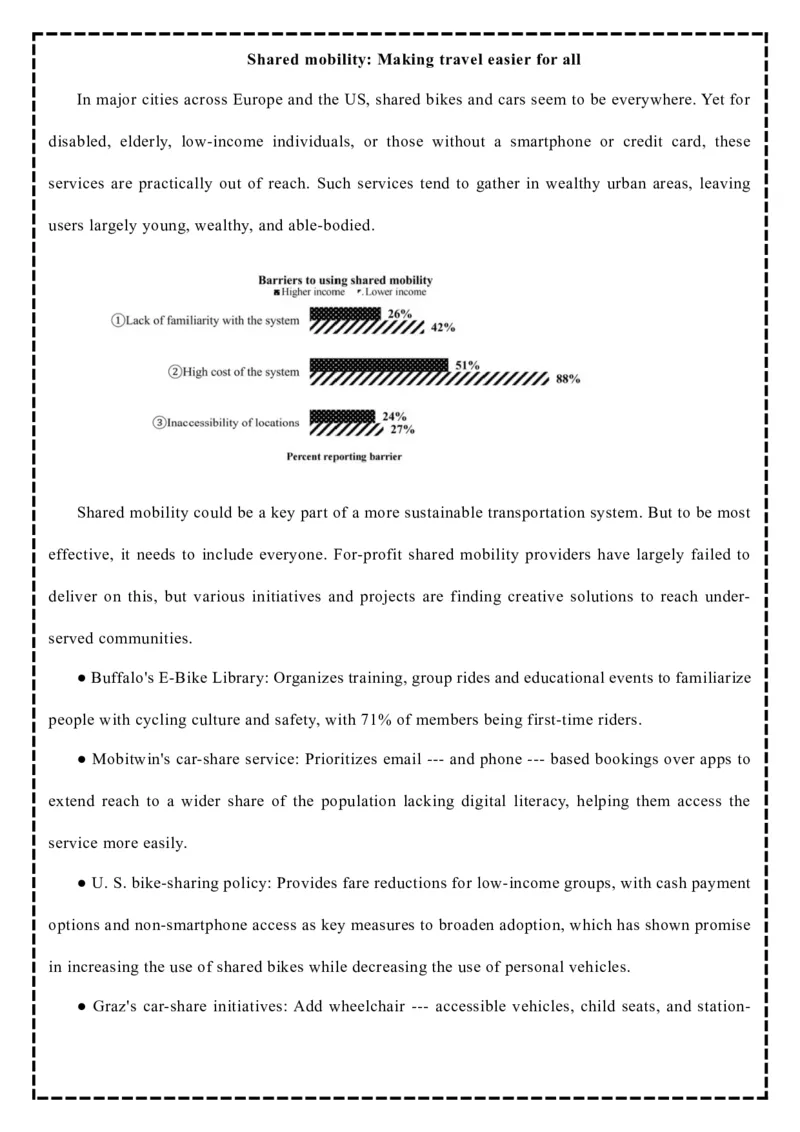
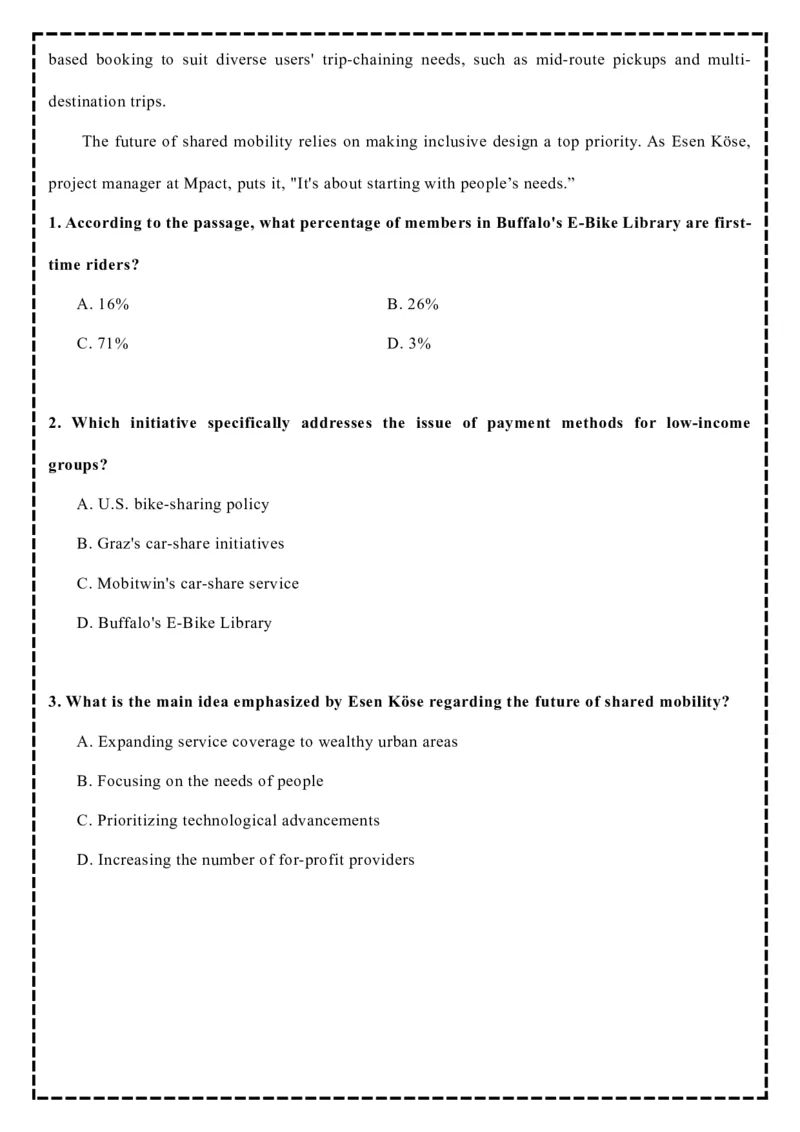
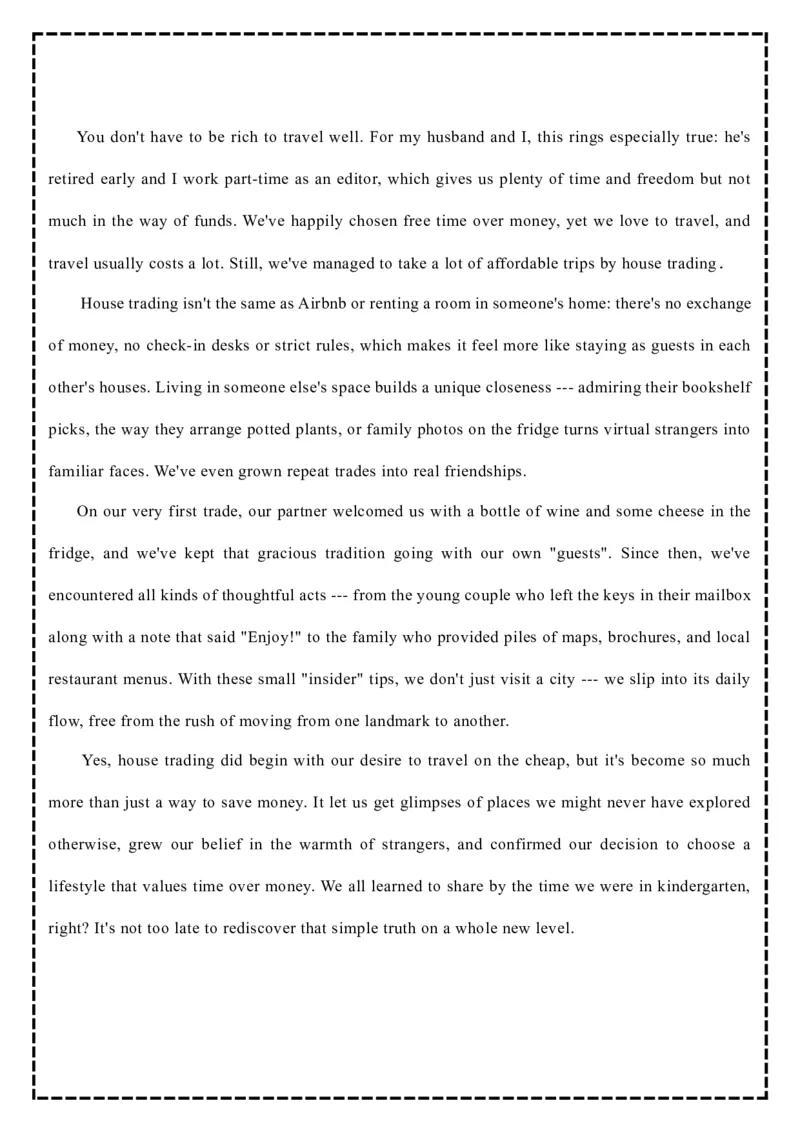
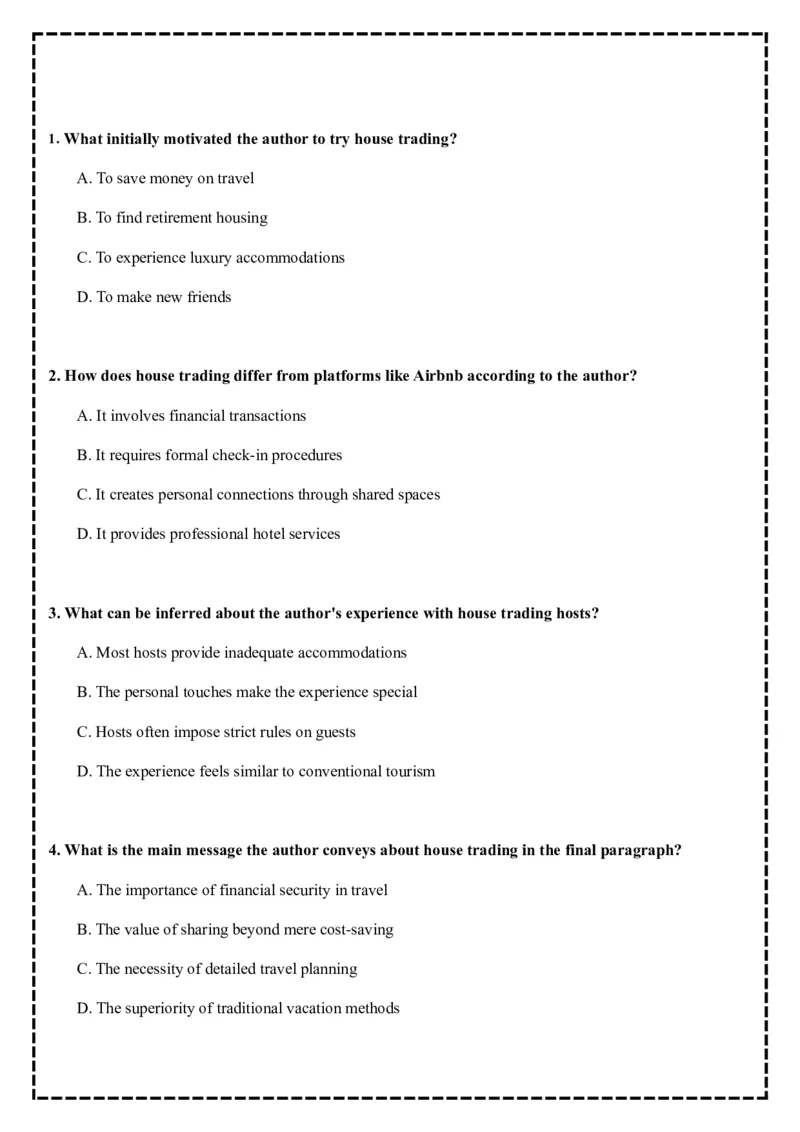
In major cities across Europe and the US, shared bikes and cars seem to be everywhere. Yet for
disabled, elderly, low-income individuals, or those without a smartphone or credit card, these
services are practically out of reach. Such services tend to gather in wealthy urban areas, leaving
users largely young, wealthy, and able-bodied.
Shared mobility could be a key part of a more sustainable transportation system. But to be most
effective, it needs to include everyone. For-profit shared mobility providers have largely failed to
deliver on this, but various initiatives and projects are finding creative solutions to reach under-
served communities.
● Buffalo's E-Bike Library: Organizes training, group rides and educational events to familiarize
people with cycling culture and safety, with 71% of members being first-time riders.
● Mobitwin's car-share service: Prioritizes email --- and phone --- based bookings over apps to
extend reach to a wider share of the population lacking digital literacy, helping them access the
service more easily.
● U. S. bike-sharing policy: Provides fare reductions for low-income groups, with cash payment
options and non-smartphone access as key measures to broaden adoption, which has shown promise
in increasing the use of shared bikes while decreasing the use of personal vehicles.
● Graz's car-share initiatives: Add wheelchair --- accessible vehicles, child seats, and station-
based booking to suit diverse users' trip-chaining needs, such as mid-route pickups and multi-
destination trips.
 The future of shared mobility relies on making inclusive design a top priority. As Esen Köse,
project manager at Mpact, puts it, "It's about starting with people’s needs.”
1. According to the passage, what percentage of members in Buffalo's E-Bike Library are first-
time riders?
A. 16%
B. 26%
C. 71%
D. 3%
2. Which initiative specifically addresses the issue of payment methods for low-income
groups?
A. U.S. bike-sharing policy
B. Graz's car-share initiatives
C. Mobitwin's car-share service
D. Buffalo's E-Bike Library
3. What is the main idea emphasized by Esen Köse regarding the future of shared mobility?
A. Expanding service coverage to wealthy urban areas
B. Focusing on the needs of people
C. Prioritizing technological advancements
D. Increasing the number of for-profit providers
You don't have to be rich to travel well. For my husband and I, this rings especially true: he's
retired early and I work part-time as an editor, which gives us plenty of time and freedom but not
much in the way of funds. We've happily chosen free time over money, yet we love to travel, and
travel usually costs a lot. Still, we've managed to take a lot of affordable trips by house trading.
 House trading isn't the same as Airbnb or renting a room in someone's home: there's no exchange
of money, no check-in desks or strict rules, which makes it feel more like staying as guests in each
other's houses. Living in someone else's space builds a unique closeness --- admiring their bookshelf
picks, the way they arrange potted plants, or family photos on the fridge turns virtual strangers into
familiar faces. We've even grown repeat trades into real friendships.
On our very first trade, our partner welcomed us with a bottle of wine and some cheese in the
fridge, and we've kept that gracious tradition going with our own "guests". Since then, we've
encountered all kinds of thoughtful acts --- from the young couple who left the keys in their mailbox
along with a note that said "Enjoy!" to the family who provided piles of maps, brochures, and local
restaurant menus. With these small "insider" tips, we don't just visit a city --- we slip into its daily
flow, free from the rush of moving from one landmark to another.
 Yes, house trading did begin with our desire to travel on the cheap, but it's become so much
more than just a way to save money. It let us get glimpses of places we might never have explored
otherwise, grew our belief in the warmth of strangers, and confirmed our decision to choose a
lifestyle that values time over money. We all learned to share by the time we were in kindergarten,
right? It's not too late to rediscover that simple truth on a whole new level.
1. What initially motivated the author to try house trading?
A. To save money on travel
B. To find retirement housing
C. To experience luxury accommodations
D. To make new friends
2. How does house trading differ from platforms like Airbnb according to the author?
A. It involves financial transactions
B. It requires formal check-in procedures
C. It creates personal connections through shared spaces
D. It provides professional hotel services
3. What can be inferred about the author's experience with house trading hosts?
A. Most hosts provide inadequate accommodations
B. The personal touches make the experience special
C. Hosts often impose strict rules on guests
D. The experience feels similar to conventional tourism
4. What is the main message the author conveys about house trading in the final paragraph?
A. The importance of financial security in travel
B. The value of sharing beyond mere cost-saving
C. The necessity of detailed travel planning
D. The superiority of traditional vacation methods
Can you pass me the whatchamacallit? It's right over there next to the thingamajig. Many of us
encounter the "tip-of-the-tongue" phenomenon or word-finding difficulties in our daily lives. And
it usually becomes more noticeable with age.
Frequent difficulty finding the right word was often regarded as an early sign of Alzheimer
disease. However, a recent study from the University of Toronto suggests that it's the speed of speech,
rather than the difficulty in finding words that is a more accurate indicator of brain health in older
adults.
The researchers asked 125 healthy adults, aged 18 to 90, to describe a scene in detail. Recordings
of these descriptions were subsequently analyzed by AI software to analyze features such as speed
of talking , duration of pauses between words , and the variety of words used . Participants also
completed a standard set of tests that measure concentration , thinking speed , and the ability to plan
and carry out tasks. It is found that age - related decline in decision - making abilities was closely
linked to a slower speaking pace, suggesting a broader decline than just difficulty in finding the right
word .
The study also employed a picture - naming task , where participants were shown pictures of
everyday objects while being played a recording of a word , either a meaning-related one ( making
picture - naming harder ) or a sound - similar one ( making it somewhat easier ). Interestingly, the
study showed that older adults who spoke more slowly in general were also slower at naming these
pictures. Notably , this highlights the potential of speech rate changes as a significant yet subtle
marker of cognitive (认知的) health that could aid in identifying people at risk before more severe
symptoms become apparent.
While this study lays valuable groundwork for future research, its reliance on picture - based
word tasks falls short of grasping the essence of real-world language use. As such, a target for
subsequent studies should be integrating more naturalistic language patterns to gain deeper insights
into cognitive health.
1. What is the phrase "tip-of-the-tongue" used to illustrate?
A. A common temporary word recall issue
B. A clinical memory disorder term
C. A vocabulary improvement method
D. A speech rate measurement indicator
2. How does the study distinguish its approach from previous beliefs?
A. Proves word pauses lack cognitive meaning
B. Shows word-finding issues are Alzheimer-specific
C. Finds more tip-of-tongue cases in youth
D. Shifts focus to speech speed as cognitive indicator
3. What does the picture-naming task reveal?
A. Everyday objects are easier to name universally
B. Speech rate links to cognitive processing speed
C. Sound clues greatly help elder recall
D. Meaning-related words equally challenge all ages
4. What’s the research's main purpose in the final paragraph?
A. Note limitations and guide future natural language studies
B. Validate picture tasks over spontaneous speech
C. Recommend immediate clinical use for diagnosis
D. Critique AI's role in language analysis
Methane (甲烷) has spread into the atmosphere through leaks from rice fields, landfills, dairy
farms and coal mines, becoming a hidden driver behind near-term global warming. Though short-
lived in the atmosphere for just 7-12 years, methane traps much more heat than CO2. Cutting its
emissions is therefore a key route to slowing near-term warming of the climate, especially as these
emissions have been increasing recently.
New research suggests that a specially grown methane-eating bacteria ( 细菌) called
methanotrophs may offer a solution to control these methane leaks. Originally found in a lake in
Russia, these tiny organisms work by "eating" methane . When air with methane flows through a
large container holding the bacteria, they turn the methane into proteins, which will be harvested and
sold for animal feed. While this does release small amounts of greenhouse gas, the net effect is less
warming power in the air. Tests show they could reduce methane by 60 to 80 percent in air that has
been treated.
Lidstrom and her colleagues at the University of Washington have been working to improve the
bacteria's ability to harvest methane even at relatively low levels. "Since existing bacteria are
designed by nature to carry out this work, the vision is to use this inborn ability as a flexible
technology worldwide," says Mary Lidstrom. " Once it becomes profitable, this solution can grow
to handle millions of tons of methane every year, providing a nature-based solution to reducing
methane in the atmosphere," she adds. It's an exciting approach, but she warns that this method is
not a silver bullet for all methane emissions.
Still, the potential is significant: when expanded, it could remove 24 million tonnes of CO2
equals by mid- century. Similar work by Canada's Lisa Stein, who uses methanotrophs in wetlands,
highlights the broader promise." Methanotrophs have huge potential to address real-world methane
emissions," she notes, with a landfill pilot and an agricultural trial set to roll out this year to build
on that progress.
1. Why does the author mention "rice fields, landfills, dairy farms and…" in paragraph 1?
A. To compare their methane production levels
B. To illustrate the variety of human-related methane sources
C. To argue for stricter regulations on these industries
D. To explain why methane is short-lived in the atmosphere
2. What is the primary function of the number "24 million tonnes" in the last paragraph?
A. To quantify the potential impact of expanded methanotroph technology
B. To demonstrate the economic value of harvested protein
C. To compare methane reduction across different countries
D. To show the annual methane emissions from agriculture
3. What can be inferred about the current limitation of methanotrophs that Lidstrom's team is
addressing?
A. They cannot function in cold environments
B. Their methane consumption rate is too slow
C. They require high methane concentrations to work effectively
D. They produce too much CO2 during the conversion process
4. Which statement best expresses the main purpose of the passage?
A. To criticize the slow response to methane emissions
B. To describe a natural approach to reducing methane pollution
C. To explain why methane is more dangerous than carbon dioxide
D. To promote investment in renewable energy sources
Discovering My Authentic Voice
My professional journey commenced with considerable uncertainty. After completing dual
degrees in communication and design, I anticipated building a career in either field. _____1_____
Instead, I found myself moving through a series of unfulfilling positions that left me feeling
disconnected from my true aspirations.
_____2_____ This period of professional dissonance ultimately served as my catalyst for change.
I came to recognize my emotional boundaries after experiencing persistent exhaustion. The ancient
wisdom of "insanity is doing the same thing expecting different results" resonated profoundly with
my situation. I ceased investing energy in paths that contradicted my core values. My new principle
became clear: only pursue directions that align with both my capabilities and convictions.
During this transformative phase, a long-neglected passion gradually reemerged—storytelling.
When I confided this revelation to Michael, a mentor in creative fields, his response was illuminating.
"Genuine passion transforms effort into fulfillment, not obligation," he wisely noted. _____3_____
I understood that authentic calling is engraved in one's essence; when honored, consistent practice
emerges organically, creating the foundation for meaningful achievement.
Empowered by this insight, I implemented practical changes. I established protected time for
daily writing, beginning with modest but consistent goals.  _____4_____ The decisive moment
arrived when a lucrative freelance project threatened to consume my creative time—I respectfully
declined. This wasn't loss but affirmation. I wrote with purpose I had never experienced in
conventional workplaces.
Creating space for meaningful work transformed my existence. Regular creative practice brought
clarity and confidence. While financial stability remains essential, working with purpose reveals
unexpected opportunities. Fulfillment isn't discovered in abstract fantasies.  _____5_____ When you
move toward your genuine direction, the current of life supports your journey in unexpected ways.
A. This revelation fundamentally shifted my perspective.
B. Such achievement demands extraordinary capability.
C. It gets built through consistent conscious choices.
D. Months of frustration finally prompted my breakthrough.
E. I secured an ideal position at a digital media agency.
F. This translated to writing three pages every morning.
G. The truth involved cycling through various creative roles.
答案与解析
阅读A 篇
【答案】 1. C 2. A 3. B
1. 答案:C 解析:本题为细节理解题。根据原文中“Buffalo's E-Bike Library”部分明确提到:
“with 71% of members being first-time riders”,即71%的成员是首次骑行者。因此正确答案为C。
2. 答案:A 解析:本题为细节理解题。原文在“U.S. bike-sharing policy”部分指出,该政策通
过“fare reductions for low-income groups, with cash payment options and non-smartphone access”
等措施,专门针对低收入群体提供支付方式的便利,包括现金支付和非智能手机接入。因此正确答
案为A。
3. 答案:B
解析:本题为主旨大意题。原文最后引用Mpact 项目经理Esen Köse 的观点:“It's about
starting with people’s needs”,强调共享出行的未来应基于用户需求,以人为中心。因此正确答案
为B。选项A(扩展富裕城区服务)、C(技术优先)和D(增加营利性提供商)均与原文主旨不符。
阅读B 篇
【答案】 1. A 2. C 3. B 4. D
1 答案:A 解析:本题为细节理解题。根据原文第四段开头:"Yes, house trading did begin
with our desire to travel on the cheap" 明确说明作者尝试房屋交换的最初动机是为了节省旅行费用
(travel on the cheap)。选项B(赚取退休金)、C(升级住宿)和D(结识有趣的人)均不符合原
文表述。
2. 答案:C 解析:本题为细节理解题。原文第二段明确指出:"House trading isn't the same as
Airbnb... which makes it feel more like staying as guests" 并详细描述了通过欣赏主人的书籍摆放、
盆栽植物和家庭照片等细节"turns virtual strangers into familiar faces",强调这种模式创造的人际联
系。选项A(涉及金钱交换)和B(需要正式登记手续)与原文"no exchange of money, no check-
in desks"直接矛盾;选项D(提供酒店服务)未被提及。
3. 答案:B 解析:本题为推理判断题。作者在第三段列举了 hosts 的周到行为(留红酒奶酪、钥
匙便条、当地指南等),并总结这些"insider tips"让他们能够融入当地日常生活("slip into its daily
flow"),暗示这些个性化安排使体验变得特别。选项A(多数房东提供不足住宿)与原文描述的温
馨细节相反;选项C(房东制定严格规则)与原文"no strict rules"矛盾;选项D(类似传统旅游)与
原文"free from the rush of moving from one landmark to another"相悖。
4. 答案:D 解析:本题为主旨大意题。最后一段通过"become so much more than just a way
to save money"的转折,强调房屋交换带来了意外探索机会、对人性温暖的信任以及时间重于金钱的
生活理念确认,最终落脚于"share"这一核心价值的重新发现。选项A(旅行财务安全的重要性)偏
离主旨;选项C(详细规划的必要性)未提及;选项D(传统度假方式的优越性)与文章倡导的创
新方式不符。
阅读C 篇
【答案】 1. A 2. D 3. B 4. A
1. 答案:A 解析: 本题为词义猜测题。原文使用“tip-of-the-tongue”这个习语,并紧接着用
“word-finding difficulties”(找词困难)对其进行同义解释,描述一种常见的暂时性想不起词语的
现象。选项B(临床记忆障碍术语)、C(词汇改进方法)和D(语速测量指标)均不符合该短语在
上下文中的含义。
2. 答案:
D 解析: 本题为细节理解题。解题关键在第二段:“ it's the speed of speech,
rather than the difficulty in finding words that is a more accurate indicator”(语速比找词困难是
更准确的指标)。这表明该研究的新颖之处在于将焦点从“找词困难”转向了“语速”。选项B、
C、A 的描述均与原文研究发现不符。
3. 答案:B 解析: 本题为推理判断题。根据第四段,图片命名任务的实验结果是:“ older
adults who spoke more slowly in general were also slower at naming these pictures”(平时说话慢
的老年人,给图片命名的速度也更慢)。这揭示了普遍语速(speech rate)与特定认知任务的处理速
度(cognitive processing speed)之间存在关联。选项A、C、D 均曲解了实验的设计目的或发现。
4. 答案:A 解析: 本题为主旨大意题。最后一段在肯定当前研究价值(“lays valuable
groundwork”)后,用“While...”转折指出其局限性(“falls short of grasping the essence of real-
world language use”),并明确提出了未来研究的目标(“a target for subsequent studies should
be...”)。因此,该段的主要目的是评价当前研究的不足并指引未来方向。选项A 准确概括了该目
的。选项C(推荐立即临床应用)是过度推断,原文无此意。
阅读D 篇
【答案】 1. B 2. A 3. C 4. B
1. 答案:B 解析:本题为写作手法题(举例子)。作者在第一段中列举"稻田、垃圾填埋场、奶
牛场和煤矿"这些具体例子,是为了具体说明前文所说的甲烷"通过泄漏进入大气"的各种人为来源,
帮助读者理解甲烷污染的广泛性和多样性。选项A(比较产量)、C(主张严格监管)和D(解释甲
烷短期存在)均不是这些例子的主要作用。
2. 答案:A 解析:本题为写作手法题(列数字)。最后一段中"2400 万吨"这个具体数字用于量
化和具体说明前文所说的"潜力巨大(potential is significant)",即如果甲烷氧化菌技术扩大应用规
模,到本世纪中期可能实现的二氧化碳当量减排效果,使论述更具说服力。选项B(证明经济价
值)、C(比较不同国家减排)和D(显示农业排放量)均不符合该数字的上下文作用。
3. 答案:C 解析:本题为推理判断题。第三段提到Lidstrom 团队一直在努力"提高细菌在甲烷浓
度相对较低时收集甲烷的能力(improve the bacteria's ability... at relatively low levels)",由此可以
推断,当前的技术限制在于天然细菌需要较高浓度的甲烷才能有效工作,而这正是研究人员试图突
破的问题。选项A(低温环境)、B(消耗速率)和D(产生CO2)在文中均未提及。
4. 答案:B 解析:本题为主旨大意题。文章通篇围绕利用甲烷氧化菌这一天然细菌来减少大气
中甲烷这一核心方案展开:先说明甲烷问题的严重性(第一段),再介绍解决方案的原理(第二
段),然后讨论技术改进和潜力(第三、四段)。因此文章的主要目的是描述这一自然方法。选项
A(批评反应缓慢)不是文章焦点;选项C(解释甲烷更危险)只是第一段的部分内容;选项D(推
广可再生能源)完全未涉及。
阅读七选五
【答案】 1. G 2. D 3. A 4.F 5. C
1. 答案:G 解析: 本题为段首题。空后句“Instead”表示转折,说明实际情况与前面的预期
“building a career in either field”形成对比。选项G“The truth involved cycling through various
creative roles”(实际情况是在各种创意职位间辗转)恰好形成这种转折关系,并引出下文
“unfulfilling positions”的论述。
2. 答案:D 解析: 本题为段中题。空后句“This period”需要指代对象,选项D“Months of
frustration finally prompted my breakthrough”(数月的挫折最终促成了我的突破)正好提供了这一
指代内容,同时与下文的“catalyst for change”形成语义衔接。
3. 答案:A 解析: 本题为段中题。空前提到导师的话语,空后是作者对此的感悟。选项
A“This revelation fundamentally shifted my perspective”(这一启示从根本上改变了我的视角)承
上启下,既指代前文的导师建议,又引出后文的个人理解。
4. 答案:F  解析: 本题为段中题。空前提到“beginning with modest but consistent goals”
(从适度但持续的目标开始),选项F“This translated to writing three pages every morning”(这
转化为每天早晨写三页)具体说明了这些目标如何实施,与下文“protective time”形成呼应。
5. 答案:C  解析: 本题为段尾题。空前句“ Fulfillment isn't discovered in abstract
fantasies”(满足感不是在抽象的幻想中发现的)需要后续说明实现途径,选项C“It gets built
through consistent conscious choices”(它通过持续的有意识选择构建而成)正好完成这一论述,并
与全文强调“daily practice”的主题相呼应。