专题15  阅读理解记叙文
______________________________________________________________________________________
目录
1. 高考真题练
2. 创新基础练
3. 高考模拟练
一  高考真题练
1.(2025·全国一卷·高考真题)In my ninth-grade writing class last year, I met a cowboy who
saved his town, a strict father who demanded his son earn straight A’s, and a modern-day Juliet who died of
heartbreak after her p
arents rejected the love of her young life. More than once, I found myself wondering just how my
students, who’d created these people, knew their subjects so well.
But things were different for their first essay, which was about the question: “Why is writing
important?” Most of the essays filled less than one page, and few contained a sentence that could be
interpreted as a thesis (论点) statement. I was shocked. Then I realized that the problem was the question
itself. They could have written pages on the necessity of computers, but writing, in and of itself, simply
didn’t strike them as important. This would have to change.
As a new unit started, I asked everyone to write a persuasive piece on a health-related topic of their
choice. This time they found the exercise much more interesting. For the next two assignments, a personal-
narrative unit followed by a creative-writing workshop, I only required that the piece meet the
specifications of its genre (体裁) and that it contain a thesis. The results were staggering. The students
took on diverse topics and turned in stories, 10 to 20 pages each, with characters that broadened my view
and touched my heart.
I walked into class believing that writing is important as a means of communication. However, my
students demonstrated something more important to me. When the final bell rang in June, I walked away
with a yearbook full of messages about writing’s most powerful significance — the ability to connect
people, to put us in another’s skin, to teach us what it means to be human.
1.Who are the people mentioned at the beginning of paragraph 1?
A.Ninth graders.
B.Students’ parents.
C.Modern writers.
D.Fictional characters.
2.Why did the students perform poorly in writing their first essay?
A.They were not given enough time.
B.They had a very limited vocabulary.
C.They misunderstood the question.
D.They had little interest in the topic.
3.What does the underlined word “staggering” in paragraph 3 mean?
A.Mixed.
B.Amazing.
C.Similar.
D.Disturbing.
4.What does the author’s experience show?
A.Teaching is learning.
B.Still waters run deep.
C.Knowledge is power.
D.Practice makes perfect.
2.(2025·全国二卷·高考真题)Kathy Ho teaches high school inside Lucile Packard Children’s
Hospital Stanford (LPCH). “Sometimes I don’t like saying that I’m a teacher,” says Ho. “People get in
their minds an idea of what teachers do, but that’s not really what it is here.”
“Here” is room 386, where each year, about 500 LPCH patients also become students. The hospital
school is free of parents, doctors, and medical procedures. It’s a place of learning. About half of Ho’s
students stay for a week or less; others are there for more than a year. Most of Ho’s students will recover,
which means that preparing them to return to school is an increasingly important component of care.
Still, in room 386, academics don’t come first. Physical health and mental health are the priority. “If
you’re scared about something and thinking only about that, there’s no way you’re going to be able to
learn,” Ho says. “I’m a coach, an adviser, and a comforter, and that’s what it means to be a hospital
teacher.”
There are up to 30 students at any given time in Ho’s class. She generally works with their regular
teachers to get lessons and tests being used at their home schools. Some teachers don’t give the kids any
assignments; they express sympathy instead. “I feel like it is a disservice to the kids,” Ho says. “They
think their teachers don’t care about their schoolwork.”
Ho recognizes the psychological benefit of helping kids keep up with their peers (同龄人) outside
the hospital. “I actually think the medicine is only a small piece for some problems,” says Julie Good,
director of pain management services at LPCH. “It’s about problem-solving around what it means to have a
full life. Those kids have dreams. School can keep those dreams alive by giving kids a way to learn and
grow.”
5.Who does Ho teach at LPCH?
A.Sick children.
B.Young nurses.
C.Medical students.
D.Patients’ parents.
6.What is a characteristic of Ho’s job?
A.Prioritizing academics.
B.Encouraging innovation.
C.Treating various diseases.
D.Playing multiple roles.
7.What does the underlined word “it” refer to in paragraph 4?
A.Offering regular lessons.
B.Paying extra attention.
C.Assigning no schoolwork.
D.Showing no sympathy.
8.How does the hospital school benefit the students according to Good?
A.It eases peer pressure.
B.It helps them live in hope.
C.It frees them from aches.
D.It entertains them with stories.
3.(2023·上海·高考真题)In the vast, untouched expanse of wilderness, Isla and her faithful golden
retriever (猎犬), Finn danced in a harmony of souls. Together, they weaved through myriad terrains, from
shadowed forests echoing with ancient secrets to rugged mountain paths that touched the heavens. Their
bond was not of mere circumstance, but of shared dreams, Isla sought quiet away from the urban noise,
while every rustle and murmur of the wild ignited Finn’s spirit.
As dawn’s first light kissed the earth, Isla deliberately packed away memories of the nigh while Finn,
with eager anticipation, wagged (摇摆) his tail, eager for the day’s melodies. Their journey was not charted
by maps or compasses, but by the gentle touches of their hearts, caressed by nature’s ideal breezes.
One dusky evening, painted with deep red colors and ethereal purples, an unexpected storm took them
off guard, Raindrops, heavy with sorrow, transformed familiar trails into flowing streams, in a desperate
bid for refuge, Isla was trapped by the fierce embrace of the currents. It was Finn’s instinctive courage that
shone brightly in that moment of despair, as he moved forward suddenly, securing her backpack with a
steadfast grip, drawing her back to safety’s shore.
Nestled in u rocky embrace, they clung to each other against the storm’s fury. Isla whispered tales of
bygone days and distant horizons into Finn’s eager cars, in return, he moved slowly and complained
weakly, weaving tales without words, sharing a symphony of silent stories.
When the storm’s rage decreased, the world they knew was covered in unfamiliarity. Trails they once
danced upon had vanished, and landmarks whispered in unfamiliar tongues. For the first time, Isla felt the
weight of disorientation. But Finn, with unwavering confidence, stepped forward, trusting his instincts to
unveil the path ahead.
As days melted into weeks, just when hope seemed a distant star, the embrace of a hidden village
hugged them gently, interested by the long exciting journey, villagers welcomed them, their journey
becoming woven into the picture of local legend. But the wild’s temptation could not be ignored. Restored,
the two partners ventured once more into the embrace of nature, carrying with them the blessings and
hopes of newfound friends.
Through the rich and colorful picture of their adventures, it became evident that their true strength was
not in conquering the elements but in the unyielding bond they shared. The wild was but a stage for their
eternal ballet of friendship and perseverance.
9.What connected Isla to Finn?
A.The untouched expanse of wilderness.
B.Shadowed forests echoing with ancient secrets.
C.Circumstance and shared dreams.
D.The urban noise.
10.What drove Isla into despair?
A.A dusk of crimson and purple.
B.A sudden storm.
C.The familiar trails.
D.A rocky embrace.
11.What were the villagers interested in?
A.Finn’s confidence and intuition.
B.Isla’s respect for nature.
C.Isla and Finn’s exciting journey
D.The wild’s temptation.
12.What can we learn from the passage?
A.Isla and Finn made their journeys based on a map or a compass.
B.Finn failed to pull Isla back to the safety of shore.
C.The villagers wove Isla and Finn’s journey into local legend.
D.Isla and Finn’s real strength lied in conquering harsh environments.
4.(2024·北京·高考真题)When I was a little girl, I liked drawing, freely and joyously making
marks on the walls at home. In primary school, I learned to write using chalks. Writing seemed to be
another form of drawing. I shaped individual letters into repeating lines, which were abstract forms,
delightful but meaningless patterns.
In secondary school, art was my favourite subject. Since I loved it so much I thought I was good at
it. For the art O-level exam I had to present an oil painting. I found it difficult, but still hoped to pass. I
failed, with a low grade. I’d been over-confident. Now I’d been declared talentless.
But other channels of creativity stayed open: I went on writing poems and stories. Still, I went to
exhibitions often. I continued my habitual drawing, which I now characterised as childish doodling (乱画).
In my 30s, I made painter friends and learned new ways of looking at art. However, I couldn’t let myself
have a go at actually doing it. Though these new friends were abstract painters using oil paints, or were
printmakers or sculptors, I took oil painting as the taboo (禁忌) high form I wasn’t allowed to practice.
     One night, in my early 40s, I dreamed that a big woman in red approached me, handed me a bag of
paints, and told me to start painting. The dream felt so authoritative that it shook me. It was a form of
energy, giving me back something I’d lost. Accordingly, I started by experimenting with water colours.
Finally, I bought some oil paints.
Although I have enjoyed breaking my decades-long taboo about working with oil paints, I have
discovered I now prefer chalks and ink. I let my line drawings turn into cartoons I send to friends. It all
feels free and easy. Un-anxious. This time around, I can accept my limitations but keep going.
Becoming a successful painter calls for being resolute. I realised I was always afraid of wanting too
much. That dream reminded me that those fears and desires could encourage me to take risks and make
experiments.
13.How did the author feel about the result of the art exam?
A.Scared.
B.Worried.
C.Discouraged.
D.Wronged.
14.In her 30s, the author _________.
A.avoided oil painting practice
B.sought for a painting career
C.fancied abstract painting
D.exhibited child paintings
15.Which word would best describe the author’s dream?
A.Confusing.
B.Empowering.
C.Disturbing.
D.Entertaining.
16.What can we learn from this passage?
A.Actions speak louder than words.
B.Hard work is the mother of success.
C.Dreams are the reflections of realities.
D.Creative activities involve being confident.
5.(2024·浙江·高考真题)When was the last time you used a telephone box? I mean to make an
actual phone call — not to shelter from the rain. Ages ago, right? The last time I used a phone box for its
intended purpose was…2006. I was conducting auditions (试演) for my play in my tiny old shared house
in London. Hoping to impress some talented actors to come and work for me for nothing, I spread some
throws over the sofas and lit candles to make it seem a bit more ”young professional”.
As I rushed outdoors to empty the wastepaper baskets, the door swung shut behind me. Suddenly I
was locked outside. My mobile phone was inside, but luckily there was a telephone box across the street.
So, I called Directory Assistance, got put through to our landlady’s managing agent, and had a spare key
sent to me with just enough time to get back in before the actors arrived.
As it has been many years since I last used one, I should hardly be surprised that then are no longer
any public telephones near my house. The last one standing has just been turn into a “mini community
library”: any passer-by can “borrow” a book from its shelves return it later, or replace it with another title
from their own collection.
For a few months after the “library” opened, I didn’t bother taking a look, as I had assumed that it
would be stuffed full of cheese love stories. Then I noticed folk conducting spring cleans dropping boxes
of voluminous books on various subjects there. And these books were free. This unbeatable price-point
encouraged me to experiment with dozens of titles that I would never normally consider buying. And I’ve
discovered some great books!
If I ever get trapped outside my house again, my local telephone box will, sadly no longer be able to
connect me with my keys. But it can certainly keep me entertained while I wait for my wife to rescue me.
17.What does the underlined word “it” in the first paragraph refer to?
A.The play.
B.The shared house.
C.The sofa.
D.The telephone box.
18.Why did the author use the telephone box in 2006?
A.To place an urgent call.
B.To put up a notice.
C.To shelter from the rain.
D.To hold an audition.
19.What do we know about the “mini community library”?
A.It provides phone service for free.
B.Anyone can contribute to its collection.
C.It is popular among young readers.
D.Books must be returned within a month.
20.Why did the author start to use the “library”?
A.He wanted to borrow some love stories.
B.He was encouraged by a close neighbour.
C.He found there were excellent free books.
D.He thought it was an ideal place for reading.
二  创新基础练
Passage  1
My first trip to the cinema almost ended up being my last. On Christmas Eve 1996, a friend’s dad
took a group of us to the cinema for an afternoon showing of Matilda. I was excited to see one of my
storybook heroes get projected onto the silver screen. Everything started out just fine: The magic of the
book was brought to life with the backing of its $36 million budget, and Embeth Davidtz made a perfectly
acceptable Miss Honey. But then, somewhere around the halfway point, something happened that shook
the five-year-old me to his tiny core.
Matilda and Miss Honey, seeking the return of a stolen painting, had broken into the home of Agatha
Trunchbull, Matilda’s evil headmistress. As they explored the house, Trunchbull suddenly returned,
sending the pair scrabbling for an exit. Matilda ducked down a darkened staircase into the basement.
Trunchbull ran down after her, screaming as she went. The soundtrack rose to fever pitch ( 狂热), and I
sunk, terrified, into my seat.
Horror movies are preoccupied with sensory matters. It is no coincidence that in Under the Skin,
Scarlett Johansson’s murderous alien walks the streets in search of prey under the cover of night. In low
light, the limitations of our senses render the world a more uncertain place, filled with half-seen figures
and spaces. The color-sensitive cones (视锥细胞) in our eyes lose ground to the light-sensitive rods (视杆
细胞). The result is a monochrome (单色的) vision of the world, where even the slightest movement in the
corner of your eye is amplified tenfold.
Moreover, the color red has a powerful effect on the human mind, causing a feeling of fear even
when divorced from any real threat. Is it any wonder then that horror cinema’s default color palette (默认
主色调) is soaked in vermilion (鲜红色的) tones? Just think of the bright red pullover favored by Freddy
Krueger in the Nightmare on Elm Street film series.
Our sensitivity to sound is even more vulnerable to manipulation. We unthinkingly accept the reality
of a film’s soundscape. Even the slightest sonic provocations (声音的刺激) can catch us entirely off guard.
A University of California study found that non-linear sounds — those that go beyond the limits of an
instrument’s normal musical range — frequently appear in horror movie soundtracks, like the screechy (声
音尖锐的), violin-soaked shower scene from Psycho. Their similarity to the noises produced by animals
under threat triggers an instinctive fear response in us.
Ultimately, our relationship with horror is a symbiotic (共生的) one. The scares brought to life on
the screen are made possible by our ability to perceive them, just as 3D filmmaking relies on the ability of
the human mind to perceive a 3D reality through the overlap of two separate images. In other words, horror
movies are less expert at implanting scares in our minds than at drawing out those that already exist within
us. This might explain why, two decades on, I still can’t bring myself to revisit the world of Matilda.
1.What can we learn about the author from the article?
A.He was not a big fan of Matilda during his childhood.
B.He was taken to see a film for the first time by a group of friends.
C.He has never gone back to see a film at a cinema since the age of five.
D.He was on an emotional roller coaster during his first trip to the cinema.
2.According to the article, which of the following factors make a film scary?
Sound effects.
①

The faint light.
②

Half-seen figures.
③

Air-conditioned cinemas.
④
A.①②③
B.①③④
C.①②④
D.②③④
3.According to the article, which of the following is NOT an example of “non-linear sounds”?
A.A baby’s loud scream.
B.A distress call sent out by a cat.
C.The sound of an alarm clock going off.
D.The sound of a trumpet being overblown.
4.In the last paragraph, the author took “3D filmmaking” as an example to show that the horror movies
_________.
A.are good at telling scary stories
B.take advantage of human instinct
C.aren’t a new product of the 21st century
D.can be made more realistic with 3D technology
Passage  2
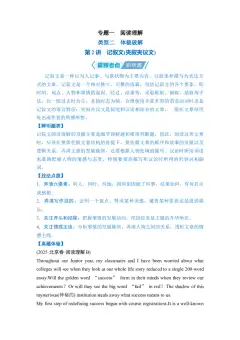
When I was a child, I was terrified of storms, especially those violent ones that occurred in summer.
I remember one occasion in August, when I had just turned six years old. I was out shopping with my
parents, when suddenly there was a loud noise coming from the direction of the Apennine Mountains (亚平
宁山脉).
As the storm got closer, lightning fell a few hundred metres from us, and hail whitened the streets
in minutes. This was a totally new experience for me, and I ran into my father’s arms in terror. It’s a
memory that remains with me to this day. I was afraid. But I was also in awe.
Like the pull of a gripping horror movie, my fear developed into fascination as I grew older.
When a thunderstorm broke out at night, I would rush to my window to witness a brilliant show in the
night sky. I would wait in eager anticipation, equipped with my parents’ camera, ready to try and capture a
fleeting moment.
An interest in storm photography arose from these youthful attempts. What once frightened me now
gave me a strong adrenalin rush (肾上腺素飙升), especially the first time lightning struck just a few
metres away from me, an experience which resulted in me capturing a spectacular photo of the moment.
From that moment on, I realized that I absolutely had to chase storms throughout southern Italy.
When people ask me about the dangers of storm chasing, I put it this way: My parents are not too
keen on my chosen activity. They certainly preferred me photographing newlyweds (新婚夫妇), because it
is of course a lot less risky. But it’s also a lot less exciting!
The truth is that storm chasing is quite dangerous, especially to those who set out to chase storms
without acknowledging the risks involved, or respecting nature, or doing their due research. Most accidents
caused by lightning occur outdoors. You are most at risk in the mountains, but all large and exposed places
such as a lawn or a soccer field can also be dangerous places to be during a storm, especially anywhere in
the presence of water, such as the sea, beaches, piers, docks or outdoor pools.
One day soon I will set off to expand my storm-chasing journey beyond Italy’s horizons. I would
love to go to Venezuela where electrical storms are guaranteed almost all year round on the Catatumbo
River and Lake Maracaibo. It’s one of the most fascinating places on the planet for those drawn to extreme
weather.
Another dream destination would be the United States, where it’s possible to see and photograph
supercell storms (超级单体风暴), tornadoes (龙卷风) and lightning all at the same time. My hope is to
one day join a team of storm chasers in the U. S. and around the world, working with National
Geographic. Maybe that will be the day that my parents finally accept the choice of my career.
5.Which group of the following words best describes the emotions that the author had towards storms
when he was six?
A.Curious and eager.
B.Scared and amazed.
C.Excited and obsessed.
D.Frightened and awed.
6.Paragraphs 3 and 4 mainly talk about _________.
A.how the author was able to get over his fear of storms
B.the childhood memory that impressed the author the most
C.what the author would do as a child whenever a storm approached
D.how the author ended up developing a strong interest in storm chasing
7.It can be dangerous to be _________ during a storm.
 in the house
①

in the mountains
②
 near a stretch of water
③

 outside in the middle of a large and open area
④
A.①②③
B.①②④
C.①③④
D.②③④
8.The author would like to go to Venezuela in the future to _________.
A.seek opportunity to work with National Geographic
B.capture the frequent electrical storms that occur in that country
C.join a team that chases supercell storms, tornadoes and lightning
D.enjoy the splendid scenery on the Catatumbo River and Lake Maracaibo
Passage  3
Just how bad of a mother am I, I silently wondered, as I watched my 13-year-old son deep in
conversation with Siri. Gus has autism (自闭症), and Siri, Apple’s “intelligent personal assistant” on the
iPhone, is currently his BFF (Best Friend Forever). Obsessed with weather formations, Gus had spent the
past hour exploring the difference between isolated and scattered thunderstorms — an hour during which,
thank God, I did not have to discuss them with him myself. After a while I heard this:
Gus: “You’re a really nice computer.”
Siri: “It’s nice to be appreciated.”
Gus: “You’re always asking if you can help me. Is there anything you want?”
Siri: “Thank you, but I have very few wants.”
Gus: “OK. Well, good night!”
Siri: “Ah, it’s 5: 06 p. m.”
Gus: “Oh sorry, I mean, goodbye.”
Siri: “See you later!”
That Siri. She does not let my communicatively impaired son get away with anything. Indeed, many
of us wanted an imaginary friend when we were young, and now we can all have one anytime we wish to.
Only she is not entirely imaginary. In a world where the commonly held wisdom is that technology isolates
us, it is worth considering another side of the story.
Gus had never noticed Siri before, but when he discovered there was someone who would not only
find information for him that was related to his various obsessions but would also be willing to tirelessly
discuss these subjects, he was hooked. Online critics have claimed that Siri’s voice recognition technology
is not as accurate as Android’s assistant, but for some of us, this is a feature, not a bug. Gus speaks as if he
has marbles (弹珠) in his mouth, but if he wants to get the right response from Siri, he must pronounce his
words clearly.
She is also wonderful for someone who does not pick up on social cues: Siri’s responses are not
entirely predictable, but they are predictably kind — even when Gus is rude. I heard him talking to Siri
about music, and Siri offered some suggestions. “I don’t like that kind of music,” Gus snapped ( 厉声说).
Siri replied, “You’re certainly entitled to your opinion.” Siri’s politeness reminded Gus what he owed Siri.
“Thank you for that music, though,” Gus said.
My son’s practice conversations with Siri are starting to translate into increased facility with actual
humans. Yesterday I had the longest ever conversation with him. Admittedly, it was about different species
of turtles and whether I preferred the red-eared slider to the diamond-backed terrapin. This might not have
been my choice of topic, but it was back and forth, and it followed a logical trajectory. I can promise you
that for most of my beautiful son’s 13 years of existence, this has not been the case.
The developers of intelligent assistants recognize their potential usefulness for those with speech
and communication problems — and some are currently pondering new ways in which the assistants can
help. “For example, the assistant would be able to track eye movements and help the autistic learn to look
you in the eye while talking,” said William Mark, vice president at SRI International, the company from
whom Apple purchased the technology behind Siri. “See, that’s the wonderful thing about technology.
Getting results requires a lot of repetition. Machines are very, very patient.”
9.The author felt ________ when she overheard her son having a conversation with Siri about
thunderstorms.
A.concerned
B.excited
C.relieved
D.surprised
10.Which of the following statements about Gus is true?
A.He had always dreamed of having an imaginary friend.
B.He shows no interest in anything that is not related to the weather.
C.He has trouble communicating with others because of his illness.
D.He has been friends with Siri ever since he was diagnosed with autism.
11.Siri has helped Gus to ________.
set a fixed bedtime
①

improve his pronunciation
②
mind his manners while talking
③

 have a real conversation with other people
④
A.①②③
B.①②④
C.②③④
D.①②③④
12.What can we learn from the last paragraph?
A.Intelligent assistants will be more widely used in the future.
B.The use of intelligent assistants will likely be limited to autistic people.
C.Machines are more skilled and patient at communication than humans.
D.William Mark was critical of the future development of intelligent assistants.
Passage  4
On the first day of school this year, Joseph Riley, the headmaster of Pocahontas County High School
in West Virginia, dropped by the band classroom and told the 38 students that the school had been unable
to find a band teacher after the former teacher left over the summer to take a teaching position at a different
school.
“I said that we’d have to get them into other classes,” Riley said. Then he gave the students a second
option. If the teens wanted to keep the Warriors band going and teach themselves, the school would support
them. Most students decided to take a different class, but 10 students took him up on the offer. The guys
didn’t give up in the face of difficulties and they found the courage to keep the band going.
The 10 band members elected Hailey Fitzgerald, 17, as band director, and then invited 2 teachers
from the school to serve as advisors. Math teacher Jennifer Cook agreed to offer support. “They’re an
impressive group of kids,” Cook said, “We’re all very proud of them.” Band students practice the school
song every day, and they’ve learned to work together, Fitzgerald said. They also had to solve a problem
when they realized they had too many drummers (鼓手).
The band’s latest performance was on their school’s Homecoming Day. “When we do our school
song, that’s probably everybody’s favorite,” said Jadyn Lane, 17.
“To see so many people supporting and cheering us on, that’s inspiring.”
Several schoolmates volunteered to join the students in the stands on Homecoming Day. “Our
school is the heart of the community,” Riley said. “Everyone is really appreciative of these kids working
together to make sure our school still has a band. It’s amazing to see the progress they’ve made on their
own.”
Years from now, Fitzgerald imagines she’ll look back on her junior year as the band director with
pride. “It was never an option for us to quit — we all love it too much,” she said.
13.What happened to the Warriors band when school started this year?
A.The school hired a new band teacher.
B.The band members chose other classes.
C.The band continued with student leadership.
D.The headmaster was not satisfied with the band.
14.Which words can best describe the 10 band members?
A.Mild and patient.
B.Capable and generous.
C.Intelligent and imaginative.
D.Determined and impressive.
15.What do we know about the band’s latest performance?
A.It was organized by several schools.
B.It was staged for a yearly local festival.
C.It was well recognised by the audience.
D.It was attended by every community member.
16.How has Fitzgerald benefited from directing the band?
A.It has led her to a lifelong hobby.
B.It has helped her to be a top student.
C.It has brought her a sense of community.
D.It has given her a memory to be treasured.
Passage  5
At Lincoln High School, a Spanish teacher, Ms Rodriguez, has aroused (激起) students’ interest in
Spanish and Latino culture through her innovative teaching methods. Despite the school’s limited
resources, Ms Rodriguez always strives (努力) to keep her students engaged through creative teaching
strategies and community cooperation, enhancing their cultural identity.
However, Ms Rodriguez’s teaching journey at Lincoln High School wasn’t always smooth. She
found that students weren’t very interested in Spanish classes, with some thinking that learning Spanish
had no practical use. Additionally, there was a cultural gap in the school, with some students lacking a
sense of identity with Latino culture. Faced with these challenges, Ms Rodriguez didn’t back down. She
decided to introduce interactive teaching methods like role-playing, cultural workshops, and community
projects to increase student engagement.
Ms Rodriguez also worked together with the local community, inviting Latino artists, writers, and
entrepreneurs to the school to share their stories, thus enhancing students’ cultural identity. She encouraged
students to involve their families in language learning through homework and community activities,
strengthening family interaction and cultural heritage.
Ms Rodriguez’s efforts gradually paid off. Students’ interest in Spanish classes increased
significantly, and classroom participation and grades improved remarkably. The school successfully hosted
several Latino cultural events, attracting participation from students and teachers across the school, thus
enhancing the school’s cultural diversity. Ms Rodriguez’s efforts were also recognized by the community,
and she was invited to share her teaching experiences at several educational conferences.
When asked about the secret to her success, Ms Rodriguez modestly stated that the key lies in
innovative teaching methods and community cooperation. She believes that by enhancing students’ cultural
identity and family involvement, their enthusiasm for learning can be aroused. In the future, she hopes to
continue promoting cultural education in schools and breaking down cultural barriers.
17.How did Ms Rodriguez arouse students’ interest in Spanish and Latino culture?
A.By giving them extra homework.
B.By teaching advanced students first.
C.By improving teaching ways with the new.
D.By asking the school leader for more resources.
18.What did Ms Rodriguez do to enhance students’ cultural identity?
A.She gave orders to the local community.
B.She invited professionals to give lectures.
C.She told many interesting Spanish stories.
D.She required her family members to offer help.
19.Which is a future goal of Ms Rodriguez’s?
A.Keeping boosting cultural learning.
B.Releasing the secret to her success.
C.Focusing on discovering cultural barriers.
D.Writing a book about her teaching methods.
20.What can be the best title for the text?
A.The Effective Ways to Increase Students’ Studies
B.The Challenges of Ms Rodriguez’s Teaching Spanish
C.Innovative Teaching Methods at Lincoln High School
D.Ms Rodriguez’s Journey to Inspire Cultural Learning
三  高考模拟练
1.【河北省衡水市第二中学2025-2026 学年高三试题】
Soon after Mr. & Mrs. Bacchus started farming their little patch of land, they faced a major
problem — a plague of birds fed on their precious crops. Then, a man stopped on the road outside their
house, and asked the couple if he could take photographs of the birds on the property. Afterwards, he
suggested that instead of trying to get rid of the birds, they should instead learn to live alongside them, and
Maraksacha Reserve was born.
Today, the couple credit this man, the celebrated bird photographer Manu Espinosa, with changing
their lives, and helping them persuade others of the vital importance of conservation in this region.
Birding tourism is flourishing in Ecuador, with increasing numbers of specialist tour groups.
Ecuador contains a variety of ecosystems at differing elevations, which helps explain why it’s among the
top 10 countries in the world for bird diversity. The country is home to over 1,600 bird species — nearly
double the number found in all of Europe — within an area just slightly larger than the UK.
As the business of birding grows, more and more farmers are switching their land from agriculture
to bird reserves, benefiting not just the birds, but the country’s economy too. One notable example is the
Ajila family, who have devoted themselves to preserving the long-wattled umbrellabird. On his land near
Recinto, landowner Luis Ajila has switched from dairy farming to conservation, replanting trees and
promoting the site to wildlife tourists — work that he says is a better livelihood than farming.
“Wildlife tourism is much more profitable than farming, but that wasn’t our only motivation,” says
Luis Jr., Ajila’s son. “We aimed to protect not just the umbrellabird, but all the unique wildlife here,
safeguarding them for future generations.”
Since 2005, Angel Paz has transformed his former dairy farm into a bird reserve. At first, things
didn’t go to plan: it took a month for the first visitor to arrive, and he paid just $10 for a four-hour tour.
Since then, however, thousands of people have made the pilgrimage. “I have protected my home and its
birdlife for almost two decades, and finally watched the wildlife — and the people who visit — flourish,”
Angel Paz says.
1.What advice did the photographer give to the couple?
A.Photographing the birds.
B.Coexisting with the birds.
C.Protecting their precious crops.
D.Taking care of their property.
2.What is paragraph 3 of the text mainly about?
A.How Ecuador is geographically unique.
B.What distinguishes Ecuador’s biodiversity.
C.What makes Ecuador a birding destination.
D.How birding tourism is operated in Ecuador.
3.What have the Ajila family achieved?
A.Helping other farmers shake off poverty.
B.Combining profitability with sustainability.
C.Applying new technology in modern farming.
D.Changing the landscapes of their residential areas.
4.What can we learn from Ángel Paz’s story?
A.Well begun is half done.
B.It takes time to bear fruit.
C.The early bird catches the worm.
D.The secret to success is adaptability.
2.【2026 届南京市外国语学校高中毕业班7 月摸底测评英语试题】
In 1999, Giuliana Furci, founder and founding director of the Fungi (真菌) Foundation, developed a
deep interest in fungi. They were everywhere, and the 20-year-old took particular joy in the variety of
mushrooms: small and button-shaped; tall and umbrella-like; round with red caps topped with white flakes.
Some were commonly found in people’s diets, for they were rich in nutrients such as vitamin, fiber,
minerals and protein.
But Furci also quickly realized that these fungi went largely ignored in Chile, where there were few
guidebooks and an almost total lack of policies and resources to protect them from over-harvesting and
other human activities. Determined to correct this, Furci wrote a field guide and set up the Fungi
Foundation—a nonprofit dedicated to fungi conservation. In her guide, special attention went to the role of
fungi in the ecosystem.
“Life on the planet wouldn’t exist without fungi,” said Greg Mueller, a mushroom conservation
expert. “Because of their relationship with forests and trees, we can’t survive without fungi. In terms of the
health of the planet, they’re incredibly important to humans and the overall ecosystem.” Fungi can break
down plants and animals, thus cycling nutrients and increasing their availability in the soil. They are also
important contributors to the soil carbon stock through the same process. What’s more, fungi have been
found to help degrade (降解) various pollutants, such as plastic. And mycelium (菌丝体), which is the root
structure of mushrooms, is now being used to replace unsustainable materials, such as plastic and animal-
based products.
Because of these, exploration of fungi was expanded at a faster pace. However, some were already
listed as critically endangered. In 2010, Furci took an even bigger step—with other environmental
nonprofits, she put forward a proposal for the government to systematically assess how large new
developments such as housing, dams, and highways affect fungi. In 2012, a law was passed and Chile
became the first country in the world to protect fungi by law.
5.What can we learn about Furci from the first two paragraphs?
A.She enjoyed collecting mushrooms.
B.She was fond of cooking mushrooms.
C.She worried about the situation of fungi.
D.She had a habit of writing field guidebooks.
6.What is Paragraph 3 of the text mainly about?
A.The life on earth without fungi.
B.The importance of fungi on earth.
C.The relations between trees and fungi.
D.The practical uses of fungi in the future.
7.How did Furci protect the ecosystem?
A.By writing free instructions on plants.
B.By starting a non-profit ecotourism company.
C.By raising awareness of the importance of fungi.
D.By passing laws to ban over-harvesting mushrooms.
8.Which of the following best describes Furci’s work?
A.Ground-breaking.
B.Debatable.
C.Romantic.
D.Unmatched.
3.【2026 届江苏省如皋中学高三上学期一轮复习摸底考试英语试题】
I knew it was going to be a bad fireworks season this year when I saw so many different tents selling
them to the public. I was right. The bangs and booms (噼啪声) started before the first of January and lasted
way past the fourth. I have never been a big fan of fireworks since I was a boy. It was then that a local fair
set off a huge show near our house and I saw how the noise terrified our dogs. I sat on the floor with them
during the whole show, holding their shaking bodies.
I know a lot of people enjoy the colorful light shows the fireworks can put on at times. They can be
bright and beautiful. Still, I find that I prefer the gentler lights of summer to these noisy ones. I love seeing
the moon rising above the hills in the evening. Its gentle, smiling face always reminds me that someone
loves me and is watching over me from above.
The shinning stars also always look so heavenly and wonderful when you take the time to look up
into the skies and watch them shine. I also love the beautiful, blinking (眨眼的) lights of the fireflies this
time of the year. Seeing their lovely, little lights as they fly around always fills my heart with light and
delight as well. It warms my soul and reminds me of what a perfect world we live in.
I think we all might do better to grow the gentler lights within ourselves. Our society seems to praise
and admire those who come off as booming and brash (自以为是的).
9.Why does the author mention his childhood’s experience?
A.To share an old story.
B.To explain his tiredness of fireworks.
C.To stress a joyful atmosphere with fireworks.
D.To remind us of the danger of fireworks.
10.Why does the author prefer lights like the moonlight?
A.Because they are bright, and beautiful.
B.Because they give him pleasant feelings.
C.Because they don’t scare his dogs any more.
D.Because they keep him free from being monitored.
11.How does the author feel when seeing the fireflies?
A.Grateful.
B.Joyful.
C.Determined.
D.Beloved.
12.What would the author write about in the following paragraph?
A.Why gentler lights are better than noisy ones.
B.What gentler lights will really bring to our life.
C.How we can make the world a gentler place.
D.When we can stop great noises such as fireworks.
4.【2025 届福建省厦门第一中学高三模拟试题】
The great elephant stands in the hot African sun. Slowly the beast lifts its head and its thick trunk
delicately curls around the leaves of a nearby tree, pulling out the leaves and politely slipping them into its
mouth.
The beast’s great grey skin is partly broken and aged from the African sun. Some mud drops on one
side from its last trip to a nearby river. Its rough hair sticks out from all over its skin and two large, white
tusks curve elegantly from either side of its mouth.
Somewhere a lion roars and something else gives a loud high shout. A vulture (秃鹫) drifts over far
above this world, barely a black dot in the sky. The buzzing of the countless bush insects seems to
collectively shift up in high tune, almost like the whole of the savanna (热带草原) was singing some song
that only they knew.
I peer through the lens ( 镜头) at this scene. The zoom lens shows almost every detail of the
elephant: the three small cuts in its left ear from playing as a baby around thorn trees, the scar down its
front leg where a lion caught it unaware as a young adult, and weathering on its great, valuable tusks from
decades of living in this unforgiving grassland on a dusty continent.
And then the elephant looks at me.
It looks at me with those big, eyelashed eyes with a warmth coming outwards from a vast, hidden
depth there. I can suddenly feel its soul, and feel the line of elephants that came before this one, trailing
back to the very beginnings of this great savanna. We will never understand what wonders this ancient
being and its kind have seen and whispered to each other across the ages on this old, sacred grassland.
It looks at me, and it looks through me and sees me.
The elephant knows I am there. It always did. It is not running away, nor is it fighting. It accepts and
forgives. It loves. But, mostly, it just feels sad. It feels sorry for me. I cannot do this anymore.
I take my eye off the sights and hand the gun back to my partner. “Let’s go home,” I said in a quiet
voice, “let’s just go home.”
13.According to the first two paragraphs, which word can best describe the elephant?
A.Mysterious.
B.Depressed.
C.Aggressive.
D.Graceful.
14.When the author sees through the lens, he is .
A.deeply moved and filled with sympathy
B.overwhelmed by the elephant’s strength
C.annoyed at the presence of other animals
D.shocked and scared by the elephant’s scars
15.What does the author intend to do initially?
A.Take a picture.
B.Observe the elephant.
C.Hunt the elephant.
D.Study African grassland.
16.What can we learn from the passage?
A.Nature calms our anger.
B.Nature purifies our souls.
C.Nature heals our wounds.
D.Nature enriches our imagination.
5.【山东省青岛第二中学2024-2025 学年高三下学期4 月月考英语试题】
Contrary to most boys, I’ve never had a problem saying “no”. No to let my desk neighbor borrow a
pencil. No to just take “one sip” (尝一口) of a drink I didn’t want. Saying “no” to everything just felt
natural, and the two letters slid off my tongue so well that eventually people stopped asking me to do
things. My thought process was simple: If something wasn’t within my comfort zone, I should avoid it.
One of my favorite poems from the Bible has always been, “She is clothed with strength and
dignity, and she laughs without fear of the future”, but I never actually laughed or did anything without
fearing what would happen next. So, with a sudden urge, I decided to start saying “yes” as long as it wasn’t
illegal and didn’t violate my own moral code.
This one word brought all kinds of new experiences where I found myself in a bar playing late one
night with new friends and sitting in the front row at SoulCycle — a nice change from my back row, corner
spot. Of course this change has had both good and bad outcomes, ranging from fun memories to lots of
work and making semi - costly mistakes, leading to the unavoidable blames from my boss.
Remember when we were six and the whole world was ours? We colored on the walls and slid into
the cookie jar, fearless and unconcerned. We said “yes” to whatever we felt like doing, and then we became
adults. Our dreams and sense of adventure faded away with our imaginary friends.
Reality is that we all have dreams, but most of us make excuses for not pursuing them. It’s more like
a matter of inertia (惰性), of just ignoring the dreams, of maintaining the present situation. “No” keeps
everything predictable. But you can break out of your comfort zone and get more out of life through the
simple power of “yes”.
17.Why did people no longer ask the author for help?
A.He had no ability to offer help.
B.They had no confidence in him.
C.They already knew his response.
D.He disliked to relate with others.
18.What did the author learn from the poem in the Bible?
A.Tolerating uncertainty was a must.
B.It was necessary to stay cautious.
C.What was not banned was allowed.
D.Moral principles could be adjusted.
19.What did saying “yes” bring to the author?
A.Laughter from his boss.
B.Vital mistakes at work.
C.Friends and higher status.
D.More tasks and less focus.
20.Which of the following best summarizes the passage?
A.Children are more brave than adults.
B.Life gives back to those who dare to try.
C.Golden days in childhood are precious.
D.Dreams fuel one’s courage to take risks.
-