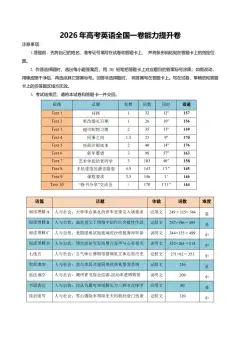
2024 届全国名校区域大联考高三英语试题精选集锦(第四期)
专题 02: 阅读理解 B 篇记叙文为主
编者按:
遴选全国各地近期区域大联考试题,精心编辑,排版整齐。
目 录
1. 浙江省北斗星盟2023-2024学年高三上学期12月阶段性联考
2. 浙江省精诚联盟2023-2024学年高三上学期12月适应性联考
3. 2024届浙江省Z20名校联盟高三上学期第二次大联考
4. 2024届江苏省百校大联考高三上学期第二次考试
5. 江苏省新高考基地学校2023-2024学年高三上学期12月考试
6. 湖北省九师联盟2023-2024学年高三上学期12月考试
7. 湖北省腾云联盟2023-2024学年高三上学期12月考试
8. 湖南省五市十校教研教改共同体2023-2024学年高三上学期12月考试
9. 山东高中名校大联盟2023-2024学年高三上学期12月统一调研考
10. 安徽省“皖江名校联盟”2023-2024学年高三上学期12月考试
11. 安徽省“耀正优+”2023-2024学年高三上学期12月名校联考
12. 皖豫联盟2023-2024学年高三毕业班上学期第二次考试
13. 河北省保定市金科大联考2023-2024学年高三上学期12月考试
14. 广东省江西省等百师联盟2023-2024学年高三上学期一轮复习联考
15. 福建省优质名校联盟2023-2024学年高三上学期12月阶段性检测
1. 浙江省北斗星盟2023-2024学年高三上学期12月阶段性联考
B
Losing an eye might be an unthinkable thing, especially for a young woman, but not for Xintong. She chose to
become an ocularist (义眼师) who makes prosthetic eyes (义眼) for herself and people in the same situation to help
them get back their confidence. Xintong is the name that she gave to herself – which she prefers people to call her
instead of her real name – because “xintong” in Chinese sounds like “new pupils”.
Nearly 10 years after losing her right eye in a car accident, 28-year-old Xintong from Beijing transformed the
hollow of her eye socket – a “flaw” she used to hide – into a fashion statement. She shared a short video online in
which she wears a glowing prosthetic eye. As she waves her hand, the prosthetic eye begins to shine with red light.With another wave, the light changes to green and then purple and white.
The video soon went viral on social media, with many comments praising her for being “creative”, “beautiful”
and “optimistic”. But that wasn’t the case 10 years ago.
“The prosthetic eye I wore at that time was torturing me,” Xintong said. “It hurt and gave me a red and swollen
eye socket, and it looked so dull and fake. I was young and I wanted to look attractive.”
She took matters into her own hands and began researching prosthetic eyes. Beginning in 2019, she dedicated
about two years to mastering the production techniques and skills under the guidance of an ocularist. This journey
led her to establish her own prosthetic eye studio, providing personalized services for those requiring them.
She produces prosthetic eyes as if she is creating pieces of artwork. “The position, direction, and even stroke
thickness of the blood streaks on the prosthetic eyeballs matter,” the ocularist said. Sometimes she also paints special
patterns according to customers’ needs: twinkling stars, cartoon characters like Cardcaptor Sakura and effects like
colored contact lenses.
Now when Xintong hears her customers say words such as “Finally, I can accept myself” or “Now I feel free to
take selfies”, she feels deeply moved.
24. Why did Xintong give the name “Xintong” to herself?
A. To attract more people. B. To forget her real name.
C. To look like new pupils. D. To start a brand new life.
25. Why did the video gain much popularity on social media?
A. The prosthetic eyes had various colors.
B. She cured her hollow by waving her hand.
C. Many comments praised her for her beauty.
D. She changed a “flaw” into a fashionable state.
26. What can we learn about Xintong from paragraph 5?
A. She failed to set up her own prosthetic eye studio.
B. She began researching prosthetic eyes on her own.
C. She was able to offer some specific services on prosthetic eyes.
D. She paid no attention to grasping the production techniques and skills.
27. What can be inferred from the passage?
A. Xintong is a woman with determination and creativity.
B. Becoming an ocularist helped Xintong gain much profit.
C. Xintong lost all her hopes in her life after the car accident.D. Many customers are deeply moved by Xintong’s artworks.
2. 浙江省精诚联盟2023-2024学年高三上学期12月适应性联考
B
At 67, Joyce Faulkner thought she was looking for a holiday. Her husband, Jim, had recently died and exploring
possible house swaps on the Home Exchange website felt less painful. In the end, it was not a vacation Faulkner
found but a job. She left her home in Edinburgh to become mother’s help to seven-year-old twins in Varese, Italy.
“It’s halfway crazy,” she says. A house swap she was interested in didn’t work out, but the owner, Rachele,
asked: “‘Do you know anyone who might help me with the children?’ I wrote back and said: ‘Tell me what that
involves!’ She wrote me a little list, and I said: ‘I could do that!’ We seemed to believe in each other.”
Two months later, when Faulkner reached Varese, “the dad, Andrea, was walking towards me with the children
hiding behind his legs, kind of shy, thinking: ‘Who is this woman in a long black coat?’ I don’t think it was quite
Mary Poppins, but the atmosphere was immediately warm and friendly.”
Eighteen months on, Faulkner’s job no longer feels like a job. “I just feel like part of the family.” They joke:
“You think you’re going back to Scotland? No, you’re staying here!” She gives English lessons, helps with the
housework, meets the children from school, plays chess or table tennis with them, and takes them to the park. “It
never feels like work,” she says. “It has been absolutely the perfect match.” Faulkner’s son, Steven, who lives in
London, has visited her and they have cycled around the northern Italian lakes. She feels no more distant than when
she lived in Edinburgh.
“You have to take the opportunity when it presents itself,” Jim once said.
“I’ll be 70 in January, but in my head, I’m 30. I still feel the same person, I have the same enthusiasm for life,
the same interest in people and things. In that sense, I wish I had another 70,” Faulkner jokes.
24. Why did Joyce Faulkner search the Home Exchange website?
A. To hunt for a job. B. To buy a house in Italy.
C. To explore holiday resorts. D. To find a holiday home for exchange.
25. What probably caused Faulkner to be hired by Rachele?
A. Good luck. B. Mutal trust.
C. Common interests. D. First impression.
26. What can be inferred from paragraphs 3 and 4?
A. Faulkner feels less close to her son
B. Faulkner feels quite at home while babysitting in Italy.C. Faulkner returned to her old business despite her advanced years.
D. Faulkner was thought of as a typical baby-sitter at the first meeting.
27. Which of the following can best describe Joyce Faulkner?
A. Caring and outgoing. B. Strict and responsible.
C. Devoted and passionate. D. Humorous and independent.
3. 2024届浙江省Z20名校联盟高三上学期第二次大联考
B
It was the winter when I taught in a small country school on the west coast of Vancouver Island. I had three
grades of little people in my class, all beaming with the desire to learn all they could. One little boy named David
from my grade one class wanted to learn more than all the others. His round swollen face would smile up at me,
reminding me over and over of his disease—leukemia. More often than not, he would be missing from our classroom
for rounds of treatments.
,
All of us were so pleased then, to have that happy little boy with us for Christmas. We decorated our classroom,
practised for the concert, and prepared Christmas stories to share.
Two days before school let out for the three-week Christmas holiday, I read a story to the class. It was the story
of “The Littlest Angel”. This little angel had an awful time in heaven. He could not adjust to the routine. He was
always in trouble, bumping into other angels, tripping over clouds or dropping his halo. Nothing seemed to make his
time easier until one celestial day an archangel suggested that the little angel take some items with him. Just a few
things to remind him of his good old days, which might be of some help.
As I read the story, a complete silence fell over the class as each child became more involved in the plight of the
angel. Everyone was sympathetic for his misfortune, including David.
The following day during our regular show-and-tell time, holding a small wooden box, David began his sharing,
“This is my first tooth,” he explained. “This is a ribbon from my sister’s hair, and this is my puppy’s collar. My dad
gave me this old key. My mom says this big coin is for good luck.” Even before he told us the purpose of the box, we
all seemed to know. Shiny tears went dot-to-dot down the faces of the other children. The rest of the day witnessed
all of us carefully preparing items to fill David’s wooden box.
When the holidays came to a close, we all returned to our class—all except David. He had got a good chance
and left for a big city to get better treatment, clutching the wooden box that held his hope and memories, and ours.
.
4 What can we learn about David from the first paragraph?
A. His attractive smile impressed his teacher a lot.B. Though seriously ill, he was passionate to learn.
C. His disease prevented him from going to school.
D. Though looking normal,he suffered from a fatal disease.
5. What does the underlined part “the plight” refer to?
A. The past time. B. The promising future.
C. The awful situation. D. The daily routine.
6. Why did David prepare a wooden box?
A. To share his items. B. To help the little angel.
C. To treat his disease. D. To hold the good memories.
7. Which of the following best describes David?
A. Intelligent and diligent. B. Sociable and adventurous.
C. Strong-willed and ambitious. D. Optimistic and courageous.
4. 2024届江苏省百校大联考高三上学期第二次考试
B
It’s 1:30 am in Kenya’s populated north, and 50 people are lying on their backs on the shore of a dried-up river,
staring up at the night sky. These stargazers have travelled 250 miles to Samburu to witness the Perseid meteor
shower(英仙座流星雨). They are not disappointed: Every few minutes, arrows of light shoot across the sky like
silent fireworks.
The Star Safari is organised by a Kenyan astronomer, Susan Murabana, who has brought a 50 kg,170 cm-long
telescope to allow the group to view Mars and deep-sky objects. But here in Samburu, where light pollution is
minimal, the Perseid meteors—visible with the naked eye (裸眼)—steal the show.
Every two months, Murabana and her husband load their telescope on to the roof of their 4×4 and set off to rural
communities, where they give up to 300 children a chance to view the planets and learn about constellations (星座)
and the basics of astrophysics. They primarily targets schools in remote areas because of her mission to give girls an
opportunity that she wishes had been available to her.
“When I started this work, I didn’t see people who looked like me. I was a lone ranger and I wanted to change
that.” says Murabana.
“There is a common misconception in Kenya that astronomy in general is hard, boring, and only for boys,” she
adds. “I’d like to teach young girls that astronomy is neither of these things and that they, too, can become astronomers,”
says Murabana.Murabana’s passion for astronomy began in her early 20s when her uncle invited her to join a similar outreach
session organized by the Cosmos Education. “That was a gamechanger. If an outreach group had come to me when I
was a young teenager, my attitude towards a career in astronomy would have been positive. I ended up studying
sociology and economics, but maybe I would have desired to be an astronomer,” she says.
Inspired by the Cosmos Education, Murabana completed an online master’s degree in astronomy with the James
Cook University in 201l and set up her own outreach programme. She looked to Dr Mae Jemison, the first black
woman in space, as a role model. “I hope that one day, through this work, I will spark a chain reaction that leads to
the first African woman in space.”
24. What do the underlined words “steal the show” in paragraph 2 mean?
A. Ruin the effort. B. Face the challenge.
C. Attract more attention. D. Keep the promise.
25. Why does Murabana target girl students in remote areas?
A. To help them out of poverty. B. To inspire their love of astronomy.
C. To look for assistants for her work. D. To give them an edge over boys in studies.
26. What can we learn about Murabana from paragraph 6?
A. She enjoyed playing games.
B. She longed to be an astronomer.
C. She is an initiator of Cosmos Education.
D. She regretted not taking astronomy earlier.
27. What’s the passage mainly about?
A. The birth of a Kenyan woman astronomer.
B. The prejudice against girls in rural Kenyan.
C. The Kenyan astronomer bringing astronomy to the people.
D. The Kenyan stargazers watching the Perseid meteors shower.
5. 江苏省新高考基地学校2023-2024学年高三上学期12月考试
B
In 1997, the Hungarian biochemist Katalin Kariko met another struggling researcher, the American immunologist
Drew Weissman, as they queued to photocopy scientific papers at the University of Pennsylvania (UPenn). The two
scientists found they followed the same research direction and decided to cooperate. Now, their partnership achieved
the peak of scientific recognition. They jointly won the Nobel Prize in Medicine. But while both scientists enduredyears of professional struggle on the way to the huge success, Kariko had to overcome greater setbacks than Weissman.
For decades she never found a permanent position.
Having grown up in a village in a house without running water or a refrigerator, Kariko got a biochemistry
doctorate in Szeged before she and her husband sold their car, sewed some cash into their toddler daughter’s teddy
bear and went to the U. S. on a one-way ticket. The daughter became a U. S. national rower and Olympic gold
winner.
Kariko worked in a few different research jobs before landing a junior position at the UPenn. And for many
years her career at the UPenn was fragile. She migrated from lab to lab, relying on one senior scientist after another
to take her in. She never made more than $60, 000 a year. She struggled to raise the grant funding essential for a
scientific career. Kariko said she endured ridicule (奚落) from university colleagues for her pursuit. In 2013, Kariko
“was kicked out from UPenn— forced to retire”. The university told her that her work was not of faculty quality, she
said in an interview. Yet the scientist’s commitment to her work didn’t change at all. “When I was fired, I didn’t
feel sorry for myself, ”she said. “I have to focus all the energy on seeking out what’s next. ”
In a news conference held at UPenn, she encouraged young scientists to love learning to solve problems and to
be prepared for failure. “You have to learn how to handle the failure, because most of the time, we don’t understand-we
make an experiment and the outcome is not what we want, ” Kariko said. Researchers in Kariko’s field are full of
admiration for her generosity and persistence. “She is really the symbol of perseverance and what it takes to be a
great researcher, ”Elliot Barnathan, a cardiologist who hired Kariko, said.
24. What was a major contributor to the cooperation of Kariko and Weissman?
A. An accidental encounter. B. Shared scientific interest.
C. Pursuit of the Nobel Prize. D. Demand for photocopying.
25. What can be inferred from the underlined sentence in paragraph 3?
A. The research at the Upenn was rewarding. B. She was fired because of her casual attitude.
C. The career made her psychologically weak. D. She didn’t get the recognition she deserved.
26. How did Kariko react to her dismissal from UPenn?
A. She criticized her lab colleagues. B. She switched her career goal.
C. She stuck to her original belief. D. She abandoned her research work.
27. What’s the author’s purpose of writing this text?
A. To inform readers of Kariko’s latest research.
B. To reveal the fierce competition in universities.
C. To applaud the cooperation between scientists.D. To highlight a scientist’s extraordinary quality.
6. 湖北省九师联盟2023-2024学年高三上学期12月考试
B
Miss England, Jessica Gagen, is not the ordinary beauty pageant (选美) winner. She just earned an impressive
title, rocket scientist.
The 27-year-old girl just graduated from the University of Liverpool with a degree in Aerospace Engineering
and she has set her sights on being an astronaut. But winning her title just a few months before completing her degree
was no easy task. She is the first rocket scientist to be crowned Miss England.
Gagen was able to balance between her competition and her schoolwork, but the stress of doing both left her
with chest pains and insomnia (失眠). However, she didn’t give up.
“The way to get to this point was a rocky five years in the making, and I faced challenges before I’d even begun,”
Gagen told The Daily Mail. “I think it’s important that today’s youth know that sometimes things don’t go entirely
as planned, and that’s perfectly OK.”
Before starting at the university, Gagen studied a year in physics while working at weekends because she didn’t
have all the courses she needed for the program. She began studying at the university in 2019 and when the pandemic
hit, all the coursework went online. She did this while working full time at night.
“I’d return home to do that day’s online lectures and homework and then stop at 8 pm to get ready for bed, before
the cycle would repeat. I was constantly knackered, but I was a mature student and had bills to pay.”
During the course of her studies, Gagen saw that there were very few females in engineering and decided to
make it her duty to promote careers in science for women and girls on her social media. This idea led to her being
scouted (物色) for the Miss England contest. In 2022 Gagen was accepted into a Master’s program and she entered
the Miss England pageant and won.
4. What did Gagen desire to do upon graduation?
A. Work as an engineer. B. Become a spacewoman.
C. Continue rocket research. D. Win a beauty contest.
5. What does Gagen want to convey in paragraph 4?
A. Plans do not change based on human will.
B. Today’s youth should perform perfectly.
C. Feeling a bit uncomfortable seems normal.
D. The youth should face the challenges bravely.6. Why did Gagen work at night?
A. To support females. B. To enter the contest.
C. To earn a living. D. To promote free careers.
7. What does the underlined word “knackered” in paragraph 6 probably mean?
A. Worn-out. B. Confused. C. Simple-minded. D. Embarrassed.
7. 湖北省腾云联盟2023-2024学年高三上学期12月考试
B
My chairs are almost a part of the family. They were first purchased in Calcutta in the year 1975 when my father
shifted into his flat in the city. Over the next 25 years the chairs had been to five cities. In 2002, when I set up my
first house in Chennai my folks transported the chairs there. The chairs have since made the journey between Chennai
and Mumbai twice over and currently sit on the 17th floor in Andheri. Before I go any further, I must tell you
something about this special set of furniture.
In the summer of 2005, things weren’t looking very good for me. A broken relationship, a dilemma at work, a
growing dependence on alcohol and tobacco all made me upset. I was almost at breaking point when my mother
decided to pay me a visit, for like only mothers can sense, she figured out from a 1000 miles away that everything
wasn’t as rosy as I was making it out to be over the telephone. On the first evening of her visit she tried to get me
talking about where I was at in life, what was working and what wasn’t. I resisted and tried every trick in the book to
cover up. I thought I had succeeded.
When I got back from work the next evening, my small hall room looked like a painter’s workshop. My mother
was repainting every single one of my chairs herself. Somehow, over the hours spent painting what she was actually
doing was standing witness to the situation I was in. She was screaming ‘I UNDERSTAND’ without saying a word.
Over the next 4 days she painstakingly pursued perfection in an art she had never practiced up to that point in her
life. Eventually, the chairs looked brand new.
As I sink into one of the chairs, I can still feel the comforting embrace of my mother’s company from those days
she spent with me. All too often we forget that the two unconditional votes you get in life are always those of your
parents.
4. What can be inferred from Paragraph 1?
A. The chairs were purchased by the author in Calcutta.
B. The author lives in Andheri now.
C. The chairs were moved between Chennai and Mumbai more than twice.D. In 2002 the author left Mumbai for Chennai.
5. What made the author’s mother pay a visit?
A. The natural ability that a mother is born with.
B. Her son’s addiction to alcohol and tobacco.
C. The author talked about his life on the phone.
D. Her life wasn’t rosy as expected.
6. What happened on the first evening of mother’s visit?
A. They had a successful conversation.
B. The author was unwilling to admit his situation.
C. The author searched tricks from books.
D. His mother tried to figure out where he was working.
7. What is probably the reason for mother’s painting the chairs?
A. The chairs were too old. B. She tried to release her anger.
C. She was a real artist. D. She wanted to comfort him.
8. 湖南省五市十校教研教改共同体2023-2024学年高三上学期12月考试
B
Out in the woods stood a nice little Fir Tree. It was the sun shining on him and the fresh air surrounding him that
made him gorgeous. In summer, children often came and sat down near him and said, “What a nice little fir!” In
winter, when the snow lay glittering on the ground, a hare hopped over the little tree. But he never felt any pleasure.
What the little Fir wanted so much was to grow into a big tree as his neighbors.
“Oh! Were I but such a high tree as the others are,” thought he. “Then I should be able to spread out my branches,
and with the tops to look into the wide world!”
When Christmas came, quite young trees with the finest looking were cut down. And so was the Fir Tree. He
found himself, in the middle of the living-room, stuck upright in a bucket that was filled with sand and decorated
with the most splendid things-apples, colorful lights and at the very top a large golden star, which made him
incomparably beautiful.
“What a splendor!” thought the Fir Tree, believing he would take root here and forever stand covered with
decorations!
However, the splendor never came back again. After the Christmas, the servant dragged him out of the room,
and up the stairs into the loft in a dark corner, where no daylight could enter.“If it only were not so dark here, and so terribly lonely. Not even a hare!” he sighed. “They surely stored me
here for the next Christmas.”
One day, the tree was pulled out and a man drew him towards the stairs, where the daylight shone. Feeling the
fresh air and the first sunbeam, now he was out in the courtyard. Seeing all the beauty of the flowers and the freshness
in the garden, he firmly believed he would be replanted there.
“Now a merry life will begin again,” thought the tree, spreading out his branches only to find they were all
withered and yellow!When seeing the gardener getting close with an axe (斧头), he recalled his first youth in the
wood and sighed so deeply! Each sigh was like a shot.
24. What can we know about the Fir Tree?
A. He was willing to be a small tree.
B. He was satisfied to be a Christmas tree.
C. He was mad at the hare jumping over him.
D. He was eager to be the tallest tree in the woods.
25. Which word can best describe the Fir’s feeling when pulled out into the courtyard?
A. Hopeful. B. Lonely. C. Free. D. Anxious.
26. What can be inferred about the Fir’s fate?
A. He would be treated as firewood.
B. He would be replanted in the garden.
C. He would be taken back to the forest.
D. He would be stored for the next Christmas.
27. What can we conclude from this story?
A. If you’re failing to plan, then you’re planning to fail.
B. Live for today because tomorrow is not promised.
C. Life is not about falling down but getting back up.
D. If you dream and believe it, then you can achieve it.
9. 山东高中名校大联盟2023-2024学年高三上学期12月统一调研考
B
Dr. Tijana Blanusa, the principal scientist of the Royal Horticultural Society (RHS), has a passion for both
science and the well-being of children. When she stood at the gate of her children’s school, an idea flashed her mind:
What if there are more hedges (树篱) in playgrounds? Therefore, she decided to start a project to find out the bestspecies of hedge to plant in urban areas.
Dr. Blanusa’s inspiration for this research came from a personal realization. As a parent herself, she noticed that
her own children had very limited access to nature in their urban state primary school. “We’ve looked at hedges
because they’re cheap, people can relate to them, and they can do some good things for relatively little money in the
urban environment in terms of improving air quality, and maybe reducing noise.”
About 90 pupils of 10 years old will be involved in the experiment. A mix of hedges were planted bordering the
roadside in the school playground at Hoe Valley school, Working. Then a weather station was set up where the pupils
can take measurements of the leaf surface’s ability to influence soil moisture (水分) and the temperatures around the
hedge. Then they will take more measurements as time goes on.
The children will be involved in learning more about the role of plants in improving air quality and summertime
cooling through hands-on science classes in school, led by the science team. They will get an insight into what
working as a scientist involves—planning and taking measurements on the hedge and from the soil, and then analyzing
collected data. Results will be available in late spring.
Blanusa hopes that the project can be rolled out across the country, and the RHS is figuring out how to do that.
“We really want to make it as easy as practically possible for other schools to do it. But because you are working
with living things, they need looking after and that needs to be a person on site who knows how to do it.”
4. What is the main aim of the project?
A. To reduce urban noise levels. B. To increase hedges in schoolyards.
C. To identify best hedge species for cities. D. To boost green spaces in public schools.
5. What motivated Blanusa to conduct her research?
A. Air Pollution out of school. B. Kids’ lack of nature access.
C. School principal’s request. D. Hedge education for kids.
6. What do the students gain from participating in this project?
A. Experience on science team. B. Hedge planting without soil.
C. Country-wide project rollout. D. Hands-on work as a scientist.
7. What’s a major obstacle for Blanusa in expanding the project?
A. Extra labor cost. B. A tight budget. C. Strict regulations. D. Limited hedge species.
10. 安徽省“皖江名校联盟”2023-2024学年高三上学期12月考试
B
As one of the city’s most popular free outdoor events, the Cape Town Carnival is a multicultural celebrationwhich focuses on social inclusion and bridging the divide between the diverse communities of the Western Cape and
specifically Cape Town. It’s a celebration of the many diverse cultures which makes Cape Town stand out from the
most world-famous cities. The carnival is considered a community participation event by the Western Cape
Government and draws bigger crowds each year.
The event serves a platform for local performance groups, designers, musicians and artists to showcase their
talents to the world. Every year, it may create over 1, 000 part-time jobs. The long-term vision, however, is to create
more programmes focusing on skills development, thus permanently employing people. Since 2010 when the carnival
was held on Long Street, it has become the festival of the year, and has grown from 17, 000 spectators to as many as
55, 000. This year, the carnival will be held on the Fan Walk in Green Point.
And its theme is Mother City, Mother Nature, exploring two of Cape Town’s greatest assets, its natural beauty
and its people. The festival will showcase what makes the Mother City one of the most unique cities in the world.
Over 2, 000 shining costumed performers and musicians will take to Cape Town’s Fan Walk, entertaining viewers
with floats (花车) and dynamic dance routines. The parade (游行) will be followed by a grand street party, showcasing
some of South Africa’s hottest musical talent.
Fans and tourists are encouraged to join in the street festivities anytime from 16: 00, when it will turn into a
pedestrian walkway with 2km of food stands and festive hospitality (好客) areas. Later in the evening Cape Town
will up the pace with the most appealing and festive open air party, the Cape Town Carnival Street Party! This Culture
Comer: A Glimpse of Cape Town, was contributed by Marilyn Steward. I’m Rich Claymount. Stay tuned and see you
next time.
24. What sets the Cape Town Carnival apart?
A. Its friendly people. B. Its unique landscape.
C. Its wide participation. D. Its cultural diversity.
25. What is the carnival’s goal in the long run?
A. To build up a platform for local talents. B. To create Africa-based businesses globally.
C. To expand programs to secure employment. D. To deepen cultural links between countries.
26. What can we conclude from the text?
A. Green Point is famous for floats and music. B. Cape Town is proud of its nature and people.
C. The carnival happens on Long Street annually. D. The street party is mostly favored by the tourists.
27. Where is the text probably taken from?
A. An interview. B. A brochure. C. A reality show. D. A radio program.11. 安徽省“耀正优+”2023-2024学年高三上学期12月名校联考
B
As an engineer, I have designed electronic control systems for more than 30 years, and I expected to do so until I
retired. My wife, Krisztina Valter, is a scientist. One day, she went to a scientific activity with me. Most knowledge
of biology went over my head, but one speaker attracted my attention. Jochen Zeil, a professor who studies animal
behavior, presented a model of how insects could work out a way to go to a target despite having small brains.
At lunch time, my wife introduced us. Zeil and I had a very enjoyable discussion about his idea and biology.
Before we parted, I joked that if he wanted another PhD student, he could count me in. About a month later he emailed
me, “Haven’t heard from you. Have you enrolled (注册) yet?” And that’s how, at the age of 53, I became a part-time
doctorial student in biology.
My background in biology had been out of date for many years, so I needed to learn the basics fast. It was not
easy, but I got a lot of help from other laboratory members and my wife. The more I learnt, the more I realized how
little I knew. Every paper caused the need to read more. It was tiring, and at times disappointing, but brought a lot of
fun. You read, think, and suddenly things fall into place.
But there is something I have to get used to. If you repeat an engineering experiement, you expect to get the
same result. This is not so in behavior biology. Your experiment subjects actually have a mind of their own—You can
put an ant on a trackball, but you can’t make it walk on the ball.
Now at the age of 61, this period is nearly at an end. New knowledge enriches you, regardless of how old you
are. My advice is that if you have the opportunity to enter a new field, take it.
4. What did the author think of most of the knowledge about biology presented at the activity?
A. He couldn’t think too highly of it.
B. He couldn’t make sense of it.
C. He considered it quite easy.
D. He felt it was so practical.
5. How did the author become a doctorial student in biology according to paragraph 2?
A. He expected to realize his dream in his heart for long.
B. He said something amusing and Zeil took it seriously.
C. He was always urged by his wife to learn biology.
D. He tried hard to persuade Zeil to take him in.
6. What is the theme of third paragraph?
A. The author’s good relationship with other laboratory members.B. The author’s difficulty in learning and his discouragement.
C. The author’s learning experiences and his reflection.
D. The author’s purpose of learning the subject.
7. What can we infer from the author’s words in the last two paragraphs?
A. Experimenting with insects may get a different result.
B. Old people ought to work hard to get a college degree.
C. The author prefers behavior bi ology to engineering now.
D. Doing engineering experiments is easier than doing bi ology ones.
12. 皖豫联盟2023-2024学年高三毕业班上学期第二次考试
B
The local government of Zibo, East China’s Shandong Province, has issued two open letters in a short time to
all citizens, extending its gratitude for their warmth and hospitality toward visitors who have come to enjoy the city’s
signature barbecue, which has recently become a hit across the country. Such an unexpected success has shown the
city’s spirit of unity and tenacity (坚毅), further boosting its tourism and economic development.
For a long time, Zibo was an average city in almost all aspects on the Chinese scale. However, since early March,
Zibo local barbecue has caused a sensation (轰动) online. The little double-layer stove, small pancakes, green onions
and sauce became icons among netizen. “Taking the high-speed train to taste barbecue in Zibo” miraculously became a
trending hashtag (话题标签) for this non-traditional tourist city.
But how did Zibo rise to fame? This has not been some random coincidence.
First, it comes down to the city government’s ambition, determination and creativity. From July 2022 to February
2023, Zibo organized many trips to the city for university students. Despite reaching peak visitation numbers, there
was no sense of panic. Instead, several supportive policies were promptly introduced, such as establishing a “Golden
Stove Award”, forming a barbecue association, creating a map of Zibo barbecue restaurants, and launching 21
dedicated tourist routes that go beyond just barbecue. It also organized volunteers to guide tourists and appointed
personnel to ensure public safety.
Second, Zibo’s sudden boom in popularity also resulted from the post-pandemic tourism revival China has
experienced. The city aims to recover its tourism industry and ensure sustainable growth. To achieve this goal, it has
created a welcoming environment with convenient services for young people, particularly university students. For
instance, non-local students can enjoy three free stays per year at youth inns, each lasting two nights. The city has
also invited students from distinguished universities to visit Zibo for free, signaling its eagerness to attract talentedyoung individuals.
24. What is the purpose of the two open letters?
A. To express the city’s gratitude to its citizens.
B. To introduce the city’s impressive sights to tourists.
C. To specially promote the city’s signature barbecue.
D. To boost the city’s tourism and economic development.
25. What mainly contributes to Zibo’s rise to fame?
A. The city’s perfect location on the Chinese scale.
B. The city’s reputation as a traditional tourist city.
C. The government’s ambition, determination and creativity.
D. People’s desire for a taste of barbecue after the pandemic.
26. Why does the city invite students from famous universities to Zibo?
A. To offer part-time jobs for those students.
B. To encourage young people to be volunteers.
C. To provide students with chances to get practical knowledge.
D. To attract talented young people to work there after graduation.
27. What is the author’s attitude towards this sensation?
A. Unconcerned.
B. Supportive.
C. Doubtful.
D. Opposed.
13. 河北省保定市金科大联考2023-2024学年高三上学期12月考试
B
Last month, a group of university student volunteers from Wuhan, Hubei province, arrived at the home of a
couple who have been married for more than 60 years.
The group was taking part in a programme launched in 2015 aimed at helping elderly couples fulfill their dreams
of having special wedding photos taken. Zhang, 20, a freshman at Wuhan University of Engineering Science, is
among the students taking part in the institution’s volunteer project, Dream Fulfillment Plan.
The project’s founder, Yu Jinwen, 35, a teacher at Wuhan University of Engineering Science, said that as of last
month, the volunteers had taken wedding photos for more than 1,000 couples. They also interviewed their subjects
and recorded their love stories.The project was inspired by Yu’s regret at not having a good photo of his grandfather, who died in 2010. The
family searched hard but was unable to find a quality shot. In desperation, Yu had to use the photo on his grandfather’s
ID card as a portrait. In 2014, Yu led students applying to launch a volunteer service project, and came up with the
idea of taking good photographs for the elderly free of charge.
“When these couples were young, there was no opportunity to take wedding photos. We can help them by taking
special shots to bring back good memories of their younger days,” Yu said. Initially, he found it difficult to acquire
wedding dresses and photographic equipment. However, one of his former classmates, who owned a wedding
photography company in Wuhan, donated more than 70 secondhand wedding dresses to the project. Yu formed the
first team, which consisted of 15 volunteers.
The project, which has grown over the years, now comprises 13 groups with a total of 590 volunteers. They
have worked in 356 communities and rural areas across 43 cities in 13 provinces nationwide, gaining recognition and
appreciation for their work. In 2021, the project won the silver prize at the sixth Chinese Youth Volunteer Service
Project Competition.
4. What is the purpose of Dream Fulfillment Plan?
A. To offer opportunities to students to find jobs.
B. To help elderly couples realize their wedding photo dream.
C. To make Wuhan University of Engineering Science known.
D. To encourage more university students to do voluntary work.
5. What motivated Yu Jinwen to launch the project?
A. His wish in childhood. B. His passion for photography.
C. Lack of good photos for his late grandfather. D. The encouragement of his teachers.
6. What does the last paragraph mainly focus on?
A. The members of the project. B. The achievements of the project.
C. The promising future of the project. D. The support given by the public.
7. What is the main idea of the text?
A. Student volunteers help elderly couples turn the clock back.
B. Wuhan University of Engineering Science launched a project.
C. Taking good wedding photos for elderly people is no easy task.
D. Wedding photos for elderly people become more and more popular.
14. 广东省江西省等百师联盟2023-2024学年高三上学期一轮复习联考B
We just got back from a weeklong trip through New Mexico where we traveled through desert landscapes, hiked
up mountains, and walked through dry creek beds. We experienced nature and wildlife that was vastly distinct from
what I’ve seen before.
We’ve lived in Atlanta for 25 years so it was quite a change from our “city in a forest”. My husband and I were
joined by our adult so n who now lives in San Diego and is a little more familiar with the west. We like to visit
national parks and explore interesting ecosystems.
In New Mexico, everything seemed striking and amazing. Starting in Albuquerque, we took a tram up the Sandia
Peak in the Sandia Mountains, where we had fantastic views as we watched parasailers float off into the unending
sky. We then drove to Abiquiu, the town where artist Georgia O’Keeffe was so inspired. We stayed at a lovely home
pretty much in the middle of nowhere. First, we noticed the breathtaking setting. Then we noticed the ants: billions of
tiny ants were marching all over the outside of the property. They were carrying off a few of the native bees that had
fallen to the ground near the house.
Once we were awakened in the middle of the night by howling (嚎叫) that was both strange and musical. We
were told about the coyotes (郊狼) that share the area, so we weren’t surprised when we woke up the next morning
to some pretty impressive pawprints right outside the back door. On our final morning hike before heading south in
the state, we even spotted a large snake curled up on the path, enjoying the warm morning sun. We stayed far out of
its way but certainly watched our steps a little more carefully.
We talked about sustainability throughout the trip. In the past several decades, there’s been so much noticeable
change in our travel adventures. That will be great to keep the skies cleaner and save energy. And the coyotes and
snakes can be left to dance and enjoy in peace.
4. What was the family’s first impression of the trip to New Mexico?
A. It was familiar to them in many aspects.
B. It was dangerous but totally fresh for them.
C. It was simple and plain with little to explore.
D. It was quite different from their previous experiences.
5. Which of the following best describes the author’s experience in New Mexico?
A. Romantic. B. Eventful. C. Conventional. D. Regretful.
6. What message does the author want to convey in the last paragraph?
A. It’s beneficial for us to take an adventure tour.
B. It’s threatening to live with wildlife around.C. It’s necessary to boost sustainable tourism.
D. It’s difficult to keep the balance of ecosystem.
7. Where is the text most probably taken from?
A. A reflection in a travel journal. B. An essay about the plans for traveling.
C. A guidebook to a new destination. D. An introduction of a new type of traveling.
15. 福建省优质名校联盟2023-2024学年高三上学期12月阶段性检测
B
Have you ever received an unwanted gift and still said “thank you”? This choice to hide a negative emotion is a
display rule-one of many which define socially appropriate responses to emotions. Although display rules can promote
interpersonal harmony, they can also have negative consequences for the person choosing to change how they express
emotions. As more social interaction goes online, scientists are investigating how emojis are used to reflect our
emotions in different contexts. Are there display rules that apply to emojis, and how do those affect people’s well-
being?
Moyu Liu of the University of Tokyo investigated this question in a study published in Frontiers in
Psychology. For his study, Liu found 1,289 participants, all users of the most-downloaded emoji keyboard in Japan,
Simeji, to investigate how emojis were used to express or mask emotions.
The participants an Liu’s study provided personal information, answered questions about their subjective well-
being, and rated how often they used emojis. They were given messages with varying social contexts, responded to
them as they would normally, and rated the intensity of the expression of their emotions.
Liu found that people chose to express more emotions with emojis in private contexts or with close friends.
Respondents expressed least emotion towards individuals who hold a higher social position. Intense expressions of
emotion came with matching emojis, unless people felt the need to mask their true emotions: for instance, using
smiling emojis to mask negative emotions. Negative emojis were used only where negative feelings were very
strongly felt. Expressing emotions with emojis was associated with higher subjective well-being compared to masking
emotions.
Liu emphasized that the study should be expanded in the future. The Simeji keyboard is extremely popular
among young women, which caused an imbalance in the sample towards women and Generation Z. However, this
also reflected the gender imbalance in use of emojis in general and the Simejikey board in particular. A broader pool
of participants would provide a fuller picture of the display rules around emojis.
4. Why do people follow display rules?A. To avoid moral stress. B. To express their real emotions.
C. To maintain positive relationships. D. To shake off their negative thoughts.
5. What may participants most likely do during online interactions with their leaders?
A. Avoid using any kind of emojis. B. Mask their happy emotions with emojis.
C. Use smiling emojis as much as possible. D. Send negative emojis to show negative feelings.
6. Which aspect of the study needs expansion according to Liu?
A. Its research intention. B. Its investigation methods.
C. Its participant database. D. Its potential applications.
7. What is the main idea of the text?
A. Young women are the most active emoji users.
B. Using emojis properly matters in different contexts.
C. Emojis lead people to lose touch with their true emotions.
D. People use emojis to hide, as well as show, their feelings.