2026 年高考一轮复习验收卷(浙江卷01)
 英语·全解全析
注意事项:
1. 答题前,考生先将自己的姓名、准考证号码填写清楚,将条形码准确粘贴在条形码区域内。
2. 选择题必须使用2B 铅笔填涂;非选择题必须使用0. 5 毫米黑色字迹的签字笔书写,字体工整,笔记清楚。
3. 请按照题号顺序在答题卡各题目的答题区域内作答,超出答题区域书写的答案无效;在草稿纸、试卷上
答题无效。
4. 作图可先使用铅笔画出,确定后必须用黑色字迹的签字笔描黑。
5. 保持卡面清洁,不要折叠、不要弄破、弄皱,不准使用涂改液、修正带、刮纸刀。
第一部分  听力(共两节,满分30 分)
做题时,先将答案标在试卷上。录音内容结束后,你将有两分钟的时间将试卷上的答案转涂到答题卡上。
第一节(共5 小题;每小题1. 5 分,满分7. 5 分)
听下面5 段对话。每段对话后有一个小题,从题中所给的 A、B、C 三个选项中选出最佳选项。听完每段
对话后,你都有10 秒钟的时间来回答有关小题和阅读下一小题。每段对话仅读一遍。
例: How much is the shirt?
A. £19. 15.         B. £9. 18.         C. £9. 15.
答案是C.
1.When does Dave’s meeting start?
A.At 8:30.
B.At 9:00.
C.At 10:00.
2.Where will the woman probably work?
A.In the bakery.
B.In the school.
C.In the candy store.
3.What can we know about the man?
A.His mom bought him a car.
B.His mom gave him the new car.
C.His mom will give him the old car.
4.What will happen in the city center?
A.There will be more parking areas.
B.There will be more cycle tracks.
C.There will be more pollution.
5.What does the man decide to buy?
A.Shorts.
B.Trousers.
C.T-shirts.
第二节(共15 小题;每小题1. 5 分,满分22. 5 分)
听下面5 段对话或独白。每段对话或独白后有几个小题,从题中所给的 A、B、C 三个选项中选出最佳选
项。听每段对话或独白前,你将有时间阅读各个小题,每小题5 秒钟;听完后,各小题将给出5 秒钟的作答
时间。每段对话或独白读两遍。
听第6 段材料,回答第6 和7 题。
6.What’s the advantage of joining a sports club?
A.Making friends.
B.Learning Yoga quickly.
C.Buying expensive clothes.
7.What are the speakers talking about?
A.Friendship.
B.Exercise.
C.Clothes.
听第7 段材料,回答第8 和9 题。
8.What is the relationship between the speakers?
A.Teacher and student.
B.Mother and son.
C.Neighbors.
9.How will Josh help Tracy?
A.By attending to the garden.
B.By cleaning her house.
C.By getting her mail.
听第8 段材料,回答第10 至12 题。
10.Who is Bryan?
A.A student.
B.A director.
C.An actor.
11.What do we know about the play?
A.It is not that good.
B.All students will watch it.
C.It will be put on in the morning.
12.How does Bryan feel at the end of the conversation?
A.Excited.
B.Confused.
C.Frightened.
听第9 段材料,回答第13 至16 题。
13.What did the man lose?
A.His passport.
B.His credit card.
C.His driving license.
14.Why did the woman check the man in?
A.He had enough money.
B.The police called to confirm the theft.
C.He provided two forms of identification.
15.What will the man probably do in his room?
A.Look for his passport.
B.Put away his credit card.
C.Report the theft to the bank.
16.Where does the conversation probably take place?
A.In a hotel.
B.In a bank.
C.At the airport.
听第10 段材料,回答第17 至20 题。
17.What is Greg doing now?
A.Visiting a museum.
B.Talking to Chester Carlson.
C.Introducing an invention and its inventor.
18.Why is the machine the most successful product?
A.Its technology is widely used even today.
B.Its technology inspires many other inventors.
C.Its technology has helped earn a lot of money.
19.What happened to Chester Carlson?
A.His mother was sick.
B.His family lacked money.
C.His father died.
20.What will Greg talk about next?
A.The magazine Fortune.
B.The development of science.
C.The xerography’s working principles.
第二部分 阅读(共两节,满分 50 分)
第一节 (共 15 小题;每小题 2.5 分,满分 37.5 分) 阅读下列短文,从每题所给的 A、B、C、D 四
个选项中选出最佳选项。
A
The Future of Clean Energy in Homes
Heating, cooling, and powering homes contribute significantly to global CO₂ emissions. As nations strive to
reduce their carbon footprints, residential energy use — responsible for nearly 20% of energy-related emissions —
poses unique challenges. Below is the 2022 breakdown of household emissions by source.
ELECTRICITY  52%
HEATING  28%
COOLING  12%
APPLIANCES  6%
LIGHTING  2%
Clean energy solutions for homes must be affordable, efficient, and adaptable to diverse climates. While
technologies vary, here are key innovations driving the shift toward sustainability.
HEAT PUMPS — Efficient Heating/Cooling
Replacing gas boilers, electric heat pumps transfer warmth from air or ground, cutting heating emissions by 50%.
Hybrid models, hopefully, might be able to work in sub-zero temperatures in the near future.
SMART GRIDS (电网) — Dynamic Electricity Management
AI-powered grids optimize energy use, storing surplus solar power during peak hours and reducing reliance on
fossil-fuel backups.
SOLAR PANELS — Rooftop Revolution
Solar energy is the most accessible renewable source for households. Advances in photovoltaic cells have cut costs
by 80% since 2010, making them viable in numerous regions.
WIND TURBINES — Community Microgrids
Small-scale turbines (涡轮机) in windy areas can power neighborhoods, though land use debates persist.
“The scale of this transition is staggering,” says Dr. Elena Torres, a climate scientist at MIT. Residential renewables
like solar and heat pumps could meet 90% of global household demand by 2050 — but only if investments triple
within this decade. Recent studies show that every $1 invested in green homes today saves $5 in future climate
adaptation costs. This isn’t just an environmental imperative; it’s economically inevitable.
21.Which two categories combined account for over three-quarters of total household emissions?
A.Electricity and Heating.
B.Heating and Cooling.
C.Appliances and Lighting.
D.Cooling and Appliances.
22.Which technology is highlighted as cost-effective for diverse climates?
A.Heat pumps.
B.Smart grids.
C.Solar panels.
D.Wind turbines.
23.What does Dr. Torres emphasize about the energy transition?
A.The dominance of gas boilers.
B.The increase in solar efficiency.
C.The need for higher investment.
D.The breakthrough in heat pump technology.
B
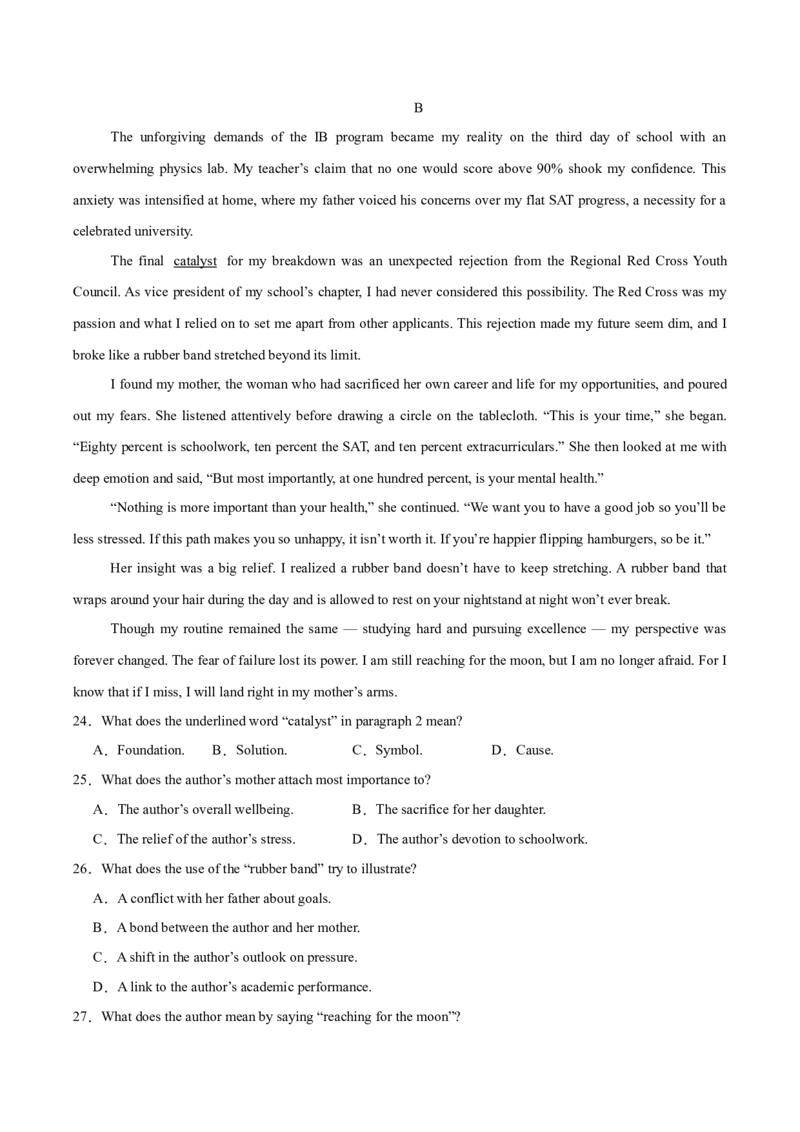
The unforgiving demands of the IB program became my reality on the third day of school with an
overwhelming physics lab. My teacher’s claim that no one would score above 90% shook my confidence. This
anxiety was intensified at home, where my father voiced his concerns over my flat SAT progress, a necessity for a
celebrated university.
The final catalyst for my breakdown was an unexpected rejection from the Regional Red Cross Youth
Council. As vice president of my school’s chapter, I had never considered this possibility. The Red Cross was my
passion and what I relied on to set me apart from other applicants. This rejection made my future seem dim, and I
broke like a rubber band stretched beyond its limit.
I found my mother, the woman who had sacrificed her own career and life for my opportunities, and poured
out my fears. She listened attentively before drawing a circle on the tablecloth. “This is your time,” she began.
“Eighty percent is schoolwork, ten percent the SAT, and ten percent extracurriculars.” She then looked at me with
deep emotion and said, “But most importantly, at one hundred percent, is your mental health.”
“Nothing is more important than your health,” she continued. “We want you to have a good job so you’ll be
less stressed. If this path makes you so unhappy, it isn’t worth it. If you’re happier flipping hamburgers, so be it.”
Her insight was a big relief. I realized a rubber band doesn’t have to keep stretching. A rubber band that
wraps around your hair during the day and is allowed to rest on your nightstand at night won’t ever break.
Though my routine remained the same — studying hard and pursuing excellence — my perspective was
forever changed. The fear of failure lost its power. I am still reaching for the moon, but I am no longer afraid. For I
know that if I miss, I will land right in my mother’s arms.
24.What does the underlined word “catalyst” in paragraph 2 mean?
A.Foundation.
B.Solution.
C.Symbol.
D.Cause.
25.What does the author’s mother attach most importance to?
A.The author’s overall wellbeing.
B.The sacrifice for her daughter.
C.The relief of the author’s stress.
D.The author’s devotion to schoolwork.
26.What does the use of the “rubber band” try to illustrate?
A.A conflict with her father about goals.
B.A bond between the author and her mother.
C.A shift in the author’s outlook on pressure.
D.A link to the author’s academic performance.
27.What does the author mean by saying “reaching for the moon”?
A.She will be unbeatable.
B.She will continue to aim high.
C.She has achieved all her goals.
D.She has a passion for astronomy.
C
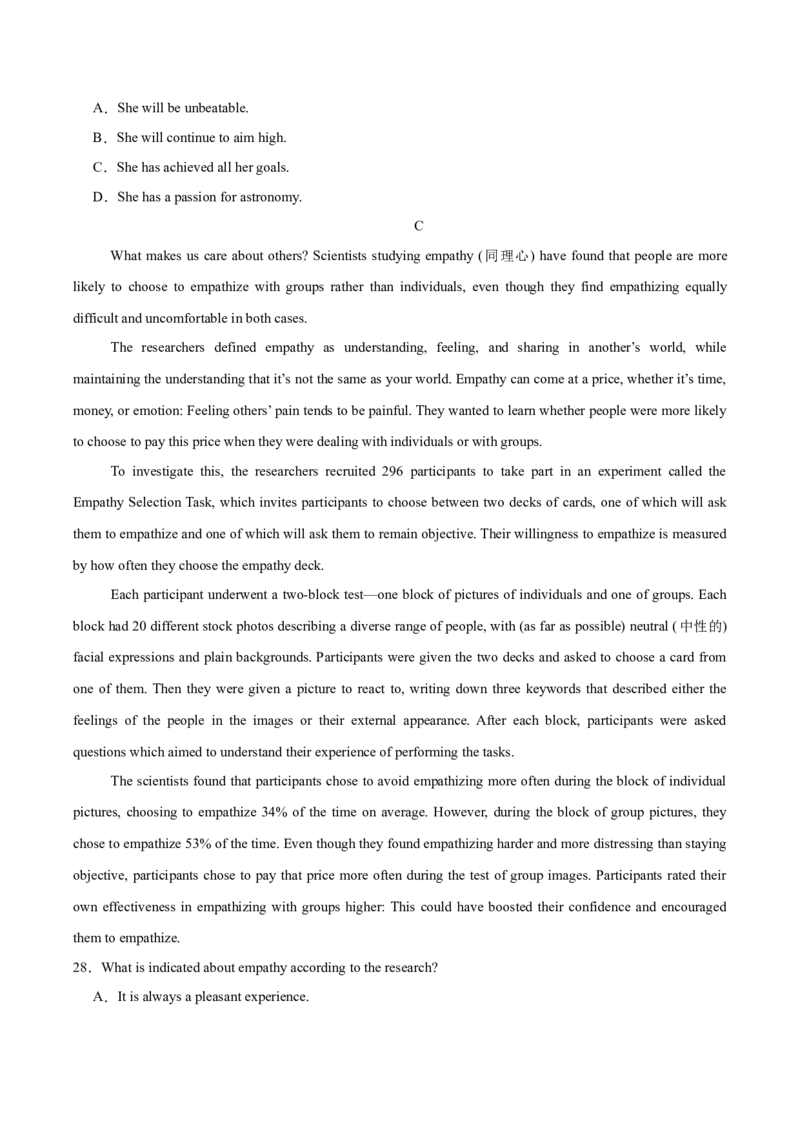
What makes us care about others? Scientists studying empathy (同理心) have found that people are more
likely to choose to empathize with groups rather than individuals, even though they find empathizing equally
difficult and uncomfortable in both cases.
The researchers defined empathy as understanding, feeling, and sharing in another’s world, while
maintaining the understanding that it’s not the same as your world. Empathy can come at a price, whether it’s time,
money, or emotion: Feeling others’ pain tends to be painful. They wanted to learn whether people were more likely
to choose to pay this price when they were dealing with individuals or with groups.
To investigate this, the researchers recruited 296 participants to take part in an experiment called the
Empathy Selection Task, which invites participants to choose between two decks of cards, one of which will ask
them to empathize and one of which will ask them to remain objective. Their willingness to empathize is measured
by how often they choose the empathy deck.
Each participant underwent a two-block test—one block of pictures of individuals and one of groups. Each
block had 20 different stock photos describing a diverse range of people, with (as far as possible) neutral ( 中性的)
facial expressions and plain backgrounds. Participants were given the two decks and asked to choose a card from
one of them. Then they were given a picture to react to, writing down three keywords that described either the
feelings of the people in the images or their external appearance. After each block, participants were asked
questions which aimed to understand their experience of performing the tasks.
The scientists found that participants chose to avoid empathizing more often during the block of individual
pictures, choosing to empathize 34% of the time on average. However, during the block of group pictures, they
chose to empathize 53% of the time. Even though they found empathizing harder and more distressing than staying
objective, participants chose to pay that price more often during the test of group images. Participants rated their
own effectiveness in empathizing with groups higher: This could have boosted their confidence and encouraged
them to empathize.
28.What is indicated about empathy according to the research?
A.It is always a pleasant experience.
B.It is easy for everyone to develop.
C.It can be uncomfortable and costly.
D.It just applies to individuals instead of groups.
29.What is the purpose of using neutral-expression photos in the experiment?
A.To avoid emotional influence.
B.To arouse participants’ curiosity.
C.To make participants focus on appearance.
D.To test participants’ ability to recognize emotions.
30.What did empathizing with groups bring about?
A.The development of a sense of belonging.
B.The possibility of remaining objective.
C.A decrease in the sense of guilt.
D.An increase in confidence.
31.Which section of a newspaper is the text taken from?
A.Education.
B.Psychology.
C.Personal growth.
D.Mental health.
D
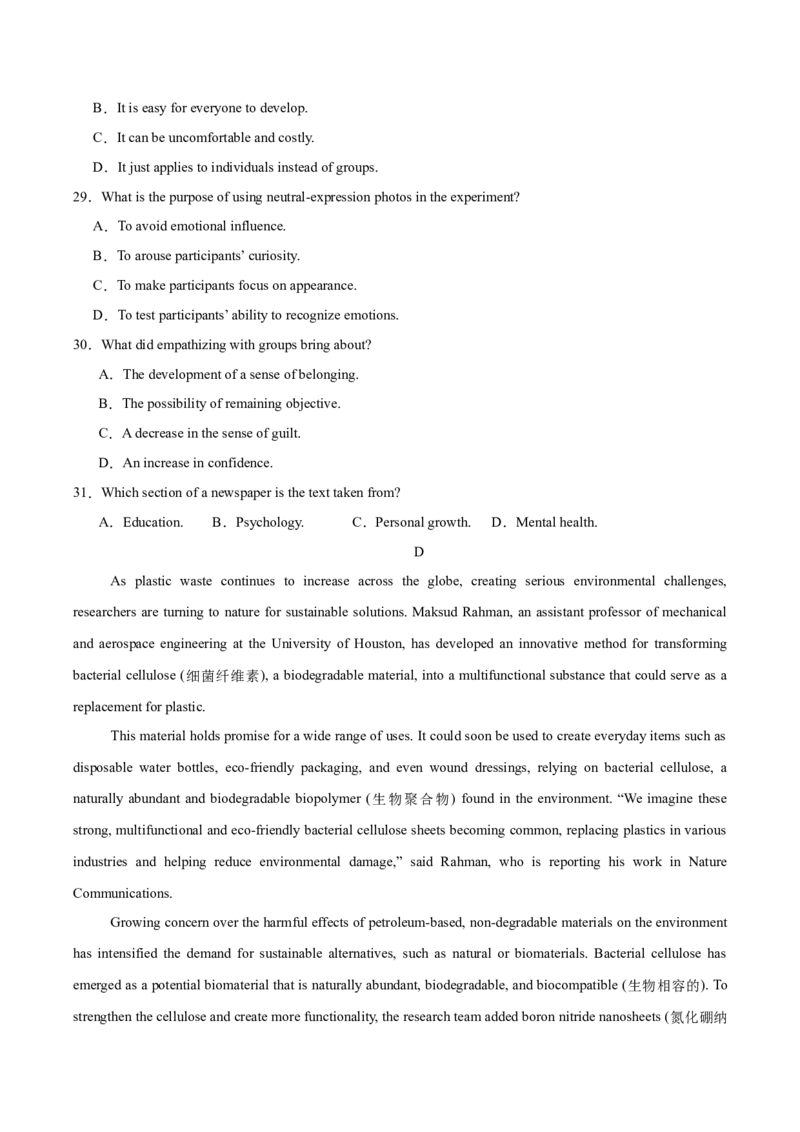
As plastic waste continues to increase across the globe, creating serious environmental challenges,
researchers are turning to nature for sustainable solutions. Maksud Rahman, an assistant professor of mechanical
and aerospace engineering at the University of Houston, has developed an innovative method for transforming
bacterial cellulose (细菌纤维素), a biodegradable material, into a multifunctional substance that could serve as a
replacement for plastic.
This material holds promise for a wide range of uses. It could soon be used to create everyday items such as
disposable water bottles, eco-friendly packaging, and even wound dressings, relying on bacterial cellulose, a
naturally abundant and biodegradable biopolymer (生物聚合物) found in the environment. “We imagine these
strong, multifunctional and eco-friendly bacterial cellulose sheets becoming common, replacing plastics in various
industries and helping reduce environmental damage,” said Rahman, who is reporting his work in Nature
Communications.
Growing concern over the harmful effects of petroleum-based, non-degradable materials on the environment
has intensified the demand for sustainable alternatives, such as natural or biomaterials. Bacterial cellulose has
emerged as a potential biomaterial that is naturally abundant, biodegradable, and biocompatible (生物相容的). To
strengthen the cellulose and create more functionality, the research team added boron nitride nanosheets (氮化硼纳
米片) to the liquid that feeds the bacteria and made a material called “bacterial cellulose-boron nitride hybrid
nanosheets” with better mechanical properties and thermal (热的) properties.
Rahman said the approach producing strong and multifunctional bacterial cellulose sheets would pave the
way towards applications in structural materials, thermal management, packaging, textiles, green electronics and
energy storage. “We’re essentially guiding the bacteria to behave with purpose. Rather than moving randomly, we
direct their motion, so they produce cellulose in an organized way. This controlled behavior, combined with our
flexible biosynthesis ( 生物合成) method with various nanomaterials, enables us to achieve multifunctional
properties in the material,” Rahman said.
“This work is a perfect example of interdisciplinary ( 跨学科的) science at the intersection of materials
science, biology, and nanoengineering,” Rahman added.
32.Why does the author mention “plastic waste” in the beginning?
A.To present an idea.
B.To explain a concept.
C.To make a prediction.
D.To give background information.
33.What is paragraph 2 mainly about?
A.The features of the new material.
B.The potential application of the new material.
C.The ways of reducing environmental damage.
D.The process of producing many everyday items.
34.What did the research team do to improve bacterial cellulose?
A.They changed the type of bacteria that produce cellulose.
B.They mixed nanomaterials into bacterial cellulose directly.
C.They added boron nitride nanosheets to the bacteria’s nutrient liquid.
D.They combined boron nitride nanosheets with bacterial cellulose completely.
35.Which of the following would Rahman agree with?
A.Cellulose is produced randomly.
B.Knowledge in a single field is applied.
C.The bacteria behave purposefully under guidance.
D.Cellulose sheets hardly benefit different applications.
第二节 (共5 小题;每小题2.5 分,满分12.5 分)
根据短文内容,从短文后的选项中选出能填入空白处的最佳选项。选项中有两项为多余选项。
Have you ever heard of the Internet of Things (IoT)? It is a term that has been gaining attention in recent
years.

 3  6

  Simply put, the IoT refers to a network of physical devices connected to the internet, enabling
them to collect, share, and act on data. From smart home appliances to wearable fitness trackers, the IoT is
transforming the way we live and work.
The concept of IoT is not as complex as it sounds.

 3  7

  Imagine your refrigerator sending you a
notification(通知)when you’re running out of milk, or your smart watch reminding you to stay active after sitting
too long. These devices make everyday tasks easier and more efficient. The IoT relies on sensors, software, and
wireless networks to create this smooth connection.


 3  8

  It enhances convenience, saves time, and improves productivity. In industries, IoT technology is
transforming processes. For instance, in agriculture, sensors can monitor soil water levels and help farmers adjust
irrigation. In healthcare, wearable devices can track patients’ vital signs and warn doctors about potential health
issues.
However, the IoT also raises concerns. One major issue is data security. As more devices collect and share
personal information, the risk of data exposure increases.

 3  9

  Privacy is another challenge, as users may
not always know how their data is being used. These issues highlight the need for better security measures.
The Internet of Things is shaping a more connected and intelligent world. While it offers many benefits, it
also comes with challenges that need to be addressed. As technology continues to develop, the IoT will likely play
an even greater role in our lives.

 4  0


A.What does it truly refer to?
B.What items might be part of the IoT?
C.The benefits of the IoT are undeniable.
D.It’s more straightforward than you expect.
E.Users often share data freely without realizing its value.
F.Sensitive data can be subject to misuse without adequate safeguards.
G.It is up to us to accept its potential while remaining mindful of its risks.
第三部分:语言运用(共两节,满分 30 分)
第一节:(共15 小题;每小题 1 分,满分15 分)
阅读下面短文,从短文后各题所给的 A、B、C 和 D 四个选项中,选出可以填入空白处的最佳选项。
Karen, 16, was a college freshman in a local university. She was thrilled to earn a    41    in the
renowned choir for their international tour. However,    42    overcame her when she overslept before a key
performance at a distant church. Missing the bus, she    43    helplessly in her dorm hallway. She had no cars
nor friends nearby to help. Ironically, her neighbor Pam emerged, the    44    person Karen expected to see.
Their relationship had been    45   . Karen’s group frequently disturbed the floor with late-night noise,
46    Pam’s requests for quiet. They    47    temporarily just long enough to catch their breath — before the
disruptions came crashing back in. Now facing    48    of her own mistake, Karen awkwardly confessed her
dilemma to Pam.
To her astonishment, Pam offered a ride immediately, which stunned Karen — Why did he extend kindness
to someone who had shown    49   ? They raced to Pam’s car and arrived just as the choir entered the church —
a miraculous    50   .
Decades later, Karen still    51    that gesture. It was never    52    a ride, but a profound lesson in
grace. Pam’s complaints gave way to forgiveness,    53    Karen redemption (救赎) she hadn’t earned. If she
could speak to Pam today, Karen would offer an apology for her youthful selfishness, and    54    for that
transformative compassion. Its ripple effects    55    her next thirty years, proving that true mercy bridges
divides and heals hearts.
41.A.spot
B.chance
C.bonus
D.prize
42.A.calmness
B.panic
C.thrill
D.relief
43.A.paced
B.stormed
C.bounced
D.tripped
44.A.best
B.worst
C.first
D.last
45.A.tense
B.close
C.familiar
D.distant
46.A.disapproving
B.doubting
C.supporting
D.dismissing
47.A.stayed
B.waited
C.paused
D.hesitated
48.A.processes
B.conclusions
C.causes
D.consequences
49.A.some
B.none
C.any
D.much
50.A.save
B.contribution
C.performance
D.movement
51.A.calls on
B.reflects on
C.holds back
D.looks back
52.A.totally
B.rarely
C.merely
D.fairly
53.A.gifting
B.rewarding
C.supplying
D.sparing
54.A.complaint
B.gratitude
C.welcome
D.regret
55.A.restricted
B.formed
C.constructed
D.shaped
第二节:(10 个小题;每小题1.5 分,满分15 分)
阅读下面短文,在空白处填入1 个适当的单词或括号内单词的正确形式。
Moscow Zoo hosted a week-long celebration, starting on Sunday, to mark the second birthday of Katyusha,
the first giant panda born in Russia.
The zoo

 56


  (decorate) with traditional Chinese elements, including red lanterns and festive displays.
Celebrations featured lively dragon dances, tea ceremonies,

 57


  educational workshops on panda
conservation. The parade created a carnival atmosphere, with crowds cheering and laughing as the dragon wove
through the pathways. Visitors enjoyed interactive

 58


  (activity), such as handmade craft sessions and
thematic tours showcasing animals native to China.
Katyusha, the center of attention, received a specially crafted birthday cake made of bamboo, fruits, and ice
carved into the number “2”,

 59


  (mark) the panda's age in a display combining Chinese tradition with
zoological enrichment. Dedicated zookeepers went to great lengths

 60


  (refresh) her and keep both her mind
and body active and enriched Katyusha’s daily life by adding edible (可食用的) decorations and hiding food in
new toys. She enjoyed a bamboo playhouse filled with treats,

 61


  she enthusiastically unpacked to find the
62


  (hide) biscuits.
Moscow Zoo Director Svetlana Akulova shared updates on Katyusha’s growth, noting that Katyusha is
63


  unique example of natural upbringing and a key part of Sino-Russian

 64


  (science) research on giant
pandas. Zhang Wei, minister counselor at China’s embassy in Russia, attended the event, saying: “Katyusha is not
only a special

 65


  (represent) of cultural exchange but also a beloved star on social media in both
countries.”
第四部分  写作(共两节,满分40 分)
第一节(满分 15 分) 假定你是李华,你的外教Mary 在口语课上组织同学们围绕“Music or sports: which do
you choose for class break time?”这一话题展开讨论。请你代表所在小组进行发言,内容包括:
1.小组观点;
2.陈述理由。
注意:
1.写作词数应为80 左右;
2.请按如下格式在答题卡的相应位置作答。
Good morning, everyone.
____________________________________________________________________________________________
____________________________________________________________________________________________
____________________________________________________________________________________________
____________________________________________________________________________________________
___________________________
第二节  (满分 25 分)
阅读下面材料,根据其内容和所给段落开头语续写两段,使之构成一篇完整的短文。
A powerful storm erupted in North Carolina, causing many roads to be severely damaged and some houses
to collapse. In the aftermath of the terrible storm, an animal protection society discovered a surprise at their booster
that both broke and warmed their hearts.
The surprise was that a group of baby dogs were left with a sad note, revealing a tale of sympathy in the
hardship. The note, written by a homeless man, explained that the heartbreaking circumstances led him to adopt the
baby dogs. He regularly fed their mother dog, but he discovered that she had unfortunately been hit by a car.
Despite his own homelessness, he had provided the baby dogs with a chance to have a better life. However, the
storm destroyed his temporary residence, and he had to leave them at the animal protection society’s doorstep with
a heartfelt request for help.
The note read, “Please help! I was sad to find a local homeless dog that I used to feed when I could, dead by
the road. What made me sadder was that her babies were left homeless. I’m sorry for leaving them like this, but I
am also homeless and cannot afford to look after them. My heart breaks for them and their mother. I just want them
to be taken good care of. I know that it’s wrong to abandon them. But please don’t think poorly of me. I really don t
have any other choice. Sincerely, a homeless man, George.”
David, who was in charge of the animal protection society, posted the story, on the social media pages,
expressing gratitude to the homeless man and admiration for his selfless act. David assured nim that his kindness,
had not gone unnoticed and promised to honor his gesture by offering the baby dogs the love and care they would
deserve. David also gave an invitation to him which read, “If you would like, please come to the animal protection
society to see how the baby dogs will live, and I think that they will be glad to see you again!”
注意:
1. 续写词数应为150 左右;
2. 请按如下格式在答题卡的相应位置作答。
A few days later, George, the homeless man, walked into the animal protection society.
____________________________________________________________________________________________
____________________________________________________________________________________________
____________________________________________________________________________________________
____________________________________________________________________________________________
____________________________________________________________________________________
Then George and David started looking for new homes for the baby dogs.
____________________________________________________________________________________________
____________________________________________________________________________________________
____________________________________________________________________________________________
____________________________________________________________________________________________
____________________________________________________________________________________