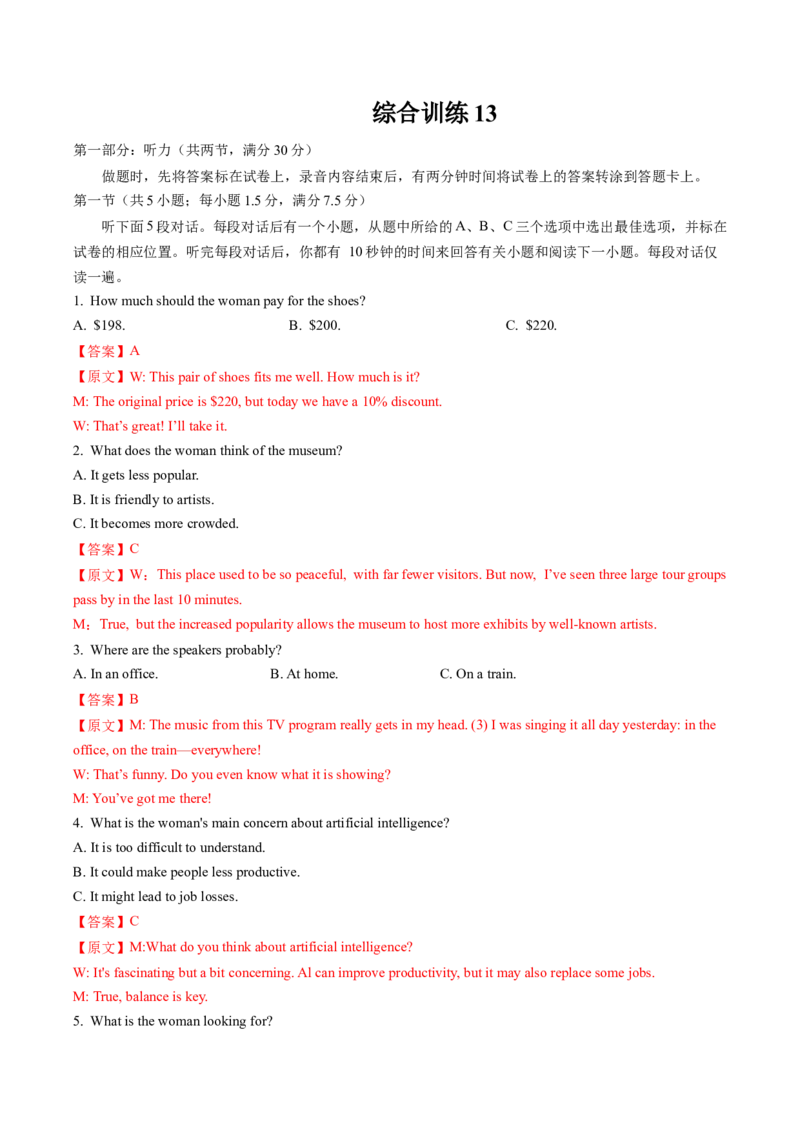
综合训练 13
第一部分:听力(共两节,满分30分)
做题时,先将答案标在试卷上,录音内容结束后,有两分钟时间将试卷上的答案转涂到答题卡上。
第一节(共5小题;每小题1.5分,满分7.5分)
听下面5段对话。每段对话后有一个小题,从题中所给的A、B、C三个选项中选出最佳选项,并标在
试卷的相应位置。听完每段对话后,你都有 10秒钟的时间来回答有关小题和阅读下一小题。每段对话仅
读一遍。
1. How much should the woman pay for the shoes?
A. $198. B. $200. C. $220.
【答案】A
【原文】W: This pair of shoes fits me well. How much is it?
M: The original price is $220, but today we have a 10% discount.
W: That’s great! I’ll take it.
2. What does the woman think of the museum?
A. It gets less popular.
B. It is friendly to artists.
C. It becomes more crowded.
【答案】C
【原文】W:This place used to be so peaceful, with far fewer visitors. But now, I’ve seen three large tour groups
pass by in the last 10 minutes.
M:True, but the increased popularity allows the museum to host more exhibits by well-known artists.
3. Where are the speakers probably?
A. In an office. B. At home. C. On a train.
【答案】B
【原文】M: The music from this TV program really gets in my head. (3) I was singing it all day yesterday: in the
office, on the train—everywhere!
W: That’s funny. Do you even know what it is showing?
M: You’ve got me there!
4. What is the woman's main concern about artificial intelligence?
A. It is too difficult to understand.
B. It could make people less productive.
C. It might lead to job losses.
【答案】C
【原文】M:What do you think about artificial intelligence?
W: It's fascinating but a bit concerning. Al can improve productivity, but it may also replace some jobs.
M: True, balance is key.
5. What is the woman looking for?A. Her bag. B. Her car. C. Her key.
【答案】C
【原文】M: Think it over carefully. You must have left it somewhere.
W: But the problem is that I have to have it now. I need it to open the door when I get home.
第二节(共15小题;每小题1.5分,满分22.5分)
听下面 5 段对话或独白。每段对话或独白后有几个小题,从题中所给的 A、B、C 三个选项中选出最佳
选项,并标在试卷的相应位置。听每段对话或独白前,你将有时间阅读各小题,每小题 5 秒钟;听完后,
各小题将给出 5 秒钟的作答时间。每段对话或独白读两遍。
听第 6 段材料,回答第 6 至 7 题。
6. What might help the woman most in speaking English?
A. Social clubs.
B. Foreign bars.
C. Language exchange centers.
7. What is probably the man?
A. A tour guide.
B. A businessman.
C. A teacher.
【答案】6. C 7. A
【原文】M: Wang Mei, you can speak English very well. Have you ever studied in an English-speaking country?
W: No. Though I haven’t been to an English-speaking country, I have my own ways of speaking to native English
speakers.
M: So how do you meet native English speakers?
W: Sometimes I go to foreign bars and restaurants. I also go to sports clubs and social clubs. But I usually go to
language exchange centers to practice my English. I heard you’re learning French and Spanish. Why do you learn
the languages?
M: My work means I have to meet tourists from all over the world. I need to explain tourist attractions to them.
听第 7 段材料,回答第 8 至 10 题。
8. Where does the man come from?
A. Vietnam.
B. France.
C. China.
9. What does the woman say about the food?
A. Delicious.
B. Unappealing.
C. Common.
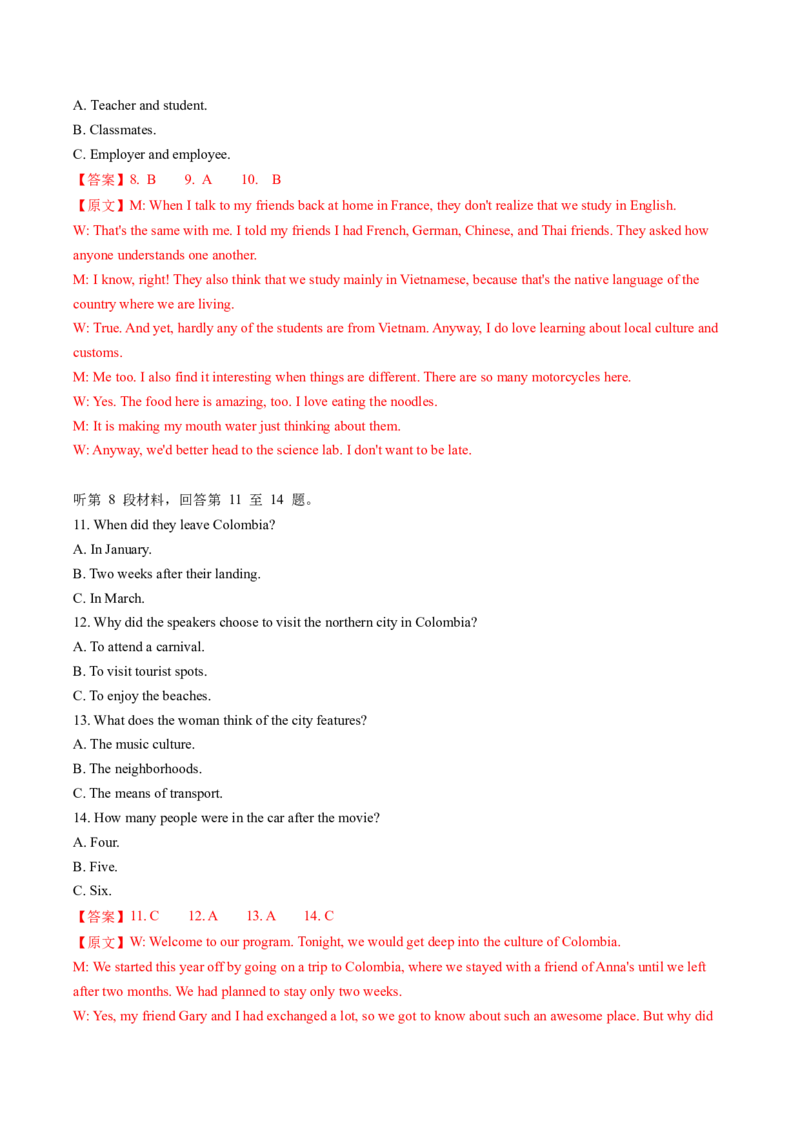
10. What is the relationship between the speakers?A. Teacher and student.
B. Classmates.
C. Employer and employee.
【答案】8. B 9. A 10. B
【原文】M: When I talk to my friends back at home in France, they don't realize that we study in English.
W: That's the same with me. I told my friends I had French, German, Chinese, and Thai friends. They asked how
anyone understands one another.
M: I know, right! They also think that we study mainly in Vietnamese, because that's the native language of the
country where we are living.
W: True. And yet, hardly any of the students are from Vietnam. Anyway, I do love learning about local culture and
customs.
M: Me too. I also find it interesting when things are different. There are so many motorcycles here.
W: Yes. The food here is amazing, too. I love eating the noodles.
M: It is making my mouth water just thinking about them.
W: Anyway, we'd better head to the science lab. I don't want to be late.
听第 8 段材料,回答第 11 至 14 题。
11. When did they leave Colombia?
A. In January.
B. Two weeks after their landing.
C. In March.
12. Why did the speakers choose to visit the northern city in Colombia?
A. To attend a carnival.
B. To visit tourist spots.
C. To enjoy the beaches.
13. What does the woman think of the city features?
A. The music culture.
B. The neighborhoods.
C. The means of transport.
14. How many people were in the car after the movie?
A. Four.
B. Five.
C. Six.
【答案】11. C 12. A 13. A 14. C
【原文】W: Welcome to our program. Tonight, we would get deep into the culture of Colombia.
M: We started this year off by going on a trip to Colombia, where we stayed with a friend of Anna's until we left
after two months. We had planned to stay only two weeks.
W: Yes, my friend Gary and I had exchanged a lot, so we got to know about such an awesome place. But why didwe arrive in a northern city of Colombia in January?
M: Actually, they had the world's second largest carnival. This city isn't rather touristic, with little beaches, but
what do you think drives this city?
W: I would say vibrant music, all sorts of music going on and on everywhere.
M: It is. But there's always a neighbor playing music loud, which bothered me a lot. Except for that, we were well
immersed in their day-to-day life. Remember the night after the movie? We had to pack into the car. How many
people were there?
W: Unbelievable. Two girls were in the front, Gary, you and me in the backseat where there were three seats. We
had four people, with Jack on Gary's lap.
听第 9 段材料,回答第 15 至 17 题。
15. What does the woman say about the book for her report?
A. It's lost. B. It's damaged. C. It's sold out.
16. Why is the man's uncle mentioned in the conversation?
A. He is a famous writer. B. He used to work in the library. C. He has many books on architecture.
17. What will the man probably do next?
A. Go to the library. B. Attend a class. C. Make a call.
【答案】15. B 16. C 17. A
【原文】M: Is something wrong, Amanda? You look upset today.
W: Oh, I got a book from the library today that I need for my report on ancient architecture. But I just realized it’s
missing pages from the most important part.
M: Oh. Have you checked if there are other copies in the library?
W: Yes, and the librarian told me this was the only one they had.
M: Did you say your report is about ancient architecture?
W: That’s right.
M: Well, my uncle studies architecture. He has many books about architecture at his house. He probably has a copy
of the book you’re looking for, or at least a different book with the same information.
W: Wow! Do you think he’ll let me borrow it?
M: Of course. Let me return my book first. Then we can walk to my uncle’s together and talk to him about the
book.
W: OK.
听第 10 段材料,回答第 18 至 20 题。
18. Where were the first skis found?
A. In Norway. B. In Switzerland. C. In China.
19. What did skiing originally serve as?
A. A means of transportation.
B. A form of recreation.
C. A type of exercise.20. What does the speaker mainly talk about?
A. The significance of skiing.
B. The popularity of skiing.
C. The development of skiing.
【答案】18. C 19. A 20. C
【原文】M: The history of skiing dates back to ancient times. The very first skis date back to about 8,000 years
BC and were found in Northern China. Besides, ancient rock carvings found in Norway also show early skiing.
As a matter of fact, the word “ski” originates from Old Norse, where it referred to split pieces of wood or firewood,
indicating that early skis were likely made of wood and were long and narrow in shape.
In ancient times, skiing was a necessary means of transportation, but now it has become a popular recreational
activity and a multi-billion dollar industry that contributes significantly to the economies of many countries.
In the 19th century, skiing became the latest craze for the wealthy. They would escape to the mountains to
participate in this activity. The ski resorts in Switzerland and Austria served the upper class at that time. As ski
technology advanced, skiing became a beloved sport for people from all walks of life.
Today, advancements in ski technology have made the sport safer and more enjoyable than ever before. Whether
you are a beginner or an experienced skier, there is no denying that the excitement of skiing will appeal to you.
Skiing is more than a sport. It is a way that brings people together and creates unforgettable memories.