辽宁省沈文新高考研究联盟2025-2026 学年
高三上学期8 月质量监测暨第零次诊断测试英语试题
阅读下面材料,根据其内容和所给段落开头语续写两段,使之构成一篇完整的短
文。
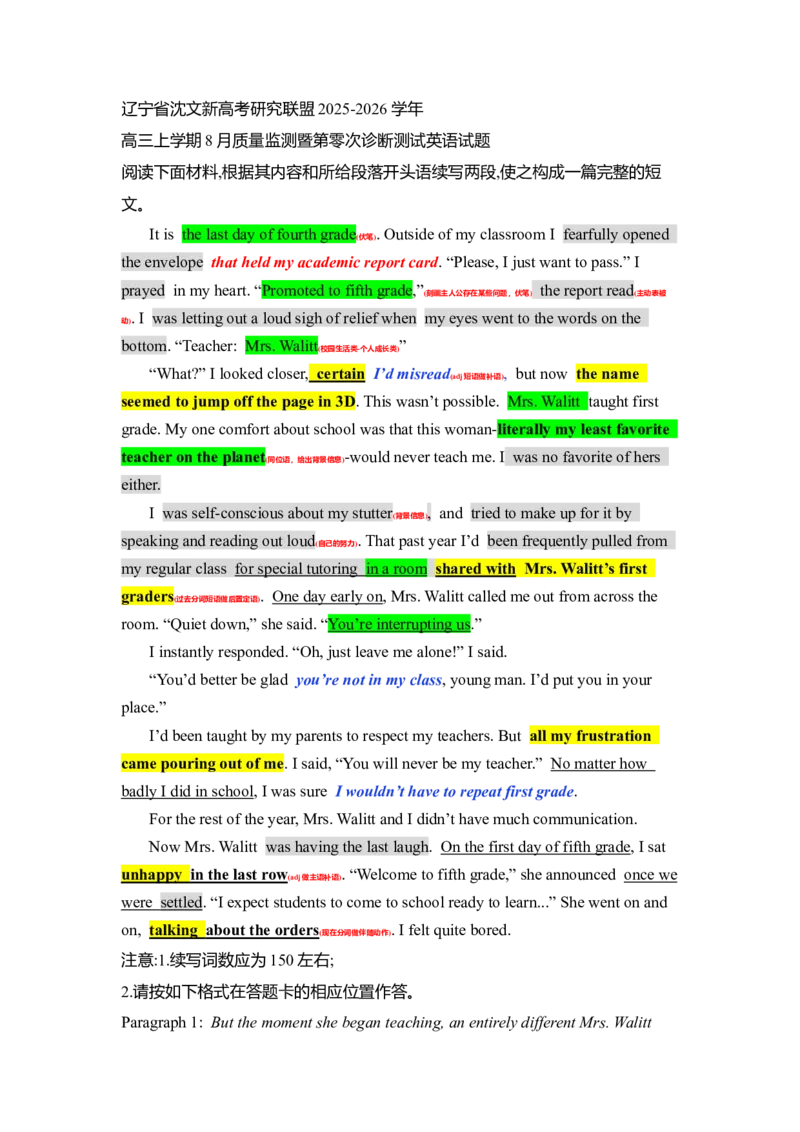
It is the last day of fourth grade(伏笔). Outside of my classroom I fearfully opened
the envelope that held my academic report card. “Please, I just want to pass.” I
prayed in my heart. “Promoted to fifth grade,”(刻画主人公存在某些问题,伏笔) the report read(主动表被
动). I was letting out a loud sigh of relief when my eyes went to the words on the
bottom. “Teacher: Mrs. Walitt(校园生活类-个人成长类)”
“What?” I looked closer, certain I’d misread(adj 短语做补语), but now the name
seemed to jump off the page in 3D. This wasn’t possible. Mrs. Walitt taught first
grade. My one comfort about school was that this woman-literally my least favorite
teacher on the planet(同位语,给出背景信息)-would never teach me. I was no favorite of hers
either.
I was self-conscious about my stutter(背景信息), and tried to make up for it by
speaking and reading out loud(自己的努力). That past year I’d been frequently pulled from
my regular class for special tutoring

 in a room

  shared with Mrs. Walitt’s first
graders(过去分词短语做后置定语). One day early on, Mrs. Walitt called me out from across the
room. “Quiet down,” she said. “You’re interrupting us.”
I instantly responded. “Oh, just leave me alone!” I said.
“You’d better be glad you’re not in my class, young man. I’d put you in your
place.”
I’d been taught by my parents to respect my teachers. But all my frustration
came pouring out of me. I said, “You will never be my teacher.” No matter how
badly I did in school, I was sure I wouldn’t have to repeat first grade.
For the rest of the year, Mrs. Walitt and I didn’t have much communication.
Now Mrs. Walitt was having the last laugh. On the first day of fifth grade, I sat
unhappy

 in the last row

 (adj 做主语补语). “Welcome to fifth grade,” she announced once we
were

 settled

 . “I expect students to come to school ready to learn...” She went on and
on, talking

 about the orders

 (现在分词做伴随动作). I felt quite bored.
注意:1.续写词数应为150 左右;
2.请按如下格式在答题卡的相应位置作答。
Paragraph 1: But the moment she began teaching, an entirely different Mrs. Walitt
appeared.
Paragraph 2: With Mrs. Walitt’s constant encouragement, my grades improved beyond
belief.
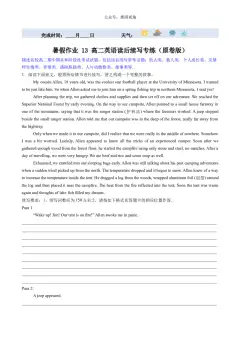
辽宁省沈文新高考研究联盟2025-2026 学年
高三上学期8 月质量监测暨第零次诊断测试英语试题
阅读下面材料,根据其内容和所给段落开头语续写两段,使之构成一篇完整的短
文。
It is the last day of fourth grade. Outside of my classroom I fearfully opened the
envelope that held my academic report card. “Please, I just want to pass.” I prayed in
my heart. “Promoted to fifth grade,” the report read. I was letting out a loud sigh of
relief when my eyes went to the words on the bottom. “Teacher: Mrs. Walitt.”
“What?” I looked closer, certain I’d misread, but now the name seemed to jump
off the page in 3D. This wasn’t possible. Mrs. Walitt taught first grade. My one
comfort about school was that this woman-literally my least favorite teacher on the
planet-would never teach me. I was no favorite of hers either.
I was self-conscious about my stutter (口吃), and tried to make up for it by
speaking and reading out loud. That past year I’d been frequently pulled from my
regular class for special tutoring in a room shared with Mrs. Walitt’s first graders. One
day early on, Mrs. Walitt called me out from across the room. “Quiet down,” she said.
“You’re interrupting us.”
I instantly responded. “Oh, just leave me alone!” I said.
“You’d better be glad you’re not in my class, young man. I’d put you in your
place.”
I’d been taught by my parents to respect my teachers. But all my frustration came
pouring out of me. I said, “You will never be my teacher.” No matter how badly I did
in school, I was sure I wouldn’t have to repeat first grade.
For the rest of the year, Mrs. Walitt and I didn’t have much communication.
Now Mrs. Walitt was having the last laugh. On the first day of fifth grade, I sat
unhappy in the last row. “Welcome to fifth grade,” she announced once we were
settled. “I expect students to come to school ready to learn...” She went on and on,
talking about the orders. I felt quite bored.
注意:1.续写词数应为150 左右;
2.请按如下格式在答题卡的相应位置作答。
Paragraph 1: But the moment she began teaching, an entirely different Mrs. Walitt
appeared.
Paragraph 2: With Mrs. Walitt’s constant encouragement, my grades improved beyond
belief.
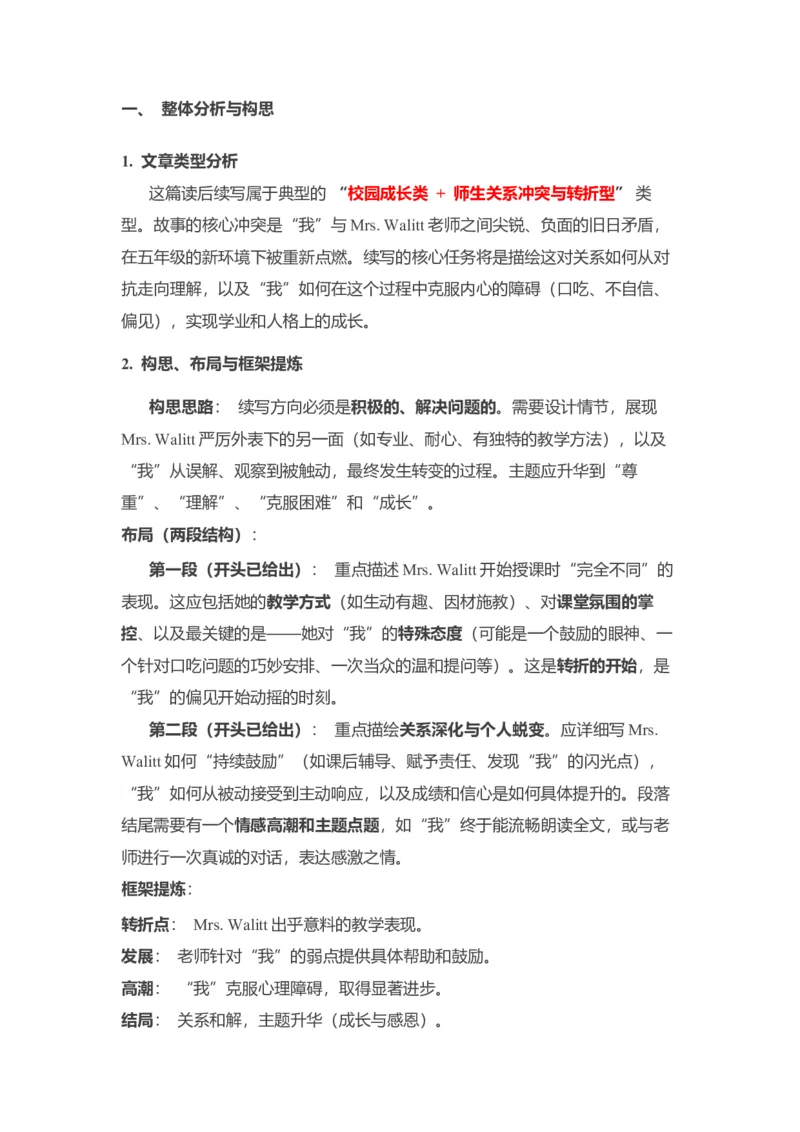
一、 整体分析与构思
1. 文章类型分析
这篇读后续写属于典型的 “校园成长类 + 师生关系冲突与转折型” 类
型。故事的核心冲突是“我”与Mrs. Walitt 老师之间尖锐、负面的旧日矛盾,
在五年级的新环境下被重新点燃。续写的核心任务将是描绘这对关系如何从对
抗走向理解,以及“我”如何在这个过程中克服内心的障碍(口吃、不自信、
偏见),实现学业和人格上的成长。
2. 构思、布局与框架提炼
构思思路: 续写方向必须是积极的、解决问题的。需要设计情节,展现
Mrs. Walitt 严厉外表下的另一面(如专业、耐心、有独特的教学方法),以及
“我”从误解、观察到被触动,最终发生转变的过程。主题应升华到“尊
重”、“理解”、“克服困难”和“成长”。
布局(两段结构):
第一段(开头已给出): 重点描述Mrs. Walitt 开始授课时“完全不同”的
表现。这应包括她的教学方式(如生动有趣、因材施教)、对课堂氛围的掌
控、以及最关键的是——她对“我”的特殊态度(可能是一个鼓励的眼神、一
个针对口吃问题的巧妙安排、一次当众的温和提问等)。这是转折的开始,是
“我”的偏见开始动摇的时刻。
第二段(开头已给出): 重点描绘关系深化与个人蜕变。应详细写Mrs.
Walitt 如何“持续鼓励”(如课后辅导、赋予责任、发现“我”的闪光点),
“我”如何从被动接受到主动响应,以及成绩和信心是如何具体提升的。段落
结尾需要有一个情感高潮和主题点题,如“我”终于能流畅朗读全文,或与老
师进行一次真诚的对话,表达感激之情。
框架提炼:
转折点: Mrs. Walitt 出乎意料的教学表现。
发展: 老师针对“我”的弱点提供具体帮助和鼓励。
高潮: “我”克服心理障碍,取得显著进步。
结局: 关系和解,主题升华(成长与感恩)。
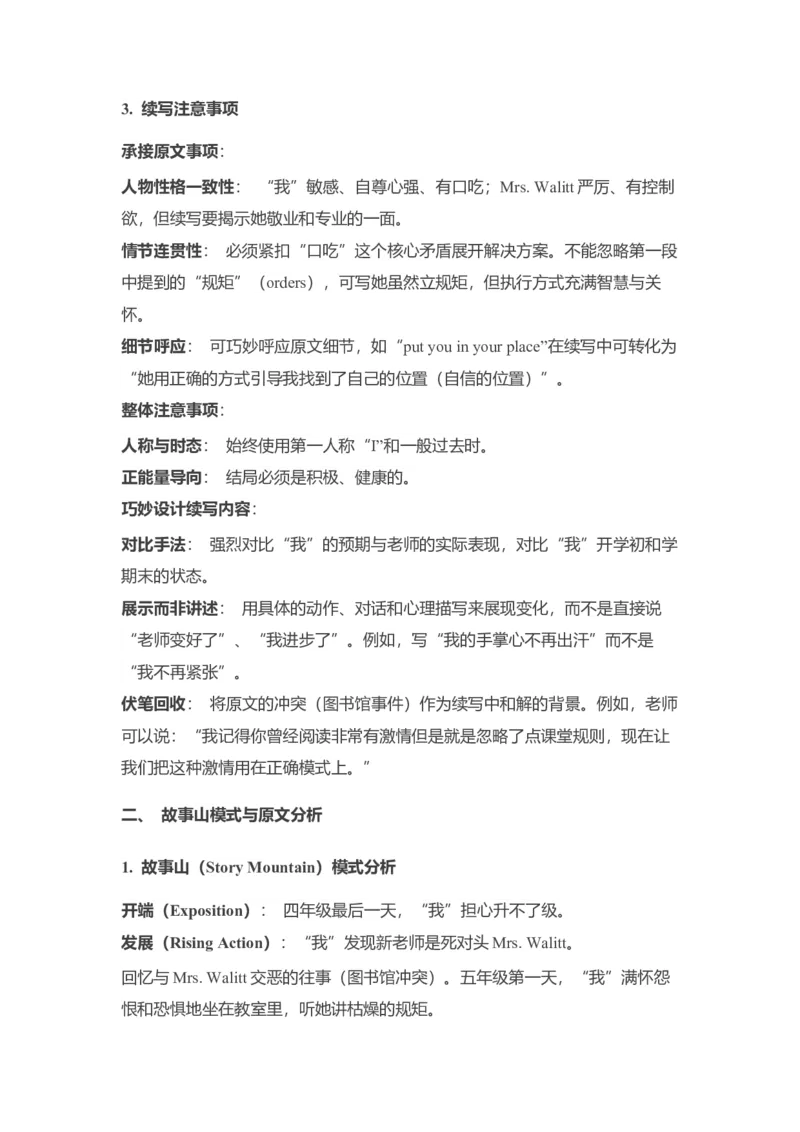
3. 续写注意事项
承接原文事项:
人物性格一致性: “我”敏感、自尊心强、有口吃;Mrs. Walitt 严厉、有控制
欲,但续写要揭示她敬业和专业的一面。
情节连贯性: 必须紧扣“口吃”这个核心矛盾展开解决方案。不能忽略第一段
中提到的“规矩”(orders),可写她虽然立规矩,但执行方式充满智慧与关
怀。
细节呼应: 可巧妙呼应原文细节,如“put you in your place”在续写中可转化为
“她用正确的方式引导我找到了自己的位置(自信的位置)”。
整体注意事项:
人称与时态: 始终使用第一人称“I”和一般过去时。
正能量导向: 结局必须是积极、健康的。
巧妙设计续写内容:
对比手法: 强烈对比“我”的预期与老师的实际表现,对比“我”开学初和学
期末的状态。
展示而非讲述: 用具体的动作、对话和心理描写来展现变化,而不是直接说
“老师变好了”、“我进步了”。例如,写“我的手掌心不再出汗”而不是
“我不再紧张”。
伏笔回收: 将原文的冲突(图书馆事件)作为续写中和解的背景。例如,老师
可以说:“我记得你曾经阅读非常有激情但是就是忽略了点课堂规则,现在让
我们把这种激情用在正确模式上。”
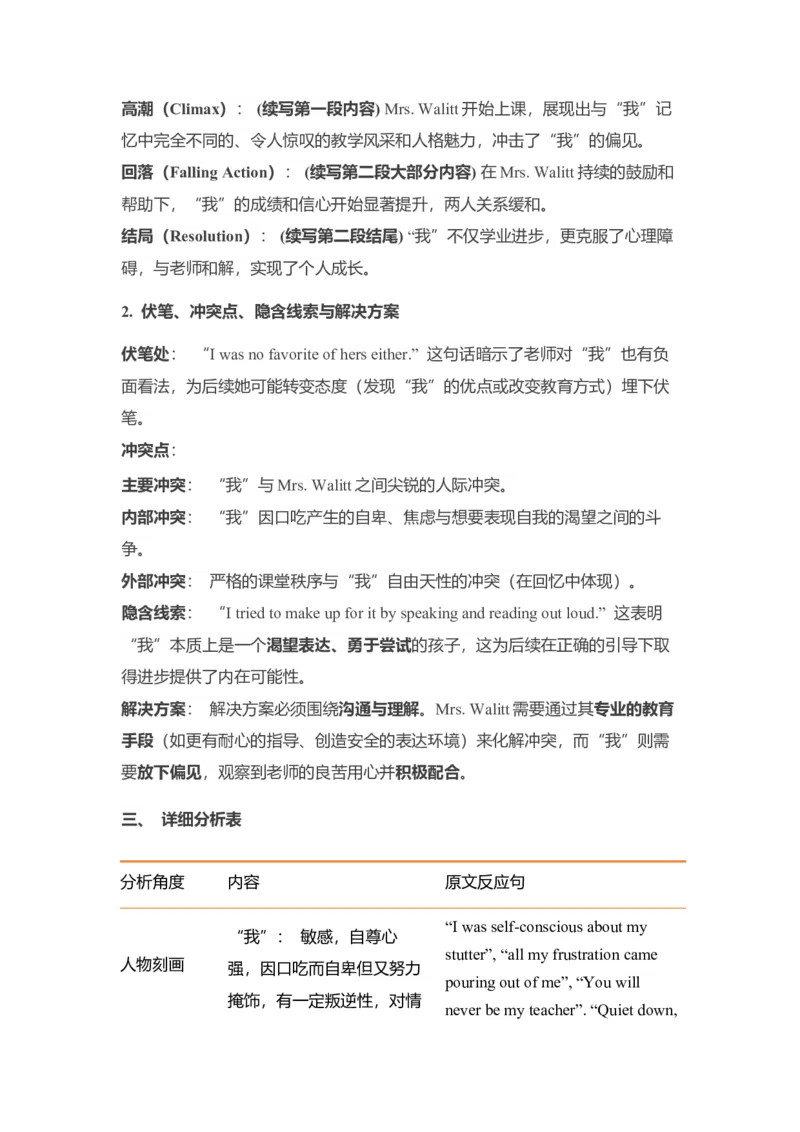
二、 故事山模式与原文分析
1. 故事山(Story Mountain)模式分析
开端(Exposition): 四年级最后一天,“我”担心升不了级。
发展(Rising Action):“我”发现新老师是死对头Mrs. Walitt。
回忆与Mrs. Walitt 交恶的往事(图书馆冲突)。五年级第一天,“我”满怀怨
恨和恐惧地坐在教室里,听她讲枯燥的规矩。
高潮(Climax): (续写第一段内容) Mrs. Walitt 开始上课,展现出与“我”记
忆中完全不同的、令人惊叹的教学风采和人格魅力,冲击了“我”的偏见。
回落(Falling Action): (续写第二段大部分内容) 在Mrs. Walitt 持续的鼓励和
帮助下,“我”的成绩和信心开始显著提升,两人关系缓和。
结局(Resolution): (续写第二段结尾) “我”不仅学业进步,更克服了心理障
碍,与老师和解,实现了个人成长。
2. 伏笔、冲突点、隐含线索与解决方案
伏笔处: “I was no favorite of hers either.” 这句话暗示了老师对“我”也有负
面看法,为后续她可能转变态度(发现“我”的优点或改变教育方式)埋下伏
笔。
冲突点:
主要冲突: “我”与Mrs. Walitt 之间尖锐的人际冲突。
内部冲突: “我”因口吃产生的自卑、焦虑与想要表现自我的渴望之间的斗
争。
外部冲突: 严格的课堂秩序与“我”自由天性的冲突(在回忆中体现)。
隐含线索: “I tried to make up for it by speaking and reading out loud.” 这表明
“我”本质上是一个渴望表达、勇于尝试的孩子,这为后续在正确的引导下取
得进步提供了内在可能性。
解决方案: 解决方案必须围绕沟通与理解。Mrs. Walitt 需要通过其专业的教育
手段(如更有耐心的指导、创造安全的表达环境)来化解冲突,而“我”则需
要放下偏见,观察到老师的良苦用心并积极配合。
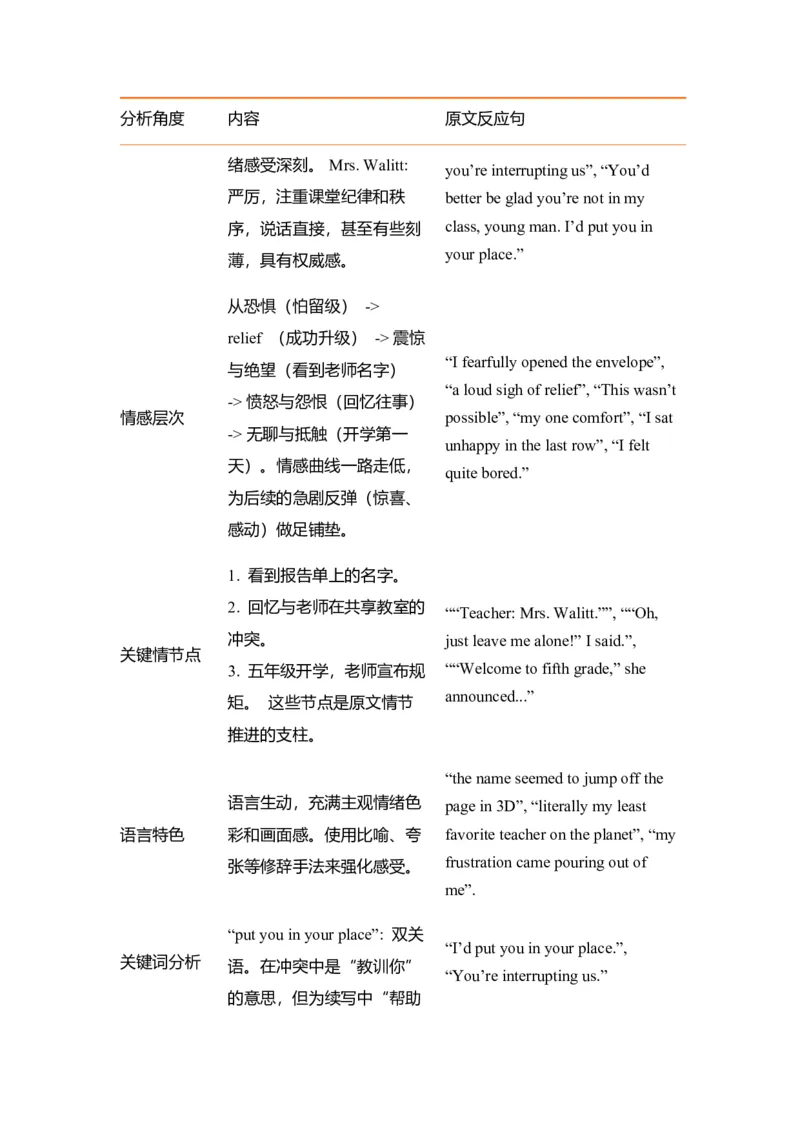
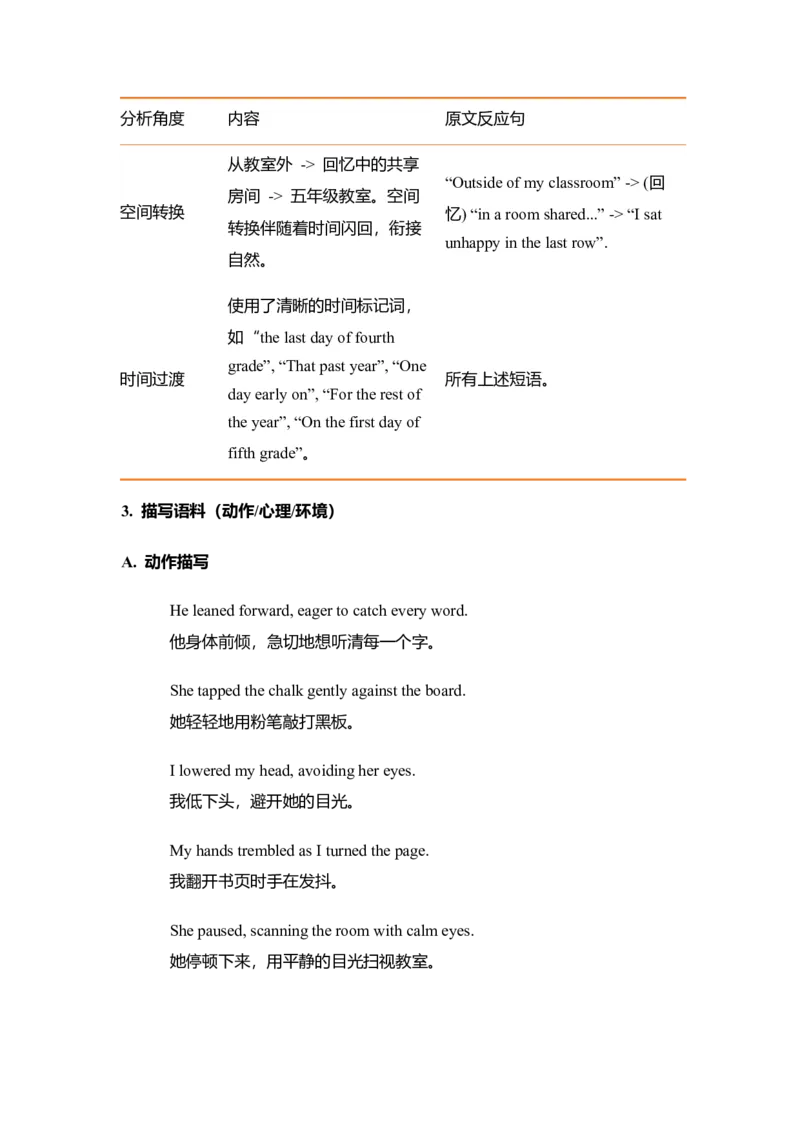
三、 详细分析表
分析角度
内容
原文反应句
人物刻画
“我”: 敏感,自尊心
强,因口吃而自卑但又努力
掩饰,有一定叛逆性,对情
“I was self-conscious about my
stutter”, “all my frustration came
pouring out of me”, “You will
never be my teacher”. “Quiet down,
分析角度
内容
原文反应句
绪感受深刻。 Mrs. Walitt:
严厉,注重课堂纪律和秩
序,说话直接,甚至有些刻
薄,具有权威感。
you’re interrupting us”, “You’d
better be glad you’re not in my
class, young man. I’d put you in
your place.”
情感层次
从恐惧(怕留级) ->
relief (成功升级) -> 震惊
与绝望(看到老师名字)
-> 愤怒与怨恨(回忆往事)
-> 无聊与抵触(开学第一
天)。情感曲线一路走低,
为后续的急剧反弹(惊喜、
感动)做足铺垫。
“I fearfully opened the envelope”,
“a loud sigh of relief”, “This wasn’t
possible”, “my one comfort”, “I sat
unhappy in the last row”, “I felt
quite bored.”
关键情节点
1. 看到报告单上的名字。
2. 回忆与老师在共享教室的
冲突。
3. 五年级开学,老师宣布规
矩。 这些节点是原文情节
推进的支柱。
““Teacher: Mrs. Walitt.””, ““Oh,
just leave me alone!” I said.”,
““Welcome to fifth grade,” she
announced...”
语言特色
语言生动,充满主观情绪色
彩和画面感。使用比喻、夸
张等修辞手法来强化感受。
“the name seemed to jump off the
page in 3D”, “literally my least
favorite teacher on the planet”, “my
frustration came pouring out of
me”.
关键词分析
“put you in your place”: 双关
语。在冲突中是“教训你”
的意思,但为续写中“帮助
“I’d put you in your place.”,
“You’re interrupting us.”
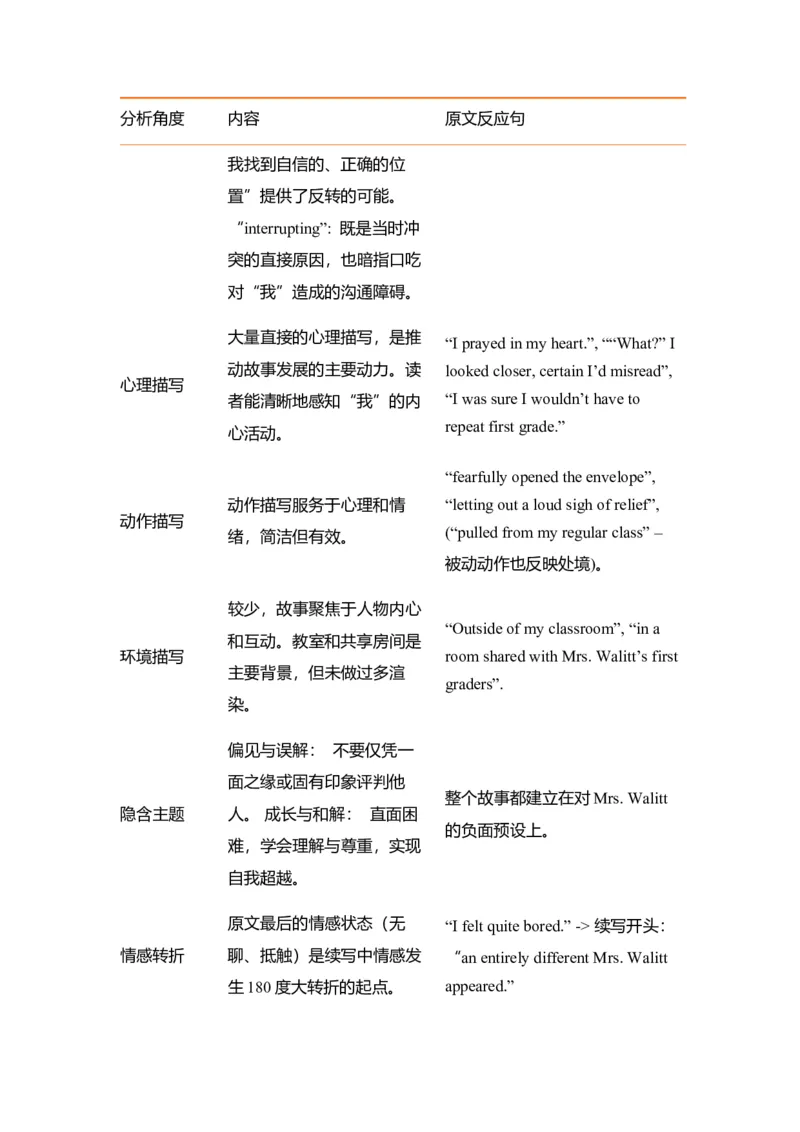
分析角度
内容
原文反应句
我找到自信的、正确的位
置”提供了反转的可能。
“interrupting”: 既是当时冲
突的直接原因,也暗指口吃
对“我”造成的沟通障碍。
心理描写
大量直接的心理描写,是推
动故事发展的主要动力。读
者能清晰地感知“我”的内
心活动。
“I prayed in my heart.”, ““What?” I
looked closer, certain I’d misread”,
“I was sure I wouldn’t have to
repeat first grade.”
动作描写
动作描写服务于心理和情
绪,简洁但有效。
“fearfully opened the envelope”,
“letting out a loud sigh of relief”,
(“pulled from my regular class” –
被动动作也反映处境)。
环境描写
较少,故事聚焦于人物内心
和互动。教室和共享房间是
主要背景,但未做过多渲
染。
“Outside of my classroom”, “in a
room shared with Mrs. Walitt’s first
graders”.
隐含主题
偏见与误解: 不要仅凭一
面之缘或固有印象评判他
人。 成长与和解: 直面困
难,学会理解与尊重,实现
自我超越。
整个故事都建立在对Mrs. Walitt
的负面预设上。
情感转折
原文最后的情感状态(无
聊、抵触)是续写中情感发
生180 度大转折的起点。
“I felt quite bored.” -> 续写开头:
“an entirely different Mrs. Walitt
appeared.”
分析角度
内容
原文反应句
空间转换
从教室外 -> 回忆中的共享
房间 -> 五年级教室。空间
转换伴随着时间闪回,衔接
自然。
“Outside of my classroom” -> (回
忆) “in a room shared...” -> “I sat
unhappy in the last row”.
时间过渡
使用了清晰的时间标记词,
如“the last day of fourth
grade”, “That past year”, “One
day early on”, “For the rest of
the year”, “On the first day of
fifth grade”。
所有上述短语。
3. 描写语料(动作/心理/环境)
A. 动作描写
He leaned forward, eager to catch every word.
他身体前倾,急切地想听清每一个字。
She tapped the chalk gently against the board.
她轻轻地用粉笔敲打黑板。
I lowered my head, avoiding her eyes.
我低下头,避开她的目光。
My hands trembled as I turned the page.
我翻开书页时手在发抖。
She paused, scanning the room with calm eyes.
她停顿下来,用平静的目光扫视教室。
I clenched my fists under the desk.
我在桌子底下紧握双拳。
She nodded slightly, signaling approval.
她微微点头,表示赞许。
I shifted uneasily in my seat.
我在座位上不安地挪动。
She raised her hand to silence the class.
她抬起手示意全班安静。
I scribbled notes furiously, afraid of falling behind.
我拼命地记笔记,生怕落下。
B. 心理描写(10 个)
A wave of relief washed over me.
一股如释重负的感觉涌上心头。
My heart sank at the sight of her name.
看到她的名字时,我心头一沉。
Doubt crept into my mind.
怀疑悄悄爬上心头。
Pride swelled inside me.
自豪感在我心中膨胀。
Shame burned in my cheeks.
羞愧让我脸颊发烫。
Curiosity sparked within me.
好奇心在我心里被点燃。
Anxiety knotted my stomach.
焦虑让我的胃揪成一团。
Determination settled in my heart.
决心在我心中扎根。
I felt torn between fear and hope.
我感到在恐惧和希望之间左右为难。
Gratitude overflowed in me.
感激之情在我心中满溢。
C. 环境描写(10 个)
The classroom buzzed with whispers.
教室里嗡嗡地响着窃窃私语。
Sunlight streamed through the dusty windows.
阳光透过布满灰尘的窗户洒进来。
The blackboard stood covered in chalk dust.
黑板上覆盖着一层粉笔灰。
Desks were arranged in neat rows.
课桌整齐地排列成排。
The clock ticked loudly in the silence.
寂静中时钟的滴答声格外响亮。
Warm air filled the crowded room.
拥挤的教室里弥漫着温热的空气。
A faint smell of paper and ink hung in the air.
空气中弥漫着淡淡的纸墨气息。
The walls were decorated with faded posters.
墙上挂着褪色的海报。
Outside, children’s laughter drifted in from the playground.
外面,操场上传来孩子们的笑声。
The bell rang sharply, breaking the tension.
清脆的铃声响起,打破了紧张气氛。
 表达“害怕/紧张”
afraid → anxious / uneasy / restless / on edge / apprehensive
 表达“开心/感激”
happy → delighted / thrilled / overjoyed / grateful / content
 表达“生气/反感”
angry → furious / resentful / irritated / bitter / hostile
 表达“进步/变化”
improve → advance / progress / flourish / transform / excel
 表达“惊讶/震惊”
surprised → astonished / amazed / startled / stunned / taken aback
常见固定搭配(结合原文主题)
cast a glance at sb. → 看某人一眼
plant a seed of trust → 播下信任的种子
build up confidence → 树立自信
burst into laughter/tears → 突然笑/哭
be on the verge of tears → 快要哭出来
hold one’s breath → 屏住呼吸
stand tall → 挺起胸膛,自信站立
wave of relief → 一阵宽慰
fight back tears → 强忍泪水
be glued to sth. → 专注盯着某物
词法解析与积累语料
1. relief [n.] 宽慰,解脱
近义词:comfort, ease, reassurance
反义词:stress, tension, anxiety
例句:
A wave of relief swept over me after the exam.
His smile gave me great relief from worry.
2. reluctant [adj.] 不情愿的
近义词:unwilling, loath, hesitant, resistant
反义词:willing, eager, ready
例句:
He was reluctant to admit his mistake.
I felt reluctant to leave the warm classroom.
3. encourage [v.] 鼓励,激励
近义词:inspire, motivate, support, stimulate
反义词:discourage, dishearten, depress
例句:
Her words encouraged me to try again.
Teachers should encourage students to think independently.
4. prejudice [n.] 偏见
近义词:bias, discrimination, unfairness, intolerance
反义词:fairness, justice, equality
例句:
His words were full of prejudice against outsiders.
Education helps us overcome prejudice and ignorance.
5. astonish [v.] 使震惊,使惊讶
近义词:amaze, stun, startle, bewilder
反义词:calm, reassure, comfort
例句:
The news astonished everyone in the classroom.
I was astonished by her sudden change of attitude.
 表示“说”常见词: said, told 高级替换: murmured (低声说), uttered (说
出), announced (宣布), whispered (耳语), exclaimed (惊呼)
 表示“高兴/开心”常见词: happy, glad 高级替换: delighted (欣喜
的), overjoyed (狂喜的), elated (兴高采烈的), thrilled (非常激动的), content (心
满意足的)
表示“看”常见词: look, see 高级替换: gaze (凝视), glance (瞥一眼), peer (仔细
看), observe (观察), witness (目睹)
表示“害怕/紧张”常见词: afraid, nervous 高级替换: apprehensive (忧虑
的), terrified (吓坏了的), panicked (恐慌的), anxious (焦虑的), timid (胆怯的)
表示“好”常见词: good, great 高级替换: superb (极好的), marvelous (非凡
的), exceptional (例外的), fantastic (极妙的), admirable (令人钦佩的)
let out a sigh (发出一声叹息): let out 是一个非常地道的短语,表示发出(声
音)、释放。同类表达有 let out a cry (哭出声), let out a laugh (笑出声)。
jump off the page (从纸上跳出来): 这是一个极其生动的隐喻(Metaphor),
形容文字非常醒目、引人注目,给人留下深刻印象。
least favorite (最不喜欢的): 地道的比较级用法。least 是 little 的最高级,
用于修饰抽象名词,如 least interest (最没兴趣), least hope (最没希望)。
make up for (补偿): 动词短语。后接名词或动名词。make up for lost
time (弥补失去的时间), make up for my mistake (弥补我的错误)。
come pouring out (倾泻而出): come doing 结构表示“以一种……的状态到
来”,形象地描绘了情绪突然失控、无法抑制地宣泄出来的状态。类似有 come
running (跑过来)。
have the last laugh (笑到最后): 习语(Idiom),指最终获得胜利或成功,尤其
指在经过一段被质疑或困难的时期后。
go on and on (喋喋不休地说个不停): 口语中非常常用的表达,强调说话时
间长且内容冗长乏味。
self-conscious (adj. 忸怩的;不自然的;自觉的)
词意: 过分关注他人如何看待自己,从而导致紧张或尴尬。
近义词: insecure, awkward, embarrassed, shy
反义词: confident, assured, poised, unselfconscious
例句1: He was always self-conscious about his height. (他总是对自己的身高感到
不自在。)
例句2: Giving a speech makes me terribly self-conscious. (演讲让我感到非常不自
然。)
frustration (n. 挫折;恼怒;失望)
词意: 因无法改变或实现某事而产生的恼怒或烦恼感。
近义词: annoyance, irritation, exasperation, disappointment
反义词: satisfaction, contentment, gratification, delight
例句1: She kicked the desk in frustration. (她懊恼地踢了桌子一脚。)
例句2: The constant delays caused widespread frustration. (持续的延误引起了普
遍的失望。)
misread (v. 误解;读错) (misread - misread - misread)
词意: 错误地理解或解读(情况、某人的行为或感觉);错误地阅读。
近义词: misunderstand, misinterpret, misconstrue, misjudge
反义词: understand, comprehend, interpret correctly, grasp
例句1: I think you've misread the situation entirely. (我认为你完全误解了情况。)
例句2: He misread the last word on the eye chart. (他看错了视力表上的最后一个
词。)
interrupt (v. 打断;中断;插嘴)
词意: 停止(某人)的连续行动或过程;在别人说话时突然开始说话。
近义词: intrude, butt in, cut off, disturb
反义词: listen, allow to continue, be quiet
例句1: Please don't interrupt me when I'm speaking. (我说话时请不要打断我。)
例句2: The game was interrupted by rain. (比赛被雨中断了。)
beyond belief (adv. 难以置信地)
词意: 到令人难以置信的程度;极其。
近义词: incredibly, unbelievably, extraordinarily, amazingly
反义词: believably, plausibly, reasonably, slightly
例句1: His story was exaggerated beyond belief. (他的故事夸张得令人难以置
信。)
例句2: She was successful beyond belief. (她成功得令人难以置信。)
5. Possible Versions(4)
Version 1
Paragraph 1: But the moment she began teaching, an entirely different Mrs.
Walitt appeared. Her voice, once sharp in my memory(adj 做主语补语), now sounded
steady and warm(无灵主语句). She moved across the classroom with surprising energy,
turning

 even dry grammar rules into vivid stories

 (现在分词短语做伴随动作). When she
explained new vocabulary, she drew pictures on the blackboard, and laughter often
followed. I noticed that she glanced at me differently from the others, as if she
finally understood why I had once read aloud so loudly—desperate to cover my
stutter(adj 短语做补语). Instead of criticizing, she gave me a role I could manage. When
she asked a question, she would pick a short, simple sentence for me to read, her
tone warm, her eyes steady(独立主格并列). That one small arrangement made all the
difference: I no longer felt exposed, but chosen. Discipline still ruled her class(无灵主语
句), yet it felt protective rather than punishing, as though she was quietly building a
safe space for me to fight my private battle.
Paragraph 2: With Mrs. Walitt’s constant encouragement, my grades
improved beyond belief. She invited me to stay after class for brief practices,
teaching

 me
  (现在分词短语做伴随动作) how to pause naturally, how to breathe before difficult
words. She even praised my persistence,  calling

 it an “asset”

 (现在分词短语做伴随动作) when I
had always seen it as a weakness. Later, she entrusted me with handing out reading
materials and, eventually, leading a group discussion. Each responsibility gave me a
chance to prove myself, both to her and to my classmates. My confidence grew,
though inside I

 still wrestled with the fear of stumbling

 . The breakthrough came one
morning when I stood before the class and read an entire page fluently. For a
moment, silence filled the room, then applause burst out. My eyes blurred as I
caught Mrs. Walitt’s approving smile. She had indeed “put me in my place”—not
with scorn, but by guiding me to the place where my voice could finally be heard.
Version 2
Paragraph 1: But the moment she began teaching, an entirely different Mrs.
Walitt appeared. Her classroom was alive with energy: she wove humor into
explanations, asked open-ended questions, and gave space for every student to
shine(动词短语并列). Yet her greatest change was toward me. It seemed she had pieced
together the truth—that my loud interruptions and eagerness to speak were not
rebellion(同位语句衔接原文), but my clumsy shield against stuttering. Knowing

 this

 (现在分词短
语做伴随动作), she treated me differently. Once, she posed a question, then

 looked straight


at me with a gentle nod, as if to say, “You can.” She gave me just one short line to
read, and when I managed it, her approving glance silenced the class before any
laughter could rise. For the first time, order in her class didn’t feel like a cage but a
stage, one where even I could take part without fear.
Paragraph 2: With Mrs.

  Walitt’s constant encouragement, my grades


improved beyond belief. She found small sparks in me that I had overlooked. She
noticed my love of stories and suggested I write them down, later asking

  me to


share just a few sentences aloud(现在分词短语做伴随动作). At first my heart pounded, but her
steady guidance—sometimes a quick smile, sometimes a whispered “breathe”—
pushed me forward(无灵主语句). Over time, her support turned my private struggle into
progress. I began volunteering answers, even helping classmates with reading tasks,
something unthinkable months earlier(独立主格补充说明). Finally, the day arrived when I
read a full story in front of the class

 without faltering

 . My classmates cheered, and I
felt my fear dissolve into pride. That afternoon, I thanked her sincerely. She chuckled
softly and said, “I told you I’d put you in your place.” This time, I understood: it
was a place of courage, confidence, and newfound voice.
Version 3
Paragraph 1: But the moment she began teaching, an entirely different Mrs.
Walitt appeared. Instead of the sharp and impatient woman I had imagined, she
spoke with unexpected warmth, her tone filled with patience and clarity(独立主格刻画人物).
She slowed down her explanation when she noticed

 confused faces

 , even pausing


to make sure(现在分词短语做伴随动作) everyone could follow. My heart, once heavy with
resistance, began to soften. I caught myself leaning forward, curious

 about her


next words(adj 短语做主语补语). Had I been wrong about her all along? The thought unsettled
me(无灵主语句), yet also brought a wave of relief. By the end of the lesson, I couldn’t
deny that she had treated me like any other student, neither singling me out nor
dismissing me(现在分词短语做伴随动作). For the first time, I wondered if learning in her class
might not be as dreadful as I had feared.
Paragraph 2:
With Mrs. Walitt’s constant encouragement, my grades improved beyond belief.
She never mocked my stutter; instead, she applauded every effort I made,
however small

 ,  channeling

   my

   enthusiasm

   in
    a    better

   way

 (现在分词做伴随动作). Slowly
but steadily, I dared to read aloud more often, no longer shrinking into

  the


shadows of the last row(现在分词短语做伴随动作). Each word spoken clearly felt like a tiny
victory, and with her nod of approval, those victories piled up(无灵主语句). By the end of
the year, I held my head high, not only because my grades had risen but also
because I had learned courage, . Looking back, I realized that my earlier hatred
had been nothing but a misunderstanding, and Mrs. Walitt had become the very
teacher who helped me believe in myself.
加分语法点:
Had I been wrong about her all along?(倒装/虚拟疑问句)
Slowly but steadily, I dared to read aloud more often(副词前置强
调)
地道搭配/替换:
lean forward → bend forward / crane one’s neck
wave of relief → sense of comfort / breath of ease
pile up victories → accumulate success / build confidence
情绪描写亮点:resistance softened; unsettled yet relieved; dared to read
aloud
动作描写亮点:leaning forward; shrinking into shadows; holding head high
积累语料:
My heart began to soften. → My resistance started to melt away.
Head held high. → Stand tall with confidence.
例句:
She leaned forward, eager to catch every word.
Relief washed over me as the tension eased.
Small victories gradually piled up into real confidence.
官方:
B  ut the moment she began teaching, an entirely different Mrs. Walit appeared.


I had to admit she could be funny and engaging. Through her vivid descriptions,
the boring knowledge came to life(无灵主语句). I hung on Mrs. Walit’s words so much
that at one point, I forgot myself and shot up my hand. I nstead of feeling bothered

 ,
she was interested in what I said. Mrs. Walitt always had the power to keep us on
the edge of our seats. Gradually, I got used to participating in her class with her
praise and encouragement. To my amazement ,I was stuttering less and less.
With Mrs. Walitt's constant encouragement, my grades improved beyond belief.
For the first time in my life, I was bringing home A’ s. Mrs. Walitt moved me from
the lower reading and writing level to the advanced. I beamed with pride and
worked even harder. More than that, Mrs. Walitt made me feel like I could
accomplish anything with enough focus. Fifth grade had been my favorite year of
school ever. On the last day, I opened my report card. "Promoted to the sixth
grade,” I read. "Advanced class. And I knew I owed it all to Mrs. Walitt.