2026 届高三年级英语试题一轮复习B 篇记叙文综合训练
二次学案学生版(二)【浙江省】
浙江强基联盟2025 年10 月高三联考
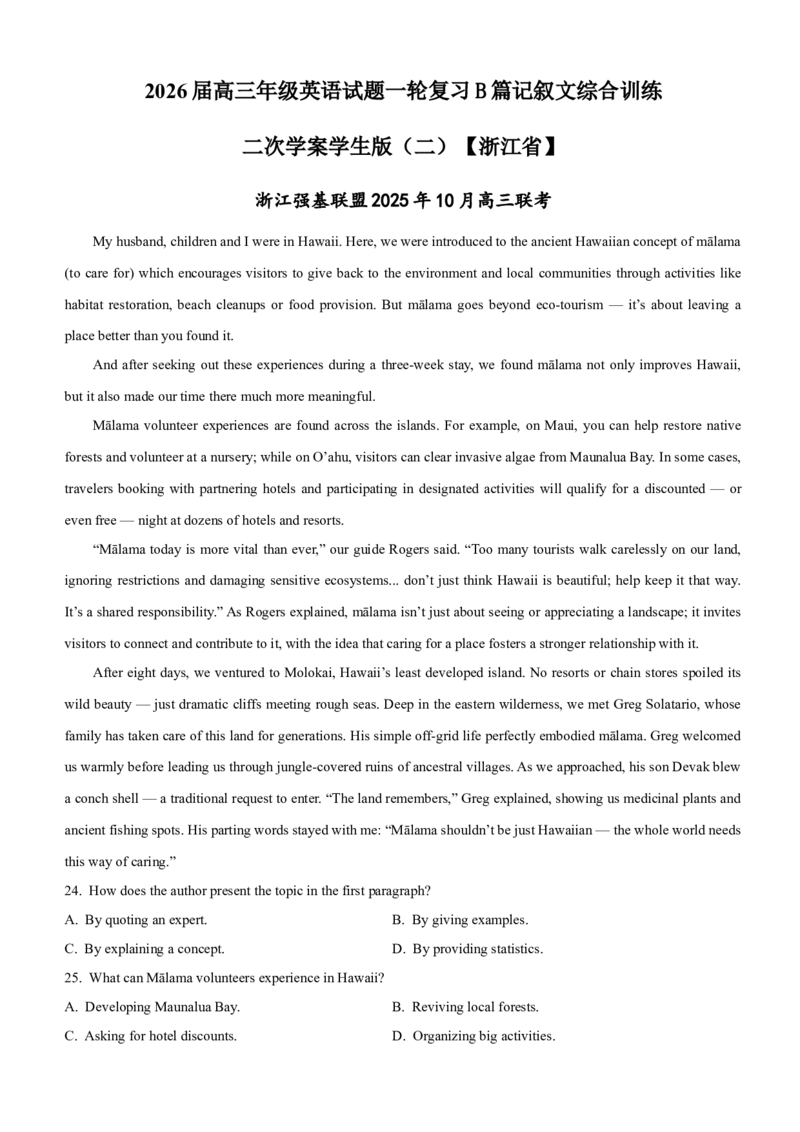
My husband, children and I were in Hawaii. Here, we were introduced to the ancient Hawaiian concept of mālama
(to care for) which encourages visitors to give back to the environment and local communities through activities like
habitat restoration, beach cleanups or food provision. But mālama goes beyond eco-tourism — it’s about leaving a
place better than you found it.
And after seeking out these experiences during a three-week stay, we found mālama not only improves Hawaii,
but it also made our time there much more meaningful.
Mālama volunteer experiences are found across the islands. For example, on Maui, you can help restore native
forests and volunteer at a nursery; while on O’ahu, visitors can clear invasive algae from Maunalua Bay. In some cases,
travelers booking with partnering hotels and participating in designated activities will qualify for a discounted — or
even free — night at dozens of hotels and resorts.
“Mālama today is more vital than ever,” our guide Rogers said. “Too many tourists walk carelessly on our land,
ignoring restrictions and damaging sensitive ecosystems... don’t just think Hawaii is beautiful; help keep it that way.
It’s a shared responsibility.” As Rogers explained, mālama isn’t just about seeing or appreciating a landscape; it invites
visitors to connect and contribute to it, with the idea that caring for a place fosters a stronger relationship with it.
After eight days, we ventured to Molokai, Hawaii’s least developed island. No resorts or chain stores spoiled its
wild beauty — just dramatic cliffs meeting rough seas. Deep in the eastern wilderness, we met Greg Solatario, whose
family has taken care of this land for generations. His simple off-grid life perfectly embodied mālama. Greg welcomed
us warmly before leading us through jungle-covered ruins of ancestral villages. As we approached, his son Devak blew
a conch shell — a traditional request to enter. “The land remembers,” Greg explained, showing us medicinal plants and
ancient fishing spots. His parting words stayed with me: “Mālama shouldn’t be just Hawaiian — the whole world needs
this way of caring.”
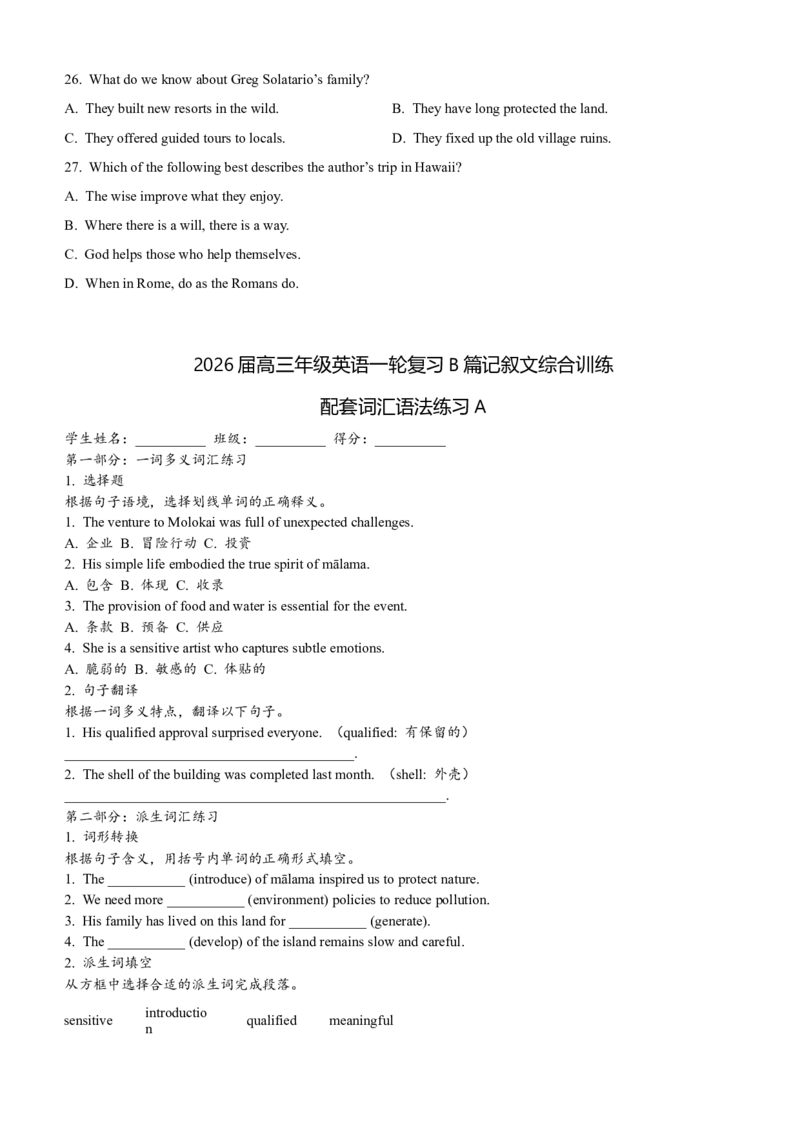
24. How does the author present the topic in the first paragraph?
A. By quoting an expert.
B. By giving examples.
C. By explaining a concept.
D. By providing statistics.
25. What can Mālama volunteers experience in Hawaii?
A. Developing Maunalua Bay.
B. Reviving local forests.
C. Asking for hotel discounts.
D. Organizing big activities.
26. What do we know about Greg Solatario’s family?
A. They built new resorts in the wild.
B. They have long protected the land.
C. They offered guided tours to locals.
D. They fixed up the old village ruins.
27. Which of the following best describes the author’s trip in Hawaii?
A. The wise improve what they enjoy.
B. Where there is a will, there is a way.
C. God helps those who help themselves.
D. When in Rome, do as the Romans do.
2026 届高三年级英语一轮复习B 篇记叙文综合训练
配套词汇语法练习A
学生姓名:__________ 班级:__________ 得分:__________
第一部分:一词多义词汇练习
1. 选择题
根据句子语境,选择划线单词的正确释义。
1. The venture to Molokai was full of unexpected challenges.
A. 企业 B. 冒险行动 C. 投资
2. His simple life embodied the true spirit of mālama.
A. 包含 B. 体现 C. 收录
3. The provision of food and water is essential for the event.
A. 条款 B. 预备 C. 供应
4. She is a sensitive artist who captures subtle emotions.
A. 脆弱的 B. 敏感的 C. 体贴的
2. 句子翻译
根据一词多义特点,翻译以下句子。
1. His qualified approval surprised everyone. (qualified: 有保留的)
_________________________________________.
2. The shell of the building was completed last month. (shell: 外壳)
______________________________________________________.
第二部分:派生词汇练习
1. 词形转换
根据句子含义,用括号内单词的正确形式填空。
1. The ___________ (introduce) of mālama inspired us to protect nature.
2. We need more ___________ (environment) policies to reduce pollution.
3. His family has lived on this land for ___________ (generate).
4. The ___________ (develop) of the island remains slow and careful.
2. 派生词填空
从方框中选择合适的派生词完成段落。
sensitive
introductio
n
qualified
meaningful
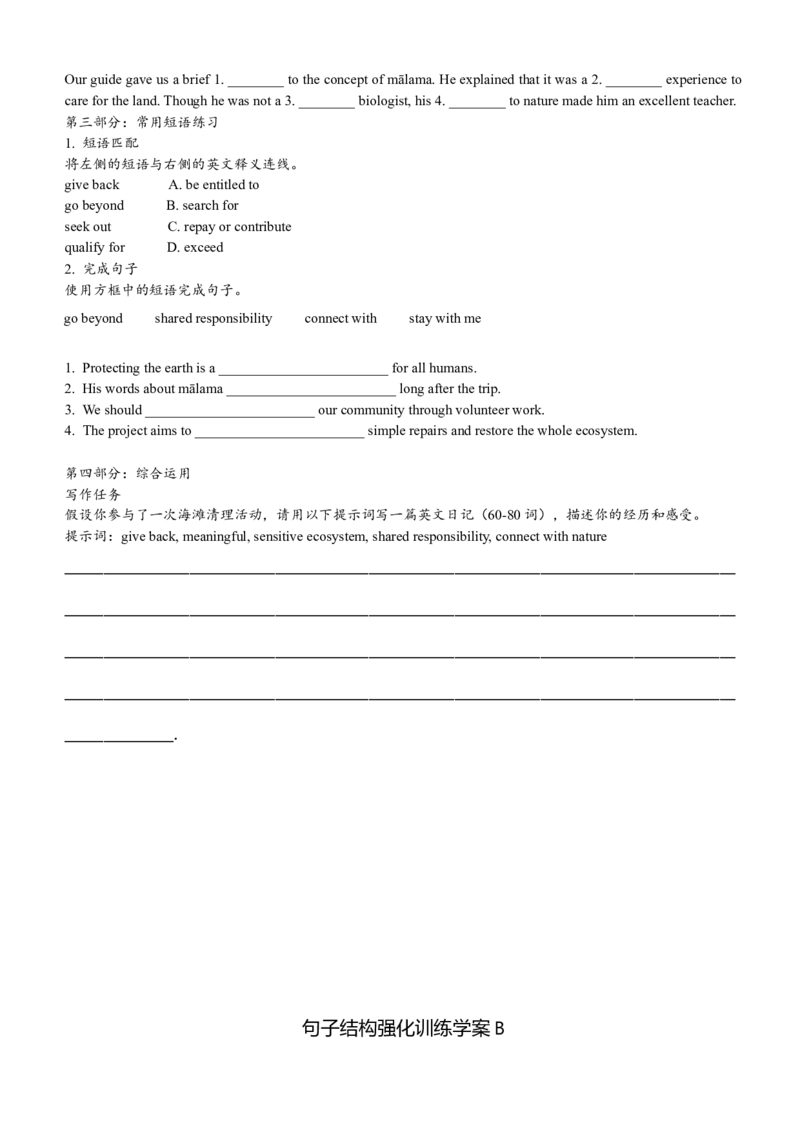
Our guide gave us a brief 1. ________ to the concept of mālama. He explained that it was a 2. ________ experience to
care for the land. Though he was not a 3. ________ biologist, his 4. ________ to nature made him an excellent teacher.
第三部分:常用短语练习
1. 短语匹配
将左侧的短语与右侧的英文释义连线。
give back       A. be entitled to
go beyond      B. search for
seek out        C. repay or contribute
qualify for      D. exceed
2. 完成句子
使用方框中的短语完成句子。
go beyond
shared responsibility
connect with
stay with me
1. Protecting the earth is a ________________________ for all humans.
2. His words about mālama ________________________ long after the trip.
3. We should ________________________ our community through volunteer work.
4. The project aims to ________________________ simple repairs and restore the whole ecosystem.
第四部分:综合运用
写作任务
假设你参与了一次海滩清理活动,请用以下提示词写一篇英文日记(60-80 词),描述你的经历和感受。
提示词:give back, meaningful, sensitive ecosystem, shared responsibility, connect with nature
______________________________________________________________________________________
______________________________________________________________________________________
______________________________________________________________________________________
______________________________________________________________________________________
______________.
句子结构强化训练学案B
第一部分:核心句型结构训练
请观察例句的结构和功能,并仿照示例,根据括号内的中文提示完成英文句子。
1. 句型:Here, we were introduced to the ancient ... concept of... which encourages...
功能: 用于引入并定义一个核心概念。
例句: Here, we were introduced to the ancient Hawaiian concept of mālama which encourages visitors to give back.
仿写:(在这里,我们了解到了“天人合一”这一古老的中国概念,它鼓励人们与自然和谐共处。)
→ Here, we were introduced to the ancient Chinese concept of "Tian Ren He Yi" which encourages
_________________________.
2. 句型:... goes beyond ... --- it's about...
功能: 用于深化论述,揭示事物的本质。
例句: But mālama goes beyond eco-tourism --- it's about leaving a place better than you found it.
仿写:(学习一门语言远不止记忆单词和语法——它关乎理解一种全新的思维方式。)
→ Learning a language goes beyond _________________________.
3. 句型:We found ... not only ..., but it also made ... much more meaningful.
功能: 用于阐述某件事物带来的双重积极影响。
例句: We found mālama not only improves Hawaii, but it also made our time there much more meaningful.
仿写:(我们发现团队合作不仅能提高效率,也使得整个项目过程更有意义。)
→ We found teamwork not only _________________________.
5. 句型:"...," our guide ... said. "..." / As ... explained, ...
功能: 通过直接引语或间接引语,引用权威或当地人的话来增强说服力。
例句: "Mālama today is more vital than ever," our guide Rogers said. / As Rogers explained, mālama isn't just about
seeing a landscape.
仿写:(我的爷爷常说:“勤俭是持家之本。” 正如他解释的那样,这不仅仅是省钱。)
→ "Frugality is the foundation of a good family," my grandfather often said. / As he explained,
_________________________.
5. 句型:... shouldn't be just ... --- the whole world needs ...
功能: 用于结尾,将一个地方性的理念升华到普世高度。
例句: Mālama shouldn't be just Hawaiian --- the whole world needs this way of caring.
仿写:(这种互助精神不应该只是我们社区的——整个世界都需要这种邻里守望相助的方式。)
→ This spirit of mutual help shouldn't be just _________________________.
第二部分:微写作训练
任务一:应用文写作(倡议书)
假设你是学校“绿色家园”社团的社长李华。在学习了“Mālama”文化后,你深受启发,请用英文写一封倡议
书,呼吁同学们参与本学期的“关爱校园(Campus Mālama Week)”活动。
写作要点:
解释“Mālama”的含义及其对你的启发。
介绍活动内容(如:清洁校园、垃圾分类宣传、种植本地植物等)。
说明参与活动的意义,并发出呼吁。
要求:
字数:100 词左右。
必须使用本课学到的至少2 个核心句型。