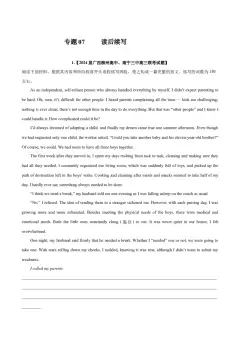
湖南省长郡中学、湖南师大附中、长沙一中2026 届高中毕业班7 月摸底联考英
语试题
阅读下面材料,根据其内容和所给段落开头语续写两段,使之构成一篇完整的短
文。
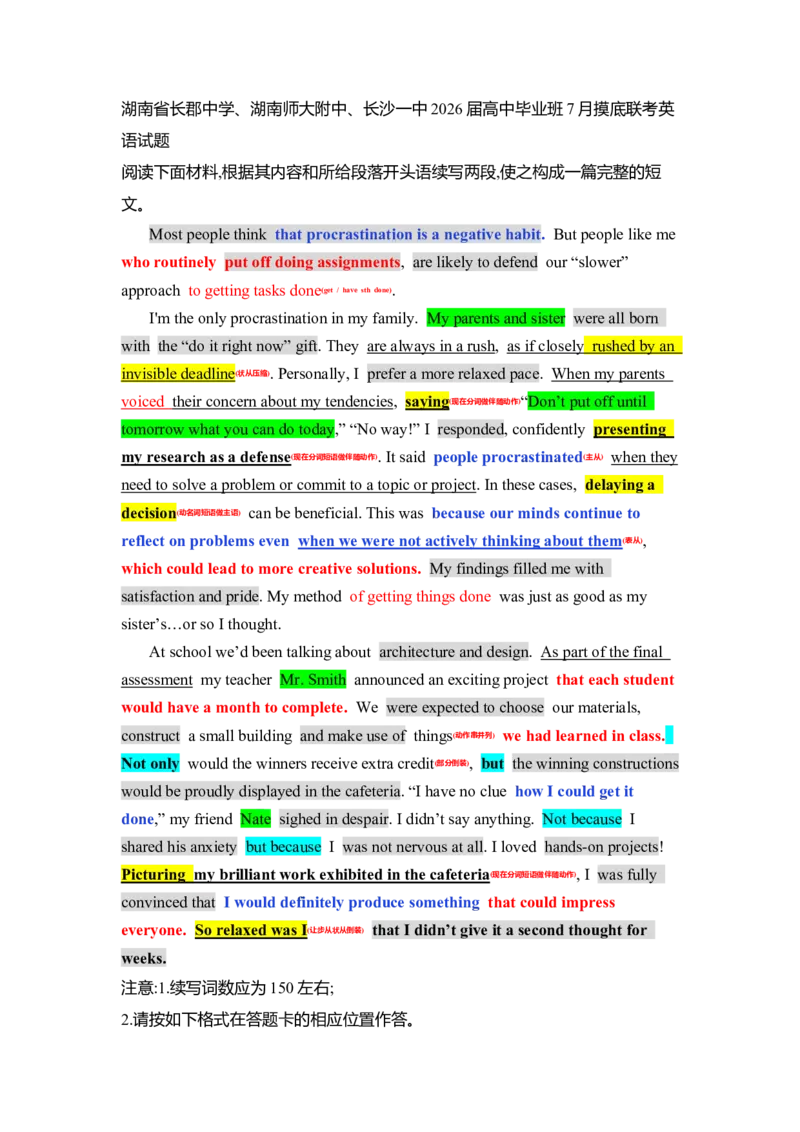
Most people think that procrastination is a negative habit. But people like me
who routinely put off doing assignments, are likely to defend our “slower”
approach to getting tasks done(get / have sth done).
I'm the only procrastination in my family. My parents and sister were all born
with the “do it right now” gift. They are always in a rush, as if closely

  rushed by an


invisible deadline(状从压缩). Personally, I prefer a more relaxed pace. When my parents
voiced

 their concern about my tendencies

 , saying(现在分词做伴随动作)“Don’t put off until
tomorrow what you can do today,” “No way!” I responded, confidently presenting
my research as a defense(现在分词短语做伴随动作). It said people procrastinated(主从) when they
need to solve a problem or commit to a topic or project. In these cases, delaying a
decision(动名词短语做主语) can be beneficial. This was because our minds continue to
reflect on problems even when we were not actively thinking about them(表从),
which could lead to more creative solutions. My findings filled me with
satisfaction and pride. My method of getting things done was just as good as my
sister’s…or so I thought.
At school we’d been talking about architecture and design. As part of the final
assessment my teacher Mr. Smith announced an exciting project that each student
would have a month to complete. We were expected to choose our materials,
construct a small building and make use of things(动作串并列) we had learned in class.
Not only would the winners receive extra credit(部分倒装), but the winning constructions
would be proudly displayed in the cafeteria. “I have no clue how I could get it
done,” my friend Nate sighed in despair. I didn’t say anything. Not because I
shared his anxiety but because I was not nervous at all. I loved hands-on projects!
Picturing

 my brilliant work exhibited in the cafeteria

 (现在分词短语做伴随动作), I was fully
convinced that I would definitely produce something that could impress
everyone. So relaxed was I(让步从状从倒装) that I didn’t give it a second thought for
weeks.
注意:1.续写词数应为150 左右;
2.请按如下格式在答题卡的相应位置作答。
Paragraph 1: Before I knew it, I had only one day left for the project.
Paragraph 2: That taught me a great lesson.
湖南省长郡中学、湖南师大附中、长沙一中2026 届高中毕业班7 月摸底联考英
语试题
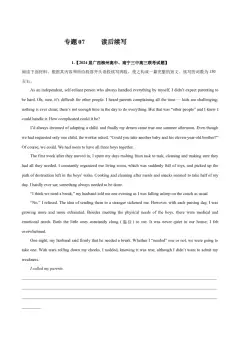
阅读下面材料,根据其内容和所给段落开头语续写两段,使之构成一篇完整的短
文。
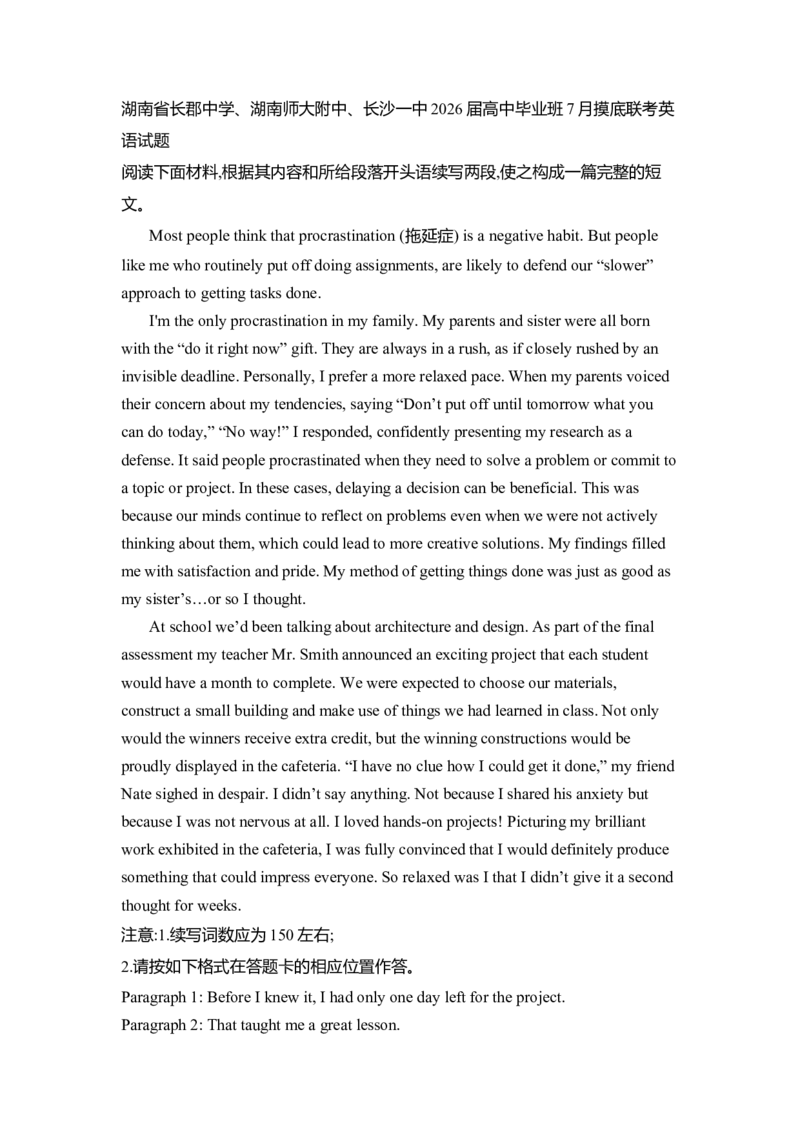
Most people think that procrastination (拖延症) is a negative habit. But people
like me who routinely put off doing assignments, are likely to defend our “slower”
approach to getting tasks done.
I'm the only procrastination in my family. My parents and sister were all born
with the “do it right now” gift. They are always in a rush, as if closely rushed by an
invisible deadline. Personally, I prefer a more relaxed pace. When my parents voiced
their concern about my tendencies, saying “Don’t put off until tomorrow what you
can do today,” “No way!” I responded, confidently presenting my research as a
defense. It said people procrastinated when they need to solve a problem or commit to
a topic or project. In these cases, delaying a decision can be beneficial. This was
because our minds continue to reflect on problems even when we were not actively
thinking about them, which could lead to more creative solutions. My findings filled
me with satisfaction and pride. My method of getting things done was just as good as
my sister’s…or so I thought.
At school we’d been talking about architecture and design. As part of the final
assessment my teacher Mr. Smith announced an exciting project that each student
would have a month to complete. We were expected to choose our materials,
construct a small building and make use of things we had learned in class. Not only
would the winners receive extra credit, but the winning constructions would be
proudly displayed in the cafeteria. “I have no clue how I could get it done,” my friend
Nate sighed in despair. I didn’t say anything. Not because I shared his anxiety but
because I was not nervous at all. I loved hands-on projects! Picturing my brilliant
work exhibited in the cafeteria, I was fully convinced that I would definitely produce
something that could impress everyone. So relaxed was I that I didn’t give it a second
thought for weeks.
注意:1.续写词数应为150 左右;
2.请按如下格式在答题卡的相应位置作答。
Paragraph 1: Before I knew it, I had only one day left for the project.
Paragraph 2: That taught me a great lesson.
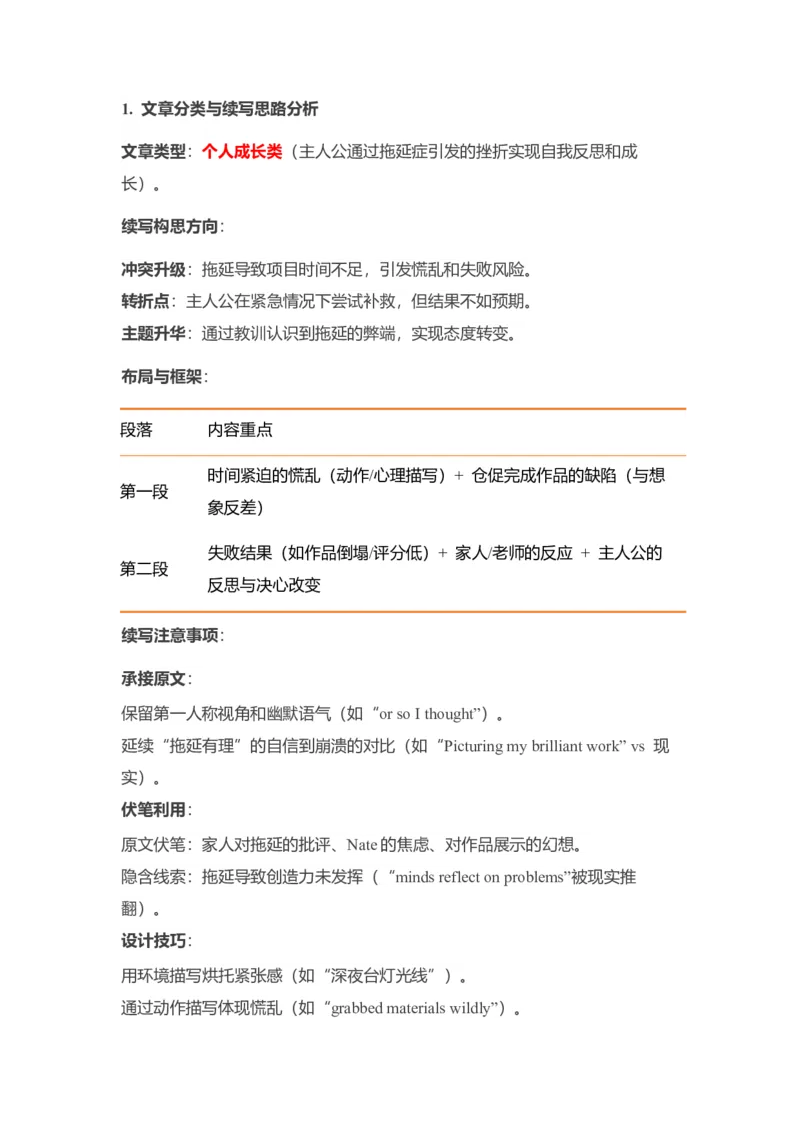
1. 文章分类与续写思路分析
文章类型:个人成长类(主人公通过拖延症引发的挫折实现自我反思和成
长)。
续写构思方向:
冲突升级:拖延导致项目时间不足,引发慌乱和失败风险。
转折点:主人公在紧急情况下尝试补救,但结果不如预期。
主题升华:通过教训认识到拖延的弊端,实现态度转变。
布局与框架:
段落
内容重点
第一段
时间紧迫的慌乱(动作/心理描写)+ 仓促完成作品的缺陷(与想
象反差)
第二段
失败结果(如作品倒塌/评分低)+ 家人/老师的反应 + 主人公的
反思与决心改变
续写注意事项:
承接原文:
保留第一人称视角和幽默语气(如“or so I thought”)。
延续“拖延有理”的自信到崩溃的对比(如“Picturing my brilliant work” vs 现
实)。
伏笔利用:
原文伏笔:家人对拖延的批评、Nate 的焦虑、对作品展示的幻想。
隐含线索:拖延导致创造力未发挥(“minds reflect on problems”被现实推
翻)。
设计技巧:
用环境描写烘托紧张感(如“深夜台灯光线”)。
通过动作描写体现慌乱(如“grabbed materials wildly”)。
2. 故事山模式与原文分析
故事山结构:
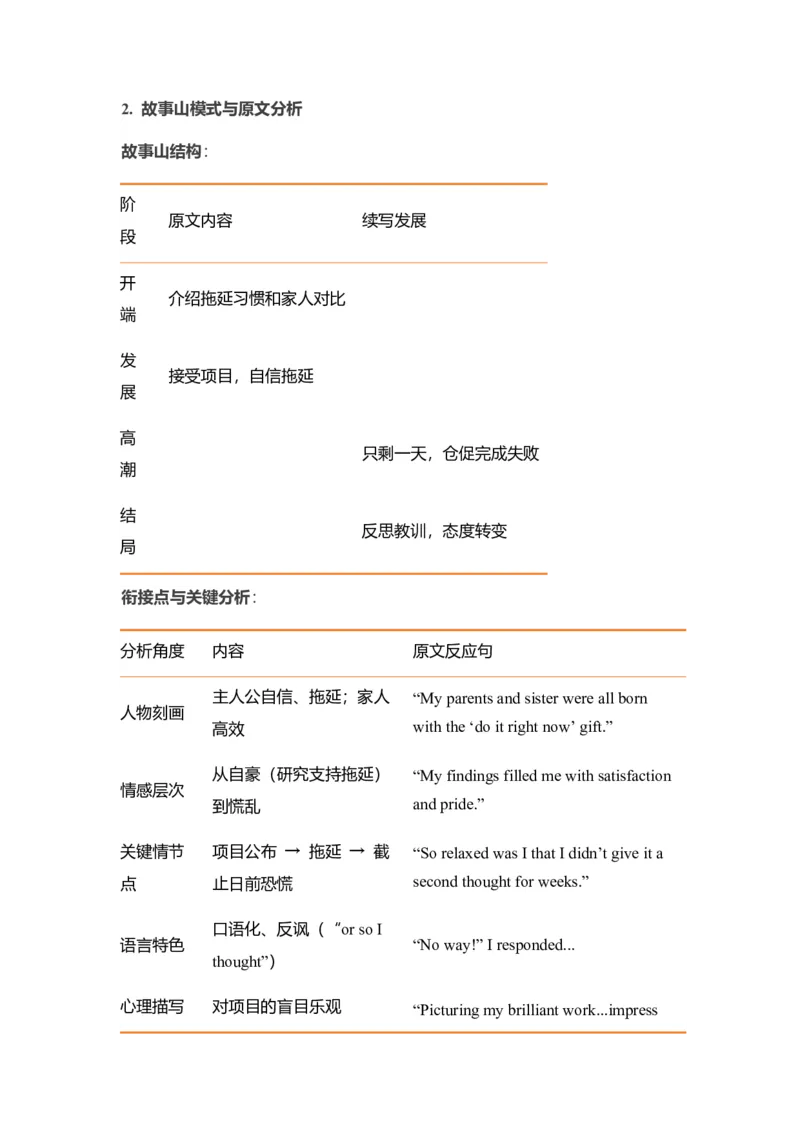
阶
段
原文内容
续写发展
开
端
介绍拖延习惯和家人对比
发
展
接受项目,自信拖延
高
潮
只剩一天,仓促完成失败
结
局
反思教训,态度转变
衔接点与关键分析:
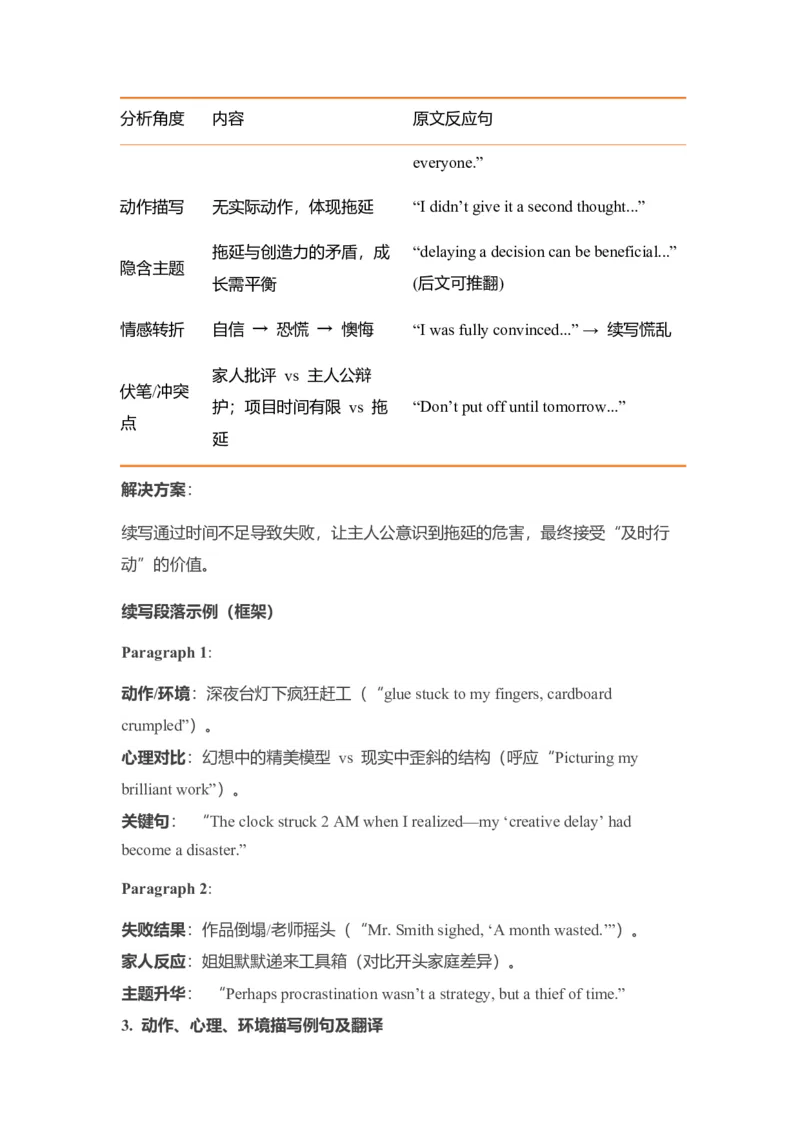
分析角度
内容
原文反应句
人物刻画
主人公自信、拖延;家人
高效
“My parents and sister were all born
with the ‘do it right now’ gift.”
情感层次
从自豪(研究支持拖延)
到慌乱
“My findings filled me with satisfaction
and pride.”
关键情节
点
项目公布 → 拖延 → 截
止日前恐慌
“So relaxed was I that I didn’t give it a
second thought for weeks.”
语言特色
口语化、反讽(“or so I
thought”)
“No way!” I responded...
心理描写
对项目的盲目乐观
“Picturing my brilliant work...impress
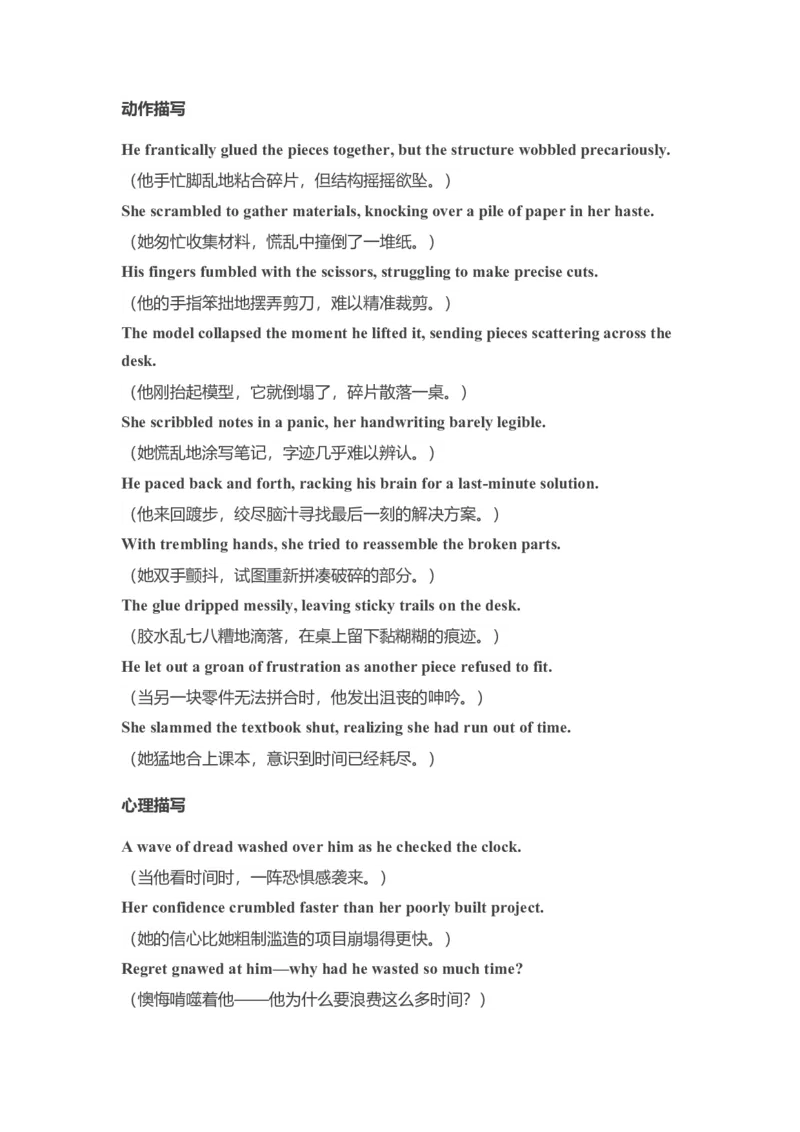
分析角度
内容
原文反应句
everyone.”
动作描写
无实际动作,体现拖延
“I didn’t give it a second thought...”
隐含主题
拖延与创造力的矛盾,成
长需平衡
“delaying a decision can be beneficial...”
(后文可推翻)
情感转折
自信 → 恐慌 → 懊悔
“I was fully convinced...” → 续写慌乱
伏笔/冲突
点
家人批评 vs 主人公辩
护;项目时间有限 vs 拖
延
“Don’t put off until tomorrow...”
解决方案:
续写通过时间不足导致失败,让主人公意识到拖延的危害,最终接受“及时行
动”的价值。
续写段落示例(框架)
Paragraph 1:
动作/环境:深夜台灯下疯狂赶工(“glue stuck to my fingers, cardboard
crumpled”)。
心理对比:幻想中的精美模型 vs 现实中歪斜的结构(呼应“Picturing my
brilliant work”)。
关键句: “The clock struck 2 AM when I realized—my ‘creative delay’ had
become a disaster.”
Paragraph 2:
失败结果:作品倒塌/老师摇头(“Mr. Smith sighed, ‘A month wasted.’”)。
家人反应:姐姐默默递来工具箱(对比开头家庭差异)。
主题升华: “Perhaps procrastination wasn’t a strategy, but a thief of time.”
3. 动作、心理、环境描写例句及翻译
动作描写
He frantically glued the pieces together, but the structure wobbled precariously.
(他手忙脚乱地粘合碎片,但结构摇摇欲坠。)
She scrambled to gather materials, knocking over a pile of paper in her haste.
(她匆忙收集材料,慌乱中撞倒了一堆纸。)
His fingers fumbled with the scissors, struggling to make precise cuts.
(他的手指笨拙地摆弄剪刀,难以精准裁剪。)
The model collapsed the moment he lifted it, sending pieces scattering across the
desk.
(他刚抬起模型,它就倒塌了,碎片散落一桌。)
She scribbled notes in a panic, her handwriting barely legible.
(她慌乱地涂写笔记,字迹几乎难以辨认。)
He paced back and forth, racking his brain for a last-minute solution.
(他来回踱步,绞尽脑汁寻找最后一刻的解决方案。)
With trembling hands, she tried to reassemble the broken parts.
(她双手颤抖,试图重新拼凑破碎的部分。)
The glue dripped messily, leaving sticky trails on the desk.
(胶水乱七八糟地滴落,在桌上留下黏糊糊的痕迹。)
He let out a groan of frustration as another piece refused to fit.
(当另一块零件无法拼合时,他发出沮丧的呻吟。)
She slammed the textbook shut, realizing she had run out of time.
(她猛地合上课本,意识到时间已经耗尽。)
心理描写
A wave of dread washed over him as he checked the clock.
(当他看时间时,一阵恐惧感袭来。)
Her confidence crumbled faster than her poorly built project.
(她的信心比她粗制滥造的项目崩塌得更快。)
Regret gnawed at him—why had he wasted so much time?
(懊悔啃噬着他——他为什么要浪费这么多时间?)
Panic set in, his mind racing with worst-case scenarios.
(恐慌袭来,他的脑海里闪过最糟糕的情况。)
For the first time, he questioned his belief in “productive procrastination.”
(他第一次质疑自己对“高效拖延”的信念。)
She bit her lip, torn between giving up and making a desperate attempt.
(她咬着嘴唇,在放弃和孤注一掷之间挣扎。)
His earlier pride now felt like foolish arrogance.
(他先前的自豪现在感觉像愚蠢的自负。)
A sinking feeling told him this wouldn’t end well.
(一种不祥的预感告诉他,这不会有好结果。)
If only he had started earlier, he wouldn’t be in this mess.
(要是他早点开始,就不会陷入这种困境。)
Defeat weighed heavily on his shoulders as he stared at the ruined project.
(当他盯着失败的项目时,挫败感沉重地压在他肩上。)
环境描写
The dim glow of the desk lamp cast long shadows across the cluttered workspace.
(台灯昏暗的光线在凌乱的工作区投下长长的阴影。)
The clock’s ticking grew louder, a relentless reminder of time slipping away.
(时钟的滴答声越来越响,无情地提醒着时间的流逝。)
Scraps of paper and discarded materials littered the floor.
(纸屑和废弃的材料散落一地。)
Outside, the quiet of the night contrasted sharply with his inner turmoil.
(外面夜晚的宁静与他内心的混乱形成鲜明对比。)
The air smelled of glue and sweat, a testament to his frantic efforts.
(空气中弥漫着胶水和汗水的味道,证明了他的慌乱努力。)
Moonlight streamed through the window, illuminating his half-finished disaster.
(月光透过窗户洒进来,照亮了他半成品的灾难。)
The empty coffee cup sat abandoned, its contents long gone.
(空咖啡杯被遗弃在一旁,里面的咖啡早已喝完。)
A cold draft made him shiver, adding to his growing unease.
(一阵冷风让他发抖,加剧了他不断增长的不安。)
The classroom, usually lively, now felt eerily silent as students focused on their
projects.
(平时热闹的教室现在异常安静,学生们专注于他们的项目。)
The cafeteria’s display case loomed in his mind, mocking his unfinished work.
(食堂的展示柜在他脑海中挥之不去,嘲笑着他未完成的作品。)
高级替换词(场景分类)
基础词
高级替换词
适用场景
Bad
Disastrous, Catastrophic
形容项目失败
Fast
Frantic, Hasty
形容慌乱行动
Sad
Devastated, Crestfallen
形容挫败感
Happy
Elated, Triumphant
形容成功喜悦
Think
Contemplate, Ponder
形容深度思考
常见固定搭配 & 词法解析
Rack one’s brain(绞尽脑汁)
He racked his brain for a solution but found none.
Last-minute effort(最后一刻的努力)
Her last-minute effort couldn’t save the project.
Crumbling confidence(崩塌的信心)
His confidence was crumbling under the pressure.
A race against time(与时间赛跑)
It was a race against time to finish before the deadline.
Fall apart(崩溃,散架)
The poorly built model fell apart instantly.
可积累的语料(生词短语)
Precariously (adv.) – 视情况而定的,危险的
近义词: Unsteadily, Dangerously
反义词: Securely, Firmly
例句:
The tower stood precariously, threatening to collapse.
He balanced precariously on the edge of failure.
Gnaw at (phr.) – 啃噬(比喻心理折磨)
近义词: Torment, Haunt
反义词: Comfort, Soothe
例句:
Guilt gnawed at him as he remembered his procrastination.
The thought of failure gnawed at her confidence.
Frantic (adj.) – 疯狂的,慌乱的
近义词: Frenzied, Desperate
反义词: Calm, Composed
例句:
She made frantic attempts to fix the mistake.
His movements were frantic as the deadline approached.
Loom (v.) – 隐约逼近(常用于形容压力或威胁)
近义词: Approach, Threaten
反义词: Recede, Fade
例句:
The deadline loomed larger with each passing hour.
Failure loomed over him like a dark cloud.
Crestfallen (adj.) – 沮丧的,垂头丧气的
近义词: Dejected, Disheartened
反义词: Elated, Jubilant
例句:
He stood crestfallen in front of his ruined project.
Her crestfallen expression revealed her disappointment.
总结
动作描写:突出慌乱、失误、补救尝试。
心理描写:强调后悔、恐慌、自我怀疑。
环境描写:渲染紧张氛围(时间、光线、杂乱)。
高级替换词:提升语言质量,避免重复。
固定搭配:增强表达地道性(如 rack one’s brain)。
生词语料:积累精准词汇(如 gnaw at, loom)。
5. Possible Versions(4)
Version 1
Paragraph 1:
Before I knew it, I had only one day left for the project.

   Panic gripped me(无灵主语
句) as I stood in front of the

 desk

 , pulling out

  random pieces of

  cardboard, bottle
caps, and old magazines(名词并列). My heart raced, and the once-clear image of a
brilliant building blurred into a desperate mess. My fingers fumbled as I glued
crooked walls and shaky roofs, hoping(现在分词短语做伴随动作)some part of it would
miraculously impress the judges. When I brought my “

 creation

 ” to school

 , I
avoided everyone’s eyes. Nate’s model, built

 from wood with smooth paintwork


and clean lines(过去分词做后置定语), looked like something out of a professional studio. Mr.
Smith nodded approvingly, even pausing to compliment

 the details

 (现在分词短语做伴随动作).
I pretended to smile, but inside, embarrassment burned. I had misjudged my
approach, and now the evidence stood lopsided before me.
Paragraph 2
That taught me a great lesson. No amount of last-minute effort could hide the
truth(无灵主语句): I had wasted precious time. From that day forward, I made a conscious
effort to plan ahead and face tasks early, no matter how confident I felt at the start.
Surprisingly, I discovered that starting early didn’t kill creativity—it sparked
more of it. Not only did I finish projects ahead of time(部分倒装句), but also I found joy
in revising and improving. In our final project of the semester, I began sketching my
design the same week it was announced.  Seeing

 my improved model displayed

 (现
在分词短语做伴随动作), I couldn’t help smiling. Watching

  my family’s

  proud faces

 (现在分词短语做伴
随动作), especially my sister’s approving nod, I finally understood: discipline was not
the enemy of creativity—it was its foundation.
Version 2
Paragraph 1
Before I knew it, I had only one day left for the project. Despite my earlier
confidence, I found myself sitting at my desk, staring at

  a pile of mismatched


materials from our recycle bin(现在分词短语做伴随动作). The silence in the room was almost
mocking. As I hurried to put things together, each cut, fold, and glue(名词主语并列) felt
more like damage control than design. I remembered the pride I had felt while
defending

 procrastination

 to my parents

 —and it now felt hollow. In class the next
day, Nate’s model stood tall and balanced, constructed

 from clay and painted


with impressive detail(过去分词短语做后置定语). Others had used wood, wires, and even mini
glass windows(名词并列). My project, fragile and crooked(adj 做主语补语), barely stood upright.
When Mr. Smith walked past mine with only a glance, I knew I hadn’t just
missed the deadline—I had missed an opportunity, and more importantly, I
failed the class .
Paragraph 2
That taught me a great lesson. What I once called “creative delay”(主从) was
simply poor planning. From then on, I began by setting mini-deadlines for big tasks.
Bit by bit, I improved—not just in architecture but in all my classes. Not only(部分倒装
句) did I feel more in control of my time, but also I felt proud of my work,
knowing(现在分词短语做伴随动作) I had given it my full effort. The next time Mr. Smith gave
us a design task, I started immediately, sketching

 and building step by step

 (现在分词短语
做伴随动作). When he selected mine for the end-of-term display, I couldn’t stop smiling.
Watching

 my sister

  take a photo beside my model

 (现在分词短语做伴随动作),,my parents’
proud smile, I finally felt the satisfaction I once only imagined. That moment
made one thing clear: time is not the enemy—it’s your partner if you learn to
respect it.
Version 3
Paragraph 1
Before I knew it, I had only one day left for the project. I rushed home, dug
through the recycle bin, and grabbed whatever I could find—cardboard tubes,
bottle caps, and scraps of string(名词并列). There was no plan, no design, just panic(并
列递进). I worked late into the night, hands trembling, heart heavy(独立主格). The result
was a leaning mess of parts barely held together with glue. The next morning, I
avoided looking at anyone’s work. But when

 Mr. Smith

  gathered the class to


praise outstanding projects, I couldn’t help peeking. Nate’s building had arched
doorways and intricate details carved from clay. Another classmate had even installed
a tiny LED inside a wooden house. Compared

 to theirs

 (过去分词做方式状语), mine looked
like a last-minute school art project. I lowered my eyes, ashamed(adj 做主语补语).
Paragraph 2
That taught me a great lesson. For the first time, I realized my approach
wasn’t just lazy—it was disrespectful to my own potential. After that day, I
promised myself I would never let my creativity be ruined by procrastination.
Instead of waiting for pressure to push me forward, I learned to act early and improve
gradually. Not only did my confidence grow with every early start, but also my
results improved in ways I hadn’t expected. By the end of the term, I had developed
a system—plan, sketch, build, review(动词短语并列). My final model was chosen for the
school’s spring showcase. Seeing

 it under the spotlight

 (现在分词短语做伴随动作), and my
parents quietly taking photos, I smiled, with

   my
    sister

   holding

   my
    arms

 . I had
beaten procrastination not by working harder—but by working wiser after the
crucial lesson I had learned last time.
类型
亮点表达
高考句式/语法点
情绪描写
panic gripped me, heart raced,
embarrassment burned, felt hollow,
ashamed
独立主格:Hands shaking, I
glued...
动作描写
fumbled with, glued together, avoided eye
contact, sketched step by step
倒装句结构:Not only did I
finish… but also...
高分句型
it dawned on me that…, not just…but…, I
couldn’t help doing
强调句、虚拟语气、过去完
成时等可灵活应用
积累素材
分类
表达亮点
地道搭配
a pile of mismatched junk;sting from lack of sleep;half-baked
building
同义替换
panic → anxiety, fear;idea → concept, vision;frustration →
annoyance
情绪描写
panic began to creep in;frustration overwhelmed me;felt a pang of
regret
动作描写
stared at, sketched, glued, gritted my teeth, handed in
语法亮点
if only 虚拟语气;强调句It was...that;非谓语做伴随(trembling
hands)等
写作语料
inspiration works best with preparation;quitting wasn’t an option
官方读后续写
Para.1 Before I knew it, I had only one day left for the project. In a panic I
hastily and quickly glued together what I pulled out from our recycle bin, my
hands shaking with the weight of each hasty decision

 ,   not

   a    creative

   one

 . The
finished result looked miserable. Several of my classmates, including

 Nate

 , had
created amazingly detailed constructions. They used materials like clay, wood and so
on(名词并列) and were highly praised by Mr. Smith. When I saw their models, I felt
even more embarrassed about mine. It was obvious that they had put a lot more time
into the assignment than I had.
Para.2 That taught me a great lesson. I learnt from that day the importance of
deciding on my priorities and budgeting my time. From then on, I tackled things a
lot earlier instead of putting things off until tomorrow. As a result, not only did I
finish my tasks on time, but also(部分倒装句) I felt better because I didn’t have to panic at
the last minute. At the end of the semester, my work was chosen by Mr. Smith on
another occasion. Seeing

 my change

 (现在分词短语做伴随动作), my parents and my sister were
so proud of me. It dawned on me that getting things done on time instead of being
a procrastinator really counted.