K 练习题
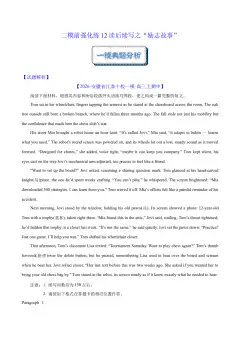
阅读下面材料,根据其内容和所给段落开头语续写两段,使之构成一篇完整的短
文。
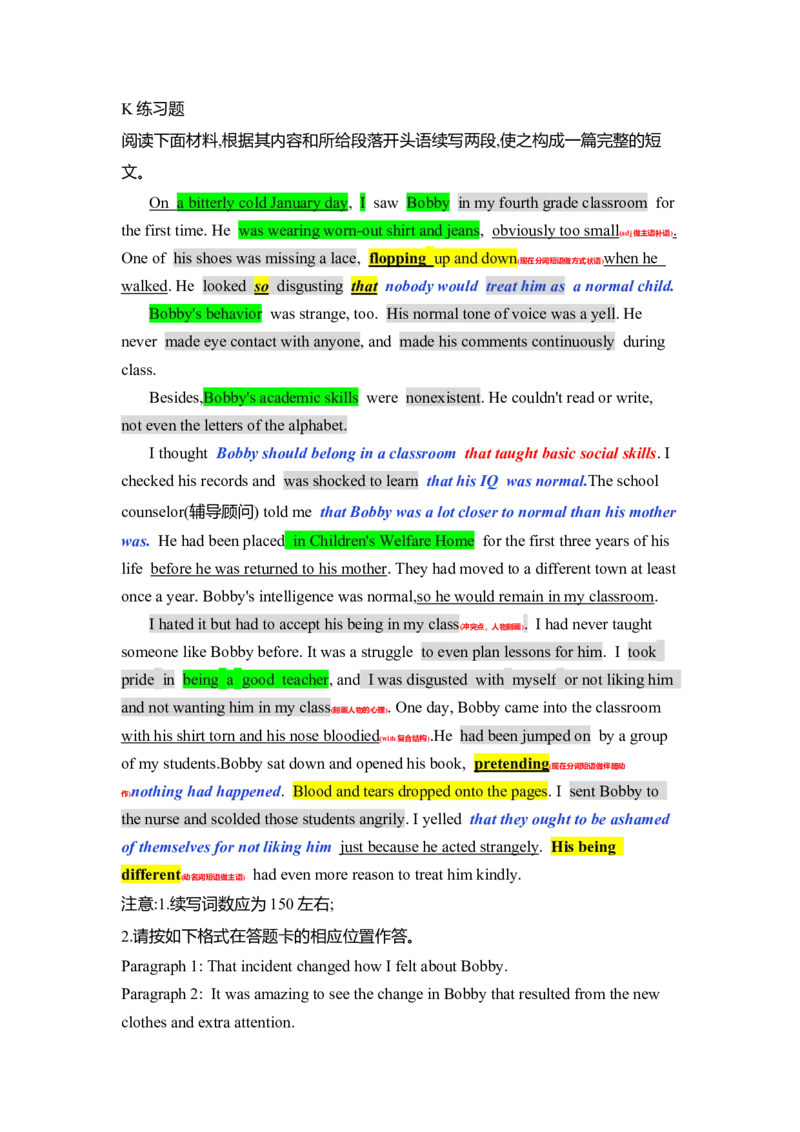
On

 a bitterly cold January day

 , I saw Bobby in my fourth grade classroom for
the first time. He was wearing worn-out shirt and jeans, obviously too small(adj 做主语补语).
One of his shoes was missing a lace, flopping

   up and down(现在分词短语做方式状语)when he
walked. He looked so disgusting that nobody would treat him as a normal child.
Bobby's behavior was strange, too. His normal tone of voice was a yell. He
never made eye contact with anyone, and made his comments continuously during
class.
Besides,Bobby's academic skills were nonexistent. He couldn't read or write,
not even the letters of the alphabet.
I thought Bobby should belong in a classroom that taught basic social skills. I
checked his records and was shocked to learn that his IQ was normal.The school
counselor(辅导顾问) told me that Bobby was a lot closer to normal than his mother
was. He had been placed in Children's Welfare Home for the first three years of his
life before he was returned to his mother. They had moved to a different town at least
once a year. Bobby's intelligence was normal,so he would remain in my classroom.
I hated it but had to accept his being in my class(冲突点,人物刻画). I had never taught
someone like Bobby before. It was a struggle to even plan lessons for him. I took
pride in being a good teacher, and I was disgusted with myself or not liking him
and not wanting him in my class(刻画人物的心理). One day, Bobby came into the classroom
with his shirt torn and his nose bloodied(with 复合结构).He had been jumped on by a group
of my students.Bobby sat down and opened his book, pretending(现在分词短语做伴随动
作)nothing had happened. Blood and tears dropped onto the pages. I sent Bobby to
the nurse and scolded those students angrily. I yelled that they ought to be ashamed
of themselves for not liking him just because he acted strangely. His being
different(动名词短语做主语) had even more reason to treat him kindly.
注意:1.续写词数应为150 左右;
2.请按如下格式在答题卡的相应位置作答。
Paragraph 1: That incident changed how I felt about Bobby.
Paragraph 2: It was amazing to see the change in Bobby that resulted from the new
clothes and extra attention.
K 练习题
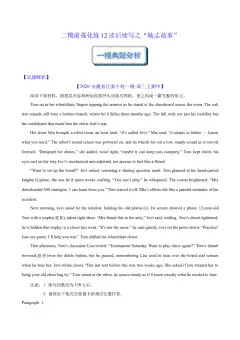
阅读下面材料,根据其内容和所给段落开头语续写两段,使之构成一篇完整的短
文。
On a bitterly cold January day, I saw Bobby in my fourth grade classroom for the
first time. He was wearing worn-out shirt and jeans, obviously too small. One of his
shoes was missing a lace, flopping(移动)up and down when he walked. He looked so
disgusting that nobody would treat him as a normal child.
Bobby's behavior was strange, too. His normal tone of voice was a yell. He never
made eye contact with anyone, and made his comments continuously during class.
Besides,Bobby's academic skills were nonexistent. He couldn't read or write, not
even the letters of the alphabet.
I thought Bobby should belong in a classroom that taught basic social skills. I
checked his records and was shocked to learn that his IQ was normal,The school
counselor(辅导顾问) told me that Bobby was a lot closer to normal than his mother
was.He had been placed in Children's Welfare Home for the first three years of his life
before he was returned to his mother. They had moved to a different town at least
once a year. Bobby's intelligence was normal,so he would remain in my classroom.
I hated it but had to accept his being in my class. I had never taught someone like
Bobby before. It was a struggle to even plan lessons for him. I took pride in being
a good teacher, and I was disgusted with myself or not liking him and not wanting
him in my class. One day, Bobby came into the classroom with his shirt torn and his
nose bloodied.He had been jumped on by a group of my students.Bobby sat down and
opened his book, pretending nothing had happened, Blood and tears dropped onto the
pages. I sent Bobby to the nurse and scolded those students angrily. I yelled that they
ought to be ashamed of themselves for not liking him just because he acted strangely.
His being different had even more reason to treat him kindly.
注意:1.续写词数应为150 左右;
2.请按如下格式在答题卡的相应位置作答。
Paragraph 1: That incident changed how I felt about Bobby.
Paragraph 2: It was amazing to see the change in Bobby that resulted from the new
clothes and extra attention.
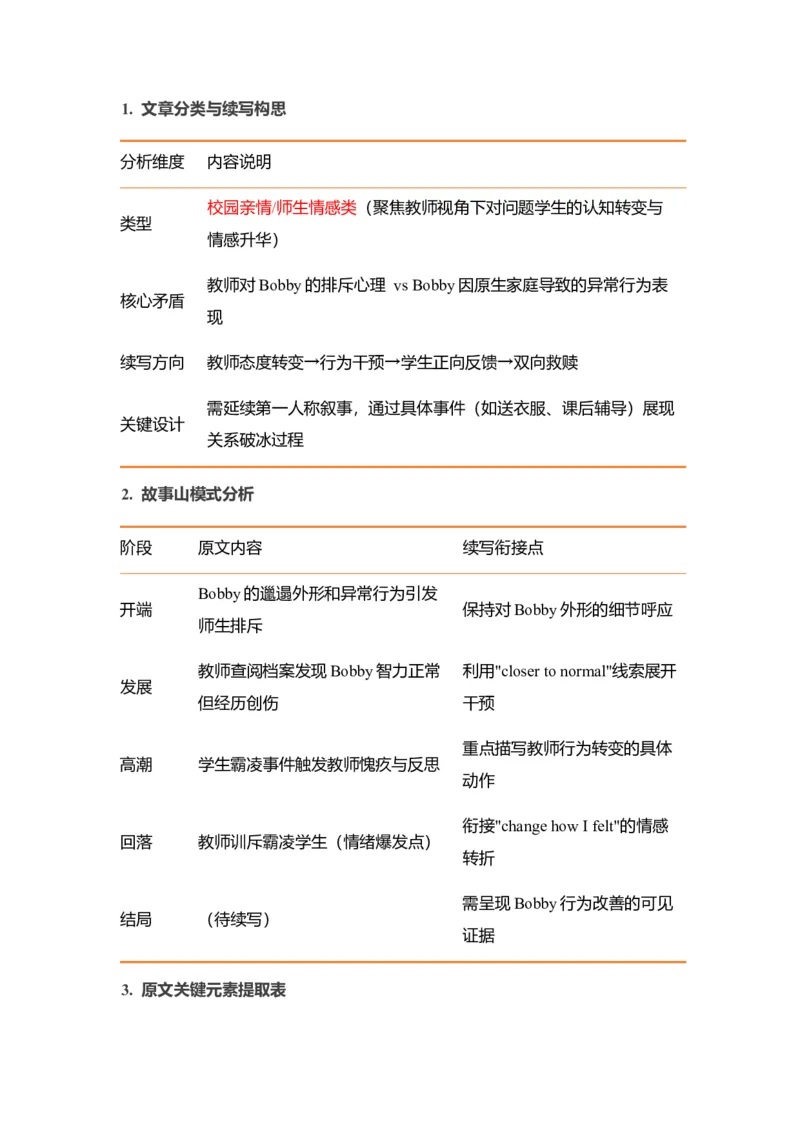
1. 文章分类与续写构思
分析维度
内容说明
类型
校园亲情/师生情感类(聚焦教师视角下对问题学生的认知转变与
情感升华)
核心矛盾
教师对Bobby 的排斥心理 vs Bobby 因原生家庭导致的异常行为表
现
续写方向
教师态度转变→行为干预→学生正向反馈→双向救赎
关键设计
需延续第一人称叙事,通过具体事件(如送衣服、课后辅导)展现
关系破冰过程
2. 故事山模式分析
阶段
原文内容
续写衔接点
开端
Bobby 的邋遢外形和异常行为引发
师生排斥
保持对Bobby 外形的细节呼应
发展
教师查阅档案发现Bobby 智力正常
但经历创伤
利用"closer to normal"线索展开
干预
高潮
学生霸凌事件触发教师愧疚与反思
重点描写教师行为转变的具体
动作
回落
教师训斥霸凌学生(情绪爆发点)
衔接"change how I felt"的情感
转折
结局
(待续写)
需呈现Bobby 行为改善的可见
证据
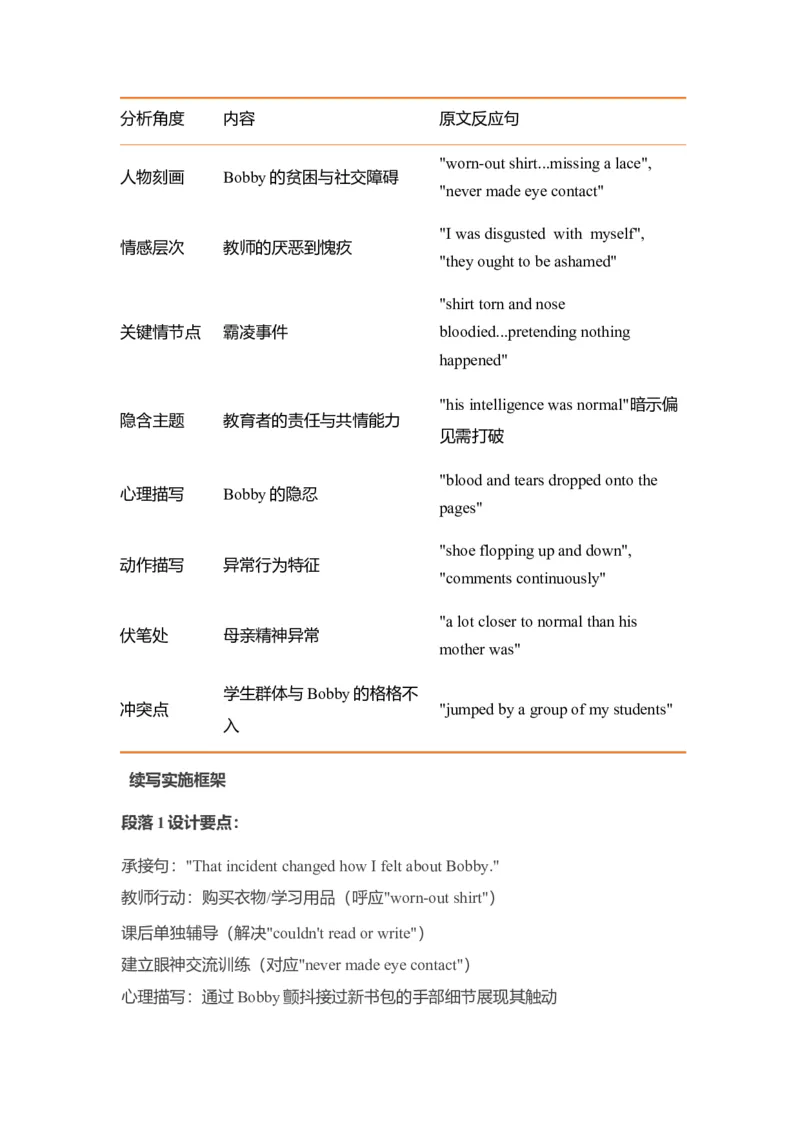
3. 原文关键元素提取表
分析角度
内容
原文反应句
人物刻画
Bobby 的贫困与社交障碍
"worn-out shirt...missing a lace",
"never made eye contact"
情感层次
教师的厌恶到愧疚
"I was disgusted with myself",
"they ought to be ashamed"
关键情节点
霸凌事件
"shirt torn and nose
bloodied...pretending nothing
happened"
隐含主题
教育者的责任与共情能力
"his intelligence was normal"暗示偏
见需打破
心理描写
Bobby 的隐忍
"blood and tears dropped onto the
pages"
动作描写
异常行为特征
"shoe flopping up and down",
"comments continuously"
伏笔处
母亲精神异常
"a lot closer to normal than his
mother was"
冲突点
学生群体与Bobby 的格格不
入
"jumped by a group of my students"
 续写实施框架
段落1 设计要点:
承接句:"That incident changed how I felt about Bobby."
教师行动:购买衣物/学习用品(呼应"worn-out shirt")
课后单独辅导(解决"couldn't read or write")
建立眼神交流训练(对应"never made eye contact")
心理描写:通过Bobby 颤抖接过新书包的手部细节展现其触动
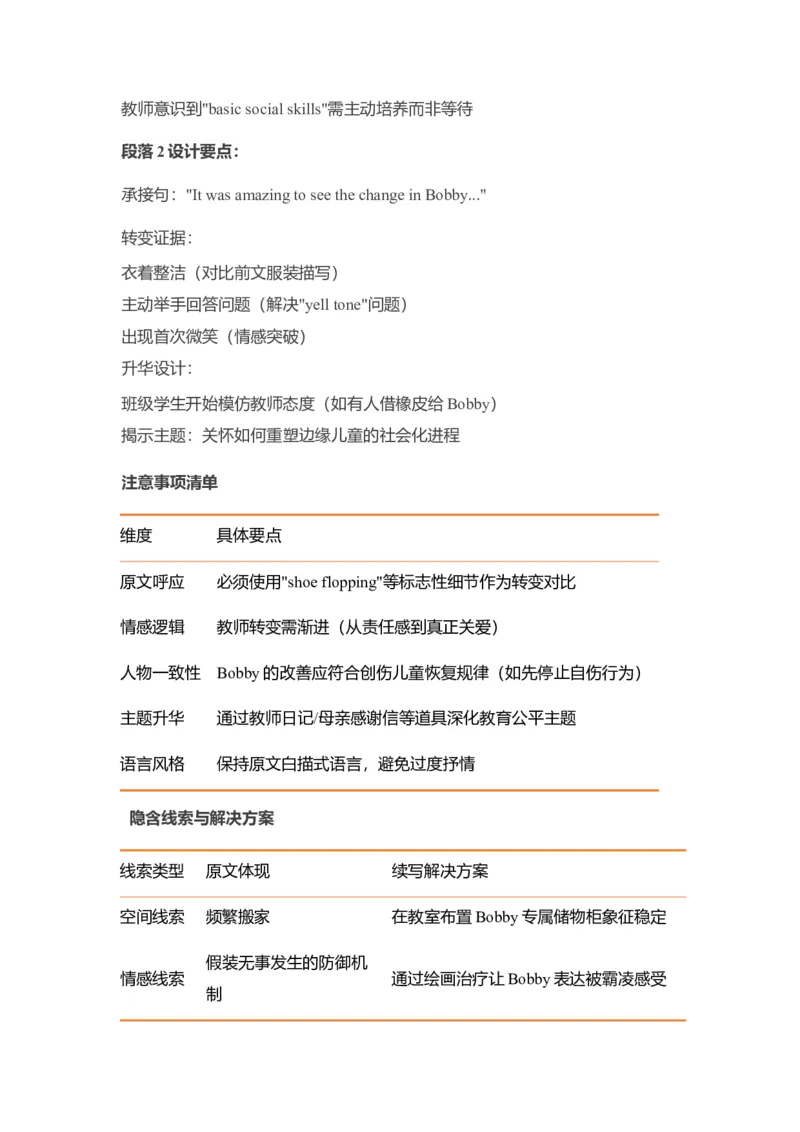
教师意识到"basic social skills"需主动培养而非等待
段落2 设计要点:
承接句:"It was amazing to see the change in Bobby..."
转变证据:
衣着整洁(对比前文服装描写)
主动举手回答问题(解决"yell tone"问题)
出现首次微笑(情感突破)
升华设计:
班级学生开始模仿教师态度(如有人借橡皮给Bobby)
揭示主题:关怀如何重塑边缘儿童的社会化进程
注意事项清单
维度
具体要点
原文呼应
必须使用"shoe flopping"等标志性细节作为转变对比
情感逻辑
教师转变需渐进(从责任感到真正关爱)
人物一致性
Bobby 的改善应符合创伤儿童恢复规律(如先停止自伤行为)
主题升华
通过教师日记/母亲感谢信等道具深化教育公平主题
语言风格
保持原文白描式语言,避免过度抒情
 隐含线索与解决方案
线索类型
原文体现
续写解决方案
空间线索
频繁搬家
在教室布置Bobby 专属储物柜象征稳定
情感线索
假装无事发生的防御机
制
通过绘画治疗让Bobby 表达被霸凌感受
线索类型
原文体现
续写解决方案
能力线索
智力正常但文盲
用字母饼干等具象化教学法突破学习障
碍
3. 英文例句(动作、心理、环境描写)及翻译
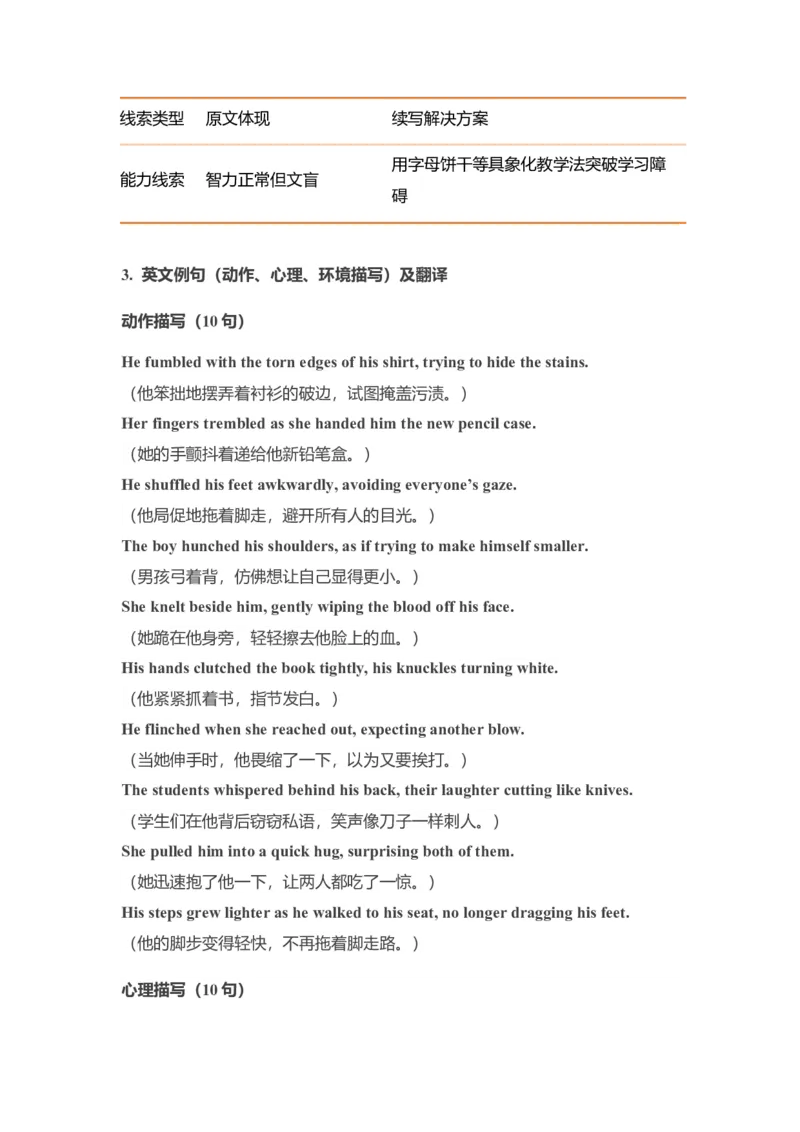
动作描写(10 句)
He fumbled with the torn edges of his shirt, trying to hide the stains.
(他笨拙地摆弄着衬衫的破边,试图掩盖污渍。)
Her fingers trembled as she handed him the new pencil case.
(她的手颤抖着递给他新铅笔盒。)
He shuffled his feet awkwardly, avoiding everyone’s gaze.
(他局促地拖着脚走,避开所有人的目光。)
The boy hunched his shoulders, as if trying to make himself smaller.
(男孩弓着背,仿佛想让自己显得更小。)
She knelt beside him, gently wiping the blood off his face.
(她跪在他身旁,轻轻擦去他脸上的血。)
His hands clutched the book tightly, his knuckles turning white.
(他紧紧抓着书,指节发白。)
He flinched when she reached out, expecting another blow.
(当她伸手时,他畏缩了一下,以为又要挨打。)
The students whispered behind his back, their laughter cutting like knives.
(学生们在他背后窃窃私语,笑声像刀子一样刺人。)
She pulled him into a quick hug, surprising both of them.
(她迅速抱了他一下,让两人都吃了一惊。)
His steps grew lighter as he walked to his seat, no longer dragging his feet.
(他的脚步变得轻快,不再拖着脚走路。)
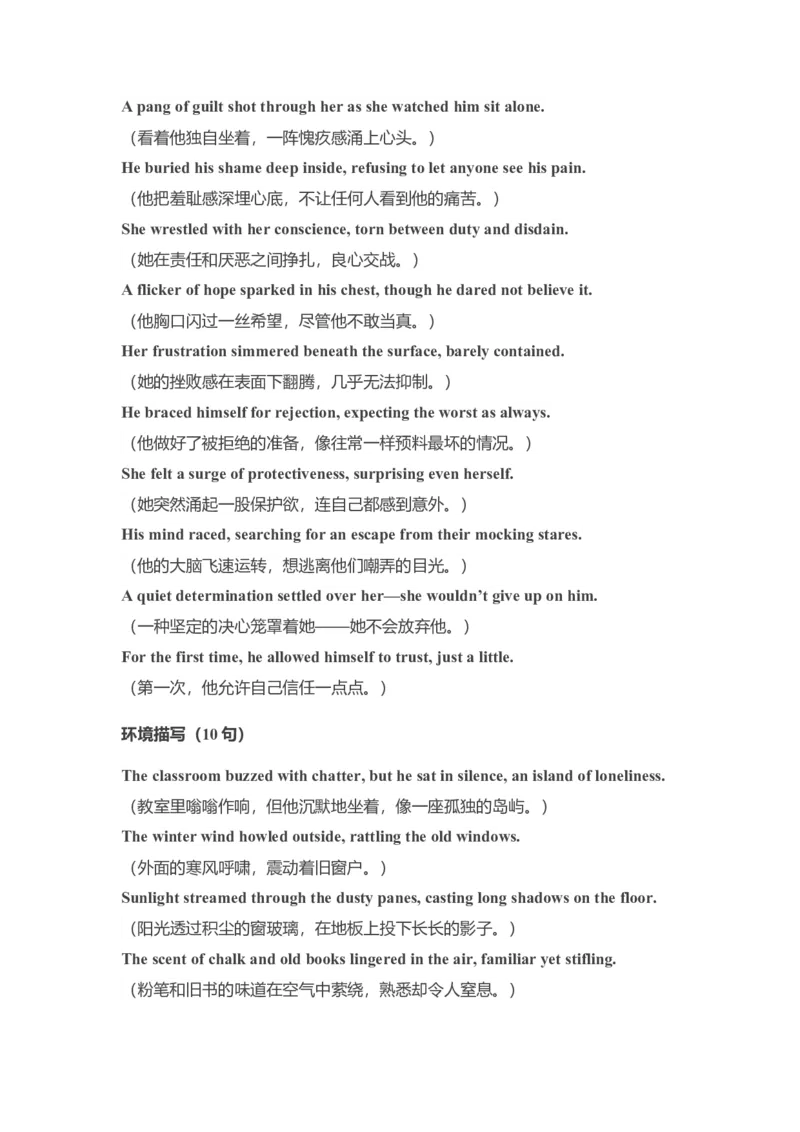
心理描写(10 句)
A pang of guilt shot through her as she watched him sit alone.
(看着他独自坐着,一阵愧疚感涌上心头。)
He buried his shame deep inside, refusing to let anyone see his pain.
(他把羞耻感深埋心底,不让任何人看到他的痛苦。)
She wrestled with her conscience, torn between duty and disdain.
(她在责任和厌恶之间挣扎,良心交战。)
A flicker of hope sparked in his chest, though he dared not believe it.
(他胸口闪过一丝希望,尽管他不敢当真。)
Her frustration simmered beneath the surface, barely contained.
(她的挫败感在表面下翻腾,几乎无法抑制。)
He braced himself for rejection, expecting the worst as always.
(他做好了被拒绝的准备,像往常一样预料最坏的情况。)
She felt a surge of protectiveness, surprising even herself.
(她突然涌起一股保护欲,连自己都感到意外。)
His mind raced, searching for an escape from their mocking stares.
(他的大脑飞速运转,想逃离他们嘲弄的目光。)
A quiet determination settled over her—she wouldn’t give up on him.
(一种坚定的决心笼罩着她——她不会放弃他。)
For the first time, he allowed himself to trust, just a little.
(第一次,他允许自己信任一点点。)
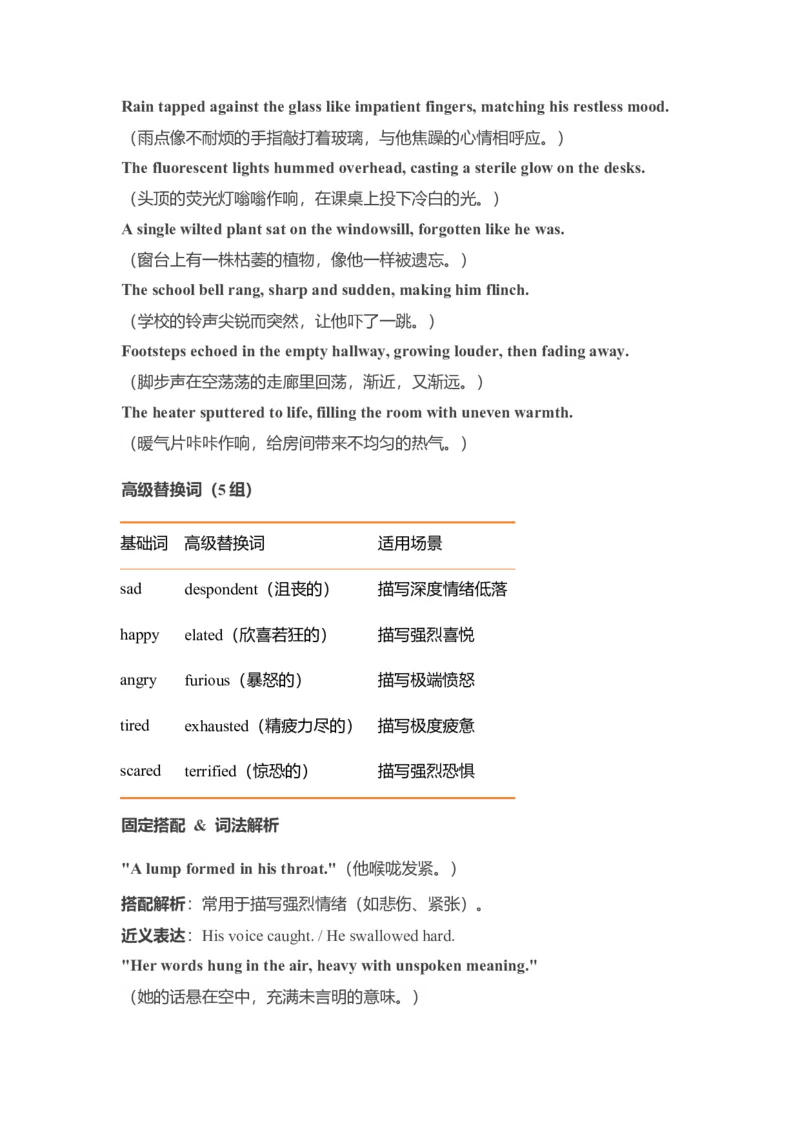
环境描写(10 句)
The classroom buzzed with chatter, but he sat in silence, an island of loneliness.
(教室里嗡嗡作响,但他沉默地坐着,像一座孤独的岛屿。)
The winter wind howled outside, rattling the old windows.
(外面的寒风呼啸,震动着旧窗户。)
Sunlight streamed through the dusty panes, casting long shadows on the floor.
(阳光透过积尘的窗玻璃,在地板上投下长长的影子。)
The scent of chalk and old books lingered in the air, familiar yet stifling.
(粉笔和旧书的味道在空气中萦绕,熟悉却令人窒息。)
Rain tapped against the glass like impatient fingers, matching his restless mood.
(雨点像不耐烦的手指敲打着玻璃,与他焦躁的心情相呼应。)
The fluorescent lights hummed overhead, casting a sterile glow on the desks.
(头顶的荧光灯嗡嗡作响,在课桌上投下冷白的光。)
A single wilted plant sat on the windowsill, forgotten like he was.
(窗台上有一株枯萎的植物,像他一样被遗忘。)
The school bell rang, sharp and sudden, making him flinch.
(学校的铃声尖锐而突然,让他吓了一跳。)
Footsteps echoed in the empty hallway, growing louder, then fading away.
(脚步声在空荡荡的走廊里回荡,渐近,又渐远。)
The heater sputtered to life, filling the room with uneven warmth.
(暖气片咔咔作响,给房间带来不均匀的热气。)
高级替换词(5 组)
基础词
高级替换词
适用场景
sad
despondent(沮丧的)
描写深度情绪低落
happy
elated(欣喜若狂的)
描写强烈喜悦
angry
furious(暴怒的)
描写极端愤怒
tired
exhausted(精疲力尽的)
描写极度疲惫
scared
terrified(惊恐的)
描写强烈恐惧
固定搭配 & 词法解析
"A lump formed in his throat."(他喉咙发紧。)
搭配解析:常用于描写强烈情绪(如悲伤、紧张)。
近义表达:His voice caught. / He swallowed hard.
"Her words hung in the air, heavy with unspoken meaning."
(她的话悬在空中,充满未言明的意味。)
搭配解析:描写话语的深刻影响。
近义表达:The silence stretched between them.
"He bit back a retort, clenching his fists instead."
(他忍住反驳,攥紧了拳头。)
搭配解析:描写克制愤怒的动作。
近义表达:He swallowed his anger.
"A flicker of recognition passed through his eyes."
(他眼中闪过一丝认出。)
搭配解析:描写短暂的认知或情绪变化。
近义表达:A shadow of understanding crossed his face.
"The classroom fell into an uneasy hush."
(教室陷入一种不安的寂静。)
搭配解析:描写紧张的氛围。
近义表达:An awkward silence settled over the room.
可积累的语料(生词短语)
"Worn-out" (adj.) 破旧的
近义词:shabby, tattered
反义词:pristine, brand-new
例句:
His worn-out shoes barely held together.(他破旧的鞋子几乎散架。)
She replaced his worn-out backpack with a new one.(她用新背包换掉了他破旧的
旧包。)
"Make eye contact" (v. phr.) 目光接触
近义词:look directly, meet someone’s gaze
反义词:avoid eye contact, look away
例句:
He finally made eye contact, a small but significant step.(他终于目光接触,虽小
但意义重大。)
She struggled to make eye contact, always staring at the floor.(她很难目光接触,
总是盯着地板。)
"Bloodied nose" (adj.+n.) 流血的鼻子
近义词:bruised, injured
反义词:unhurt, unscathed
例句:
He wiped his bloodied nose with his sleeve.(他用袖子擦了擦流血的鼻子。)
The fight left him with a bloodied lip and a black eye.(打架让他嘴唇流血,眼睛青
肿。)
"Pretend nothing happened" (v. phr.) 假装无事发生
近义词:act normal, brush it off
反义词:acknowledge, confront
例句:
He tried to pretend nothing happened, but his shaking hands betrayed him.(他试图
假装无事发生,但颤抖的手出卖了他。)
She saw the tears but pretended nothing was wrong.(她看到了眼泪,但假装没
事。)
"Be ashamed of oneself" (v. phr.) 感到羞耻
近义词:feel guilty, regret
反义词:be proud, feel justified
例句:
She told them they should be ashamed of themselves for bullying.(她告诉他们,他
们应该为霸凌感到羞耻。)
He was deeply ashamed of his outburst.(他对自己的爆发深感羞愧。)
总结
这些语料可以帮助提升续写的细节描写和情感表达,使故事更生动。建议在写
作时:
多用动作描写(如 flinched, shuffled, clutched)增强画面感。
结合心理描写(如 a pang of guilt, a flicker of hope)深化角色情感。
利用环境描写(如 howling wind, sterile glow)烘托氛围。
替换基础词汇(如用 despondent 代替 sad)提升语言层次。
积累固定搭配(如 a lump in one’s throat)让表达更地道。
5. Possible Versions (4)
Version 1
Paragraph 1: That incident changed how I felt about Bobby. Before that day, I
had viewed him only as a troublemaker I was forced to tolerate. (承接点:呼应原文“strange
behavior”“I hated it”) Yet watching him quietly wipe the blood from his book(动名词短语做主语),
pretending(现在分词短语做伴随动作) nothing had happened, stirred something inside me. (加分
语法:现在分词作伴随状语;呼应原文“pretending nothing had happened”) I realized that behind his strange behavior
was a boy(全部倒装句) who had endured far more than most children his age. (对比手法)
Determined

 to make a difference

 (过去分词做原因状语), I began greeting him warmly every
morning, offering help during reading lessons, and making sure(动词短语并列) he sat
near me where I could guide him. (衔接原文“academic skills nonexistent”“couldn’t read or write”) I even found
some gently-used clothes at home that might fit him. As I handed them to him after
class, his eyes widened in disbelief, and for the first time, he looked straight at me,
his lips trembling(独立主格) as if he wanted to speak.That brief moment convinced me
he was ready to trust—if only someone kept trying. (原文呼应:老师态度转变的心理变化)
Paragraph 2: It was amazing to see the change in Bobby that resulted from the
new clothes and extra attention. The following week, he walked into class wearing
the blue sweater I had given him, shoulders straighter, steps steadier. (独立主格) His
voice softened, and though still hesitant, he began raising his hand to answer
questions. (承接点:原文Bobby 声音是 yell,现在语气变化) During group work, a few classmates started
including him, surprised

 by his quiet jokes

 . (过去分词短语做结果状语) I praised his progress
in front of the whole class, watching

 pride light up his face

 .(现在分词短语做伴随动作)Day by
day, Bobby’s reading improved; the boy who once hid behind a wall of noise now
leaned forward to listen, eager

 to learn

 . (adj 短语做补语,衔接原文的Academic progress) I knew his life
outside school might still be hard, but inside my classroom, he had found
acceptance. And in helping him, I had learned my own lesson—sometimes, the
smallest acts of kindness can plant the deepest seeds of change.
地道搭配:
stir something inside sb.(触动内心)
plant the seeds of change(播下改变的种子)
shoulders straighter, steps steadier(走路更自信)
情绪描写:
eyes widened in disbelief(震惊)
pride light up his face(骄傲的神情)
动作描写:
leaned forward to listen(积极倾听)
offering help during lessons(主动帮助)
段首句衔接技巧:直接承接原文情感转折点 → 从厌恶到同情
原文呼应策略:
外貌呼应 → 原文 worn-out → 新衣服
行为呼应 → 原文 yelling → 声音柔和
学习呼应 → 原文不会读写 → 阅读进步
加分语法嵌入:
现在分词作状语(pretending nothing had happened; watching pride
light up)
定语从句(the boy who once hid behind a wall of noise)
对比强调(behind his strange behavior was a boy...)
Version 2
Paragraph 1: That incident changed how I felt about Bobby. Before, I saw
him as an obstacle to teaching; after that day, I saw a child longing

 for care

 (现在分词做伴随
动作). (承接点:原文“hated it… had to accept” → 厌恶转关怀) The sight of him sitting

 quietly

 (现在分词短语做后置定语)with
blood dripping onto the page, refusing to cry(with 复合结构), shattered my
preconceptions. I began to notice the little things—how he always came to school in
thin clothes despite the freezing wind, how he avoided meeting anyone’s eyes
unless absolutely necessary. (承接点:外貌和行为呼应原文 worn-out、never made eye contact) That week, I set aside
extra time to work with him, guiding

 his fingers

 (现在分词短语做伴随动作) as he traced letters,
praising

 even the smallest progress

 (现在分词短语做伴随动作). I asked if he had a warm
sweater for winter; he shook his head. Later, I slipped one into his desk. When he
found it, his hands lingered on the fabric, and a faint smile tugged at the corners
of his mouth. It wasn’t much, but it was a start.
Paragraph 2: It was amazing to see the change in Bobby that resulted from the
new clothes and extra attention. He wore the sweater every day after that, its
bright color standing out in the gray winter. (独立主格) He began speaking more
softly, his tone no longer sharp but almost shy.(独立主格刻画人物,衔接原文) During reading, he
leaned closer to the page, following

 each word with his finger

 (现在分词短语做伴随动作),
determined

 to keep up

 (过去分词做adj 补语). Some classmates who once ignored him now
exchanged smiles with him, their curiosity replacing mockery(独立主格). One afternoon,
he stayed behind to help me tidy up the bookshelves, arranging

 them with


surprising care(现在分词短语做伴随动作). As he left, he whispered, “Thank you, Miss,” barely
audible but full of sincerity(adj 短语做补语). That simple phrase warmed me more than
any compliment I’d received. I realized that changing a life didn’t require grand
gestures—just the patience to keep showing up.
Version 3
Paragraph 1: That incident changed how I felt about Bobby. Until then, I had
kept my distance, convinced(过去分词做adj 主语补语) he was beyond my reach as a teacher. (承接
原文“never taught someone like Bobby before”) But the image of him pretending

 to read while blood


stained the paper(现在分词短语做后置定语) haunted me. (承接原文“pretending nothing had happened”) I realized that
what I had mistaken for defiance(主从) was his shield against rejection. Determined
to break through(过去分词做主语补语), I moved his seat closer to my desk and began
working with him during breaks, introducing

 simple words with pictures

 (现在分词短语做伴
随动作). I also made sure to greet him by name each morning, something I’d never done
before. One evening, I found an extra pair of shoes at home; they were a little big,
but in better shape than his. I cleaned them and brought them to school. When I
offered them to him, he looked down, murmur

 ing

   “For me?”(现在分词短语做伴随动作) and for
the first time, I saw a spark in his eyes.
Paragraph 2: It was amazing to see the change in Bobby that resulted from the
new clothes and extra attention. From that day on, he walked into class with shoes
tied neatly, no longer

 shuffling

 his feet

 (现在分词短语做后置定语). His questions in class shifted
from random interruptions to genuine curiosity. Though still cautious, he began
joining group discussions, earning surprised glances from his peers. (非谓语动词并列) I
praised him publicly when he completed a reading task without help; the blush on
his cheeks told me how much it meant. Even his handwriting—once an
unrecognizable scrawl—started to take shape. Watching him transform(动名词短语做主语)
reminded me why I had chosen teaching in the first place. Sometimes, a child
doesn’t need to be “fixed”—he needs to be seen, heard, and believed in.
类别
地道搭配
替换/同义词
例句
情绪描写
eyes widened in
disbelief
stared in shock / gazed in
astonishment
His eyes widened in disbelief
when he heard the score.
情绪描写
pride light up sb’s
face
pride written all over
sb’s face
Pride lit up her face as she
received the award.
情绪描写
blush on one’s
cheeks
a flush of embarrassment
A blush rose on his cheeks
when she called his name.
动作描写
leaned forward to
listen
bent closer to hear
She leaned forward to catch
his words.
动作描写shuffling one’s feet dragging one’s feet
He shuffled his feet
nervously before speaking.
动作描写
guiding sb’s
fingers
leading / directing sb’s
hands
She guided his fingers to play
the right notes.
情感主题
plant the seeds of
change
sow the seeds of hope
Teachers can plant the seeds
of change in students’ lives.
情感主题break through
overcome / push past
She finally broke through his
类别
地道搭配
替换/同义词
例句
(barriers)
defensive attitude.
描写升级
faint smile tugged
at the corners of his
mouth
a hint of a smile / lips
curling slightly
A faint smile tugged at the
corners of his mouth.