第06 讲  选修三 词汇考点
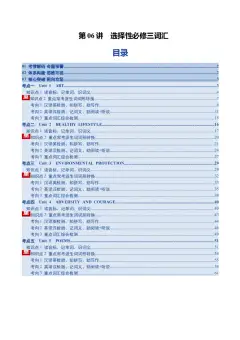
目录
01 课标达标练
【题型一】易考单词变形
【题型二】核心单词拼写
【题型三】重点短语词组
02 核心突破练
【题型一】阅读词汇和短语
【题型二】完形词汇和短语
【题型三】语法填空词汇和短语
03 高考溯源练
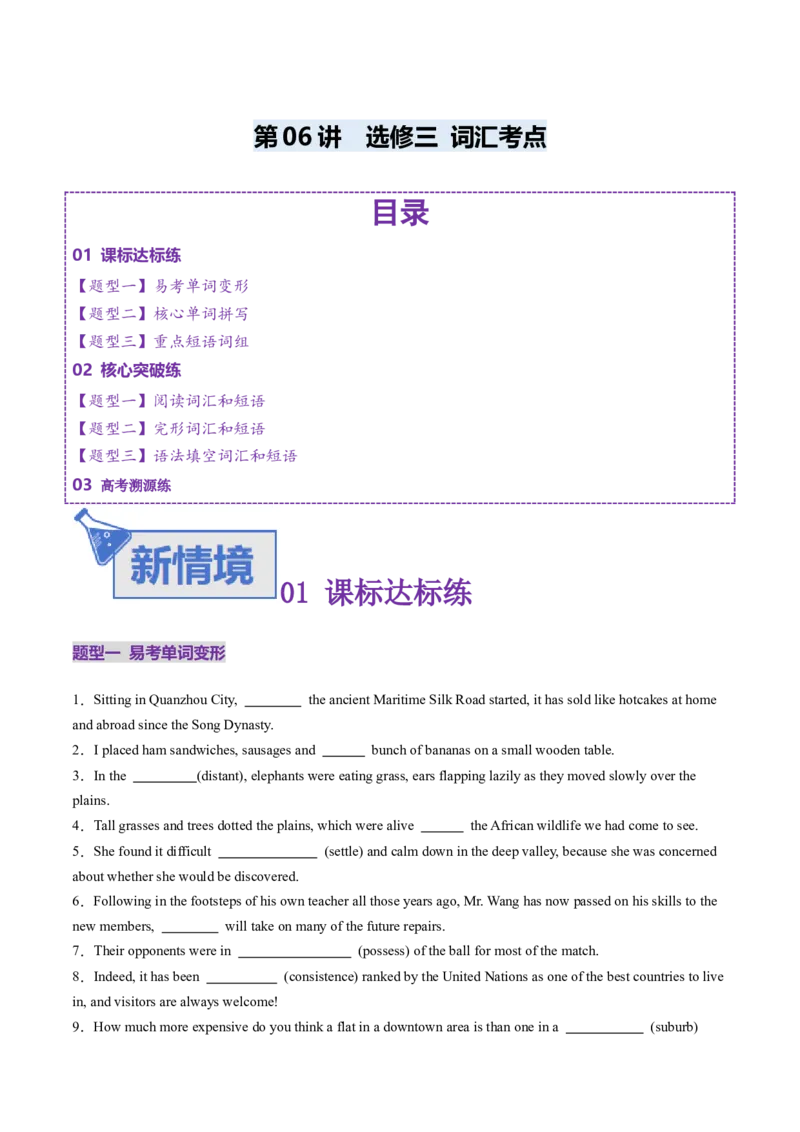
01 课标达标练
题型一 易考单词变形
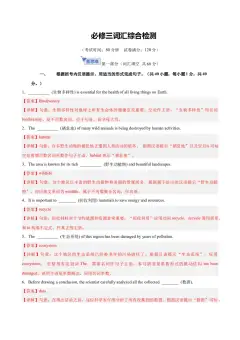
1.Sitting in Quanzhou City,          the ancient Maritime Silk Road started, it has sold like hotcakes at home
and abroad since the Song Dynasty.
2.I placed ham sandwiches, sausages and        bunch of bananas on a small wooden table.
3.In the          (distant), elephants were eating grass, ears flapping lazily as they moved slowly over the
plains.
4.Tall grasses and trees dotted the plains, which were alive        the African wildlife we had come to see.
5.She found it difficult                (settle) and calm down in the deep valley, because she was concerned
about whether she would be discovered.
6.Following in the footsteps of his own teacher all those years ago, Mr. Wang has now passed on his skills to the
new members,          will take on many of the future repairs.
7.Their opponents were in                  (possess) of the ball for most of the match.
8.Indeed, it has been            (consistence) ranked by the United Nations as one of the best countries to live
in, and visitors are always welcome!
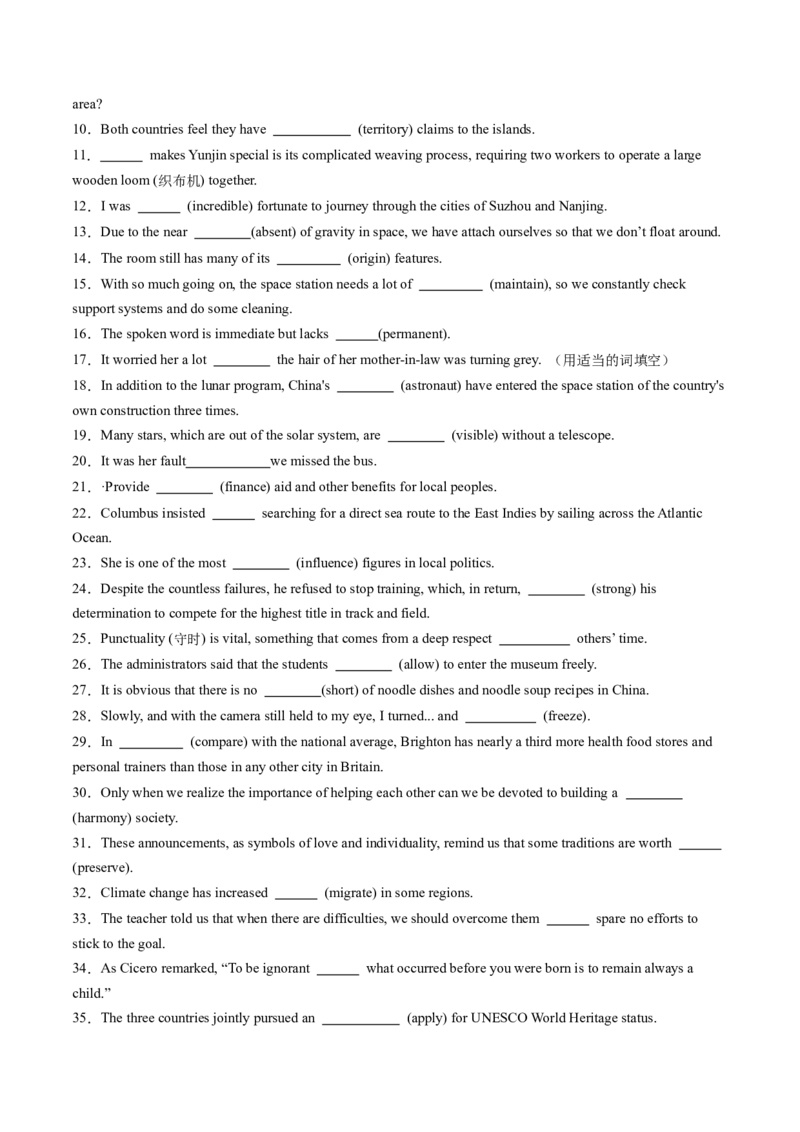
9.How much more expensive do you think a flat in a downtown area is than one in a             (suburb)
area?
10.Both countries feel they have             (territory) claims to the islands.
11.       makes Yunjin special is its complicated weaving process, requiring two workers to operate a large
wooden loom (织布机) together.
12.I was        (incredible) fortunate to journey through the cities of Suzhou and Nanjing.
13.Due to the near         (absent) of gravity in space, we have attach ourselves so that we don’t float around.
14.The room still has many of its           (origin) features.
15.With so much going on, the space station needs a lot of           (maintain), so we constantly check
support systems and do some cleaning.
16.The spoken word is immediate but lacks       (permanent).
17.It worried her a lot          the hair of her mother-in-law was turning grey. (用适当的词填空)
18.In addition to the lunar program, China's          (astronaut) have entered the space station of the country's
own construction three times.
19.Many stars, which are out of the solar system, are          (visible) without a telescope.
20.It was her fault            we missed the bus.
21.·Provide          (finance) aid and other benefits for local peoples.
22.Columbus insisted        searching for a direct sea route to the East Indies by sailing across the Atlantic
Ocean.
23.She is one of the most          (influence) figures in local politics.
24.Despite the countless failures, he refused to stop training, which, in return,          (strong) his
determination to compete for the highest title in track and field.
25.Punctuality (守时) is vital, something that comes from a deep respect            others’ time.
26.The administrators said that the students          (allow) to enter the museum freely.
27.It is obvious that there is no         (short) of noodle dishes and noodle soup recipes in China.
28.Slowly, and with the camera still held to my eye, I turned... and            (freeze).
29.In           (compare) with the national average, Brighton has nearly a third more health food stores and
personal trainers than those in any other city in Britain.
30.Only when we realize the importance of helping each other can we be devoted to building a
(harmony) society.
31.These announcements, as symbols of love and individuality, remind us that some traditions are worth
(preserve).
32.Climate change has increased        (migrate) in some regions.
33.The teacher told us that when there are difficulties, we should overcome them        spare no efforts to
stick to the goal.
34.As Cicero remarked, “To be ignorant        what occurred before you were born is to remain always a
child.”
35.The three countries jointly pursued an             (apply) for UNESCO World Heritage status.
36.The teacher issued a                  (suspend) for the student who was caught cheating on the exam.
37.It’s high time that we healed the deep            (divide) between the rich and the poor. (根据所给词的适
当形式填空)
38.We must encourage the planting of new trees and be devoted to        (preserve) our existing woodlands.
39.Catching sight of the sunrise and sunset, Kua Fu suddenly hit upon an idea          he wanted to race
against the sun to see who ran faster!
40.The two passengers occupying seats were reported          (ban) from taking trains for 180 days.
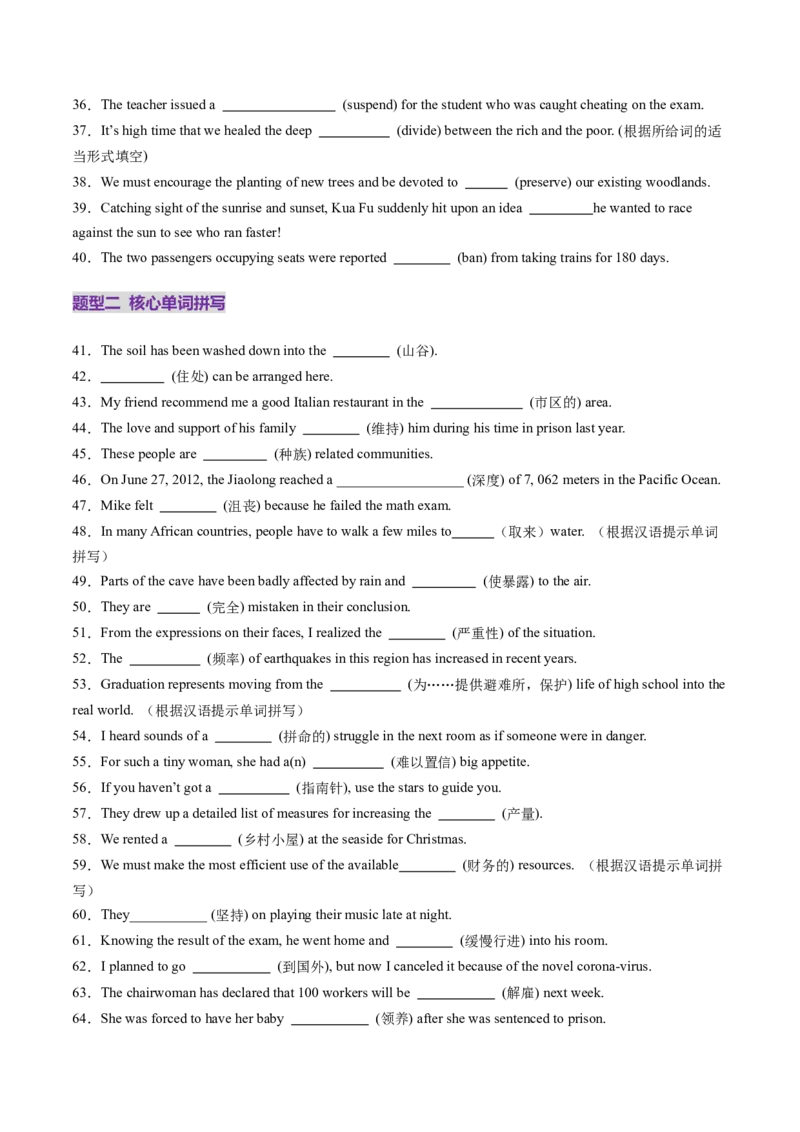
题型二 核心单词拼写
41.The soil has been washed down into the          (山谷).
42.          (住处) can be arranged here.
43.My friend recommend me a good Italian restaurant in the               (市区的) area.
44.The love and support of his family          (维持) him during his time in prison last year.
45.These people are           (种族) related communities.
46.On June 27, 2012, the Jiaolong reached a __________________ (深度) of 7, 062 meters in the Pacific Ocean.
47.Mike felt          (沮丧) because he failed the math exam.
48.In many African countries, people have to walk a few miles to      (取来)water. (根据汉语提示单词
拼写)
49.Parts of the cave have been badly affected by rain and           (使暴露) to the air.
50.They are        (完全) mistaken in their conclusion.
51.From the expressions on their faces, I realized the          (严重性) of the situation.
52.The            (频率) of earthquakes in this region has increased in recent years.
53.Graduation represents moving from the            (为……提供避难所,保护) life of high school into the
real world. (根据汉语提示单词拼写)
54.I heard sounds of a          (拼命的) struggle in the next room as if someone were in danger.
55.For such a tiny woman, she had a(n)            (难以置信) big appetite.
56.If you haven’t got a            (指南针), use the stars to guide you.
57.They drew up a detailed list of measures for increasing the          (产量).
58.We rented a          (乡村小屋) at the seaside for Christmas.
59.We must make the most efficient use of the available         (财务的) resources. (根据汉语提示单词拼
写)
60.They___________ (坚持) on playing their music late at night.
61.Knowing the result of the exam, he went home and          (缓慢行进) into his room.
62.I planned to go             (到国外), but now I canceled it because of the novel corona-virus.
63.The chairwoman has declared that 100 workers will be             (解雇) next week.
64.She was forced to have her baby             (领养) after she was sentenced to prison.
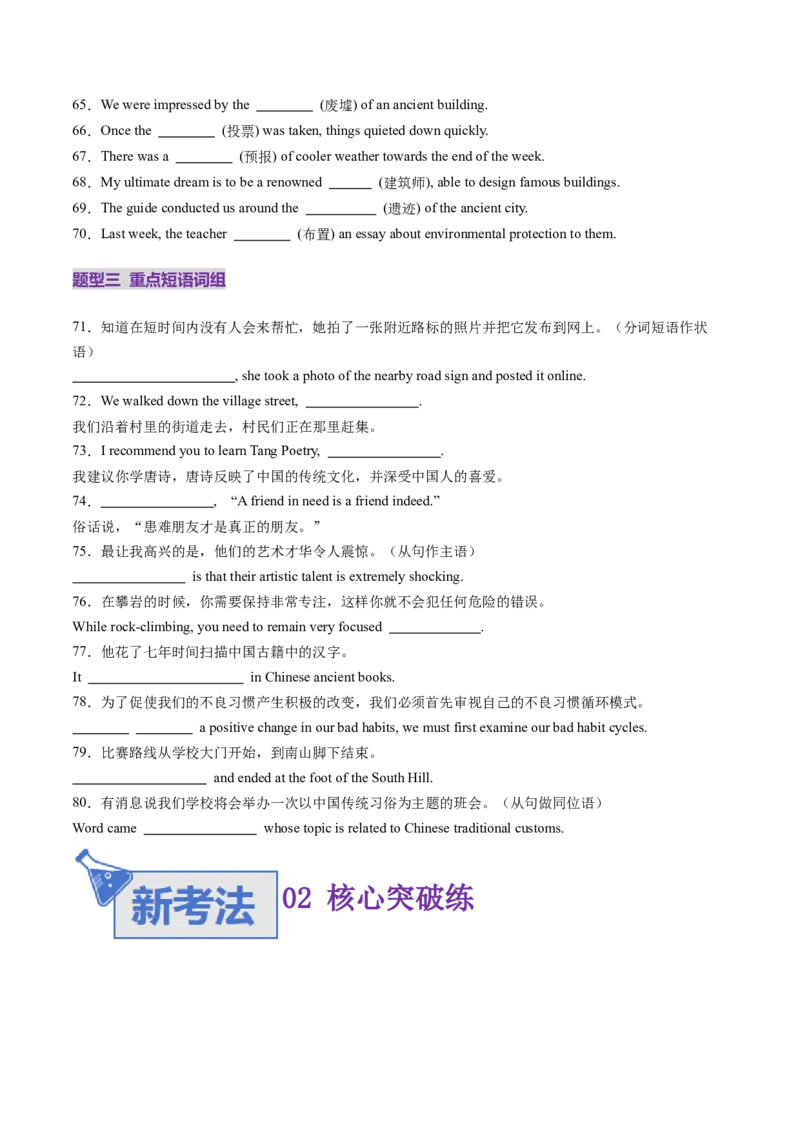
65.We were impressed by the          (废墟) of an ancient building.
66.Once the          (投票) was taken, things quieted down quickly.
67.There was a          (预报) of cooler weather towards the end of the week.
68.My ultimate dream is to be a renowned        (建筑师), able to design famous buildings.
69.The guide conducted us around the            (遗迹) of the ancient city.
70.Last week, the teacher          (布置) an essay about environmental protection to them.
题型三 重点短语词组
71.知道在短时间内没有人会来帮忙,她拍了一张附近路标的照片并把它发布到网上。(分词短语作状
语)
                       , she took a photo of the nearby road sign and posted it online.
72.We walked down the village street,                 .
我们沿着村里的街道走去,村民们正在那里赶集。
73.I recommend you to learn Tang Poetry,                 .
我建议你学唐诗,唐诗反映了中国的传统文化,并深受中国人的喜爱。
74.                ,  “A friend in need is a friend indeed.”
俗话说,“患难朋友才是真正的朋友。”
75.最让我高兴的是,他们的艺术才华令人震惊。(从句作主语)
                 is that their artistic talent is extremely shocking.
76.在攀岩的时候,你需要保持非常专注,这样你就不会犯任何危险的错误。
While rock-climbing, you need to remain very focused              .
77.他花了七年时间扫描中国古籍中的汉字。
It                        in Chinese ancient books.
78.为了促使我们的不良习惯产生积极的改变,我们必须首先审视自己的不良习惯循环模式。
                  a positive change in our bad habits, we must first examine our bad habit cycles.
79.比赛路线从学校大门开始,到南山脚下结束。
                    and ended at the foot of the South Hill.
80.有消息说我们学校将会举办一次以中国传统习俗为主题的班会。(从句做同位语)
Word came                  whose topic is related to Chinese traditional customs.
02 核心突破练
题型一   阅读词汇和短语
(2025·山东泰安·模拟预测)While climbing the Great Wall is a once-in-a-lifetime dream for many, Jim
Spear has taken it a step further, spending the last 18 years as a villager residing beneath this ancient wonder.
“Never did I dream I would have the chance to visit the Great Wall, let alone live under it,” said 68-year-old
Spear, a self-taught architect from the United States.
Spear’s interest in China began during his college days. It deepened when he met Tang, a Chinese girl, in
1980, and they got married two years later. In 1986, he decided to drop out of his doctoral studies in Chinese
politics at the University of California and moved to China “to get to the heart of things”. “I realized that if I
became a scholar of China, based overseas, I wouldn’t be able to experience what was happening in China,” Spear
said.
In 1995, the couple secured a long-term rent of a traditional village farmhouse in Mutianyu and decided to
make it their full-time home ten years later. Shortly after possessing full-time village life, he rented an abandoned
schoolhouse and transformed it into a restaurant and art glass factory for a sustainable tourism business. He also
turned a former factory into a hotel and helped renovate ( 翻新) over 20 households into restaurants. Besides, he
explored other ways to support those residents in rural areas. “I want to do something for them,” Spear said.
Spear’s designs reflect his natural talent for fusing (融合) traditional and modern elements, adopting the
Great Wall style. However, Spear emphasized his approach involves creating designs and views “that echo (呼应)
the Great Wall, not copy it”. In 2014, Spear received the Great Wall Friendship Award from the Beijing
government.
Talking about the future, Spear sees abundant possibilities in China, driven by significant domestic demand
and a growing emphasis on preserving historic structures.
1.What do we know about Spear?
A.He likes to climb the Great Wall.
B.He came to China when he was 18.
C.He once dreamed of becoming a villager.
D.He has lived beneath the Great Wall for years.
2.Why did Spear move to China in 1986?
A.To see a real China.
B.To marry a Chinese girl.
C.To work as an architect.
D.To study Chinese politics.
3.What is special about Spear’s designs?
A.They are inspired by rural residents.
B.They copy the style of the Great Wall.
C.They connect the past with the present.
D.They have received a world-wide prize.
4.What can we infer about Spear’s future plans?
A.He will focus on cultural exchange programs.
B.He will explore more rural support projects.
C.He will pursue awards for preserving buildings.
D.He will research China’s historic structures.
(2025· 重庆· 模拟预测)What if you could use the plastic waste littering everywhere to help solve
construction problems? For architect Oscar Issac, the inspiration led to an invention that shows his core value.
Issac owns a company whose main business is to build houses. In 2017, Marcus Kampo, a representative for
an official organization in Côte d’ Ivoire, contacted him to explain how a large amount of plastic waste there
blocked the sewer (下水道) systems. Meanwhile, Côte d’ Ivoire faced a shortage of schools, and many existing
rural ones needed frequent rebuilding in case of the rainy season. To give him a clearer picture, Kampo invited
Issac to the nation’s most populous city, where he was moved by the sight of women carrying children on their
backs while picking plastic from landfills for little pay.
“I think of a solution,” Issac said. His company transforms plastic, including bags, snack-food containers,
and shampoo bottles into a modular (模块化的) building system of bricks and columns. The Lego-like blocks are
made of about 95 percent plastic; builders only need to supply a roof and windows. So far, over 4, 000 tons of
plastic have been transformed into more than 550 classrooms, all for approximately 60 percent of what traditional
construction methods cost.
Issac is now negotiating on a similar school project in Ethiopia and investigating how to build public
restrooms in refugee camps in South Sudan. To promote the brick-making technology in more places, Issac recently
upgraded his system that can be transported in a 40-foot container. The technology runs on trash, but as Kampo
puts it, “the concept is not just beautiful but brilliant.”
1.What was a major challenge in Côte d’ Ivoire?
A.Lack of construction materials.
B.High costs of building schools.
C.Large quantities of plastic waste.
D.Discrimination against women.
2.Which word best describes Issac’s solution?
A.Expensive.
B.Revolutionary.
C.Traditional.
D.Inefficient.
3.Why does the author mention other projects in the last paragraph?
A.To raise funds for the projects.
B.To demonstrate Issac’s lasting efforts.
C.To advocate a low-carbon lifestyle.
D.To prove Kampo’s designing concept.
4.What can we learn from the passage?
A.Water is life’s blood.
B.Nature can repair itself.
C.Waste can be treasure.
D.Life on Earth is diverse.
题型二  完形词汇和短语
(2025·浙江宁波·二模)While her French classmates ate salads, Li Mei took out a package of steamed
rice. When she transferred to a high school in Paris, her lunch became a daily     1    . One Monday, one boy
Pierre pointed at her lunch and whispered, “That looks     2    !” Li Mei flushed, quietly avoiding the cafeteria.
Everything     3     when her history teacher, Mr. Dupont,     4     a project “Food & Culture
Week”. Each student was to     5     a traditional dish and present its cultural significance. Li Mei     6

— would anyone care about Chinese food here? Eventually, she decided on jianbing, a flavor from hometown.
On presentation day, she     7     the materials with trembling hands. To her surprise, Pierre volunteered
to help cook. As they spread the batter (面糊), he     8    . “I made fun of your food at first, but now I see it’s
part of your     9    .” When the crispy jianbing was served, classmates crowded around, asking questions
about Chinese New Year traditions.
The event made everyone     10    . Students who once     11     her now greeted her warmly. A girl
named Sophie even proposed     12     a French-Chinese cookbook together for the school fair and suggested
including family dishes passed down through generations.
On the final day,     13     filled a book titled Bites Beyond Borders. Holding it, Li Mei realized that
cultural gaps weren’t about walls but doors — waiting to be unlocked. A simple     14     had taught her more
about belonging than any textbook.
“Food is the     15     foreign policy,” Mr. Dupont said, biting into a red bean croissant.
1.A.adventure
B.struggle
C.routine
D.necessity
2.A.messy
B.ordinary
C.strange
D.special
3.A.mattered
B.worked
C.rested
D.changed
4.A.praised
B.postponed
C.concluded
D.launched
5.A.purchase
B.review
C.prepare
D.receive
6.A.joked
B.hesitated
C.insisted
D.protested
7.A.laid out
B.held back
C.heated up
D.gave away
8.A.argued
B.denied
C.admitted
D.added
9.A.identity
B.interest
C.personality
D.quality
10.A.freed
B.relaxed
C.amused
D.connected
11.A.betrayed
B.overlooked
C.envied
D.misled
12.A.borrowing
B.authoring
C.promoting
D.sponsoring
13.A.stories
B.photos
C.recipes
D.quotes
14.A.game
B.question
C.gift
D.lunch
15.A.tastiest
B.heaviest
C.oldest
D.fastest
(2025·湖北武汉·二模)Growing up in Calgary, our kids had only seen buildings from the 1900s. We
wanted to show them     1     castles, medieval monuments, and grand palaces, so we traveled to Edinburgh to
take a family trip.
Scotland holds a personal connection for us, as my boys have Scottish     2    , we hoped this trip would
connect them to their ancestors’ culture.
Our airport taxi driver pointed out landmarks and shared historical facts. Through his     3     Scottish
accent, he suggested visiting the National Records office to explore our family history. Despite their    4    , my
kids grew excited to explore their family history. As we entered the city, Edinburgh Castle was     5

majestically on the volcanic rock — a     6     reminder of Scotland’s     7     past that would help my
children connect with their heritage.
Walking along the Royal Mile, my boys were     8     by the souvenir shops. Among the tartan scarves
arranged by     9    , they found their family’s unique     10    . Though we didn’t     11     anything,
this discovery gave them a strong sense of     12     to their ancestors.
This trip became a meaningful     13     of cultural discovery. Sometimes the most valuable things aren’t
what we buy, but what we     14     about ourselves and our     15    .
1.A.modern
B.ancient
C.damaged
D.fictional
2.A.friends
B.language
C.heritage
D.food
3.A.indifferent
B.peculiar
C.familiar
D.thick
4.A.curiosity
B.jet lag
C.drawback
D.confusion
5.A.situated
B.stood
C.lay
D.floated
6.A.painful
B.permanent
C.temporary
D.visual
7.A.awful
B.glorious
C.dull
D.luxurious
8.A.bored
B.embarrassed
C.scared
D.attracted
9.A.character
B.size
C.tribe
D.gesture
10.A.pattern
B.tradition
C.choir
D.privacy
11.A.sell
B.purchase
C.make
D.break
12.A.connection
B.distance
C.struggle
D.conflict
13.A.journey
B.business
C.career
D.navigation
14.A.achieve
B.hide
C.reflect
D.learn
15.A.future
B.routine
C.past
D.Setback
题型三  语法填空词汇和短语
(2025·江西新余·模拟预测)阅读下面短文,在空白处填入1 个适当的单词或括号内单词的正确形式。
The Hakka (客家) origins are obscure (含糊的). Like other Han people of China, their ancestors     1
(originate) from someplace in the Yellow River basin in north China, but unlike other people of China, they tended
2     (remain) migratory for the last 1,000 years. They are a people who, either out of necessity or because they
wanted to, migrated a lot,     3     (go) from Central China to southern China and then overseas in the last
several hundred years.
They have a distinct Hakka language that is somewhat related     4     Mandarin, and though they are
Han Chinese, their customs are different. As the tulou in Fujian, Jiangxi, and northern Guangdong show, they had
their own preferred style of     5     (construct) too. In northeast Guangzhou, the Hakka built in the weilongwu
and the sijiaolou styles as explained in the Architecture Features section.
Hakka have their own cuisine style. They are good at making a salted pickled mustard (榨菜) cabbage,     6
one special Hakka dish combines steamed pork or fish with the salted mustard cabbage to make meicai kourou.
Also, many Hakka went overseas to settle when massacres (屠杀) against     7     (they) started in the
19th century.
Many famous people in China’s history     8     (be) Hakka. They often had leadership     9

(role) in governments and armies of the past. Sun Yat Sen, called the “Father of Modern China,” was     10

Hakka for example.
(2025·海南海口·三模)阅读下面短文,在空白处填入1 个适当的单词或括号内单词的正确形式,并将答
案填写在答题卡上。
Blue-and-white porcelain (青花瓷), a product of     1     (share) creativity, tells a story of how East and
West craftsmanship harmonized. In the Yuan Dynasty, Persian merchants     2     (bring) special pigments (颜
料) to Jingdezhen,     3     porcelain traditions had been perfected. Local craftsmen mixed these pigments with
white clay, creating the iconic blue patterns. By     4     (paint) traditional Chinese designs using foreign
materials, they achieved a perfect     5     (combine) of traditions.
Over the centuries, this technique steadily advanced. During the Ming Dynasty, porcelain became     6

major export product. European nobles loved its unique charm, calling it “white gold”.     7     (meet) their
needs, Chinese artists added European elements like rose patterns to traditional landscapes, making the porcelain
more appealing     8     westerners.
Today, this global dialogue continues in museums worldwide. A Ming-era dish that once belonged to a
French King sits in the Louvre nowadays. Its journey from Jingdezhen to the Palace of Versailles, marked by
countless hands across continents, reflects how beauty goes beyond borders.     9     Craig Clunas noted, “The
blue that fascinates the world is never     10     (mere) a color — it is a language.”
03 高考溯源练
(2025·全国二卷·高考真题)English Market Towns to Visit in the UK
English market towns come in many shapes and sizes. Each has a personality shaped by the goods and
services produced and traded for centuries. But each town has more to do than shop.
Hereford, Herefordshire
Hereford has remained a lively market town since 1189. Skirting the town square, you’ll find lovely shops,
eateries, and the Black and White House Museum. The Hereford Cathedral is the most impressive building in town.
It’s also home to an ancient library. One of the four original copies of the Magna Carta is displayed there.
Ludlow, Shropshire
Ludlow is known as the Foodie Center of England. Butcher shops, greengrocers, bakeries, and cheese shops
line the town square. Bordering the square, the Ludlow Castle is a “must explore” medieval stronghold. The three-
day Ludlow Food Festival is held each September.
Shrewsbury, Shropshire
Getting to Shrewsbury Town Center from London is challenging but worth the anxiety. The River Severn has
a significant turn through town, almost making an island of Shrewsbury Town Center. The shape creates a perfect
market where goods could be shipped and received using the river as a highway. Flowers are everywhere-hanging
baskets, window boxes, and planters-just what you imagine in an attractive English market town.
Mevagissey, Cornwall
Even if you haven’t been to the small fishing village Mevagissey, you’ve probably seen it in a movie or
British TV show. The working harbor (港口) took shape in 1774. Fishermen go out to sea daily and sell their fish in
harbor-side markets. Don’t leave the harbor without a traditional Cornish pie. It’s delicious.
1.Where can you find an original copy of the Magna Carta?
A.In the Ludlow Castle.
B.In the Foodie Center of England.
C.In the Hereford Cathedral.
D.In the Black and White House Museum.
2.What is a feature of Shrewsbury Town Center?
A.It’s situated near a big island.
B.It’s almost surrounded by water.
C.It’s known for its flower festival.
D.It’s easily accessible from London.
3.What does the author suggest visitors do in Mevagissey?
A.Try the Cornish pie.
B.Watch a British TV show.
C.Go fishing in the sea.
D.Take pictures of the harbor.
(2025·全国一卷·高考真题)While safety improvements might have been made to our streets in recent
years, transport studies also show declines in pedestrian (行人) mobility, especially among young children. Many
parents say there’s too much traffic on the roads for their children to walk safely to school, so they pack them into
the car instead.
Dutch authors Thalia Verkade and Marco te Brömmelstroet are bothered by facts like these. In their new
book Movement: How to Take Back Our Streets and Transform Our Lives, they call for a rethink of our streets and
the role they play in our lives.
Life on city streets started to change decades ago. Whole neighbourhoods were destroyed to make way for
new road networks and kids had to play elsewhere. Some communities fought back. Most famously, a Canadian
journalist who had moved her family to Manhattan in the early 1950s led a campaign to stop the destruction of her
local park. Describing her alarm at its proposed replacement with an expressway, Jane Jacobs called on her mayor
(市长) to champion “New York as a decent place to live, and not just rush through.” Similar campaigns occurred in
Australia in the late 1960s and 1970s as well.
Although these campaigns were widespread, the reality is that the majority of the western cities were
completely redesigned around the needs of the motor car. The number of cars on roads has been increasing rapidly.
In Australia we now have over twenty million cars for just over twenty-six million people, among the highest rate
of car ownership in the world.
We invest a lot in roads that help us rush through, but we fail to account for the true costs. Do we really
recognise what it costs us as a society when children can’t move safely around our communities? The authors of
Movement have it right: it’s time to think differently about that street outside your front door.
1.What phenomenon does the author point out in paragraph 1?
A.Cars often get stuck on the road.
B.Traffic accidents occur frequently.
C.People walk less and drive more.
D.Pedestrians fail to follow the rules.
2.What were the Canadian journalist and other campaigners trying to do?
A.Keep their cities livable.
B.Promote cultural diversity.
C.Help the needy families.
D.Make expressways accessible.
3.What can be inferred about the campaigns in Australia in the late 1960s and 1970s?
A.They boosted the sales of cars.
B.They turned out largely ineffective.
C.They won government support.
D.They advocated building new parks.
4.What can be a suitable title for the text?
A.Why the Rush?
B.What’s Next?
C.Where to Stay?
D.Who to Blame?