专题14 阅读理解应用文
______________________________________________________________________________________
目录
1. 高考真题练
2. 创新基础练
3. 高考模拟练
一 高考真题练
1.(2025·全国二卷·高考真题)English Market Towns to Visit in the UK
English market towns come in many shapes and sizes. Each has a personality shaped by the goods
and services produced and traded for centuries. But each town has more to do than shop.
Hereford, Herefordshire
Hereford has remained a lively market town since 1189. Skirting the town square, you’ll find lovely
shops, eateries, and the Black and White House Museum. The Hereford Cathedral is the most impressive
building in town. It’s also home to an ancient library. One of the four original copies of the Magna Carta is
displayed there.
Ludlow, Shropshire
Ludlow is known as the Foodie Center of England. Butcher shops, greengrocers, bakeries, and
cheese shops line the town square. Bordering the square, the Ludlow Castle is a “must explore” medieval
stronghold. The three-day Ludlow Food Festival is held each September.
Shrewsbury, Shropshire
Getting to Shrewsbury Town Center from London is challenging but worth the anxiety. The River
Severn has a significant turn through town, almost making an island of Shrewsbury Town Center. The
shape creates a perfect market where goods could be shipped and received using the river as a highway.
Flowers are everywhere-hanging baskets, window boxes, and planters-just what you imagine in an
attractive English market town.
Mevagissey, Cornwall
Even if you haven’t been to the small fishing village Mevagissey, you’ve probably seen it in a movie
or British TV show. The working harbor (港口) took shape in 1774. Fishermen go out to sea daily and sell
their fish in harbor-side markets. Don’t leave the harbor without a traditional Cornish pie. It’s delicious.
1.Where can you find an original copy of the Magna Carta?
A.In the Ludlow Castle.
B.In the Foodie Center of England.
C.In the Hereford Cathedral.
D.In the Black and White House Museum.
2.What is a feature of Shrewsbury Town Center?
A.It’s situated near a big island.
B.It’s almost surrounded by water.
C.It’s known for its flower festival.
D.It’s easily accessible from London.
3.What does the author suggest visitors do in Mevagissey?
A.Try the Cornish pie.
B.Watch a British TV show.
C.Go fishing in the sea.
D.Take pictures of the harbor.
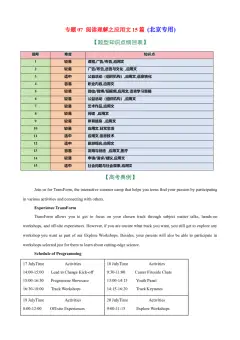
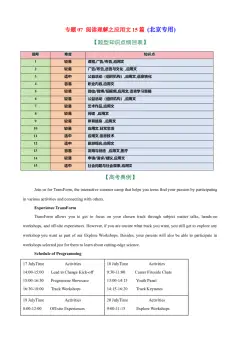
2.(2025·北京·高考真题)Join us for TransForm, the interactive summer camp that helps you
teens find your passion by participating in various activities and connecting with others.
Experience TransForm
TransForm allows you to get to focus on your chosen track through subject matter talks, hands-on
workshops, and off-site experiences. However, if you are unsure what track you want, you still get to
explore any workshop you want as part of our Explore Workshops. Besides, your parents will also be able
to participate in workshops selected just for them to learn about cutting-edge science.
Schedule of Programming
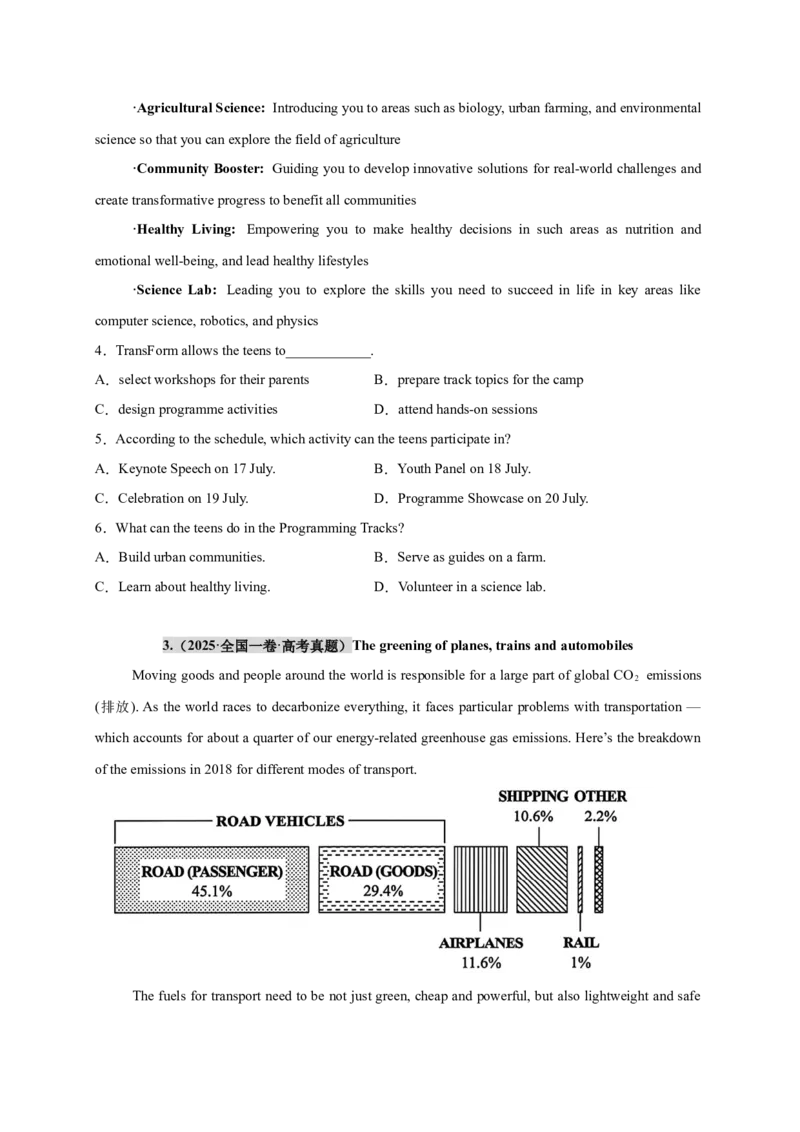
17 JulyTime Activities
14:00-15:00 Lead to Change Kick-off
15:00-16:30 Programme Showcase
16:30-18:00 Track Workshops
18 JulyTime Activities
9:30-11:00 Career Fireside Chats
13:00-14:15 Youth Panel
14:15-16:20 Track Keynotes
19 JulyTime Activities
8:00-12:00 Off-site Experiences
13:00-15:00 Gallery Viewing
15:15-16:45 Adult Workshops
20 JulyTime Activities
9:00-11:15 Explore Workshops
13:30-16:00 Keynote Speech
16:15-17:00 Celebration
Programming Tracks
·Agricultural Science: Introducing you to areas such as biology, urban farming, and environmental
science so that you can explore the field of agriculture
·Community Booster: Guiding you to develop innovative solutions for real-world challenges and
create transformative progress to benefit all communities
·Healthy Living: Empowering you to make healthy decisions in such areas as nutrition and
emotional well-being, and lead healthy lifestyles
·Science Lab: Leading you to explore the skills you need to succeed in life in key areas like
computer science, robotics, and physics
4.TransForm allows the teens to____________.
A.select workshops for their parents
B.prepare track topics for the camp
C.design programme activities
D.attend hands-on sessions
5.According to the schedule, which activity can the teens participate in?
A.Keynote Speech on 17 July.
B.Youth Panel on 18 July.
C.Celebration on 19 July.
D.Programme Showcase on 20 July.
6.What can the teens do in the Programming Tracks?
A.Build urban communities.
B.Serve as guides on a farm.
C.Learn about healthy living.
D.Volunteer in a science lab.
3.(2025·全国一卷·高考真题)The greening of planes, trains and automobiles
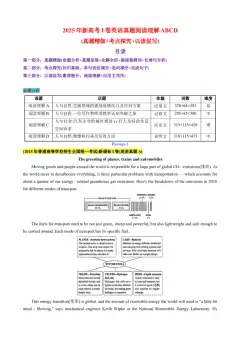
Moving goods and people around the world is responsible for a large part of global CO 2 emissions
(排放). As the world races to decarbonize everything, it faces particular problems with transportation —
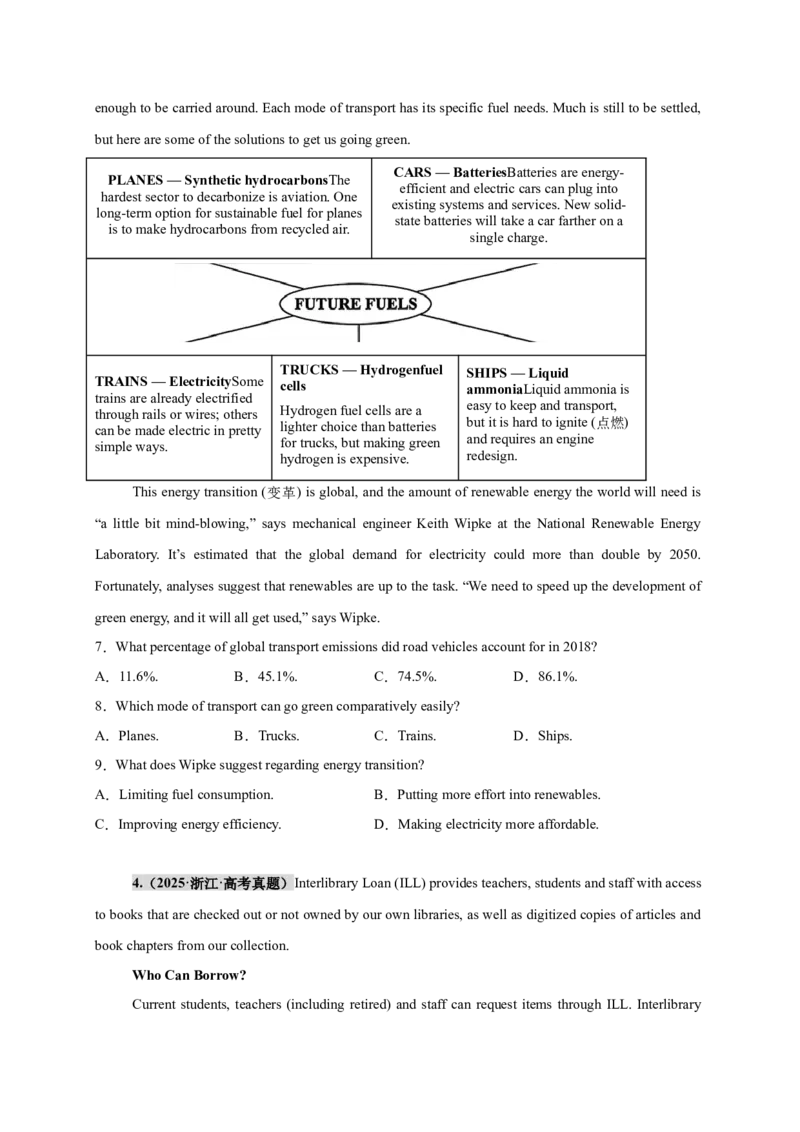
which accounts for about a quarter of our energy-related greenhouse gas emissions. Here’s the breakdown
of the emissions in 2018 for different modes of transport.
The fuels for transport need to be not just green, cheap and powerful, but also lightweight and safe
enough to be carried around. Each mode of transport has its specific fuel needs. Much is still to be settled,
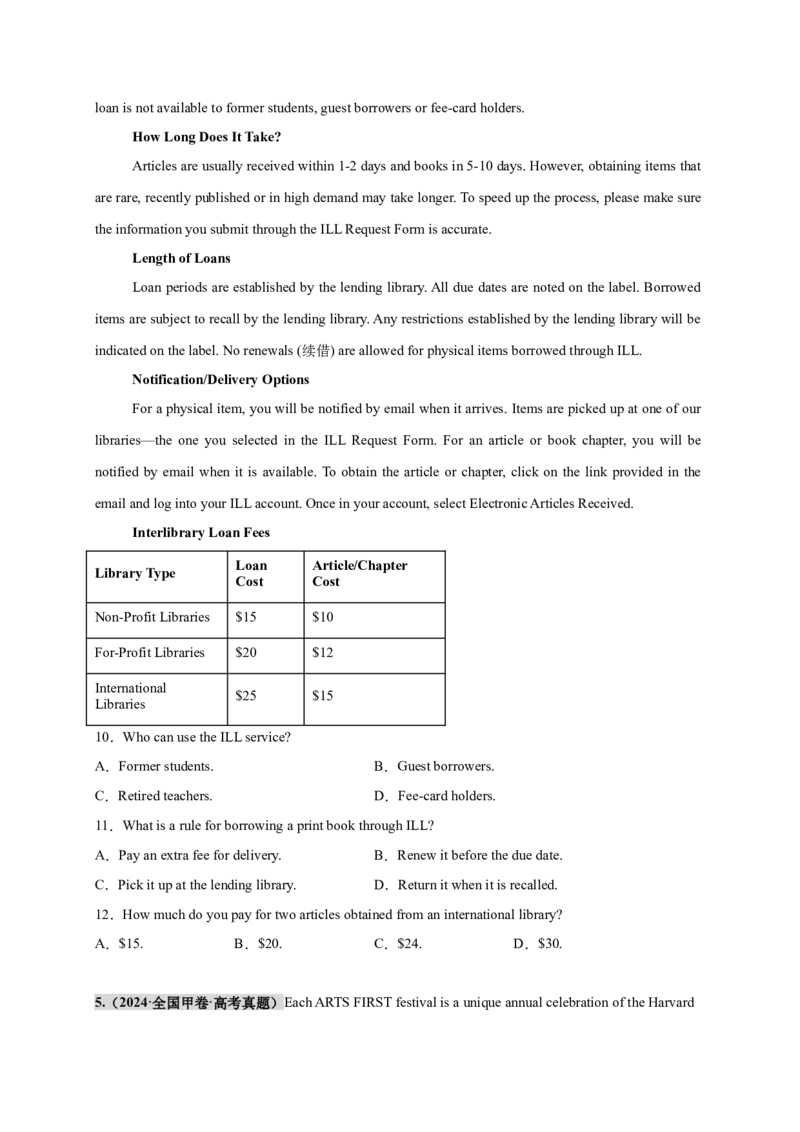
but here are some of the solutions to get us going green.
PLANES — Synthetic hydrocarbonsThe
hardest sector to decarbonize is aviation. One
long-term option for sustainable fuel for planes
is to make hydrocarbons from recycled air.
CARS — BatteriesBatteries are energy-
efficient and electric cars can plug into
existing systems and services. New solid-
state batteries will take a car farther on a
single charge.
TRAINS — ElectricitySome
trains are already electrified
through rails or wires; others
can be made electric in pretty
simple ways.
TRUCKS — Hydrogenfuel
cells
Hydrogen fuel cells are a
lighter choice than batteries
for trucks, but making green
hydrogen is expensive.
SHIPS — Liquid
ammoniaLiquid ammonia is
easy to keep and transport,
but it is hard to ignite (点燃)
and requires an engine
redesign.
This energy transition (变革) is global, and the amount of renewable energy the world will need is
“a little bit mind-blowing,” says mechanical engineer Keith Wipke at the National Renewable Energy
Laboratory. It’s estimated that the global demand for electricity could more than double by 2050.
Fortunately, analyses suggest that renewables are up to the task. “We need to speed up the development of
green energy, and it will all get used,” says Wipke.
7.What percentage of global transport emissions did road vehicles account for in 2018?
A.11.6%.
B.45.1%.
C.74.5%.
D.86.1%.
8.Which mode of transport can go green comparatively easily?
A.Planes.
B.Trucks.
C.Trains.
D.Ships.
9.What does Wipke suggest regarding energy transition?
A.Limiting fuel consumption.
B.Putting more effort into renewables.
C.Improving energy efficiency.
D.Making electricity more affordable.
4.(2025·浙江·高考真题)Interlibrary Loan (ILL) provides teachers, students and staff with access
to books that are checked out or not owned by our own libraries, as well as digitized copies of articles and
book chapters from our collection.
Who Can Borrow?
Current students, teachers (including retired) and staff can request items through ILL. Interlibrary
loan is not available to former students, guest borrowers or fee-card holders.
How Long Does It Take?
Articles are usually received within 1-2 days and books in 5-10 days. However, obtaining items that
are rare, recently published or in high demand may take longer. To speed up the process, please make sure
the information you submit through the ILL Request Form is accurate.
Length of Loans
Loan periods are established by the lending library. All due dates are noted on the label. Borrowed
items are subject to recall by the lending library. Any restrictions established by the lending library will be
indicated on the label. No renewals (续借) are allowed for physical items borrowed through ILL.
Notification/Delivery Options
For a physical item, you will be notified by email when it arrives. Items are picked up at one of our
libraries—the one you selected in the ILL Request Form. For an article or book chapter, you will be
notified by email when it is available. To obtain the article or chapter, click on the link provided in the
email and log into your ILL account. Once in your account, select Electronic Articles Received.
Interlibrary Loan Fees
Library Type
Loan
Cost
Article/Chapter
Cost
Non-Profit Libraries
$15
$10
For-Profit Libraries
$20
$12
International
Libraries
$25
$15
10.Who can use the ILL service?
A.Former students.
B.Guest borrowers.
C.Retired teachers.
D.Fee-card holders.
11.What is a rule for borrowing a print book through ILL?
A.Pay an extra fee for delivery.
B.Renew it before the due date.
C.Pick it up at the lending library.
D.Return it when it is recalled.
12.How much do you pay for two articles obtained from an international library?
A.$15.
B.$20.
C.$24.
D.$30.
5.(2024·全国甲卷·高考真题)Each ARTS FIRST festival is a unique annual celebration of the Harvard
community's artistic creativity. We invite you to join us for the coming ARTS FIRST. We look forward to
welcoming you as we showcase the creativity of the Harvard arts community through performances, art
exhibitions and art-making activities. The festival is a public event for Harvard and community members
of all ages. Light Awash in Watercolor
Learn about the materials and qualities of watercolor paint with experts from the Harvard Art Museums
Materials Lab. Try your hand at some of the painting tricks used by artists whose works will be in the
upcoming exhibition of American Watercolors 1880-1990: Into the Light. Spineless Artists:
Invertebrate Creativity
From webs to cocoons, invertebrates (无脊椎动物) create some of nature's most delicate and beautiful
designs. Join Javier Marin from the Harvard Museum of Natural History to learn how insects and other
invertebrates dance, inspire fashion and create art, while making your own spineless artists out of craft (手
工艺) materials. Wheel Throwing
Join instructors from the Ceramics Program and great potters from Quincy, Cabot and Mather Houses for
demonstrations using the potter's wheel. Then create your own masterpiece! Knitting and Pom-Pom
Making
Join the Harvard Undergraduate Knitting Circle to make pom-poms and tassels out of thread, or pick
up a pair of needles and learn to knit (编织).
13.What do we know about ARTS FIRST?
A.It is an exhibition of oil paintings.
B.It offers art courses for all ages.
C.It presents recreational activities.
D.It is a major tourist attraction.
14.Which program will you join if you're interested in drawing pictures?
A.Light Awash in Watercolor.
B.Spineless Artists: Invertebrate Creativity.
C.Wheel Throwing.
D.Knitting and Pom-Pom Making.
15.What can you do together with Javier Marin?
A.Practice a traditional dance.
B.Make handcrafts.
C.Visit a local museum.
D.Feed invertebrates.
二 创新基础练
Passage 1
Summer is a perfect time for high school students to relax, but it’s also an ideal period to prepare for
college applications. Here are some tasks students can complete during each summer break to stay ahead.
Summer Before Freshman Year
The summer before freshman year is the ideal time to start mapping out your four-year high school
class schedule. Attend freshman introduction to understand your school’s academic and behavioral
expectations, required classes, electives, etc. It is helpful for you to map out a plan for success.
Summer Before Sophomore Year
With the first year of high school behind you, it's time to explore career interests. Part-time jobs,
volunteering, or job shadowing can help you discover what you enjoy and improve your social skills.
Participate in activities out of school to show your initiative and hold leadership positions to make your
college application stand out.
Summer Before Junior Year
Junior year is key for improving your GPA and academic profile. Consider taking more challenging
courses. This summer is also a great time to start preparing for the ACT or SAT. Familiarize yourself with
college terms and start building a list of colleges based on size, type, cost and programs offered. Summer
Before Senior Year
Senior year is time to put your college application elements together. Plan campus visits to narrow
down your college choices. Start drafting your application essays and securing recommendation letters
from teachers or counselors in advance.
1.Why freshman introduction is recommended?
A.To earn extra credits before starting high school.
B.To help students form friendships with classmates.
C.To allow early access to advanced course materials.
D.To understand academic requirements and plan effectively.
2.How do you end your last summer vacation in high school?
A.By preparing for college application.
B.By making a study schedule.
C.By improving academic performance.
D.By developing career interest.
3.Which column of a newspaper is the text most probably taken from?
A.Life.
B.Education.
C.Entertainment.
D.Opinion
Passage 2
The Southwest Museum
The collections of the Southwest Museum represent the remarkable cultural diversity of Native
Americans from Alaska to South America. The museum contains some of the finest examples of Indian art
and artifacts in the United States.
EXHIBITIONS
In its permanent exhibitions, the Southwest Museum presents the various cultural activities and some
celebrations of America’s earliest residents. The museum’s four main exhibit halls focus on the native
people of the Southwest, California, the Great Plains, and the Northwest Coast. Visitors may survey
prehistoric Southwest painted earthenware (陶器), and on some special occasions there are chances to
enjoy the temporary exhibitions and exhibits that are moved between museums.
PROGRAMS
Throughout the year the museum offers a wide range of programs including performances, classes,
lectures, festivals, films and interaction with noted artists and other educational programs for members and
the general public. Guided gallery tours are offered by reservation, for student and adult groups.
MEMBERSHIP
Museum membership provides individuals and families with many chances to participate in the active
and exciting Southwest Museum community. The membership benefits include: free admission to the
Museum; invitations to exhibition openings and special events; reduced rates on programs and classes;
discounts in the Museum Store; the priority to receive calendars of events; members’ newsletter and
subscription to the museum’s magazine, Masterkey.
MUSEUM STORE
The museum store offers beautifully-made Southwest silver jewelry, Pueblo earthenware, and
kachina dolls. It also offers folk art from Mexico and Peru. The store carries a large selection of
publications on Native American history, and on several famous Native American and Western artists.
Museum members receive a 10% discount on all in-store purchases and a 20% discount on all museum
publications.
4.The collections of the Southwest Museum focus on _______.
A.lifestyles of American residents
B.native cultures of the Americas
C.diversity of American festivals
D.development of American arts
5.What can a visitor do at the Southwest Museum all year round?
A.Talk with noted artists.
B.Try painting earthenware.
C.Appreciate traveling exhibitions.
D.Survey modern American folk art.
6.Which benefit can a museum member enjoy?
A.The right to extend invitations to exhibition openings.
B.The priority to reserve guided tours.
C.A 10% discount on kachina dolls.
D.Free classes and programs.
Passage 3
The world’s great rivers evoke a sense of romance and timelessness, linking grand cities, idyllic
villages, and endless countryside. On a National Geographic River Cruise operated by Ama Waterways, a
leader in luxury river cruising, a world-class ship is your base to explore historic waterways. Step aboard
and unpack just once without the need for multiple hotels.
Choose from a wide range of guided excursions every day, from hikes and bike rides to in-depth
experiences that focus on the natural world, culture, and history. You’ll travel with a National Geographic
Expert, who will give talks on board and accompany daily outings; a National Geographic Photography
Expert joins all European sailings to share tips on technique and artistry.
Along the way, enjoy the utmost in personalized service and amenities: delectable regionally
inspired meals served in a variety of dining venues, complimentary hand-selected wines with every lunch
and dinner, wellness facilities, Wi-Fi, spacious suites and lounges, and so much more.
What can you expect when you travel on a National Geographic River Cruise?
1. A National Geographic Expert, such as an archaeologist or conservationist, and a National
Geographic Photography Expert, who enriches your experience with their knowledge and insights, will
join every National Geographic River Cruise departure
2. Special access to museums, sites, events, and experts in the field — including our own grantees,
whose programs we visit whenever we can
3. A seasoned Cruise Director who curates a personalized, seamless journey, as well as
knowledgeable local guides who join us along the way
4. Delectable meals served in a variety of venues
5. Taxes, gratuities, and airport transfers are all included
7.What is NOT included in the package of a National Geographic River Cruise?
A.The cost of taxes and gratuities.
B.Airport transfers to and from the cruise ship.
C.The fee for private guided excursions.
D.The expertise and insights of National Geographic professionals.
8.On a National Geographic River Cruise, passengers can expect which of the following?
A.Frequent unpacking and packing due to changes in accommodation.
B.Travel solely with a photography expert for daily excursions.
C.Personalized services and amenities, including regionally inspired meals
D.Limited Wi-Fi access and small lounges.
9.Which is the prime factor causes large price differences?
A.Cabin size and amenities.
B.Quantity of cultural sites.
C.Travel agency promotions.
D.Interact with Geo experts.
Passage 4
Burning oil, gas and coal — fuels that come from the remains of ancient plants and animals —
releases carbon (碳) into Earth’s atmosphere, where it traps heat and changes the climate. That process has
caused massive destruction and loss of life, and it will continue to do so. As a result, carbon is seen as a
pollutant.
However, Paul Hawken argues in his new book Carbon: The Book of Life that both the thinking and
the message of the climate movement are wrong. “Those who call carbon a pollutant should rethink what
they are saying,” Hawken writes. “Carbon is the building block of life. Without it, Earth would just be a
lonely, dead rock.”
Hawken believes that treating carbon as a pollutant not only misses what has caused climate change
in the first place, but also further separates people from the living world. “There is no climate crisis, but a
crisis of human thinking and behavior that’s damaging the soil, wiping out entire species, and changing the
weather faster than people can adapt,” he argues. “The warming atmosphere is a response, a teaching.”
Hawken’s book is a lesson in what’s sometimes called “unlearning”, or letting go of old
assumptions, like the idea that nature is something to fix or control. Instead, it explores ways to repair a
broken relationship with the natural world by drawing inspiration from native cultures and new scientific
discoveries.
First of all, Hawken wants a change in how people talk about the natural world. He describes the
word “biodiversity” as “a bloodless term”. Even terms like “nature” are not proper for Hawken. He points
out that such terms would only be needed if we are not a part of the living world.
The goal of the book is not to map out a plan for saving Earth, but to rebuild the relationship with it.
“My community recently broke down a barrier under a bridge that had blocked the fish on their journey up
the stream to give birth. The lesson from the project is about care,” Hawken writes. “That’s where we
should start.”
10.According to Paul Hawken, carbon should be treated as ________.
A.a polluting element
B.the result of burning fuels
C.a part of the living world
D.the cause of climate change
11.What does Paul Hawken say about “biodiversity” and ”nature“?
A.They are not based on the latest discoveries.
B.They are helpful in fighting climate changes.
C.They are not easy for the public to understand.
D.They are misleading and should be abandoned.
12.What does Paul Hawken suggest people do in his new book?
A.“Unlearn” to co-exist with nature.
B.Find ways to control nature.
C.Return to traditional ways of living.
D.Fix the problems scientifically.
13.From which is the text probably taken?
A.A new book.
B.A book review.
C.An advertisement.
D.An environment report.
Passage 5
Community Clean-Up Day: Make a Difference!
Date: Saturday, June 28th, 2025
Time: 9:00 AM-1:00 PM
Meeting Point: Riverside Park Main Entrance
What to Bring: Work gloves, reusable water bottle, comfortable clothes and shoes you don’t mind
getting dirty. We will provide trash bags, pickers, and hand sanitizer.
Activities:
Litter Collection: Focus on park trails, riverbanks, and picnic areas.
Invasive Plant Removal: Help remove non-native species threatening the local ecosystem (training
provided).
Tree Planting: Assist in planting native saplings to enhance biodiversity and prevent soil erosion.
Why Participate?
Protect Local Wildlife: Reduce pollution harming birds, fish, and other creatures.
Improve Water Quality: Prevent trash from entering our rivers.
Build Community: Meet neighbors who care about our environment.
Fulfill Volunteer Hours: Great for students needing community service credit.
Sign Up: Visit www. riversidecleanup. org (http://www. riversidecleanup. org) or call 555-0199 by
June 25th. Walk-ins also welcome!
14.What is the main purpose of the Community Clean-Up Day?
A.To hold a picnic party in Riverside Park.
B.To raise funds for purchasing new equipment.
C.To improve the local environment and ecosystem.
D.To provide professional training for park rangers.
15.Which activity requires prior training according to the notice?
A.Litter Collection.
B.Tree Planting.
C.Invasive Plant Removal.
D.Distributing trash bags.
16.What should participants definitely bring themselves?
A.Trash bags and pickers.
B.Work gloves and a water bottle.
C.Hand sanitizer.
D.Native saplings.
三 高考模拟练
1.【2025 届河南省实验中学高三模拟试卷]
The Language Exchange Programme allows students in pairs to communicate in two different
languages they wish to share and learn each week. Students record short entries after each partner meeting
noting the language skills practised and the topics discussed. Each pair of students meets three times
throughout the term with a teacher who decides if the exchange is effective. Students who successfully
complete the programme will receive one credit each.
Requirements for completion:
•One welcoming session on the second Friday of the term
•18 weekly one-hour pair meetings
•Weekly progress reports for all pair meetings
•At least three pair-teacher meetings
•One five-minute final video
Sign up!
The sign-up and registration process is as follows:
•Students sign up and indicate the languages they can share and languages they are interested in
learning.
•Based on the information entered by each student, potential pairs are identified.
•Proficiency (熟练) levels are confirmed through coursework or placement tests.
•Once a pair has been determined to be suitable, the students will be contacted individually with a
special permission number to register for the programme.
Reminders:
Signing up for the programme does not automatically mean that you will be able to register and
participate. Pairs are matched by languages of interest and proficiency levels. Since there are many factors
involved in the pairing process, not all students who sign up will be matched with a partner and be able to
register for the programme.
1.In the programme, students will _________.
A.chair daily meetings
B.evaluate the exchange
C.meet teachers each week
D.practise their language skills
2.To complete the programme, students are required to _________.
A.development tests
B.participate in pair meetings
C.welcome new students
D.work on weekly videos
3.What do students need to do during the registration?
A.Indicate their languages of interest.
B.Select their own coursework.
C.Make individual contact.
D.Choose their partners.
2.【2026 届南京市外国语学校模拟试题]
Free Community SwapContact:
Catherine Crawford, (718) 809-1603 ccrawford@grownyc.org
Jon Klar, (646) 530-0381 jklar@grownyc.org
New Yorkers looking to reduce, reuse, and save money this year are invited to participate in Stop ‘N’
Swap, a free community event organized by local nonprofit GrowNYC.
The average NYC household throws away about 2,000 pounds of waste a year. By reusing through events
like Stop ‘N’ Swap, NYC residents can take part in saving over 40 million pounds of material from landfill
every year. Take a break from shopping, support a cleaner future, and join the ever-growing reuse
community!
WHAT: Free Stop ‘N’ Swap Community Reuse Event
WHEN: February 19th,12pm-3pm
WHERE: Bronx Works Classic Community Center-286 East 156th Street, Bronx, NY 10451
The public is invited to bring clean and reusable items. No one is required to bring something to take
something-you can simply show up with a bag and see what’s free for the taking. Books, toys, clothing,
and electronics are just some of the offerings. Furniture and other large items are not accepted at the swap.
Anything leftover at the end of the day is donated or recycled.
Stop ‘N’ Swaps have developed a regular following among environmentally conscious New Yorkers.
After almost two years without swaps, GrowNYC has set a goal of hosting one swap in each of the city’s
59 community districts each year, providing opportunities to make NYC truly livable-a place where every
person can enjoy a healthier life.
4.What should you do to get more information from Catherine?
A.Cal1 (646) 530-0381.
B.Cal1 (718) 809-1603.
C.Email jklar@grownyc.org.
D.Visit 286 East 156th Street, Bronx.
5.What items are unacceptable at the Stop ‘N’ Swap?
A.Dry-as-dust books.
B.Old-fashioned clothes.
C.Out-of-date electronics.
D.Second-hand furniture.
6.What is the aim of GrowNYC’s Stop ‘N’ Swap?
A.To make NYC a better place to live.
B.To enrich New Yorkers’ community life.
C.To reduce the cost of dealing with waste in NYC.
D.To encourage districts to compete in sustainability.
3.【2026 届江苏省如皋中学高三英语试题】
Volunteering is a great outlet for self-improvement while helping others, and with Bookmark, you
can truly make a difference to the futures of primary school children. Three Bookmark volunteers have
shared their stories with us.
Claire
Claire began reading with Zach in 2019. As a writer, she wanted to share her love of books with
children who may have not discovered theirs. When packing up in their final session, Zach became happy
to try various types of books. In this moment, Claire remembered the child she’d met at the beginning of
her sessions, who didn’t believe anyone would read if they could choose not to and started to understand
her impact as a Bookmark volunteer.
Sally
Before volunteering with Bookmark, Sally had never worked with children, so beginning the
sessions was truly a step out of her comfort zone. Sally felt a real connection to Bookmark’s mission and
knew the challenge would pay off. “Volunteering has made me feel more content. I feel I am making a
difference.”
Aurélien
Aurélien signed up to read with Connor online in 2020. He had been looking for a way of getting
back into volunteering with children as he’d found a past experience rewarding. The flexibility of
Bookmark caught his eye, as the online programme fitted in well around his work commitments.
400 children are waiting for a volunteer to help them learn to read. Sign up to become a Bookmark
volunteer today and change a child’s story.
7.What can we learn about Zach before he started reading with Claire?
A.He lacked confidence.
B.He couldn’t afford books.
C.He was unwilling to read.
D.He behaved badly in school.
8.Why did Aurélien join Bookmark?
A.It suited his schedule.
B.He was keen on reading.
C.It benefited him in the past.
D.He favored online communication.
9.What is the purpose of this text?
A.To promote sales.
B.To advocate reading.
C.To share real-life stories.
D.To encourage participation.
4.【2025 届安徽省淮北市第十二中学高三质量检测试题 】
Organizations design courses to help you learn new skills or improve your current skill set. Here’re
the best course providers of 2024.
Codecademy
It provides information technology (IT) and other technical users with courses in coding and other
software engineering areas. You can choose from several subscription plans or choose a free option to
explore the website’s course collection.
Memrise
It’s a website and an application created to help you learn another language. It’s free to use and
offers up to 23 languages to pursue. It aims to work on developing your long-term memory to support your
learning journey and make it more effective. Additionally, it provides video examples of individuals using
the language’s terms and phrases in everyday life.
Pluralsight
It’s a paid subscription site but offers a free trial, so you can try a few classes to determine if it fits
your needs. You can take a Skill IQ assessment to know your skill levels and help you determine a plan to
improve your abilities. It employs certified experts as the course instructors, which benefits you as a
learner.
Alison
It’s a free learning platform offering classes, including fields such as personal development, health,
language, finance and science. It offers learners the flexibility of taking the courses anywhere and anytime,
so users can fit it into their schedule. And the platform is for individuals with various skill levels, from
beginner to expert. Additionally, the site has two types of courses, allowing you to choose between earning
a certificate or getting a diploma.
10.Which is most likely to be the course provided on Codecademy?
A.Computer Science.
B.Drawing for Beginners.
C.Advanced Parenting Skills.
D.Civil Engineering.
11.Which website invites specialists to assist the learners?
A.Codecademy.
B.Pluralsight.
C.Alison.
D.Memrise.
12.What is special about Alison’s courses?
A.They are designed for adults.
B.They require learners to pay.
C.They offer no certificates.
D.They are self-paced.
5.【河北省衡水市第二中学2025-2026 学年高三上学期一调考试英语试题】
Harvard undergraduates have the opportunity to study and practice the performing arts through the
recently launched Theater, Dance &. Media concentration; to benefit from the work of the American
Repertory Theater — a world-class professional company in residence; and to create theater outside of the
curriculum through more than a dozen student theatre organizations as well as projects initiated by
individual students.
Outside of productions presented by TDM and A .R. T., the majority of the many productions
staged each year are produced, directed, designed, acted and run by students with support from the Office
for the Arts and a variety of student-led theater groups.
Welcome, Harvard Class of 2026!
The First-Year Arts Program, produced by the Office for the Arts with the dean of Students Office,
covers seven artistic disciplines, consisting of Creative Writing, Dance, Drama, Film, Music, Studio Arts,
and Theater Design. This year’s program takes place between August 19-25 and we couldn’t be more
excited about the line-up.
Visit the First-Year Arts Program website
Learning Opportunities
Masterclasses: 90-minute classes with our professionally working alumni (校友) Resident Artists
Keynote Dialogues: several 90-minute moderate discussions and Q& As with nationally
renowned (有声望的) artists
Workshops: smaller form classes that focus on specialty hands-on art making taught by faculty,
staff, and alumni
Getting to know Harvard
Involvement Opportunities: how to get engaged with curricular and extracurricular artmaking
opportunities on campus
The First-Year Musical: a 60-minute info session with last year’s creative team about what the
First-Year Musical is, how to get involved, how they created their show and how they adapted the show for
the transition to an online format.
13.What benefit is available to undergraduates in performing arts?
A.Residential theater courses.
B.Full performance scholarships.
C.International exchange programs.
D.Theater, Dance & Media program.
14.What does the First-Year Arts Program 2026 offer to participants?
A.Discussions led by faculty members.
B.Classes taught by celebrated artists.
C.Workshops featuring hands-on learning.
D.Q&As hosted by renowned alumni.
15.Where is the information probably sourced from?
A.A brochure for potential students.
B.An official web page for incoming students.
C.A social media post by a Harvard student.
D.A news article about performing arts programs.
-