2026 年高考一轮复习验收卷(全国II 卷02)
 英语·全解全析
本试卷:阅读B 原创;语法填空原创
注意事项:
1. 答题前,考生先将自己的姓名、准考证号码填写清楚,将条形码准确粘贴在条形码区域内。
2. 选择题必须使用2B 铅笔填涂;非选择题必须使用0. 5 毫米黑色字迹的签字笔书写,字体工整,笔迹清楚。
3. 请按照题号顺序在答题卡各题目的答题区域内作答,超出答题区域书写的答案无效;在草稿纸、试卷上
答题无效。
4. 作图可先使用铅笔画出,确定后必须用黑色字迹的签字笔描黑。
5. 保持卡面清洁,不要折叠、不要弄破、弄皱,不准使用涂改液、修正带、刮纸刀。
第一部分  听力(共两节,满分30 分)
做题时,先将答案标在试卷上。录音内容结束后,你将有两分钟的时间将试卷上的答案转涂到答题卡上。
第一节(共5 小题;每小题1. 5 分,满分7. 5 分)
听下面5 段对话。每段对话后有一个小题,从题中所给的 A、B、C 三个选项中选出最佳选项。听完每段
对话后,你都有10 秒钟的时间来回答有关小题和阅读下一小题。每段对话仅读一遍。
例: How much is the shirt?
A. £19. 15.         B. £9. 18.         C. £9. 15.
答案是C.
1. Why is Chloe wearing boots?
A.She was hiking.
B.She follows fashion.
C.She got them from her friend.
2. Where are the speakers probably?
A.In a theater.
B.At home.
C.On a train.
3. What does the man think about fishing?
A.Boring.
B.Interesting.
C.Exciting.
4. What are the speakers mainly talking about?
A.A talented actress.
B.The details of a plot.
C.A movie they’ve just seen.
5. What does the woman want to do?
A.Give up smoking.
B.Go for a run regularly.
C.Lose weight.
第二节(共15 小题;每小题1. 5 分,满分22. 5 分)
听下面5 段对话或独白。每段对话或独白后有几个小题,从题中所给的 A、B、C 三个选项中选出最佳选
项。听每段对话或独白前,你将有时间阅读各个小题,每小题5 秒钟;听完后,各小题将给出5 秒钟的作答
时间。每段对话或独白读两遍。
听第6 段材料,回答第6 和7 题。
6.What does the man like about the house?
A.The stairs.
B.The light.
C.The windows.
7.What are the speakers going to do next?
A.Get a gate.
B.Look at more rooms.
C.Bargain with the seller.
听第7 段材料,回答第8、9 题。
8.What kind of photos does the woman mostly take now?
A.Nature and wildlife.
B.Travels.
C.Street scenes.
9.What does the man mean in the end?
A.He is fond of traveling.
B.He wants to start a new hobby.
C.He likes taking photos with an old camera.
听第8 段材料,回答第10 至12 题。
10.What position does the woman apply for?
A.A secretary.
B.A doctor.
C.A nurse.
11.What does the woman find difficult in her previous work?
A.A lack of experience.
B.Her poor education background.
C.Problems with mental health work.
12.Which aspect of the job appeals to the woman?
A.Dealing with heart issues.
B.Working with her family. C.Sorting out
paperwork.
听第9 段材料,回答第13 至16 题。
13.When does the conversation probably take place?
A.In June.
B.In August.
C.In September.
14.Why did the speakers go to the museum?
A.They were advised to go there.
B.They had a history class there.
C.They followed a tour group there.
15.What did the woman find the most impressive about the museum?
A.Its unique design.
B.Its number of pieces.
C.Its collection of literature.
16.How will the speakers probably go home?
A.By bike.
B.By subway.
C.On foot.
听第10 段材料,回答第17 至20 题。
17.Why does the speaker give the talk?
A.To share his path to success.
B.To introduce his colorful school life.
C.To provide ways on becoming a top chef.
18.What did the speaker leave home for?
A.Furthering his study.
B.Opening a restaurant.
C.Traveling around the world.
19.Where was the speaker’s first restaurant set up?
A.In the UK.
B.In France.
C.In the US.
20.What do we know about the speaker’s mother?
A.She is a leading chef.
B.She inspired the speaker in his career.
C.She took care of the speaker at university.
第二部分 阅读(共两节,满分 50 分)
第一节 (共 15 小题;每小题 2.5 分,满分 37.5 分) 阅读下列短文,从每题所给的 A、B、C、D 四
个选项中选出最佳选项。
A
Solving the growing plastic waste puzzle
As hard as it is to imagine a time when we weren’t buried in plastics, mass production of synthetic polymers
(合成聚合物) didn’t really begin until about 1950. Since then, however, we’ve generated an estimated 8.3 billion
tons of the stuff — with about half that total coming since 2000 — and we’ve deserted something like 6.3 billion
tons of it.
Unfortunately for the planet, only about 9 percent of that plastic waste has ever been recycled. Another 12
percent has been burned, most recently in waste-to-energy facilities. But most of the rest has gone into landfills —
or worse, into the environment.
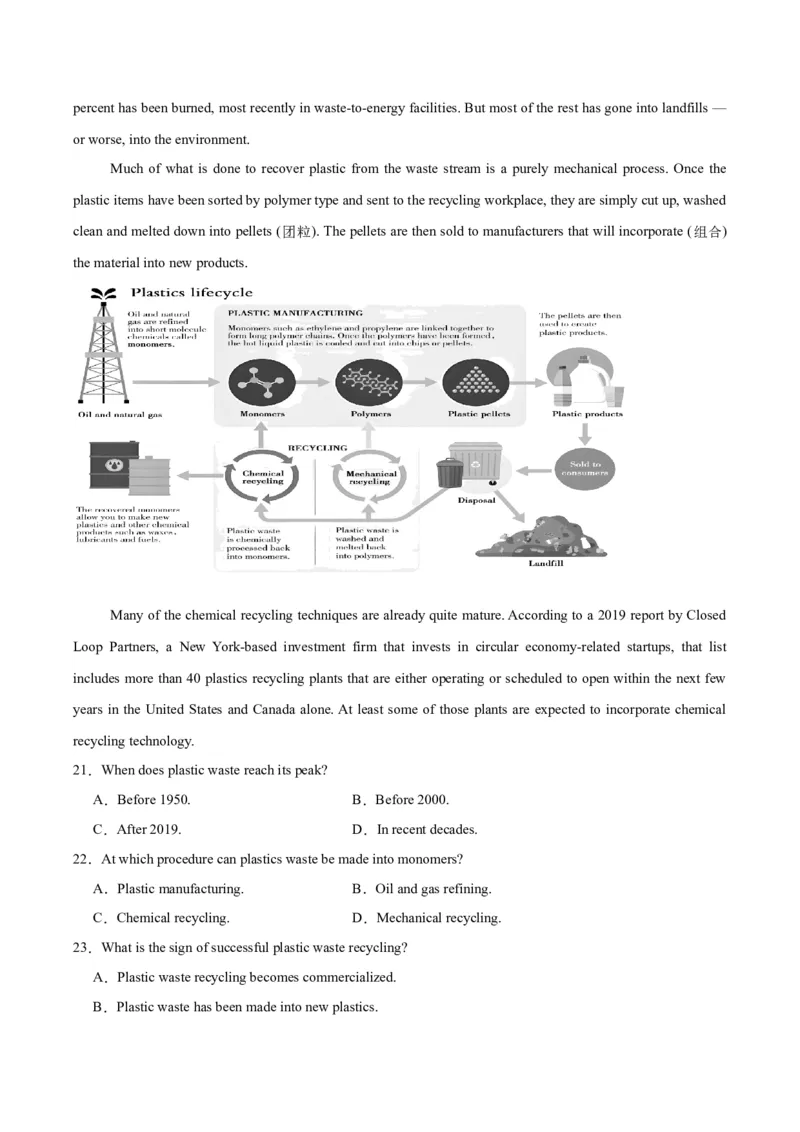
Much of what is done to recover plastic from the waste stream is a purely mechanical process. Once the
plastic items have been sorted by polymer type and sent to the recycling workplace, they are simply cut up, washed
clean and melted down into pellets (团粒). The pellets are then sold to manufacturers that will incorporate (组合)
the material into new products.
Many of the chemical recycling techniques are already quite mature. According to a 2019 report by Closed
Loop Partners, a New York-based investment firm that invests in circular economy-related startups, that list
includes more than 40 plastics recycling plants that are either operating or scheduled to open within the next few
years in the United States and Canada alone. At least some of those plants are expected to incorporate chemical
recycling technology.
21.When does plastic waste reach its peak?
A.Before 1950.
B.Before 2000.
C.After 2019.
D.In recent decades.
22.At which procedure can plastics waste be made into monomers?
A.Plastic manufacturing.
B.Oil and gas refining.
C.Chemical recycling.
D.Mechanical recycling.
23.What is the sign of successful plastic waste recycling?
A.Plastic waste recycling becomes commercialized.
B.Plastic waste has been made into new plastics.
C.Most of plastic waste has already gone into landfills.
D.Much has been burned in waste-to-energy facilities.
B(原创)
Tributes have been paid to legendary chimpanzee expert Dr Jane Goodall, who has died aged 91.
Widely considered the world's leading expert on the creatures, the UN Messenger of Peace and Founder
dedicated her life to the protection of the animals with her ground-breaking studies. The primatologist passed away
while on tour in California.
A post on her institute's Facebook page said: "The Jane Goodall Institute has learned this morning,
Wednesday, October 1, 2025, that Dr. Jane Goodall DBE, UN Messenger of Peace and Founder of the Jane Goodall
Institute has passed away due to natural causes.
"She was in California as part of her speaking tour in the United States. Dr. Goodall's discoveries as an
ethologist revolutionised science, and she was a tireless advocate for the protection and restoration of our
natural world."
The ethologist, a winner of the Mirror's Animal Hero award, worked with the incredible creatures for almost
70 years. Jane – who was made a dame in recognition of her achievements – previously recalled the moment she
was accepted by the chimp community when a primate she named David Greybeard, due to his silver facial hair,
first approached her.
She said in 2020: “The chimpanzees spent the first two to three months running away from me and I’d get
upset because I knew if I didn’t see something exciting, funding would run out for the project.
“They eventually tolerated me. But David Greybeard will always be special because he was the first of the
chimpanzees to come close to me. Then one day he took a banana from my hand. He was amazingly gentle.”
What followed was an extraordinary relationship between Jane and the apes, caught on film by a cameraman
who would later become her husband. She admitted there were times she was scared.
“The chimpanzees are 10 times stronger than me and when the big males charged or sometimes hit me, it was
scary but I was there for a reason.”
Dame Jane was born in London in 1934 and began researching free-living chimpanzees in Tanzania in
1960.In 1977 she founded the Jane Goodall Institute, which works to protect the species and supports youth
projects aimed at benefiting animals and the environment.
In 2002 she was handed a prominent United Nations role when she became a Messenger of Peace.A post to the
official X account of the UN said: "Today, the UN family mourns the loss of Dr Jane Goodall. The scientist,
conservationist and UN Messenger of Peace worked tirelessly for our planet and all its inhabitants, leaving an
extraordinary legacy for humanity and nature."
24.When did Jane Goodall become a Messenger of Peace?
A.In 1977.
B.In 2020.
C.In 2002.
D.In 1960.
25.How can we best describe Jane Goodall according to the text?
A.courageous and determined.
B.honest and confident.
C.intelligent and grateful.
D.considerate and energetic
26.What is the main purpose of the author writing the text?
A.To introduce Jane Goodall.
B.To remember Jane Goodall.
C.To praise Jane Goodall.
D.To raise the consciousness of Environment.
27.Which of the following is the best title for the text?
A.Jane Goodall
B.World's 'top expert
C.Jane Goodall and the chimp
D.Jane Goodall passed away
C
Neighboring groups of birds within the same species can create very different-looking nests — showing that
their nest-building choices aren’t only controlled by instinct (本能) and the environment. Instead, these birds seem
to learn rules for nest-making that get passed down within a family group from generation to generation.
That’s the conclusion of researchers who studied nearly 450 grassy structures built over two years by white-
browed sparrow weavers living in the Kalahari Desert in South Africa. These small, brown-and-white birds live in
groups, and it turns out that groups of birds that lived quite near to each other built distinctive architectural forms.
The biggest difference was in “how short or long the structures are,” says study lead author Maria C .
Tello-Ramos, a cognitive ecologist at the University of Hull in England. Furthermore, each group maintained the
same architectural style over time— and when outsiders joined, they adapted to this style.
To examine what might account for the observed differences, the team carefully analyzed factors that can
determine a nest’s size and shape for a given bird species: weather conditions, tree height, individuals’ body size
and genetic (基因的) relatedness. Yet none of these factors seemed to play a relevant role in shaping how the
Kalahari sparrows built their nests, the researchers report in Science.
“Then we say, ‘Okay, so what is left?’ ” Tello-Ramos explains. She and her colleagues proposed that cultural
transmission (传输) might be key to nest building. “In our paper, we haven’t gotten there yet with experiments, but
we have very good clues that that might be it, ” she says.
“These are important questions that are understudied, ” says Christina Riehl, an evolutionary biologist. She’s
not convinced the study’s data are enough to fully rule out genetic influence. “They can’t actually look at the effect
of, say, genetic differences, because they don’t have really good genetic information on all the individuals in these
groups,” she says. “I think there’s a lot left to be done, and I think this paper will inspire future research in a really
good way. ”
28.What plays a key role in birds’ nest-building choices according to the new study?
A.Living conditions.
B.Group traditions.
C.The influence of neighbors.
D.The species of birds.
29.What do we know about the nests built by neighboring groups of birds?
A.They are modeled after each other.
B.They are made of different materials.
C.They vary most significantly in length.
D.They share the same architectural style.
30.How did Tello-Ramos and his colleagues reach the study conclusion?
A.Through statistical methods.
B.Through careful experiments.
C.By excluding other possible factors.
D.By reviewing findings of previous studies.
31.What does Christina Riehl think of the study?
A.Limited but inspiring.
B.Understudied and misleading.
C.Controversial but well-designed.
D.Convincing and groundbreaking.
D
Small setbacks in your day — like spilling your coffee or waiting in a long line at the gas station — can ruin
your day. But the burnt toast theory is a belief that those minor inconveniences can lead to a positive outcome at a
later time.
What is the burnt toast theory? “It’s a concept based on reframing similar to redefine. something as simple as
burning your toast in the morning, though it might be depressing and inconvenient, might actually have happened
for good reason,” explains Dr. Markley. “Maybe it slows you down a bit, but it may also give you an extra two
minutes to breathe while you wait for new toast.”
The idea is that these depressing situations may have a domino effect (多米诺效应) in your life — setting
you up for something positive or keeping you from other problematic situations. Dr. Markley says that even if
burning your toast impacts your day by changing the course of events, the setback does provide an opportunity to
deal with, reframe your depression, and then refocus your thoughts and energy more productively. And it doesn’t
just have to be burnt toast that leads to you reframing your day — it’s more of a metaphor (暗喻) for how daily
troublesome occurrences can lead to a positive moment in your life.
It’s easy to think that burnt toast is just like other positive thinking methods such as lucky girl syndrome (综
合征) or harmful positivity, which is a belief that you should have a positive outlook on life regardless of the
situation. “I describe harmful positivity as throwing light at things that don’t shine. Harmful positivity is not
actually all that helpful. some things are allowed to be upsetting and not everything needs to be positively
reframed,” stresses Dr. Markley.
“The burnt toast theory isn’t encouraging you to be grateful for blackened toast. You can still be depressed
that your toast is burnt, but it gives you an opportunity to reroute, reframe and overcome a small setback.”
32.How does the author explain “setbacks” in paragraph 1?
A.By quoting an expert.
B.By listing examples.
C.By giving a definition.
D.By citing a theory.
33.What can we learn about the burnt toast theory?
A.It was initiated by Dr. Markley.
B.It is based on domino effects.
C.It helps distinguish false depression.
D.It encourages redefining negativity.
34.What does paragraph 4 mainly discuss about the burnt toast theory?
A.Its basic principle.
B.Its unique feature.
C.Its current popularity.
D.Its future development.
35.Which saying matches the idea of the burnt toast theory?
A.Each dog has its day.
B.still waters run deep.
C.Every cloud has a silver lining.
D.Misfortune never comes single.
第二节 (共5 小题;每小题2.5 分,满分12.5 分)
根据短文内容,从短文后的选项中选出能填入空白处的最佳选项。选项中有两项为多余选项。
Studies have shown that physical activity can improve mental alertness and cognitive function. Your brain
works better and you can think more clearly after exercising.

 36


  If you are looking for a way to boost your
studying, try integrating daily exercise into your routine.
Try light exercise while you study.
A few studies have shown that performing light exercise while studying can help recall of information.
These studies found that energetic exercise while studying may hurt recall because your brain is focused on the
workout instead of the information.

 37


  You can use the stationary bike while you study for at least half an
hour, making sure to keep the intensity light.
Exercise at your desk.
You can get your blood pumping at your desk while you study. If you don’t want to leave everything and go
for a quick 15-minute walk, try getting some physical activity where you are. Do some chair squats (蹲) at your
desk. Stand up from your chair, and then squat down without sitting down. Hang just above the chair for about 10
seconds.

 38

Take a walk on breaks.


 39


  Get up and take a fifteen-minute walk around the building or around campus nearby. You can also
do this if you are studying in your dorm or a coffee shop. Taking a break helps refresh yourself and gets blood
flowing to the brain, which can help you think and remember better.


 4  0


Consistent daily workouts, integrated with your study and class schedule, are more effective than forcing
150 minutes of physical activity into the weekend. Regular physical activity throughout the week enhances brain
function when you need it most — during your study sessions — rather than leaving it to the weekend.
A.Repeat this 20 times.
B.Focus on consistency.
C.Make the exercise an enjoyable experience.
D.If you are going to exercise while studying, just make sure to keep it gentle.
E.If you are studying in the library, break up your study sessions with physical activity.
F.Do low-impact gentle exercises, such as walking or swimming, at least 30 minutes a day.
G.Physical activity also helps boost memory and recall, which is important for your studying.
第三部分:语言运用(共两节,满分 30 分)
第一节:(共15 小题;每小题 1 分,满分15 分)
阅读下面短文,从短文后各题所给的 A、B、C 和 D 四个选项中,选出可以填入空白处的最佳选项。
When my ten-year-old son Luke joined a local football team, I never expected to witness such a profound
life lesson on the field. During a critical match against our town’s     41     team, the stadium buzzed with
unexpected energy as crowds packed the     42    .
At a crucial time in the game, Luke got the football and was running for a touchdown. He ran this way and
that,     43     players on the other team. His teammates did a     44     job in blocking too. Finally, only
one opponent stood between my son and a touchdown. Then a teammate made a hard block,     45     the
player to the ground.
There was now nothing between the goal and my son, who ran all out, then,     46    , stopped, turned
around, ran back to the boy lying on the ground, and took a     47    .
The crowd went wild. Fans from our team     48     terrible words at Luke. People I had known for
years said hateful things, staring at my son angrily and     49     him.
My heart pounding, I dashed across the field. Before I spoke, Luke whispered, “Dad, I heard a      50

crack when he fell. His leg’s broken—scoring would have      51      medical help.” Tears filled his eyes as he
added, “Remember? True      52      means doing what’s right.”
Overwhelmed with pride, I held him. Later, X-rays showed a serious break needing      53     . That
night, Luke got no prize—yet his moral      54      lit up the locker room (更衣室). Years later, coaches still
tell how one boy’s compassion redefined      55     .
41.A.opposing
B.same
C.winning
D.practice
42.A.field
B.stands
C.locker rooms
D.parking lot
43.A.coaching
B.greeting
C.assisting
D.avoiding
44.A.solid
B.messy
C.hesitant
D.half-hearted
45.A.lifting
B.knocking
C.guiding
D.inviting
46.A.cheerfully
B.gradually
C.unexpectedly
D.unwillingly
47.A.bow
B.breath
C.knee
D.step
48.A.aimed
B.directed
C.mouthed
D.shouted
49.A.threatening
B.grabbing
C.ignoring
D.comforting
50.A.soft
B.musical
C.sickening
D.repeated
51.A.called off
B.put off
C.held back
D.gave up
52.A.strategy
B.competition
C.fitness
D.sportsmanship
53.A.rest
B.surgery
C.help
D.medicine
54.A.judgment
B.talent
C.effort
D.integrity
55.A.value
B.rules
C.victory
D.privilege
第二节:(10 个小题;每小题1.5 分,满分15 分)
阅读下面短文,在空白处填入1 个适当的单词或括号内单词的正确形式。(原创)
STOCKHOLM, Oct. 6 (Xinhua) -- Mary E. Brunkow, Fred Ramsdell, and Shimon Sakaguchi were awarded
the 2025 Nobel Prize in Physiology or Medicine on Monday for their discoveries 56._______(concern)
peripheral immune tolerance(外周免疫耐受)."Their discoveries have been 57._______(decide) for our
understanding of how the immune system functions and 58._______we do not all develop serious autoimmune
diseases," said Olle Kampe, chair of the Nobel Committee.
The Nobel Assembly at Sweden's Karolinska Institute said the trio's work has had far-reaching clinical
implications, 59._______(pave)the way for new treatments for autoimmune diseases and cancer, and
60._______(potential)improving the success of transplantations.
Brunkow, born in 1961, is a senior program 61._______(manage) at the Institute for Systems Biology in
the United States. Ramsdell, born in 1960, serves 62._______ a scientific advisor at Sonoma Biotherapeutics, also
in the United States. Sakaguchi, born in 1951, is 63._______ professor at the Immunology Frontier Research
Center of Osaka University in Japan.
The laureates will share the prize sum of 11 million Swedish kronor (about 1.17 million U.S. dollars).
The Nobel Prize in Physiology or Medicine 64._______( award) since 1901. Last year's prize went to
American scientists Victor Ambros and Gary Ruvkun for discovering microRNA and 65._______(it) role in
gene regulation.
第四部分  写作(共两节,满分40 分)
第一节(满分 15 分)
假定你是李华,在学校组织的国际文化交流活动筹备中,你负责制作展示各国文化特色的PowerPoint。但
由于电脑故障,你未能在规定日期前完成任务。请你给负责此次活动的外教Mr Johnson 写一封道歉信,
内容包括:
1.表示歉意;
2.说明原因;
3.补救措施和预计完成时间。
注意:
1.词数80 左右;
2.可适当增加细节,以使行文连贯。
Dear Mr Johnson,
____________________________________________________________________________________________
____________________________________________________________________________________________
____________________________________________________________________________________________
____________________________________________________________________________________________
____________________________________________________________________________________________
Yours sincerely,
Li Hua
第二节  (满分 25 分)
阅读下面材料,根据其内容和所给段落开头语续写两段,使之构成一篇完整的短文。
Bear was not a bear. She was a big dog on the Perkinses’ family farm, a woolly creature with floppy ears and
paws like bedroom slippers. She protected the ducks and chickens from being eaten by foxes and raccoons (浣熊) .
She guarded the children as well, watching over them as closely as she did the chickens and ducks. In winter
the dog ran alongside the children as they sledded (滑雪橇) down snowy hills. In summer she swam with them in a
nearby river.
Bear belonged to a breed (品种) that had long been used by Atlantic fishermen to help with their work, and it
had a keen instinct for water rescue. When the children were in the river, the dog would swim in circles around
them, barking when she felt they went out too far. She was the perfect farm dog — companion, guardian, protector.
The dog’s favorite among the three children was three-year-old little Mike. They often curled up together.
Sometimes Bear would doze while Mike pretended to read to her. Often both were sound asleep, a tangle of dark
fur, blond hair, small hands and huge paws. At bedtime, Mike saved his last hug for Bear, his “best friend”.
On a cold winter day, when their parents went out to send a parcel, eight-year-old Martha, seven-year-old
Sara and Mike, went to slide on the frozen pond of their farm. Shouting happily, they slid back and forth, their
boots gliding easily across the ice. They laughed as they watched Bear’s attempts to stop suddenly, which would
instead send her skidding beyond them. Then, tired, the three sat down on the ice, with Bear beside them. Suddenly
the ice gave way under their combined weight.
As Bear jumped for shore, the three children fell into the freezing cold water. Screaming, Martha and Sarah
struggled to find footing on rocks underwater. Branches from a tree nearby provided handholds, and using every bit
of their strength, the two girls pulled themselves to shore.
注意:1. 续写词数应为150 左右;
2. 请按如下格式在答题卷的相应位置作答。
    Paragraph 1: Looking back, they saw little Mike holding on to a broken chunk (大块) of ice, unable to crawl
onto it.
____________________________________________________________________________________________
____________________________________________________________________________________________
____________________________________________________________________________________________
____________________________________________________________________________________________
____________________________________________________________________________________________
    Paragraph 2: Seeing that, Bear let out a series of woofs and jumped into the water, heading straight for Mike.
____________________________________________________________________________________________
____________________________________________________________________________________________
____________________________________________________________________________________________
____________________________________________________________________________________________
____________________________________________________________________________________________