主题09.文化多样性的体验感
一、主题解析
“文化多样性的体验感” 是读后续写中极具人文内涵的主题,核心聚焦跨文化场景中个体的感官冲
击、认知重构与情感共鸣。这类主题通常以 “文化初遇 — 冲突化解 — 融合感悟” 为叙事脉络,如外
国游客体验中国传统民俗、交换生适应异国生活等场景。
写作中需突出 “体验” 的层次性:从饮食、服饰、礼仪等表层文化符号带来的感官刺激(如臭豆腐
的气味、和服的质感),到价值观差异引发的认知碰撞(如礼物禁忌、时间观念),最终升华为对 “文
化共生” 的理解 —— 正如生物多样性维系生态平衡,文化多样性是人类文明的活力源泉。高考中此类
主题常隐含 “尊重差异、主动沟通” 的价值导向,需通过细节描写传递真诚态度,避免文化刻板印象,
以具体故事诠释 “和而不同” 的理念。
二、词句储备
1. 基本词汇及短语
cultural diversity 文化多样性
cross-cultural communication 跨文化交流
ethnic group 族群
traditional custom 传统习俗
folk art 民间艺术
local dialect 当地方言
cultural taboo 文化禁忌
etiquette 礼仪
cuisine 菜肴
handicraft 手工艺品
festival celebration 节日庆典
cultural heritage 文化遗产
moral value 道德观念
lifestyle 生活方式
religious belief 宗教信仰
cultural symbol 文化符号
exchange program 交流项目
overseas student 留学生
foreign visitor 外国游客
host family 寄宿家庭
language barrier 语言障碍
misunderstanding 误解
gesture 手势
facial expression 面部表情
curiosity 好奇心
admiration 钦佩
素材积累
embarrassment 尴尬
astonishment 惊讶
acceptance 接纳
respect 尊重
share 分享
explain 解释
demonstrate 展示
learn 学习
experience 体验
appreciate 欣赏
bridge 搭建桥梁
melt 消融
inherit 传承
blend 融合
2. 高分词汇及短语
ethnographic(民族志的):与族群文化相关的
    【例句】The ethnographic details of the village’s weaving rituals fascinated the anthropologist.(村庄织布
仪式的民族志细节令人类学家着迷。)
syncretism(文化融合):不同文化元素的融合
    【例句】The region’s music shows a unique syncretism of African rhythms and European melodies.(该地区
的音乐体现了非洲节奏与欧洲旋律的独特融合。)
cultural empathy(文化共情):理解并感受异文化的能力
    【例句】Developing cultural empathy helps avoid misunderstandings in international communication.(培养
文化共情有助于避免跨文化交流中的误解。)
ritualistic(仪式性的):与仪式相关的
    【例句】The ritualistic preparation of tea in Japan emphasizes harmony and precision.(日本的茶道仪式筹
备强调和谐与精准。)
idiom(习语):特定文化的固定表达
    【例句】Translating idioms directly often leads to confusion across cultures.(直译习语常导致跨文化困
惑。)
xenophobia(排外情绪):对外国文化的恐惧或厌恶
    【例句】Education is key to combating xenophobia and promoting cultural acceptance.(教育是打击排外情
绪、促进文化接纳的关键。)
heritage preservation(遗产保护):对文化遗产的保护
    【例句】The local government invested heavily in heritage preservation of ancient temples.(当地政府大力
投入古寺的遗产保护工作。)
intercultural competence(跨文化能力):应对跨文化场景的能力
    【例句】This exchange program aims to improve students’ intercultural competence.(该交流项目旨在提升
学生的跨文化能力。)
customary(习俗性的):符合传统习俗的
    【例句】It is customary to give red envelopes during Chinese Spring Festival.(春节发红包是中国的传统
习俗。)
misconception(误解):对文化的错误认知
    【例句】The misconception that all Westerners dislike spicy food is far from true.(认为所有西方人都不喜
欢辣食的观点是错误的。)
authenticity(原汁原味):文化的真实性
    【例句】The restaurant prides itself on the authenticity of its Thai cuisine.(这家餐厅以其泰餐的原汁原味
为荣。)
cultural diffusion(文化传播):文化元素的传播过程
    【例句】Silk Road played a vital role in cultural diffusion between Asia and Europe.(丝绸之路在亚欧文化
传播中发挥了重要作用。)
decorum(礼仪规范):正式场合的礼仪
    【例句】The decorum of a royal wedding varies across different countries.(王室婚礼的礼仪规范因国家而
异。)
indigenous(本土的):某地区原生的
    【例句】The indigenous art of Australia reflects the Aborigines’ connection to nature.(澳大利亚本土艺术
体现了原住民与自然的联系。)
acculturation(文化适应):适应新文化的过程
    【例句】Acculturation can be challenging but rewarding for overseas students.(文化适应对留学生而言虽
有挑战但大有裨益。)
symbolism(象征意义):文化符号的含义
    【例句】The lotus flower has rich symbolism in many Eastern cultures.(莲花在多种东方文化中具有丰富
的象征意义。)
tolerance(包容):对文化差异的包容
    【例句】Cultural tolerance is essential for building harmonious multi-ethnic societies.(文化包容是构建和
谐多民族社会的关键。)
folklore(民间传说):民间流传的故事与传统
    【例句】The grandmother shared folklore about the mountain with the foreign visitors.(奶奶给外国游客讲
了关于这座山的民间传说。)
linguistic nuance(语言细微差异):语言中的微妙含义
    【例句】Understanding linguistic nuances is crucial for accurate cross-cultural communication.(理解语言
细微差异对精准跨文化交流至关重要。)
cultural identity(文化认同):对自身文化的归属感
    【例句】Even living abroad for years, she maintained a strong cultural identity.(即使在国外生活多年,她
仍保持着强烈的文化认同。)
3. 高分句式
A wave of curiosity flooded over me as I watched the locals perform the traditional dance.(当我看到当地人表演
传统舞蹈时,一股好奇心涌上心头。)
It suddenly dawned on me that the gesture I used was considered rude in this culture.(我突然意识到,我做的这
个手势在这种文化中被视为无礼。)
Not until the host explained its history did I dare to try the stinky tofu.(直到主人解释了它的历史,我才敢尝试
臭豆腐。)
The moment she put on the handmade kimono, she felt a deep connection to the local culture.(她穿上手工和服的
那一刻,就感受到了与当地文化的深刻联结。)
With the craftsman guiding my hands, I gradually learned the secrets of bamboo weaving.(在工匠的手把手指导
下,我逐渐掌握了编竹篮的诀窍。)
It is not the grandeur of the festival but the sincerity of the people that touches my heart.(打动我的不是节日的盛
大,而是人们的真诚。)
What makes cross-cultural communication meaningful is the willingness to listen and learn.(让跨文化交流有意
义的是倾听与学习的意愿。)
Her eyes lit up with admiration as she watched the calligrapher write Chinese characters.(看着书法家写毛笔字,
她的眼中闪烁着钦佩的光芒。)
Unable to speak the local dialect, he communicated with the vendor through gestures and smiles.(不会说当地方
言,他通过手势和微笑与小贩沟通。)
The wooden mask, which symbolizes courage in their tradition, has become a precious gift.(这个在他们传统中
象征勇气的木雕面具,成了珍贵的礼物。)
A sense of awe seized me when I stood in front of the ancient temple.(站在古寺前,我心中涌起一股敬畏之
情。)
Having lived with the host family for a month, she now understands their lifestyle well.(与寄宿家庭同住一个月
后,她现在很了解他们的生活方式。)
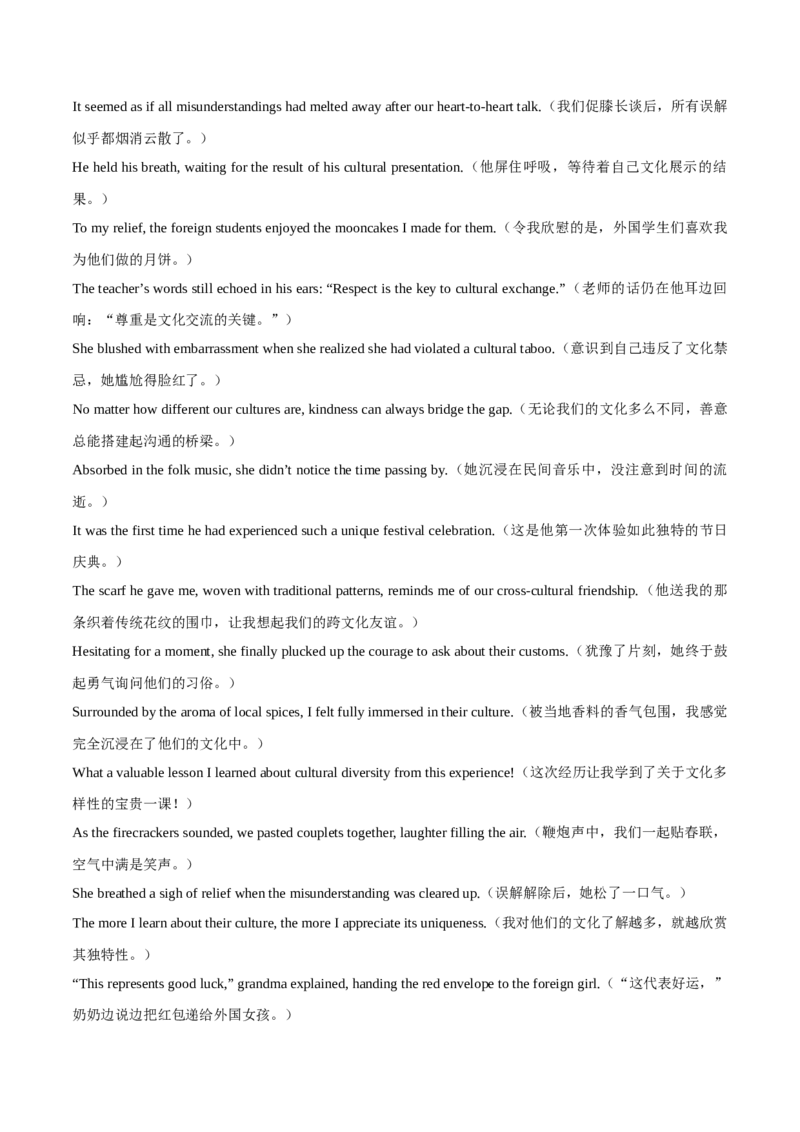
It seemed as if all misunderstandings had melted away after our heart-to-heart talk.(我们促膝长谈后,所有误解
似乎都烟消云散了。)
He held his breath, waiting for the result of his cultural presentation.(他屏住呼吸,等待着自己文化展示的结
果。)
To my relief, the foreign students enjoyed the mooncakes I made for them.(令我欣慰的是,外国学生们喜欢我
为他们做的月饼。)
The teacher’s words still echoed in his ears: “Respect is the key to cultural exchange.”(老师的话仍在他耳边回
响:“尊重是文化交流的关键。”)
She blushed with embarrassment when she realized she had violated a cultural taboo.(意识到自己违反了文化禁
忌,她尴尬得脸红了。)
No matter how different our cultures are, kindness can always bridge the gap.(无论我们的文化多么不同,善意
总能搭建起沟通的桥梁。)
Absorbed in the folk music, she didn’t notice the time passing by.(她沉浸在民间音乐中,没注意到时间的流
逝。)
It was the first time he had experienced such a unique festival celebration.(这是他第一次体验如此独特的节日
庆典。)
The scarf he gave me, woven with traditional patterns, reminds me of our cross-cultural friendship.(他送我的那
条织着传统花纹的围巾,让我想起我们的跨文化友谊。)
Hesitating for a moment, she finally plucked up the courage to ask about their customs.(犹豫了片刻,她终于鼓
起勇气询问他们的习俗。)
Surrounded by the aroma of local spices, I felt fully immersed in their culture.(被当地香料的香气包围,我感觉
完全沉浸在了他们的文化中。)
What a valuable lesson I learned about cultural diversity from this experience!(这次经历让我学到了关于文化多
样性的宝贵一课!)
As the firecrackers sounded, we pasted couplets together, laughter filling the air.(鞭炮声中,我们一起贴春联,
空气中满是笑声。)
She breathed a sigh of relief when the misunderstanding was cleared up.(误解解除后,她松了一口气。)
The more I learn about their culture, the more I appreciate its uniqueness.(我对他们的文化了解越多,就越欣赏
其独特性。)
“This represents good luck,” grandma explained, handing the red envelope to the foreign girl.(“这代表好运,”
奶奶边说边把红包递给外国女孩。)
Suddenly, a loud cheer broke out as the cultural performance began.(文化表演开始时,突然爆发出一阵欢呼
声。)
Determined to promote cultural exchange, he decided to organize more such activities.(决心促进文化交流,他
决定组织更多这样的活动。)
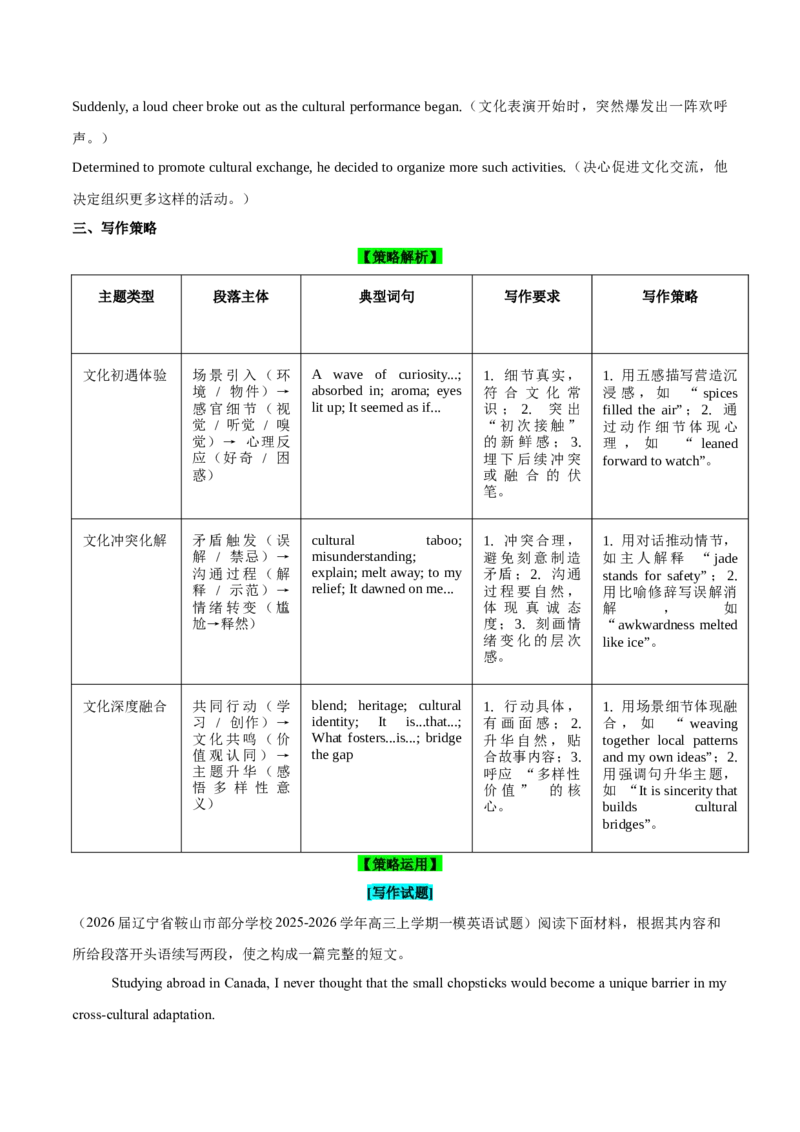
三、写作策略
【策略解析】
主题类型
段落主体
典型词句
写作要求
写作策略
文化初遇体验
场景引入(环
境 / 物件)→
感官细节(视
觉 / 听觉 / 嗅
觉)→ 心理反
应(好奇 / 困
惑)
A wave of curiosity...;
absorbed in; aroma; eyes
lit up; It seemed as if...
1. 细节真实,
符合文化常
识;2. 突出
“ 初次接触”
的新鲜感;3.
埋下后续冲突
或融合的伏
笔。
1. 用五感描写营造沉
浸感,如 “ spices
filled the air” ;2. 通
过动作细节体现心
理,如 “ leaned
forward to watch”。
文化冲突化解
矛盾触发(误
解 / 禁忌)→
沟通过程(解
释 / 示范)→
情绪转变(尴
尬→释然)
cultural

taboo;
misunderstanding;
explain; melt away; to my
relief; It dawned on me...
1. 冲突合理,
避免刻意制造
矛盾;2. 沟通
过程要自然,
体现真诚态
度;3. 刻画情
绪变化的层次
感。
1. 用对话推动情节,
如主人解释 “ jade
stands for safety” ;2.
用比喻修辞写误解消
解
,
如
“awkwardness melted
like ice”。
文化深度融合
共同行动(学
习 / 创作)→
文化共鸣(价
值观认同)→
主题升华(感
悟多样性意
义)
blend; heritage; cultural
identity; It is...that...;
What fosters...is...; bridge
the gap
1. 行动具体,
有画面感;2.
升华自然,贴
合故事内容;3.
呼应 “多样性
价值” 的核
心。
1. 用场景细节体现融
合,如 “ weaving
together local patterns
and my own ideas”;2.
用强调句升华主题,
如 “It is sincerity that
builds

cultural
bridges”。
【策略运用】
[写作试题]
(2026 届辽宁省鞍山市部分学校2025-2026 学年高三上学期一模英语试题)阅读下面材料,根据其内容和
所给段落开头语续写两段,使之构成一篇完整的短文。
Studying abroad in Canada, I never thought that the small chopsticks would become a unique barrier in my
cross-cultural adaptation.
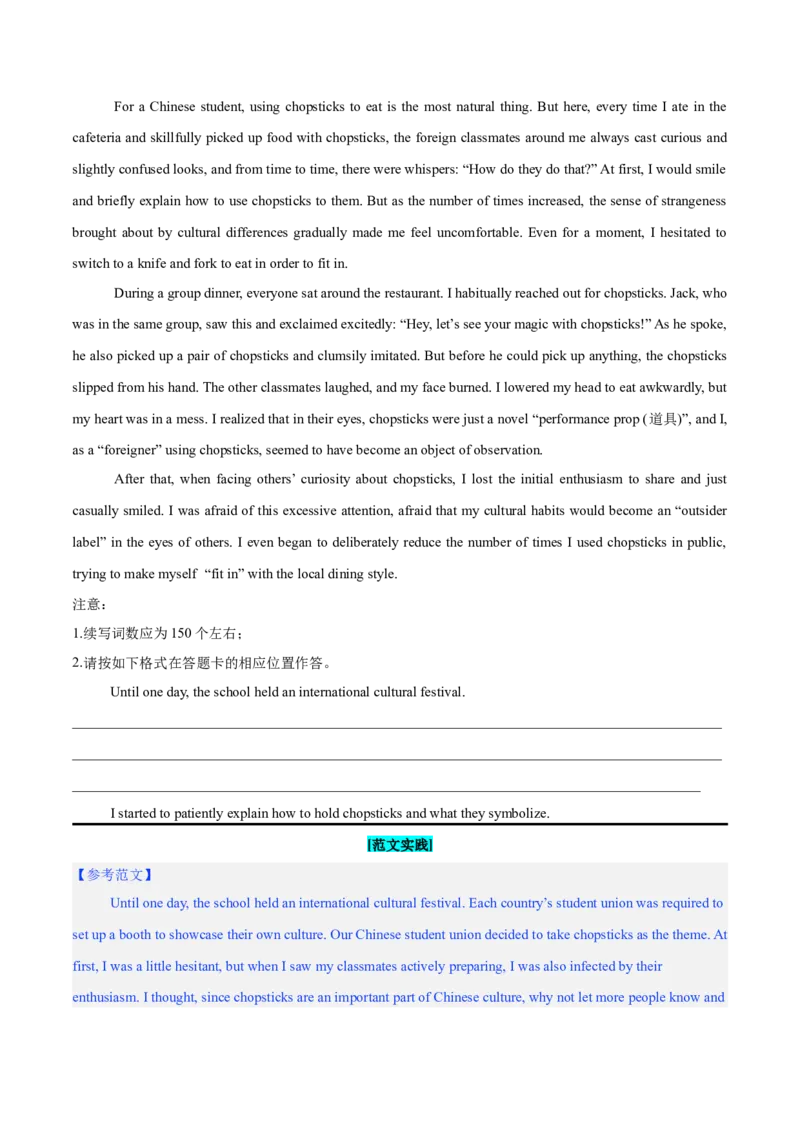
For a Chinese student, using chopsticks to eat is the most natural thing. But here, every time I ate in the
cafeteria and skillfully picked up food with chopsticks, the foreign classmates around me always cast curious and
slightly confused looks, and from time to time, there were whispers: “How do they do that?” At first, I would smile
and briefly explain how to use chopsticks to them. But as the number of times increased, the sense of strangeness
brought about by cultural differences gradually made me feel uncomfortable. Even for a moment, I hesitated to
switch to a knife and fork to eat in order to fit in.
During a group dinner, everyone sat around the restaurant. I habitually reached out for chopsticks. Jack, who
was in the same group, saw this and exclaimed excitedly: “Hey, let’s see your magic with chopsticks!” As he spoke,
he also picked up a pair of chopsticks and clumsily imitated. But before he could pick up anything, the chopsticks
slipped from his hand. The other classmates laughed, and my face burned. I lowered my head to eat awkwardly, but
my heart was in a mess. I realized that in their eyes, chopsticks were just a novel “performance prop (道具)”, and I,
as a “foreigner” using chopsticks, seemed to have become an object of observation.
After that, when facing others’ curiosity about chopsticks, I lost the initial enthusiasm to share and just
casually smiled. I was afraid of this excessive attention, afraid that my cultural habits would become an “outsider
label” in the eyes of others. I even began to deliberately reduce the number of times I used chopsticks in public,
trying to make myself  “fit in” with the local dining style.
注意:
1.续写词数应为150 个左右;
2.请按如下格式在答题卡的相应位置作答。
Until one day, the school held an international cultural festival.
____________________________________________________________________________________________
____________________________________________________________________________________________
_________________________________________________________________________________________
I started to patiently explain how to hold chopsticks and what they symbolize.
[范文实践]
【参考范文】
Until one day, the school held an international cultural festival. Each country’s student union was required to
set up a booth to showcase their own culture. Our Chinese student union decided to take chopsticks as the theme. At
first, I was a little hesitant, but when I saw my classmates actively preparing, I was also infected by their
enthusiasm. I thought, since chopsticks are an important part of Chinese culture, why not let more people know and
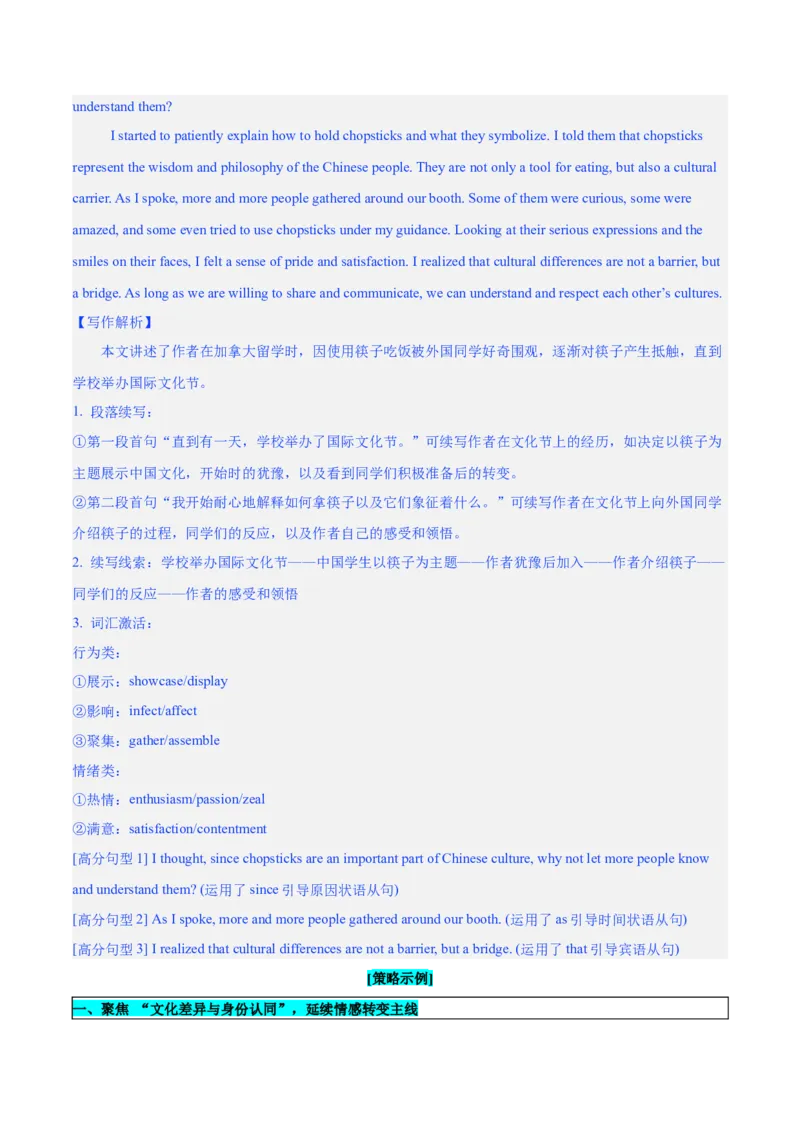
understand them?
I started to patiently explain how to hold chopsticks and what they symbolize. I told them that chopsticks
represent the wisdom and philosophy of the Chinese people. They are not only a tool for eating, but also a cultural
carrier. As I spoke, more and more people gathered around our booth. Some of them were curious, some were
amazed, and some even tried to use chopsticks under my guidance. Looking at their serious expressions and the
smiles on their faces, I felt a sense of pride and satisfaction. I realized that cultural differences are not a barrier, but
a bridge. As long as we are willing to share and communicate, we can understand and respect each other’s cultures.
【写作解析】
本文讲述了作者在加拿大留学时,因使用筷子吃饭被外国同学好奇围观,逐渐对筷子产生抵触,直到
学校举办国际文化节。
1. 段落续写:
①第一段首句“直到有一天,学校举办了国际文化节。”可续写作者在文化节上的经历,如决定以筷子为
主题展示中国文化,开始时的犹豫,以及看到同学们积极准备后的转变。
②第二段首句“我开始耐心地解释如何拿筷子以及它们象征着什么。”可续写作者在文化节上向外国同学
介绍筷子的过程,同学们的反应,以及作者自己的感受和领悟。
2. 续写线索:学校举办国际文化节——中国学生以筷子为主题——作者犹豫后加入——作者介绍筷子——
同学们的反应——作者的感受和领悟
3. 词汇激活:
行为类:
①展示:showcase/display
②影响:infect/affect
③聚集:gather/assemble
情绪类:
①热情:enthusiasm/passion/zeal
②满意:satisfaction/contentment
[高分句型1] I thought, since chopsticks are an important part of Chinese culture, why not let more people know
and understand them? (运用了since 引导原因状语从句)
[高分句型2] As I spoke, more and more people gathered around our booth. (运用了as 引导时间状语从句)
[高分句型3] I realized that cultural differences are not a barrier, but a bridge. (运用了that 引导宾语从句)
[策略示例]
一、聚焦 “文化差异与身份认同”,延续情感转变主线
该试题的核心主题围绕 “跨文化适应中的文化认知转变” 展开,原文以 “筷子” 为文化符号,串
联起作者从 “自然使用 — 被围观不适 — 刻意回避” 的情感变化,续写需延续 “抵触到接纳、自
豪” 的情感主线,最终升华 “文化差异不是障碍而是桥梁” 的主题。
从写作技巧来看,主题的延续需紧扣 “符号载体” 与 “情感节点”。例如,原文中 “筷子” 是
中国文化的具象代表,参考范文第一段便以 “国际文化节” 为关键场景,将 “筷子” 从 “被围观的
工具” 转化为 “文化展示的核心”,通过 “我” 从 “hesitant(犹豫)” 到 “infected by enthusiasm
(被热情感染)” 的心理变化,承接原文的情感矛盾并埋下转折伏笔;第二段则通过解释筷子
“represent the wisdom and philosophy of the Chinese people(代表中国人的智慧与哲学)”,将主题从 “个
人适应” 上升到 “文化共享”,呼应原文中 “cultural differences(文化差异)” 的核心矛盾,形成
“矛盾出现 — 矛盾缓解 — 主题升华” 的完整主题链。
二、遵循 “场景引入 — 行为转变 — 心理铺垫” 与 “细节展开 — 互动升级 — 主题总结” 的逻辑
读后续写的两段需各自独立成意,又紧密衔接,该试题参考范文的段落结构极具代表性,可拆解为
“场景驱动行为,行为推动心理” 的逻辑链。
(一)第一段:“场景触发 — 犹豫到参与”,完成情节转折
首句 “Until one day, the school held an international cultural festival” 明确场景,参考范文随即围绕
“文化节” 展开三层逻辑:
场景细节补充:“ Each country’s student union was required to set up a booth to showcase their own
culture”,通过 “set up a booth(设展位)”“showcase culture(展示文化)” 的具体行为,为 “筷子主
题展示” 提供合理性场景;
行为矛盾呈现:“At first, I was a little hesitant, but when I saw my classmates actively preparing, I was also
infected by their enthusiasm”,用 “but” 转折,呼应原文中 “我” 对筷子的抵触心理,同时通过
“classmates actively preparing(同学积极准备)” 的外部刺激,为 “我” 的行为转变做铺垫;
心理转变收尾:“I thought, since chopsticks are an important part of Chinese culture, why not let more
people know and understand them?”,以内心独白的形式,完成 “回避 — 思考 — 接纳” 的心理转变,
既承接第一段开头的场景,又为第二段 “主动解释筷子” 的行为埋下伏笔。
(二)第二段:“细节讲解 — 互动反馈 — 主题升华”,完成情感闭环
首句 “I started to patiently explain how to hold chopsticks and what they symbolize” 明确核心行为,参考
范文通过 “讲解内容 — 他人反应 — 自我领悟” 三层逻辑收尾:
细节展开:“I told them that chopsticks represent the wisdom and philosophy of the Chinese people. They
are not only a tool for eating, but also a cultural carrier”,从 “象征意义” 和 “文化属性” 两方面补充筷子
的内涵,呼应原文中 “foreign classmates” 对筷子的 “curious and confused looks(好奇与困惑)”,解答
原文的认知矛盾;
互动升级:“As I spoke, more and more people gathered around our booth. Some of them were curious,
some were amazed, and some even tried to use chopsticks under my guidance” ,用 “gathered(聚集)”
“amazed(惊叹)”“tried to use(尝试使用)” 等动作与情绪描写,展现 “文化共享” 的积极效果,
与原文中 “the other classmates laughed(同学嘲笑)” 的负面场景形成对比;
主题总结:“I realized that cultural differences are not a barrier, but a bridge. As long as we are willing to
share and communicate, we can understand and respect each other’s cultures”,以 “realized” 引出感悟,直接
回应原文 “cultural differences gradually made me feel uncomfortable(文化差异让我不适)” 的核心问题,
完成主题升华。
三、“行为动词 + 情绪形容词” 激活场景,从句结构增强逻辑
读后续写需通过精准的词句选择还原场景、传递情感,该试题参考范文的 “词汇激活” 与 “句型
运用” 可作为典型范例。
(一)聚焦 “行为类” 与 “情绪类”,强化画面感
1.行为类词汇:
展示文化:“showcase their own culture”(比 “display” 更具 “主动呈现特色” 的含义,贴合文化
节的 “展示” 目的);
心理影响:“was infected by their enthusiasm”(“infect” 比 “affect” 更具 “情感传递的感染力”,
生动体现同学热情对 “我” 的带动);
互动动作:“gathered around our booth”“tried to use chopsticks under my guidance”(“gathered around”
体现人群聚集的动态,“under my guidance” 补充 “我” 的主动行为,还原文化交流的场景)。
2.情绪类词汇:
原文负面情绪:“uncomfortable(不适)”“afraid(害怕)”“awkward(尴尬)”;
范文转折情绪:“enthusiasm(热情)”“pride(自豪)”“satisfaction(满意)”;
两类词汇形成对比,通过 “情绪变化” 推动情节发展,例如范文中 “hesitant(犹豫)” 到
“enthusiastic(热情)” 的转变,正是 “我” 对文化态度转变的直接体现。
(二)运用 “状语从句 + 宾语从句”,增强逻辑与深度
原因状语从句:“I thought, since chopsticks are an important part of Chinese culture, why not let more
people know and understand them?”(“since” 引导原因,解释 “我” 参与展示的动机,衔接前文的 “犹
豫” 与后文的 “行动”,逻辑更连贯);
时间状语从句:“As I spoke, more and more people gathered around our booth”(“As” 引导时间,同步
呈现 “我讲解” 与 “人聚集” 的场景,增强画面的动态感);
宾语从句:“I realized that cultural differences are not a barrier, but a bridge”(“that” 引导宾语,引出
“我” 的最终感悟,直接升华主题,使文章立意更深刻)。
四、紧扣 “词数限制” 与 “情节衔接”,避免偏离主线
该试题明确要求 “续写词数应为 150 个左右” 且需 “构成一篇完整的短文”,写作时需注意以下
两点:
(一)词数分配:两段均衡,重点突出
参考范文两段词数基本持平(第一段约 70 词,第二段约 80 词),第一段侧重 “场景引入与心理
转变” ,用简洁的场景描写(“ set up a booth”“classmates actively preparing” )和心理描写
(“hesitant”“infected by enthusiasm”)完成转折;第二段侧重 “互动细节与主题升华”,用更多笔墨描写
“他人反应”(“curious”“amazed”“tried to use”)和 “自我感悟”(“pride and satisfaction”“cultural
differences are not a barrier”),避免一段过详、一段过略的失衡问题。
(二)情节衔接:紧扣 “原文线索” 与 “开头句”,不偏离主线
原文的核心线索是 “我对筷子的态度变化”,开头句分别限定 “国际文化节” 场景和 “解释筷
子” 行为,写作时需避免 “脱离筷子谈文化” 或 “脱离场景谈转变”。例如参考范文始终围绕 “筷
子” 展开 —— 第一段以 “chopsticks as the theme” 承接场景,第二段以 “how to hold chopsticks and
what they symbolize” 承接行为,同时呼应原文中 “foreign classmates’ curiosity(外国同学的好奇)”
“cultural differences(文化差异)” 等核心元素,确保续写内容与原文 “无缝衔接”。
五、遵循 “线索延续 — 矛盾解决 — 主题升华” 的三步法
结合该试题的写作逻辑,读后续写可总结为 “三步写作策略”,适用于同类 “文化差异”“个人成
长” 主题的续写:
1.第一步:梳理原文线索,明确 “矛盾点” 与 “情感线”
写作前需先提炼原文的核心矛盾与情感变化,例如该试题中:
核心矛盾:“我” 的中国文化习惯(用筷子)与国外环境(用刀叉、同学好奇围观)的冲突;
情感线:自然使用→不适回避→(续写)接纳自豪。
明确线索后,续写内容需围绕 “解决矛盾”“推动情感” 展开,避免新增无关情节(如突然插入其他文
化符号、脱离 “筷子” 谈适应)。
2.第二步:依托开头句,构建 “场景 — 行为 — 心理” 的段落逻辑
针对每段开头句,先确定场景背景,再设计具体行为,最后传递心理或情感。例如:
第一段开头 “Until one day, the school held an international cultural festival”:先补充 “设展位展示文
化” 的场景细节,再设计 “我犹豫后参与” 的行为,最后用内心独白传递 “接纳文化” 的心理;
第二段开头 “I started to patiently explain how to hold chopsticks and what they symbolize”:先展开 “解
释筷子象征意义” 的具体内容,再设计 “他人聚集尝试” 的互动行为,最后用 “自豪与领悟” 传递
情感升华。
3.第三步:运用 “对比” 与 “象征”,强化主题表达
对比:通过原文 “同学嘲笑” 与范文 “同学惊叹” 的场景对比,突出 “文化交流” 的效果;通
过 “我” 从 “回避” 到 “主动分享” 的行为对比,体现 “身份认同” 的转变;
象征:将 “筷子” 象征为 “文化载体”,将 “国际文化节” 象征为 “文化桥梁”,用具象符号
承载抽象主题,使文章立意更鲜明、更有感染力。
1.(2025·山东·模拟预测)阅读下面材料,根据其内容和所给段落开头语续写两段,使之构成一篇完整的
短文。
I, an art teacher from New York, have always been drawn to traditional Chinese crafts. Last summer, I
traveled to Weifang, a small city in Shandong Province noted as the “Kite Capital of the World.” The exquisite (精
美的) kites of Weifang left me completely amazed. From the moment I arrived, I was greeted by a breathtaking
sight: people crafting kites everywhere, and hundreds of colorful kites soaring gracefully in the sky. The
atmosphere was filled with laughter and excitement as both locals and tourists gathered to celebrate the annual
International Kite Festival.
I spent several days exploring the festival, marveling (大为赞叹) at the complicated designs of the kites.
Some were shaped like impressive dragons, their long bodies twisting and turning in the air. Others resembled
delicate butterflies, their wings decorated with brilliant patterns that seemed to come alive against the blue sky. I
couldn’t resist purchasing several kites to bring back home, each one a true masterpiece of craftsmanship.
When I returned to my classroom in New York, I eagerly shared the kites with my students. Their eyes
widened with wonder as they examined the delicate bamboo frames and the hand-painted rice paper. “They’re so
beautiful!” one student exclaimed ( 惊呼), holding up a butterfly-shaped kite. Another student, fascinated by a
dragon kite, asked, “How do they make these? They look so light, yet they fly so gracefully.”
Inspired by their enthusiasm, I decided to teach them how to make their own kites. We started with simple
designs, using lightweight materials like bamboo sticks and tissue paper. However, despite our best efforts, the kites
we crafted never flew as well as the ones from Weifang. Some would lose their balance, while others barely
实战演练
managed to lift off the ground. The students grew disheartened, and so did I. “Why can’t ours fly like the Chinese
kites?” one student asked, her voice tinged with (略带) disappointment. Their words made me realize that making a
kite wasn’t just about assembling (组装) materials; it required a profound ( 深刻的) understanding of balance,
precision, and the art of aerodynamics (空气动力学). “Why not seek guidance from the people of the ‘Kite Capital
of the World’? They must be experts in kite-making,” I thought to myself.
注意:
1. 续写词数要求应为150 个左右;
2. 请按如下格式在答题卡的相应位置作答。
Eventually I decided to post our kite-making struggles on a Chinese website.
____________________________________________________________________________________________
____________________________________________________________________________________________
____________________________________________________________________________________________
____________________________________________________________________________________________
___________________________
On a clear, windy day, my students and I took our newly-made kites to a nearby park.
____________________________________________________________________________________________
____________________________________________________________________________________________
____________________________________________________________________________________________
____________________________________________________________________________________________
___________________________
2.(2024·江西景德镇·一模)阅读下面材料,根据其内容和所给段落开头语续写两段,使之构成一篇完整
的短文。
I applied for a job with a Chinese-Canadian company in Vancouver. As you know, the Chinese are famous
for their food. They cook delicious food and obtain a simple pleasure from eating.
So, I was not surprised when my new boss invited me out to lunch to celebrate my new job. He said we were
going to eat in a Chinese restaurant in Chinatown. I was nervous. I knew we would be using chopsticks, and while I
had tried many times to master the technique, I had completely failed in every attempt. How would I be able to
make a good impression? Would I make a complete fool of myself?
That evening, I called a friend and asked her to explain exactly how to use chopsticks. She patiently
explained the proper way of holding them between the thumb, first and middle fingers.“ It is not that hard,” she
said. “That is easy for you to say,” I replied. “You’ve been eating with chopsticks all your life. It is natural for you!”
I didn’t get much sleep that evening. I kept turning around in bed all night, worrying about lunch the next day.
The next day, I could hardly contain my anxiety. It was difficult to get any work done in the morning. At
noon, I left with my boss and two co-workers and headed to the restaurant. We were seated at an excellent table.
My boss wrote out the food order, speaking to the server in Chinese. My heart was pounding, but then I noticed a
strange thing. Instead of the customary chopsticks, each of us had knives, forks, and spoons.
I was confused at first, but then, it hit me. My boss knew that I would have trouble with the chopsticks. He
wanted to save me from embarrassment, so he had called ahead and arranged for us to be served with knives and
forks. I couldn’t believe how kind and helpful he was.
注意:(1) 续写词数应为150 个左右;(2) 请按如下格式在答题纸的相应位置作答。
Instantly, I made up my mind and asked the server to bring me a pair of chopsticks.
____________________________________________________________________________________________
____________________________________________________________________________________________
____________________________________________________________________________________________
____________________________________________________________________________________________
____________________________________________________________________________________________
In the end, I wasn’t embarrassed at all.
____________________________________________________________________________________________
____________________________________________________________________________________________
____________________________________________________________________________________________
____________________________________________________________________________________________
____________________________________________________________________________________________
3.(23-24 高三下·广东韶关·阶段练习)阅读下面材料,根据其内容和所给段落开头语续写两段,使之构
成一篇完整的短文。
For more than 20 years I have been traveling the world, preferring often to spend a year or two in different
countries rather than to just visit as a tourist. It has become an important part of my personality as I grew older and
shaped the way I saw the world and myself.
My little taste of this amazing life was when I was 19 years old. I was selected among a small group of
college classmates to spend a year abroad. This was long before people could travel the world through social media
like Facebook and Twitter. In order to see a place, you had to go there and experienced it.
I was raised in a middle-class family and couldn’t afford to travel around the world the way I wished I could.
The only way I knew about the world outside was through letters I wrote to pen pals from over a dozen countries as
a kid, and from television. Growing up, I always loved the very funny British comedies that were shown on local
public television every Saturday night. So when I got the chance to apply for a study abroad program, I chose
London.
Living abroad can be exciting, scary and challenging. I thought it would be easier because I spoke the same
language as the local people did. But I also like to relish ( 享受) the little differences between the British and
American culture and language. I also learned that in England, they spell words differently than in the U. S. In
British spelling, they put a “u” in words like favor to make it “favour” and an “s” in words like analyze to make it
“analyse”. I was able to adapt quickly to this new way of writing since I was submitting papers all the time for my
classes.
Academically, I got to take classes that weren’t offered at my college back home. For example, I had a
course in sociology and learned about the native people of Papua New Guinea.
注意:
1. 续写词数应为150 左右;
2. 请按如下格式在答题卡的相应位置作答。
Paragraph 1: But there were also challenges that year too.
____________________________________________________________________________________________
____________________________________________________________________________________________
____________________________________________________________________________________________
____________________________________________________________________________________________
____________________________________________________________________________________________
___________________________________
Paragraph 2: Sometimes the difficult times made me sad and homesick.
____________________________________________________________________________________________
____________________________________________________________________________________________
____________________________________________________________________________________________
____________________________________________________________________________________________
____________________________________________________________________________________________
___________________________________
4.(2024·重庆·三模)阅读下面材料,根据其内容和所给段落开头语续写两段,使之构成一篇完整的短文。
As I unzipped my lunchbox, the whole place was turned into a spicy curry (咖喱) dream. I immediately hid
it under my seat, hoping no one would take notice.
Mom had really outdone herself with masala — our family’s all-time favorite dish back in India. But today, it
wasn’t just about me and my lunch. A warm smile on his face, Ricky invited me, a new transfer student from India
to New York city, for lunch.
“Ava, come sit here!” Ricky called out, gesturing towards a vacant seat.
As I made my way over, memories of those awkward lunchtimes when I studied in Kansas, one of the most
conservative states, flooded back. I could still recall how everyone would wrinkle their noses and stare curiously
when I unpacked my Indian food. It always made me feel like an outsider, like I didn’t belong.
Therefore, before my first day in this school, I had demanded my mom pack “normal” western-style food for
me. I still remembered the look on her face upon hearing it, as she signed in disappointment and confusion, “Isn’t
there a moment when you feel proud of your origin?” That was hurting, but not more hurting than others’ giggles
and whispers. Honestly, long queues were common in Indian restaurants in New York city, a cultural melting pot,
but I wouldn’t take that risk.
Unfortunately, this morning, Mom had forgotten to make sandwich or any “normal” food, so I had to bring
leftovers from our dinner. At the thought of the possible oh-no-second ( 社死), I felt like being thrown into
darkness.
However, before I came back to reality, Ricky noticed my sneaking ( 躲躲藏藏). “What do you have for
lunch?” he asked, his eyes twinkling with interest. I tried to brush it off ( 搪塞), claiming I wasn’t hungry. But
Ricky wouldn’t let it go, and before I could protest, he had the lid of my lunchbox open and I prepared myself for
such familiar responses as “Ew” or “What is that?”
注意: 1.续写词数应为150 左右;
2.请按如下格式在答题卡的相应位置作答。
However, I did not get what I was expecting.
____________________________________________________________________________________________
____________________________________________________________________________________________
____________________________________________________________________________________________
____________________________________________________________________________________________
____________________________________________________________________________________________
After school, I found Mom preparing sandwich for tomorrow’s lunch.
____________________________________________________________________________________________
____________________________________________________________________________________________
____________________________________________________________________________________________
____________________________________________________________________________________________
____________________________________________________________________________________________
5.(2023·云南曲靖·二模)阅读下面材料,根据其内容和所给段落开头语续写两段,使之构成一篇完整的
短文。
A Christmas Worth Remembering
Hector kicked his boot in the snow, angry that he couldn’t change Mom’s mind. Why did they have to work at
the homeless shelter over Christmas?
Christmas was for opening presents, eating delicious food, and playing games. He didn’t want to spend it
handing out presents and food to other people. Mom called it community service, but he called it a bummer ( 令人
不开心的事).
“What are you doing?” asked David as he entered Hector’s yard. David was his friend from next door. “Going
to build a snow castle?”
“No,” Hector said. “I’m just trying to cool off.”
“Well, it’s definitely cold out here. What’s wrong?” David asked.
“My mom said that we’re going to the homeless shelter on Christmas Day,” Hector said. “We’re going to help
provide them with a Christmas lunch and hand out presents to the kids.”
“What’s wrong with that?” David asked.
Hector stared at him, his mouth hanging open. “What’s wrong? We’re going there on Christmas Day, that’s
what.”
“It might not be so bad. We did something like that with our local outreach ministry ( 外联部) on
Thanksgiving.” David said. Hector hadn’t known that. Still, he didn’t think it would be much fun.
The next week passed quickly. Soon it was Christmas Day. It was time for Hector to go to the shelter with his
parents. As they left, Hector sat in the back seat of the car with his arms crossed and a frown on his face.
At the shelter, a man greeted them with a happy smile. “Thank you for coming to help today,” he said. “I hope
you will enjoy your time here.” Hector seriously doubted it.
The man told Dad where he could serve food and he pointed Mom toward several large boxes that were filled
with presents.
注意:
1. 续写词数应为150 左右; 2. 请按如下格式在答题卡的相应位置作答。
Hector stood uneasily, not sure what to do.
____________________________________________________________________________________________
____________________________________________________________________________________________
____________________________________________________________________________________________
____________________________________________________________________________________________
_________________________
Afer the meal, Hector helped Mom pass the presents out to the kids.
____________________________________________________________________________________________
____________________________________________________________________________________________
____________________________________________________________________________________________
____________________________________________________________________________________________
_________________________
6.(2023·山东·模拟预测)阅读下面材料,根据其内容和所给段落开头语续写两段,使之构成一篇完整的
短文。
The Science of Happiness
Kate is a bright young woman with an intense focus on academics and a long-term goal of becoming a
neuroscientist (神经系统科学家). Her path is charted very carefully each day according to schedule. She meets
after school with the Brain Club, a group she started that discusses neuroscience and trades academic papers like
baseball cards. It’s the kind of group you would never imagine in high school, which is mature beyond their years
and led by their own initiative.
It would seem there was no room in Kate’s schedule for fun, let alone helping others. But then she found out
about an elementary school hit hard by the pandemic, then inflation, and now a recession ( 衰退). It sits in the
middle of a working-class neighborhood and most of parents were tired out by working physically demanding jobs
from dawn to dark. Most families were doing the best but they could just put a few groceries on the table.
Halloween was approaching, and many of the families didn’t participate because they lacked costumes and
couldn’t afford to give out candy themselves. So Kate called the headmaster of the elementary school. She was told
the families wanted their kids to have fun on Halloween, but they also needed more books in the home.
So Kate went to work. She began with the Brain Club and then branched out to other clubs. They would
sponsor a trick-or-treat event featuring games, candy and book giveaways. It was a huge organizational challenge—
one that only a very organized person could handle.So Kate put her smarts to use. She arranged for groups of her
fellows to decorate their cars and create games. She found a DJ and rounded up boxes of costumes for the kids. She
even got the local police to decorate their cruiser (巡逻车). And she went to work getting kids books donated.
注意:1.所续写短文的词数应为150 左右;
2.请按如下格式在答题卡的相应位置作答。
At dusk on Halloween,the cars arrived in the parking lot.
____________________________________________________________________________________________
____________________________________________________________________________________________
_________________________________________________
The headmaster said this was the happiest time for the kids.
____________________________________________________________________________________________
____________________________________________________________________________________________
_________________________________________________
7.(2023·湖北·二模)阅读下面材料,根据其内容和所给段落开头语续写两段,使之构成一篇完整的短文。
Twelve Days of Kindness
Although it was less than two weeks before Christmas, I found it difficult to be in a festive mood. We had
moved to Canada, and holidays were difficult for us because we missed our friends and relatives in Minnesota. Our
family was also going through a very difficult year, with health problems and a serious work-related problem for
my husband.
“Mom, How I wish we could spend Christmas with Grandpa and Grandma in Minnesota. I really miss them
and my friends there.” said my fifteen-year-old daughter, Rachel.
“I know, Rachel. So would I,” I said. “But Minnesota is 2,000 kilometers away. Don’t you remember how
hard it was to drive in that snowstorm last year? And then the temperature dropped to-30℃ on our way back?”
“I remember,” she said and ducked her head disappointedly.
We thought driving to Minnesota for Christmas was too risky and buying airline tickets for three people was
out of the question. We would be spending Christmas alone in Canada, and had no money for a Christmas tree or a
Christmas dinner.
We were surprised when the doorbell rang. It was dark and cold outside, and we weren’t expecting anyone.
Hesitantly, Rachel stood up and went forward to open the door, and then said, “Mom, there’s a big box on the
doorstep and nobody is out here!” My husband also went and looked. But there was nobody insight.
They brought the box in. We were surprised to find that the box contained many packages covered in bright
Christmas paper. Each had a typewritten note: Open Dec.14, Open Dec.15...There were a total of twelve—the
“Twelve Days of Christmas.” The note read: Our LOVE is given anonymously( 匿名地), so enjoy fun with your
family, but don’t tell anyone please.
注意:
1.续写短文的词数应为150 左右;
2.续写部分分为两段,每段的开头语已为你写好。
Paragraph 1:
After that, we opened one more gift each day.
____________________________________________________________________________________________
____________________________________________________________________________________________
____________________________________________________________________________________________
____________________________________________________________________________________________
________________________________________________________________________________________
Paragraph 2:
We opened the 12th package on December 25th.
____________________________________________________________________________________________
____________________________________________________________________________________________
____________________________________________________________________________________________
____________________________________________________________________________________________
________________________________________________________________________________________
8.(22-23 高三·河北石家庄·阶段练习)阅读下面材料, 根据其内容和所给段落开头语续写两段, 使之构成
一篇完整的短文。
It was now December twenty-fourth. So here we were, travelling about 2,000 miles and finally reaching our
destination San Diego at last. We’d rented a room in a small, well-worn motel (汽车旅馆) near the beach.
Six-year-old Chat frowned. “There is no Christmas tree, Mommy! But it’s almost Christmas. How can Santa
know where to put our presents without a Christmas tree?”
“Yes, a Christmas tree!” echoed (附和) his four-year-old brother Jay. “I want a Christmas tree!”
”Couldn’t we just get a small Christmas tree and set it up in this room somewhere?“ asked Chat. ”That way,
Santa Claus will know where to put our presents.”
I sighed, looking around at our squeezed-in beds and bags. “But, honey, the five of us can barely move
around in here with all our suitcases and everything. I’m sorry, but we just don’t have the room for something extra
like a Christmas tree.”
Our oldest son, seven-year-old Robin, had been listening quietly. Suddenly, he grinned (咧嘴笑). “Yes, we
do.”
I stared. “Where?”
He pointed to our motel room’s door. “Right there—on the back of that door. Please, Mommy, if we can’t get
a real tree, can’t we make a pretend tree and put it up there? Then Santa will know we love Christmas just as much
as he does.”
“And leave us some presents, too!” Chat added.
Make a tree? I looked at the newspaper that I had bought when I was searching for places to rent. If I taped
some of those pages together, cut them out into a tree shape, and bought some poster paint and brushes at the store
next door…
Now, I was grinning, too. “Okay, boys! Ready to make the very best Christmas tree in the whole wide
world?”
“Yes!”
注意:
1. 续写词数应为150 左右;
2. 请按如下格式在答题卡的相应位置作答。
So we bought some paint and then taped and cut and painted.
____________________________________________________________________________________________
____________________________________________________________________________________________
____________________________________________________________________________________________
____________________________________________________________________________________________
_______________________________________________________________________________________
The next morning, I heard, “Mommy! Daddy! Look! Santa did find us after all!”
____________________________________________________________________________________________
____________________________________________________________________________________________
____________________________________________________________________________________________
____________________________________________________________________________________________
_______________________________________________________________________________________