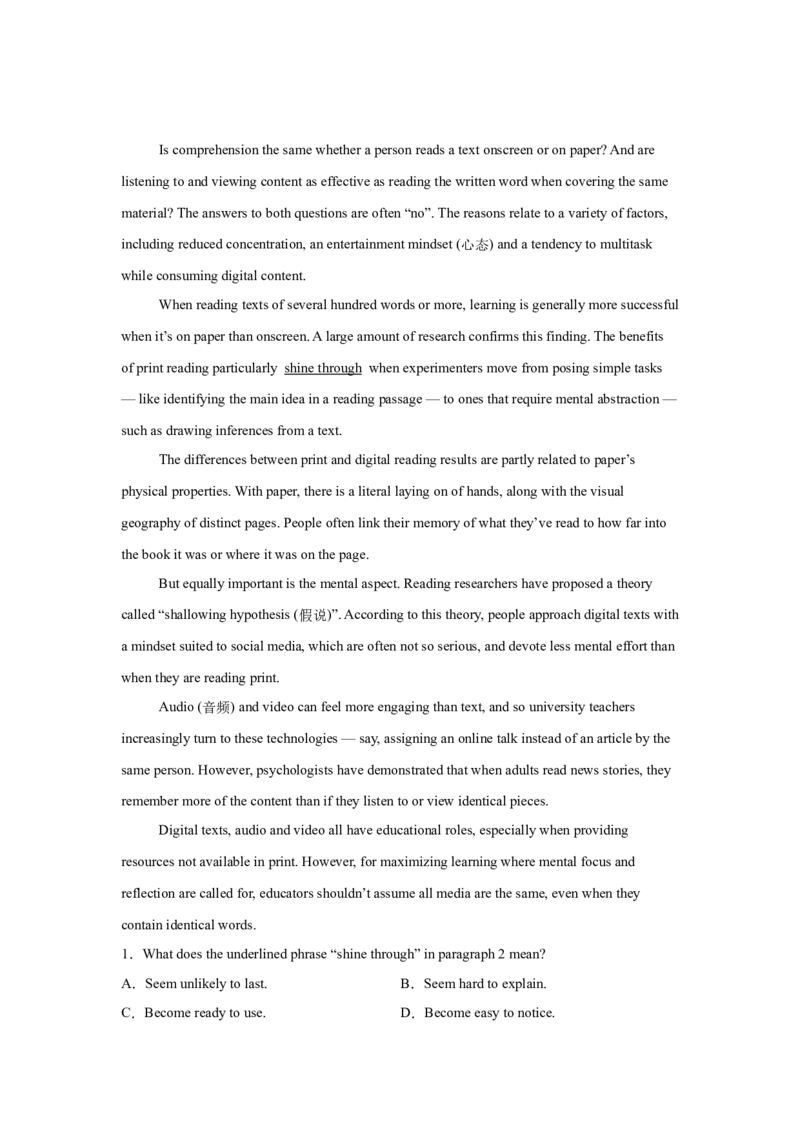
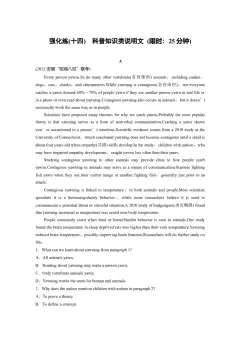
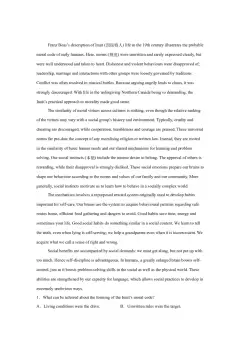
Is comprehension the same whether a person reads a text onscreen or on paper? And are
listening to and viewing content as effective as reading the written word when covering the same
material? The answers to both questions are often “no”. The reasons relate to a variety of factors,
including reduced concentration, an entertainment mindset (心态) and a tendency to multitask
while consuming digital content.
When reading texts of several hundred words or more, learning is generally more successful
when it’s on paper than onscreen. A large amount of research confirms this finding. The benefits
of print reading particularly shine through when experimenters move from posing simple tasks
— like identifying the main idea in a reading passage — to ones that require mental abstraction —
such as drawing inferences from a text.
The differences between print and digital reading results are partly related to paper’s
physical properties. With paper, there is a literal laying on of hands, along with the visual
geography of distinct pages. People often link their memory of what they’ve read to how far into
the book it was or where it was on the page.
But equally important is the mental aspect. Reading researchers have proposed a theory
called “shallowing hypothesis (假说)”. According to this theory, people approach digital texts with
a mindset suited to social media, which are often not so serious, and devote less mental effort than
when they are reading print.
Audio (音频) and video can feel more engaging than text, and so university teachers
increasingly turn to these technologies — say, assigning an online talk instead of an article by the
same person. However, psychologists have demonstrated that when adults read news stories, they
remember more of the content than if they listen to or view identical pieces.
Digital texts, audio and video all have educational roles, especially when providing
resources not available in print. However, for maximizing learning where mental focus and
reflection are called for, educators shouldn’t assume all media are the same, even when they
contain identical words.
1.What does the underlined phrase “shine through” in paragraph 2 mean?
A.Seem unlikely to last. B.Seem hard to explain.
C.Become ready to use. D.Become easy to notice.2.What does the shallowing hypothesis assume?
A.Readers treat digital texts lightly. B.Digital texts are simpler to understand.
C.People select digital texts randomly. D.Digital texts are suitable for social media.
3.Why are audio and video increasingly used by university teachers?
A.They can hold students' attention. B.They are more convenient to prepare.
C.They help develop advanced skills. D.They are more informative than text.
4.What does the author imply in the last paragraph?
A.Students should apply multiple learning techniques.
B.Teachers should produce their own teaching material.
C.Print texts cannot be entirely replaced in education.
D.Education outside the classroom cannot be ignored.
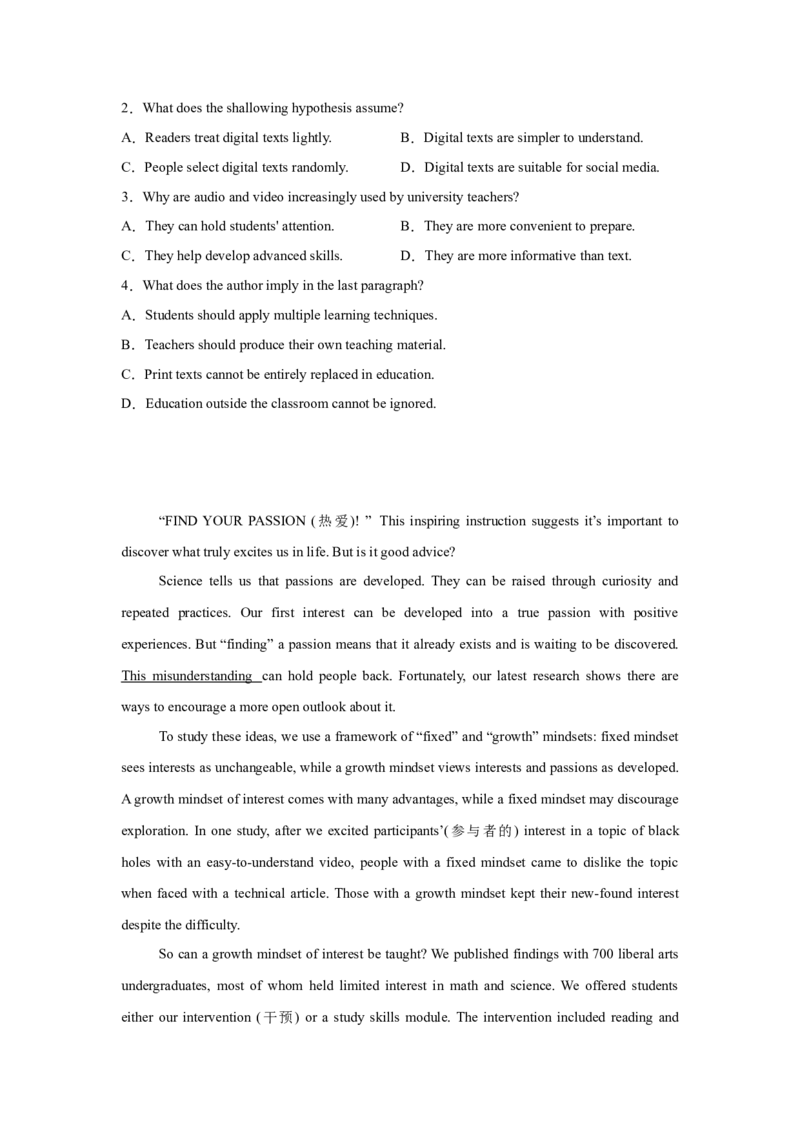
“FIND YOUR PASSION (热爱)! ” This inspiring instruction suggests it’s important to
discover what truly excites us in life. But is it good advice?
Science tells us that passions are developed. They can be raised through curiosity and
repeated practices. Our first interest can be developed into a true passion with positive
experiences. But “finding” a passion means that it already exists and is waiting to be discovered.
This misunderstanding can hold people back. Fortunately, our latest research shows there are
ways to encourage a more open outlook about it.
To study these ideas, we use a framework of “fixed” and “growth” mindsets: fixed mindset
sees interests as unchangeable, while a growth mindset views interests and passions as developed.
A growth mindset of interest comes with many advantages, while a fixed mindset may discourage
exploration. In one study, after we excited participants’(参与者的) interest in a topic of black
holes with an easy-to-understand video, people with a fixed mindset came to dislike the topic
when faced with a technical article. Those with a growth mindset kept their new-found interest
despite the difficulty.
So can a growth mindset of interest be taught? We published findings with 700 liberal arts
undergraduates, most of whom held limited interest in math and science. We offered students
either our intervention (干预) or a study skills module. The intervention included reading andreflective writing activities that helped students think about interests and passions as developed
rather than found and fixed. For example, students wrote a paragraph about a case when they
developed interest in a new activity. The study skills module, meanwhile, stressed practices such
as time management. By the end of the school year, the students who had received the intervention
were more interested in their required math and science courses——and earned better grades in
those courses—than their study skills peers.
While our intervention offers a way for schools to support their students, we also believe
people can independently build up a growth mindset of interest. Realize that passions aren’t
waiting to be “found.” Take an active role in developing them.
5.What does “this misunderstanding” underlined in paragraph 2 refer to?
A.Passions can be developed with more practices.
B.Interest is of great help to build up confidence.
C.Passions are fixed and wait to be uncovered.
D.Interest can be discouraged by repeated work.
6.Why does the author mention the “black holes” study?
A.To make a prediction. B.To show the difference.
C.To protest a decision. D.To explain the rule.
7.What can we learn about the study from paragraph 4?
A.Students were grouped based on types of mindset.
B.Reflective writings helped students build up interest.
C.Study skills were used to reduce students’ stress.
D.Better grades contributed to one’s favour to a subject.
8.Which of the following does the author probably agree with?
A.Love what you do, and you’ll keep going and become better.
B.Find what you love, and you’ll never have to work a day.
C.It can always be easy and exciting to dig into new areas.
D.It is much better to get lost in the passion than to lose it.
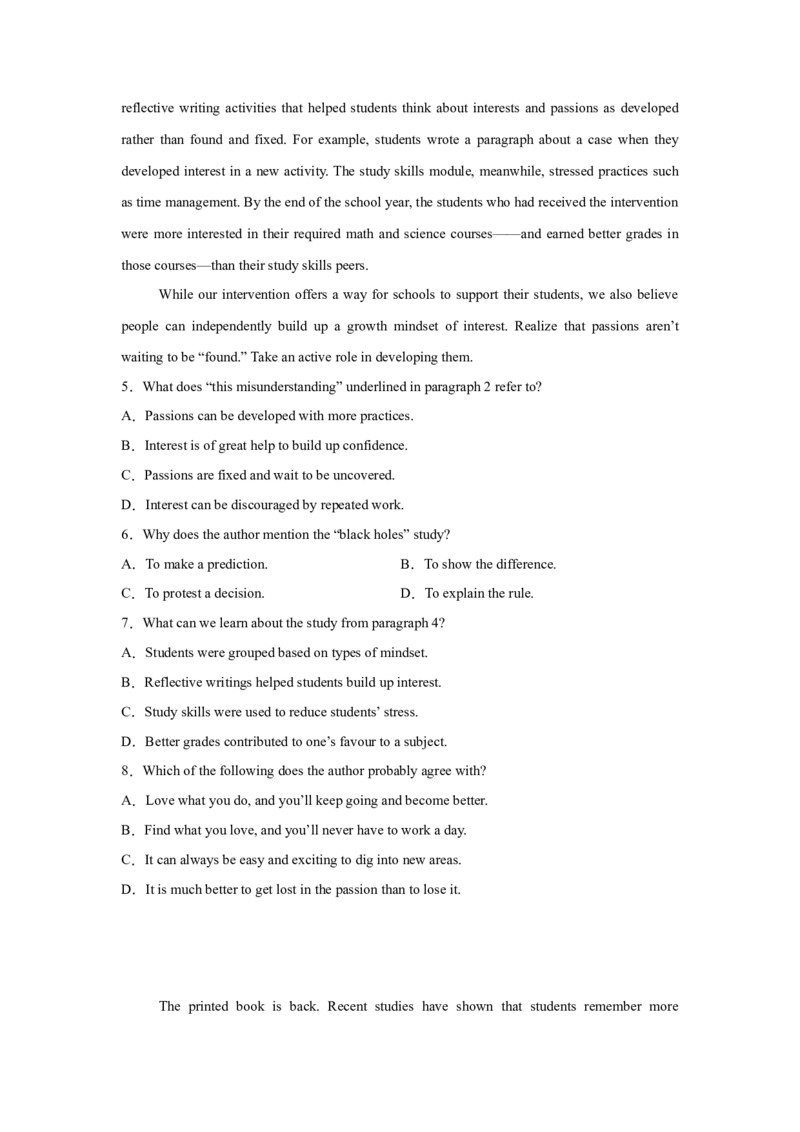
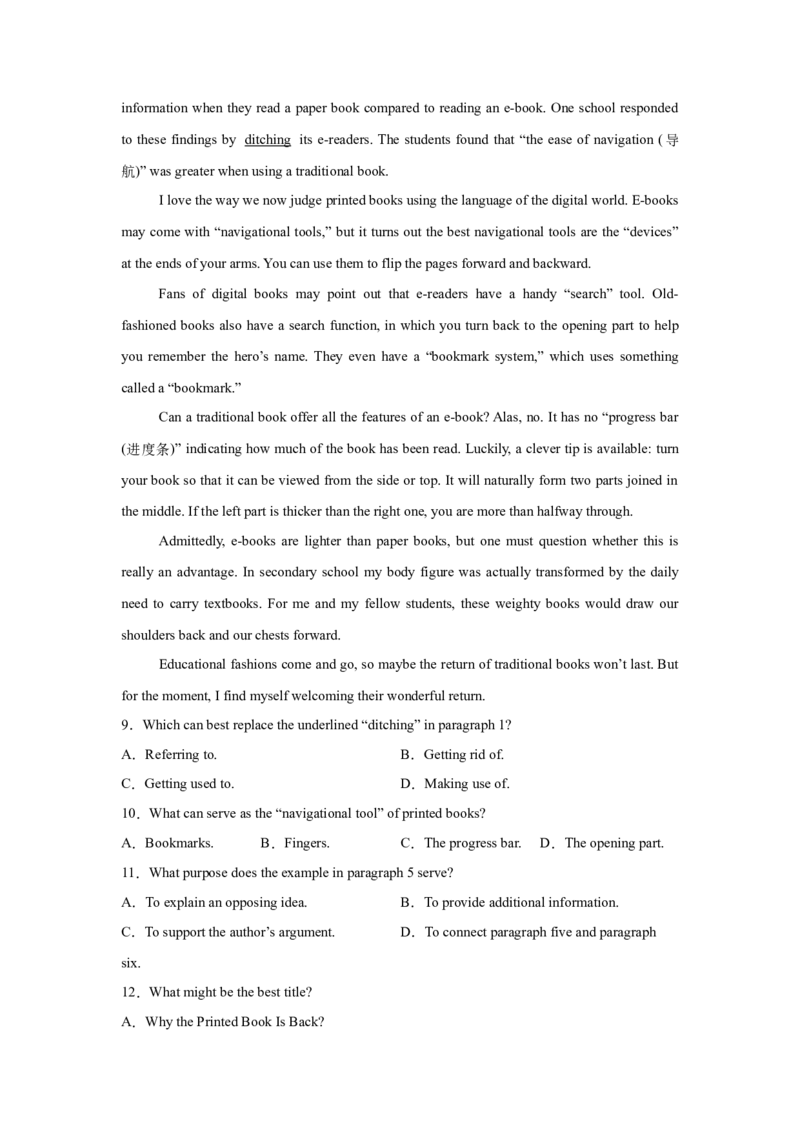
The printed book is back. Recent studies have shown that students remember moreinformation when they read a paper book compared to reading an e-book. One school responded
to these findings by ditching its e-readers. The students found that “the ease of navigation (导
航)” was greater when using a traditional book.
I love the way we now judge printed books using the language of the digital world. E-books
may come with “navigational tools,” but it turns out the best navigational tools are the “devices”
at the ends of your arms. You can use them to flip the pages forward and backward.
Fans of digital books may point out that e-readers have a handy “search” tool. Old-
fashioned books also have a search function, in which you turn back to the opening part to help
you remember the hero’s name. They even have a “bookmark system,” which uses something
called a “bookmark.”
Can a traditional book offer all the features of an e-book? Alas, no. It has no “progress bar
(进度条)” indicating how much of the book has been read. Luckily, a clever tip is available: turn
your book so that it can be viewed from the side or top. It will naturally form two parts joined in
the middle. If the left part is thicker than the right one, you are more than halfway through.
Admittedly, e-books are lighter than paper books, but one must question whether this is
really an advantage. In secondary school my body figure was actually transformed by the daily
need to carry textbooks. For me and my fellow students, these weighty books would draw our
shoulders back and our chests forward.
Educational fashions come and go, so maybe the return of traditional books won’t last. But
for the moment, I find myself welcoming their wonderful return.
9.Which can best replace the underlined “ditching” in paragraph 1?
A.Referring to. B.Getting rid of.
C.Getting used to. D.Making use of.
10.What can serve as the “navigational tool” of printed books?
A.Bookmarks. B.Fingers. C.The progress bar. D.The opening part.
11.What purpose does the example in paragraph 5 serve?
A.To explain an opposing idea. B.To provide additional information.
C.To support the author’s argument. D.To connect paragraph five and paragraph
six.
12.What might be the best title?
A.Why the Printed Book Is Back?B.How the Printed Book Benefits us?
C.What Future the Printed Book Faces?
D.Which Is Better, Printed Book or E-book?
Growing up, I felt that I learned some things quickly and other things painfully slowly.
Picking up French and Spanish seemed to come naturally, while painting and drawing required a
lot of practice. I thought that some people just have a talent for languages; others don’t.
You’ve probably felt the same way—that certain things were easier for you to learn. And so
did my research partners. So we set out to identify what makes some people learn faster than
others. If we could just distill (提取) these unique characteristics, we thought, we would be able to
create better learning environments—and make everyone a fast learner.
In our study, we model data from student performance on groups of tasks that assess the
same skill component and that provide follow-up instructions on student errors. Our models
estimate the increase in correctness after each practice opportunity. We applied our models to 1.3
million observations across 27 datasets of student interactions with online practice systems in the
context of elementary to college courses. In contrast, and much to our surprise, we found students
to be astonishingly similar in estimated learning rate. There are no such things as fast and slow
learners!
We find that a typical student needs about seven learning opportunities to master a typical
knowledge component. They start at different levels of proficiency but, when provided with high-
quality practice opportunities, they learn at about the same speed. Yes, they will end in different
places-but that’s because they have different starting lines, not because they are quicker or slower
to learn.
That means the types of opportunities you get are important. Detailed, timely feedback and
hints provide favorable conditions that allow you to consistently make progress, regardless of
where you began.
Don’t think you’re alone if learning feels slow and effortful. Do try, try again. You can
make as much progress as everyone else—and so can the young people in your life. Achievementgaps are the result of opportunity gaps, not individual differences in learning speed.
13.What is the author’s previous thought according to the first two paragraphs?
A.He can’t learn painting and drawing. B.All people have a talent for languages.
C.People learn things in the same way. D.People have different learning speeds.
14.What did the researchers do in the research?
A.Teach elementary courses. B.Criticize students’ mistakes.
C.Apply their models extensively. D.Distinguish the fast and slow learners.
15.How can a student make greater achievements according to the research?
A.By using high-quality equipment. B.By doing more efficient practice.
C.By competing with other students. D.By increasing learning speed.
16.What is the best title of the text?
A.There Is No Such Things as a Fast Learner B.How We Can Learn Faster than Others
C.There Is No Difference Between Students D.Why Education Is Important to Us
Until decades ago, our visions of the future were largely positive. We thought science and
technology would cure all the ills of humanity, leading to lives of fulfillment and opportunity for
all. However, as we have gained a deeper appreciation of the range of threats facing us, from
epidemic (流行病) flu to climate change, we might even tend to assume that humanity has little
future to look forward to.
Yet such depression is misplaced. The fossil record shows that many species have existed
for millions of years — so why shouldn’t we? Take a look at our species in the universe, and it
becomes clear we have an excellent chance of surviving for tens of thousands of years. Look up
Homo sapiens (智人) in the “Red List” of threatened species of the International Union for the
Conversation of Nature (IUCN), and you will read: “Listed as Least Concern because the species
is widely distributed, adaptable, currently increasing, and there are no major threats resulting in an
overall population decline.”
So what does our deep future hold? Many researchers and organizations are now thinking
seriously about the question. The potential evolution of today’s technology is complicated, so it’s
perhaps best left to science fiction writers and futurologists to explore the possibilities of thebright future.
Our future is quite rosy because it shows many promising possibilities of achievement.
Besides, we are now knowledgeable enough to reduce risks that threatened the existence of earlier
humans and to improve those to come. Take a longer view and we can say with considerable
assurance that the past holds the key to the future: by analyzing the past, we can make evidence-
based forecasts about the situations in which our descendants (后代) will find themselves.
17.What can we know about human beings according to IUCN’s “Red List”?
A.They control the world’s development.
B.They severely threaten the environment.
C.They are strong enough to continue existing.
D.Their overall population will decrease.
18.What does the underlined word “rosy” in the last paragraph probably mean?
A.Dangerous. B.Annoying.
C.Hopeful. D.Undisturbed.
19.What should we do to ensure the future of mankind?
A.Explore our planet’s abundant resources.
B.Draw upon our experience from the past.
C.Build our ambition to reshape history.
D.Increase the population of the world.
20.Which of the following would be the best title for the text?
A.The Bright and Promising Future of Mankind
B.Science and Technology Connected with Humans
C.The Fully and Highly Evolved Human Species
D.Different Researches Conducted on Our Future
The two terms nature and nurture have been subjects of comparison since the 16th century.
The argument is centered on the question as to whether it is nature or nurture that makes us who
we are.
Nature provides the starting point for an organism that will interact with nurture, theenvironment, during the organism’s life. Nature does not just affect an organism during its
lifetime, but it also can directly affect the expression of genes in offspring ( 后代). For the
Geneticists, they believe that our lives are entirely determined by genetics, which is nature. An
opposing view is that there is no indication that genes (基因) determines one’s personality, rather
there is growing evidence that nurture serves as the determining factor in personality development.
Nurture refers to the conditions under which living things grow and develop after birth.
When applied to human beings, it means how the person is raised, which includes nutrition,
education, care, as well as the kind of surroundings, such as cultural influence, family and friends.
The argument of nature and nurture as to which is more important is necessitated by an
attempt to differentiate how much effect genetics has on a person’s development against how
easily humans are influenced by one’s environment.
While nurture undeniably plays its part on the growth and development of one’s personality,
nature dramatically outweighs nurture, for nature can be likened to a foundation. The impact of
nurture on the development of persons cannot be totally denied. However, nature is regarded as
being of most importance because of the fact that it affords an opportunity and creates a
foundation and the basis for the question of nurture to arise at the very first instance. Even without
nurture, the nature impact can still stand independently without necessarily causing destruction.
More so, even when the nurture impact is successfully effected, it does not remove the genetic
characteristics of a person. It therefore stands correctly that nature is that which determines the
substance of a person.
21.What can we learn from Paragraph 2?
A.Nature’s role is supported by additional evidence.
B.Personality development is determined by nurture.
C.Nature impacts gene expression in later generation.
D.Environment shapes personality more than genetics.
22.What does Paragraph 3 mainly talk about?
A.What nurture means to human beings.
B.How living things develop after birth.
C.How nurture shapes human development.
D.How surroundings influence human beings.
23.How does the author stress the greater importance of nature?A.By giving examples.
B.By making contrast.
C.By conducting experiments.
D.By citing research data.
24.What is the best title for the text?
A.A Long Story of Nature and Nurture
B.A New Research on Nature and Nurture
C.Who Can Tell What Makes Who We Are?
D.Which Is More Important, Nature or Nurture?
Each year, people buy millions of aquarium (水族箱) fish. But somehow most of the fish
died within weeks or even within hours after you had bought them. For sure, fish are weak
creatures compared to us. It does not mean they died for no reason at all.
Since fish have no body heat, they are sensitive to sudden changes of water temperature.
Water PH and water hardness can also affect them if there is a sudden change. Most of the quick
deaths of fish are due to shock.
Tap water is not a perfect choice for aquarium fish because of the chlorine (氯) in the tap
water, which can kill the fish. So the best way is to just put the tap water in the sun for a few days.
Fish need oxygen in the water. They will die if the oxygen in the aquarium runs out. Several
things can cause it to happen. The aquarium is too small, that is, less water means less oxygen.
The aquarium is too crowded, for the more fish you have, the more oxygen they need. The
temperature is too high, because the higher the water temperature, the less dissolved oxygen.
Overfeeding the fish can cause a digestive (消化的) problem and kill the fish directly. More
food than it is needed can also cause water pollution and create more harmful waste which will
kill the fish too. Feed the fish only once a day, with no more food than they can eat in less than a
minute. In this case, less is better.
25.What’s the function of paragraph one?
A.Raising a question.
B.Putting forward an argument.C.Posing a problem.
D.Listing the causes of the problem.
26.Why are fish sensitive to sudden changes of water temperature?
A.They are warm-blooded.
B.They have no body heat.
C.They live in the water.
D.They are very weak.
27.What’s the purpose of putting tap water in the sun?
A.To let out the chlorine.
B.To warm the water.
C.To kill the viruses.
D.To make the water clear.
28.How is the passage mainly developed?
A.Problem—solution pattern.
B.Question—answer pattern.
C.Doubt—explanation pattern.
D.View—argument pattern.
Reading books can obviously make you a better, smarter entrepreneur. According to a 2018
study of over 160, 000 adults in 31 countries, the more books that were present in participants’
childhood homes, the more competent they now are as adults with skills in literacy, mathematics,
and technological problem-solving. Researchers note that book-oriented socialization, indicated
by home library size, equips youth with lifelong tastes, skill and knowledge.
Growing up with home libraries boosts adult skills in literacy, numeracy and technological
problem-solving beyond the benefits acquired from parental education or your own educational or
occupational attainment. Kids who grow up in a home where reading is valued and modeled are
more likely to be good readers. Strangely enough, though, advanced education doesn’t necessarily
offset the “lots of books in the home” advantage. Adults who grew up with relatively few books in
their homes and later earned a college degree had literacy levels approximately equal to adultswho grew up in homes with large libraries but only attended school for nine years.
Jessica Stillman writes, surrounding yourself with more books than you could ever read
says good things about your mind. Those books serve as a constant reminder of all the things you
don’t know — which helps keep you intellectually hungry and curious. And possibly, this will
keep you a little more modest, since research shows the quicker you are to admit you don’t know
something, the faster you can then learn it. As Jeff Bezos says, a key sign of intelligence is the
willingness to change your mind, something that only happens if you’re willing to admit that your
current thinking may not be the best thinking. Modesty, learning and the willingness to change
your mind when new data presents itself: That’s another three bonus every entrepreneur can
benefit from.
29.What does paragraph 1 mainly talk about?
A.The tough process of the research.
B.An inspiring discovery of the research.
C.Numerous data of the research.
D.Advanced technology of the research.
30.Which of the following can best replace the underlined word “offset” in paragraph 2?
A.Compete with. B.Differ from.
C.Go against. D.Compensate for.
31.Why does the author mention Jessica?
A.To keep readers intellectually hungry.
B.To stress the significance of modesty.
C.To remind readers of their ignorance.
D.To evidence the benefits of home library.
32.What is the passage mainly about?
A.Home library size indicates some lifelong skills.
B.Home reading equals to a college degree.
C.Modesty makes a promising entrepreneur.
D.Childhood libraries lead to adulthood success.The pandemic saw an increased demand for stories that excite children in new ways and
support them in processing difficult emotions. The features of personalized(个性化的) books meet
this need well. With personalized Loss Books, children read about losing a family member. With
personalized Me and My Pet Books, children read about how they first met their dogs or cats.
Identified as the main driver of the rapidly growing interactive children’s book market,
personalized books are far from a gimmick(噱头).
Personalized books are printed or digital books that have been crested based on the needs of
a specific child. They follow a simple principle: the publisher provides the users with a pattern,
which parents fill with children’s data. Thanks to the advanced print-on-demand possibilities of
small-scale publishers, it’s not difficult to create a personalized version of any story.
Publishers claim that personalized books teach children empathy(同理心) and encourage
love for reading. Now, you might think that it is surely what all parents and teachers want, so
should we replace all books with personalized stories?
Our observational studies confirmed publishers’ claim that children are highly engaged and
motivated to read personalized books. However, in a recent study, we compared children’s
understanding of the moral(寓意) of a story and its application to their lives after they read a
personalized, non-personalized or control story. Although children who read personalized stories
had more detailed retellings, there was no other difference between the three groups. This could be
because the differences among the children were higher than the effect of personalization. Studies
with personalized books are too few for us to know for sure.
Besides, while personal stories are often used in therapeutic(治疗性的) practice or in
children with special educational needs, personalized stories are a new writing style, raising many
open questions. The misuse of children’s personal data and the questions concerning diversity(差
异) make one wonder how “personalized” the books actually are. The other key point lies in
directing children’s focus towards the other. However, given the increased focus on personalized
learning during the pandemic, and the need to customize(定制) children’s reading experiences,
there is every reason to believe that the rising trend of personalized books will continue.
33.By writing Paragraph 1, the author mainly aims to stress ______.
A.the impact of the pandemic on children
B.the improvement in personalized books’ market positionC.the positive role of personalized books
D.the urgency of paying attention to children’s mental health
34.What can we say about personalized books?
A.They are mainly in digital form. B.They are easy to be created.
C.They are highly praised by teachers. D.They are created by outstanding young
writers.
35.What can be inferred from the author’s recent study?
A.The varieties of personalized stories need to expanded.
B.Personalized stories help children have a strong sense of fairness.
C.Personalized stories help children apply what they’ve learned to real life.
D.The effects of personalized stories need to further studied.
36.What’s the author’s attitude to personalized books?
A.Objective. B.Doubtful. C.Negative. D.Uncaring.
A recent paper describes bees rolling tiny wooden balls, not for a reward, but apparently
just for fun. This discovery emphasizes a long-standing conflict in our view of animals. On the
one hand, we want to find the features that distinguish humans from other animals: tools, language
and a theory of mind. On the other hand, we delight in finding animals that break those
boundaries: chimps, crows and now bees that use tools, dolphins with signature whistles. But what
do those boundaries mean?
As a biologist who studies animal behaviour, I am puzzled by this effort to rank animals by
their capabilities. I applaud the desire to show that animals are like us, but we can recognize
animals for what they are, and be amazed at their abilities, without having to make their behaviour
mirror that of humans.
Once we get out from the assumption that animals have to be like people with human
motivations and feelings, we are freed up to consider the mechanisms ( 机理) behind the
behaviours. For example, the same serotonin (血清素) influences anxiety in humans and maze (迷
宫) exploration in crayfish. In a tank divided into well-lit and shadowy areas, crayfish explore
both, but prefer the darker areas, consistent with their night lifestyle.Does this mean crayfish experience anxiety? No. In the bees’ case, they might be exhibiting
some very interesting behaviour that has nothing to do with wanting to “have fun”—but we will
never examine it if we simply assume they are playing just like people. I am not disparaging the
bee researchers’ conclusions, and I am not trying to be a killjoy, but there is something about all
this humanizing that prevent exploration, instead of encouraging it.
37.What’s the purpose of paragraph 1?
A.To list out facts. B.To raise an argument.
C.To arouse readers’ interest. D.To explain a concept.
38.What can we learn from paragraph 3?
A.Behaviour mechanisms work. B.Crayfish prefer the light sections.
C.The assumption proves reasonable. D.Animals are similar to human in mind.
39.What does the underlined word “disparaging” mean in paragraph 4?
A.Criticizing. B.Explaining.
C.Confirming. D.Acknowledging.
40.Which of the following can be the best title for the text?
A.Feelings: Guiding Human Being B.Boundaries: Making No Sense
C.Humanizing: Covering the Truth D.Animals: Mirroring Human Behaviours参考答案:
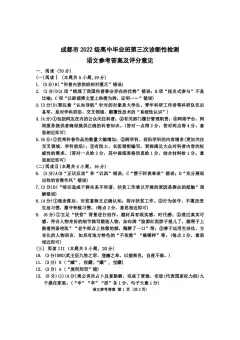
1.D 2.A 3.A 4.C
【导语】本文是议论文。主要讨论了纸质阅读与数字阅读、音频和视频学习方式的差异和
效果。
1.词句猜测题。根据前文“When reading texts of several hundred words or more, learning is
generally more successful when it’s on paper than onscreen. A large amount of research confirms
this finding.(当阅读几百字或更多的文本时,在纸上学习通常比在屏幕上学习更成功。大量
的研究证实了这一发现)”可知,在纸上学习更有成效,以及后文“when experimenters move
from posing simple tasks — like identifying the main idea in a reading passage — to ones that
require mental abstraction — such as drawing inferences from a text.(当实验人员从提出简单的
任务(如识别阅读文章的主旨)转移到需要思维抽象的任务(如从文本中推断)时)”推知,此处
应是表达“当实验者从简单的任务转向需要精神抽象的任务时,纸质阅读的益处就变得显
而易见”之意,所以shine through应是“显而易见”之意,和D项意思相近。故选D项。
2.推理判断题。根据第四段“But equally important is the mental aspect. Reading researchers
have proposed a theory called “shallowing hypothesis (假说)”. According to this theory, people
approach digital texts with a mindset suited to social media, which are often not so serious, and
devote less mental effort than when they are reading print.(但同样重要的是精神层面。阅读研
究人员提出了一个名为“shallowing hypothesis”的理论。根据这一理论,人们以适合社交媒
体的心态接触数字文本,这些文本通常不那么严肃,与阅读印刷品时相比,投入的精神努
力也更少)”可知,shallowing hypothesis假设读者在阅读数字文本时会持有一种轻松的心态,
不会像阅读纸质书籍那样投入太多的心理努力。故选A项。
3.细节理解题。根据第五段“Audio (音频) and video can feel more engaging than text, and so
university teachers increasingly turn to these technologies — say, assigning an online talk instead
of an article by the same person.(音频和视频可能比文本更具吸引力,因此大学教师越来越多
地转向这些技术,例如分配在线讲座而不是同一作者的文章)”可知,音频和视频比文本更
能吸引学生的注意力,所以大学教师越来越多地使用这些技术。故选A项。
4.推理判断题。根据最后一段“Digital texts, audio and video all have educational roles,
especially when providing resources not available in print. However, for maximizing learning
where mental focus and reflection are called for, educators shouldn’t assume all media are thesame, even when they contain identical words.(数字文本、音频和视频都具有教育作用,尤其
是在提供印刷品中无法获得的资源时。然而,为了在需要精神集中和反思的情况下最大限
度地学习,教育工作者不应假定所有媒体都是相同的,即使它们包含相同的单词)”可知,
尽管数字文本、音频和视频在教育中有一定作用,但当需要精神集中和反思以最大化学习
时,教育者不应假定所有媒体都是相同的,即使它们包含相同的单词。这表明作者认为纸
质文本在教育中的作用仍然不可替代,因此暗示纸质文本在教育中的重要性。故选C项。
【点睛】
5.C 6.B 7.A 8.A
【导语】本文是一篇议论文。文章探讨了“找到你的热爱”这一流行观念,并指出激情并
非与生俱来、等待被发现的,而是可以通过好奇心、重复实践以及积极的体验逐步培养和
发展的。
5.词句猜测题。根据第二段划线词上文“But “finding” a passion means that it already exists
and is waiting to be discovered.( 然而,“找到”激情意味着它已经存在并等待被发现)”可推
理出,划线词指的是上文说的“激情是固定的,等待被发现”,故选C项。
6.细节理解题。根据第三段“In one study, after we excited participants’(参与者的)interest in
a topic of black holes with an easy-to-understand video, people with a fixed mindset came
to dislike the topic when faced with a technical article. Those with a growth mindset kept their
new-found interest despite the difficulty.( 在一项研究中,当我们在一个易于理解的视频中激
发参与者对黑洞主题的兴趣后,面对一篇技术文章时,具有固定心态的人开始不喜欢这个
话题。而具有成长心态的人即使面临困难,也保持了他们新发现的兴趣)”可知,作者提到
对黑洞的研究,其目的是为了对具有固定心态的人和具有成长心态的人进行对比,展示差
异,故选B项。
7.细节理解题。根据第三段“We published findings with 700 liberal arts undergraduates, most
of whom held limited interest in math and science.( 我们在700名文理学院的本科学生中进行
了研究,他们中的大多数人在数学和科学方面兴趣有限)”可知,学生是根据思维方式进行
分组的,故选A项。
8.推理判断题。根据第二段“Science tells us that passions are developed. They can be raised
through curiosity and repeated practices.(科学告诉我们,激情是可以培养和发展的。它们可以
通过好奇心和重复实践得以提升)”、倒数第二段“By the end of the school year, the studentswho had received the intervention were more interested in their required math and science courses
——and earned better grades in those courses—than their study skills peers.( 到学年结束时,接
受干预的学生比接受学习技能指导的同学在必修的数学和科学课程上表现出了更大的兴趣,
并且在这些课程中取得了更好的成绩。)”以及最后一段“While our intervention offers a way
for schools to support their students, we also believe people can independently build up a growth
mindset of interest. Realize that passions aren’t waiting to be “found.” Take an active role in
developing them(虽然我们的干预措施为学校支持学生提供了一种途径,但我们同样认为,
人们也可以独立地建立起对兴趣的成长心态。认识到激情不是等待被“发现”的,而是要
主动去培养和发展它们。)”可知,作者认为激情是可以培养和发展的,人们也可以独立地
建立起对兴趣的成长心态,并主动去培养和发展它们,A项“Love what you do, and you’ll
keep going and become better(热爱你所做的,你将保持前进并变得更好)”表达的含义与作者
的观点一致,故选A项。
9.B 10.B 11.C 12.A
【导语】这是一篇议论文。文章主要论述了纸质书的时代又回来了并阐述了纸质书优于电
子书的原因。
9.词句猜测题。由文章第一段“Recent studies have shown that students remember more
information when they read a paper book compared to reading an e-book. One school responded
to these findings by ditching its e-readers.(最近的研究表明,与阅读电子书相比,学生在阅读
纸质书时记住的信息更多。一所学校对这些发现做出了回应,ditching 电子阅读器)”可知,
最新调查说明电子书不如纸质书,所以这里指一个学校“放弃”电子书,从而推测
ditching为“放弃”的意思。故选B项。
10.推理判断题。由文章第二段“E-books may come with ‘navigational tools,’ but it turns out
the best navigational tools are the ‘devices’ at the ends of your arms. You can use them to flip the
pages forward and backward. (电子书可能会附带‘导航工具’,但事实证明,最好的导航工
具是你手臂末端的‘设备’。你可以使用它们向前和向后翻页)”可推知,这里手臂末端的
“设备”应指的是手指。故选B项。
11.推理判断题。由文章第五段“Admittedly, e-books are lighter than paper books, but one
must question whether this is really an advantage. In secondary school my body figure was
actually transformed by the daily need to carry textbooks. For me and my fellow students, theseweighty books would draw our shoulders back and our chests forward.(诚然,电子书比纸质书
更轻,但人们必须质疑这是否真的是一种优势。在中学时,我的身材实际上因每天需要背
课本而发生了变化。对我和我的同学们来说,这些沉重的书会把我们的肩膀向后拉,把我
们的胸部向前拉)”可推知,作者用本段中的例子来支持作者的论点——纸质书比电子书更
好些。故选C项。
12.主旨大意题。由文章第一段“The printed book is back. Recent studies have shown that
students remember more information when they read a paper book compared to reading an e-book.
One school responded to these findings by ditching its e-readers. The students found that ‘the ease
of navigation (导航)’ was greater when using a traditional book.(印刷好的书回来了。最近的研
究表明,与阅读电子书相比,学生在阅读纸质书时记住的信息更多。一所学校对这些发现
做出了回应,放弃了电子阅读器。学生们发现,当使用传统书籍时,‘导航的便利性’更
高)”以及下文可知,文章主要论述了纸质书的时代又回来了并阐述了纸质书优于电子书的
原因。故选A项。
13.D 14.C 15.B 16.A
【导语】本文为一篇议论文,主要论述了学习成就差距是机会差距的结果,而不是学习方
面的个人差异,所以,没有学得快这类事。
13.细节理解题。根据文章第一段“Growing up, I felt that I learned some things quickly and
other things painfully slowly.(在成长过程中,我觉得有些东西学得很快,有些东西学得很
慢)”及“I thought that some people just have a talent for languages; others don’t.(我以为有些人
就是有语言天赋;其他人则没有)”及第二段“You’ve probably felt the same way—that certain
things were easier for you to learn.(你可能也有同样的感觉——某些东西对你来说更容易学
会)”可知,作者原来的观点是有些人学得快,有的人学得慢,有些东西对某些人来说更容
易,即,人们有不同的学习速度。故选D。
14.细节理解题。根据文章第三段“We applied our models to 1.3 million observations across
27 datasets of student interactions with online practice systems in the context of elementary to
college courses.(我们将我们的模型应用于27个数据集的130万个观察结果,这些数据集是
学生在小学到大学课程背景下与在线练习系统的互动)”可知,研究者将数据模型应用于130
万个观察结果,可以说是广泛应用了数据模型。故选C。
15.推理判断题。根据文章第四段“They start at different levels of proficiency but, whenprovided with high-quality practice opportunities, they learn at about the same speed.(他们开始时
的熟练程度不同,但当提供高质量的练习机会时,他们的学习速度大致相同)”及第五段
“That means the types of opportunities you get are important. Detailed, timely feedback and
hints provide favorable conditions that allow you to consistently make progress, regardless of
where you began.(这意味着你获得的机会类型很重要。无论你从哪里开始,详细、及时的反
馈和提示都能为你持续进步提供有利条件)”及最后一段“Achievement gaps are the result of
opportunity gaps, not individual differences in learning speed.(成绩差距是机会差距的结果,而
不是学习速度的个体差异)”可推知,高质量和效率的练习能让学生获得更大的学习成就。
故选B。
16.主旨大意题。根据文章第三段“In contrast, and much to our surprise, we found students to
be astonishingly similar in estimated learning rate. There are no such things as fast and slow
learners!(相比之下,令我们惊讶的是,我们发现学生在估计的学习速度上惊人地相似。学
习速度没有快慢之分)”及最后一段“Achievement gaps are the result of opportunity gaps, not
individual differences in learning speed.(成绩差距是机会差距的结果,而不是学习速度的个体
差异)”并结合全文内容可知,文章主要介绍学习成就差距是机会差距的结果,而不是学习
方面的个人差异,所以,没有学得快这类事,A选项“没有所谓的快速学习者”符合本文
主旨,适合作为最佳标题。故选A。
17.C 18.C 19.B 20.A
【导语】本文是议论文。文章从几个方面论述了人类的未来是光明灿烂的。
17.推理判断题。由第二段中的“Look up Homo sapiens (智人) in the “Red List” of
threatened species of the International Union for the Conversation of Nature (IUCN), and you will
read: “Listed as Least Concern because the species is widely distributed, adaptable, currently
increasing, and there are no major threats resulting in an overall population decline.”(在国际自然
保护联盟(IUCN)的受威胁物种“红名单”中查找智人,你会读到:“被列为最不受关注
的物种,因为该物种分布广泛,适应性强,目前正在增加,没有导致总体种群下降的主要
威胁。”)”可知,根据世界自然保护联盟的“红名单”,人类足够强大,可以继续生存下
去。故选C项。
18.词句猜测题。由最后一段中的“Our future is quite rosy because it shows many promising
possibilities of achievement. (我们的未来相当rosy,因为它显示了许多有希望取得成就的可能性)”可知,因为未来显示了许多有希望取得成就的可能性,可得出我们的未来相当美
好,,画线词意为“充满希望(Hopeful)”。故选C项。
19.细节理解题。由最后一段中的“Take a longer view and we can say with considerable
assurance that the past holds the key to the future: by analyzing the past, we can make evidence-
based forecasts about the situations in which our descendants (后代) will find themselves. (从长
远来看,我们可以相当有把握地说,过去是未来的关键:通过分析过去,我们可以对我们
的后代将面临的情况做出基于证据的预测)”可知,我们应该借鉴我们过去的经验来确保人
类的未来。故选B项。
20.主旨大意题。由第一段中的“Until decades ago, our visions of the future were largely
positive. (直到几十年前,我们对未来的愿景基本上是积极的)”和最后一段中的“Our future
is quite rosy because it shows many promising possibilities of achievement. (我们的未来相当美
好,因为它显示了许多有希望取得成就的可能性)”可知,文章讲述的是人类光明灿烂的未
来,A项“人类光明而充满希望的未来”是最佳标题。故选A项。
21.C 22.A 23.B 24.D
【导语】本文是一篇议论文。先天和后天这两个术语自16世纪以来一直是比较的主题。文
章论述了究竟是先天还是后天造就了我们。
21.细节理解题。根据第二段中的“Nature provides the starting point for an organism that will
interact with nurture, the environment, during the organism’s life. Nature does not just affect an
organism during its lifetime, but it also can directly affect the expression of genes in offspring (后
代). (在有机体的一生中,先天为有机体提供了与滋养、环境相互作用的起点。先天不仅会
影响一个生物体的一生,还会直接影响其后代的基因表达)”可知,先天影响后代的基因表
达。故选C。
22.主旨大意题。根据第三段“Nurture refers to the conditions under which living things grow
and develop after birth. When applied to human beings, it means how the person is raised, which
includes nutrition, education, care, as well as the kind of surroundings, such as cultural influence,
family and friends.(后天指的是生物出生后生长发育的条件。当应用于人类时,它指的是一
个人是如何成长的,包括营养、教育、照顾,以及环境的类型,如文化影响、家庭和朋
友)”可知,第三段主要讨论了后天对人类意味着什么。故选A。
23.推理判断题。根据最后一段中的“While nurture undeniably plays its part on the growthand development of one’s personality, nature dramatically outweighs nurture, for nature can be
likened to a foundation. The impact of nurture on the development of persons cannot be totally
denied. However, nature is regarded as being of most importance because of the fact that it affords
an opportunity and creates a foundation and the basis for the question of nurture to arise at the
very first instance.(不可否认,后天培养在一个人的个性成长和发展中起着一定的作用,但
先天的作用远远超过后天培养,因为先天可以被比作基础。后天对人的发展的影响是不能
完全否认的。然而,先天被认为是最重要的,因为它提供了一个机会,创造了一个基础,
为后天问题的出现提供了基础)”可推知,作者通过对比强调了先天的重要性。故选B。
24.主旨大意题。根据第一段“The two terms nature and nurture have been subjects of
comparison since the 16th century. The argument is centered on the question as to whether it is
nature or nurture that makes us who we are.(先天和后天这两个术语自16世纪以来一直是比较
的主题。争论的核心问题是,究竟是先天还是后天造就了我们)”及下文论述可知,文章主
要论述了究竟是先天还是后天造就了我们。由此可知,Which Is More Important, Nature or
Nurture?(先天和后天,哪个更重要?)适合作文章最佳标题。故选D。
25.C 26.B 27.A 28.A
【导语】本文是一篇议论文。文章分析了观赏鱼死亡的原因,并给出了解决问题的办法。
25.推理判断题。根据文章第一段话“But somehow most of the fish died within weeks or
even within hours after you had bought them. For sure, fish are weak creatures compared to us. It
does not mean they died for no reason at all.(但不知何故,大多数鱼在你买了它们后几周甚至
几小时内就死了。当然,和我们相比,鱼是弱小的生物。这并不意味着他们毫无理由地死
去。)”可知,第一段主要作用是提出了观赏鱼频频死亡的现象,即提出了本文论述的话题。
故选C项。
26.细节理解题。根据文章第二段话“Since fish have no body heat, they are sensitive to
sudden changes of water temperature.(由于鱼没有体温,它们对水温的突然变化很敏感。) ”可
知,鱼对水温敏感的原因是鱼本身没有自己的体温,体温取决于环境。故选B项。
27.推理判断题。根据文章第三段话“because of the chlorine in the tap water, which can kill
the fish.(因为自来水中的氯会杀死鱼。)”可知,自来水中的氯是造成鱼死亡的原因,据此可
以推断把自来水放到阳光下暴晒的目的是去除水中的氯。故选A项。
28.推理判断题。根据文章第一段话“It does not mean they died for no reason at all.(这不意味着他们毫无理由地死去。)”可知,本文的主体是第二段至第五段。这四个段落各分析了
一个鱼死亡的原因,并各自提出了一个解决问题的办法。故选A项。
29.B 30.D 31.B 32.A
【导语】本文是一篇说明文。文章主要说明了家庭图书馆给人带来的各种优势和益处,研
究人员注意到,人在家庭图书馆的环境中长大,可以提高成年人的读写、计算和解决技术
问题的能力,这远远超过了父母教育或自己的教育或职业成就所带来的好处。
29.主旨大意题。由第一段“Reading books can obviously make you a better, smarter
entrepreneur. According to a 2018 study of over 160, 000 adults in 31 countries, the more books
that were present in participants’ childhood homes, the more competent they now are as adults
with skills in literacy, mathematics, and technological problem-solving. Researchers note that
book-oriented socialization, indicated by home library size, equips youth with lifelong tastes, skill
and knowledge. (读书显然可以让你成为一个更好、更聪明的企业家。根据2018年对31个
国家的16万多名成年人进行的一项研究,参与者童年时家里的书越多,他们成年后就越有
能力掌握识字、数学和技术解决问题的技能。研究人员指出,以图书为导向的社会化,以
家庭图书馆的规模为指标,使年轻人具备终身的品味、技能和知识)”可知,第一段主要介
绍了2018年的一项研究发现:读书显然能让人成为一个更好、更聪明的企业家,参与者小
时候家里的书越多,他们成年后所具备的读写、数学和解决技术问题的技能就越强。由此
可知,第一段主要讲的是一项鼓舞人心的研究发现。故选B项。
30.词句猜测题。由第二段中的“Strangely enough, though, advanced education doesn’t
necessarily offset the “lots of books in the home” advantage. Adults who grew up with relatively
few books in their homes and later earned a college degree had literacy levels approximately equal
to adults who grew up in homes with large libraries but only attended school for nine years. (然而,
奇怪的是,高等教育并不一定offset“家里有很多书”的优势。那些在家里读书相对较少的
成年人,后来获得了大学学位,他们的识字水平与那些在有大型图书馆的家里长大但只上
了九年学的成年人大致相当)”可知,那些在家中书籍相对较少的环境中长大、后来获得大
学学位的成年人,其文化水平与那些在拥有大量图书馆的家庭中长大、但只上了九年学的
成年人大致相当。由此可见,高等教育并不一定能弥补“家里有很多书”的优势。故画线
词意思是“弥补”(Compensate for)。故选D项。
31.推理判断题。由最后一段中的“Jessica Stillman writes, surrounding yourself with morebooks than you could ever read says good things about your mind. Those books serve as a constant
reminder of all the things you don’t know — which helps keep you intellectually hungry and
curious. And possibly, this will keep you a little more modest, since research shows the quicker
you are to admit you don’t know something, the faster you can then learn it. (Jessica Stillman写道,
身边的书比你读过的还要多,这说明你的思想很好。这些书不断提醒你所有你不知道的事
情,这有助于让你在智力上保持饥饿和好奇。这可能会让你更加谦虚,因为研究表明,你
越快承认自己不知道什么,你就越快学会它)”可知,作者提到杰西卡是为了强调谦虚的重
要性。故选B项。
32.主旨大意题。文章主要说明了家庭图书馆给人带来的各种优势和益处,研究人员注意
到,人在家庭图书馆的环境中长大,可以提高成年人的读写、计算和解决技术问题的能力,
这远远超过了父母教育或自己的教育或职业成就所带来的好处,由此可知,这篇文章主要
讲的是家庭图书馆的规模暗示着一些终身技能。故选A项。
33.C 34.B 35.D 36.A
【导语】本文是一篇议论文。文章讲述了疫情使得个性化书籍的需求增加,文章分析了个
性化故事是否会产生出版商所说的积极影响,并在最后指出个性化书籍的上升趋势会继续
下去。
33.推理判断题。根据第一段中的“With personalized Loss Books, children read about losing
a family member. With personalized Me and My Pet Books, children read about how they first met
their dogs or cats.(通过个性化的“失去书籍”,孩子们可以阅读关于失去家庭成员的内容。
通过个性化的“我和我的宠物书”,孩子们可以阅读他们第一次见到狗或猫的经历。)”及
全段内容可知,作者主要想强调个性化书籍所产生的积极影响。故选C。
34.细节理解题。根据第二段中的“Thanks to the advanced print-on-demand possibilities of
small-scale publishers, it’s not difficult to create a personalized version of any story.(得益于小型
出版商先进的按需印刷的可能性,创作任何故事的个性化版本都不难。)”可知,个性化书
籍很容易创作出来。故选B。
35.推理判断题。根据倒数第二段中的“Studies with personalized books are too few for us to
know for sure.(有个性化书籍的研究太少了,我们无法确定。)”可知,在谈到最近一项关于
个性化书籍的影响的研究时,作者认为与个性化书籍有关的研究太少,以至于无法确定最
终结果。由此可推测出,作者认为个性化书籍的影响需要进一步进行研究。故选D。36.推理判断题。根据第三段中的“Publishers claim that personalized books teach children
empathy(同理心) and encourage love for reading.(出版商声称,个性化的书籍教会了孩子们同
理心,并鼓励他们热爱阅读。)”,第四段的“Our observational studies confirmed publishers’
claim that children are highly engaged and motivated to read personalized books.(我们的观察性
研究证实了出版商的说法,即儿童高度参与并有动力阅读个性化书籍。)”以及最后一段的
“However, given the increased focus on personalized learning during the pandemic, and the need
to customize(定制) children’s reading experiences, there is every reason to believe that the rising
trend of personalized books will continue.(然而,鉴于疫情期间人们越来越关注个性化学习,
以及需要定制儿童的阅读体验,我们完全有理由相信个性化书籍的上升趋势将继续。)”等
内容可知,作者在文中引用了出版商的说法以及研究给出的发现,在下结论时也是根据各
种客观的事实证据,由此可推测出,作者对个性化书籍的态度是客观的。故选A。
37.B 38.A 39.A 40.C
【导语】本文是一篇议论文,主要讲的是作者赞赏展示动物和我们一样的愿望,但我们可
以认识动物的本来面目,并对它们的能力感到惊讶,而不必把它们的行为模仿成人类的行
为,一旦我们摆脱了动物必须像人类一样具有人类动机和情感的假设,我们就可以自由地
考虑行为背后的机制。
37.推理判断题。根据第一段的“A recent paper describes bees rolling tiny wooden balls, not
for a reward, but apparently just for fun. This discovery emphasizes a long-standing conflict in our
view of animals.(最近的一篇论文描述了蜜蜂滚动小木球,不是为了奖励,而显然只是为了
好玩。这一发现强调了我们对动物的看法中一个长期存在的冲突。)”可推知,第一段的目
的是提出论点——我们对动物的看法中一个长期存在的冲突。故选B。
38.细节理解题。根据第三段的“Once we get out from the assumption that animals have to be
like people with human motivations and feelings, we are freed up to consider the mechanisms (机
理) behind the behaviours. For example, the same serotonin (血清素) influences anxiety in
humans and maze (迷宫) exploration in crayfish. In a tank divided into well-lit and shadowy
areas, crayfish explore both, but prefer the darker areas, consistent with their night lifestyle.(一旦
我们摆脱了动物必须像人类一样具有人类动机和情感的假设,我们就可以自由地考虑行为
背后的机制。例如,同样的血清素影响人类的焦虑和小龙虾的迷宫探索。在一个被分成光
线充足和阴暗的区域的水箱里,小龙虾会在两个区域都探索,但更喜欢黑暗的区域,这与它们的夜间生活方式一致。)”可知,我们可以从第三段中了解到行为机制起作用。故选
A。
39.词句猜测题。根据最后一段的“In the bees’ case, they might be exhibiting some very
interesting behaviour that has nothing to do with wanting to “have fun”—but we will never
examine it if we simply assume they are playing just like people.(在蜜蜂的例子中,它们可能会
表现出一些非常有趣的行为,这些行为与想要“玩得开心”无关——但如果我们简单地假
设它们像人一样玩耍,我们就永远不会研究它。)”和“and I am not trying to be a killjoy, but
there is something about all this humanizing that prevent exploration, instead of encouraging it(我
并不想扫兴,但所有这些人性化的东西阻碍了探索,而不是鼓励探索)”可知,作者在此声
明的是自己并不是在贬低蜜蜂研究人员的结论,也不是想要扫兴,因此划线词disparaging
的意思是“贬低,诋毁”,和criticizing意思相近,故选A。
40.主旨大意题。通读全文,尤其是第二段的“As a biologist who studies animal behaviour, I
am puzzled by this effort to rank animals by their capabilities. I applaud the desire to show that
animals are like us, but we can recognize animals for what they are, and be amazed at their
abilities, without having to make their behaviour mirror that of humans.(作为一名研究动物行为
的生物学家,我对这种按能力给动物排序的做法感到困惑。我赞赏展示动物和我们一样的
愿望,但我们可以认识动物的本来面目,并对它们的能力感到惊讶,而不必把它们的行为
模仿成人类的行为。)”和第三段的“Once we get out from the assumption that animals have to
be like people with human motivations and feelings, we are freed up to consider the mechanisms
(机理) behind the behaviours.(一旦我们摆脱了动物必须像人类一样具有人类动机和情感的假
设,我们就可以自由地考虑行为背后的机制。)”可知,本文主要讲的是作者赞赏展示动物
和我们一样的愿望,但我们可以认识动物的本来面目,并对它们的能力感到惊讶,而不必
把它们的行为模仿成人类的行为,一旦我们摆脱了动物必须像人类一样具有人类动机和情
感的假设,我们就可以自由地考虑行为背后的机制,也就是说动物的人性化掩盖了关于它
们的行为,因此最好的标题是C选项“Humanizing: Covering the Truth(人性化:掩盖真相)”,
故选C。